Valentin Silvestrov: Sacred Songs (ECM New Series 2279)

2279 X

Valentin Silvestrov
Sacred Songs

Kiev Chamber Choir
Mykola Hobdych conductor
Recorded 2008 at St. Michael’s Cathedral, Kiev
Engineer: Andrij Mokrytskij
Project coordinator: Tayisa Yurieva
Recording by Kyiv Choir Productions
Co-production of Kyiv Choir Productions/ECM Records

Hear, O Lord, when I cry with my voice:
have mercy also upon me, and answer me.

The Book of Genesis tells us that in the beginning was the Word and that the Word was sound. But what if it was music? What if God, in contemplating the creation of Creation, sang being into being? If so, it might have sounded something like the Sacred Songs of Valentin Silvestrov. In this seventh ECM album devoted to the Ukrainian composer’s music, we thusly encounter a sense of space unique to the Russian liturgy: the more the voices unify in movement, the more they lift from one another like temporary tattoos, leaving behind mirror images that wash away with baptism into infinite oneness with the Holy Spirit. Sin as sun. Firmament as fundament.

Under the direction of Mykola Hodbych, the Kiev Chamber Choir likewise turns breath into physical substance, each particle activated by thrum of flesh and shaping of air. Although divided into separate collections, Silvestrov’s compositions are together a whole song—if not a song of wholeness. Their liturgical relationships, in other words, expound on mysteries of faith through an abiding faith in mysteries. The grandest statement in this regard is to be found in the Songs For Vespers (2006), which undoes two millennial knots to reveal the single thread within. “Come, Let Us Worship” invites listener and singer alike to set ancient jewels in a modern crown. Its shifting harmonies are sunrays incarnate, each taking ablution by shadow. Soloists blot the remaining songs with their supernova curls, each a messenger of immaculate peace. Among them, alto Tetiana Havrylenko glows without the need for a telescope, revealing the inner venation of sung text, as would a carpenter in wood when staining a table. Tides do not ebb and flow here on a horizontal plane, but revolve in many directions around the surfaces of natural grammars. It is only by brush of torch that their script becomes discernible to the human ear. As the music nurtures its exponents, it riddles temptation with intensities of understanding only found in scripture. Voices change their clothing in a vestry of the heart until their constitution is indistinguishable from the blood that fills its chambers. And in the slumber of a “Silent Night,” footprints leave their impressions in plush snow, extending from a childhood when the world’s shadows were merely the stuff of storybooks and dreams, now creeping into a lagoon of basses.

The Psalms And Prayers of 2007 overtake more distant mountains with their sunrise. On their watery surface floats the contradiction of a mortal life, which reaches upward even as it sinks into pleasure. In thinning the scrim of resistance to love, these melodies demonstrate one’s relationship to God as a process. Each glorifies a name that cannot contain its own holiness. With so much brightness to drink in, it is all one can do to keep from drowning. A trio of diptychs follows with further psalms and refrains. At once brooding and angelic, these cycle through pity and forgiveness and bend under the grind of faith and action. All roads then lead to the Three Spiritual Songs of 2006, by which mirrors and eyes change places, so that it is we who come to reflect ourselves.

Silvestrov’s output, much like his input, has always been concerned with memory. In this instance, it is a memory of birth that haunts the soul in search of knowledge before creation. In response to that original song, which gave us life and bodies with which to know it, only song can suffice. These are the lullabies that sustain us when the world cages us and turns out the lights. These are the hymns that remind us of the weary when we enjoy the comforts of congregation and rest.

(To hear samples of Sacred Songs, click here.)
Harrison Birtwistle: Chamber Music (ECM New Series 2253)

Birtwistle Chamber Music

Harrison Birtwistle
Chamber Music

Lisa Batiashvili violin
Adrian Brendel cello
Till Fellner piano
Amy Freston soprano
Roderick Williams baritone
Recorded August 2011, Herkulessaal der Münchner Residenz
Engineer: Markus Heiland
Produced by Manfred Eicher

Harrison Birtwistle has garnered continental attention as Britain’s leading living composer, despite (if not also because of) the occasional controversy, including a much-criticized broadcast of Panic, a work for alto saxophone and orchestra written for the Last Night of the Proms in 1995. If that work caused a stir, it wasn’t so much due to the music itself. Even the infamous riot provoked by Stravinsky’s Rite of Spring had less to do with sound than staging. It was a question of context and expectation. In a space typically occupied by Elgar and the like, it was jarring to be thrown into the deep end of modernism without a life preserver. One can approach a recital album, however, on one’s terms, treating it as would a scientist who both knows what to expect and expects the unknown.

In his liner notes for ECM’s first ever reckoning with Birtwistle, English composer and music critic Bayan Northcott stresses the cyclical, as opposed to the goal-directed, vision of the music selected here. Like Elliott Carter, to whom it is sometimes compared, Birtwistle’s music rides the edge of incomprehensibility, all while maintaining the exuberance of one who enjoys his craft. His chamber works in particular are non-confrontational, welcoming the listener by virtue of their genre-defying grammar and rhythmic impetuses. This puts no small demand on would-be performers, who in this instance carve likenesses of the scores as if they’d hewn the originals.

Any knee-jerk instinct to call this disc “fantastic” will be quickly doused by the Objectivist poetry of Lorine Niedecker (1903-1970), whose biological realism and observational intelligence are upheld by Birtwistle’s analogic Three Settings. Scored for soprano and violoncello, these elicit flashes of avian anatomy, of the body as pendulum (and vice versa), of scavenging lives compressed into molecules of continuity. Amy Freston gives an airy yet tactile quality to the texts, tracing their flow in high-resolution detail, while cellist Adrian Brendel hops along a more fragmented path, the plural to Freston’s singular. This same combination closes the program in the Nine Settings of Lorine Niedecker, where again the intertextuality of the verses finds kindred spirit in the writing. Freston meets the unenviable task of constant jumps in register with utmost precision, and in so doing highlights the symbiosis of sound and signal. This is particularly evident in the ecologically minded “My Life,” wherein she (poet or singer) pulls sentiments right out of the ground, clods of earth still clinging to every other branch and waiting to be notated before letting go. “Sleep’s Dream” is another beauty, its cello seesawing while the voice tears a childhood photograph so gradually that by the time its parents have been burned, it is too late to reverse the smoke.

Between these works, one first discovers the Trio for violin, violoncello, and piano. Characterized by an adroit cogency of part to whole, its every space has purpose. Violinist Lisa Batiashvili and pianist Till Fellner make democratic use of volume and pitch, drawing a horizon line through a sky that is lit neither by sunrise nor sunset. Every color has its opposite, every action its reaction. Second, and more peaked than valleyed, is the enigmatically titled Bogenstrich—Meditations on a poem of Rilke for baritone, violoncello, and piano. The instrumentation is somewhat misleading, as Roderick Williams’s role serves to bookend the piece against skeletal pianism and ashen string. In the final “Liebes-Lied” especially, cello and voice become equal partners in their worlding. The connective tissue of cello-piano duets along the way grows into a self-sustaining ecosystem and shows Birtwistle at his colorful best.

This is chamber music in the truest sense: not simply because it is performed in one, but also because it builds another by virtue of an architecture made translucent by the opacity of the soul.

(To hear samples of this album, click here.)

Dénes Várjon: Precipitando (ECM New Series 2247)

Precipitando

Precipitando

Dénes Várjon piano
Recorded April 2011, Auditorio Radiotelevisione svizzera, Lugano
Engineer: Markus Heiland
Produced by Manfred Eicher

Following his traversals of programs by Robert Schumann (New Series 2047) and Heinz Holliger/Clara Schumann (New Series 2055), Dénes Várjon returns to ECM with his first solo recital. Recorded in the pristine acoustics of the Auditorio Radiotelevisione svizzera in Lugano, Switzerland, Precipitando documents a new level of interpretive power from the Hungarian pianist.

Varjón

If the album’s title, a music term meaning “rushing” or “headlong,” is realized anywhere, it is in the concluding b-minor Sonata of 1853 by Franz Liszt, with whom Várjon’s intimate familiarity is obvious from the start. Dark beginnings breed a full-blown thesis statement to almost overwhelming effect, yet Várjon handles a technically demanding interweaving of poetry and prosody with especial care. Because passages of quietude are relatively short-lived in this sonata, they tend to feel ominous whenever they do occur, fighting the invitation of descending motifs toward hope of light. Each such eclipse gives way to the diamond rings of Liszt’s dramatic reveals and, ultimately, to a shining, heavenly ladder.

At the beginning of the program we have Alban Berg’s Sonata op. 1 (1907/08, rev. 1920). Theodor Adorno called it his “apprentice piece,” as it was written under Arnold Schoenberg’s tutelage and bears the stamp of that teacher’s attention to detail. Although intended to be an example of traditional sonata form, after completing the single movement of which it is now composed, Berg (read: Schoenberg) found it to be complete. Like the Liszt, it is in b minor, but wanders into chromatic alcoves wherever it can. Also like the Liszt, it makes a torrent of a trickle and finds balance in the occasional reflection, sailing an ocean of tough-skinned lyricism toward delicate shores. A notably intense feeling of tactility cries out from Várjon’s reading.

Leoš Janáček’s V mlhách (In the mists) of 1912 makes its second appearance on ECM, following an interpretation by András Schiff (New Series 1736). Where Schiff’s mists are diffuse and autumnal, Várjon’s curl in the oncoming light of a spring dawn. In less uncertain terms, Schiff teases out the darkness in the light, while Várjon emphasizes the light in the darkness. It’s a bold and effective move, considering that these melancholy pieces tend to be associated with a composer thrown by conflict. Particularly memorable here are the arcing Andantino and final Presto, the resolve of which the pianist tenderizes with open eyes.

As a performer, Várjon is distinguished by his command of dynamics. At his fingertips, pianissimos are dreams and fortes are destructions. He is particularly adept at stalking the piano’s lower register, from which he elicits a rare fullness of clarity and in the soil of which he finds the harmonic roots of all three pieces here tangled in secret.

(To hear samples of Precipitando, click here.)

Bach: Six Sonatas for Violin and Piano – Makarski/Jarrett (ECM New Series 2230/31)

Six Sonatas for Violin and Piano

Johann Sebastian Bach
Six Sonatas for Violin and Piano

Michelle Makarski violin
Keith Jarrett piano
Recorded November 2010 at American Academy of Arts and Letters, New York
Engineer: Peter Laenger
Executive producer: Manfred Eicher
An ECM Production

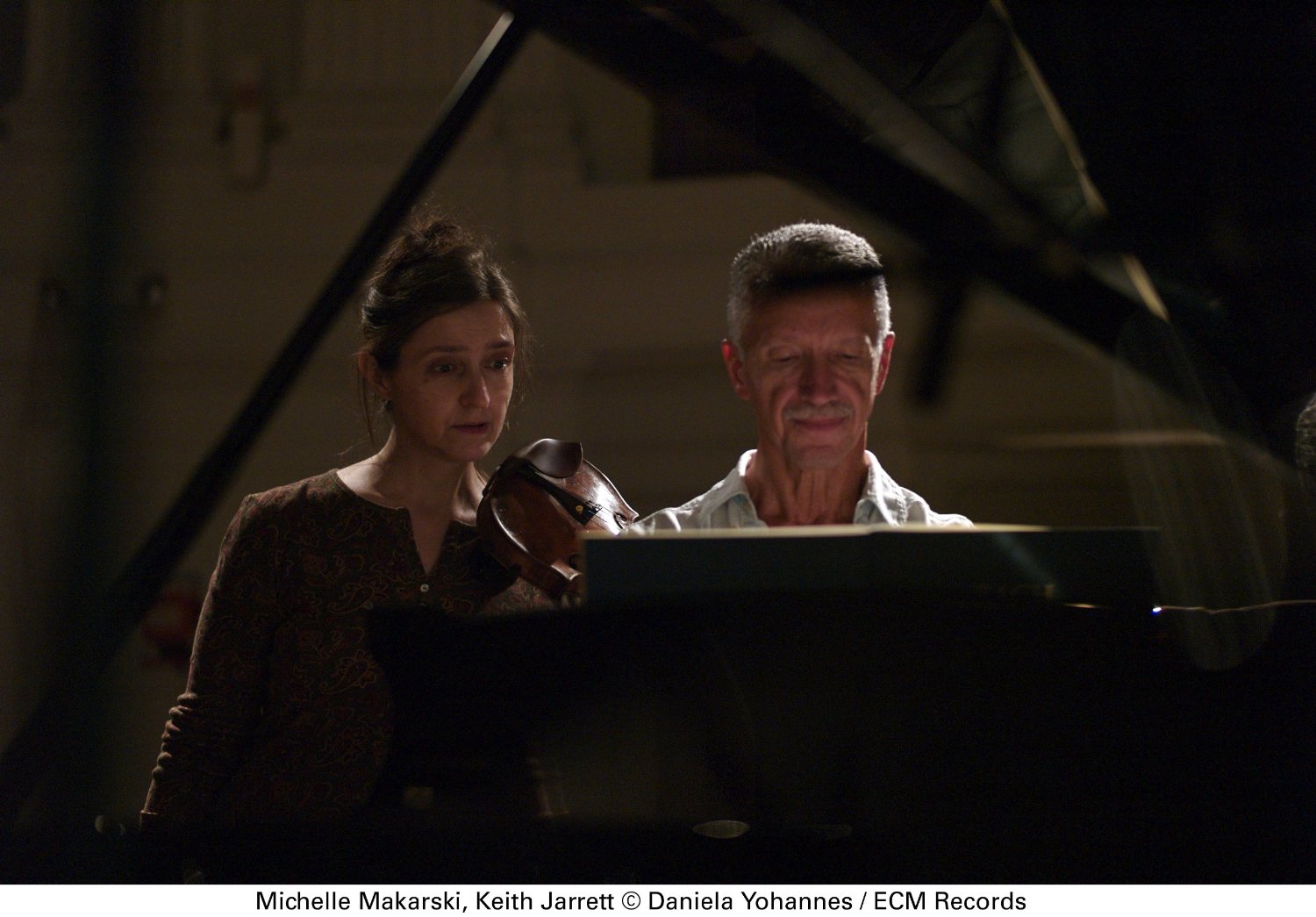
J. S. Bach’s Six Sonatas for violin and obbligato harpsichord (BWV 1014-1019) are not often recorded on piano, but few masters of the modern keyboard could make the combination work so articulately as Keith Jarrett. Although he might just as well have opted for harpsichord, as he did in duet with violist Kim Kashkashian for a benchmark recording of Bach’s Three Sonatas for viola da gamba and harpsichord (ECM New Series 1501), this time around the piano seems an intuitive choice. And for a partner, Michelle Makarski is ideal. Not only because she and Jarrett had been playing these pieces together on their own time for two years before stepping into the studio, but more importantly because she recognizes the power of an unfettered performance that serves the music over ego.

Makarski and Jarrett

Written in the early 1720s during Bach’s Cöthen period, which encompassed both the tragedy of his first wife’s death and the triumph of his Brandenburg Concerti, these sonatas have rarely sounded more tessellated. There is a rounded quality to Jarrett’s pianism, which cushions Makarski’s pin-like precision. Thus, to the common characterization of the violin and keyboard as equal partners in these pieces, Makarski and Jarrett seem to say, “Let’s just see where the music leads us.” And indeed, spotlights of favor fall on either instrument at different points throughout the cycle.

Half of the sonatas are in major keys (Nos. 2 in A Major, 3 in E Major, and 6 in G Major), the other half in minor (Nos. 1 in b minor, 4 in c minor, and 5 in f minor). The majors are distinguished by their dulcet introductions and masterful harmonies, but each has its own idiosyncrasies. Where No. 2 balances spiraling architecture with pointillist delicacies, the astonishing No. 3 boasts interlocking color schemes and a heartrending Adagio, in which the violin emotes with all the history of a folksong. Yet the Sonata No. 6 is the most maturely constructed of them all. From its opening courtship of wing and wind, through the uniquely solo keyboard meditation at sonata center, and on to the boisterous finish, it follows a downright linguistic arc of development.

It is sometimes tempting to treat slow movements in Baroque repertoire as filler. Not so here, for in them Bach has cut some of the most precious jewels of his entire oeuvre. In addition to their robustness and lyrical integrity, Makarski’s uniquely nuanced vibrato lends them sanctity over ornament. Whether shining through Jarrett’s laden branches in the Andante of the Sonata No. 1 or chaining double stops through the Adagio of the Sonata No. 5, she treats each draw of the bow as a song in and of itself. Jarrett, by contrast, excels in the faster portions, showing in the final Allegro of No. 1 why his sense of rhythm is so acutely suited to Bach. The two find deepest equilibrium in the Sonata No. 4, which is like one giant helix, unbreakable and spinning.

The album’s booklet contains no notes—rare for an ECM classical release. Then again, the music has all the notes it needs. These roll off the fingers of the present interpreters like fluent speech from the tongue, creating a book on the first listen, the binding of which will only strengthen as its cover is opened time and again.

(To hear samples of Six Sonatas for Violin and Piano, click here.)

Widmann/Lonquich: Schubert – Fantasie C-Dur, etc. (ECM New Series 2223)

Widmann Lonquich Schubert

Carolin Widmann
Alexander Lonquich
Schubert: Fantasie C-Dur, etc.

Carolin Widmann violin
Alexander Lonquich piano
Recorded October 2010, Historischer Reitstadel, Neumarkt
Engineer: Stephan Schellmann
Produced by Manfred Eicher

“We cry, knowing in untold happiness, that this music is as it is in the promise of what one day we ourselves will be. This is music we cannot decipher, but it holds up to our blurred, over-brimming eyes the secret of reconciliation at long last.”
–Theodor W. Adorno, “Schubert” (1928),
trans. Jonathan Dunsby and Beate Perrey

If Adorno’s thoughts on Franz Schubert seem as indecipherable as the music they describe, it’s only because I have taken them out of context, arriving as they do at the tail end of a dense essay. Similarly, the C-Major Fantasie of 1827 that begins this all-Schubert program from violinist Carolin Widmann and pianist Alexander Lonquich comes to us excised from the tail end of a dense life. Just shy of 31, Schubert would die 11 months after committing it to paper in bipolar flurry of activity. The piece is widely considered to be the most significant he ever composed for violin, and is distinguished by the technical and emotional demands it places on worthy performers. Even Adorno was ambivalent about the overall success of the Fantasie, rightly praising its protracted Andantino as a melancholy masterstroke while in the same breath criticizing the final Presto as something of a cop-out. If we are to take the implications of this reaction to their fullest, however, then we must also accept that Schubert was less at ease proclaiming endings than he was contemplating their inevitability.

Over a traversal of seven movements, Widmann’s tone control yields thrilling restraint and expectorations by turns, while Lonquich matches her every move with an inward-looking fluidity. Together they crumple rays of light into balls of shadow, tossing them over cliffs of uncertainty until they learn to fly. To the latter end, the Allegretto has never sounded so uplifting than in their hands. With unforced drive and organic handling of tempi, the duo articulates the aforementioned Andantino as if it were a lullaby they’d heard since the cradle. In true Schubertian fashion, they feel intimately connected at a distance, stretching between them a connective emotional reserve. In so doing, they deviate from ECM’s previous recording of this piece (New Series 1699) by way of a less parallel approach that emphasizes the final movement’s reversal of the first.

Schubert’s Opus 70, the b-minor Rondo brilliant of 1826, fills the program’s sweet center with an intriguing diptych. A declamatory Andante sets up a nearly 12-minute Allegro, of which the running melodies and gorgeous key changes reveal a crystalline intellect at play. There is a seemingly inexhaustible energy about this piece, which cracks open each potential ending like an egg and scrambles it back into the shell.

The A-Major Sonata of 1817 closes with the youngest work of the program. Some Beethoven influence is palpable, especially in the leaping Scherzo, but the methodical, nuanced airiness of the opening Allegro is all Schubert, as are the kaleidoscopic Andantino and sly finale. Hearing Widmann and Lonquich navigate its many corridors, one may agree with their characterization of Schubert as the proverbial wanderer, but to these ears their interpretations depict the opposite. It was not Schubert but the landscape in which Adorno situated him that wandered in concentric circles, leaving the composer to pick and choose his songs until the circles closed their mouths far too early.

(To hear samples of this album, click here.)

John Cage: As it is (ECM New Series 2268)

-> Cover*

John Cage
As it is

Alexei Lubimov piano, prepared piano
Natalia Pschenitschnikova voice
Recorded December 2011, Radio Studio DRS, Zürich
Engineer: Stephan Schellmann
Produced by Manfred Eicher

“turning from the tremendous lie of sleep
i watch the roses of the day grow deep.”
–e. e. cummings

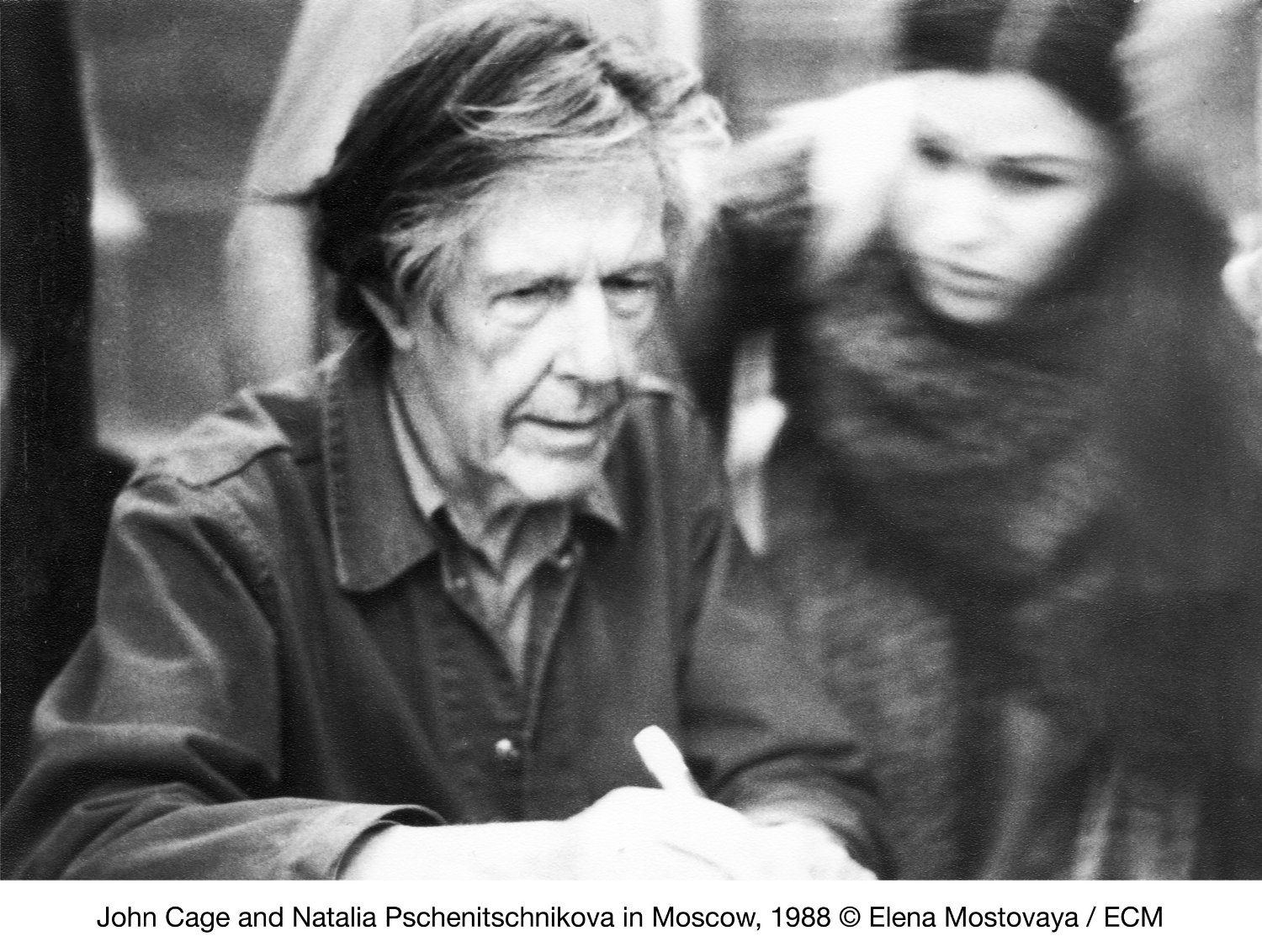
The music of John Cage has an intimate, if sporadic, history on ECM, where its deepest proponents have been pianists Herbert Henck and Alexei Lubimov. The latter joins soprano Natalia Pschenitschnikova for this collection of early works. Both performers were fearless advocates of Cage in their native Russia at a time when Western music registered peripherally, if at all, on the Soviet radar. Since meeting Cage during the 1988 International Contemporary Music Festival in Leningrad, they have championed his music with a vitality that translates pristinely in the present recording. Here is the portrait of a jovial man who took pleasure in the edible, the empty, in the unpretentious.

JC1

The solo piano Dream opens the program with a meditation in the vein of Cage’s In a landscape, only with a more circumscribed palette. It is a painting in miniature, a raking of stones, an attunement to the way things are. It is at once an organic and calculated introduction into a universe dictated not only by chance but also by the hands of musicians, producers, and engineers. One can locate this triangulation elsewhere in Lubimov’s pianism, which infuses the occasional prepared piano piece with bells, pulses, and, somehow, solitude. Both The Unavailable Memory of and Music for Marcel Duchamp are quintessential examples of what the instrument can do, and Lubimov does a fine job showing that it is not a piano augmented but its own entity. Multifarious and adaptive, the music it produces is a dance without bodies.

JC2

While the solo repertoire included on this disc moves with the quality of cinematic tracking shots, accepting whatever comes into frame, the introduction of voice slashes the screen so slowly that by the time backlight seeps through, it’s already too late to repair. Cage would surely have welcomed the glow. James Joyce’s Finnegans Wake provides the texts for The Wonderful Widow of Eighteen Springs, which Pschenitschnikova navigates as though on the verge of tears. As Lubimov hits the piano in microscopic footsteps, words cease to matter and extend tendrils far beyond their semantic shelters. Unlike Cathy Berberian, who gave the piece her lusciously operatic flair, Pschenitschnikova strips her voice bare and finds fresh physicality in its nakedness. Even when singing wordlessly, as in A Flower or She is Asleep, her powers of illustration are no less potent. And when she does elicit meaning from lips and tongue, it is already fragmented. The poetry of e. e. cummings lends itself permeably to Cage’s aesthetic proclivities, and the performers adapt themselves in kind. Pschenitschnikova sings at the back of the room in Experiences No. 2, for example, to beautifully unsettling effect. The programmatic Five Songs (also setting cummings) show the playfulness that was integral to Cage’s character. With such titles as “little four paws” and “Tumbling hair,” they make much of the little things in life that grasp the scarcest rungs of memory. (The final “wheeEEE” of “hist whist” conjures up cummings’s goat-footed balloon man.) Even the Rubik’s cube of Gertrude Stein (Three Songs) becomes transformed in Pschenitschnikova’s affected interpretation. As does Nowth upon nacht, which mines Joyce in a string of single notes and the slam of a piano lid. It’s a gem in the Cage catalogue, one all the more difficult to perform for its brevity and compactness of expression. It hasn’t sounded this vibrant since Joan La Barbara recorded it for New Albion in 1990.

JC3

Always comforting about Cage’s music is its attention to inhalation, the storehouse of emotion from which issues his cellular melodies. We can hear this in the Two Pieces for Piano, which together form roots and stem. Like the Dream in variation, which ends the program by redrawing the circle until it becomes a sphere, they wait behind closed eyes for life to begin.

(To hear samples of As it is, click here.)

Sofia Gubaidulina: Canticle of the Sun (ECM New Series 2256)

Canticle of the Sun

Sofia Gubaidulina
Canticle of the Sun

Gidon Kremer violin
Marta Sudraba violoncello
The Kremerata Baltica
Nicolas Altstaedt violoncello
Andrei Pushkarev percussion
Rihards Zalupe percussion
Rostislav Krimer celesta
Riga Chamber Choir Kamēr…
Māris Sirmais conductor
Recorded July 2006 (Lyre) and July 2010 (Canticle) at Lockenhaus Festival
Engineer: Peter Laenger
Executive producer: Manfred Eicher

The liner notes for Canticle of the Sun open with a laudatory note from Gidon Kremer, who thanks Sofia Gubaidulina “for generously sharing your magic world with all of us.” Few recordings abide by that sentiment as vividly as ECM’s first album dedicated entirely to the Russian composer. The two pieces featured here were both recorded at Kremer’s Lockenhaus Festival, captured in all their spirit of absolution.

SOFIA GUBAIDULINA

The Lyre of Orpheus (2006), of which this is the world premiere recording, is the first of a triptych that explores the space between summation tone and difference tone (produced when two tones are sounded together), grinding them down into states where notes lose their value and become pulses alone. These pulses are, however, inaudible—an “acoustic no man’s land” as Gubaidulina calls it. Her search for intersections of metrical unity yields a sequence of notes corresponding to the titular lyre and its Pythagorean intervals, with which she inscribes a musical memorial to her late daughter. A mass of orchestral molecules coalesces into a solo violin, yet what seems to be a narrative focal point is more accurately heard as an obfuscation of linear storytelling. Beneath its glassine surface beats a heart of ash, reaching out toward the cellos for confirmation of purpose. Bow slaps and other percussive elements—a triangle here and snare drum there, along with touches of marimba and tympani—thread the soloist’s every needle. Strings work dichotomously between high and low, forging an inner realm between them and, at one point, lapsing into one of the most foreboding pizzicato passages of modern music. Kremer’s mastery labors in the service of Gubaidulina’s own, evoking her acute sense of mythological becoming by a thread of breath and mirror’s glint.

The album’s title composition, written in 1997 and revised in 1998, bears dedication to Mstislav Rostropovich for his 70th birthday. Scored for cello, percussion, and choir, and setting the eponymous poem by St. Francis of Assisi, it treats choral voices as, in Gubaidulina’s term, “secretive.” The cellist is likewise instructed to consolidate his or her playing on the C string, tuning it down to the brink of viability and eventually abandoning the bow altogether for bass drum and flexatone, only to return to the highest reaches of the cello in the final “Glorification of Death.” One might see this piece as an expansion of the light that concludes The Lyre of Orpheus, in the wake of which this catachresis of voices feels like flesh and scars. Where so much of Orpheus assumes a bird’s-eye view, Assisi’s beloved personifications shine through fractured glass, a webbing of damage that sees the sinful subject as a vessel for illumination. The cello gives voice to that illumination as if it were a self-aware body. In a variety of icons—some taut like Christmas carols, others stretched like spiritual elastic—Gubaidulina paints with a brush that manages to be declamatory even as it trembles in abundance of dawn. Of the percussion, marimba figures as an earthly voice, leaving the cellist with the difficult task of transfiguration. Whether or not the music is worthy of such characterization even after the fact will depend on the listener’s willingness to stare into our nearest star.

(To hear samples of Canticle of the Sun, click here.)

Claude Debussy: Préludes (ECM New Series 2241/42)

Préludes

Claude Debussy
Préludes

Alexei Lubimov piano
Alexei Zuev piano
Recorded April 2011, Sint-Pieterskerk, Leut, Belgium
Engineer: Peter Laenger
Production coordination: Guido Gorna
Executive producer: Manfred Eicher
An ECM Production

My shadow glides in silence
over the watercourse
[…]
A glow arises in my breast,
the one mirrored in the water.
–Federico García Lorca, “Debussy”

Though unconventional in form, the two books of piano music known as Claude Debussy’s Préludes have withstood the test of time by means of their structural integrity and ordering—or, in the latter case, their lack thereof. For while their collective title conjures the well-tempered catalogs of composers as divergent as Bach, Chopin, and Shostakovich, in practice they bear little resemblance to those 24-part pantheons of keyboard literature. Whether by the descriptive titles famously appended to the ends individual pieces or by the fact that Debussy never intended for them to be played as a unified set, one can see that the Préludes were built as agents of a creative mind for whom fragments were worlds unto themselves. On the latter note, it’s easy to see why Debussy’s sound has so often been misconstrued as “impressionistic,” when in fact it was more closely aligned to the assured stroke of a pen than to the fleeting contact of a paintbrush. With such knowledge held firmly in mind, Russian pianist Alexei Lubimov roulettes the sonority of these emotionally charged miniatures by recording Book I on a 1925 Bechstein and Book II on a 1913 Steinway—the logic being that such instruments might better express Debussy’s own envisioning of how they should be played. This decision brings about surprising color shifts and, somehow, a keener feel for the rhythms therein.

Lubimov

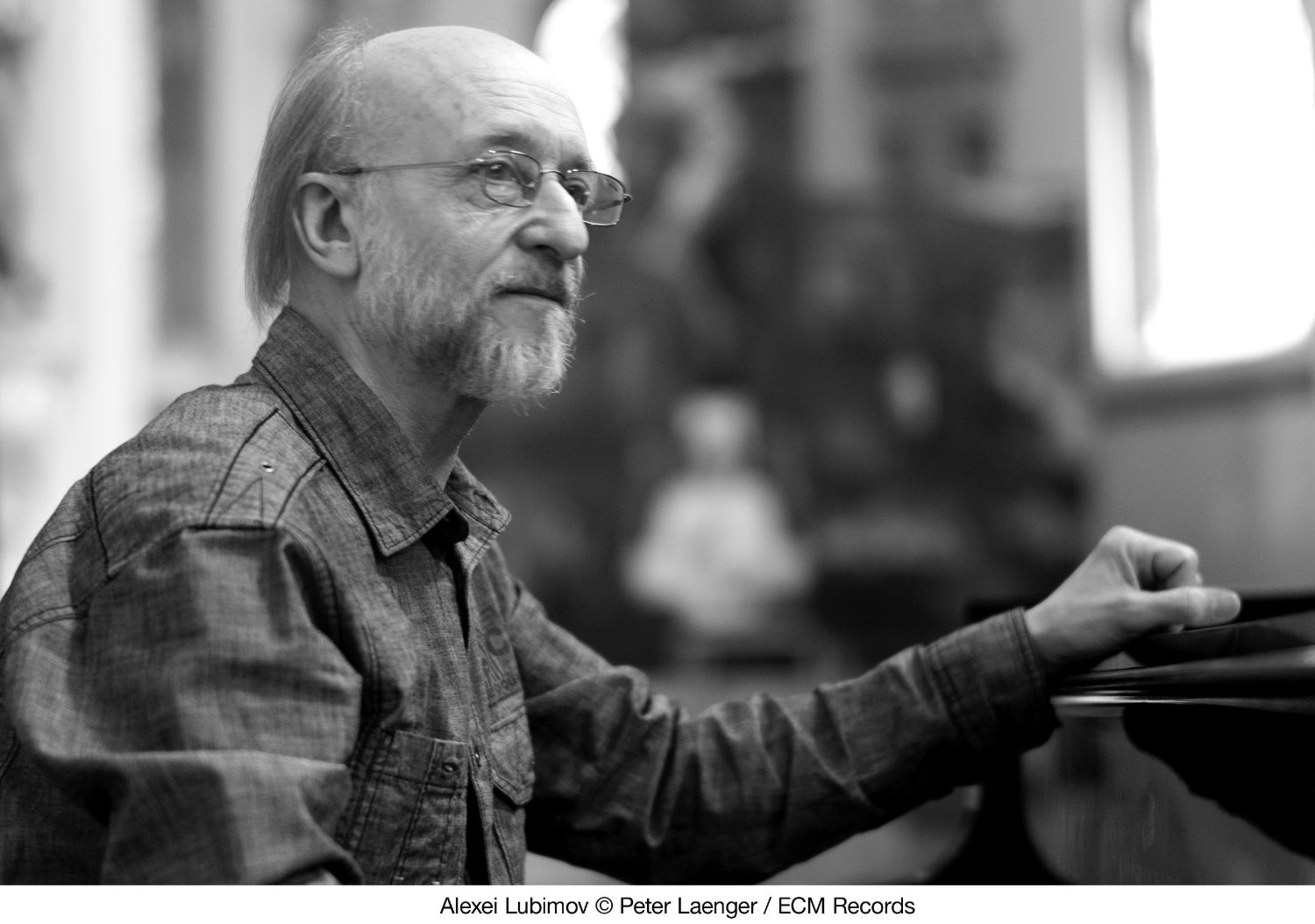
Book I, composed between 1909 and 1910, opens and closes with touches of cabaret, balancing the sweep of Debussy’s pastoral vision with “pingbacks” of striking modernism. Between them is nothing so dramatic as to bog down the listener’s response, so that even the most provocative spirals—viz: “Le vent dans la plaine,” “Ce qu’a vu le vent d’ouest,” and the flamenco-inspired “La sérénade interrompue”—seem but compressions of the more typified mysteries of “Les sons et les parfums tournent dans l’air du soir” and the echoing passage of “Des pas sur la neige.” Even the sportive “Les collines d’Anacapri,” while exuberant enough, only reinforces the reflective heart of this music. Nowhere do these two ends of the spectrum mesh so democratically than in the “La cathédrale engloutie,” which drips from Lubimov’s fingers like the anointing perfume from Mary Magdalene’s alabaster jar. Cutting across their timeworn densities, Lubimov lets those block chords sing with ecumenical clarity and hits that fated low note with perfect pressure.

Through this “inside-out” approach, Lubimov nurtures a sustainable ecosystem from Debussy’s already-organic notecraft, thus clarifying the bas-relief of Book II. Composed between 1911 and 1912, its elemental pathways range from watery swirls (“Brouillards,” “Ondine,” and “Canope”) and flowering dances (“La puerta del vino” and “Feux d’artifice”) to downright Bartókian diversion (“General Lavine – excentric”) and sweeping intimacies (“Les fées sont d’exquises danseuses” and “Bruyères”). A note-worthily deep point coheres around “La terrasse des audiences du clair de lune,” the exposition of which calls forth the composer’s opera Pelléas et Mélisande as if it were a lucid dream.

In addition to the Préludes, Lubimov’s student Alexei Zuev joins his teacher to traverse piano versions of two of Debussy’s most beloved orchestral works. Maurice Ravel’s transcription of the Trois Nocturnes cuts a tree of plaintive ornaments, swaying to increasingly fervent winds toward the final “Sirènes,” wherein seeps 11 minutes of nutrients for roots stretching far into the interpretive histories of those on either side of the score, the undercurrent of which teems with an oceanic abundance of life. To finish, the duo benchmarks Debussy’s own transcription of Prélude à l’après-midi d’un faune with a performance of such scope and vision that one need no effort trying to imagine the landscape burgeoning beneath its 20 fingers.

Kurtág/Ligeti: Music for Viola (ECM New Series 2240)

Kashkashian KL

Kurtág/Ligeti
Music for Viola

Kim Kashkashian viola
Recorded May 2011 at Propstei St. Gerold
Engineer: Peter Laenger
Produced by Manfred Eicher

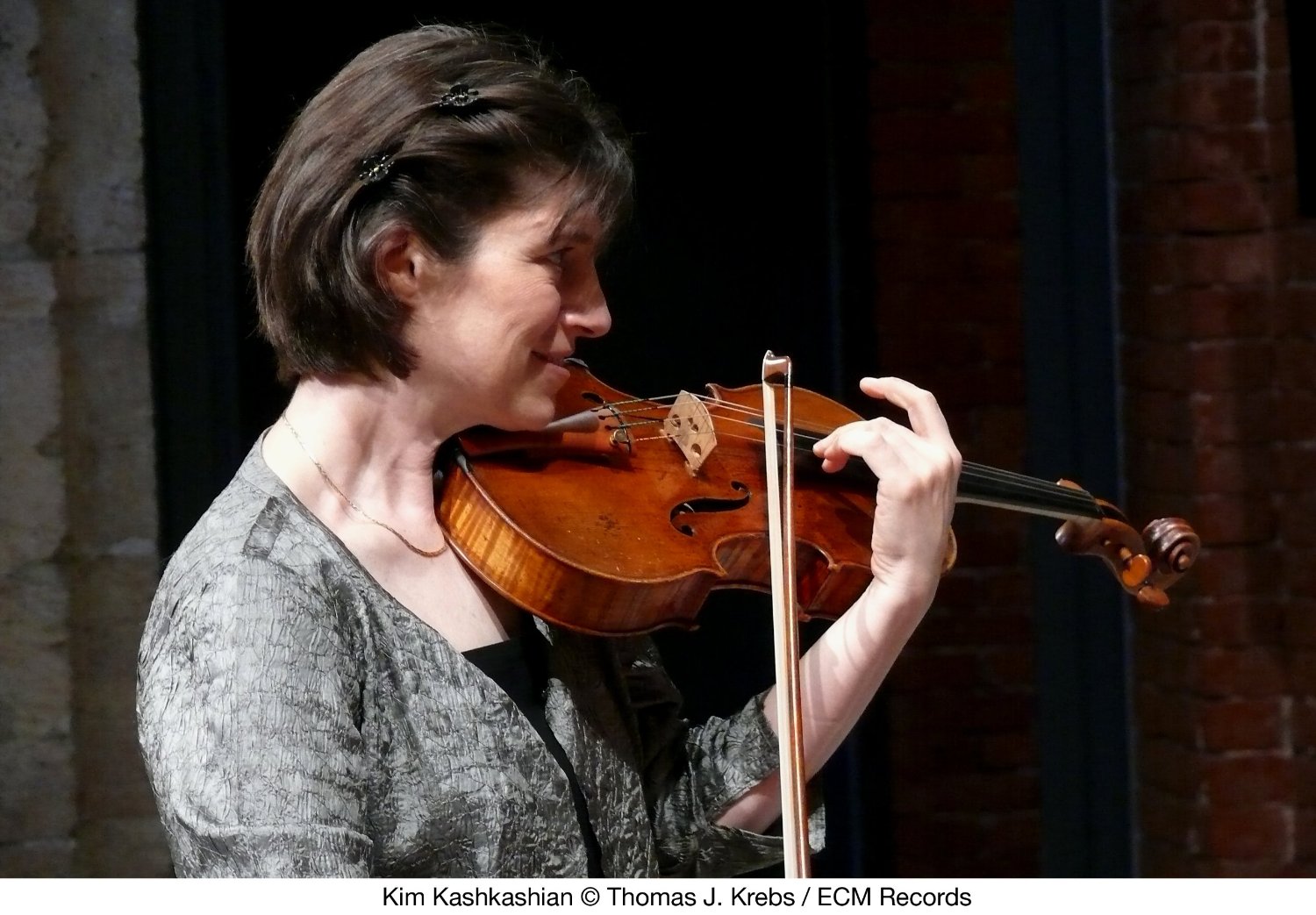
Two Györgys, Kurtág and Ligeti, are subjects of violist Kim Kashkashian’s adventurous solo program—“adventurous” because the music steps bravely out into the open, absorbing the elements as they come: wind, water, earth, fire, and air, but also mineral, animal, and vegetable. The end result begins an experience which, if handled with time and care, is sure to grow with the listener in ways only the most intimate albums can.

Kashkashian

Kurtág’s Signs, Games and Messages is an ongoing project begun in 1989. Instigated by the composer’s usual insistence on note integrity, these pieces divide like cells in a colony toward a body that will likely never walk upright. It is, rather, content to slither and percolate into mental corners both dark and delightful. Though characterized as a master miniaturist, Kurtág is more the scientist whose microscopy reveals terrains not audible to the naked ear without intervention of ink and staves. Bound to an honest, exploratory spirit, Kurtág charms in the purest sense of the word, combining thought and action through a system of articulation that is only magnified by Kashkashian’s dynamic readings thereof.

An introductory “In Nomine” widens the scope of possibilities from the earliest stirrings. It slides and swivels like a Rubik’s cube without a solution but which finds language hidden in every manipulation. The pieces that follow don’t so much have beginnings and endings as they do openings and closings. This gives them a three-dimensionality, forged at the intersection of an inner space the musician might enter, an outer space from which she might shut herself away, and a sense of time that meshes the two. Details emerge in literary fashion—which is to say, by the scrawl of a writer’s instrument. The most frenetic passages swirl behind closed eyes, manifesting in their destined form before emerging on the open page. The notion of the solo performer as one who interacts as much with herself as with the music finds itself multiply confirmed by a tactility that only Kashkashian can bring to her instrument. Even at points of least resistance, she remains aware of the skin at hand, scars and all.

That Kurtág and Ligeti were lifelong friends may not be so obvious based on their compositional output alone, but through this recording one may locate an affinity that goes beyond the mere juxtaposition of their works. For while Ligeti’s masterful Sonata for viola solo (1991-1994) would seem a more constructed organism, its veins guide a likeminded bloodstream between inhale and exhale. The opening “Hora lungă,” modeled after a traditional lament, is played exclusively on the viola’s C string. Kashkashian deftly handles the timbral subtleties required to bring it to life. She bends notes at the cusp of their chromatic defaults, warping them like the convex surface tension of a fully filled glass. After the candle’s flicker that is “Loop,” the ashen “Facsar” revisits the psychological vessel in which the sonata began, only now with the addition of double stop harmonies and thus a feeling of ceremonial craftsmanship. The fourth movement, marked “Prestissimo con sordino,” is an energetic afterimage, but also preludes the fifth movement, a “Lamento” that works muscles of mystery in the finish before the final “Chaconne chromatique” parts the darkness to reveal a lantern’s glow. Though tense and sinuous, it feeds its own melancholy by taking a step forward to contain the shadows.

This album’s earning of a Grammy Award for Best Classical Instrumental Solo is proof enough of the wonders of its performance, program, and production. But neither award nor accolade can express Kashkashian’s embodied art better than the recording itself. It’s a truth that comes out only in the listening, so that even these words, as I write them, turn to smoke in the firelight of experiencing it for yourself.

(To hear samples of Music for Viola, click here.)