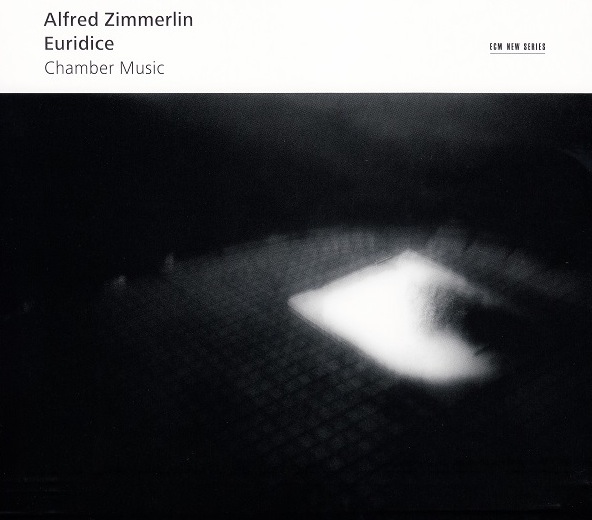
Alfred Zimmerlin: Euridice (ECM New Series 2045)

Euridice

Alfred Zimmerlin
Euridice

Carmina Quartett
Æquatuor

Aria Quartett
Euridice singt
Recorded October 2007
Kultur- & Kongresshaus Aarau
Streichquartette
Recorded August 2006
Radio Studio DRS, Zürich
Engineer: Stephan Schellmann
Produced by Manfred Eicher

One day, when this terrifying vision’s vanished,
let me sing ecstatic praise to angels saying yes!
Let my heart’s clear-struck keys ring and not one
fail because of a doubting, slack, or breaking string.
–Rainer Maria Rilke*

Continuing its mission to make internationally known the work of underrepresented composers, ECM documents on Euridice three chamber pieces by Swiss composer Alfred Zimmerlin. Born in 1955 and currently a professor of free improvisation at the University of Music in Basel, he is the recipient of numerous awards and a longtime member of the Werkstatt für improvisierte Musik (Workshop for Improvised Music), where his reputation as cellist precedes his reputation as composer. Thankfully, we have this pristine, artfully performed album to even the latter scale.

The program is bookended by two string quartets. The first is Zimmerlin’s second; the last is his first. The Second String Quartet, composed in 2003, comes into being by smooth, if ephemeral, brushwork and balances its draw with distinct pointillism. There is a strange push behind the music, a feeling of perpetual motion underlying the very barest outer ripples of a chaotic epicenter: a tsunami in a cupped hand’s worth of droplets. For this relationship, Zimmerlin looks to the “hermetic language” (hermetischen Sprache) of Rainer Maria Rilke’s “Duino Elegies.” Rilke, of course, was known to lament the limitations of orthography, and here Zimmerlin enables a sonic confrontation with those very limitations. As the composer notes, Rilke, too, breaks free from this constriction in the Ninth Elegy, which ends:

Look, I’m alive. On what? Neither childhood nor
the future grows less…More being than I’ll ever
need springs up in my heart.

Such effusion advances the strings along their own semantic path through space and time, finding eternity in a grain of sand. Each instrument is thus born of its own grammar: first violin as verb, second as declension, viola as punctuation, and cello as arbiter of marginalia. One feels the indefinite shape of their text as solidly as a printed page.

The First String Quartet, completed in 2002, at first feels imported from an opposite pole. Like a Terry Riley ritual spiked with a George Crumb infusion, it projects both shaman and possessing spirit. From a “dense state” (einem dichten Aggregatszustand), the quartet unfolds in an inherently even keel. The musicians hiss and muscle their way through this music, which somehow retains an edge of accessibility. It is enticing in its chaos, ordered not only by score but also by interpretation. There is an almost symphonic quality to the slower passages, fragmentary though they may be, suffused with local colorations and vocal paroxysms before settling in a flowerbed of pizzicati. That this quartet pays homage to the 18th-century Swiss folk song “Guggisberglied” and to Heinrich Ignaz Franz Biber’s Mystery Sonatas is of ultimately little consequence. Zimmerlin designates these not as thematic touchstones, but rather as echoes of a cultural memory, of which the string quartet is but one banal expression—one reason, perhaps, why he avoided the format for so long.

At the heart of the album is Euridice singt (2001-2003/04), a self-styled “scene” for soprano, oboe, cello, piano, and soundtrack (i.e., a prerecorded CD of electronics and vocals). Where the Second String Quartet sought inspiration in Rilke, Euridice is foremost a meditation on the opening of Ingeborg Bachmann’s poem, “Darkness Spoken”: Like Orpheus I play / death on the strings of life.** From this arises a refashioned Orphic myth, one in which Orpheus himself is bolstered by the generative power of his grief, brought on by his doomed Euridice. The latter’s death by snakebite (represented here by electronics) is where the piece begins in a text by avant-garde Swiss writer Raphael Urweider. The oboe (played by Matthias Arter) is Orpheus’s grief made manifest, while Euridice’s spirit lingers in the form of soprano Sylvia Nopper, who gifts her beloved a choir upon his return to the Overworld. Meanwhile, Euridice takes a certain reflective solace in her death. At first, she is ghostlike, nearly overtaken by the oboe: reeds above larynx. Euridice’s initial stirrings sound closer to Japanese Noh theatre than to song cycle as Orpheus’s rapping entourage emerges hauntingly. This is not, however, an infusion of contrasts, but a simultaneous reckoning of elements, so that none holds dominance. Although the oboe is a point of particular fascination in this milieu, it navigates the waters of a turgid anger on both sides of the crust, so that by the end it is spent, slave to its own fatigue. There is one passage, for instance, during which the oboe jackknives between clean and multi-phonic notes over an array of white noise, piano, and pizzicati. Even then, it walks the line between confusion and transcendence, of dreams and reality, in kind. Hence the droning conclusion, which culminates in an electronic fade to dark: the cycle will repeat until all colors become one.

There is an unforced feeling to Zimmerlin. He lets the sounds unfold of their own seeming accord and marks their passage as a jazz musician might transcribe a solo after the fact. In this respect, his experience as an improviser pays marked dividends. This leaves us with a compass that is at once full of direction and directionless, a relic from a past we may never recover, except through the affective, if ultimately illusory, experience of making music.

* All Rilke translations by A. Poulin, Jr.
** The translation of Bachmann is by Peter Filkins.

Erkki-Sven Tüür: Strata (ECM New Series 2040)

Strata

Erkki-Sven Tüür
Strata

Jörg Widmann clarinet
Carolin Widmann violin
Nordic Symphony Orchestra
Anu Tali conductor
Recorded May 2007 and June 2009, Estonia Concert Hall
Engineer: Maido Maadik
Assistant engineer: Jaan Tsadurjan
Executive producer: Manfred Eicher

The music of Estonian composer Erkki-Sven Tüür is much like his name. Its frame contains doubled elements, a cosmic chemical signature that embraces a hyphenated signifier in the middle, connection to some gravid space from which one can observe the unfolding of his distinctly personal character. Of that character we get plenty on this album, his fifth for the New Series, for which the usual roster of ECM performers is swapped for the phenomenally talented Nordic Symphony Orchestra and its principal founder and conductor, Anu Tali. Together they bring luminescence to two recent works with mellifluous authority.

The Symphony No. 6, the subtitle of which gives this album its name, is in fact dedicated to Tali and the NSO, who commissioned it. From the first bars, the reasons behind this inception become clear, for the musicians play this music as if they have known it all their lives. Composed in 2007, Tüür’s massive symphony is a master class in affect. It heralds a new direction for the maverick composer, who abandons his “architectonic” method (although echoes of Crystallisatio remain) in favor of self-styled “vectorial writing.” Where the former embodied an interlocking or amalgamation, the latter is more of an expansive or, in the composer’s terms, “genetic” development. One might say that architectonics constructed the body in which the cellular divisions of his vectorial composing could divide. Evolution over invention.

The nature of this newer method is obvious in the symphony’s opening and closing bars, stretching as it does a sudden awakening into a dream of perpetual motion that, like all such experiments, inevitably journeys toward stasis. The result of all this is an orchestra that moves amorphously but singly, even if particular instruments do leave trails in the water. In the latter vein, for instance, piano and harp share a brief yet memorable dialogue. On the whole, strings lurk in recession for some time before revealing their palette of light—all the more effective in music that seeks through a glass darkly.

What makes this feel like a symphony at all is perhaps its grandness of scope, which nevertheless retains an internal spirit, as indicated by the subtle (and not-so-subtle) percussive touches throughout. Tüür’s feel for color and space in this regard is so acute that it opens doors in the mind one never knew were closed. The smoothness of his transitions likewise enhances another symphonic staple: a feeling of luxuriance and orientation of detail that are remarkable for a 33-minute duration. Tüür’s narrative language is thus overlapping yet practical, a form of meta-speech that stretches a whisper to a sigh and allows the listener to draw any number of conclusions.

Noēsis, composed in 2005, grew out of a very different commission (by the Detroit Symphony Orchestra and the Philharmonia Orchestra London, at the behest of Neeme Järvi). Although billed as a concerto for clarinet, violin and orchestra, the soloists are scurrying forces, less leading and more integrative. Each section of the orchestra becomes the panel of a fan, unfolding one rib at a time to reveal a connected focal point. Clarinetist Jörg Widmann joins his sister, violinist Carolin Widmann, in this wonderfully evocative piece, which is equally illustrative of Tüür’s new approach. Unlike the symphony, it begins in a hush of ambience that smoothes into the clarinet’s refracted introduction. The violin, on the other hand, is possessed of a free, if trembling, quality. The orchestra, meanwhile, pitches slowly, a boat on waves of molasses. The ending is one of Tüür’s finest, a braid of violin and clarinet carried into afterlife by a soft gong hit, resonant and touched by the sun.

Tüür’s craft has always been deeply physiological, but with Strata he shows it to be also physiologically deep. Whereas his previous work seemed forged from raw material (cf. Ardor), now it issues a line of spider’s thread, pulled by an unseen hand from galaxy to galaxy. It is an expansion rather than a compression of time, the audio equivalent of quantum physics, the equation of which again finds articulate form in the name.

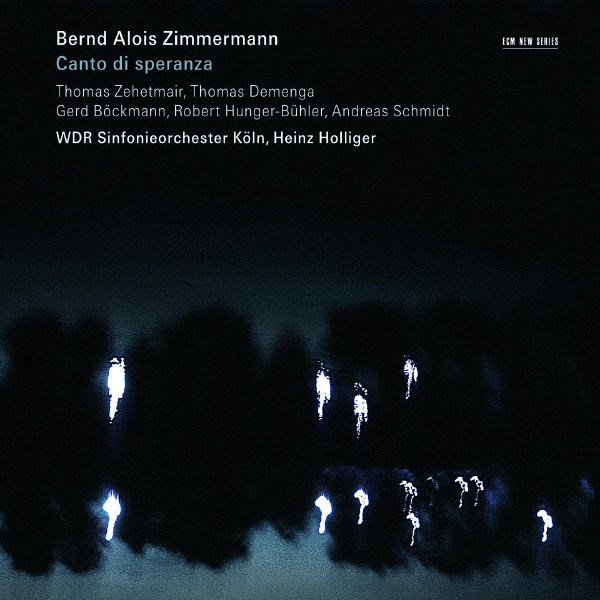
Bernd Alois Zimmermann: Canto di speranza (ECM New Series 2074)

Canto di speranza

Bernd Alois Zimmermann
Canto di speranza

Thomas Zehetmair violin
Thomas Demenga cello
Gerd Böckmann voice
Robert Hunger-Bühler voice
Andreas Schmidt bass
WDR Sinfonieorchester Köln
Heinz Holliger conductor
Recorded May 2005, Kölner Philharmonie
Engineers: Brigitte Angerhausen and Günther Wollersheim
Edited and mastered by Renate Reuter
Produced by Harry Vogt

In his 2003 monograph, Quotation and Cultural Meaning in Twentieth-Century Music, musicologist David Metzer describes West German composer Bernd Alois Zimmermann (1918-1970) as having “exposed the delusion behind the modernist renunciation of the past and offered a vision of time in which [past, present, and future] were interconnected.” Zimmermann, he goes on to say, “saw time as a broad sphere in which all periods were equally within reach.” Such philosophy was at the heart of a self-styled pluralistic approach to composition, taking comfort in a Joycean spirit of drift and adaptation.

One might say that ECM’s New Series imprint has followed suit, pulling lesser-heard composers like Zimmermann into an orbit equidistant from the massive planets he references. In line with this spirit, the label has brought together a meticulous team of interpreters—at the core of which Heinz Holliger conducts the WDR Sinfonieorchester Köln—to paint the portrait of a composer whose personal demons eventually won out: the final piece of this disc was, in fact, completed just five days before his suicide. Such biographical details, however, render the Violin Concerto that opens this disc all the more effective for its unabashedly serial touches. Completed in 1950 and cited as a model for the postwar concerto, it spans three richly contrasting movements, opening in a cacophony of details at once whimsical and shadowy.

The soloist’s relationship to the orchestra is very much in the Romantic mode, as emphasized by violinist Thomas Zehetmair’s gorgeous traversal of the second movement. As in the work of Erkki-Sven Tüür, the piano figures mysteriously, a distant echo of the violin’s central presence, a simulacrum of the internal. It finds entry points in the periphery and parasitizes the orchestral body therein. Despite some beauteous, even transcendent moments, this portion of the concerto is no fantasy, but rather an intense reality of its own making that transitions into the final movement, which dances circles around a joyful center: a rite of spring, if you will. Some magnificent brass writing spurs a solo violin passage into explosive yet contained finale.

Zimmermann’s sound walks the line between capriciousness and foreboding. Despite the composer’s fatalist (?) trajectory, the concerto exudes panache, presenting the soloist with no small technical task. His neoclassicism suggests Stravinsky and Bartók, but influences from Bach to jazz are equally discernible. His plurivocity is clearest in the cadenzas. The almost bacchanal exuberance and rhythmic color of the concerto is every bit as intense as the program’s relatively brooding title composition, which at the fingertips of cellist Thomas Demenga delineates an even thinner line between nostalgia and forgetting. Originally composed in 1952 and revised in 1957, the title of this “cantata” for cello and small orchestra means “Song of Hope,” although its distinctly internal dialogue would seem to shelter very little at first glance.

The sparse instrumentation yields a world of ideas, which Demenga handles with remarkable sensitivity. Tension is so smooth that it no longer feels like tension, but rather like the metaphorical harmony of lock and key: the yin of security and the yang of trespass. The chamber aesthetic, especially in Zimmermann’s pointillist writing for percussion, is solemn and melds beautifully with the cello’s forthright porosity. Demenga brings to these energies a feeling of such effortlessness that the music seems to unfold of its own need to be heard.

Yet, no solemnity can match that of the final piece on the program: Ich wandte mich und sah an alles Unrecht, das geschah unter der Sonne (“And turning then, I saw there great injustice is done under the heavens”). Designated as “an ecclesiastical action for two speakers, bass soloist, and orchestra,” this 1970 oratorio sets biblical verse and Dostoevsky’s “The Grand Inquisitor” parable from The Brothers Karamazov. Andreas Schmidt is the singer, a pathos-ridden reflection of actors Gerd Böckmann and Robert Hunger-Bühler, who provide the spoken voices.

Despite the large instrumental forces at his command, Zimmermann makes spare use of textural overlap, with brass and percussion adding particular and occasional resonance to the immediate voices. One can almost hear the theatrical gestures built into the score, the very comportment of which forms a language unto itself that is subtext to the piece’s articulated surface. Even with knowledge of German or a translation of the texts in hand, this is morose going. Sitting with it is a nevertheless dark fascination. Some moments recall the drama of Shostakovich’s The Execution of Stepan Razin, while others are their own brand of interlocking parable. It ends with a brass iteration of the Bach chorale “Est is genug” and an orchestral afterthought thereof, the latter an indication of a mind at play to the very end.

Concerning the level of musicianship required bringing this music to life, it is only appropriate that Holliger should hold the baton. This is clearly music after his own heart. Even the most dedicated listeners aren’t likely to pop Ich wandte mich… into their car stereo, but its rewards come earlier in the program, felt only as a retroactive lean toward infinity. In accordance to Zimmermann’s “sphericality of time,” the aftereffects are just as musical as the performances they follow, and sow their traces into our mental fields until, some time later, they sprout anew.

The Dowland Project: Night Sessions (ECM New Series 2018)

Night Sessions

The Dowland Project
Night Sessions

John Potter tenor
John Surman saxophones, bass clarinet, percussion
Stephen Stubbs lute, chitarrone, baroque guitar, vihuela
Maya Homburger violin
Miloš Valent violin, viola
Barry Guy double bass
Recorded September 2001 and January 2006, Propstei St. Gerold
Engineer: Markus Heiland
Produced by Manfred Eicher

The Dowland Project was the brainchild of former Hilliard Ensemble tenor John Potter, and had before this album’s release lulled listeners over the course of three traversals: In Darkness Let Me Dwell, Care-charming sleep, and Romaria. As the story goes, after shedding its light in the middle recording, the Project returned to the studio at producer Manfred Eicher’s unexpected behest. Thus the night sessions documented herein were born, in and of the moment.

With Potter are reedist John Surman, lutenist Stephen Stubbs, violinists Maya Homburger and Miloš Valent (by turns), and bassist Barry Guy. Together they forge a sigil of such intuitive, adaptive power that the texts treated here come alive in new and evocative ways. Of those texts, Potter selected a wide assortment, reading them aloud to the group before giving each a onetime go. Improvising around both familiar and adlibbed tunes, the musicians drew their individual lines with such openness that only a bold stripe of unrepeatable music making was left behind. Following that line as listeners after the fact is half the fun. Imagining what it might have been like to be a fly on the wall at Austria’s Monastery of Sankt Gerold, where the sounds were captured for posterity, is the other.

The songs span a range of eras and moods, but all with a twinge of heart that only a troubadour’s pen can elucidate. In that vein, the 12th-century “Can vei la lauzeta mover” by Bernart de Ventadorn yields some of the album’s richest musical textures. Although Potter is the focus, Guy (especially when in conversation with Homburger) proves to be another defining voice. Potter’s own is the horizon line between extremes, while Surman’s soprano saxophone is achingly present, a trail of firefly light running through the darkness.

Sources run the gamut from Portuguese pilgrim song (“Menino Jesus à Lappa”) to Byzantine chant (“Theoleptus 22”). Whether cracking like parchment in the Middle English lyric of “Man in the moon,” clanging like the blacksmith’s hammer in the anonymous 15th-century “Swart mekerd smethes,” or luxuriating in the delicate unabashed descriptiveness of “Whistling in the dark,” Potter navigates all of it with a conscious comfort and playfulness of spirit. Notables include the early 16th-century carol “Corpus Christi” and the 14th-century “Fumeux fume,” the latter by the recherché French composer Solage. Both pair Potter with Surman’s bass clarinet, while the second adds Guy’s upright. Also intriguing are “Mystery play,” in which Potter occupies a back corner of the studio, and “I sing of a maiden,” another Middle English lyric that is by far the most haunting on the album.

Instrumental pieces sprinkled throughout lend reflective prowess to the program’s flow. Two improvised “triages” make contrasts of dance and shadow, while the rest put the lute of Stubbs to full effect, whether in his own improvisations or in the works of Joan Ambrosio Dalza (fl. 1508) and Pierre Attaignant (1494-1551/52). His soloing provides anchorage for the more complex spider’s filament strung between. He also ends the album as tenderly as he begins, with Attaignant’s “Prelude”: an indication of things yet to come, of dreams yet to be dreamed.

It must be said that every musician of Night Sessions is as much a singer as Potter’s voice is an instrument. They’re all storytellers, finding order in chaos, plucking pearls from historical oysters, forgotten in oceans long unswum.

Arvo Pärt: Lamentate (ECM New Series 1930)

Lamentate

Arvo Pärt
Lamentate

The Hilliard Ensemble
Sarah Leonard soprano
David James counter-tenor
Rogers Covey-Crump tenor
Steven Harrold tenor
Gordon Jones baritone
Alexei Lubimov piano
SWR Stuttgart Radio Symphony Orchestra
Andrey Boreyko conductor
Lamentate recorded June 2004 at Stadthalle Sindelfingen
Engineers: Dietmar Wolf and Jürgen Buss
Da Pacem Domine recorded April 2005 at Propstei St. Gerold
Engineer: Peter Laenger
Produced by Manfred Eicher

Tempting as it may be, the typing of Estonian composer Arvo Pärt as a spiritual modernist hardly begins to assess the reach, import, and atmospheric integrity of his music. The more closely one listens to it, the more one hears between every heartbeat an alternating current, whereby shadows take solace in their own orientation of elements. Awareness of this dichotomy throws sanctity over the banal, and lends banality to the sacred, so that by the end of any Pärt listening experience one emerges changed yet profoundly the same—the self made clear under a magnifying glass polished by sound.

And so, while Lamentate may be said to represent a new direction for Pärt, whose music has hardly sounded this visceral since his formative dips into the avant-garde, it also feels like a reflection back to the womb, if only because the composer has so carefully woven into its basketry a conscious structural flaw. Said flaw is the essence of being human. It is what turns the visage of existence firmly away from the realm of fantasy toward the mirror of reality. This “lamento for the living” takes its inspiration from the enormous sculpture “Marsyas” by Anish Kapoor, at the time located in Turbine Hall of London’s Tate Modern, and anchors a piano soloist (here it is Alexei Lubimov at the keyboard) in an orchestral ocean. In the album’s liner notes, Pärt describes his first encounter with the sculpture: “My first impression was that I, as a living being, was standing before my own body and was dead—as in a time-warp perspective, at once in the future and the present.” Lamentate thus concerns itself with time—or, more precisely, with those who deal with time. The work was premiered at the sculptural site in London on February 7 and 8, 2003, and was recorded for ECM in 2004 at Germany’s Stadthalle Sindelfingen, near Stuttgart.

Before throwing us into these prophetic waters, the disc opens with the prayer for peace that is Da pacem Domine. Composed in 2004 on the basis of a ninth-century Gregorian antiphon and recorded here a year later at St. Gerold monastery near the Austrian mountains, it features the Hilliard Ensemble with soprano Sarah Leonard in a moving, timeless performance (the work reappears in updated form on In Principio). Like much of Pärt’s choral writing, its simplicity is its strength, requiring discipline from interpreters to bring out inner complexities. The antiphon is stretched to reveal a stratum unto itself, a melody to be born into and from. Its lines mark the binding of a book of experiences, the pages of which fade in one direction and become crisper in the other. All, however, bear equal wisdom of the divine hand that inscribed them.

With such pulchritude still warming the chest, Lamentate (2002) comes like a hit in the gut. Each of its ten movements is a monument—now fragile, now menacing—to some emotional shell. These surfaces act as palimpsests for the cellular activities that unspool from a brass incantation. A bass drum rumbles as would the hand of a god trapped beneath the earth’s surface pound for escape. In that frustration are flashes of a life confounded by lifelessness, declarations of dependence wrought in beat and bow. Over the piece’s own lifespan, the recording takes on a wavelength that cracks open intersections of space and time and spins from their yolks an entirely new cosmos. In this parallel universe, the winds are seemingly still yet utterly dynamic like nebulae as fetal kicks javelin fresh thought through a needle of questioning. The piano’s solitude provides the only answer it ever needed to breathe, for in the crafting of flesh lurks a question far beyond our articulation, and to which music nevertheless brings us steps closer. As relays of brass, piano, and percussion give way to whispering tides, echoes of earlier compositions (such as Psalom) make themselves known as a lilting oboe swims against the current. And even the nominal resolution treats alignment like a fantasy, leaving us by the end looking above for any sign of what it means to be below.

Marsyas
(Photo credit: Empics)

Monika Mauch/Nigel North: Musical Banquet (ECM New Series 1938)

Musical Banquet

Musical Banquet

Monika Mauch soprano
Nigel North lute
Recorded May 2005, Propstei St. Gerold
Engineer: Peter Laenger
Produced by Manfred Eicher

Named for an anthology of lute songs compiled in 1610 by Robert Dowland (1586-1641), son of John (1563-1626), Musical Banquet offers up exactly that. Lutenist Nigel North joins soprano Monika Mauch in an expert dovetailing of musicality, detail, and, above all, emotive power. Performing such songs is no small task. The separation of lutenist from the voice that must once have issued from the same—the result of a long recital tradition—means that singer and accompanist must balance poetry and setting with poise. One hears both throughout this spaciously engineered recording, which is to say that Mauch and North bring the precise intonation of classical rigor in harmony with the raw affect of the words.

To that end, Mauch’s diction is so crisp and finely scored that, were one to snap it anywhere, it would break off in cleanest lines. Whether bound by the tenderness of “Passava Amor su arco desarmado” (Love walked by unarmed) or freed by the self-pity of “Far from triumphing court,” respectively the program’s opening and closing songs, Mauch navigates a veritable maze of lovelorn dimensions with gorgeous uplift. North’s cogent luting is equally alluring, a pleasure to behold in its adaptive variety. Between their covers flip beautiful pages—some tattered, others gilded—dripping with sentiment.

In addition to French and English songs, the repertoire includes more from Italy by Giulio Caccini (1551-1618), as well as a handful of anonymous examples from Spain. Each stream has its own quality. The French songs are like necklaces, beads held true by strings of regard. The English, especially those by Father Dowland (Robert avoided inclusion of his own), weave contradictory tapestries. The lyrics might at one moment invite with a flirtatious lilt (“Lady, if you so spite me”), while at the next steep the narrative voice in claustrophobia. In the latter vein, consider your ears fortunate should you ever encounter a more heartrending rendition of his timeless “In darkness let me dwell.”

As for the Italian, and especially the ever-popular “Amarilli mia bella” (My fair Amaryllis), they tend to favor brevity, exerting all the more inertia for it. The Spanish encompass Mauch’s depth of range, making full use of her dynamic control. Furthermore, they challenge North to maintain intrigue by switching one backdrop after another in a gallery of rhythms and styles. Such colors nuance every mystery behind the words. Throughout them all, a peppering of lute solos by John Dowland is the glue that binds. Each is a gorgeous, multifaceted thing, carved with the geometrical precision of a Celtic knot.

Not only is the music of this collection brimming with allure; it also comes to us by the art of two peerless early music interpreters. Mauch’s singing combines the innocence of an Emma Kirkby with the passion of an Arianna Savall into something uniquely her own. North, for his part, looks longingly in the mirror and draws messages from the past. All it requires is a cadence or snatch of melody, and our hand has already been taken, led through a landscape where bodies once danced before they were buried to nourish the trees that to this day grow in their place.

John Holloway: Veracini Sonatas (ECM New Series 1889)

Veracini Sonatas

Veracini Sonatas

John Holloway violin
Jaap ter Linden cello
Lars Ulrik Mortensen cembalo
Recorded September 2003, Propstei St. Gerold
Engineer: Stephan Schellmann
Executive Producer: Manfred Eicher

Francesco Maria Veracini (1690-1768) is the subject of John Holloway’s fourth ECM traversal of Baroque violin repertoire. Joined now by cellist Jaap ter Linden and harpsichordist Lars Ulrik Mortensen, who together comprise a formidable continuo, Holloway mines the ore of yet another underrepresented violinist-composer, this one an iconoclast to the last: showman, itinerant solo artist, and experimenter. The variety of his contributions to the sonata canon of the time—in both its four- and five-movement incarnations—is expertly represented on this disc. Through them all runs a deep mineral vein of melodic and atmospheric sensitivity.

The Sonata No. 1 in g minor, composed in 1721, comes from the composer’s Opus 1. Its pentagonal structure flies effortlessly from Holloway’s bow, by which he elicits a tone so organic that one hardly notices the trills and mordents of his interpretive genius—some of the most artful to be found in the world of Baroque violining. Whether by the leaping Allegros or the darker, quasi-operatic turns, Holloway and friends mark the passage of this music with instruments as cartographic as they are sonorous.

One quickly notices an airiness to this music that, while charming, is never paltry. This is due equally to the writing and to the playing, both of which work in lively, scintillating congruence. And even though Holloway occupies the spotlight, the interactions between cello and harpsichord are so integral—the former weaving comets through the latter’s pinpointed stars—that to imagine the music without them is to imagine a sky without clouds. The result is a sense of open space, whereby each sonata lends grandeur to even the airiest movements—to wit: the Largo that begins the Sonata No. 5 in C Major. Taken from the Sonate a violino, o flauto solo, e basso, a collection that predates the Opus 1 by five years yet which was published only posthumously, it sketches canvas with bolder ground lines. This renders the exuberant movements all the more emphatic, enacting balance between the violin’s flight paths and the bass lines entrenched below. The concluding Allegro emotes with bravado in a blush of call and response.

The date of composition of the Sonata No. 1 in D Major, from Veracini’s “dissertation” on Corelli’s Opus 5, is uncertain. Considering its programmatic brilliance, youth dominates the possibilities. The dual voicing in particular invokes the antennae of a butterfly fresh from the cocoon. The contrast of this sonata’s shadows and lights presage the maturity of narrative voice achieved in the Sonata No. 6 in A Major, from Veracini’s Opus 2, the Sonate accademiche. Written in 1744, its sweep and drama are on par with Vivaldi’s The Four Seasons. The brief Siciliana that opens betrays nothing of the variety about to ensue. This one has it all: tearful beauty and folk-like revelry in equal measure. At its center is a memorable Andante, in which we are treated to a lute-registered harpsichord, while pizzicato cello and muted strings from the violin touch hands in a most delicate choreography before funneling into a spirited Allegro assai to superb closure.

Where some composers have left only breadcrumbs for future listeners to follow in the wake of paltry imitations, this benchmark recording offers loaves of sonic goodness that are as warm and nourishing as the days they were first baked. The mastery of their realization is matched only by the engineering, which captures details from a respectable distance. Yet another essential document of 18th-century repertoire from those who know its secrets best.

Leonidas Kavakos/Péter Nagy: Stravinsky/Bach (ECM New Series 1855)

Stravinsky:Bach

Stravinsky/Bach

Leonidas Kavakos violin
Péter Nagy piano
Recorded October 2002, Radio Studio DRS, Zurich
Engineer: Stephan Schellmann
Produced by Manfred Eicher

Igor Stravinsky (1882-1971) and Johann Sebastian Bach (1685-1750). Mirrors or two sides of the same coin? This electrifying album by Greek violinist Leonidas Kavakos and Hungarian pianist Péter Nagy answers the question: neither. Stravinsky was indebted to Bach, as so many who put pen to staves ever will be, and explored the Baroque master’s architectures to the very end—even working, the story goes, on Bach transcriptions on his death bed. Yet the Russian iconoclast accomplished a remarkable something that set him apart. Unlike so many before him, he did not shine his light through Bach’s prism but rather shined Bach’s through his own.

Stravinsky’s crucible in this regard was at its hottest in the Duo concertant (1931/32). One of two pieces written for violinist Samuel Dushkin (this for violin and piano, the other his 1931 Violin Concerto), it was not in a format the composer favored at the time but one he nonetheless reconciled through neoclassical rigor. Oscillating between the earthly and the mythological, the piece its composer called a “musical versification” finds unity in gradually joining the two. The first and last of its five movements—the Cantilène and the Dithyrambe—bear mysterious nomenclature. The one blossoms from a pianistic blush to an overpowering charge from the bow. The other drips with lachrymose quality, suspended high above Olympus casting threads to mortal hearts down below. Between them is another dyad, this of two “Epilogues” of friction and protraction in turn. And with them is the sprightly Gigue, one of Stravinsky’s finest moments, played here with integrity.

What sets Kavakos’s playing apart is his ability to be at once fluid and sharp, a quality that lends itself well to the above but also to the below, for in the Partita No. 1 in B minor that follows we hear exactly this contradiction at play. Although two centuries separate these works, Bach’s solo violin masterpiece feels remarkably present in this rendering. Kavakos gives the almighty Allemande a stately treatment, beginning with it a series of four movements and their faster “Doubles.” The first of the latter reveals barest tuning issues in Kavakos’s instrument, but these are quickly brushed away by the Corrente, which he plays with especial care, in the process exploiting the record’s engineering at full potential. The Sarabande likewise unfolds in its dance of blade and water toward the final Tempo di Borea and its Double, by which the music reaches a cavernous interior filled with stalagmites pontific.

The program returns to Stravinsky with the 1933 Suite Italienne for violin and piano. Based on his ballet Pulcinella, it proves the glistening counterpart to the Duo concertant, the spring to its thaw. The affirmation of its introductory motives barely hints at the fiery Tarantella which is the piece’s prime turn—a ball of yarn expertly unraveled. Kavakos’s hefty double stops nourish their flames on Nagy’s pointillist sparks. The folk-like Scherzino is another highlight and sets up the Minuet and Finale with authorial flourish.

From these concentrations we return once more to Bach, whose Sonata No. 1 in G minor reveals further affinity. From the cautious first half to the dawn-like awakening of the third movement and into the forward thinking of the final Presto, it develops itself like one long proclamation—slowed here and sped up there—until it glows.

Those thinking of buying this album for ECM’s treatment of the Bach will want to check out Holloway and Kremer’s versions first. In any event, the Sonatas and Partitas will always overshadow their interpreter. For the Stravinsky? Look no further.

Dobrinka Tabakova: String Paths (ECM New Series 2239)

String Paths

Dobrinka Tabakova
String Paths

Kristina Blaumane violoncello
Maxim Rysanov viola, conductor
Janine Jansen violin
Roman Mints violin
Julia-Maria Kretz violin
Amihai Grosz viola
Torleif Thedéen violoncello
Boris Andrianov violoncello
Raimondas Sviackevičius accordion
Vaiva Eidukaitytė-Storastienė harpsichord
Stacey Watton double bass
Donatas Bagurskas double bass
Lithuanian Chamber Orchestra
Recorded March/April 2011 at National Philharmonic Hall, Vilnius by Laura Jurgelionyté and Valdemaras Kiršys, Studija Aurea in Vilnius
Such different paths recorded June 2011 at Jesus-Christus-Kirche Dahlem, Berlin by Markus Heiland
Mixed and mastered at Rainbow Studio in Oslo by Jan Erik Kongshaug, Manfred Eicher and Dobrinka Tabakova
Produced by Manfred Eicher

When art promises to be revelatory, it may become something to fear. Such is the case of String Paths, the first conspectus of music by Dobrinka Tabakova. Fear, in this sense, is close to awe, for before hearing a single note one knows its details will seep into places to which few others have traveled. Fear, because the trust and intimacy required of such an act is what the composer’s life is all about: she fills staves with glyphs so that anyone with an open heart might encounter their fleeting interpretations and become part of their accretion. Indeed, many factors go into the creation of a single instrumental line, incalculably magnified by its interaction with others. Fear, then, is closer still to love.

Born in 1980, Tabakova moved at age 11 from her Bulgarian hometown of Plovdiv to London, where she went on to study at the Guildhall School of Music and Drama. Her career began in earnest after winning an international competition at 14, since which time she has developed a voice that is refreshingly full and melodious. Such a biographical sketch, despite its prodigious overtones, does little to set Tabakova apart from her contemporaries. Recognition is one thing; experience is another. The coloring of imagination sustained in this timely album’s program, the whole of its corporeal sensibilities, can only come across when its water fills a listener’s cup.

Ukrainian violist-conductor Maxim Rysanov, notable proponent of Kancheli and other composers of our time, has become one of Tabakova’s strongest advocates. It was, in fact, his performance of the Suite in Old Style (written 2006 for solo viola, harpsichord and strings) at the prestigious Lockenhaus Festival that first caught ECM producer Manfred Eicher’s ear and led him to propose the present disc. As the album’s seed, it shelters refugees of the surrounding works. In amending a practice established by such visionaries as Górecki, Schnittke, Eller, and others who have mined elder idioms as a means of looking forward, Tabakova might be placed squarely in an ongoing tradition. She, however, prefers to trace the piece’s genealogy back to Rameau by way of Respighi. Given its descriptive edge, we might link it further to the great Baroque mimeticists—Farina, Biber, Muffat, Schmelzer, and Vivaldi—who were less interested in imitating each other (although some intertextuality was to be expected) than they were in describing nature and circumstance. In this respect, Tabakova’s triptych interfaces a variety of signatures, from which her own stands boldest.

The first movement is a triptych unto itself. Beginning with a Prelude marked “Fanfare from the balconies,” proceeding to “Back from hunting,” and on to “Through mirrored corridors,” already one can note Tabakova’s special affinity for space and place. A rich and delightful piece of prosody, its syncopations feel like ballet, a joyous dance of fit bodies. The viola leaps while the harpsichord adds tactile diacritics to Rysanov’s slippery alphabet. The transcendent centerpiece, entitled “The rose garden by moonlight,” is a shiver down the spine in slow motion, a season at once born and dying. The harpsichord elicits brief exaltations, pushing its wordless song into snowdrift, even as intimations of spring exchange glances with those of autumn. The quasi-Italian filigree of “Riddle of the barrel-organ player” and the Postlude (“Hunting and Finale”) fosters a nostalgic air of antique tracings, bearing yin and yang with plenty of drama to spare.

Insight (2002) for string trio opens the program with exactly that. Played by its dedicatees (Rysanov, Russian violinist Roman Mints, and Latvian-born Kristina Blaumane, principal cellist of the London Philharmonic), it unfolds in dense streams. For Tabakova the trio breathes as one, as might the moving parts of some singing, bellowed engine. The trio thus becomes something else entirely (a phenomenon achieved via the same configuration perhaps only by Górecki in his Genesis I). Moments of shining vibrato add pulse and skin. Glissandi also play an important role in establishing a smooth, coherent fable. The violin’s harmonics are glassine, somehow vulnerable. Indications of dances hold hands with jagged flames. Hints of a free spirit shine through the cracks. A decorated return to the theme looses a bird from an open palm, watching it fly until its song grows too faint to hear.

The 2008 Concerto for Cello and Strings, written for and featuring Blaumane as soloist, moves in three phases, the names of which recall the designations of John Adams. The music, too, may remind one of the American humanist, singing as it does with a likeminded breadth of inflection. The first movement (“Turbulent, tense”) unfolds in pulsing energy. Like a spirit coursing through the sky, it searches the heavens, lantern in hand, for earthly connection. The spirit casts a longing gaze across the oceans, leaping from continent to continent, harming not a single blade of grass by her step. The cello thus takes up the opening theme like a haul from the deep, letting all creatures slip through its fingers to hold the one treasure it seeks by their tips. In that box: a beating heart, one that seeks its own undoing by virtue of its discovery. It is a story revived in countless historical tragedies. The orchestra flowers around the soloist, carrying equilibrium as might a parent cradle a sickly child, laying her down on the altar where the opening motif may reach. The slow movement, marked “Longing,” thus revives that body, spinning from the treasure’s contents a trail she might follow back toward breath. With her resurrection come also the fears that killed her: the conflicts of a warring state, the ideals of a corrupt ruler, the confusion of a hopeless citizenry. The kingdom no longer smiles beneath the sun but weeps by moonlight. Chromatic lilts keep those tears in check, holding them true to form: as vast internal calligraphies whose tails find purchase only on composition paper. Echoes appear and remain. Blaumane’s rich, singing tone conveys all of this and more, never letting go of its full-bodied emotion. The softness of the final stretch turns charcoal into pastel, cloud into dusk, star into supernova. It is therefore tempting to read resolution into the final movement (“Radiant”). From its icy opening harmonics, it seems to beg for the cello’s appearance, which in spite of its jaggedness never bleeds into forceful suggestion. For whenever it verges on puncture, it reconnects to the surrounding orchestral flow, from which it was born and to which it always returns for recharge. Its blasting high sends a message: I am fallen that I might rise again.

Frozen River Flows (2005) is scored for violin, accordion and double bass. Intended to evoke water beneath ice, it expresses two states of the same substance yet so much more. It encompasses the snowy banks, the laden trees, the footprints left beneath them. It imparts glimpses of those who wandered through here not long ago, whose warmth still lingers like a puff of exhaled breath. The violin takes on a vocal lilt, the accordion a windy rasp, the double bass a gestural vocabulary—all of which ends as if beginning.

Such different paths (2008) for string septet ends the program. Dedicated to Dutch violinist Janine Jansen, it ushers in a full, chromatic sound. There is a feeling of constant movement here that is duly organic: in one sense as flow, in another as melodic variety. There is, again, a rocking quality, as if the music always rests on some sort of fulcrum. A quiet passage that deals with the barbs lifted to our eyes. It ends in transcendent wash, a bleed of dye in cloth.

The performances on this finely produced disc are as gorgeous as they come, even more so under the purview of such attentive engineering. This is not music we simply listen to, but music that also listens to us.

It is in precisely this spirit of mutual listening that I participated in an e-mail interview with Ms. Tabakova, who kindly answered the following questions from this enamored soul…

Dobrinka Tabakova

Tyran Grillo: In the String Paths CD booklet, your mention of a powerful first encounter with Keith Jarrett’s Köln Concert makes me recall my own. I felt as if that music had always existed beyond time, but that somehow Jarrett’s performance gave us the means to hear it at mortal speed. Because improvisation is, of course, vital to the compositional act, do you feel this way about your own music (i.e., that you funnel it from the ether), or do you see it emerging entirely from within, by your own design?

Dobrinka Tabakova: Longfellow said that “music is the universal language of mankind,” and I think this is what happens when you “meet” a work of music for the first time and it speaks in a way that you understand and/or it resonates with you. The time-old abstract dilemma of where music comes from, in this case, could be discussed under the larger topic of “how do we communicate.” Of course there is inspiration, and I hope the process of how that sparks the beginning of a new work will remain the wonderful mystery that it is. But that spark gets refracted through the artist’s own prism, made up of the experiences around, exposure to different musics, aesthetic preference… With composition we have the added layer of not working in real time and being able to work at the form and structure of a piece of music far longer than it will take to listen to it. Mendeleev imagined the periodic table in a dream, and the same is sometimes said of compositions, but that dream can only be the beginning, I think. It is a responsibility to capture it in the best possible way, and make it speak.

TG: As a listener who has been moved by your music, I see it as a gift. What has your music given you?

DT: The ability to express something through music has been the main focus of my life, and to have connected with someone is a privilege. That feeling is beyond words.

TG: I’ve always felt that music and literature are much alike: both are “written,” both “tell stories,” one has “movements” instead of “chapters,” etc. How do you envisage the relationship between the two?

DT: I am engrossed by literature, well-told stories, captivating multi-layered characters and, like you say, there are similarities with music in terms of form. But, at least for me, words and music occupy two very different worlds, and I am distracted to think too “literally” when composing. I don’t mean writing music to words—there is a relationship there, and this is when words become music.

TG: There is a seesawing quality to the opening and closing pieces of the program (Insight and Such different paths), as if they rest atop an unvoiced fulcrum and spin a melodic and chromatic equilibrium throughout. How do you visualize the structural nature of those two compositions?

DT: I am glad that you felt it this way and asked about this, because the structure of the album was an important part of the concept of the whole project. Although each of the pieces has its own structure, the feeling of an overarching symmetry to the structure of the album was important. The opening to Insight is almost deliberately aiming to make your ear search. The gradual development of the sounds from there, I feel, leads quite naturally and logically to the effect of the closing of Such different paths: having walked aurally through the album, reaching a kind of settled, calm sonic space.

TG: It’s easy to see your Suite in Old Style as continuing a trend among composers such as Górecki, Schnittke, Eller, and others who have leaned toward the past as a means of looking forward. Yet I wonder if what you have done in this marvelous piece is not more like the great Baroque mimetic composers—Farina, Biber, Muffat, Schmelzer, and Vivaldi—who seemed more interested in describing nature and action than in imitating each other.

DT: I think ultimately, I didn’t wish to try and sound like a composer from a certain time. The Suite is a bow to the music which inspired me and that I grew up hearing. Trying to capture that inspiration and present it through modern eyes/ears was at the heart of the concept of this work.

TG: Speaking of the same piece, your subsection titles have a very dramaturgical sheen to them.

DT: Yes, it helped me imagine being in this other time and also to emphasize the daily distance between then and now, but fundamentally hoping that the music would bridge the time gap.

TG: Insight is an appropriate way to open the program of String Paths. I particularly enjoy its horizontal energies, its balance of density and openness. Compared to the pieces that follow, it feels like a stream of consciousness that has undergone relatively little revision. Can you talk about its inception and unfolding throughout the process of composing it?

DT: I am glad you had that reaction—that it sounds like a stream of consciousness. I think at the start of most pieces, I have a general shape which I would like to achieve with a composition, so I am happy if it is perceived as a flowing unfolding. There are always edits and re-thinks, but I try to stick to the original shape. Also, having challenging parts for each voice makes the work dramatic which propels the motion of the piece.

TG: I am so fond of the little chromatic descending motifs in the second movement of your Concerto for Cello and Strings. They catch my attention every time like the teeth of a zipper locking together. How did this detail come to be in the piece?

DT:  The almost glissando motif came together with the melody—the two have always been inseparable. As I was imagining this to be the “human” section of the concerto (see my next answer), there is a desire to be particularly expressive and almost transform the cello to a singer.

TG: In relation to my earlier question regarding literature, I find the concerto to be especially vivid in its storytelling. What kinds of images does it bring to your mind?

DT: The overall shape of the concerto is an upward one—an ascent. As a student, my main thesis was about Music and Science, and while researching that I discovered the writing of Boethius, a 4th-century Roman philosopher who categorized music in three levels: musica instrumentalis, musica humana, and musica mundana. The first movement can be seen as an expression of musica instrumentalis—the “taming” of the instrument, challenging and stretching the performer and the instrument. Musica humana—believed to be the music of the soul, and everything that affects us as humans—is expressed in the second movement, while musica mundane—also known as music of the spheres—is our impression and hope for what may lie beyond our planet, which finds an expression in the final movement. I didn’t have a particular story in mind, more a shape, perhaps.

TG: Frozen River Flows, more than by virtue of its title, is a remarkably organic piece. The combination of instruments is intriguing. Did your decisions in this regard arise out of wanting to write for particular musicians or was there something about their admixture that spoke to you?

DT: Frozen River Flows was originally written for two conservatoire colleagues of mine, who formed an oboe-and-percussion duo called newnoise. Soon after I completed it, Roman Mints, who I also studied with at Guildhall, asked me if I could contribute a piece to a concert he was programming with violin, accordion, and double bass. This is how the unusual instrumentation came about.

TG: Such different paths is a piece of many layers. Where do you situate yourself among them?

DT: Perhaps, being the composer, I might situate myself at the foundation. But, in all seriousness, it is true, the septet is very layered and polyphonic/contrapuntal. This for me is the great pleasure in writing chamber music: one can have all these lines and give equal weight to each. The inter-relationships between parts can be very complex. Setting myself to this challenge—to have complexity within a clear structure and sound—was one of the first steps in the compositional process.

TG: Such different paths feels like an emblematic piece. What personal importance does it hold for you?

DT: I feel that way about all the pieces on the CD, to be honest. In each there are elements which build from previous ideas or thoughts, and since both the Cello Concerto and Such different paths are the latest compositions on the disk, I guess I’ve had more time to accumulate further thoughts when writing.

TG: Much of your music seems cyclical. Is this conscious?

DT: It really depends on the piece, I wouldn’t say that, for example, Such different paths is cyclical. But sometimes there is a satisfaction in hearing material in two contexts—without having a reference and after a certain development.

TG: Manfred Eicher has been a blessing to so many composers since beginning his New Series in the mid-80s. What does it mean for you to have worked with him and to see your music represented by an influential and prestigious venue?

DT: Manfred Eicher is inspirational, and it has been an unparalleled privilege to work with him and his team! It’s more than a dream to be part of such a catalogue of creativity. As a composer, it is a really great feeling to be able to feel that your music is understood and that those responsible for its delivery on record are concerned, above all, with the integrity and true nature of the music.

TG: On a related note, can you describe your involvement in the recording/mixing process and any insights Mr. Eicher imparted along the way?

DT: Well, my ability to navigate around a mixing desk would perhaps equal my ability to ice-skate, so I couldn’t have a detailed and technical conversation, as much as I may have liked. The process was very natural and dependent on what we were hearing, and at least my main point of reference was the feeling of being in the hall and experiencing the music as if it were played live.

TG: What currently excites you about being a composer? What currently excites you as a listener?

DT: I have a ton of research to get through for some upcoming projects, including one for the Shakespeare anniversary in 2016, and this is providing me with a well of inspiration and excitement. Being a Londoner excites me as a listener—with access to so many fantastic concerts and events as well as sounds.

TG: Generally speaking, how do you compose? Do you have a preferred space, environment, or atmosphere in which to do so?

DT: As long as I can have some quiet, a piano, and my notepad, I’m happy.

(See this article as it originally appeared in Sequenza 21. To hear samples of String Paths, please click here.)