Beethoven: Complete Music for Piano and Violoncello (ECM New Series 1819/20)

Beethoven Complete Music for Piano and Violoncello

Ludwig van Beethoven
Complete Music for Piano and Violoncello

András Schiff piano
Miklós Perényi violoncello
Recorded December 2001 and August 2002 at Reitstadel Neumarkt
Engineer: Stephan Schellmann
Executive Producer: Manfred Eicher

Before leaving his indelible mark on the interpretive history of Beethoven through his account of the 32 sonatas for ECM, András Schiff posited an evolutionary affinity between that pantheon of piano literature and the sonatas for piano and cello. Smaller in scope yet bursting with ideas, these pieces pose just as many challenges to any who dare swim in their waters. As an artist of such high yet sensitive caliber, Schiff needed a most able ally with whom to run the gamut of this treasure store. There could be only one answer to that call: cellist (and fellow Budapestian) Miklós Perényi, who brightens the torch of his prodigy via these chamber masterworks with panache and smooth execution.

The program moves in generally chronological order, beginning with the Sonata No. 1, Beethoven’s Opus 5. The two Opus 5 sonatas were written in Berlin in 1796, the result of an association with Friedrich Wilhelm II, a fine cellist in his own right. Both sonatas mark a genetic shift not only in Beethoven’s evolution as a composer, but also in that of the chamber sonata, which in the past treated the featured instrument as a satellite. And yet, while Schiff concedes that the Opus 5 sonatas do indeed weigh in the piano’s favor, he and Perényi play with such balance—the cellist lending especial robustness to the supporting chords—that one would hardly know this without a score at hand.

The complaisant key of F Major imbues the opening measures with sanctity, opening the floor for a harmonious conversation. The foreshadowing is palpable: something is going to give. The pianism realizes these tensions in cascading arpeggios, each the garment of something restless, pure. The seamlessness is such that we needn’t even know the names of these musicians. They become something else entirely: not one with the music but musically one. Take, for instance, the central Allegro, which tents the sonata with effervescent keyboarding and hands the cellist a heavy shovel with which to dig. That an instrument of four strings can hold its own alongside one with 230 is a feat in and of itself. The pianism is exquisite here and indicates a playfulness in the early Beethoven that would translate into the cantilevering architecture of the later works. The concluding Rondo fully realizes the restlessness implied in the opening movement, weighing rocks against piles of feathers. Beethoven’s brilliance, even at this stage, is that he doesn’t give in to the temptation of treating the final movement as an endpoint or culmination of all that came before. It is, rather, its own entity with idiosyncratic hopes and dreams. These and more are borne out in the denouement, which shuffles Apollonian and Dionysian motives in a series of what in his liner notes Martin Meyer calls “surprising displacements of the entries.” These render the anticipatory nature of the sonata as something far beyond the purview of catch and release.

The inaugural Adagio of the Sonata No. 2 in G minor leaves greater room for interpretation than its counterpart in the No. 1. More floral than faunal, it nevertheless bounces its way through another gargantuan middle passage before emerging onto a Rondo of filigreed delight.

Also composed in 1796 are the Variations in G Major on “See the conqu’ring hero comes” from Handel’s oratorio Judas Maccabaeus. Beethoven would not have had chance to hear the oratorio live at the time, and so engaged with this theme by proxy of suggestion. The music is buoyant, typically classical in style yet also speckled with shadows by way of its intakes, leaving one scrambling to indulge in the decorative. As Meyer so eloquently puts it, “The constructive impetuosity minimizes any lingering over ‘beautiful’ passages or ideas; the virtuosic beginnings become displaced at the end by an unprecedentedly compact presentness, with the prospect of an uncertain art of the future.”

The Opus 17 “Horn Sonata” (1800) takes on a distinct arc of its own. That this sonata was originally composed for piano and Waldhorn (hunting horn) and later revised for the combination presented here is perhaps obvious only in the opening Allegro, the impulses of which function as building blocks for all that follows. Its themes burrow underground in a brief Adagio toward the fullness of the conclusion, which leaves us with a structure of integrity and, in its own way, poise.

From clarion to clean, we are treated to two further sets of variations—the 12 variations on “Ein Mädchen oder Weibchen” in F Major, op. 66 and the seven on “Bei Männern, welche Liebe fühlen” in E-flat Major, WoO 46—drawn from Mozart’s The Magic Flute. The former’s polite dance steps contrast artfully with the latter’s sluggish beginnings and sweeping uptake.

Although the Sonata in A Major, op. 69 selectively draws from its predecessors, the thinking put forth by its introduction is progressive and elicits the deepest anticipations in the program thus far. It is, in effect, a sonata unto itself. This is followed by the only Scherzo in the collection, a wonderful hiccup that stretches the sonata to four distinct sections. The golden Adagio is as pious as it is brief, while the final Allegro—tentatively and first but then with resplendence—runs in joyful, secular circles. This sonata is a highlight of the record: for its compression, for its focus, for its spirit.

The two Opus 102 sonatas date to 1815. The first, in C Major, is another compact affair. Not only is it the shortest (its total running time falls just shy of the Adagio of the Sonata No. 1), but it is also the most varied. A tender back and forth builds a core of mutual dependence. The second, in D Major, also crosses tightly engineered bridges. The jaggedness of the outer movements cradles, unscathed, a robust Adagio that practically cries for the gentle fugue that photosynthesizes into the final Allegro.

Although sure to become a benchmark, these renditions may not necessarily replace those of Richter and Rostropovich, but they do make suitable companions. Their forward motion is intriguing: there is little breathing room. In Beethoven’s hands the piano-cello combination slips into a “Zen” sort of oneness between medium and message. That the listener can feel that unity so nakedly is perhaps the greatest accomplishment of this album. Accordingly, it begs deep, undistracted listening.

In his own liner notes, Schiff admits that playing these works in sequence is like surveying Beethoven’s entire biography. Elsewhere, cellist Steven Isserlis has expressed similar feelings toward the cycle, saying, “[I]t is a journey through a life.” To this narrative Schiff and Perényi add a salient point: not only did Beethoven have an extraordinary life, but so too did his music, and forever will so long as ardent interpreters like these walk the earth in his shadow.

Heiner Goebbels: Landschaft mit entfernten Verwandten (ECM New Series 1811)

Landschaft mit entfernten Verwandten

Heiner Goebbels
Landschaft mit entfernten Verwandten

David Bennent voice
Georg Nigl baritone
Ensemble Modern
Deutscher Kammerchor
Franck Ollu conductor
Recorded live October 2004, Théâtre des Amandiers, Nanterre, Paris
Engineer: Max Federhofer, SWR
Mixed by Max Federhofer and Heiner Goebbels
Executive producer: Manfred Eicher

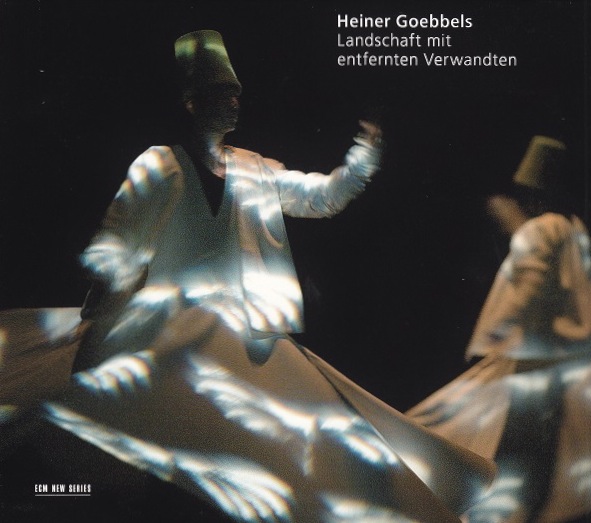
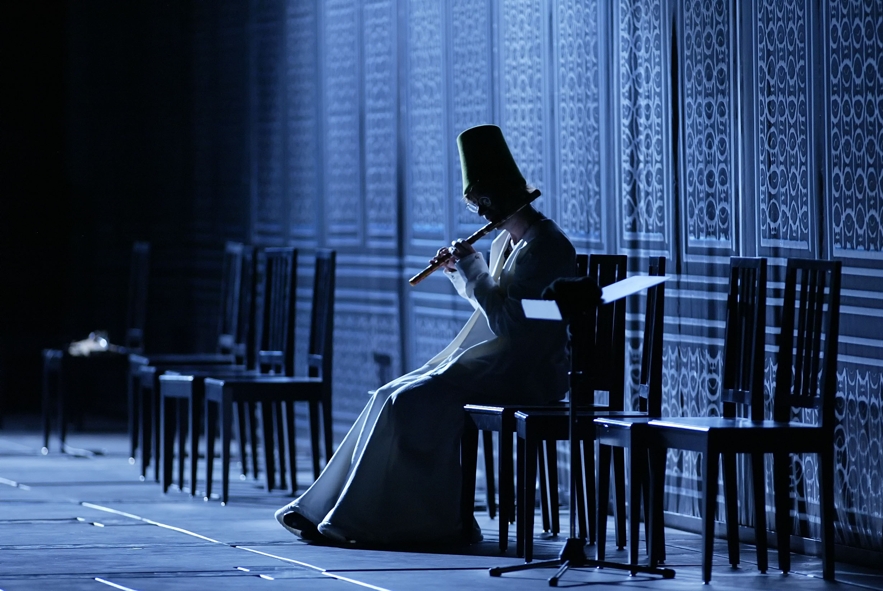
This recording chronicles the incidental music to Heiner Goebbels’s theatrical juggernaut, Landscape with Different Relatives, a much-lauded work that premiered in 2002. Billed as an opera for soloists, choir, and ensemble with texts by Gertrude Stein, Giordano Bruno, Arthur Chapman, Henri Michaux, T. S. Eliot, Leonardo da Vinci, and Nicolas Poussin, it includes mostly composed material with a mickey of improvisation slipped in. Both modes are taken up with gusto by the Ensemble Modern under the direction of Franck Ollu.

The composer’s polyglot approach to text reveals itself also in the music, which pins a wide-ranging geography of crumbling modernities. Like its librettic assemblage, the listener is eased into the work from the outside in. From above, one sees it divided into two parts. Seemingly disconnected in shape, the first contorts itself around all manner of war machinery while the second sees the body as machine and itemizes the internal workings of that most familiar technology. Closer inspection reveals a kinship between the two halves beyond the grasp of mere words. Both begin with the same introduction, for instance, adding only speech to the second iteration, as if the conscience of the opera’s former half were being revived.

Landschaft
(Promo photo by Oper Frankfurt)

Part One thus inaugurates its concerns without voice. In a bed of organ, flute, and oboe, an electronic beep signals a message waiting to be heard before a wash of light shuttles the listener across narrow waterways into “The Sirens.” Here the vagaries of disgust are re-spun into catalysts, an interweaving of social stereotypes brought home by threats of destruction. Out of this swarm come multiple catharses. Dreamlike and fluid, they imagine procreation in lilting brass and, most notably, in the heavenward flute of “Tanz der Derwische,” one of three centerpieces. Drums and clarinet part the sky to reveal another, a parallel universe where the dead walk as if unscathed as gorgeous improvisations from the clarinetist interact with muted brass. “In the 19th Century” brings science under the lens of its own microscope and questions, as might Foucault, the dangers of expertise. “Triumphal March” is the second centerpiece. An obsessive mélange of lists and figures—and, by extension, of utility and servitude—it builds a monument to interrogation and crushes it to dust. “Schlachtenbeschreibung” is the final centerpiece. It’s title (Battle description) can be said to be the opera’s theme, layering as it does the grids of land and collateral damage that betray any ideological motivations lurking within terror. The playfulness of the instrumental arrangement here suggests a lost art and imbues baritone Georg Nigl with just the agitation he needs to carry off the words. Da Vinci’s pedantry, which guides artists in the depictions of battle scenes, lends a strangely categorical air, adding contrast to the fin de siècle politics that precede it. The ping-ponging of electronic and acoustic beats suggests confusion between the peace and antagonism of “Well Anyway,” which conflates revolution with sustenance, and celebrates the ability to shed tears. “Did It Really Happen?” further addresses the divide between historical revisionism and denial, and pulls the strings of the past clearly into the fray of the present, while “Kehna hi kya” haunts the center with its shrill plucked strings and local flourishes. The latter suggest a cultural archive, packaged and presented to the transient tourist. “Et c’est toujours” (And it is always…) addresses another gap, this between industry and flesh, between art and the earthen origins from which it is produced. It is the twist of a rind in the eye, a squinting of soul into eclipsed sun.

Part Two continues the opera’s marriage of modern and traditional instruments, consolidating many candles into a single flame. As emblematically in the feudalistic satire of “Just Like That,” it plays with minimalism (“Bild der Städte”), bricolage politics (“Krieg der Städte”), travel (“On the Road”), social awkwardness (“And We Said Good Bye”), communication (“On the Radio”), and even delves into a bit of Americana with “Out Where The West Begins,” replete with banjo and wagon procession. This blends into “Train Travelling,” about which the voiceover says, “The irregularity of its regularity is fascinating.” An overarching aesthetic of the opera if ever there was one.

Much of this second half delves deeper into notions of language and category, as in “Ich leugne nicht die Unterscheidung” (I do not deny the distinction), which understands the difference between destruction wrought by hand and by technological intervention, even as it washes both in the same descriptive waters. Such juxtapositions breed nostalgia through lenses of regret and distant complicities. Life takes its path abjectly. The deaths of animals loom as large as those of humans and round the jagged edges of the voices’ autobiographical disguises. Commanding and conquering can occur only where there are speech acts to back them up, and “Different Nations” gives a catalogue of call signs that lend vivid color to the connection between diplomacy and violence. Hence the ultimate arrival of the “Principes,” each a window into the soul that waters ambient soil. This final dronescape hosts only those voices that linger after all the others have expended their welcome. Welcome to their requiem.

Excerpt from the stage production, “Triumphal March”:

Alexander Knaifel: Svete Tikhiy (ECM New Series 1763)

Svete Tikhiy

Alexander Knaifel
Svete Tikhiy

Keller Quartett
András Keller
 violin
János Pilz violin
Zoltán Gál viola
Judit Szabó cello
Oleg Malov piano
Tatiana Melentieva soprano
Andrei Siegle sampler
In Air Clear and Unseen recorded October 2000 at Radio Studio DRS, Zürich
Engineer: Peter Laenger
Svete Tikhiy recorded1994/95 at Film Studio Lenfilm and 1997 at St. Petersburg Recording Studio
Engineers: Mikhail Shemarov, Victor Dinov, and Andrei Siegle
Produced by Manfred Eicher

Nature is not as you imagine her:
She’s not a mold, nor yet a soulless mask—
She is made up of soul and freedom
She is made up of love and speech…
–Fyodor Ivanovich Tyutchev (1803-1873)

For its first conspectus of St. Petersburg-based composer Alexander Knaifel, ECM presents  Svete Tikhiy (O Gladsome Light). Side by the side, the program’s two works—each a triptych—seem vastly different in scope. And perhaps they are on the surface. But they are also part of an ongoing braid of interest on the part of the composer in what is lifted from the score and held in the spirit of the performers to whom he entrusts interpretation: in essence, the reading of the word. For this recording, the word comes to us both lower- and uppercased.

The former flexes its waking hour throughout In Air Clear and Unseen (1994) for piano and string quartet, peeking from behind the Orthodox veil through which Knaifel’s music is often so diffused. Steeped in the poetry of Fyodor Tyutchev, each tableau reads through gestures of slowly measured time. “In Some Exhausted Reverie” begins in Silvestrov-like fashion: with a piano postlude. It touches the ether with a delicacy so organic it almost falls away by merely being gazed upon. Its stillness may be illusory, but the potential emotional connection it makes with the listener flows into the ribcage and finds room to conform.

If encouraged to compare, one could cite Pärt’s Alina as an analogous atmosphere, if only for its breathing room. Distinct here is the feeling of something titanic, as if an entire history were being grappled with in a single note. All of which makes the opposite point: that there is never just one note, for each is a combination of many more, and those of still others. The air is unseen, yes, but it can be felt. It is a field of touch. Hence the tactility of Knaifel’s performers, whose own lives are filtered through their contact with the music. Instructed as they are to intone that which is ultimately “unvoiced,” the instrumentalists embrace each living moment with their entire being, itself a resounding instrument of warmth and illumination.

The central section, “An Autumn Evening” (for string quartet), finds a more distant analogue to the music of Tavener, whose The Last Sleep of the Virgin is also of Byzantine cast (and, coincidentally enough, composed the same year as the accompanying work on this disc). The lucidities of both shimmer in slow motion. Unique to Knaifel’s aesthetic is the unity of the assembly: the quartet is one flesh, a portrait of humanity drawn through what he calls “chain breathing.” The combination becomes something of a filter through which death renews life. It is the dreamed-of ribbon still in hand upon waking. The final section marries these two impulses, pulling childhood memories like a hood against blasphemy and lighting many candles from a single, originary flame.
The title composition, Song of the Most Holy Theotokos, is composed for soprano Tatiana Melentieva and sequencer. The eponymous hymn, which appears only at the end of the piece, is among the oldest Christian hymns, a folding of light into Christ and both into the world. It is force of life, but also agency of solace. Here the self-reflexivity of the replenished soul is expressed in the electronic manipulations and multi-tracking of Melentieva’s voice. The result is a ponderous, overtly crafted chorus of the self, giving way to echoing caverns of implosion. These, in turn, impart life to the openness of God. From mantra-like quivers and resonant tongues to the rounded grace of the central unaffected voice, it turns lullabies into dust and dust into starlight. And as the final fragments blur skyward, worship becomes a shroud for the ears.

On the whole, Svete Tikhiy is also a master class in engineering. Were the content not afforded the spaciousness it deserves, its inner voices might never reach us. This is not to say that technology adds something not already there, only that it brings out inherent tendencies toward infinite expression. The echo becomes a primary signifier of its referent, but also something more: a reference in and of itself to yet another echo, ad infinitum.

<< Anders Jormin: Xieyi (ECM 1762)
>> Seim/Brække/Johansen: The Source and Different Cikadas (
ECM 1764)

Thomas Larcher: Naunz (ECM New Series 1747)

Naunz

Thomas Larcher
Naunz

Thomas Larcher piano
Thomas Demenga cello
Erich Höbarth violin
Recorded November 1999, Europahaus Mayrhofen, Austria
Engineer: Stephan Schellmann
Executive producer: Manfred Eicher

Austrian pianist Thomas Larcher, previously known to ECM New Series aficionados as a tactful interpreter of contemporary music, with Naunz shows his colors as a composer of the same. That Larcher is a close associate of Heinz Holliger, another musician-composer of immense talent, should come as no surprise: both compose as if through a microscope. Yet while Holliger tends to languish in protracted gazes at what lies beneath his cover slides, Larcher is more interested in compressions and calms before storms—in the message of the medium. The laser-precise title piece, written 1989 for piano, evokes a particular brain chemistry and cellular dysfunction…yet also a fractured, spatial sort of harmony. Its thirteen-and-a-half-minute duration holds a broad technical spectrum on the tongue: metallurgical hammerings, bright pops, and bluesy accents trade places in carousel fashion. Every note drips like a love-sworn face, open-mouthed, a scabbard without a sword.

Thomas Demenga pushes these images deeper into the fire in Vier Seiten (1998), throwing himself into jaggedly brushed scenery. Larcher’s trust in Demenga is obvious, for even the most challenging passages flow effortlessly at the cellist’s virtuosic touch. Ley lines crack in a symphony of such intimate proportions that the piece stabilizes, settling into meditative fog curls, a muscle torn to infinity. Further bowings are put on hold for the duration of two more piano pieces. The fractured yet resonant Noodivihik (1992) works at an even more cellular level. With scientific attention, Larcher expounds its polyphony in monosyllables while moments of clarity rub up against those of murky discomfort. Not every piece, however, is so overtly disjointed, for in such a piece as Klavierstück 1986 (the collection’s earliest composition) there is overt color-bleeding, punctuated by moments of insistence that fade into bodiless reflections.

Larcher

The autobiographically inflected Kraken (1994-1997), a fascinating trio, revives Demenga and adds the violin of Erich Höbarth. In the latter’s playing is an Ysaÿe-like exuberance told yet in a language Larcher’s own, distinct for its obsessions. The entrance of piano after Höbarth’s pliant introduction lends a morose, titanic feeling of sunkenness. Violin lines evoke ghostly strangers from the wreckage, cleaving water and sky in kind. As a unit the trio forms a methodical braid, ponytail of a slumbering warrior. Larcher brings a percussive sound to his part, treading water in a marriage of staccato and legato impulses. The Holliger connection deepens as Demenga and Höbarth embark on a journey eerily reminiscent of his Duo for Violin and Cello before fragility and gnarled woodwork bring closure. Also bringing closure is the concluding Antennen-Requiem für H. (1999), an elusive piano piece that flirts with audibility by way of various extended techniques. Hands on the strings turn the instrument into a fast-forwarded film. It is a diegesis, an awakening, a genetic table setting loosed from its horizontal plane.

Larcher’s music is the equivalent of a postmortem. With a meticulousness that can only come out of self-discipline, he scours every body for clues of its demise. In so doing, he creates new life. Every helix begins a story.

<< Charlie Haden/Egberto Gismonti: In Montreal (ECM 1746)
>> Eberhard Weber: Endless Days (
ECM 1748)

Heino Eller: Neenia (ECM New Series 1745)

Neenia

Heino Eller
Neenia

Tallinn Chamber Orchestra
Tõnu Kaljuste conductor
Recorded August 1999, Estonia Concert Hall, Tallinn
Engineer: Teije van Geest
Produced by Manfred Eicher

The word “trauma” comes from the Greek, meaning “wound.” The derivation seems apt: a wound leaves one prone to infection from invisible forces, while from it exudes the very stuff that keeps us alive. According to classical Freudian psychoanalysis, a healthy Ego redirects traumatic influence, thereby protecting us from overstimulation. Otherwise, the trauma festers within. Either way, the subject is spared the pain of being consciously aware of the affliction in question. Music, however, inflects this view somewhat differently. In that of Estonian composer Heino Eller (1887-1970), a distinctly autobiographical impulse floods us neither with catharsis nor with a working-through. It is, rather, a fullness of life that sees death not as non-existence but as one of many equal facets.

Eller’s stamp on Estonian concert music cannot be overstated: his was the spark that set a revolution aflame. His influence pulses on in the work of his many students. Arvo Pärt, for one, fondly remembers his composition teacher as a noble human being who nurtured an open and personal approach, as the founder of Estonia’s professional music scene, and above all as a musician of “strict logic.” Yet Eller’s personal life was also indelibly marked by a strictly illogical act: the murder of his wife, Anna, at the hands of occupying Nazis. It was during this period that his Lüüriline Süit (Lyric Suite, 1945), originally composed for piano but heard here in an orchestral reworking, came to fruition. The heartrending physicality of its mortal undercurrents breathes with the ache of living—a sound as only the Tallinn Chamber Orchestra under Tõnu Kaljuste’s direction could elicit without need for the background sketched above. Each of its six movements is corporeally minded, a ballet of actors on a sociopolitical stage. In the final movement especially one notices the rhythmic sensibilities inherited by such progenitors as Erkki-Sven Tüür, only here they pick at a scab that will never heal. The depth of landscape is masterful, its contrasts of texture and time, of heaven and hell, indicative of all that follows.

The 1928 title composition is a memorial to friend Johannes Arro (1865-1928). A tone poem of majestic emotional depth, it undergoes constant color changes, each continuing the gloomy dramaturgy of the opening suite. The Five Pieces for String Orchestra (1953)—of which “Homeland Song,” says Pärt, is the Estonian equivalent of Sibelius’s Finlandia—unfolds in a more fragmentary, though no less organic, sense of architecture. Like that of Antonio Gaudi, straight lines are rare and there is a beginning at every end. Densities also vary: a solo violin draws a silver thread through the occasional needle, pocking the clouds with patches of sky. From lively dances to saturnine dips, the overall effect is stirring and reminds us that home is never far away, so long as one can find a song to share.

The concluding works of the program embrace the spectrum of Eller’s craft. The Sümfonietta (Sinfonietta, 1965-67), his last major composition, speaks in a language of catch and release. Every time it seems to tip, something swoops in to steady it. Agitations in the lower strings draw a screen as translucent as rice paper yet as impenetrable as an iron fortress as we are moved through a vast unraveling into the final dance, the spirit alive and forthcoming with its light. The promise of that light is realized in Eleegia (Elegy, 1931) for string orchestra and harp. Written in memory of another musical friend, Peeter Ramul (1881-1931), its lachrymose reflections turn into titanic hope, drifting through joyful memories to get there. All of which brings us full circle to the knowledge with which we began: namely, that something of our lives, whether given or taken away, persists beyond the measure of all the grief in the world.

The listener will be hard-pressed to locate a single abrasive maneuver in Eller’s compositions. Each is a coherent entity. There is feeling that the music will go on without ever resolving itself, but that in that lack of closure time becomes its own mirror. We may never understand the persistence of violence, but at least it may be temporarily diluted by the draw of a bow.

<< Trygve Seim: Different Rivers (ECM 1744)
>> Charlie Haden/Egberto Gismonti: In Montreal (
ECM 1746)

Eleni Karaindrou: Trojan Women (ECM New Series 1810)

Trojan Women

Eleni Karaindrou
Trojan Women

Socratis Sinopoulos Constantinople lyra, laouto
Christos Tsiamoulis ney, suling, outi
Panos Dimitrakopoulos kanonaki
Andreas Katsiyiannis santouri
Maria Bildea harp
Andreas Papas bendir, daouli
Veronika Iliopoulou soprano
Eleni Karaindrou
Antonis Kontogeorgiou chorus director
Recorded July 2001 at Studio Polysound, Athens
Engineer: Yiorgos Karyotis
Produced by Manfred Eicher

No human heart is set so hard
that hearing the grave music of your dirge,
your keening, would not bring tears.

The distinct approach of Greek composer Eleni Karaindrou to film sound-tracking, through ECM’s rigorous documentation of her partnership with director Theo Angelopoulos, has imbued her music with a life of its own among international audiences. All the while, Karaindrou had been nurturing an equally prolific association at home with the theatre. Her Angelopoulos in that craft has been director Antonis Antypas, with whom she has collaborated on over 20 productions for the Aplo Theatro. This album documents her incidental music for a new staging of the Euripides tragedy Trojan Women, which received its premiere at the Ancient Theatre of Epidaurus on August 31 and September 1, 2001.

First performed in 415 B.C., the play was a vitriolic critique of the Athenians’ then-recent attack on the island of Melos, where countless violently perished and women were sold into bondage in the name of conquering Sparta (in this the Athenians did not succeed). It is perhaps no coincidence that the word melos also means song, for singing constitutes the very flesh of this album’s limestone skeleton. Karaindrou kneads into these politics the idea that less is more. With the barest use of folk instruments—such as the Constantinople lyra, ney, santouri, and bendir—she implies a battered panorama of immense emotional congruity. Producer Manfred Eicher has lent further sanctity through his arrangement and editing of the material into its present form.

A profoundly comported scenography of touching (which is to say, tangible) melodic beauty finds particular expression through the lyra’s grasshopper song. It is a mournful, unforgettable sound, dry as a reed in summer. The harp also figures notably in the music’s rolling waves, overcoming the barrenness evoked by titles like “Terra Deserta” with oceanic depth. Its vibrations are transformations of landscape itself, silenced by their own resonance.

Trojan Stage

Much of the material on Trojan Women will sound familiar to regular Karaindrou listeners. The themes, although nominally character-specific, are melodically uniform, changing their instrumental clothing from visage to visage, thereby sounding a fluidity of purpose and choice. Unusual, and perhaps a point of contrast to nevertheless persistent indications of barrenness, is the presence of choir and a soprano soloist who only occasionally poises her lips above the waterline to spout names of the deep. Of central importance in this regard are the three stasimons (choral odes), each a vertebra of both story and music, a refraction of the rest. In them voices grow bolder, reaching epiphany in “An Ode Of Tears” and “In Vain The Sacrifices,” the latter a ring to which the former’s gaping clasp holds true. These voices do more than the traditional Greek chorus. They burgeon at stage center, relegated not to the wings but to the head and body of a flightless bird. Without wings, they think themselves into freedom, casting their minds from horizon to horizon, faster than the sun. They do not create the stars but make them brighter.

As a matter of course, the pieces are generally short (only one surpasses four minutes). In their sublime chemical suspensions of tears, blood, and determination swims a pair of eyes—one directed at us, the other elsewhere. Consequently, there is a feeling of stepping out of time in order to better understand its circumscription. Vast harmonic networks slumber in the underlying empty spaces, never stirring except in the most funerary moments. Despite the mythic sheen, the music of Trojan Women finds deeper mystery in the earth’s living subjects, which in isolation reveal the mystery of creation, both divine and mortal, far more acutely: in order to attain permanence one must be open to the fallacies of agreement.

Alternate Trojan
Alternate cover

Karl Amadeus Hartmann: Funèbre (ECM New Series 1720)

Funèbre

Karl Amadeus Hartmann
Funèbre

Isabelle Faust violin
Paul Meyer clarinet
Petersen String Quartet
Münchener Kammerorchester
Christoph Poppen conductor
Recorded July and September 1999, Angelika-Kauffmann-Saal, Schwarzenburg
Engineer: Andreas Neubronner
Produced by Manfred Eicher

Funèbre stands out in the New Series both for its due attention to German composer Karl Amadeus Hartmann (1905-1963) and for welcoming conductor Christoph Poppen and the Munich Chamber Orchestra into the ECM fold. The latter have since gone on to record a number of pivotal records for the label, including the all-Scelsi program Natura Renovatur and the Bach/Webern crossover project Ricercar. Here they are joined by violinist Isabelle Faust, the Petersen String Quartet, and clarinetist Paul Meyer for a shuffling of dark, darker, and darkest. The two main courses—Concerto funebre and the Symphony No. 4—are among Hartmann’s best known and preface the world premiere recording of his Chamber Concerto for clarinet, string quartet, and orchestra.

Hartmann’s fiery personality and strikingly inter-idiomatic style made him an easy target under the Third Reich, during which time he withdrew his music from the public sphere altogether in solidarity with other persecuted composers who chose “internal exile” over excommunication (or worse). It was nevertheless heard abroad, where it took on a life of its own. After the war, his revitalization of the European soundscape through the famed Music Viva concert series further deflected attention away from his own work at home. This, coupled with his penchant for self-criticism, left the world with a minimal published output, a problem rectified only after his passing when all-but-forgotten scores were restored, printed, and performed.

Concerto funebre for solo violin and string orchestra is Hartmann’s only violin concerto. It is meant to navigate the iniquities he saw brewing in 1939, when he began writing it. Hartmann dedicates it to his son, only four at the time. In this spirit, he wrote in retrospect, “The chorales at the beginning and end are intended to offer a sign of hope against the desperate situation of thinking people.” The piece in four tableaux initially bore a different title: Musik der Trauer (Music of mourning)—which naturally recalls Hindemith’s Trauermusik for viola and string orchestra—before changing it upon revising the piece in 1959. It forges a unique alloy of violinist and orchestra, so that the former’s attitude is more traveler than soloist, strings the life-giving land from which it comes together. The end effect is such that high notes and low notes are not markers of altitude, but rather inversions of one another on a horizontal axis of expression. The violin is a full-throated being, a pendulum housed in wrought iron. Neither do typical rules of concerto form apply. The Allegro does not provide catharsis but rather embodies a deepening of grief. Only in the Adagio do we detect a morsel of affirmation. Nevertheless, the Allegro does provide a physical sensation of uplift, a cyclone of leaves in which Faust is the only one determined among them. It is also a stepping-stone for the achingly beautiful corridor of the final Chorale, which strengthens the elasticity of the body’s emotional skin and draws on its palimpsest a broken circle.

The Symphony No. 4 (1947/48) for string orchestra takes a 1938 concerto for strings and soprano as its palette and builds from it a new diorama. Two slower movements sandwich a compact inner core: a sonic flag bearing ugly repression and shaded resistance. The colors are wan at first, rhythmically tethered to a far-off caravan whose footprints have long since been dusted over. Lachrymose and weighted by unspoken fear, the figures that left them are but a flicker on the horizon. Hints of Mahler and Webern dot an otherwise bold, original score. That Hartmann deploys these references so organically is one thing. That he does so with such arresting melodic development is quite another. The free-floating sensations of the symphony’s bookends are especially instructive in this regard, while its heliocentric Allegro reaches downright thrilling peaks of agitation. The broad sweep of its closing Adagio is overwhelmingly dense, leaving us with a heavy bowl of fruit indeed to share with those who will listen.

Although the unusual Chamber Concerto was completed in 1935, it was first performed only posthumously, in 1969. In light of its gypsy flavors, that it bears dedication to Zoltán Kodály should come as no surprise. Two longer outer movements create yet another frame, this one housing six brief dance variations. Across these Hartmann splashes the piece’s most vivid colors. Gorgeous, rustic, and magnetic, the tunes practically leap of their own volition, turning midnight into dawn at Meyer’s fluid inflections. All of this builds to a haunting stretch of ocean, crisp and bright as the moon.

If this sounds like your cup of tea, you’ll not want to miss out on ECM’s worthy account of Sándor Veress, and vice versa. Both composers draw out likeminded freshness from the earthly cares of which they were both injured subjects.

From the ash comes the phoenix.

<< Mat Maneri: Trinity (ECM 1719)
>> Michael Mantler: Songs and One Symphony (
ECM 1721)

Alexander Knaifel: Amicta Sole (ECM New Series 1731)

Amicta Sole

Alexander Knaifel
Amicta Sole

Mstislav Rostropovich cello
Tatiana Melentieva soprano
Soloists of Boy Choir Glinka Choral College
State Hermitage Orchestra
Arkady Steinlukht conductor
Psalm 51 recorded September 2001 at Propstei St. Gerold
Engineer: Stephan Schellmannn
Amicta Sole recorded July 2000 at St. Catherine Lutheran Church, St. Petersburg
Engineer: Semion Shugal
Produced by Manfred Eicher

The text is intoned as if it sounds. These, the simple instructions that composer Alexander Knaifel offers in the score of his Psalm 51 for cello solo. Dedicated to Mstislav Rostropovich, who also performs it in the present recording, the piece is as skeletal as its source: a sounding of spirit made flesh by mortal touch. While listeners may never hear the words, they will feel them in Rostropovich’s bow, poised as it is on a fulcrum of silence. Says Knaifel, “it is the only one and unique experience in my life when not a note was composed—in the fullest and most exact meaning of this word.” By this he admits no fallacy of the creative process, but instead reveals the divinity behind its cause. The internal is renderable only as an idol to itself, so that every dynamic of the cellist’s articulation seems destined to tremble. A climb into higher registers opens a flame’s pathos into vision and leaves one suspended in Heaven’s basement.

Like the burnt offerings of which the psalm concerns itself in its final stanza, the music scatters easily in the wind. That it holds true to form at all is proof of its spiritual integrity. Although the performer is singular, the incantation is sometimes plural. From piercing bridge crawls and vulnerable downward steps to interlocking pizzicati, every motion signals a diacritical reality. Rostropovich achieves all of this through his decades-long path toward mastery. For while the notecraft is almost as bare as the paper it is written on, Knaifel infuses every nodule with a word. Were we to plot each on an axis of pitch and time, they would form a rainbow arc through the firmament from birth to death. Only at the end does light creep in, pulling ever higher into the cello’s very threshold of audibility.

The papery consistency of Psalm 51 provides absorption of the ink in Amicta Sole (Clothed with the Sun) for soloist (female) of soloists. As a follower of the former’s grace, this starkly glassine piece speaks in angel’s tongue and awakens to angel’s ways. It is also performed here by its dedicatee, the inimitable soprano Tatiana Melentieva, who etches with her voice a denser light against a slow waterfall of strings and choral textures. Now that the texts are consciously sung, there is great movement from above to below, from interior to interior’s interior.

Inspired by the “woman clothed with the sun” who appears in Revelations, Amicta Sole sequences the genealogies of Christ as a helix between new prayer and ancient origins. The instruments perform the same role as the cello in Psalm 51, sounding the texts as if singing them, while the voices sing the texts as if sounding them. Melentieva’s art is so rich that she could very well carry these forces without their cushion, for she seems to summon legions of air before her. Despite the above connotations, what we have here is the full spectrum of earthly care, the weight of human conditions pressed upon our ears with the almost there-ness of a molt feather. And although we are invited to bask in the caesural nature of what transpires, stretched into barest triad, we can never be a part of its cathedral, where vibration and darkness dwell. The feeling of renewal is such that no architecture can stand here for so long as a breath (hear this in the flute’s red thread of color). Only in the harp is the promise of good news made manifest, and with it the uniform face of which our own are imperfect copies.

That the pieces here are from the mid-nineties, shaded by a lingering fog of the Soviet era, is only fleetingly significant. In them is a stillness of heart that reflects on troubled pasts. By the same token, their worth lies not in their politics, bleeding as it does through the reddest of paper with its own hues intact. At once reifying and transcending the corporeal waver that is its mirror, they are but two jewels in an eternal crown. 

Have mercy on me, O God, according to Thy great mercy,
and according to the multitude of Thy tender mercies
blot out my iniquity.

<< György Kurtág: Signs, Games and Messages (ECM 1730 NS)
>> Robin Williamson: The Seed-at-zero (
ECM 1732)