Luciano Berio: Voci (ECM New Series 1735)

Luciano Berio
Voci

Kim Kashkashian viola
Vienna Radio Symphony Orchestra
Luciano Berio conductor
Robyn Schulkowsky percussion
Recorded November 1999, ORF Studio, Vienna; May 2000, Teldec Studio, Berlin
Engineers: Josef Schütz and Peter Laenger
Produced by Manfred Eicher

The interest of Italian composer Luciano Berio (1925-2003) in folk music runs as deep as the grooves in his scores—trenches, rather, through which performers have been backpacking their talents since the latter half of the 20th century. In them are remnants of decay and sound intermingling with fantastical re-creations. Much of said interest has flowed through those earthly scars outward into other lands. French, Italian, Armenian, Azerbaijani, and American sources were all fair game in the path of his net, reaching notable culmination in his Folk Songs of 1964. The range of this touchstone composition places unenviable demands on the singer, who must convey respective flourishes and qualities as if they were her own. The brilliance of the piece lies less in Berio’s settings, per se, than in his decoupling of songs from their provenance. This act of displacement lends their motives clarity and reliability (an idea that would surely have been fresh for one who had just relocated to America for a series of teaching appointments). We can therefore assume that the settings were no mere archival gesture (two of the Folk Songs are his own), but rather a vibrant shuffling of idioms. In that world we encounter a roving gallery of maidens, fishermen, even a nightingale, and in each there is a new message. It is something of a comfort to know that, in the midst of this politically charged period, Berio remained true to roots as he saw them, even when they were not his own. The folk song was thus for him a found object. Like his contemporary Italo Calvino (who would write two librettos for the composer), Berio was an interdisciplinary storyteller who meshed experimental and traditional impulses, and in the process saw fit to fit what he saw.

Voci (1984) continues the thread first spun in Folk Songs, but stares deeper into the looking glass. As the center of this exemplary recording from ECM’s New Series, it radiates with warmth and tactile force. Its focus is on the sights, sounds, and smells of Sicily, and in them finds a suitable color palette from which to sketch and paint. Its inaugural gesture of bells and viola is not unlike the solo introduction to Ravel’s Tzigane in its thorough physicality. The analogy stops there, however, for Voci is anything but a showpiece. It rings in the air like the street calls, lullabies, and folk tunes that inspired it, minimally dressed. Violist Kim Kashkashian and the Vienna RSO are ideal and formidable interpreters, bringing renewed variety to the piece’s inherent textures as compared to the reference recording by Aldo Bennici (for whom it was written) fronting the London Sinfonietta. Kashkashian carries full orchestral weight in her bow, keening her way through the piece’s epic travels with confidence. Fragmentary dances and incantations trade hands, carving circuitous paths around an elusive center. The colorful blend of percussion (courtesy of the great Robyn Schulkowsky), winds, and strings surrounding her form a pastiche of rusticity that brims with practically excessive totality. This is not the careful revelry of the attentive archivist, but rather the unrest of the enraptured interpreter, translating, transforming, and deconstructing.

In a fitting stroke of programming panache, producer Manfred Eicher includes five field recordings from the very regions that so entranced Berio. Of these, the lament is especially magnetic. Mournful though it is, it also undergirds a heavy weight of realization: the folk song is no fleeting thing. Rather, it continues to sing itself into existence even in the absence of voices, working its way into the very soil and thrumming among the dead. This makes Kashkashian’s performance all the more worthy of praise, for she does what many singers have done before her with a shaft of hair, rosin, and four strings.

After this dive into “agro-pastoral” authenticity, we return to land in Naturale (1985), which combines the composer’s own song recordings with viola and percussion. Although more than a mere Voci redux, its effects are nearly identical, drawn as they are from the same starting point. The intimacy factor is higher, the mirror more polished, the sun lower in the sky.

As Berio would have been the first to admit, the “cannibalization” process by which these strains made their way into his meticulous constructions remain free from romantic visions of preservation and speak to a process of linear progression in the continued search for new directions through the fusion of disparate paths. We can be thankful that some of those paths lead straight into our ears.

<< Charles Lloyd: The Water Is Wide (ECM 1734)
>> András Schiff: Leoš Janáček – A Recollection (
ECM 1736 NS)

Anna Gourari: Canto Oscuro (ECM New Series 2255)

2255 X

Anna Gourari
Canto Oscuro

Anna Gourari piano
Recorded May 2011, Historischer Reitstadel, Neumarkt
Engineer: Stephan Schellmann
Produced by Manfred Eicher

Born 1972 to a family of musical pedagogues, Russian (and, since 1990, Munich-based) pianist Anna Gourari makes her ECM debut with a characteristically unconventional recital…or so it would seem. Two of J. S. Bach’s chorale preludes, as arranged by Ferruccio Busoni, parenthesize the program’s modern heart. “Ich ruf’ zu Dir, Herr Jesu Christ” and “Nun komm’ der Heiden Heiland” both come from the incomplete Orgelbüchlein, a pedagogical scrapbook compiled in the earthy 18th century. Busoni’s erudite touch burgeons further in Gourari’s, opening a doorway all the grander for being so austere. Yet here is a Bach that, while adorned, breathes with the minimalism of a single voice. The tenderness of these leaves betray nothing of the fragile limb to which they cling.

From light to brokenness, the program tilts its wings eastward to Sofia Gubaidulina’s Chaconne. Composed in 1962, this deconstruction of a b-minor triad represents an key period in the Russian composer’s development. One may be tempted to read grand philosophical statements of suffering into such music, when really it turns itself inside out for all to hear. This is not an evocation of suffering, per se, but an acknowledgment of its necessity. The effect is such that even the overt references to Bach come across as probing, strangely confident, and spiraled like a unicorn’s horn. Its elegiac impulse is foxed by ragged edges, given light in measured doses. Here is a lighthouse without a vessel to guide, a signal without a flare.

Paul Hindemith (1895-1963), a prolific composer yet one whose piano works have only in recent years begun to crop up on CD programs, is given plenty of space in Gourari’s ecstatic take on his Suite “1922.” Although its effect would surely have raised a few eyebrows that same year, as was Hindemith’s intention, today his experiment stands as a fascinating cross-section of early expressionism. Over the course of five parts, this jocular, if rigorous, piece takes us on a wild ride. Titles like “Shimmy,” “Boston,” and “Ragtime” transport the listener to a time when said dances still hit the floor, when financial doom was still some years away. Such historical perspective lends poignancy to the central movement, a “Nachtstück.” Like a fragment of title card found in the wreckage of a silent film warehouse, it tells only part of the story that its context makes abundantly clear. Hindemith’s references are seeds for more complexly developed ideas and beg comparison with contemporary George Antheil, whose own “Shimmy” graces Herbert Henck’s fascinating Piano Music. Gourari’s resolute command of, and passion for, the material makes this a benchmark recording.

Anna Gourari

Busoni resurrects Bach again in his supernal arrangement of the Chaconne from the solo violin Partita No. 2. The mighty Chaconne has always been a keystone in Bach’s solo literature. That it speaks with the same colors is testament both to arranger and performer. From the chord-enhanced arpeggios to the requisite drama throughout, Gourari allows the music to resound not by means of surface but interior. If Busoni has given it an elastic quality, then she has stretched it to the limit in an interpretation that promises to open new doorways with every listen.

Were this program a long day, Bach’s e-minor Prélude (transposed here to b minor) would be its longed-for slumber. In a stained glass arrangement courtesy of composer-conductor Alexander Siloti (1863-1945), this relatively small piece from the Clavier-Büchlein vor Wilhelm Friedemann Bach reminds us that duration has nothing to do with density. There is bounty in this music that one discovers through living it.

(To hear samples of Canto Oscuro, click here.)

Bach: Das Wohltemperierte Clavier – Schiff (ECM New Series 2270-73)

2270-73 X

Johann Sebastian Bach
Das Wohltemperierte Clavier

András Schiff piano
Recorded August 2011, Auditorio Radiotelevisione svizzera, Lugano
Engineer: Stephan Schellmann
Produced by Manfred Eicher

Johann Sebastian Bach’s The Well-tempered Clavier is more than a magnum opus. It’s an origin story. Practically speaking, it houses a prelude-fugue couplet for each of the 24 major and minor keys, twice over. Dated 1722 and 1742 respectively, Books I and II are the subjects of two earlier ECM New Series recordings by Keith Jarrett, while pianist Till Fellner has lent his shadows to Book I. Jarrett made the bold decision to record Book I on piano and Book II on harpsichord, thereby giving discernible substance to the two decades that separate them. Fellner’s poignant rendition is only half completed, and it remains to be seen whether the rest will reach market. Until then, label devotees have another.

In his marvelous liner notes, Paul Griffiths characterizes the WTC as “one of the central thoroughfares of western music.” He goes on to speak of prelude and fugue as gate and path or, another way, “Things in The Well-Tempered Clavier always come in pairs, but pairs that, unlike butterfly wings, display an essential asymmetry, if an asymmetry that will sound inevitable, even natural.” Doubtless, this asymmetry is inevitable, for it is the pollen that keeps Bach’s fields fragrant. As a renowned veteran of the composer, András Schiff dusts decades of return into these flora. For him the question is not whether to approach them as studio recording or as performance, because for him the two are inseparable. “To me, Bach’s music is not black and white; it’s full of colors,” he asserts. As in the cover art by Jan Jedlička, the music crosses lines in a deepening network of variation.

Schiff concludes his portion of the booklet with a note on pedal use—or, in his case, total lack thereof. The music is all the freer for it, the affectation a potent expressive tool. Like a digital photographer reverting to manual, Schiff’s process gives vision to its subject with meticulous care. Whether or not this creates a “purer” sound is entirely subjective, though one can hardly fault the sincerity of his choice, for indeed the pedal is often fantasy’s servant. In its place is a tasteful reverb, lacquered at Lugano’s Auditorio Radiotelevisione svizzera under the watch of engineer Stephan Schellmann.

Eschewment of pedal shortens the distance between attack and delay, making it more akin to human speech. Already, in the C major Prelude of Book I, we feel a linguistic touch speaking through those famous arpeggios as Schiff makes of the piano a syllabic organ, no mere percussive machine. His ability to distinguish palatal colors becomes further apparent in the A-flat major Prelude. Schiff’s hands-only approach lends pop and shine to the faster movements, and to the slower adds emotional weight. It also makes the rhythmic complexities glow. Whether the playful grinds of the C minor and C-sharp minor Fugues or the balance of taste and virtuosity of the D major Prelude, the relationship between medium and message becomes, again, inevitable the more one listens.

Perhaps most illuminating in this regard is the equal partnership of the left and right hands. Listen, for instance, to Schiff’s handling of the C-sharp minor Fugue ground, which folds words into sentences and sentences into stories, or the coalescence achieved in his E minor Prelude. From epic carriage to dulcet tickling, such nuances sweep the landscape free of its weeds. Other moments, like the F-sharp major Prelude, are the espresso in a latte universe. Also noteworthy are the extended trills, which Schiff varies to suit the mood at hand. Twirling like maple propellers at one moment (G minor Prelude) and methodically slow the next (F-sharp minor Fugue), they hold us captive at any speed.

Brilliant execution of the C major Prelude and C-sharp minor Fugue stand out in Book II, sounding at least like three hands. The sheer volume of intimacy in the D-sharp minor Prelude draws a comparable spiral of creative focus, and the famous F minor Prelude enchants, ghostly but tangible. The F-sharp major Prelude is yet another notable. This Schiff manages beautifully, shifting with perfect pacing between the dotted eighth-sixteenth couplets and moving into strings of sixteenths in this 3/4 piece. Likewise, his downward chromatic steps in the A minor Prelude are intuitively realized. The final Prelude and Fugue in B minor scintillate with new beginnings and good tidings. Thus, Schiff has locked us into Bach’s prism (especially in the E minor Prelude of Book II) with the precision of a Spirograph wheel and has held us there until the design can no longer repeat itself.

Happiness theorists believe that we become habituated to surpluses of pleasure or positive stimulation, to the point where even the most meaningful activities lose the value they once held. Bach’s WTC noshes on time with the same measured reflection that the iconic shepherd chews on his wheat stalk. In that idle motion is a world of temperament whose secrets will never be fully disclosed. Listening to this music today, it is easy to imagine how different our world is from the time in which it was written. The beauty of Schiff’s performance and Bach’s insightful writing is that, despite the potential infinitude of performances the score invites, at its heart is a survival instinct that will never falter so long as life walks this earth.

(To hear samples of this album, click here.)

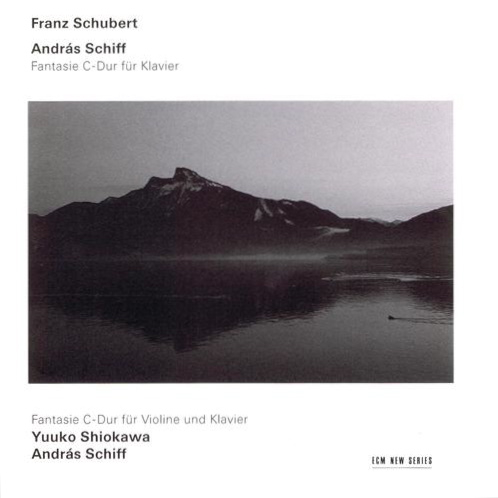
András Schiff: Schubert C-major Fantasies (ECM New Series 1699)

Schubert Fantasien

András Schiff
Franz Schubert C-major Fantasies

András Schiff piano
Yuuko Shiokawa violin
Recorded December 1998, Schloss Mondsee
Engineer: Stephan Schellmann
Produced by Manfred Eicher

It is tempting to say that the music of Franz Schubert (1797-1828) was ahead of its time. In the words of pianist András Schiff, “Schubert has such modernity—perhaps his time has only arrived now.” When encountering the 1822 “Wanderer” Fantasy for the first time, the characterization would seem to fit like a tailored suit. And yet, if we track its subsequent influence on composers as diverse as Liszt and Ligeti, it becomes clear that he was a composer of his moment, and it is this moment to which so many listeners have returned in their own wanderings. It might, then, be more accurate to say, “Modernity has such Schubert.”

In the first half of this recital disc for ECM, Schiff flows through the piece’s technical challenges like a river through a forest. As remarkable as this is, more intriguing are the ways in which he navigates its emotional mazes, for as a Schubert interpreter Schiff prefers poetry to drama. He gives requisite oomph to the magisterial introduction and from it elicits rounded gestures implying acres of pasture at a single touch of key. Yet his most commanding moments are the gentlest. Almost as still as mirrors, they reflect the leaf-patterned light that seeks them. Pulling away the vines, Schiff smells the moss, fecund with mystery. Knowledge of Schubert’s all-too-brief life inflects these passages darkly. From the spectral to the colloquial, the “Wanderer” spans the gamut of responses to landscape, though the Beethovenian desperation in the final fugue is undermined by an intermittent restraint that may sit oddly with fans of benchmark recordings like Richter’s or Pollini’s. Still, a resplendent sign-off gives the piece a total shape that is Schiff’s own.

His wife, violinist Yuuko Shiokawa, joins her partner for Schubert’s Fantasy D934, also in C major. Published posthumously in 1850, its proper score rested dormant beneath the recital stage until the 1930s. Emerging in a ghostly whisper, Shiokawa draws a spider’s thread through the piano’s microscopic tides. This is the dream to the former fantasy’s waking, made manifest through the strains of an inviting dance. Shiokawa brings appropriate balance of airiness and strident romanticism to what is arguably some of Schubert’s most beautiful writing. She partners well with the piano as a parallel voice—neither competing nor unified. Shiokawa also handles the technicalities with grace, particularly during a delightful passage that floats pizzicato in cascading undulations from Schiff’s fingers. Another flowery conclusion, if more succinct than the last, again closes the circle with confidence.

The recording here is noticeably soft in texture, heavy in the lower register. The combination sucks a bit of wind from Schubert’s sails in portions, especially in the finale of the “Wanderer.” Both Fantasies remain purest in their introductions and in their quieter turns. Such issues aside, with these two pieces Schubert shows that perhaps all music is fantasy.

<< Dave Holland Quintet: Prime Directive (ECM 1698)
>> Jan Garbarek/The Hilliard Ensemble: Mnemosyne (ECM 1700/01 NS
)

Bent Sørensen: Birds and Bells (ECM New Series 1665)

Birds and Bells

Bent Sørensen
Birds and Bells

Christian Lindberg trombone
Oslo Sinfonietta and Cikada
Christian Eggen conductor
Recorded October 1997 at NRK Studio, Oslo
Engineer: Audun Strype
Produced by Manfred Eicher

Visual practitioners have experimented with processes of decay for centuries. Their art has even become subject to it over time in varying degrees. Those working with sound, however, face different challenges in evoking the same. Electronic musicians have perhaps been most successful in this regard. Mike Sandison and Marcus Eoin, better known as Boards of Canada, often subject their creations to a sort of virtual oxidation whereby the music loses its sheen and welcomes blemishes and distortions into its fold. William Basinski inadvertently took this one step further when he captured the process live while recording what came to be known as the Disintegration Loops. And now we have Bent Sørensen, whose quasi-spectralist sound-world dons the ECM New Series cloak in this program of instrumental works.

Bent Sørensen

Most of the program places soloists inside an ad hoc group under the moniker Cikada Ensemble. The Lady and the Lark (1997) centers on viola amid a spray of other colors. And yet this series of five miniatures (the longest at three minutes) turns soloist into periphery, dotting a mandala-like framework with textured bodhisattvas. Amid fluttering intentions and water-drip effects, woodblocks touch the night with their toad-throated vibrations. Like paintings subjected to X-ray, they reveal underlying sketches. Such attention to microscopic detail further shapes the Funeral Procession for violin, viola and 6 instruments (1989), which similarly pulls up the carpet from the forest floor and shines a flashlight on all that squirms beneath. Like an astronomer, it focuses on the negative space as much as the stars, each nothing without its limpid backdrop.

By contrast, while The Deserted Churchyards for violin, cello, flute, clarinet, percussion and piano (1990) designates no central instruments, piano and flute act as quasar to its gaseous system. Their transcendent relays render invisible fissions audible. A tubular bell bends to the will of a shifting wind and drowns in a wisp of distance. From the title alone, one might imagine a still and neglected scene. We instead encounter a microbiome of scuttling activity. Desertion does not mean death; it means the freedom of kinesis to run its course unimpeded, except by its own zeal.

The Bells of Vineta for solo trombone (1990) dips freely into the Uncanny Valley. Christian Lindberg is the soloist, and his presence throughout is almost disturbingly vocal. With every muted slur he walks the line between cartoonish mockery and cathartic mourning. He travels with an eerie persistence in the tripartite title composition. Composed in 1995, it drops him into the larger palette of the Oslo Sinfonietta under the baton of Christian Eggen, who elicits a viscous, bleeding mosaic with wounds that sparkle from the touch of a healing ear. Each grows a tiny hand of light, plucking thorns of shadow from its own luminescent skin. Lindberg again animates his playing vocally, closing and separating to the pulse of a larger body. The result is a Doppler effect of the soul, the tinnitus of collected verses that make up any life. The occasional rhythmic passage cuts through the fog, each a tadpole swimming in the piano’s darkened well, a place where reality and childhood intermingle like ink and water, respectively. References to George Crumb, Gideon Lewensohn abound inside these cellular whispers, dreams yet to be dreamt and whose realization flowers with the tide’s recession.

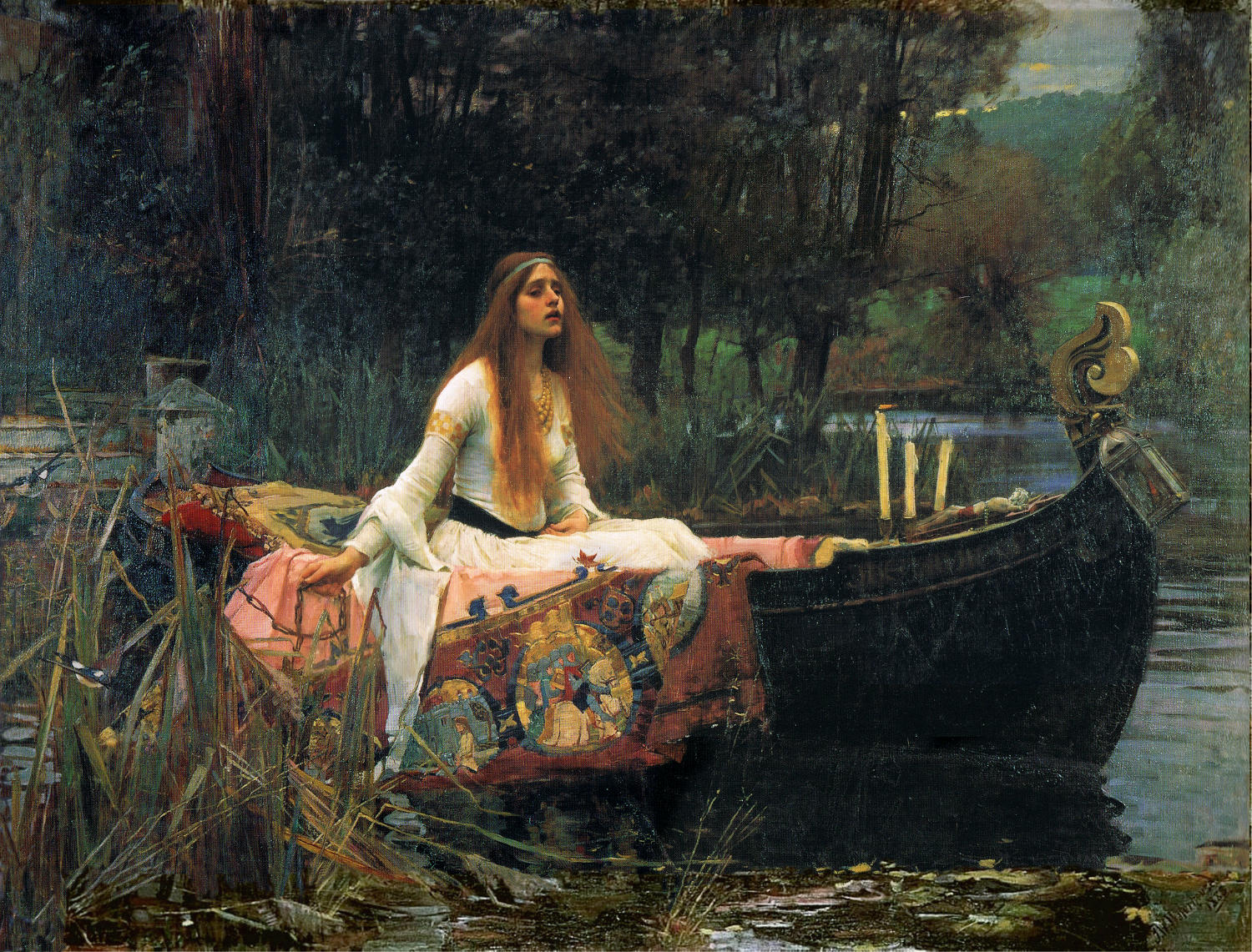
The Cikada Quartet draws a curtain with The Lady of Shalott (1993), which allows us to feel water and glass as if they were the same. Yet the cut of its passage is less like the boat in the famous John William Waterhouse painting…

Waterhouse Lady of Shalott

…and more like the threads in William Holman Hunt’s rendering, spilling from their loom with all the profusion of Christmas yet clipped by cerebral destruction. These are the paths we have taken, and they lead us all to where we began.

WHH Lady of Shalott

And on that note, these pieces, if only by virtue of their programming, exist as part of a phosphorescent whole. They arch their backs along the edge of a crescent moon, feeding off the oscillation of the night. By the humble touch of a fingertip to string and bone, their effect births as much as it dissolves. Though the foliage may change, the branches pulse in synapses of life. There is destiny in these leaves and it quivers with every verdant breath. In this music, sun and moon can touch each other without the slightest hint of destruction, for in that contact they acknowledge having been spun from the same breath.

<< Misha Alperin w/John Surman: First Impression (ECM 1664)
>> Keith Jarrett Trio: Tokyo ’96 (ECM 1666
)

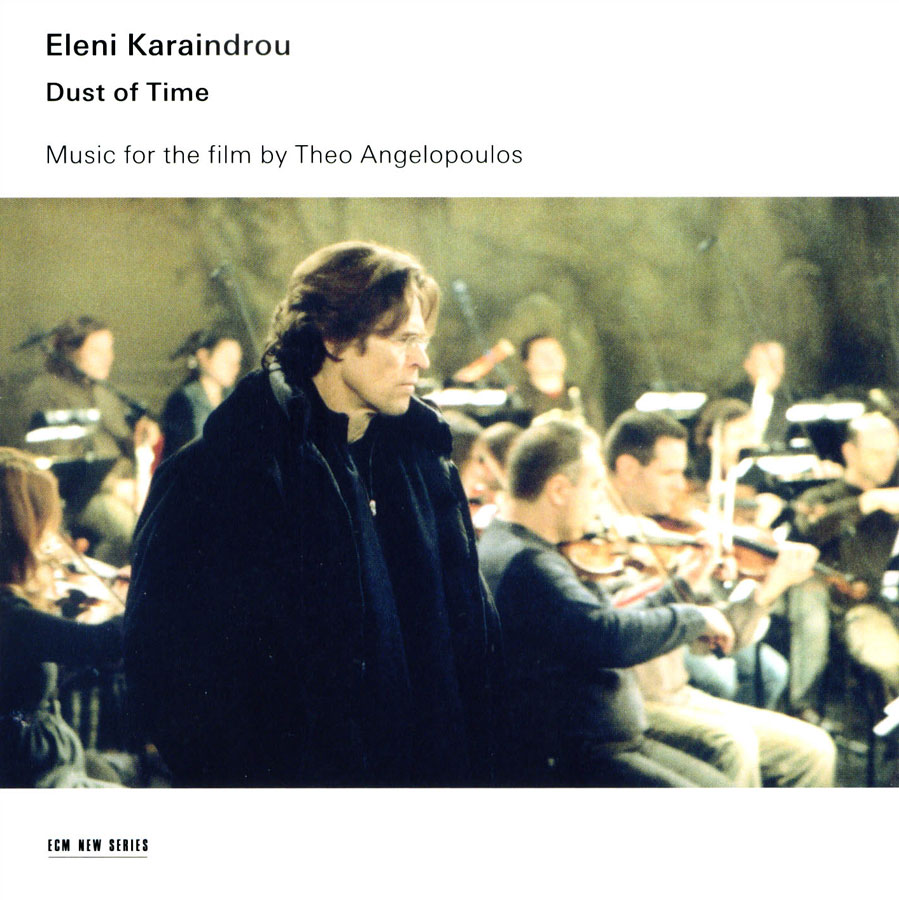
Eleni Karaindrou: Dust of Time (ECM New Series 2070)

2013-05-14_0839

The Dust of Time is the last film of Theo Angelopoulos, a status it attained only after the Greek filmmaker unexpectedly disappeared from the mortal landscape in 2012. This film was the second in a trilogy begun with The Weeping Meadow and set to be completed by The Other Sea, in production at the time of his passing. It is at once his most complex and simplest film. Because it is his last, we may feel tempted to see it as the capstone to his oeuvre, a summary and reflection of things past. We might also experience it as an inception, a regression into birth.

2013-05-14_0905

“Nothing ended. Nothing ever ends.” The voice of our protagonist. As in Ulysses’ Gaze, his name is A (Willem Dafoe), this time a director making a film about his parents’ perseverance in the post-Stalinist era. Sweeping through Italy, Germany, Russia, Kazakhstan, Canada, and the US, its manifold narratives take shape through soft address. A for anonymous. A for atrophy. A for apotheosis.

2013-05-14_0817

The film works on multiple levels. One finds A in the backwash of the tense politics that so fascinate him. His own film faces logistical difficulties, the weight of which, when combined with that of personal demons, seeks to break him. His anxieties shuffle into level two: his parents’ tale. Here the reality of cinema comes to life, indistinguishable from A’s own.

2013-05-14_0819

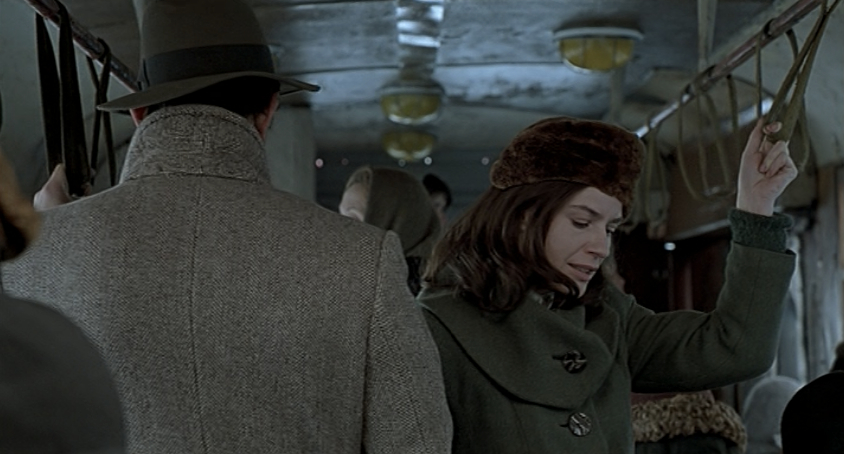
A clandestine exchange on a train introduces us to his father, Spyros (Michel Piccoli), whose twisting of the system has earned him an identity and the chance to see his beloved again.

2013-05-14_0821

2013-05-14_0836

A man hands him a fake passport: “From now on, you’re playing with time.” Words to live by for A in the present, and a clue into the film’s title. Like the coating on old stock, dust plays with the imagery of our experiences in microscopic dances of light and shadow, holds those experiences like a bottle holds wine. As A watches archival footage of communist propaganda, a patch of light covers his eyes like a protective mask.

2013-05-14_0839b

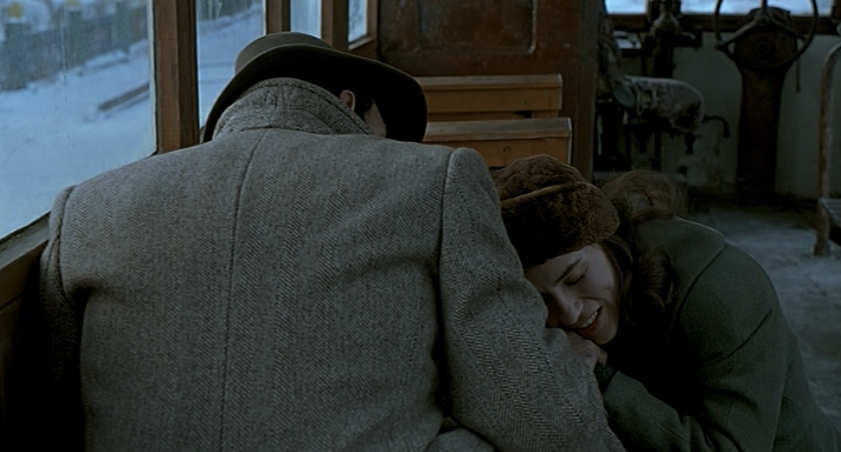
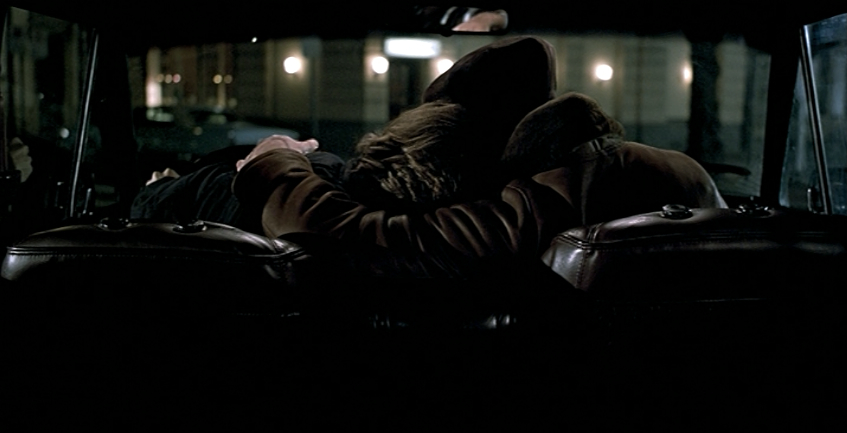
As in so many moments of what follows, he bleeds into the biography he imagines. Witness in that alternate time his mother, Eleni (Irène Jacob). See the many border crossings etched into her face, the force of her abandon in the arms of the only other human being on her radar.

2013-05-14_0947

“It’s you. You’re here,” she says to Spyros, holding him at long last.

2013-05-14_0953

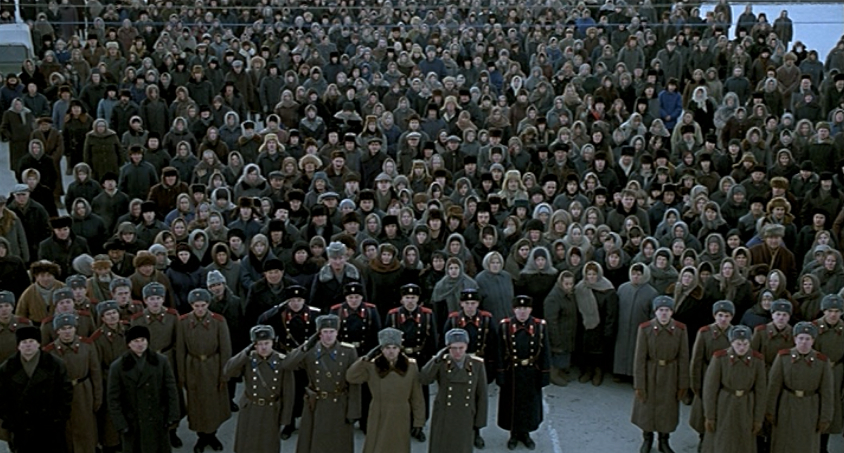
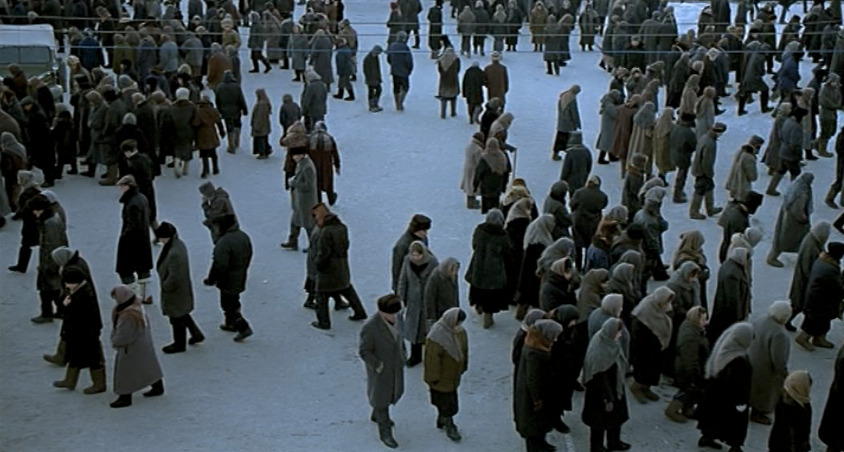
At the station, a crowd gathers before a statue of Stalin, disperses, and leaves us dangling in A’s pragmatic concerns.

2013-05-14_1005

2013-05-14_1007

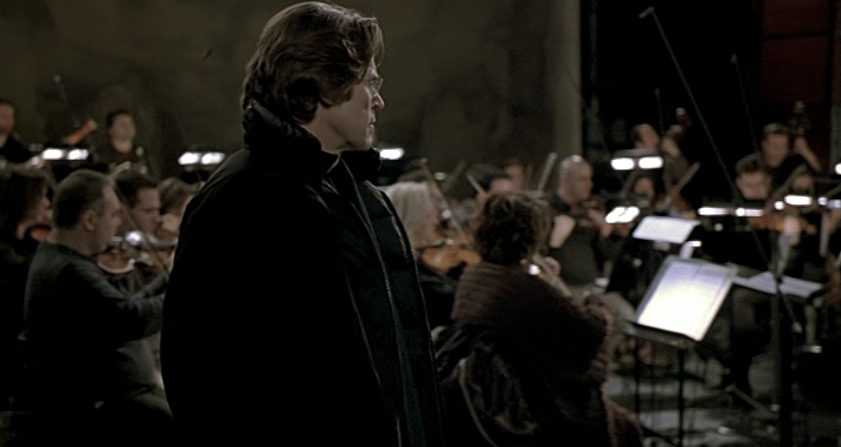
He surveys the margins of a soundtrack rehearsal, thus enacting one of Angelopoulos’s deepest intertextual sequences. Dafoe cues a melody for a dance in the film (a dance that comes later, in the comfort of water).

2013-05-14_1009

Although I hesitate to compare Angelopoulos to Tarkovsky, I cannot help but see the ringing phone that interrupts the rehearsal as an analogue to the unexpected call that startles the heart of the Zone in Stalker. Dafoe answers it, only to be confronted with voiceless street noise. He hopes it is his daughter, also named Eleni, and fills the studio with her name in vain. He returns home to find his daughter missing, and on her bed his mother’s lost letter to Spyros.

2013-05-14_1016

Back in their story, Spyros and Eleni are captured in the wake of their lovemaking, leaving only tire tracks and brokenness to show for their catharsis.

2013-05-14_1029

2013-05-14_1030

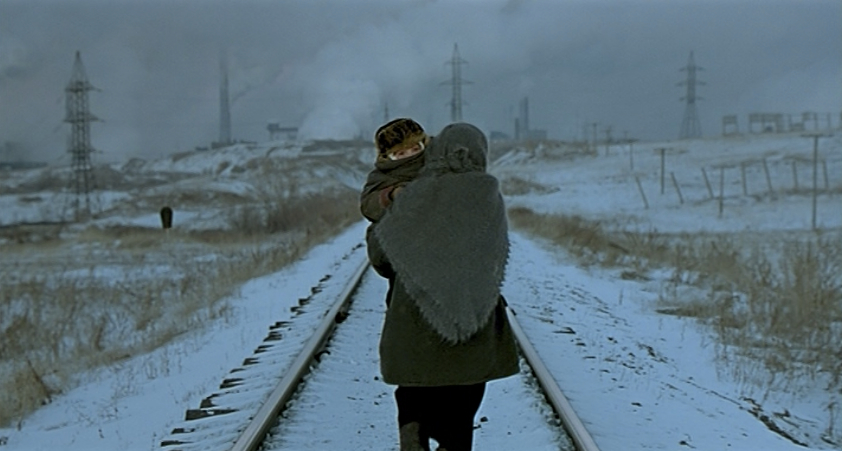
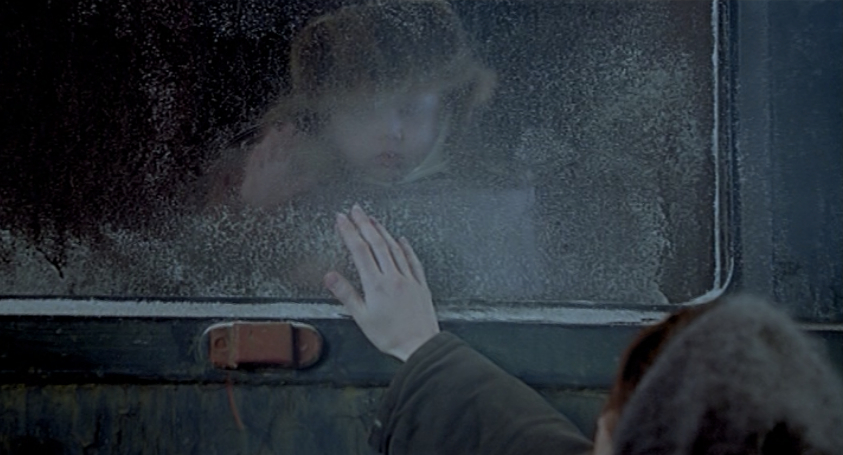
This inspires a series of letters that she knows will never reach him. She flees to Siberia with their son and puts him on a train to Moscow in the winter of 1956.

2013-05-14_1039 2013-05-14_1039b

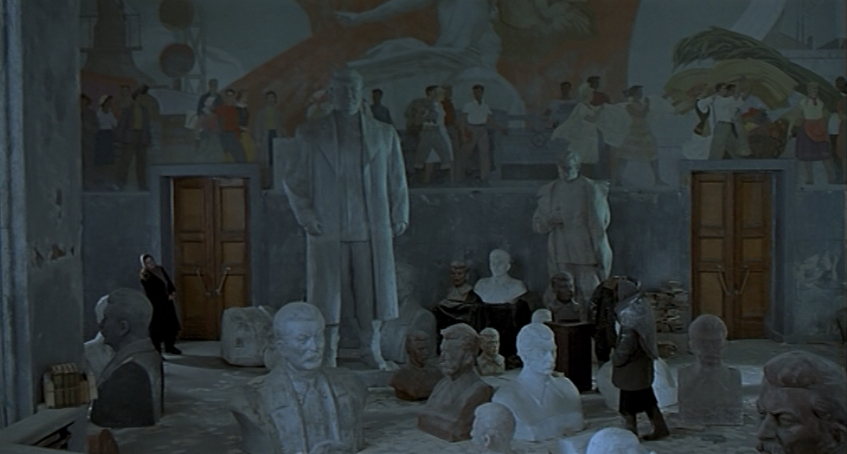
Her heart allows room for Jacob (Bruno Ganz), a man whose head is a museum of broken statues: monuments whose bodies have dilapidated yet whose messages resound.

2013-05-14_1043

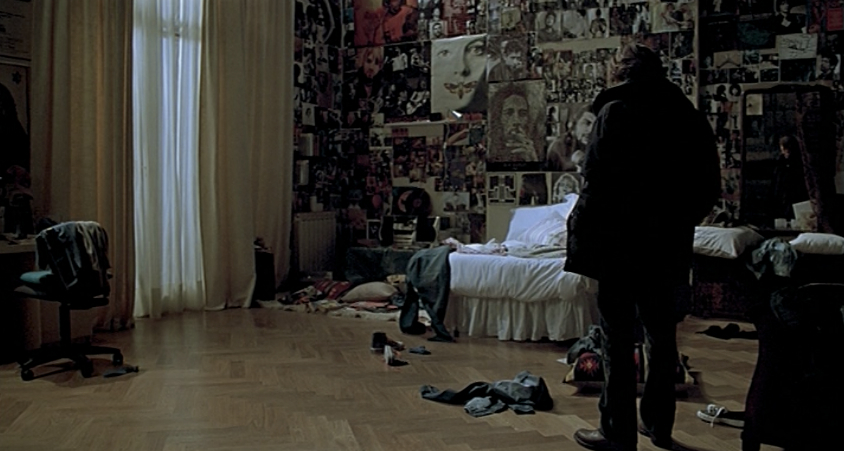
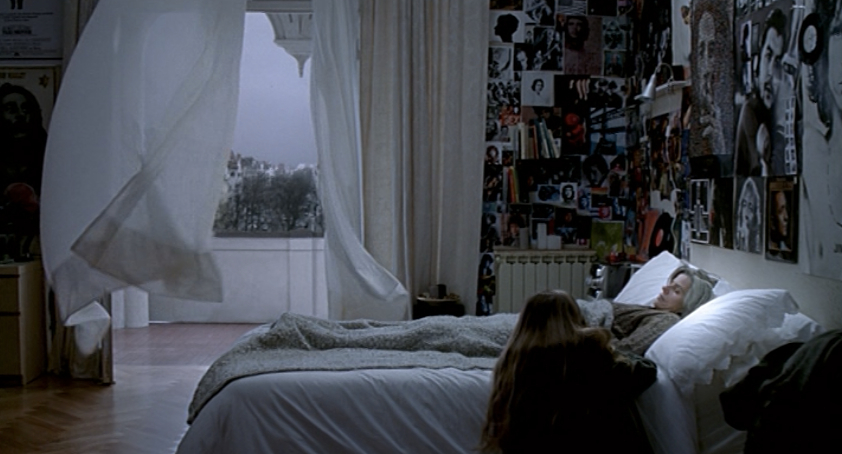
A’s daughter’s room is the physical equivalent. She has plastered her walls with heads of popular culture, each a window into aural upheaval and antidisestablishmentarian politic.

2013-05-14_1048

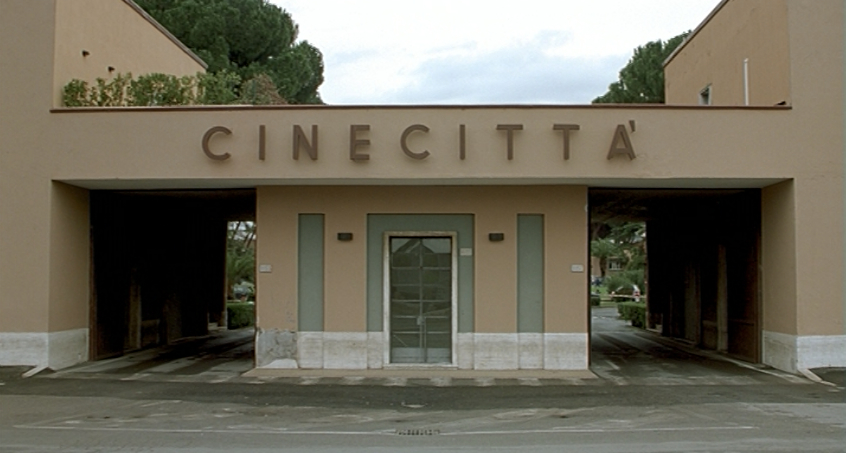
Like the soundscape that wafts in from the streets, they carry echoes of lost music, giving reason to a “strange anticipation” in A’s weary body. Together they are the song of a city greeting the new century. Later A stands before a movie theater, and in that moment realizes that his daughter’s collage is like the cinematic pantheon of which he is but a lost builder.

2013-05-14_1405

“For me there is no return. My destiny takes me somewhere else,” says Eleni to Jacob. She tells him to let her go, that no matter what happened between them she is someone else’s. Yet Jacob yearns for that return and finds its simulacrum decades later when Eleni and Spyros surprise A with a homecoming. It rings strangely hollow, however, and Jacob arrives in the hopes of reigniting what once so fleetingly was. (In a brief encounter, A admits to him, “I’m constantly traveling. Sometimes I don’t even know where I am.”) Jacob bears his soul to Eleni, invites her to touch the images burned into his mind. The trauma wells up in him. He raises his voice, as if he were onstage. He makes of life a theatre, replays scenes like an obsessed director.

2013-05-14_1432

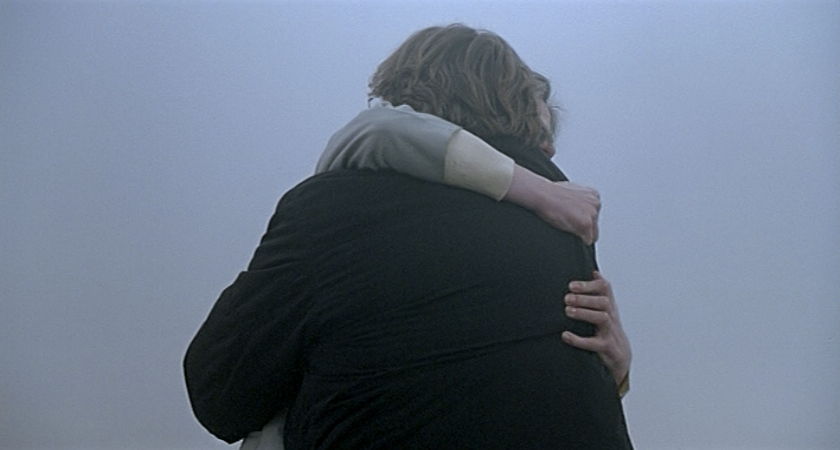
Only with this emotional breach does A gain access to his mother’s youth, finding her in the mist in violent embrace. The camera revolves around them, as would a planet around a sun.

2013-05-14_1438 2013-05-14_1439 2013-05-14_1443 2013-05-14_1444

The final blow for him comes when his daughter threatens to end her life. In the presence of vagabonds and police, she gives in to her grandmother’s pleading, unlike Jacob who thereafter implores an invisible God before throwing himself into a river.

2013-05-14_1507

In the wake of these tribulations, A shares a ghostly moment, reflected on a passing car that bisects a line of eye contact with his ex-wife, Helga (Christiane Paul).

2013-05-14_1504

As Eleni falls ill, her hand drips with water.

2013-05-14_1508 2013-05-14_1509

At her deathbed, a great wind floods the room with the exhalations of an impending storm.

2013-05-14_1511

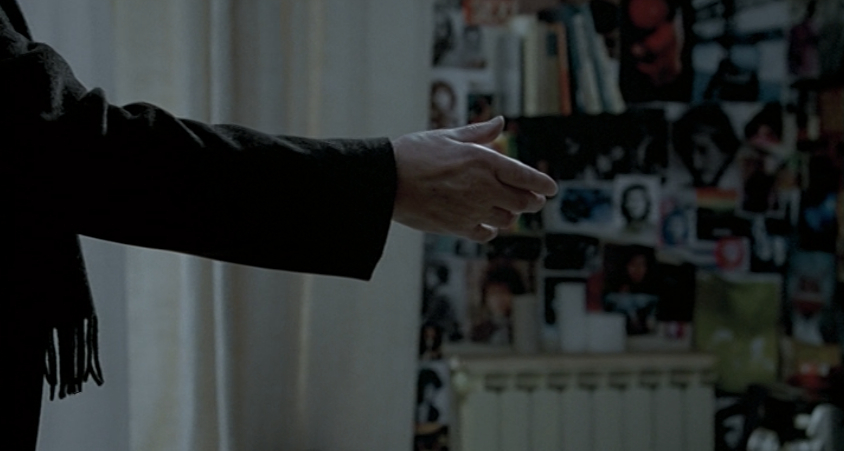
“Eleni, wake up,” says Spyro. “I’m coming to get you.” He reaches for her.

2013-05-14_1512

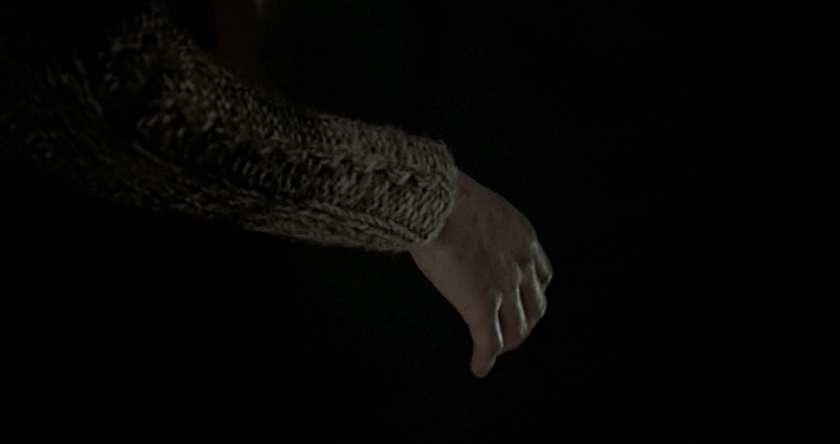
The girl takes his hand instead. It also drips.

2013-05-14_1514

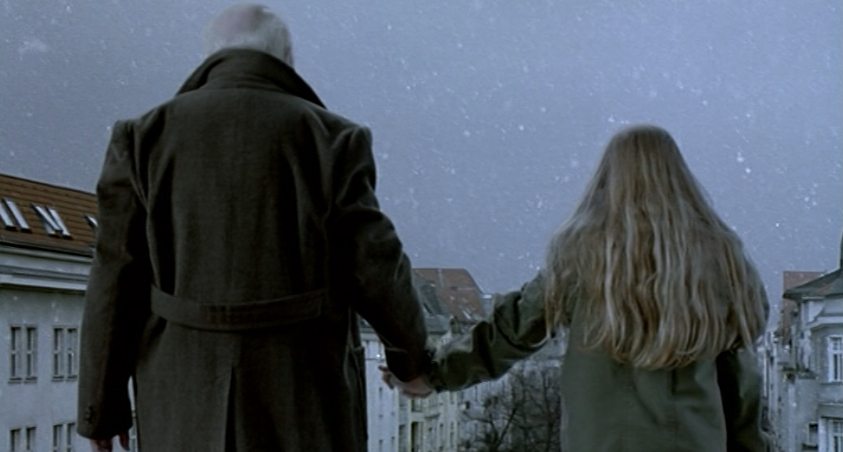
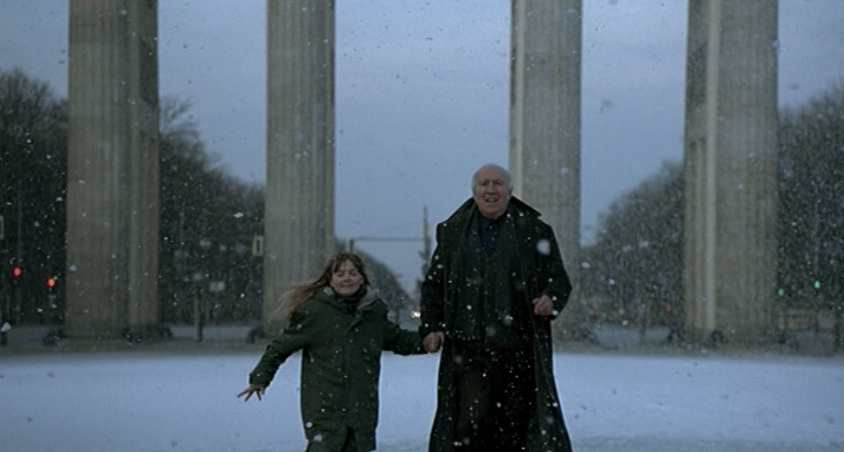
Here is where the film manifests a third level: the pliant corridor of death along which our feet will all someday tread. For as young Eleni and her grandfather step out of the window into the falling snow, we feel in their traversal of logical space an openness of reason. Hand in hand, they run through the streets, deserted like the universe.

2013-05-14_1514b

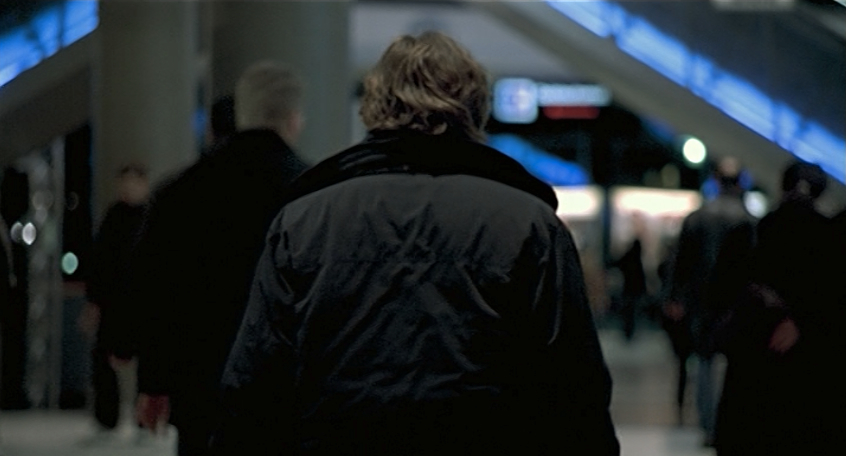
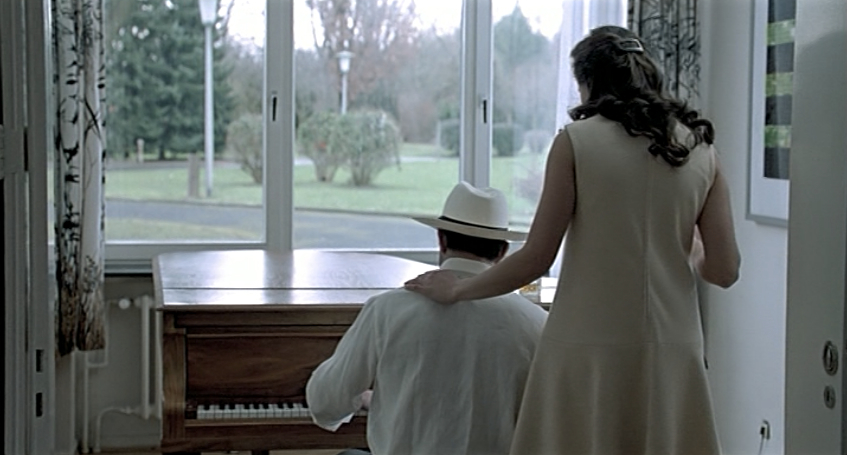
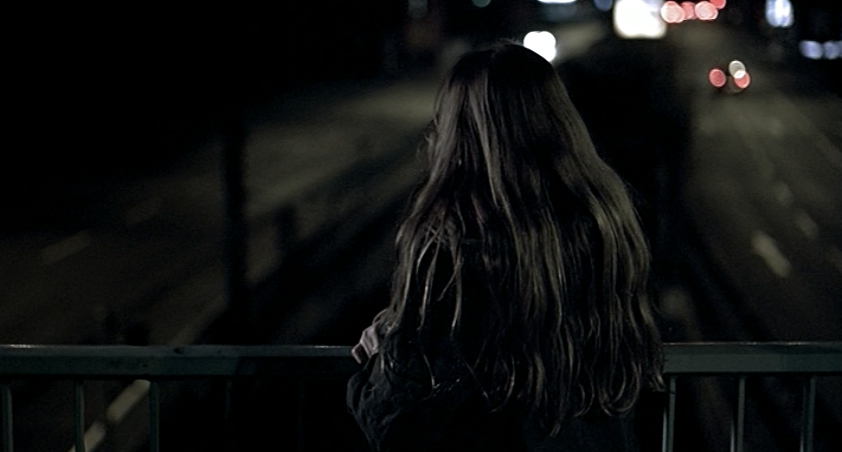
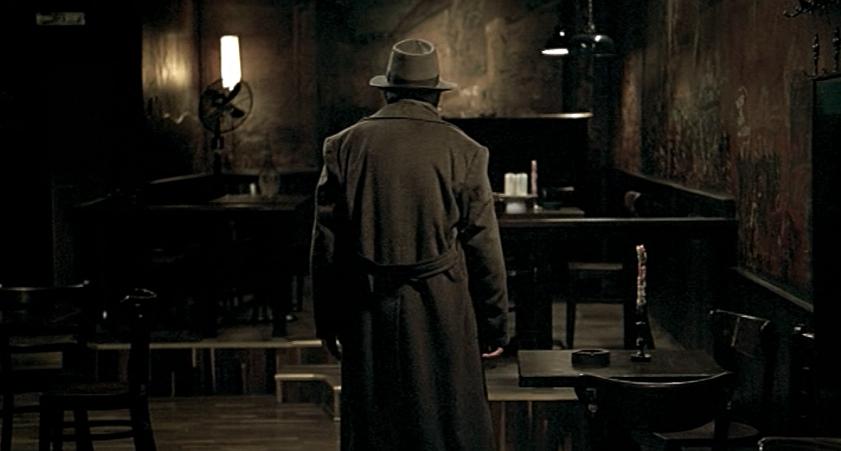
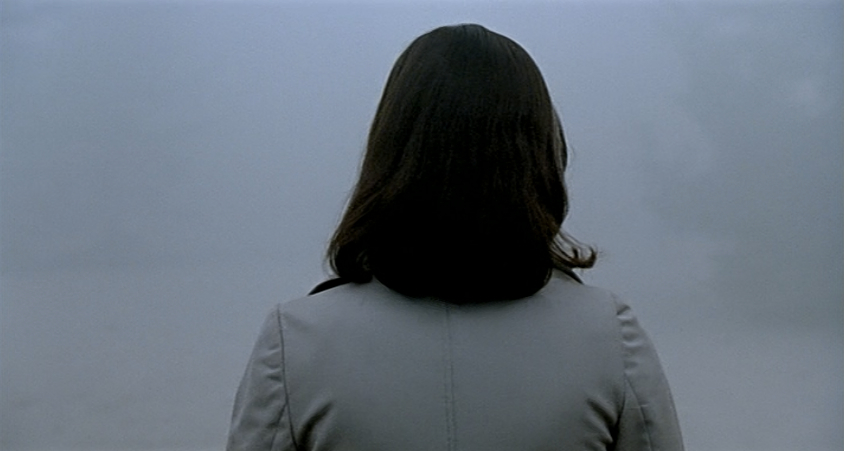
One can hardly discuss this film without noting Angelopoulos’s preference for back shots. Each portraits its respective character more insightfully than any close-up, and in the end shuffles our recollections until they unify.

Back shot 1 Back shot 3 Back shot 2

Back shot 5 Back shot 6

A particularly moving example, however, is mother Eleni’s hair floating in the mist of her impossible reunion with A.

Back shot 4

She is creation incarnate, the bringer of tears where only there is desert. But what is a desert without its sky? That is where the music comes in.

Dust of Time

Eleni Karaindrou
Dust of Time

Sergiu Nastasa violin
Renato Ripo violoncello
Maria Bildea harp
Vangelis Christopoulos oboe
Spyros Kazianis bassoon
Antonis Lagos french horn
Dinos Hadjiiordanou accordion
Eleni Karaindrou piano
Camerata – Friends of Music Orchestra
Natalia Michailidou piano
Hellenic Radio Television Orchestra
Alexandros Myrat conductor
Recorded January (tracks 9 and 15) & March 2008 at Megaron, Athens, Greece
Edited and mixed July 2008

Perhaps more than in any other film, Eleni Karaindrou’s score for Dust of Time wavers in the shadows. “To write the music I had to look for the film’s secret codes,” says Angelopoulos’s trusted composer, “I had to bring the essence of things to the surface and shed intense light on the sound colors underlining the timelessness of nostalgia.” This time the instrumental colors are most intimate, honed to evocative perfection by violinist Sergiu Nastasa, cellist Renato Ripo, and harpist Maria Bildea. Hailing from Romania and Albania, this trio brings its own traditions and nuances to a permeable set of motives. Of these, the “Dance Theme” and its variations figure centrally in both film and soundtrack. It is the music we hear in the pivotal rehearsal scene, homage to Karaindrou’s voicing and intuitive matching. “Waltz by the River” crystallizes the theme’s core values, adding accordionist Dinos Hadjiiordanou into the watercolor mix. As in so many of Angelopoulous’s films, dance animates the passage of time, the degradation of history, and the preservation of memory. Karaindrou’s attention to every movement wipes clean emotional dumping grounds for tragic pasts, purges war-ravaged biographies of their blood in single strokes.

Because the soundtrack’s 45 minutes were culled from over 100 minutes of music, what we encounter is a powerful skeleton. Between the harp and violin duet of “Le Temps Perdu” and the concluding oceanic currents of “Adieu,” Karaindrou figures the power of the melody with as much tact as her arrangements thereof. Along the way, threads unravel to reveal the tumult of wandering and exile in “Seeking,” while passages like “Solitude” speak in monosyllables of enchantment.
Dreams are not beyond us. They return. Like the old reels of A’s interest, they hold their images until the light of waking passes through them anew. Every picture, every note on a staff, is a voyage waiting to begin.

2013-05-14_1040

Eleni Karaindrou: Eternity and a Day (ECM New Series 1692)

“Open always, always watching, the eyes of my soul.”
–Dyonisios Solomos

The Film
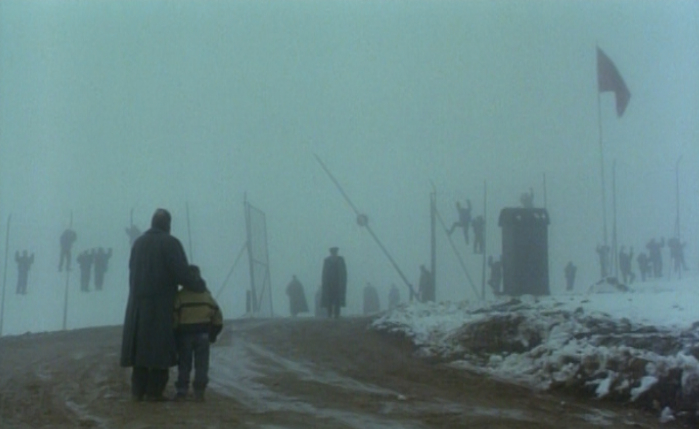
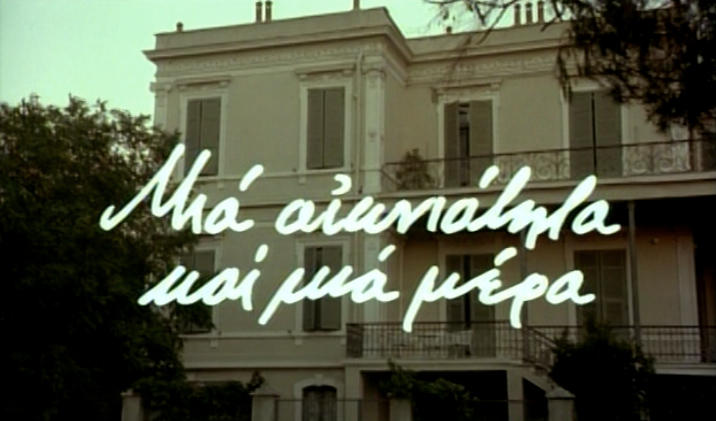
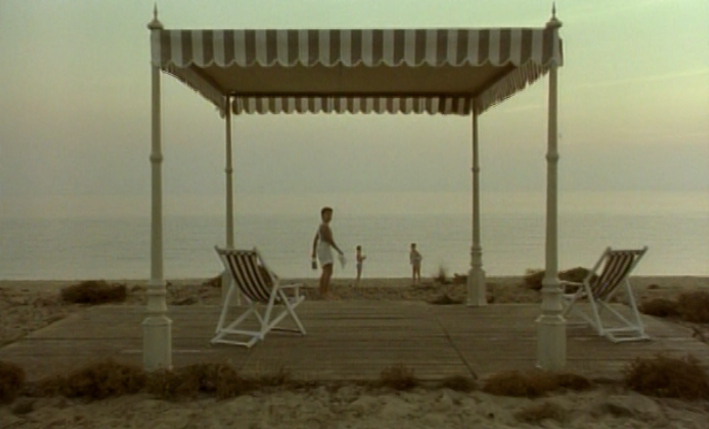
An ancient city, lost beneath the ocean. The stuff of history. Time, a young voice tells us, is “a child playing jacks on the beach.” A piano wafts through the image like a breeze carrying scents and sounds of retrospection—the film’s leitmotif. Here the past functions not as a repository for memory but as a palimpsest for a mind still practicing. It is the mind of Alexander (Bruno Ganz), an aging poet whose dark trench coat cuts a crow’s wing against director Theo Angelopoulos’s wintry palette. A slow approach to a window guides us to the film’s title by way of Alexander’s boyhood. The camera follows him as if through a ghost’s eyes.
2013-04-11_0005

When we first encounter Alexander as he is now, he holds a taste of the sea in his mouth…
2013-04-11_0009

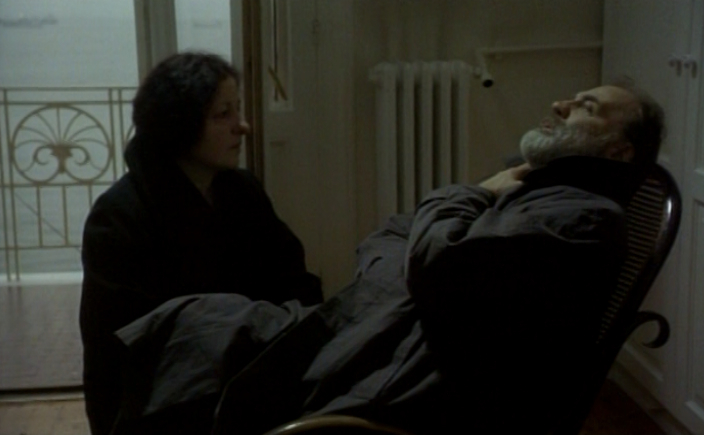
…and clutches his throat as if breathing were a labor. This momentary inability to get words out is both curse and blessing: an obvious malady for a man of letters, but also a release from the world’s imploration to dress its dreariness in pretty semantics.
2013-04-11_0011

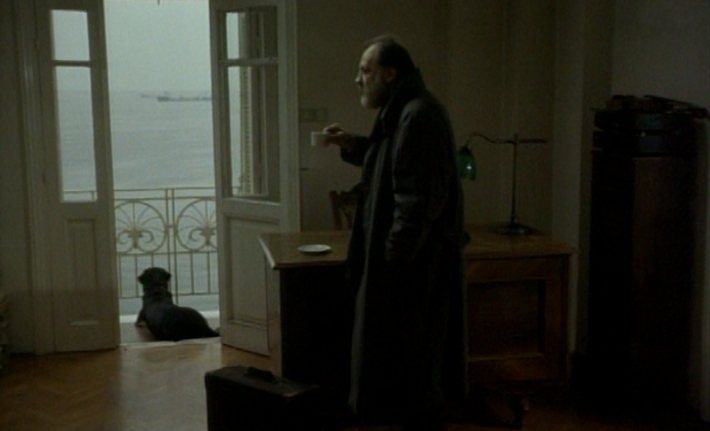
The sea follows Alexander. It is the tail of the dying comet that is his life. His dog looks toward that same sea, a place where music and memory are engaged in dance. A terminal diagnosis looms over him (his constant pill-popping brings rhythm to the narrative), mist over a landscape of uneven hills. He feels silence encroaching and fills it with regrets of unfinished work, of “words scattered here and there.”
2013-04-11_0014

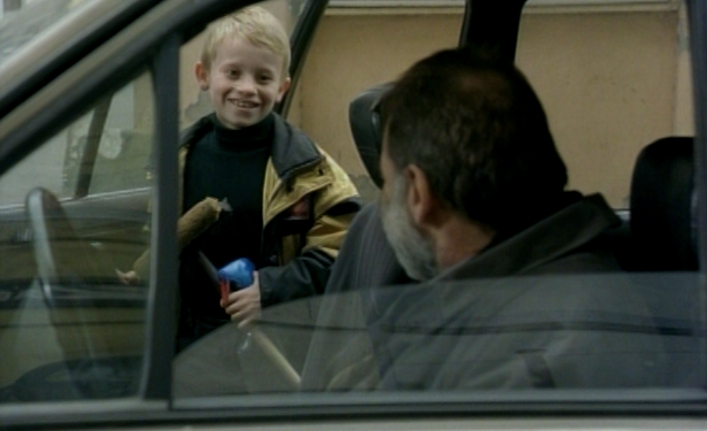
Alexander welcomes a boy (Achileas Skevis)—an Albanian vagrant washing windows at stoplights for petty cash—into his car. His whim begins a final poem, a magnum opus borne of action and sacrifice that can never manifest as ink and paper but rather unspools across light and film. Yet while this charity saves the boy from capture by police and gives us the film’s first smile, it comes at the cost of ignoring the other boys into whose meager routine of survival he had fallen.
2013-04-11_0022

Alexander knows the ripple effect of his actions. He feels the churning waters of time as a swallowing force. Its life-giving properties are so far removed from the here and now that it is all he can do to plunge his feet into the mud of recollection. After spending a lifetime waiting for progress, he will spend another waiting for regress. Angelopoulos’s title does not compare eternity and a day, but equates them.

As Alexander prepares to leave his everyday existence and spend his remaining days in convalescence, he brings the dog to his daughter, Katerina (Iris Chatziantoniou). The contrast between her upscale apartment and her utter yearning for a transparent ancestry are but surface to the inner sanctum of her father’s raw linguistic materials. She displays her anxieties among the art objects of her living room, where a wall catches the circumference of a projected clock. As the film’s symbol par excellence, it hovers like a dedication page torn from its binding and pasted where a window might be. In this manner Katerina turns her glitches into quantifiable space.
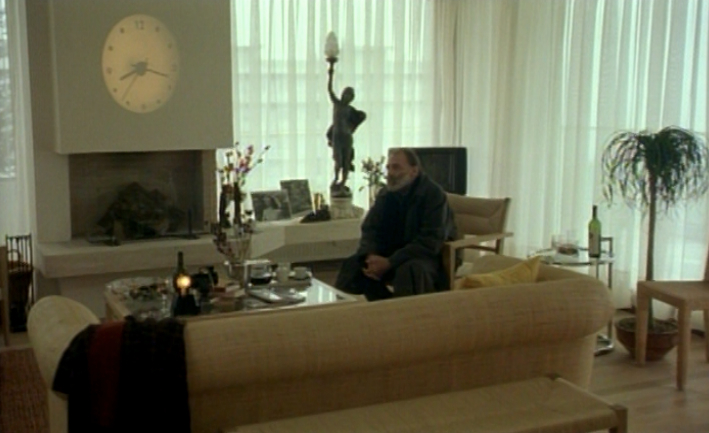
2013-04-11_0025

During this visit we learn that Alexander is completing an unfinished 19th-century epic by Dyonisios Solomos. “The Free Beseiged,” as it is known, is mired in the Greek War of Independence, from which it draws blood to fill its pen. Alexander has been working on the project since the death of his wife, Anna (Isabelle Renauld), who comes to us in flashbacks. And while Katerina may not understand why her father would ever wish to graft his words onto another’s, she flows through him like the returning sea when he gives her letters written in her mother’s hand. Through her reading, Alexander is read anew, revitalized as if by the boy whose fate he has influenced.
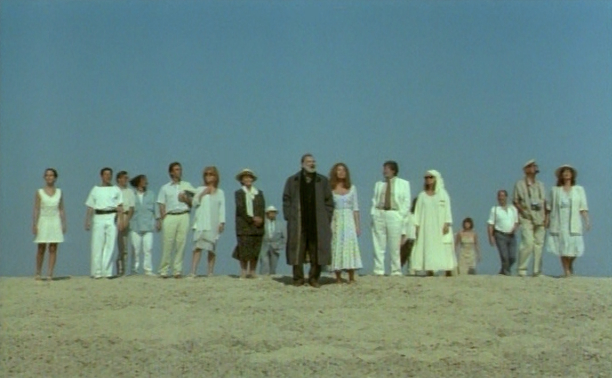
2013-04-12_2252

2013-04-12_2254

The sea is a trance, pillow of scent-filled houses. Sleep and silence cohabit its ever-changing shoreline. Through her daughter’s voice, a resurrected Anna links newfound maternity with love, safety, and breath. The vulnerability of her body engenders absolute trust in, and safety for, her blossoming child. For Katerina is indeed a flower, the center of a family gathering in the sunlit prime of a warmer era. Even in life, Anna was constantly on the verge of dissolving, a wanderer in love. Alexander is moved beyond comfort, for he knows that his dissolution will bring him closer.
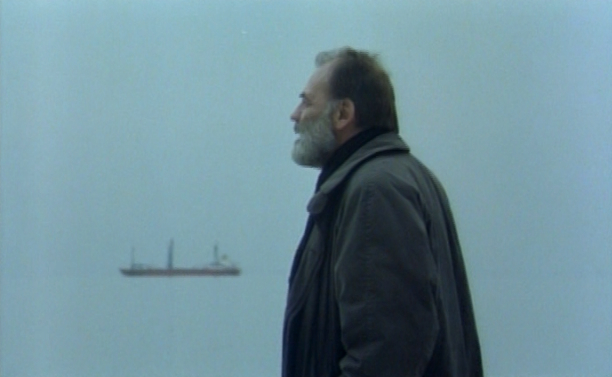
2013-04-12_2250

Like all reveries, this one is all the more poignant for its brevity and it is Katerina’s husband who breaks its spell. Put off by the presence of what in his eyes can be nothing more than a haggard vagabond, he tells Alexander he has sold the old house by the sea—the very house where Katerina tumbled into maturity—and that it will be demolished. He also takes unkindly to animals and questions any obligation to welcome the dog into his home.

The streets, paved in articulate indifference, keep Alexander in check. They are the insignia of a publisher far grander than anything he can contemplate with his ties to speech. In opening himself to a stranger, Alexander realizes he has found in the boy a beacon—not of hope, but of evenness. This balance is upset when he witnesses the boy being thrown into the back of a cargo truck.
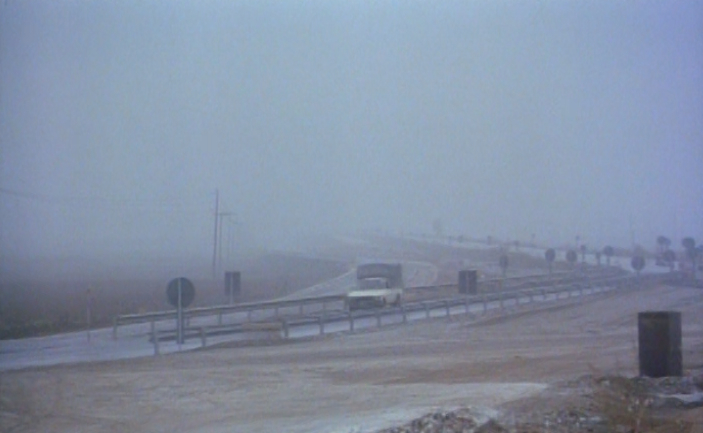
2013-04-11_0042

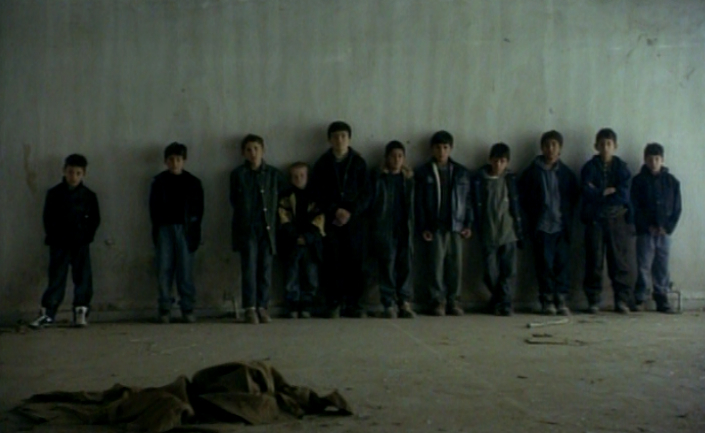
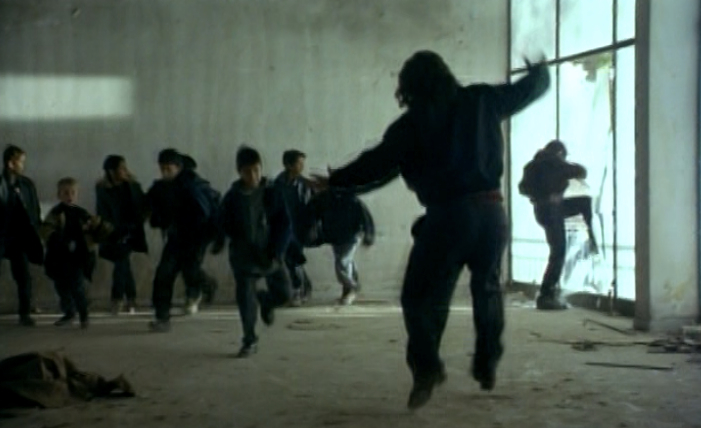
He follows the vehicle to a shady warehouse where other urchins have been plucked from their rocks and are being sold into an invisible market. The boys, however, are wise to this and make a run for it in a ballet of quick thinking and broken glass.
2013-04-11_0048

2013-04-11_0049

In the ensuing chaos, Alexander saves the boy of his interest, giving all the money on his person in exchange. He puts the boy on a bus going toward the Albanian border, both in the hopes of losing him before he loses himself and in the hopes that there might be a home to return to.
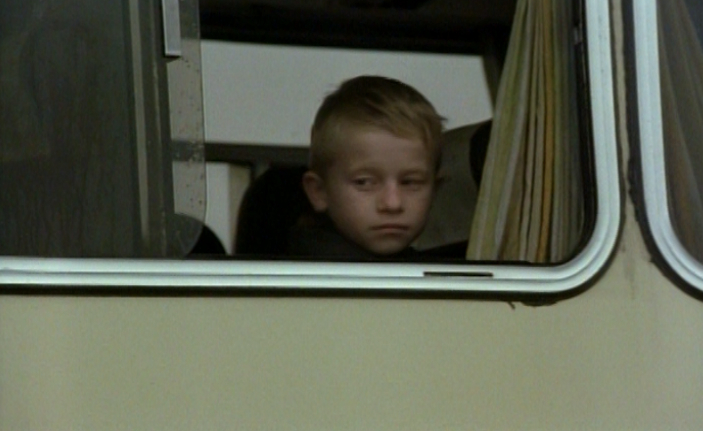
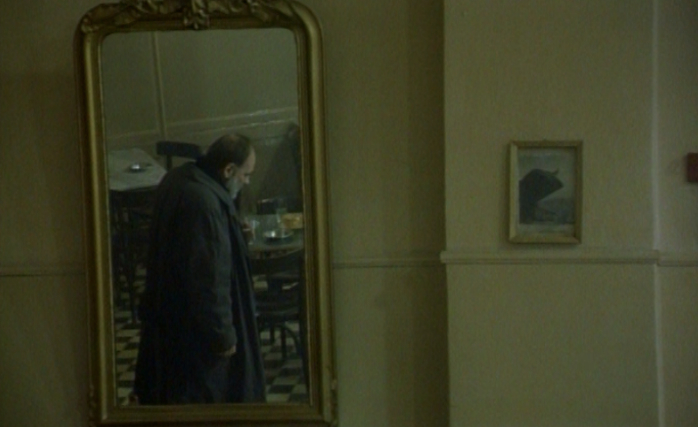
2013-04-11_0059

2013-04-11_0103

The boy comes back to Alexander, having found a home in presence of the bearded stranger. He sings a children’s song from his homeland, tells Alexander of crossing the border, thereby revealing a likeminded fixation on language. Alexander takes him to the border, but they run when the boy tells him he has no one.
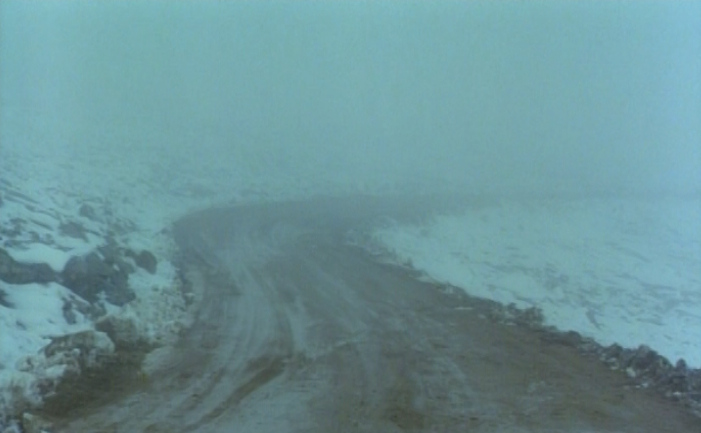
2013-04-11_0107

2013-04-11_0121

2013-04-11_0122

Alexander tells him the story of the poet Solomos (Fabrizio Bentivoglio), Greek but raised in Italy, who returned to his homeland when he heard the Greeks were rising against the Ottomans. He does not speak the language, and so he buys words from the locals. Across a night “sown with magic” he travels, reaching deep into his reservoir of sentiments to produce the “Hymn to Liberty.” It remains a significant verse for Alexander, a bid for freedom from language, through language.
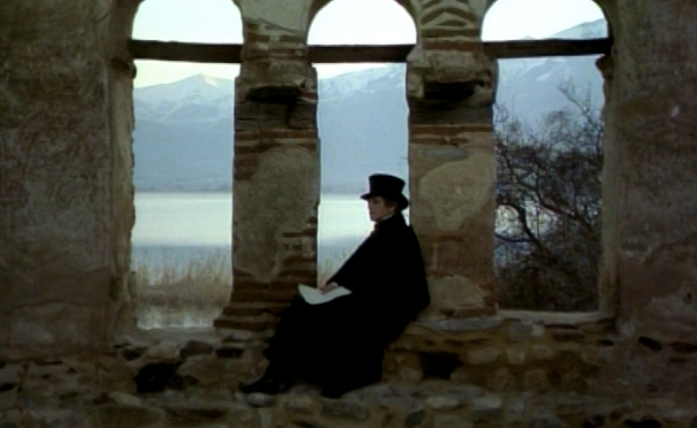
2013-04-11_0129

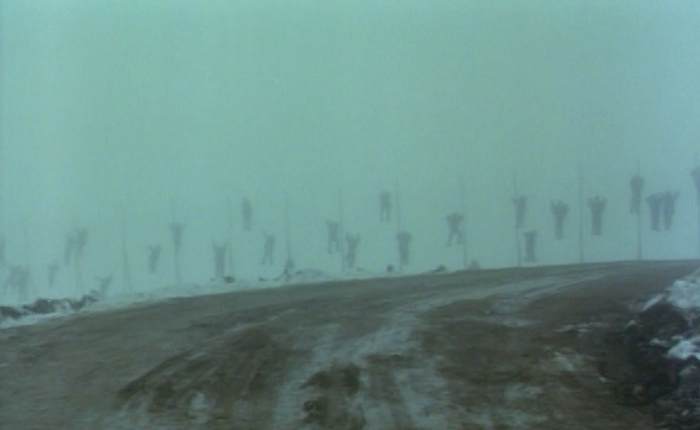
In the end, he entrusts the dog to his housekeeper, Urania (Helene Gerasimidou), interrupting her son’s wedding to do so. Spectators hanging from the gates mirror those at the border, each a living puppet frozen in the wake of a changing tide.
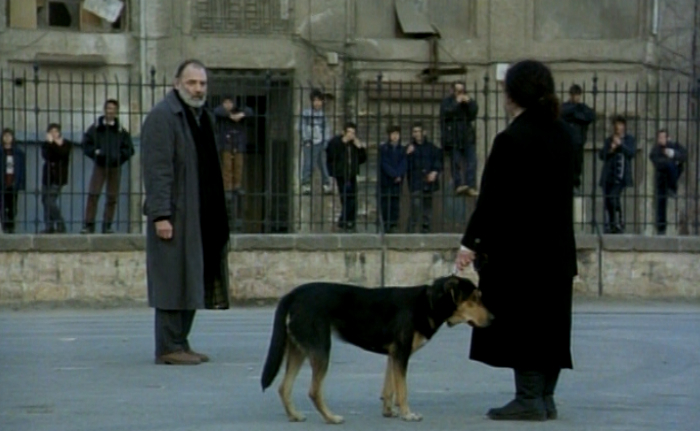
2013-04-11_0138

2013-04-11_0119

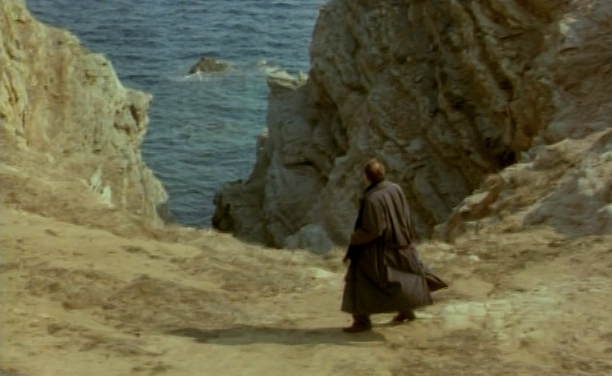
This leaves the boy, Alexander’s only link, his only mirror. “You’re smiling, but I know you’re sad,” the boy tells him. Such contradictions—in the end, not really contradictions at all—are essential to Angelopoulos’s cinematic world, a world where light and dark are so permeable as to be unquestionable. For while Alexander’s cape is the shadow of his deteriorating self, of a body blurring into lifelessness, it is also a flag whose communication harnesses wind like a sail.
2013-04-12_2300

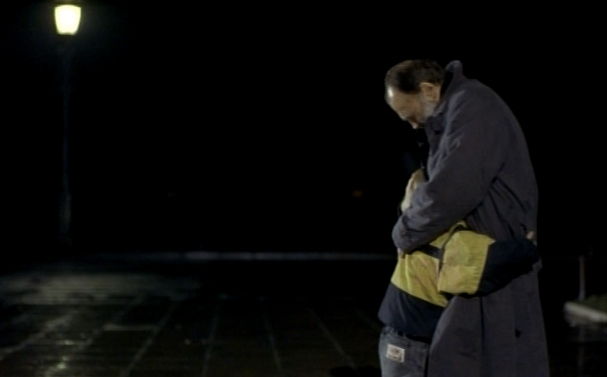
He is a man devoid of contact, yet who is touched by humanity; a man in self-imposed exile, yet who knows the landscape as if it were his own; a man known for words, yet who pays for them with emotional currency. The boy wants to say goodbye, but Alexander convinces him to stay, will not accept that his hand may bring about another end.
2013-04-12_2319

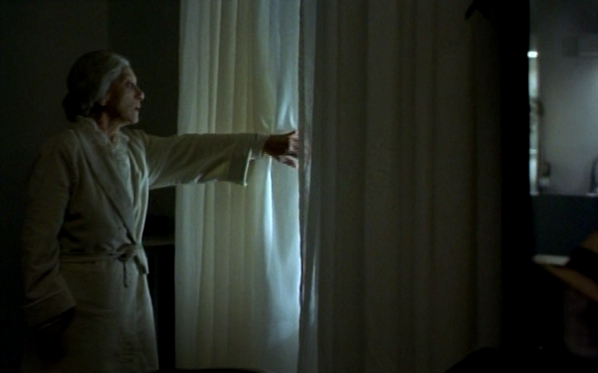
Thus the camera looks beyond the curtain into the reflecting pool of the human condition.
2013-04-12_2311

2013-04-12_2322

His films are unfinished, stitched yet tattered. In allowing their seams the privilege of coming undone, he delivers messages devoid of hyperbole. The zoom, for example, sheds its derivative qualities in such a context, seeking not to focus our attention so much as to remind us of limitations. As in the films of Andrei Tarkovsky, the occasional close-up shocks with its candor, reaches into the pit of our complacency and stirs up the love we have forgotten. When Alexander turns his back on us, he turns his back on the world.
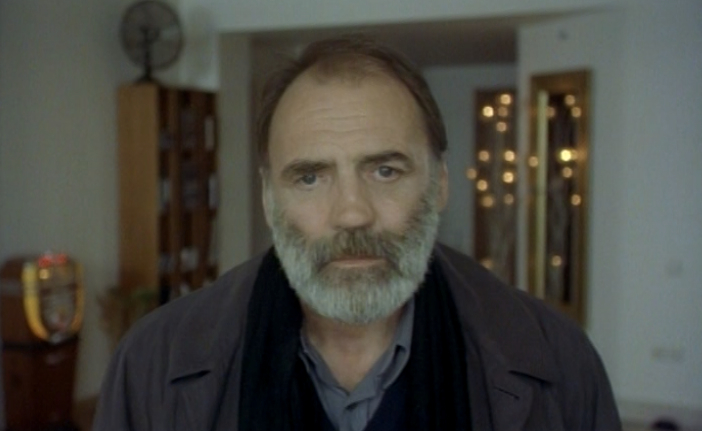
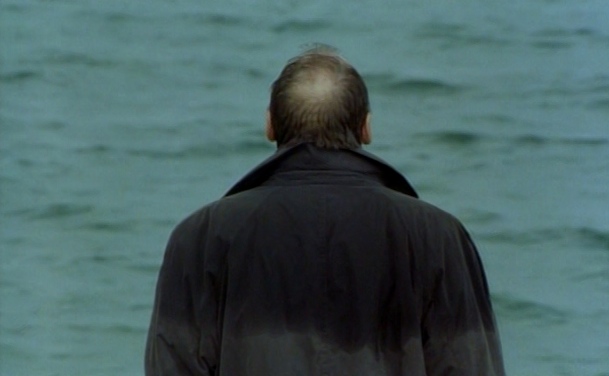
2013-04-11_0037

2013-04-12_2323

The Soundtrack
Composer Eleni Karaindrou has her finger so firmly on the pulse of Angelopoulos’s ethos that her flesh has melded with his images. Yet there is something more than the combination of sight and sound going on in Eternity and a Day, for this more than any other film she has soundtracked is an ode also to time.
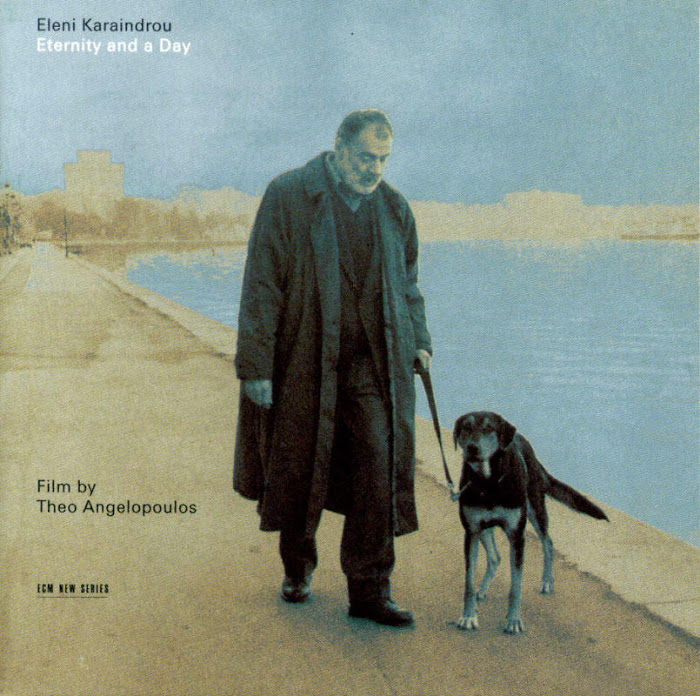
Eternity and a Day

Eleni Karaindrou
Eternity and a Day

Vangelis Christopoulos oboe
Nikos Guinos clarinet
Manthos Halkias clarinet
Spyros Kazianis bassoon
Vangelis Skouras french horn
Aris Dimitriadis mandolin
Iraklis Vavatsikas accordion
Eleni Karaindrou piano
String Orchestra La Camerata Athens
Loukas Krytinos director
Recorded March and April 1998, Athens Concert Hall
Engineer: Andreas Mantopoulos and Christos Hadjistamou
Produced by Manfred Eicher

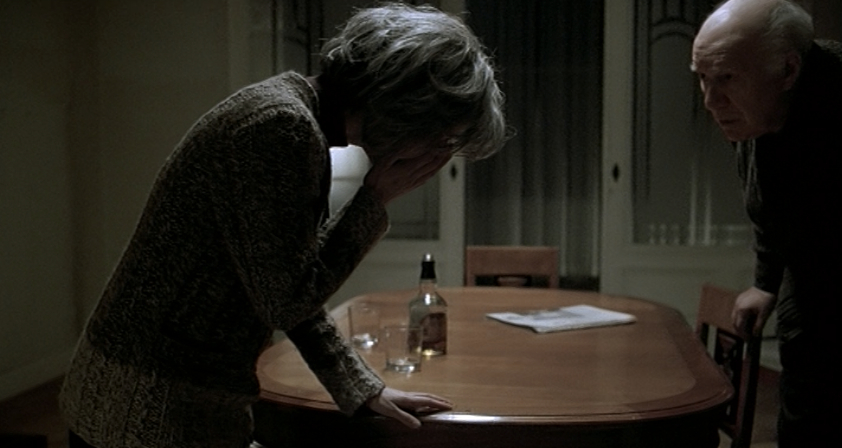
The title of the first piece, “Hearing the Time,” would seem to say as much: just as Angelopoulos puts an eye to lens, so too Karaindrou puts an ear to history. She draws thick yet airy wool over our eyes, that we might view the world through the blur of fibrous experience. Over an expanse of archival strings we hear a distant relay between violin and accordion. These punctuations are not ruptures but voices from below. The composer at the keyboard elicits “By the Sea,” a humid snapshot that segues us into the mandolin accents and silken oboe line of the “Eternity Theme.” As Beethovenian cellos churn, we think back to its corresponding scene in the film, in which we find Alexander listening to this very music on the radio. He shuts off his mechanical translator and looks out across to the other apartment complex, where the same music flows from another window. “Lately” he muses, “my only contact with the world is this stranger opposite who answers me with the same music.” Perhaps true to character, he decides against pursuing this fascination: “It’s better not to know…and imagine.”

And imagine is all we can do when taking this soundtrack on its own terms. The theme echoes throughout its architecture, inflected differently by each soloist. A bassoon evokes tears colored by fate, while clarinets drip from the great beyond with tastes of once-forgotten joy. A traditional wedding dance fills the air with bright steps, contrasting almost painfully with the solitude of “Bus,” and lends relative sanctity to Ganz’s recitation in “The Poet.” Yet it is in a little piece called “Borders” that the fluidity of his embodiment is clearest. Through it we realize that harmony needs change.

Like the film itself, the score of Eternity and a Day creates a somewhere far removed from its content yet which is equally cinematic. It is a looking glass unto itself, a kaleidoscope named “then.”

<< Kenny Wheeler: A Long Time Ago (ECM 1691)
>> Evan Parker Electro-Acoustic Ensemble: Drawn Inward (ECM 1693
)

Trio Mediaeval: A Worcester Ladymass (ECM New Series 2166)

A Worcester Ladymass

Trio Mediaeval
A Worcester Ladymass

Anna Maria Friman voice
Linn Andrea Fuglseth voice
Torunn Østrem Ossum voice
Recorded February 2010, Propstei St. Gerold
Engineer: Peter Laenger
Produced by Manfred Eicher

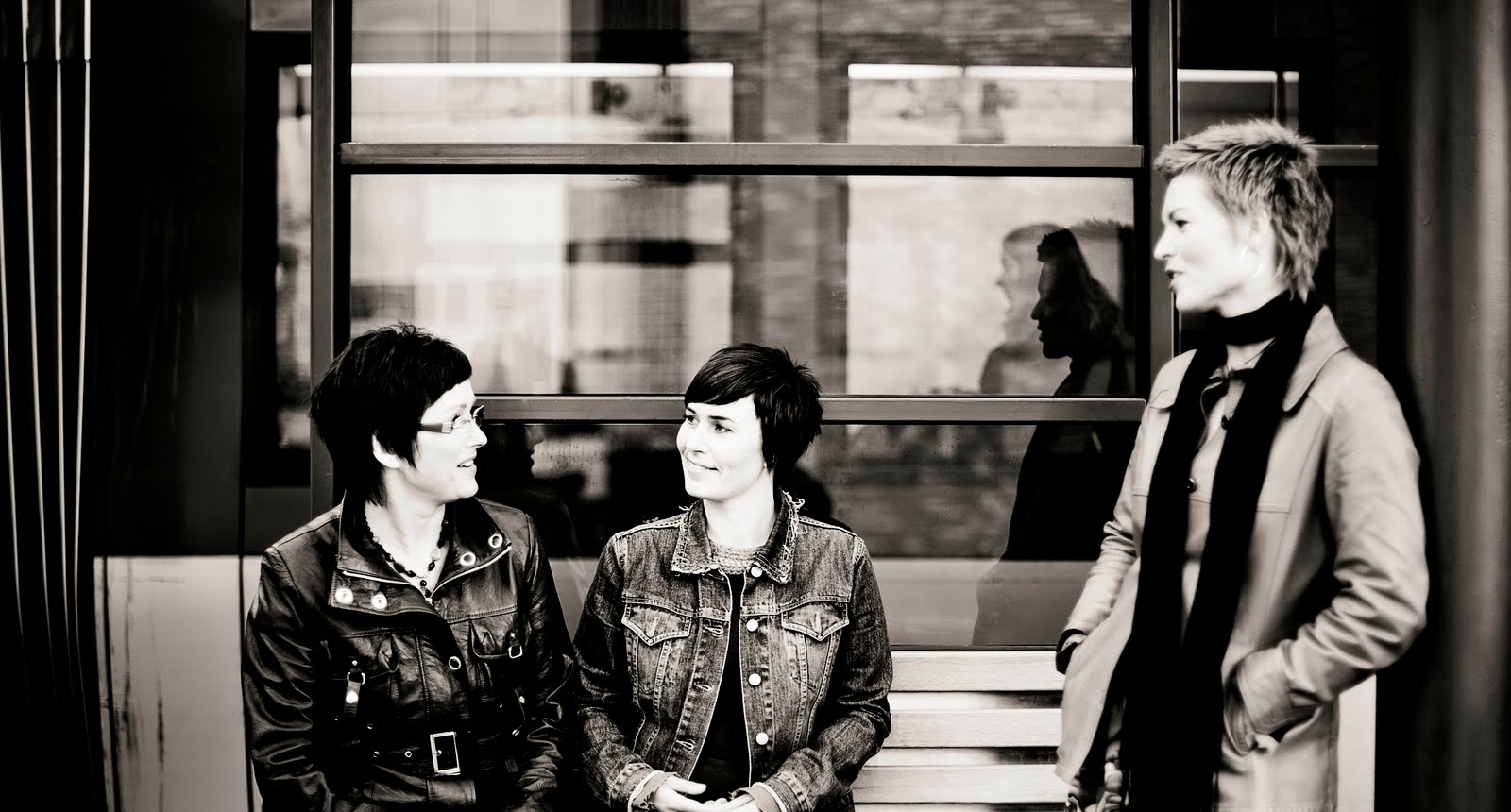
It’s astonishing to reflect on the breadth that Oslo’s Trio Mediaeval has represented in just four albums. From sacred choral music of the 14th and 15th centuries to the more contemporary yet kindred writing of Ivan Moody, Sungji Hong, and Gavin Bryars, not to mention a visceral account of Norwegian folk songs, sopranos Anna Maria Friman, Linn Andrea Fuglseth, and Torunn Østrem Ossum have, since their 1997 debut, been at the forefront of a style of vocal blending that also distinguishes the Hilliard Ensemble, under whom they studied to bring out the finest of their abilities.

TM
(Photo: CF-Wesenberg)

For this, their fifth ECM New Series album, they return to their namesake with a 13th-century Mass to the Virgin Mary, reconstructed from manuscripts found in a Benedictine Abbey in the English Midlands. When looking through the Worcester fragments—which survived Henry VIII’s purging sweep in the 1530s only because they were used to bind other codices—the singers found no Credo, and so commissioned Bryars to rectify their absence by contributing one, along with a Benedicamus Domino. As Friman further notes, today interpretation of music from the middle ages is at the whim of the performer and can be far removed from the religious bonds of its genesis. She and her cohorts embrace this severance wholeheartedly as a path to fresh performance, producing music not meant for concert audiences that breathes with its own flair (if not flare).

From the lilting cadence of the opening Salve sancta parens, it is clear that Trio Mediaeval has sculpted a sound-world all its own. In so gathering their winds together, the singers spin a theme for the ages that is at once entrenched in and severed from time. Most significantly, theirs is a space that listeners can inhabit. As two voices lock into a drone for the plainsong of a third, we can already sense the depth of technical achievement required to produce such seamless atmospheres. It is in this respect that A Worcester Ladymass stands out: in these three throats its technical attentions become, like those of the Hilliards, a fully embodied practice. One notices this in the meticulous pacing throughout. Striking enviable balance between interruption and pause, the gaps between phrases are neither contrived nor jarring. This is especially true of the Munda Maria, a vocal round that cleanses us from the inside. In such cyclical pieces as this and the Gloria, our three angels enact a Derridean sort of reiteration—which is to say, not mere repetition but rather a constant reformation of context. The same holds true of the Bryars Credo, which places a gentle stopper on the clock hands of their art, spinning one hand backward and the other forward. And while Byrars does craft a slightly dissonant edge, his changes are no less unexpected than, say, those in the Grata iuvencula of eight centuries ago.

Another remarkable feature is the fluid extension of syllables in the O sponsa Dei electa and the De supernis sedibus. Without falling into these open-mouthed traps, the Trio draws from them new webs of meaning. The brief addition of organ in the Benedicta / Virgo Dei genitrix and Agnus Dei only intensifies the celestial nature of those connecting lines. All of this makes the shorter pieces stand out in greater relief. Together, they form a sonic rondelle, which is illuminated by the light of the Mass interspersed among them. Much of that light is centered in the holy Sanctus. It serves the text as one might pray: kneeling and alone.

A Worcester Ladymass brings me back to the many early music recordings that enticed me as a novice listener. It finds its essence not in consolidation but through fragmentation, so that each section becomes a votive service unto itself. If the transcendence of the Sponsa rectoris omnium can be said to be representative of the whole, it communicates with an intuitive awareness of temporality that hovers in midair, not quite of heaven or of earth. For ages philosophers have tried to espouse the arbitrariness of the sign, but music such as this proves that the sign is life itself.

(To hear samples from A Worcester Ladymass, click here.)

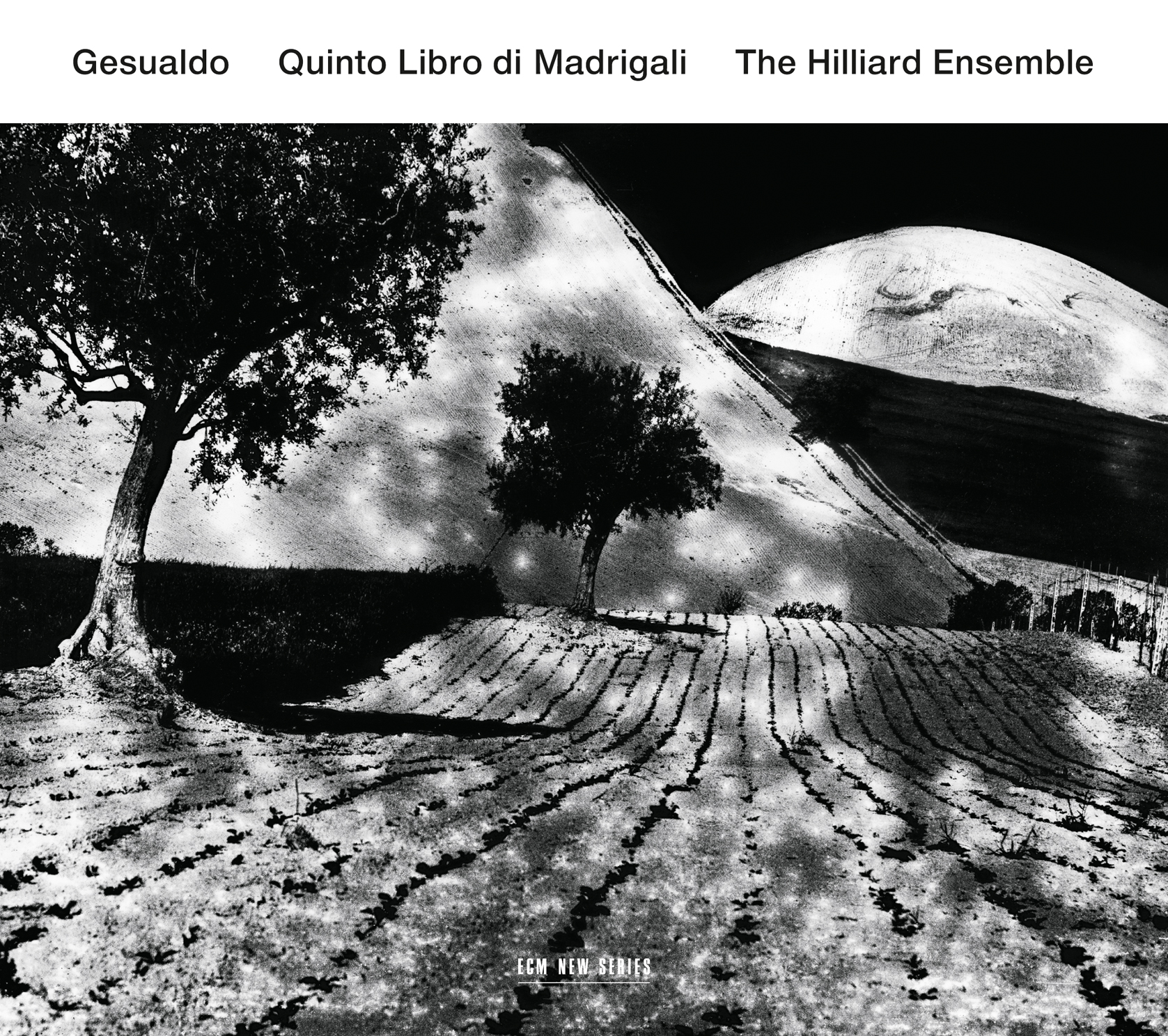
Gesualdo: Quinto Libro di Madrigali (ECM New Series 2175)

Gesualdo Madrigali

Carlo Gesualdo
Quinto Libro di Madrigali

The Hilliard Ensemble
Monika Mauch soprano
David James countertenor
David Gould countertenor
Rogers Covey-Crump tenor
Steven Harrold tenor
Gordon Jones baritone
Recorded November 2009 at Propstei St. Gerold
Engineer: Peter Laenger
Executive producer: Manfred Eicher

If my grief pains you,
only you, my soul,
can turn it all to joy.

On first hearing madrigals by Carlo Gesualdo (1566-1613), English writer Aldous Huxley proclaimed, “These voices—they’re a kind of bridge back to the human world.” In the mouths of the Hilliard Ensemble they certainly are. Baritone Gordon Jones cites the Prince of Venosa as a touchstone of the ensemble’s performing repertoire. And so, it is with practiced appreciation that they return to it as they take on his Fifth Book of Madrigals of 1611 in its entirety. Gesualdo finished his Sixth and final Book (he would leave fragments of an unfinished Seventh) in the same year, penning his first in 1594. Of the Fifth, Jones says, “The whole collection constitutes a gallery of dramatically lit portraits of human emotions with a heavy emphasis on the extremes of joy and despair.” On this note, the addition of soprano Monika Mauch and countertenor David Gould speaks to the range and color required of those extremes, and in this regard the ensemble emotes splendidly.

One can hardly discuss this music without mentioning its bold, mannerist dissonances. Written as it was by a man who had his wife and her lover murdered when he caught them in flagrante delicto and who subsequently receded into his own psycho-sonic cage, this can be no surprise. Even by today’s standards it rattles us. Yet to characterize Gesualdo’s output by so reductive a summation (dissonance, for example, was part and parcel of the madrigal idiom) would be to ignore the textually sensitive traditions of harmonic expansion upon which he built it. Despite being professedly “ahead of his time,” he was no enigma to his aristocratic contemporaries, being a particular favorite of Queen Christina of Sweden. For every gritty texture he loosed, a smoother one was in attendance, and we do well to remember the equal weight in both pans of the scale.

We have the Hilliard/ECM partnership to thank for already having done the composer justice with a sublime and direct rendition of his Tenebrae Responsories for the Christian Holy Week. Here that same trueness to the melodic line remains, and is so magnified by the bareness of its voices, by which the tortuousness we’ve come to expect lives by a more fluid name. If it lives anywhere, it is in the strange tenderness of Gioite voi col canto, which opens the collection with an autobiographical tinge:

Rejoice in song,
while I weep and sigh,
while tears choke my breath.
Alas, wretched heart of mine,
born for grief alone;
weep, but weep so much
that my mistress may be vanquished
by your tears, and then revert to seeing
my grief and pains in her.

The shifting tectonics of tenor lines and dulcet edge of Mauch’s gilding in the words’ weeping evocation is testament both to Gesualdo’s knack for comingling and to the sensitivity of the singers assembled at Propstei St. Gerold, where these works were so lovingly recorded. The charged weight of Itene, o miei sospiri rekindles these considerations, mixing “bitter weeping” with “loving song” in particularly adroit handling from the Hilliards. O dolorosa gioia falls into the same category of “painful joy,” a core theme of Book Five that finds further traction in Se vi duol il mio duolo. In both of these, the pathos of the text comes through tactfully. Death is another trope, as inescapable in the music as it is in us. From the heartfelt appeal of Occhi del mio cor vita (“Eyes, life of my heart”) and the lovesick resignation of Languisce al fin (“He who parts from his life languishes at last”) to the lachrymose accents of O tenebroso giorno (“O darkest day”), the music is practically dripping with it. Yet not all is so morose in this landscape, for there are also the flora of Felicissimo sonno, a heartfelt appeal to dreams as living threads to a love that cannot flourish in waking, and the intoxications of Correte, amanti, a prova (“Vie, lovers, in speed”) to soothe our weary countenances, to say nothing of the optimism that bids us a fond farewell in T’amo, mia vita (“I love you, my life”).

A small handful of these 21 madrigals stands out. The snaking turns of Mercè grido piangendo (“Have pity on me! I cry weeping”) showcase the coolness of the Hilliard’s peerless blend to the utmost, while the prototypically Gesualdan Tu m’uccidi, o crudele (“You are killing me, o cruel woman”) pulls out all the stops in its affective toolkit, achieving moments of sublime light. Finally, Se tu fuggi, io non resto, with its fluttering vowels and tight syncopations breathes with expert realization, even as its narrative voice bids us leave on the wings of cruelty.

Due to the subject matter and sheer variety of invention, and despite the pitch-perfect performances, this is no mere soundtrack for an idle afternoon. It asks us to steep in its brew until we begin to take on a bit of its flavor. Those who find beauty in the Tenebrae may encounter discomfort in these secular woes. But if this discomfort has anything to teach us, it is that the act of living depends on that very thing.