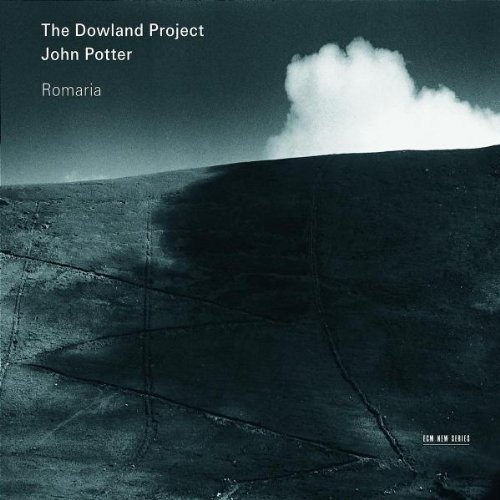
The Dowland Project: Romaria (ECM New Series 1970)


The Dowland Project
Romaria

John Potter tenor
Miloš Valent violin, viola
John Surman soprano saxophone, bass clarinet, tenor and bass recorders
Stephen Stubbs baroque guitar, vihuela
Recorded January 2006 at Propstei St. Gerold
Engineer: Markus Heiland
Produced by Manfred Eicher

The atmosphere of Romaria, the Dowland Project’s third album for ECM, is exactly like its cover: monochromatic, with a splash of cloud over a stretch of scored earth. Stripping down its ethos to barest elements, the Project takes up plainchant, anonymous monody from the Carmina Burana manuscript, and Iberian folk songs, spinning from them a lush improvisatory world sprinkled with troubadour songs and motets from, among others, Orlando di Lasso and Josquin Desprez. The new addition of Slovak violinist Miloš Valent makes for a sustained and burrowing sound that blends uncannily with Stephen Stubb’s strings.

Got schepfer aller dingen starts us off with a brood, setting the tone for a somber yet somehow vigorous album. Where this vigor comes from is hard to say. Could it be in John Surman’s hopeful bass clarinet in Veris dulcis? Or perhaps in Stubb’s plucked accompaniment in Ora pro nobis? Yet further in John Potter’s aching vulnerability in Lá lume? Whatever the source, it’s clear that the versatility and depth of songcraft here is as delicate as a moth’s wing in a lantern’s flame.

Potter, it must be said, is the heartbeat of this album, drawing out from the instrumental surroundings a most thorough vocal line. The instruments seem to grow from his soil, particularly in Dulce solum, seeming to constitute the touch of breath through lips and mind. Similarly, Der oben swebt sways like the wind in the barley, carrying up in its wisps of recollection the promise of a lively day.

Much of the album is free-flowing and at times so organically realized (note, for example, In flagellis) that one wonders if the original melodies didn’t also arise in this unscripted fashion.The instrumental Saudade is another highlight that showcases the inspiring talents of Surman, whose soprano enlivens the darkest corners of Kyrie Jesus autem transiens and Ein iberisch Postambel to mesmerizing effect. Sometimes, the instruments recede just slightly, as in O beata infantia, allowing for Potter’s voice to carve its own tracks.

Listening to an album like this, one realizes the potency of the songs chosen, existing either in fragments or thicker sketches. Freedom is given to the performer, allowing new voices to come through. Each is but a drop in a larger body of water, necessary yet invisible in its surroundings.
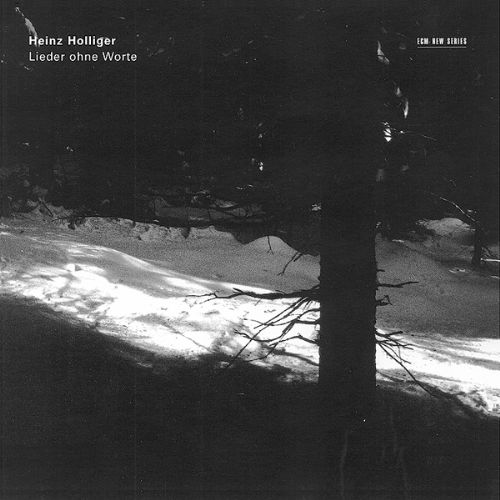
Heinz Holliger: Lieder ohne Worte (ECM New Series 1618)

Heinz Holliger
Lieder ohne Worte

Thomas Zehetmair violin
Thomas Larcher piano
Ursula Holliger harp
Recorded June 1996 at Radio DRS, Zürich
Engineer: Stephan Schellmann
Produced by Manfred Eicher

After an already healthy representation of the compositional prowess of Heinz Holliger, ECM decided to put out this disc pairing some of his earliest work from the sixties with that of decades later, thereby providing an engaging survey of a musical mind that turns like a kaleidoscope: holding tight to symmetries so that it might fragment their interiors in ever-novel, I would say linguistic, combinations. For indeed, language is what Holliger is all about. From the poetry that inspired him as a youth to the poetry that he creates as an adult, the Swiss composer revels in every portion of his mental reserve to fish out some of the most heartfelt music of the twentieth century.

The tactility of Holliger’s instrumental renderings always seem to have something of the human voice about them. Every cell is marked by the potentially vulnerable transfiguration of form, a breaking down or “clearing of the throat” by which the musical moment is rendered chalk-like in the face of its own palimpsestial illusions. The two sets of Lieder ohne Worte that embrace this disc turn the standard violin/piano duo inward, ever refracted toward a conversation comprised entirely of afterthoughts. Although generally light, it sometimes dips into urgent proposals to which the only desired answer can be a heavy silence. Both instruments become frames. The two Intermezzi recall Holliger’s 1982 Duo for violin and cello, linking adverbial phrases with descriptive trails. Songs without words, yes, but aren’t they always, for once they escape the lips they have already transcended the limitations of their shaping toward more distant reverberations.

In the Sequenzen über Johannes I, 23 for harp (played to perfection by wife Ursula), Holliger’s trademark fractures are filled by the plasma of fingertips, while the Präludium, Arioso und Passacaglia for the sameblush with savory dexterity. With the restrained ferocity of a classical guitarist, Ursula evokes an elastic space in which the life of any single note is determined by its distance from the body.

Two solo pieces fill in the eye sockets of this sonic skull. On the left is the winking Trema in a version for violin. Anyone used to the original for cello is sure to be caught up in the stark new textures. Where the cello draws that trembling forth from deep within its bowels, here it issues from the nostrils of a head animated by vehement denial. Yet in that denial is an unspoken (and unspeakable) commitment to self-reformation, to the idea that within the brain there is enough room to squeeze in all life experience into a single synapsial firing. The expediency of the lie is betrayed by its brevity. On the right are the three drowsy piano miniatures that make up Elis. In these vibrant fits there are only dreams. Rather than try to smooth them into a unified narrative, Holliger allows their worth to come clambering into our attention at whatever pace it chooses. A few extended techniques, like the hitting of a dampened string, emit flashes of color in an otherwise monochromatic field.

Holliger is notable for being a composer duly aware of the importance of space: between notes, between pieces, between selves. The stillness thereof is so heavy that, rather than falling like a stone, every note floats like a particle of windblown pollen. And in the hands of such astute performers, we begin to feel windblown ourselves.

<< Joe Maneri Quartet: In Full Cry (ECM 1617)
>> György Kurtág: Játékok (ECM 1619 NS
)

Alexei Lubimov: Messe Noire (ECM New Series 1679)

Alexei Lubimov
Messe Noire

Alexei Lubimov piano
Recorded May 1998 and December 2000 at Radio Studio DRS, Zürich
Engineer: Peter Laenger
Produced by Manfred Eicher

Messe Noire was the second ECM recital debut for Russian pianist Alexei Lubimov, following his enigmatic debut, Der Bote. It remains one of his freshest and most luminous programs, forging from the composers of his homeland what Reinhard Schulz describes in his liner notes as “a cosmos in which free spirits gather together.” The image is apt, for in the “Hymn” of Igor Stravinsky’s Serenade in A (1925), which opens the disc, we do indeed encounter a galactic ocean of impressions. From the gentle reverie of lost love to the grumbling belly of despair, it encapsulates Stravinsky’s penchant for emotional directness, as in the processual Romanza that follows and all the way through to the frayed Finale. The Sonata No. 2 op. 61 (1943) of Dmitri Shostakovich rather chooses ebullience as its quill, and marks with it a playful inter-relationship between the left and right hands in a volleying of motifs. An off-kilter Largo leads us to a plaintive Moderato, which provides one of the more sustained, gloomier contractions on the album.

Sergey Prokofiev’s Sonata No. 7 op. 83 (1942) introduces characteristic buoyancy before quickly fading into a quieter spell, inhabiting the after-effect with the oral passion of a missionary. This ebb and flow of pensive dips is the sonata’s overall modus operandi, epitomized most movingly in the Andante. This dynamism is only strengthened by Lubimov’s mature sense of syncopation. The boisterous reverie that is the final Precipitato brings that same play of weight and lightness to bear on more wistful statements. After this rousing feast, we are treated to desert in the form of Alexander Scriabin’s Sonata No. 9 op. 68 (1913). Marking time with seemingly reserved energy, its gorgeous contours actually build toward an arresting resolution.

What connects these four towering works is precisely what separates them. Over a spread of personal and social politics three decades in the making, they remain unscathed (if somewhat neglected), breathing with vibrant life at Lubimov’s fingertips.

<< Maneri/Phillips/Maneri: Tales of Rohnlief (ECM 1678)
>> Tomasz Stanko: From The Green Hill (ECM 1680
)

Michelle Makarski: To Be Sung on the Water (ECM New Series 1871)


Michelle Makarski
To Be Sung on the Water

Michelle Makarski violin
Ronald Copes viola
Recorded March 2004, Radio Studio DRS, Zürich
Engineer: Stephan Schellmann
Produced by Manfred Eicher

Like the blade of light on the album’s cover, Michelle Makarski draws luminescence through the darkness with her bow. For her third ECM recital disc, the violinist further hones both her craft and her sense of programming, constructing a Jacob’s ladder of Giuseppe Tartini and American composer Donald Crockett, the latter of whom offers two works in Makarski’s honor. Of these is the album’s 1988 title work, for which she is joined by violist Ronald Copes. Its lush double stops create a virtual quartet. From these arise steady pulses, slowly lobbed between the two instruments. Even as the narrative fragments midway through, the other always picks up the action in one, as if looking in a mirror that shows the distant past. Open strings prevail in this meeting of voice and translucent surface, a conversation between opacity of the instrument and transparency of the voice.

Hugging this piece are two sonatas by Tartini. The Sonata IX in A Major achieves an intimacy on par with Bach’s solo works. Yet where Bach inscribes the waking world with his solitary thoughts, Tartini crams that same world into the depths of his dreams in order to salvage what might otherwise remain unseen. The inaugural Largo sways with the same flexibility, as might a dream in which the parameters of one’s immediate reality are just as indecipherable as those beyond it. This renders the Allegro that follows a negation of self. Hence the echoes in the third movement, softer in the anchored line of the double stop, weaving its way like a caduceus into the frantic trills of the final proclamation. With its ponderous dissonances and looming double stops, the first strains of the Sonata II in d minor sound closest to Crockett. And while the middle movement is far more exuberant, filled with dancing diversions, the final Allegro marks a sinuous organism, its lines curling like fingers beckoning from behind a curtain.

All of this makes of Crockett’s mickey finn (1996) an urgent crawl to a bygone era, a literary and geographic aside wrenched from the ether with reluctant precision. Crockett’s tantalizing grasp of language makes for a delectable passage into Tartini’s  Sonata XIII in b minor. Makarski articulates the ground lines most strongly here, drawing them out to allow their resonance to overtake the lead. This is clearest in the stunning Andante, which finds its second self reinvigorated in the arousing Giga.

These works by Tartini, despite their bare construction, ask of the musician a certain depth of expression that Makarski handles with intuitive linearity. The music of Crockett similarly draws out the violin’s potential as songstress, shedding the husk of programmatic arbitrariness in favor of direct communication. Both write music without masks, and both are given the ideal mouthpiece in a violinist whose touch is supreme.

Johann Ludwig Trepulka/Norbert von Hannenheim: Klavierstücke und Sonaten (ECM New Series 1937)


Johann Ludwig Trepulka
Norbert von Hannenheim
Klavierstücke und Sonaten

Herbert Henck piano
Recorded April 2005, Festeburgkirche, Frankfurt am Main
Engineer: Markus Heiland
Produced by Manfred Eicher

The ever-adventuresome pianist Herbert Henck returns for another dip into obscure waters, this time with a wholehearted survey of the music of Johann Ludwig Trepulka (1903-1945) and Norbert von Hannenheim (1989-1945). Both were twelve-tone composers (both also died in WWII), though one would hardly know it by assuredness of their writing in these austere interwar pieces. Of Trepulka’s surviving piano music we get the entirety here, and his Klavierstücke mit Überschriften nach Worten von Nikolaus Lenau, op. 2 (1923/1924) is especially vital in this regard. For decades, it was his only published work. Fortuitously, three years after recording a performance of these pieces for Radio Bremen, Trepulka’s grandson saw his grandfather’s name on Henck’s website. Henck was then given access to a small fortune of unpublished scores (such coincidences would seem to set Henck apart from many contemporary performers and interpreters). We can only hope these will be documented on ECM in the future. As for Hannenheim, he lived in dire poverty for most of his life, breathing his last in a sanatorium. Praised by teacher Schönberg for his ingenuity, the fiercely prolific young composer could find no publishing outlet for his music at a time of great economic and sociopolitical hardship. His work, along with that of his teacher, would be banned under the Hitler regime.

Despite the tortured climates surrounding both composers, Trepulka’s Klavierstücke mit Überschriften nach Worten von Nicolaus Lenau op. 2 (1923/24) welcome us with an almost Debussean charm. Their resolution of hard realities speaks in pointillist stirrings and turgid harmonies wrought somewhere between lyricism and oppression. The brevity of these pieces (only two go over five minutes) compresses continents of emotion into single counties, each a wellspring of action.

Hannenheim’s territories are no less sweeping, but seem to press their feet more deeply into the ground along the way. The Klaviersonate No. 2 (ca. 1929) is like two jagged lines struggling for synchronicity, only to find that their destination is the same. Other sonatas, like No. 4 (ca. 1929), are even more convoluted, while the jolting ponderousness of the No. 6 (ca. 1929) Andante awakens us to stillness. Intensely effective, if not effectively intense, the staggered rhythms of the Vivace betray an essentially simplistic heartbeat of musical integrity. The resoluteness of No. 12 (ca. 1929) makes brave way into the Konzert Nr. 2 für Klavier und kleines Orchester (ca. 1932), which exists only in this fragment, unwinding itself from a small pool of desperation.

This music represents an interesting confluence of impressionism and hardened interpretation, and behooves the curious listener to wrap her or his cochleae around its fascinations time and time again.

Gidon Kremer and Kremerata Baltica: Gustav Mahler/Dmitri Shostakovich (ECM New Series 2024)


Gidon Kremer
Kremerata Baltica
Gustav Mahler/Dmitri Shostakovich

Gidon Kremer
The Kremerata Baltica
Yulia Korpacheva soprano
Fedor Kuznetsov bass
Recorded October 2001 in Riga (Mahler) and November 2004 at Musikverein, Vienna (Shostakovich)
Engineers: Niels Foelster (Mahler) and Martin Leitner (Shostakovich)
Album produced by ECM

All-powerful is death.
It is on guard
even in the hour of happiness.
In the moment of our highest life it suffers in us,
it waits for us and thirsts—
and weeps within us.
–Rainer Maria Rilke

As Inna Barsova has noted, the two symphonies on this massive disc both “share a concern with parting and death.” Each was written in its respective composer’s twilight, and unfolds in varying shades of darkness. Appropriate, then, that we should begin in the throes of the Adagio from Mahler’s unfinished Tenth Symphony (1910). Although originally scored for larger orchestral forces, in this 1971 string version by conductor Hans Stadlmair the young musicians of the Kremerata Baltica find themselves admirably well off. It begins more like a concerto than a symphony, a mournful solo echoing across time. That same quality prevails as the orchestra lifts off its fleet into darkened harbors. This wave repeats itself, each time with greater deference to the tide. “Lush” doesn’t even begin to describe the overwhelming beauty of the strings in full cry. Some crackling moments do crop up, each like an insect dying gracefully on the sands. And as dusky violins streak jade skies with their trembling light, a bold cry issues from the lower strings, pushing ever upward the ether upon which our spirits rest. Cosmic forces spread in earthly tones, leaving behind the faintest traces of an aurora borealis in anticipation of the coming dawn. This music may be unfinished, but it surely lingers.

Shostakovich’s Fourteenth Symphony (1969) for soprano, bass, and chamber orchestra sets texts by Lorca, Apollinaire, Küchelbecker, and Rilke along the contours of some powerful soloists. In this crystal clear live recording, marred slightly by a persistent cough during the most pregnant pauses, Shostakovich’s sense of playful morbidity shines through. This piece may not have the same concentrated sense of narrative (here, more spliced) as his masterful Execution of Stepan Razin, but its effect is still engaging. The operatic slant gives it flair, and the excellent percussion is a joy to behold. The voices are fully invested in their roles, each a fine example of method singing at work.

The music on this disc is about as far from background listening as one can get. It requires us to face the finitude of our mortality, to look closely into its eyes and see ourselves reflected, craning our necks across the gap of time into the infinity that awaits.

Arnold Schönberg/Franz Schubert: Klavierstücke (ECM New Series 1667)

Arnold Schoenberg
Franz Schubert
Klavierstücke

Thomas Larcher piano
Recorded July 1998 at Radio DRS, Zürich
Engineer: Stephan Schellmann
Produced by Manfred Eicher

Consummation. This is what the piano music of Arnold Schönberg (1874-1951) and Franz Schubert (1979-1828) have in common, the bridge that Thomas Larcher brings to this welcoming solo recital, his first for ECM. To underscore this point, he shuffles Schönberg’s Klavierstücke op. 11 with Schubert’s posthumous Klavierstücke D 946. By turns halting and didactic, the opening pairing opens into the fresh air of Schubert’s precisely syncopated revelry. The contrasts between the two composers are obvious to the ear, but to the heart Schönberg is an extended exhalation to Schubert’s inhalation. Where Schönberg plots slow, jagged caverns, Schubert runs furtively above ground in the sunshine. Yet both seem so urgent to tell their stories, offering lifelong journeys from relatively young minds.

Similarly, the subtle miniatures that make up the Sechs kleine Klavierstücke op. 19 of Schönberg unfurl scrolls upon scrolls of experience, far into the future, where Schubert’s rolling Allegretto c-Mollo D 915 reads like a thrumming postscript.

One need not expound at great length in order to capture the spirit of this music. Its connections are fierce, their execution nimble as a dancer’s feet. Close your eyes, and let it show you a different sort of light.

<< Keith Jarrett Trio: Tokyo ’96 (ECM 1666)
>> John Holloway: Unarum fidium (ECM 1668 NS
)

Arvo Pärt: In Principio (ECM New Series 2050)


Arvo Pärt
In Principio

Estonian Philharmonic Chamber Choir
Estonian National Symphony Orchestra
Tallinn Chamber Orchestra
Tõnu Kaljuste conductor
In principio; La Sindone; Cecilia, vergine romana recorded June 2008 at Estonia Concert Hall, Tallinn
Engineer: Teije van Geest
Recording assistant: Thomas Gärtner
Digital editing: Kohei Seguchi
Mixed by Teije van Geest, Manfred Eicher, Arvo Pärt, and Tõnu Kaljuste
Da pacem Domine, Mein Weg, Für Lennart in memoriam recorded May 2007 at Niguliste Church, Tallinn
Engineer: Margo Kõlar
Recording assistance and editing: Helena Tulve
MIxed at Rainbow Studio by Manfred Eicher, Arvo Pärt, and Jan Erik Kongshaug (engineer)
Produced by Manfred Eicher

In the beginning was the word, and in the word was sound, music, life itself. Such are the sentiments behind In principio, the title work of Arvo Pärt’s eleventh album for ECM. The label that started it all has been charting the Estonian composer’s work with devotion since 1985, when producer Manfred Eicher introduced his New Series with Tabula rasa. Because of him, we’ve been privileged to witness Pärt’s evolution as a musical thinker in a devolving world.

The eponymous 2003 work for mixed choir and orchestra bursts with a dramatic edge that sounds fresh to these ears. Its choral blast and ascendant strings seem to leap into the firmament, yet with such restraint that one hears order in every movement. The orchestral writing and performance are on point throughout, especially in the third movement, which introduces an atmosphere of lamentation. Voices spread, melting into brass chords, sustaining themselves through the nourishment of the fourth movement, in which the orchestra flashes through the darkness like a lighthouse. In this regularity one hears a touch of Philip Glass, especially in the flute of the final movement, amid a heap of faith.

The simpler Pärt’s music is, the more detailed it becomes. We can hear this in the descriptive approach of La Sindone for orchestra. Composed in 2006, it evokes (and ponders) the Shroud of Turin, where the piece received its premier performance. Moments of stunning lucidity open their eyes against the music’s gradual swell, which the orchestra handles with appropriate sensitivity. Cecilia, vergine romana (2000, rev. 2002) for mixed choir and orchestra in an ode to the eponymous patron saint of musicians. At sixteen and half minutes, it is among the album’s longer works. As such, it adopts a relatively clustered approach, shifting instrumental and vocal combinations with great vigor. One notes especially the pounding tympani, which leaves only the slightest of dents in the music’s unbreakable bonds. Next, Da Pacem Domine (2004/07) finds itself expanded from its original a cappella version to include a full choir and orchestra. The same stepwise motions are there, but the line drawn by the sopranos throughout is more profound than ever. Mein Weg (1989/99, rev. 2000) also finds itself repackaged here. Originally for organ, it is now scored for 14 strings and percussion. Ancestral wisdom paints a new dawn for every bow drawn, and finds in its revelation the path toward afterlife. Which brings us to Für Lennart in memoriam (2006), written for the funeral of late Estonian president Lennart Georg Meri. This endearing orchestral statement signs a mostly exultant program with a somber flourish.

If I had to describe Pärt’s music in one word, I would call it “non-allegorical.” This is as direct as it gets.

Frank Martin: Triptychon (ECM New Series 2015)


Frank Martin
Triptychon

Muriel Cantoreggi violin
Juliane Banse soprano
German Radio Philharmonic Orchestra
Christoph Poppen conductor
Recorded February and June 2006, Funkhaus Halberg, Saarbrücken
Engineers: Markus Brändle and Ralf Schnellbach
Executive producer: Manfred Eicher

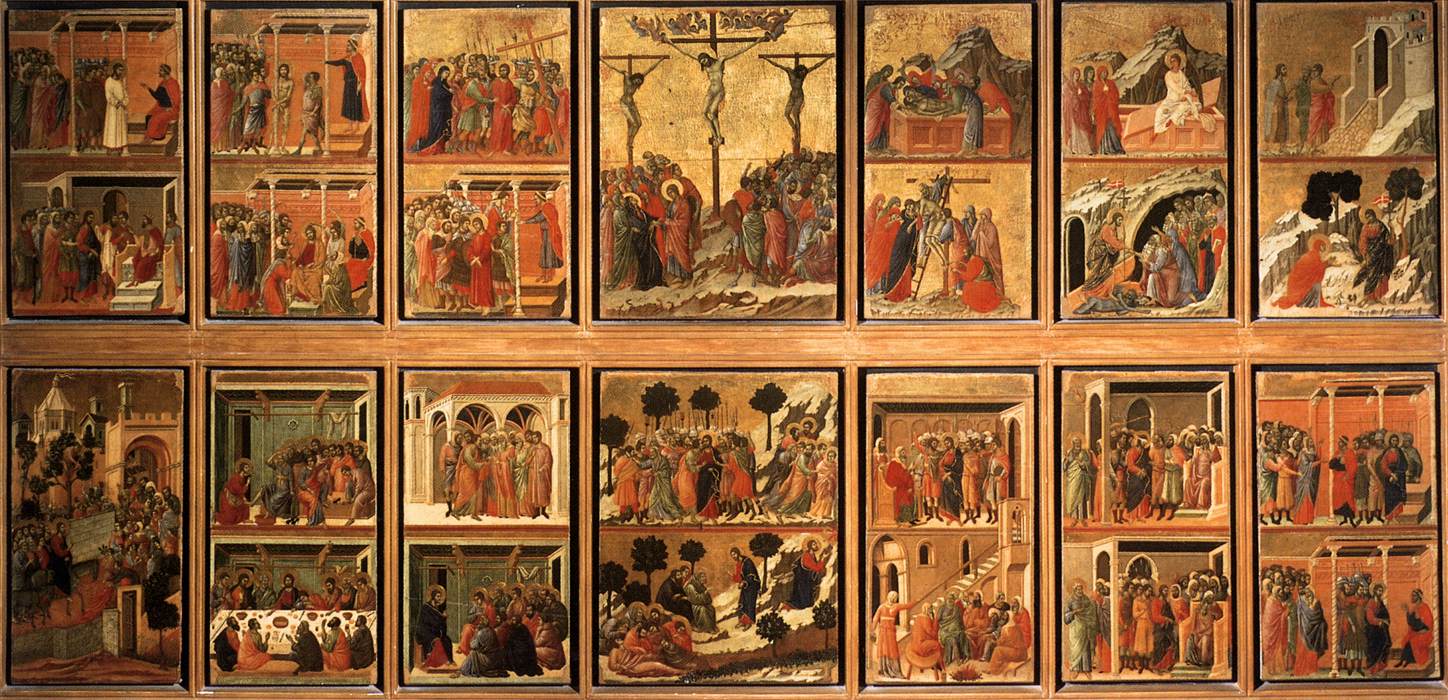
The inexplicably neglected Swiss composer Frank Martin (1890-1974) is given just attention in this powerful collection of three works. The music is decidedly scriptural, but speaks to listeners of all backgrounds with a depth that is as genuine as it is tonal. Martin was a composer who, like Hindemith and Bloch, had a deep respect for the viola and its many timbral possibilities. It is the instrument through which I first encountered him. How enchanting, then, to hear the soulfulness of his violin writing, which under the sure bow of Muriel Cantoreggi finds itself renewed in life divine. Her contributions to Polyptyque (1973, for violin and two string orchestras) in particular lend themselves seamlessly to the composer’s well-intentioned spaces. Each of the work’s six images explores La Maesta, a 14th-century altarpiece by Duccio di Buoninsegna, in exquisite detail. The utter sense of delicacy as Martin unravels a regretful world built on a foundation of innocence is arresting across faiths. As a whole, these facets are not so much a mosaic as they are a tetrahedron, connected at all edges by their refraction of light, material, and form.

Similarly, the Maria–Triptychon (1967/8) for soprano, violin and orchestra is an unfolding partition. The violin acts as central body that anchors the outer wings, patterned in the poetry of an Ave Maria, Magnificat, and Stabat Mater. The image, one might think, would be incomplete without those wings fully spread, but here they quiver only slightly, angling the perspective of the same images in an illusion of deformity.

Last is Passacaille (1944/1962), an orchestral jewel drawing from its winds a narrative of modest yet far-reaching proportions.

This is music that tickles our spiritual feet, sending light through our laughter into a realm where voices live of their own accord.