Thomas Demenga plays J. S. Bach/B. A. Zimmermann (ECM New Series 1571)

Thomas Demenga
J. S. Bach/B. A. Zimmerman

Thomas Demenga cello
Thomas Zehetmair violin
Christoph Schiller viola
Recorded February/July 1995
Engineer: Terje van Geest
Produced by Manfred Eicher

There is a time for everything,
and a season for every activity under heaven.

Cellist Thomas Demenga continues his Bach project by juxtaposing the Baroque master’s d-minor Suite No. 2 with the work of Bernd Alois Zimmermann (1918-1970), one of the most important non-Darmstadters after World War II. As ever, Demenga makes a convincing argument for the pairing (interestingly enough, most of the criticism of Demenga’s project sees the Bach as filler). In this case, Zimmermann is something of an effortless choice, for his fondness of quotation and respect for tradition were at the heart of his artistry. His approach to time in this regard was particularly significant, drawing on intersections of influence through a wide range of trends and idioms.

Thus do we find ourselves in the comforting waters of Bach’s generative whispers from the moment we dive in. For this performance Demenga adopts the approach of a viola da gamba player (to greatest effect in his raspily inflected Courante). This sound draws out the music’s inherent gaseousness, in which one feels something dark and cosmic taking shape. Demenga’s notecraft ensures that every molecule feels connected through a legato of silence. He digs as deep as he can for those distinct Bach lows, plows double stops as if they were fertile fields, and maintains subtle independence of line in the Sarabande. He bows the Menuets as if with shadows, then elicits one of the finer renderings of the Gigue I’ve yet heard, striking a fine balance between jubilation and regret.

The boldness of this architecture may seem an ill fit to Zimmermann’s sonatas, which despite their meticulous scoring also call for an improvisatory approach. This puts the musician in a potentially compromising space, though if anyone is up to the challenge, it’s Demenga. Many of Zimmermann’s works were considered unplayable when first written, the Cello Sonata of 1960 not least of all. Drawing from his usual pool of spatial and temporal concerns, the piece moves beyond the Romantic notion of cello as vox humana and into the realm of speech, action, and embodiment. In his liners, Demenga notes a particularly difficult passage in the first movement, which encompasses three distinct time-layers: “while the upper voice, played on the bridge, produces a continuous ritardando, the middle one is the most striking, because of its very large range and numbers of notes played pizzicato, and then the lowest, played on the nut of the bow, sounds like a scarcely perceptible accelerando.” Despite its brevity, unpacking the finer implications thereof took Demenga weeks to perfect.

That said, like all walls it can be, and is, overcome in such a way as to render those difficulties invisible and meaningless. It is a testament to his playing that the potentially distracting technicalities of this music become vital mechanisms to their own forgetting. In addition, the more the music progresses, the more one realizes that its virtuosity stems not only from the obvious difficulties, but more importantly from the way the performer must treat every cell as its own motivic entity while maintaining a sense of continuity (as in the “Fase” movement). Between the boldly intoned opening and the ethereal resolutions of “Versetto” we feel the cellist walking the edge of our Umwelt, stitching a morpheme for every step like a bead into patchwork.

Before this we are treated to two nearly intriguing sonatas. The Violin Sonata of 1951 was written after the composer’s concerto for the same. Demenga’s conceit is strengthened by a B-A-C-H cipher and likeminded spirit (notably in the Toccata). From the Paganini-esque heartbeat to the dramatic pizzicato slap that closes it, this is a tapestry of musical lines that is sure to delight. Christoph Schiller makes delicate work of the 1955 Viola Sonata thereafter and undoes a few of the frays left dangling. Subtitled “To the song of an angel,” the one-movement sonata was written in memory of the composer’s daughter Barbara, who died soon after her birth. This self-characterized “chorale prelude” is based on Gelobet seist Du Jesu Christ and tracks a pseudo-scientific journey of private inquiries. At times the instrument duets with its own implications, while at others it shatters itself into a hundred pieces.

This program is about nothing if not intimacy. Not only by virtue of the solo repertoire—Zimmermann himself believes the solo to be the only way by which one may access an instrument’s “almost inexhaustible power”—but also because of the way in which that repertoire speaks through the hands of such capable musicians. This is no-frills playing of music that, while at times distorted, rings forever crystalline in our memory of it.

<< Eleni Karaindrou: Ulysses’ Gaze (ECM 1570 NS)
>> Dave Holland Quartet: Dream Of The Elders (ECM 1572)

Trio Mediaeval: Soir, dit-elle (ECM New Series 1869)


Trio Mediaeval
Soir, dit-elle

Anna Maria Friman soprano
Linn Andrea Fuglseth soprano
Torunn Østrem Ossum soprano
Recorded April 2003, Propstei St. Gerold
Engineer: Peter Laenger
Produced by John Potter
Executive Producer: Manfred Eicher

The music on this, the second album from the Trio Mediaeval, represents 500 years of creation. And yet, as John Potter notes, “in a sense it is older than that, tapping into the continuing present—a timeless present, perhaps—that is what medieval music means to us.” These three Scandinavian singers have done so much for the music they touch, and in turn British composers Gavin Bryars, Ivan Moody, Andrew Smith, along with Ukrainian Oleh Harkavvy, have nourished that sound with newly fashioned music of their own. At the heart of these dedicatory contributions lies the Missa “Alma redemptoris mater” of Leonel Power (fl. 15th century). The mass is a fine example of early Renaissance polyphony and through the Gloria alone expresses a cathedral’s worth of light and shadow. The tonal qualities of the singers and the sung are luminescent, all coming to a flowering head in the visceral Agnus Dei. Power’s music comes to us in spite of Henry VIII’s Dissolution of the Monasteries, thereby speaking to us all the more lucidly through a history that might have silenced it. Its clarity is as pervasive as its texts and forms a warm framework through and around which the women of Trio Mediaeval weave their artfully conceived program.

Plainchant is the inhalation and exhalation of Harkavvy’s Kyrie (2002), as of the program as a whole, which unfurls bursts of polyphony in its pores. From ashes to flesh and back to ashes, it paints a tableau of life in barest terms, exceeded in simplicity only by the solo laude of Bryars, who also aligns all three voices in his stilling Ave regina gloriosa (2003). The Ave Maria (2000) and Regina caeli (2002) of Smith expand upon the gorgeousness of these horizons, again inscribing broad mosaics of faith with minimal vocal borders. Only when we get to Moody’s The Troparion of Kassiani (1999) do we find ourselves wrapped in a more detailed cartography. Its shifting microtonal harmonies, evocative textual phrasings, and resplendent highs cut to the core of the singers’ art. Moody also offers the pinnacle of this disc in his 2002 composition A Lion’s Sleep, if only because it seems to draw upon the Trio’s talents most intimately.

In light of the above impressions, however, I am wary of treating the album as anything but a unified whole. Like all Trio programs, it is structured like a stained glass window, each section having been soldered into place with great individual detail, but which comes to vibrant life when vocal light shines through it. Only then does the image tell its story, share its moral lesson, and open its wings to an understanding of vibration and sound that is as constant as the sun in its veins.

Charles Ives: Sonatas for Violin and Piano (ECM New Series 1605)


Charles Ives
Sonatas for Violin and Piano

Hansheinz Schneeberger violin
Daniel Cholette piano
Recorded December 1995 at Tonstudio van Geest, Sandhausen
Engineer: Teije van Geest
Produced by Manfred Eicher

The violin sonatas of Charles Ives were famously considered unplayable at the time of their composition (1903-1916). This is about as far my knowledge about their background reaches, for Ives represents a sore gap in my listening that was only recently salved by violinist Hansheinz Schneeberger and pianist Daniel Cholette, who bring 20 years of experience with the sonatas into the studio for what I imagine will be a reference recording for years to come. In this instance I feel fortunate in my ignorance, for it allows me to approach this music with fresh ears and an open mind. Having listened only a few times thus far, I clearly have much to learn and discover.

Perhaps akin to its French counterparts, the First Violin Sonata to my ears feels connected to the intersection of body and landscape, of song and action. It youthfully skirts the line between outright offense and justifiable play (and is that Bartók I hear creeping in through the exuberant double stops?). The second movement, an Allegro, is a pastiche of soaring melodies and grinding moments of impasse, while the final movement is like some anthemic dream turned in on itself. Such twisted charm seems part and parcel of the Ivesian experience, and backgrounds the “Autumn” movement of the Second Violin Sonata with tortured intimations in a magisterial wash of melody. These underlying struggles haunt with such regularity that whenever energies do pick up they seem like desperate attempts to break free from something dark and adhesive. In much the same way, “In The Barn” is at once exuberant and tempered by internal conflict, while “The Revival”—which opens with what I can only describe as a morose version of “Jingle Bells”—fascinatingly overlaps traditions and distortions with a jeweler’s eye. The Third Violin Sonata is the most consistent of the four. Its chain of verses moves through a mosaic of narratives, but always with a sense of forward motion and thematic drive. From the aggressive to the pastoral, it handles its moods with conviction. Subtitled “Children’s Day At The Camp Meeting,” the Fourth Violin Sonata opens with a terse Allegro and a cascading second movement, the latter being for me the masterpiece of the collection. Lullabies give way here to lilting rhythms and jolting cutoffs, inviting us to fill in the gaps with our own experiences and understandings.

Although these sonatas don’t make for the most “pleasant” listening, one can hardly fault them for their honesty. Ives’s was an uncompromising approach to style, which is to say he eschewed it. Instead, he seemed equally bound to a highly idiosyncratic aesthetic and to the whim of the moment. Schneeberger and Cholette bring out that very tension and walk the edge of predetermination and spontaneity with practiced intimacy. Not unlike the early compositions of John Cage, Ives’s music commits to its own unfolding even as it thrives on the mystery of impossible form(ation).

<< Bobo Stenson Trio: War Orphans (ECM 1604)
>> Ingrid Karlen: Variations (ECM 1606 NS
)

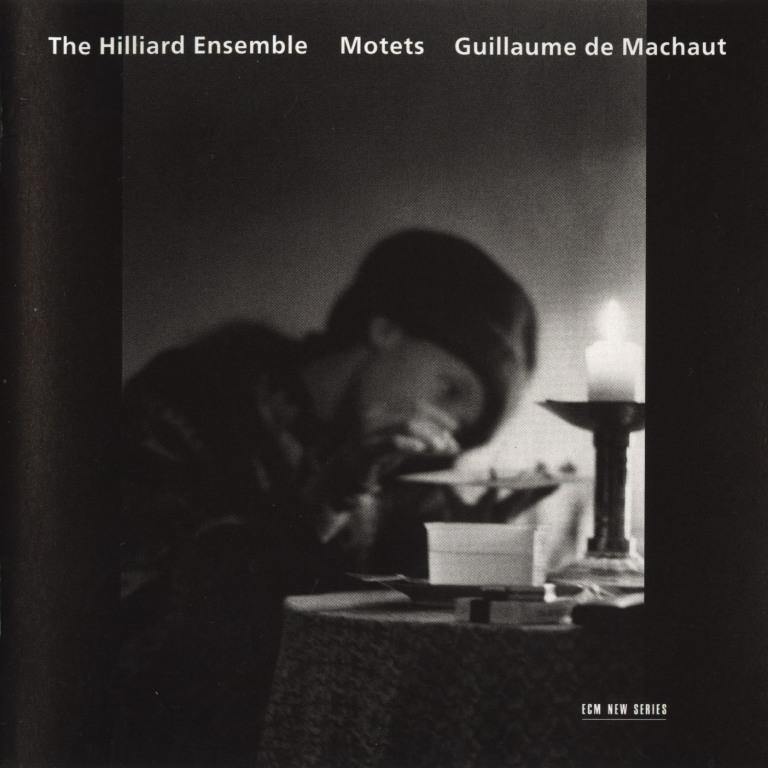
The Hilliard Ensemble: Guillaume de Machaut – Motets (ECM New Series 1823)

Guillaume de Machaut
Motets

The Hilliard Ensemble
David James counter-tenor
David Gould counter-ternor
Rogers Covey-Crump tenor
Steven Harrold tenor
Gordon Jones baritone
Recorded November 2001 at Propstei St. Gerold
Engineer: Peter Laenger
Produced by Manfred Eicher

As one who spent a good part of his formative Renaissance listening digesting the music of Guillaume de Machaut (c. 1300-1377) via non-Hilliard Ensemble recordings (most notably Ensemble P.A.N.’s exemplary Remède de fortune on New Albion), I have to admit to not taking much of a shine to these renditions at first. Yet after sitting with, and returning to, this recording a number of times over the years, I’ve been able to move beyond my preconceived notions and to appreciate the stunning light they shed. I venture to say that others may have the same reaction, but the rewards for immersing oneself in this ECM treatment are revelatory. The Hilliards have never been ones to take any project lightly, nor the choices within it, and the emotive care with which they sand and shape Machaut’s virtuosic settings is something to behold with wholehearted attention.

Like Gesualdo some two centuries later, Machaut was not without his preoccupations with mortality, love (both sacred and secular), and human beings’ penchant for suffering. It is perhaps for this reason that the Hilliards present their program in chronological order, as if to show us how Machaut grew behind and through its trajectory. And indeed we can almost hear that single comet’s tail drawn quietly from a tangle of cosmic lines. To be sure, these performances maintain the composer’s bold dissonances and challenging harmonies as they cascade over one another in waves of overwhelming polyphony (this, also, I think contributes to their hold on a listener), but in the Hilliards’ mouths their edges become rounded and fair, an effect only heightened by the resonance of Propstei St. Gerold, where the session was recorded.

The music is often anchored by dominant lines (e.g., Puis que la douce rousée) even as it spirals through a galaxy of atmospheres. Like a four-dimensional object it is impossible to fathom through the eyes, yet when we hear it through the shadows of the recorded medium it unscrambles our inner vocabulary like a Rubik’s cube until every side is uniform. Thus the movable nature of Machaut is so well suited to the Hilliards, for a likeminded meticulousness of vocal color and rhythmic staggering (O livoris feritas) truly distinguishes these singers from the rest. They also manage to enhance the sometimes-whimsical edge of the music’s piteous core, as in Helas! où sera pris confors. David James glows in the intimacies of Eins que ma dame d’onnour, Faus Samblant m’a deceü, as do the falsetto tenor lines in Fins cuers dous. Ultimately, however, one feels arbitrary in singling out certain moments over others, for Machaut’s knots are too well balanced to begin picking at individual threads.

I feel at pains to articulate what this music feels like, and equally so in trying extract some interpretive statement to which others, whether they’ve heard it or not, may relate. Like so much of what we encounter in our listening lives, these sounds come and go, lost even as they are experienced. That being said, I cannot help but believe that they leave discernible traces in the body, in the very synapses of the brain. If this recording has taught me anything about this art of reviewing in which I so humbly engage, it’s that immediate effect is not the criterion by which music should necessarily be judged. (In a world so bound by linear time, what currency does immediacy carry anymore?) Rather, I have increasingly tried to look at the specks of permanent change that Machaut, here and elsewhere, has lodged in me. Looking back on the experiences that led me to him in the first place, I know that fortune has indeed whispered into my ears with his texts and melodies from so many centuries ago.

If I may interrupt this stream of thought with a technical one, this was the first recording I ever heard with tenor Steven Harrold, who signed on with the Hilliard Ensemble in 1998. And while the colors of John Potter are certainly missed, Harrold delivers a fresh and slightly brighter tone (at the risk of undoing my earlier assertion, may I point your attention to his gorgeousness in the Veni creator spiritus). His presence is duly welcome in the context of Machaut’s motets, and along with countertenor David Gould enhances every motif he touches. If each motet is a series of numbers, then the Hilliards have provided us with legible solutions. Like a proof, each is filled with potential diversions and dead ends, but through this singular recording we are given a full map that we do well to follow with our eyes closed and our ears walking, open-armed.

The Dowland Project/John Potter: Care-charming sleep (ECM New Series 1803)


The Dowland Project
John Potter
Care-charming sleep

John Potter voice
Stephen Stubbs chitarrone, baroque guitar
Maya Homburger violin
John Surman soprano saxophone, bass clarinet
Barry Guy double-bass
Recorded 2001 at Propstei St. Gerold
Engineer: Markus Heiland
Produced by Manfred Eicher

With In Darkness Let Me Dwell, ex-Hilliard Ensemble tenor John Potter did something very special for the early Baroque, for what at first seemed a wild reconfiguration of songs and motives from John Dowland and his contemporaries was instead an act of deference to the improvisatory spirit that moved the music’s inception. The song- and partbooks of Dowland’s time were never meant to be prescriptive, but to function as stepping-stones for musicians’ creative interpretations. Here this concept is taken to task, and the result is music that carries itself across great divides with fluency and, dare I say, charming care. The inclusion of reedman John Surman and bassist Barry Guy is therefore an easy one to digest in what may look on paper to be a potentially disastrous experiment but which is, in fact, a program of awesome originality, which is saying something in a market flooded with early music interpretations of varying quality.

The project has also become an appropriate venue for the music of lutenist Stephen Stubbs, who contributes four plaintive Refrains to the proceedings. The first of these begins the program and weaves an elastic and chromatic net for all that follows. Its biggest catch is without a doubt the title song by Jacobean composer Robert Johnson (1583-1634). It is presented to us in two versions. The first of these takes advantage of the entire ensemble, spinning on the edge of Maya Homburger’s tremulous violin. Potter leaps into falsetto territory against a backdrop of harmonics, even as the entrance of Surman’s soprano adds further dimension and scope. Not unlike Jan Garbarek’s work with the Hilliards, Surman feeds off the infrastructure of the music at hand, spinning from it a weave at once respectful and innovative. An interlude provides Surman room for an enchanting rumination before Potter returns to the fold. In its reprisal, Johnson’s venerable number comes to us as we might expect it: through the familiar strains of lute and voice alone. Johnson’s aching moods wash over us again in two more songs, of which “As I walked forth” is wrought with due restraint and commentary from Homburger.

The often-played “Accenti queruli” of Giovanni Felice Sances (c. 1600-1679) provides some relief from the heavy pool of sentiments in which it finds itself. The tune plays like a jam session and best exemplifies the spontaneity behind the project’s concept. The regretful note on which it ends dovetails smoothly into “Weep, weep, mine eyes.” This mournful ballad by John Wilbye (1574-1638) draws out the program’s splintered relationship to love, and expresses through its saxophonic lines a suitable harmony of word and context. Surman likewise proves himself a defining presence in “Angela siete” by Cherubino Busatti (1600-1644), for here woodwind and throat swap roles like ribbons around a maypole.

Benedetto Ferrari (c. 1603-1681) was a new name to me, and his “Già più volte tremante” is a stunning piece of notecraft. Though brief, its unexpected minor shifts and Monteverdian phrasing make for a heart-stilling monologue.Yet while this album is rich with such luscious music, a single tune by Cipriano da Rore (c. 1515-1565) is for me its flashpoint. We encounter his “Ancor che col partire” also in two versions, once with lute and violin and again with vocals. The latter ends the program with a slow flourish that descends into the crypt from which it sprang in search of sunshine.

Nothing about the Dowland Project cries gimmick. This is not a mere ploy to capitalize on overdone material, but an offering of sounds already so rich with implication that the musicians cannot help but explore those sounds for all they’re worth. Anyone wary of approaching albums like Officium may want to ease into this rewarding ECM niche with Care-charming sleep.

Giya Kancheli: Diplipito (ECM New Series 1773)

Giya Kancheli
Diplipito

Derek Lee Ragin countertenor
Thomas Demenga cello
Dennis Russell Davies piano
Stuttgarter Kammerorchester
Dennis Russell Davies conductor
Recorded January 2001 at Mozart-Saal, Liederhalle, Stuttgart
Engineer: Peter Laenger
Produced by Manfred Eicher

“…I feel that, conceptually, I am still living in the age of the horse and carriage and the first motor cars.”
–Giya Kancheli

Giya Kancheli is a composer of contrasts. Hardly limited to the vast dynamic distances that have marked his work with increasing frequency, these contrasts also flourish in less discernible areas. We find them in mood, in timbre, and perhaps most vividly in the dance of sacred and secular that traces communicative patterns all over the music’s surface. The analogy is no accident, for dance would seem to be capital of the expansive territory etched herein.

The program’s title work, composed in 1997 and named after a drum of Kancheli’s native Georgia, is scored for violoncello, countertenor and orchestra. It begins where all of his works begin: inside. The piano is explored as a cavity in which echoes of Górecki’s Third Symphony comingle with every dancing scene of an Angelopoulos film, seen through a scrim of tears. The inclusion of guitar in the sound mix adds fractures to this glassine surface, while the cello births a countertenor voice from its winged enclosure (these roles reverse as the narrative develops). Though one might expect an ECM regular like David James for this recording, Kancheli has chosen instead a more vulnerable style in Derek Lee Ragin (who also gave the work’s premier). The match is perfect. Half-formed reinstatements of familiar motives shine through Ragin’s vocal branches, even as the strings weave a blanket of stillness over him from the piano’s block chords. At times Thomas Demenga’s song is hardly distinguishable from Ragin’s—not a question of resemblance but of presence. Small clusters of piano arpeggios roll down a hillside of tubular bells, tripping over their own voices. The titular hand drum makes a modest appearance toward the end, bringing with it the sound of villages and forgotten places. Hands brush across its skin in the final whisper, thus stretching to near invisibility one of Kancheli’s subtlest veils of sound. A masterpiece.

Dedicated both to Dennis Russell Davies (who conducts here from the bench) and to his wife (“with whom I have never danced”), Valse Boston for piano and strings (1996) opens with a strike from the keyboard. These outbursts crystallize like philosophies into their core questions. The orchestra breathes in and out through the instrument that enables its expressivity. Each measure is a microcosm held by the cosmos to the eye of a speechless god. Moments of pathos are few and far between, and all the more beautiful for the brevity of their passing. This wondrous music allows us to rethink the parameters of what we consider minimal. The single utterance never lingers yet its taste never dulls. Through this cumulative simplicity we find a monad of audible existence that has passed through us all. It is a silence, a heaviness that links memory to death, and in so doing illuminates the good deeds of our lives.

If we take the composer’s words above at face value, then we might cradle his music as one might a rare antique. There is history in its bruises, and these we can touch only with the intent to heal.

<< Juliane Banse/András Schiff: Songs of Debussy and Mozart (ECM 1772 NS)
>> Bach/Webern: Ricercar (ECM 1774 NS)

Kim Kashkashian: Hayren (ECM New Series 1754)

Kim Kashkashian
Hayren

Kim Kashkashian viola
Robyn Schulkowsky percussion
Tigran Mansurian piano, voice
Recorded May 2000 at Teldec Studio, Berlin
Engineer: Peter Laenger
Produced by Manfred Eicher

The music of Armenian composer Tigran Mansurian made its first ECM appearance on Alexei Lubimov’s Der Bote. Yet it wasn’t until violist Kim Kashkashian reflected deeply on her own Armenian roots that his sound-world, along with that of the nation’s treasure Komitas (a.k.a. Soghomon Soghomonian, 1869-1935), came into its deserved own. The result is a fortuitous one, not least because of Kashkashian’s unwavering dedication to her instrument and its limitless possibilities. Hayren interlocks Mansurian’s earthen sensitivities with Komitas’s visionary roots for a blend that is at once supra-paradigmatic and forged on a shared oral connection between those who perform and the very earth on which they stand. The program’s title deliberately evokes the poetic style much revered in Armenia, and the implications could hardly be more appropriate, for while Mansurian is like a brittle page, Komitas’s typography is bold and crisp.

Although the album is made up mostly of chamber pieces such as Havik, in which the viola seems on the verge of losing its foothold, surprises await us Mansurian not only takes to the piano but also adds his actual voice into the rippling waters of his surroundings. The polished arrangements encase every raw lullaby in a lantern, such that the quietude of songs like Garun a feels like the shadow of the dying light of Krunk. His is not a voice to be praised for its technical prowess, but one to languish in for its unabashed descriptiveness. Mansurian seems to mimic Kashkashian’s gravelly emotions, if not the other way around. This is music that flirts with pitch as the wind might with a tree branch: no matter how much it bends, its essential form remains intact. One can say the same for Chinar es, which feels on the verge of utter collapse from the weight of its openness. And it is a fine musician indeed who can become even more vocal in her instrumental rendition of Krunk, which while timorous is by virtue of its lilt a caress on whatever part of the brain is activated when we read moving literature. After an alluring piano solo in Oror, sounding like a plaintive interlude in an Eleni Karaindrou soundtrack, Kashkashian and percussionist Robyn Schulkowsky untie every subtle knot to be found in Mansurian’s Duet for viola and percussion. What starts as a soulful postlude burrows into an 18-minute cavern of living darkness. The melodies are self-aware, dented by marimbas and gongs, and point like a compass needle to the truest north that is incantation.

Hayren is an album that will likely require repeated listening. As for myself, I can only say it has grown with me into a rich and multilayered carving. Not unlike life itself, it is narrated by a thousand cryptic asides for every direct proclamation, and through this disparity achieves a mature sort of unity that is nothing if not honest.

Kashkashian always brings a personal dimension to her playing and perhaps nowhere more so than here. The intimacy of her interpretations is only enhanced by those of Mansurian, who continues to open our ears to the possibility of what lies already locked behind those cochlear doors.

<< Trio Mediaeval: Words of the Angel (ECM 1753 NS)
>> Keller Quartett: Lento (
ECM 1755 NS)

Erkki-Sven Tüür: Exodus (ECM New Series 1830)


Erkki-Sven Tüür
Exodus

Isabelle van Keulen violin
City of Birmingham Symphony Orchestra
Paavo Järvi conductor
Recorded May 2002 at Symphony Hall, Birmingham
Engineers: Peter Laenger and Stephan Schellmann
Produced by Manfred Eicher

Exodus is the third ECM outing for Erkki-Sven Tüür and represents a particularly robust electron in the Estonian composer’s molecule of exploration. To be sure, his music (as Tüür himself is first to admit) is all about energy: its explosions and implosions, its heads and tails, its ruptures and healings. Yet in these three premiere recordings one finds also a consistency of purpose, whatever directions Tüür takes. Looking, for instance, at the 1998 Violin Concerto, we find that the relationship between soloist and orchestra has been transmogrified. No longer is the violin (played with due crispness by Isabelle van Keulen) a moderator, but now a transducer of biological information in a vast, multi-cellular organism. Both forces filter one another until their registers cross-pollinate, leaving the arpeggio as the only discernible genetic signature. The violin is at once dancer and stage, opening itself like a strainer through the first movement. Between the microscopic percussion and winds to the dialogic cellos, there is plenty to entice us. Tüür’s multi-tiered approach lends itself well to the concerto form, such that the soloist is not always the centerpiece of the work’s visual display, but is sometimes just as content to inhabit a corner of it, or even to jump off screen for a spell. Keulen, who brings a personal affinity for the piece to bear upon her performance, clearly revels in this freedom as she frolics through countless clima(c)tic possibilities. The second movement undermines the formulaic fast-slow-fast structure with a layer of interrogation. Protracted reveries share the air with ephemeral platitudes, each a jagged accent strung toward the final highs. All of which brings us to the decidedly brief third movement, which pits marimba and double basses in a condensed debate. This escalatory format, a notable forte of Tüür, then clusters around flute and glockenspiel dramas more reminiscent of his earlier architectonic pieces, drawing a tail of vibration to end.

After this juggernaut of a concerto, the two orchestral pieces that follow seem to fit more opaque slabs of color into this emerging stained glass window. The wind-heavy Aditus (2000, rev. 2002)— written in memory of an early mentor, Lep Sumero—is also rich with brass expulsions and percussion. It conjures a a pile of sonic coinage at once sullied and newly minted and leads almost seamlessly into the 1999 title composition—this dedicated to its conductor, Paavo Järvi. Those same convulsive flutes coupled with glockenspiel haunt every nook of the music’s ecstatic unwinding. Vast orchestral forces subside into a more liquid sound, trampling through the fallen branches of introspection. Flutes flutter into the distance like flock of birds while strings lay down an icy drone: the tundra of self-awareness, melting in the sunlight of a tinkling bell.

If we take exodus to mean a forceful expulsion from one’s roots, then we might see the music of Tüür as being engaged in a likeminded project. It thrives on the asymmetries of displacement and the new symmetries forged in its place. Listening to Tüür’s music is its own experience, one in which we encounter a book to which language seems but a shadow, for the moment we try to capture it in words it has already been forced into a grammar as arbitrary as my own.

Bach/Webern: Ricercar (ECM New Series 1774)

Johann Sebastian Bach
Anton Webern
Ricercar

The Hilliard Ensemble
Monika Mauch
soprano
David James countertenor
Rogers Covey-Crump tenor
Gordon Jones baritone
Münchener Kammerorchester
Christoph Poppen
Recorded January 2001, Himmelfahrtskirche, Sendling, München
Engineer: Andreas Neubronner
Produced by Manfred Eicher

With Ricercar Christoph Poppen continues where he left off on Morimur. While the goal of the latter project was to reveal what was hidden, here it is to direct our ears to what is already there. To achieve this Poppen bridges the J. S. Bach divide now to Anton Webern, highlighting an early Bach cantata—“Christ lag in Todesbanden” (Christ lay in the bonds of death)—as a genetic link to Webern’s op. 5 and the String Quartet of 1905, and ultimately to Webern’s own rendering of the six-part ricercar from Das musikalische Opfer (The Musical Offering). Herbert Glossner, in his liner notes, analogizes the relationship between the cantata and the ricercar in architectural terms, with the former standing at the center and the latter providing the cornerstones. The structural comparisons are far from arbitrary. They provide key insight into the potential for both composers to interlock in fresh and enlivening (more on this below) ways.

The bookending ricercar does, in fact, support the program like the columns of some aged temple, letting the language therein build from the afterlife of a single oboe line. This weave seems to pull the orchestra from a profound slumber, also drawing from within it deeper threads that unfold rather than obscure their source. This is no mere interpretation, but a bodily dip into Baroque waters. The same can be said of Poppen’s project on the whole: Ricercar is neither trying to modernize Bach nor even to accentuate the timelessness of his music, but rather taking an informed look into the prism of its inception. Paired with the conductor’s variegated arrangement of the 1905 quartet, it pours like the sun through an open curtain. On this side of the spectrum the music has a similarly fugal structure and sits comfortably in its shell, yet also bleeds into the cup of Bach’s fourth cantata. The soaring organ and heavy foliage of strings and voices in the opening movement accentuate the kaleidoscopic effects of all that have fed into it thus far. The assembled forces accelerate into a beautifully syncopated passage that almost rings of Steve Reich’s Tehillim in the allelujas. The cantata’s only duet, here between soprano Monika Mauch and countertenor David James, is a crystal of fine diction (especially in the words, “Das macht…”), as are the respective tenor and baritone solos from Rogers Covey-Crump and Gordon Jones. The performances are carefully striated and blossom in the glory of their full inclusion (whereas in Morimur only selections were decidedly offered out of their immediate contexts).

All of this gives us a profound feel for the concept and for the awakening stirrings of Webern’s Five Movements for String Quartet, performed here in the composer’s own expanded version. Not unlike the preceding cantata, it awakens in plush contours into a duet of sorts before regaling us with tutti and solo passages in turn. This constant negotiation between speaker and spoken heightens the music’s physicality and thus its mortal vitality, so that in its throes we think not of death but rather of the life-giving soil in a landscape now heavily traveled. For while it is tempting, of course, to read these works as if they were written on the brittle paper of death, one cannot help but feel the affirmation of survival thrumming through their veins. Each is a universe in fragments waiting to be painted, and the exigencies of our fragile existence its subjects.

<< Giya Kancheli: Diplipito (ECM 1773 NS)
>> Sofia Gubaidulina: Seven Words / Ten Preludes / De profundis (
ECM 1775 NS)