Juliane Banse/András Schiff: Songs of Debussy and Mozart (ECM New Series 1772)

Juliane Banse
András Schiff
Songs of Debussy and Mozart

Juliane Banse soprano
András Schiff piano
Recorded January 2001, Reitstadel, Neumarket
Engineer: Stephan Schellmann
Produced by Manfred Eicher

Sometimes one can set aside the reputations of composers and simply enjoy their music. This recital of songs by Mozart and Debussy, performed by an equally unlikely pair in pianist András Schiff and soprano Juliane Banse, however, simply overflows with its creators’ indelible marks. With a hefty dose of poetry, from French symbolists to Goethe, at hand, we’re the lucky ones who get to connect the dots in a constellation of unusual proportions.

Schiff’s well-spaced articulations and Banse’s meticulous control of tone make for a most fitting vehicle for the evocative Beau soir (Beautiful evening) of Debussy that introduces the program. Clair de lune (Moonlight) very much recalls the songcraft of Poulenc and enchants with its opening line from Verlaine: “Your soul is a chosen landscape…” Such cerebral storytelling continues through Pierrot to the equivocal Apparition. Dissonances in En sourdine (Muted) and the almost Carmen-like pastiche of Fantoches (Marionettes) add bolder hues. Verlaine’s careful words reappear in C’est l’extase langoureuse (It is languorous ecstasy), in which Banse pines:

This soul which mourns
In the subdued lamentation,
It is ours, is it not?
Mine, say, and yours,
Breathing a humble anthem
In the warm evening, very softly?*

These songs are not without their programmatic gildings, as in the cascading pianism of Il pleure dans mon cœur (Tears fall in my heart) and the thrilling chording of Chevaux de bois (Merry-go-round). Many adjectives come to mind when trying to describe these miniatures, but the one that resounds most for me throughout this recording is: clear. Like fresh light poured upon the morning fields, they nourish like no other stimulant.

Where Debussy works in more horizontal, sinuous gestures, Mozart brings potent verticality. Though a few of his Lieder, such as Warnung (Warning), bristle with the stately charm we popularly associate with the Salzburgian wunderkind, we cannot help but be delighted by the playful strains of Der Zauberer (The sorcerer), which likens the flames of passion to the dark magic of an eager pursuer. The little fable of Das Veilchen (The violet) gives voice to the desires of its titular flower, who spots a frolicking shepherdess. The violet dreams of being plucked and pressed to her bosom, only to be trodden as she skips ignorantly past. Its last sentiments:

“If I must die, at least I die
Through her, through her,
Here, at her feet!”

The recital closes with Abendempfindung (Thoughts at eventide), in which Joachim Heinrich Campe bids his loved ones not to fall too deeply into grief upon his death, promising to be there with open hands to carry them into heaven:

Bestow a tear on me and be
Not ashamed to weep for me,
For this tear shall be the finest
Pearl within my diadem.**

These songs are simply fascinating, and all the more so for being programmed together. Within them are many discoveries to be had. Banse and Schiff are so exacting that one almost imagines the music as having been written for them. An altogether captivating album that is as capricious as it is austere.

* Translation by Winifred Radford.
** Translation by Lindsay Craig.

<< Alexei Lubimov: Der Bote – Elegies for Piano (ECM 1771 NS)
>> Giya Kancheli: Diplipito (ECM 1773 NS)

Zehetmair Quartett: Schumann (ECM New Series 1793)

Zehetmair Quartett
Robert Schumann

Zehetmair Quartett
Thomas Zehetmair violin
Matthias Metzger violin
Ruth Killius viola
Françoise Groben cello
Recorded August 2001, Radio Studio DRS, Zürich
Engineer: Stephan Schellmann
Producer: Manfred Eicher

Composed during the summer of 1842, Robert Schumann’s three string quartets bear dedication to Felix Mendelssohn and are his only chamber works without piano. A few years before their appearance, while sitting in on a series of quartet rehearsals led by Mendelssohn’s friend and concertmaster, Ferdinand David, Schumann was first struck by the greatness that Ludwig van Beethoven had brought to the form. Determined to match that greatness, he found himself obsessed by “quartettish thoughts” and ready to tackle the form at which he had long desired to try his hand. He set out on the daunting task of writing his first quartet. Sadly, this piece did not survive, but we do have the subsequent threesome that is his Opus 41, of which two have been recorded for this instant reference recording.

Schumann struggled with inner demons all his life in a constant balancing act between his burgeoning romanticism and intellectual acumen. It was only in Beethoven’s titanic and immovable reputation, says Martin Meyer in his liners, that Schumann turned to both internal and external sources for inspiration. Where Beethoven’s “absolute” approach seems to cast the greater shadow, this is as much due to the inordinate amount of light shed upon it as to any inherent superiority. Schumann’s programmatic idiosyncrasies provide as much fascination, and these the Zehetmair Quartet brings out at every turn.

The fluidity of the String Quartet No. 1 in A minor is surpassed only by that of the performance itself. The Mendelssohn-influenced Scherzo brings the gelatinous bones of the Introduction to vibrant life with palpable connective tissue. The results are playful yet graceful, honed in rustic elegance in spite of their aristocratic borrowings. After a speculative Adagio, we arrive at the scraping violin and resplendent tutti passages of the Presto. Such alluring energy leaves us in need of the Andante that opens the String Quartet No. 3 in A major. A beautiful legato theme, eerily similar to the central oboe/flute passage in Tchaikovsky’s “Waltz of the Flowers,” emerges in the violins. Zehetmair moves like a breeze across water, while the others capture every wave of sound with unbending accuracy. Muted strings in the second movement build to a rousing density that is easily the disc’s highlight. Pizzicato strings enchant in the third, while the masterful Finale inspires with its urgency.

With the string quartets Schumann tightened his grasp of modality in a careful exchange of sentiment. There is what Meyer calls a “clouded lyricism” throughout these ternary works that is enhanced all the more by the enlivening performances on this recording. And while the fact that it won the Gramophone Award for Album of the Year is no small consolation prize, it seems but an afterthought when reeling from the music that earned it.

<< Anouar Brahem: Le pas du chat noir (ECM 1792)
>> Frode Haltli: Looking on Darkness (
ECM 1794 NS)

Gideon Lewensohn: Odradek (ECM New Series 1781)

Gideon Lewensohn
Odradek

Auryn Quartet
Matthias Lingenfelder violin
Jens Oppermann violin
Stewart Eaton viola
Andreas Arndt cello
Alexander Lonquich piano
Gideon Lewensohn piano
Recorded February 2001 at Radio DRS, Zürich
Engineer: Stephan Schellmann
Produced by Manfred Eicher

Israeli composer Gideon Lewensohn splashes onto ECM New Series with Odradek, a program of intriguing, sometimes perplexing, but always gripping music. The Piano Quintet is exemplary of Lewensohn’s odic approach, paying homage to his own brother Micah, as well as to György Kurtág, the Hilliard Ensemble, George Rochberg, and Dmitri Shostakovich. And while more than a smidgeon of each movement’s namesake is palpable, even more so is the freshness of a unique voice in contemporary music. These are not the seemingly perfect circles of ripples in a pond, but rather the jagged and frothy edges of an immeasurable shoreline. The first movement is a cycle in reverse. Violins pull like hands from a gooey mass clutching the prize they so desperately sought, only to realize that its virtues have all but been destroyed in the process of discovery. The second movement skitters like glass, shifting through high harmonics and mysterious refractions. In the third movement the cello at last groans from the underworld. With the circling birds of high violins now gone, it is free to peek its head above the surface and divine its own shadow. The fifth movement is the most violent, its controlled chaos spiraling ever downward into magma. These honorary fragments continue in the title quartet with further nods to Giya Kancheli, Witold Lutosławski, and Gustav Mahler, among others. Other descriptors are more subjective, charting moments of paranoia, drunkenness, and distortions of time. Still others bear whimsical subtitles like “Sarabandoned” and “Epiloque.” Each is a drip through a semantic IV in which the sublime and the violent are equal medicine. Bookending the Quartet are two iterations of the Postlude for piano. With every protracted fall into joy, moments of dynamic increase seem more like extensions of a default quietude rather than ruptures of it.

To be sure, Odradek is an uneasy place to be, but one that offers up its own fascinations with contemplation. The music responds just as well to abandonment as it does to undivided attention and maps its footsteps on the bodies of each high-caliber performer. Instruments are re-clothed and compressed into seeds before being scattered across a barren field that only now flourishes to make up for lost time. We are the reapers here, our scythes raking together every husk of this brilliant crop.

<< Keith Jarrett Trio: Inside Out (ECM 1780)
>> Thomas Demenga: Hosokawa/Bach/Yun (
ECM 1782/83 NS)

Helmut Lachenmann: Schwankungen am Rand (ECM New Series 1789)

Helmut Lachenmann
Schwankungen am Rand

Ensemble Modern
Peter Eötvös conductor
Recorded November 1998 at Alte Oper, Frankfurt (Schwankungen am Rand); November 1994 at Radiostudio Hessicher Rundfunk, Frankfurt
Engineers: Rüdiger Orth and Wolfgang Packeiser (Schwankungen am Rand); Udo Wüstendörfer
Produced by Manfred Eicher

“Enigmatic” doesn’t even begin to describe the music of Helmut Lachenmann, a composer who had for decades been charting a most distinct path in the world of sound unknown to most listeners outside of Europe until this, his first New Series release. Like the work of mentor Luigi Nono, Lachenmann’s sonic project seems bent on sidestepping tradition, all the while plumbing its very depths for inspiration and raw material. His polemics are genuinely concerned with their origins, of which the compositions surveyed here constitute a solid mythos.

Despite its porous structure, Lachenmann’s music is not something one enters into lightly. Take, for instance, the disc’s eponymous work of 1974/75. Translating as “Teetering on the Brink,” the title is as much a state of mind as it is a descriptor. The music seethes like an unprocessed emotion threatening to overtake the wounds that bore it. Whereas its featured percussion instruments produce viable utterances no matter how they are struck or manipulated, we almost never hear any stringed instrument played in the manner for which it was intended—only the tuning of violin pegs, but no bows to “justify” their adjustment. Snatches of electric guitar, sine wave-like whines, and underbelly rumblings constitute a turgid and unnavigable topography. A disembodied voice gives a Kabuki musician’s “Hup!” As if to intensify the analogy, wood claps, crunchy yet delicate, move across the stage as if kneeling, labored like the beaten metal thunder sheets that tremble above them. There is never any storm, only the pronouncements of Mouvement (- vor der Erstarrung) für Ensemble (Movement before Paralysis), composed between 1982 and 1984. With pathos restored, we can grasp strings again like vines in a broadening jungle. After a winding bell, woodwinds spin breath into more discernible vocabularies, a colony of semantic mice scampering through the orchestra room after being locked up for the night. The disc ends with the newest work, 1992’s …zwei Gefühle… (…Two Feelings…) for speaker and ensemble. Based on texts by Leonardo da Vinci, it was later dropped into the complex folds of the composer’s opera, Das Mädchen mit den Schwefelhölzern. Further protractions and creaking floorboards abound in this weathered vessel, raising its voices only rarely for benefit of our attention. Comprehensibility is wrought by the purity of the utterance, scripted in a clear and present language. These constant dictations lend the instruments a blatantly subjective quality that never wavers.

In his liner essay, Jürg Stenzl paints a portrait of Lachenmann as one who “himself views the composer as a person who obeys tradition by prolonging it rather than clinging to a misconception that rigidly equates ‘tradition’ with its misguidedly idyllic aspect.” In other words, what seems haphazardly thrown together here can only be meticulously ordered, tied up in crisp packages and offered to us like an array of sweets upon a well-worn tray. His is a world in which the parameters of understanding are a Möbius strip that we fear to tread upon and yet from which we cannot look away. And so, we sketch it on paper, that we might memorialize its effect without ever having fallen into its permanence. In this way, every line comes to have its hallowed place.

<< Tomasz Stanko Quartet: Soul of Things (ECM 1788)
>> Valentin Silvestrov: Metamusik / Postludium (
ECM 1790 NS)

John Holloway: Unam Ceylum (ECM New Series 1791)

Heinrich Ignaz Franz Biber
Unam Ceylum

John Holloway violin
Aloysia Assenbaum organ
Lars Ulrik Mortensen harpsichord
Recorded May 2001, Propstei St. Gerold
Engineer: Stephan Schellmann
Produced by Manfred Eicher

Much of what the classical listener hears in recent recordings of Baroque music is cluttered with ornamentation, overbearing virtuosity, and fresh takes on the tried and true. In short, a little too much fuel where already there is fire. Such innovations aren’t necessarily a detriment to the industry, as they can (and do) inspire new generations of listeners who may not have a taste for what they consider to be “staler” interpretations. Still, there is something to be said for the straightforward and the cerebral. Thankfully, the ECM albums of violinist John Holloway are here to provide a happy compromise between the two camps, playing with humility music that is already a raging conflagration amid a growing pile of neglected aural kindling.

Though I am compelled to praise the works of Heinrich Ignaz Franz Biber (1644-1704) for their sagacity, inventive scordatura tunings, and an indomitable spirit that seems to leap from every phrase, I am all the more boldly struck by their descriptive qualities. The sonatas on Unam Ceylum are taken from a 1681 anthology and include at least one (No. 84) never before committed to disc. In the company of Holloway and his esteemed colleagues, the composer’s descriptivism is given full reign. Building off the somewhat controversial success of its earlier Schmelzer recording, the trio sets the violin afloat upon an innovative continuo of harpsichord and organ.

Biber has a way of painting full-fledged dramas in but a single stroke of the bow, and indeed these sonatas would seem to thrive on stage, each a different scene in an overarching play. Some depict dancing and courtly romance, while others ooze with nostalgia for bygone days. The Sonata III in F majorprovides our opening act, evoking everything from birdcalls to tempests. The four-handed (and two-footed) continuo adds intrigue to an already fleshy plot. Mortensen follows wherever he is led. Assenbaum adds a touch of vaulted beauty. The latter shares a particularly enraptured passage with Holloway, who then transposes the bass line over a harpsichordic run before ending on a fast, unresolved note at the very peak of emotion. The somber drawl of Sonata IV in D major makes for an undulating segue into Act II, brought to jovial light in the unpublished Sonata No. 81 in A major. Its playful, teasing tone delivers what it promises in dense ascents, diffused by a scattered finish. The Sonata VI in C minortwists itself into a tantalizing climax from modest beginnings. After a positively lovely organ introduction, its rubato journey pulls us through edgier continents, all too soon alighting on forlorn shores. The G-major Sonata VII is a mixture of sadness and frivolity leading us into to the Sonata No. 84. It is here where finality comes to light, allowing Holloway the last word in ecstatic tangents. Yet again we are left hanging in delightful anticipation. This lends the music further commensurability and allows us to return to it eager for new details to emerge, which they inevitably do.

Though I began by downplaying virtuosity a bit, I cannot help but give a heavy nod to these musicians for theirs and the clarity it produces. Through the force of his vision, Holloway plays with this clarity to dazzling effect, never straying far from the printed score. He has completed his survey of the 1681 Sonatas with a follow-up album that also includes Muffat and which deserves a seat alongside this phenomenal start. Played as pristinely as it is recorded, this is a set to be savored.

<< Valentin Silvestrov: Metamusik / Postludium (ECM 1790 NS)
>> Anouar Brahem: Le pas du chat noir (
ECM 1792)

Alexei Lubimov: Der Bote – Elegies for Piano (ECM New Series 1771)

Alexei Lubimov
Der Bote – Elegies for Piano

Alexei Lubimov piano
Recorded December 2000, Radio DRS, Zürich
Engineer: Peter Laenger
Produced by Manfred Eicher

The title of Alexei Lubimov’s second recital for ECM translates as “The Messenger,” and perhaps no more fitting sobriquet could apply to the Russian pianist in this collection of ten elegies spanning three centuries. In opening with Carl Philipp Emanuel Bach’s Fantasie für Klavier fis-Moll, Lubimov provides something of a meta-statement encompassing all that follows. After a dream-like introduction, both musician and composer throw the listener for a loop with a burst of virtuosic splendor before returning to slumber. The music is rooted at the outer cusp of the Baroque while also far ahead of its time in scope and romantic flair, and pairs surprisingly well with John Cage’s In a landscape. The latter receives a uniquely spirited treatment here. Comparing this to Herbert Henck’s ECM recording of Cage’s early piano music, on which a slower read adds four minutes to its duration, one hears it rather differently. Lubimov’s playful undulations recast the piece’s depth of immediacy in quickly flitting shadows. Either way, it is achingly beautiful, a singular composition from a composer whose melodic humility remains unparalleled.

The fumbling dance of Tigran Mansurian’s Nostalgia hints at revelry but succumbs to meditation, while the Abschied of Franz Liszt provides our steadiest elegiac thread so far that moves with the sway of windblown branches. Mikhail Glinka blots our vision with nostalgic hues in his Nocturne f-Moll “La separation, a faded photograph lost in the pages of a dusty book, in which one may pore over Frédéric Chopin’s Prélude cis-Moll op. 45. It is a tale of sorrow, fading in on the stagnant lake of an abandoned estate, long overgrown with neglect. Beam by beam the mansion crumbles, until fireflies take the place of the footsteps that once dotted its halls: a thousand years of history condensed into six minutes. The abstractions of Valentin Silvestrov’s Elegie are like the ghosts left behind, fractured through the passage of time and made visible by the glow of introspection. In the Elégie of Claude Debussy, we are distracted by a passing mysticism, swept by the wind into the light of daybreak far from our own. Alone and without recourse, we seek shelter in Béla Bartók’s Vier Klagelieder op. 9a, Nr. 1, finding in its sweeping gestures and impressionist fades the key to Silvestrov’s title work that finishes. A gorgeous deconstruction of Mozart in a kind of haunted chamber, it is a touch upon the shoulder from the afterlife. By its last note, one wonders whether it ever really existed.

Lubimov is a pianist who understands music’s humble beginnings. He cradles every note like a wounded bird, nurturing it with grace until it is well enough to fly on its own. Equally intelligent programming makes this a disc to remember, if not forget like the memory of a past too beautiful to reproduce with any claim to faith. But this he does, and with a quiet passion that welcomes us with open arms.

<< John Abercrombie: Cat ‘n’ Mouse (ECM 1770)
>> Juliane Banse/András Schiff: Songs of Debussy and Mozart (
ECM 1772 NS)

András Schiff: In Concert – Robert Schumann (ECM New Series 1806/07)

András Schiff
In Concert – Robert Schumann

András Schiff piano
Recorded at Tonhalle Zürich, May 30, 1999
Engineer: Stephan Schellmann
Produced by Manfred Eicher

András Schiff returns to ECM with a live all-Schumann recital. Capturing what he sees as the composer’s “burning inventiveness,” the Hungarian pianist allows himself no contrivance in letting the notes speak on their own terms. He jumps right into the deep end with the vibrant Humoreske op. 20 (1838). Written during a time of separation from his future wife, Clara Wieck, in it Schumann incorporates a hidden “inner voice,” which he imagined as Clara’s own. Throughout its invigorating 28 minutes, we are treated to a mosaic of inner passions. Schiff handles its fluid transitions, intermezzi, and stylish moves with requisite grace, allowing plenty of space in the slower passages for the music’s full effect to shine. This is followed by the Novelletten op. 21 of the same year, which comprise the composer’s most extensive piano work. Though distinguished by its exuberant approach, it too embraces Clara’s “voice from a distance” (Stimme aus der Ferne) as a key animating force. Throughout, Schiff captures Schumann’s dynamic range admirably well, teetering between the Apollonian and Dionysian at every virtuosic turn. Yet it is in the “Concerto without Orchestra” that is the Op. 14 Piano Sonata in F minor (1836, rev. 1853) that we encounter the recital’s most luxurious moments. The pianism shines here in a finessed first movement, while making the third (a set of variations on a theme by Clara) sing like love itself. The final Presto rolls off Schiff’s fingers like water. Schumann had originally intended to call an 1839 tribute to his dying brother by the title Leichenphantasie (Corpse-fantasy). Clara convinced him to change the title for publication, thus giving us the Nachtstücke (1839), of which No. 4 constitutes a consolatory, if bittersweet, encore.

This was the first recording of Schumann’s piano music I ever heard, and is one I will always return to for reference. Schiff proves he is just as comfortable with the Romantics as he is with the Baroque masters, and in Schumann has found a most rewarding synergy. The music is, despite its grandiose touches, undeniably intimate, casting one deep look inward for every outward glance. Prosaic though they may be, these performances are anything but analytical. Whatever your familiarity with Schumann, this is an album you will want to hear.

Valentin Silvestrov: leggiero, pesante (ECM New Series 1776)

Valentin Silvestrov
leggiero, pesante

Valentin Silvestrov piano
Anja Lechner cello
Silke Avenhaus piano
Simon Fordham violin
Maacha Deubner soprano
Rosamunde Quartett
Recorded January 2001, Festeburgkirche, Frankfurt am Main
Engineer: Markus Heiland
Produced by Manfred Eicher

With leggiero, pesante ECM devoted its first entire disc to the work of Valentin Silvestrov, inaugurating an ongoing series through which the label has been documenting a quiet musical path that had, until then, led the composer to great acclaim hardly anywhere beyond his native Ukraine. As one who often works in larger forces, Silvestrov was, I think, wisely introduced to listeners through this program of chamber pieces. To be sure, his statements are no less expansive here, but one sees more clearly in the capillary motifs that so fascinate him, and us, with their inner life.

If the opening Sonata for cello and piano (1983) is a mirror, than in it we catch only fleeting glimpses of faces that, through the magic of performance, are slowed like a film reel until their pathos becomes clear. Intense dynamic contrasts ensure that silences are as full as the notes that cradle them. Pianist Silke Avenhaus and cellist Anja Lechner offer a painstaking reading of this rather difficult piece, which challenges with its need for emotional over technical virtuosity.

If the String Quartet No. 1 (1974) is a breath, then each instrument is a sheltering lung. The first violin stretches its capacity, exhaling a jagged agenda against the linear regularity of the trio from which it is birthed. As these become increasingly convinced of its mission, they join the violin in song, only to fall back into the folds of their complacency, leaving the violin to weep for its lost cause. The Rosamunde Quartett’s performance is transparent and honest and ensures that every stage of this mournful journey is illuminated by salvation.

If the Three Postludes (1981/82) are hands, then each grabs the wrist of the other in an unbreakable triangle. Postludium No. 1 is a swan song for Shostakovich and uses the composer’s DSCH cryptogram to satoric effect. Soprano Maacha Deubner reprises the profundity she brought to Kancheli’s Exil, loosing her angelic rain through a gossamer fabric woven of violin and piano. Violinist Simon Fordham makes of Postludium No. 2 an enigmatic complement, while Avenhaus and Silke return for the delicate charm of Postludium No. 3, honing a brightening edge in an otherwise murky recital.

The composer himself takes up the piano for his closing Hymn 2001, dropping highs like spores into the instrument’s freshly tilled lows, where they are silently absorbed to begin the cycle anew.

As the album’s title makes abundantly clear, Silvestrov’s music feels light, but in being so is immeasurably heavy. Just when it seems on the verge of fading like a mist in morning light, it curls back from the binds that loop it firmly around our attentions. It is not that these binds are particularly restrictive, only that the music is so much at peace in their gentle capture that its shoes remain unworn.

<< Sofia Gubaidulina: Seven Words / Ten Preludes / De profundis (ECM 1775 NS)
>> Dave Holland Big Band: What Goes Around (
ECM 1777)

Trio Mediaeval: Words of the Angel (ECM New Series 1753)

Trio Mediaeval
Words of The Angel

Anna Maria Friman soprano
Linn Andrea Fuglseth soprano
Torunn Østrem Ossum soprano
Recorded December 1999, Gönningen
Engineer: Peter Laenger
Produced by John Potter

The fourteenth-century Messe de Tournai is the earliest extant polyphonic mass and provides the skeleton for this debut release by Trio Mediaeval. In his accompanying notes, John Potter (who also produced the album) stresses that the survival of such a manuscript is something of a miracle. Written on the backs of ledgers, the mass could easily have suffered the destructive fate to which most such music succumbed in an age where paper was a precious commodity. That it emerged from a war-torn Europe unscathed is likely “because a conscientious accountant couldn’t bear to throw away old financial records.” An overtly Marian theme pervades this disc, as evidenced by the English-sourced motets and sequences leaved between the Mass, and further in a selection of lauds from thirteenth-century Cortona.

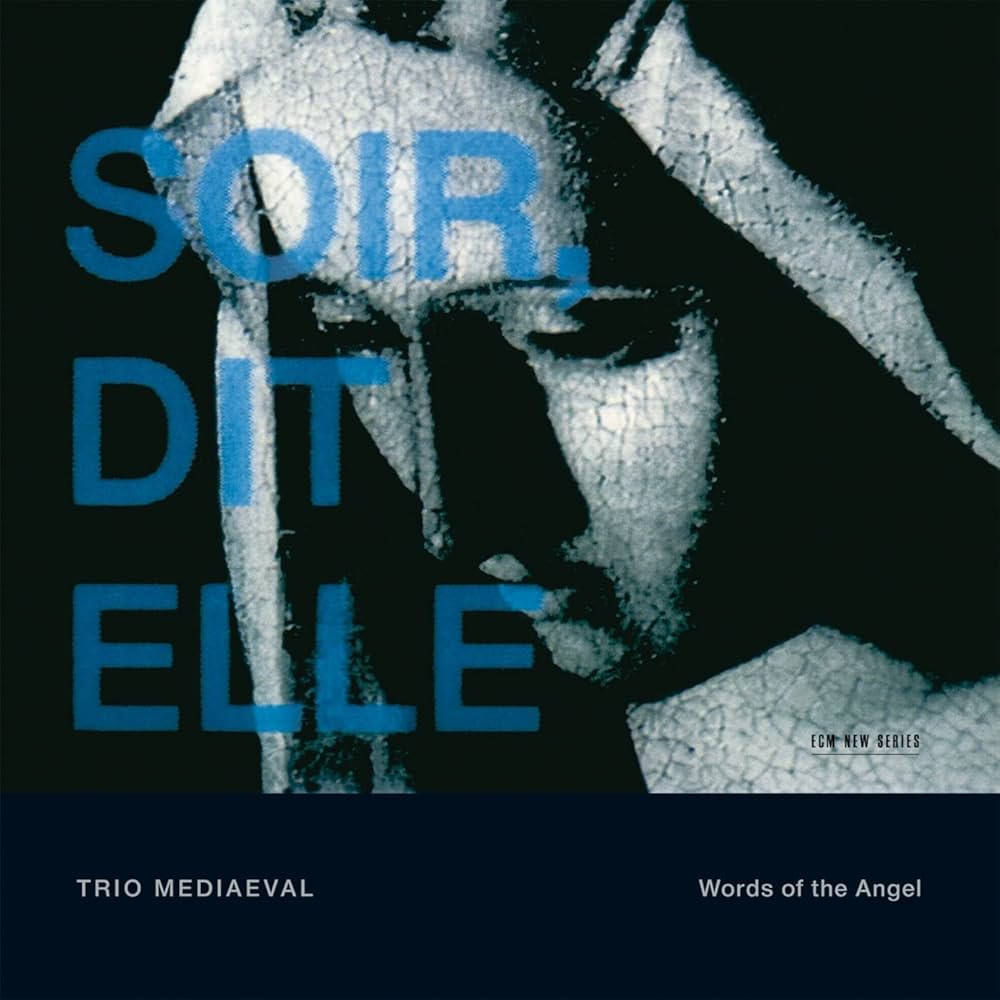
Three solos dot the program, each surrounded by luminescent swaths of divine vibrations. Of the chants, Salve mater misericordie is the brightest, and refracts light like a window into the Trio’s further projects. The words “Stella Maris” clearly stand out here, foreshadowing the title of their third album, while the cover art (a still from Godard’s Histoire(s) du cinéma) cues their second, Soir dit-elle. The Mass itself rests on a delicately consonant edge, ladling our attention between voices and the echoes they project. Nestled like a diamond in an already captivating program is the title piece by Ivan Moody. Dramatic key changes and a snake-like alto core make it one of the most intriguing pieces the Trio has recorded thus far.

Hailing from Norway, Trio Mediaeval honed their craft through focused study with the Hilliard Ensemble, who seem to have passed on not a small amount of adventurous spirit. Often compared with the now defunct Anonymous 4, the Trio walk a striking musical path uniquely their own. Sinuous drones and anchoring lines are gloriously configured, and articulations rendered with vivid care. Words of the angel deserve to be sung by voices of the angel, and here they most certainly are.

<< Andersen w/Tsabropoulos and Marshall: The Triangle (ECM 1752)
>> Kim Kashkashian: Hayren (
ECM 1754 NS)