Stephen Hartke: Tituli / Cathedral in the Thrashing Rain (ECM New Series 1861)


Stephen Hartke
Tituli/Cathedral in the Thrashing Rain

The Hilliard Ensemble
David James countertenor
Rogers Covey-Crump tenor
Steven Harrold tenor
Andreas Hirtreiter tenor
Gordon Jones baritone
Michelle Makarski violin
Lynn Vartan marimba, cymbals, shaker, cup bells, wood block
Javier Diaz marimba, cymbals, shaker, cup bells, wood block
Donald Crockett conductor
Recorded February 2003 at Mechanics Hall, Worecester, Massachusetts

Cease now, my mother, to torment yourself
in vain sobs of wretchedness all the day,
for such grief has not befallen you alone:
the same has befallen mighty kings as well.

From the First Punic War in Tituli (1999) to the dawn of World War I in Cathedral in the Thrashing Rain (2000), the music of American composer Stephen Hartke is firmly rooted in the intersection between the spatial and the temporal. It is about the vicarious presence of bygone eras engendered by their ruins; it is language as architecture, and architecture as history.

The Old Latin and Etruscan fragments of Tituli (scored for five solo male voices, violin, and two percussionists) were inscribed on pre-Imperial Roman artifacts: oracular and sacred law texts, cryptic offerings, and even a Palermo shop sign pass the Hilliards’ lips in a deft melodic oratory. In the opening “Lapis Niger,” every word rolls over the next with the perpetuity of an incoming tide. “Columna rostrata,” an account of Rome’s first major victory in Carthage, is the most dramatic section and rises like its titular structure into an audible testament of a fledgling empire. The tenderest moments are to be found in “Elogium parvuli,” an epitaph written for a six-year-old boy named Optatus, and for whom the music works its way darkly through every powerful sentiment in a beautiful twelve-minute lustration. The music of Tituli traces the contours of every word with archeological care. Violin and percussion make careful appearances, never intruding upon the texts at hand, and leave their deepest traces behind in the final two sections.

Cathedral in the Thrashing Rain for countertenor, two tenors, and baritone takes its direct inspiration from a poem by Japanese poet and sculptor Takamura Kōtarō (1883-1956), and appears here in a striking English translation (with some duplicate lines in Japanese) by the inimitable Hiroaki Sato. When I saw the Hilliard Ensemble live in 2004, they closed with this piece, leaving the audience spellbound. The concert began with a motet by Pérotin, which was written to be sung inside Notre-Dame, whereas here the sentiments are of a secular artist seeking shelter from the elements in the cathedral’s looming magnificence. Takamura cannot help but think of his homeland: “Storms are like this in my country, Japan, too,” he muses. “Only, we don’t see you soaring.” The chromatic flavor of Hartke’s setting surprises at every turn, treating each stanza as its own compositional bead on a long poetic necklace.

I have been a great admirer of Hartke since I first heard Michelle Makarski and Ronald Copes’s spirited rendition of the blues-inspired Oh Them Rats Is Mean in My Kitchen on New World Records. His acute and colorful music is resilient like a tightly knit sweater and just as comfortable to try on for size. His choral music represents a big development in a mostly instrumental oeuvre and these landmark performances are so precise and well recorded that one can almost smell the patina of age they wear. The Hilliards sing with unbridled conviction and even do a competent job with their Japanese enunciation, while the instrumentalists play with a subdued electricity all their own. This being ECM’s first Super Audio CD (SACD) recording, it practically begs to be listened to on the right equipment. Either way, its energy comes through just the same, taming our desire for the old and the new in one go.

Heinz Reber: MNAOMAI, MNOMAI (ECM New Series 1378)

Heinz Reber
MNAOMAI, MNOMAI

Thomas Demenga cello, viola
Terje Rypdal guitar
Jon Christensen drums
Tschin Zhang vocal
Ellen Horn vocal
Recorded October 1990, Rainbow Studio, Oslo
Engineer: Jan Erik Kongshaug
Produced by Manfred Eicher

The Swiss composer Heinz Reber (1952-2007) cut a fascinating figure in the world of sound. He began his career as a music therapist for psychiatric patients before turning to more public forms of audible expression. Reber would even combine the two in a 1975 play for Swiss radio, the cast of which was culled from those same patients. Such ruptures of identity would characterize his output to come. For the spiraling exegesis that is Mnaomai, Mnomai, Reber assembled a handful of equally committed (no pun intended) instrumentalists and vocalists for an intriguing mélange of sound and spoken word. The word mnaomai (pronounced “mnah’-om-ahee”) appears in the New Testament and means “to bear in mind” in Greek. Reber lifted his title from Jean-François Lyotard’s Libidinal Economy. Although the source texts are interesting in and of themselves—ranging from Beckett to Chinese protest poetry written by Tschin Zhang, one of the album’s vocal performers—they constitute a set of linguistic entities whose orthographic shapes are as equally important as their verbal ones. Thomas Demenga’s viola seems to struggle through its opening while a low groan stretches in the background. Demenga scrounges for phonetic footholds as Zhang’s voice rings out like a light to show the way. Jon Christensen and Terje Rypdal each take their own direct approach, even while Demenga continues to wrestle with his communicative role. Zhang’s voice soars through a field of strings with the surety of a homing pigeon, while that of Ellen Horn creeps in from above, percolating through Zhang’s as if to strip these languages of their semantic egos. Sometimes the voices are present, other times they are distant, but they never stray from their message. Part III consists of a repeated figure on viola, as if Demenga’s instrument has finally found a solid phrase and is reveling in its repetition. This is followed by a final spurt of poetic energy that fizzles out into a delicate cello strum.

In closing, I should like to address a concern I have over a particular way in which this piece has been interpreted. Mnaomai, Mnomai contains a fair amount of spoken Mandarin, and for those of us who don’t speak the language it’s all too easy to over-romanticize Chinese for its rhythms and other idiosyncrasies. This seemingly impenetrable barrier is further strengthened by the addition of Horn’s quieter recitations, of which Steve Lake writes: “When bringing Ellen Horn’s voice into the ensemble, Tschin Zhang’s poem was converted into Norwegian, another ‘alien’ tongue, to keep the text as a pure play of sounds.” But “pure” to whom? Surely, heritage speakers of either language will have a difficult time treating the text as a meaningless, if enchanting, jumble of phonemes. Rather, they will hear a skillful recitation of a heartfelt poem written in a time of great political upheaval. Are they somehow missing the point? I doubt it. In spite of Reber’s supposed interest in the “Far East,” I don’t feel as if he is using the world’s most populously spoken language just for the sound of it. Otherwise, what would be the purpose of using words at all? Chinese is itself no more “beautiful” or “musical” than any other language, and any assertions to the contrary are simply a matter of opinion. In the end, Reber cannot be said to be tapping in to some mystical linguistic core, but rather creating a new and personal juxtaposition of music and speech as a means of teasing out the narrative potential in both. Neither can we ignore that the musicians, and Demenga in particular, are also “speaking” through a multi-instrumental conversation. Still, I think Lake is getting at the heart of this record: namely, that language’s fundamentally arbitrary vocabularies are like composed matter—static and silent until they are enlivened by human rendering. It all comes down to the transparency of the utterance. This is music interested not in its legacy, but in its disintegration, for as the title reminds us, we do well to “bear in mind” that meaning exists only insofar as it holds our interest.

<< Werner Bärtschi: Mozart/Scelsi/Pärt/Busoni/Bärtschi (ECM 1377 NS)
>> Keith Jarrett: Dark Intervals (ECM 1379)

Harald Bergmann: Scardanelli (ECM New Series 1761)

Harald Bergmann
Scardanelli

Harald Bergmann Buch und Regie
Walter Schmidinger Sprecher

Scardanelli André Wilms
Ernst Zimmer Udo Kroschwald
Lotte Zimmer Geno Lechner
Waiblinger Baki Davrak
Schwab Jürgen Lehmann
Räuber Rainer Sellien
Marie Nathusius Amalie Bizer
Wurm Raimund Groß
Die Maske John Chambers
Dr. Gmelin Günther Weinmann
Tischlergeselle Gottfried Pipping
Zeuge Schwab Heinz E. Hirscher
Zeuge Waiblinger Ernst Specht
Zeugin Lotte Zimmer Gertrud Fritz
Zeugin Marie Nathusius Elisabeth Scheib
Sammler Wolfgang Rin
Erzähler 1 Hans Treichler
Erzähler 2 Egon Schäfer
Gedichte gesprochen von Walter Schmidinger
Recorded 1997-1998

“Yes, the poems are mine, I wrote them, but this name is a fake. I’ve never called myself Hölderlin, but Scardanelli!”
–F. Hölderlin

German filmmaker Harald Bergmann was born in 1963 in the town of Celle in Lower Saxony, and studied film in Hamburg and Los Angeles. With the exception of his latest film, all of Bergmann’s major work has been dedicated to the life and words of Scardanelli, better known as Friedrich Hölderlin. After the more experimental Lyrische Suite/Das untergehende Vaterland (1992) and Hölderlin-Comics (1994), which chart the poet’s childhood and early adulthood, Bergmann turned to the later years with Scardanelli (2000) to complete his Hölderlin trilogy. This last film explores Hölderlin’s declining mental state under the care of carpenter Ernst Zimmer, and takes great care to reconstruct the latter half of his life solely from extant witness accounts. For 36 years Hölderlin was holed up in Zimmer’s tower in Tübingen overlooking the Neckar River, where he spent his days at piano and paper, producing on both a continual stream of verses, sounds, and images, and it is precisely this creative sustenance the film seeks to capture. Hence the production of this CD, which selectively documents the film’s spoken and non-diegetic soundtracks. Moments of private insanity intermingle with dramatic readings of poetry against a backdrop of music by Mozart, Bach, Schubert, and scorer Peter Schneider. The result is a self-styled “audio book” by which Bergmann pays homage to his eponymous muse. The German-only booklet and dialogue means this album will have a limited audience, and those who don’t speak the language may wish to turn to ECM’s fine recording of the Scardanelli-Zyklus by Heinz Holliger in order to gain a deeper insight into the influential effects of one of Germany’s greatest literary minds.

<< Enrico Rava: Easy Living (ECM 1760)
>> Anders Jormin: Xieyi (
ECM 1762)

Tamia/Pierre Favre: de la nuit … le jour (ECM New Series 1364)

Tamia
Pierre Favre
de la nuit … le jour

Tamia voice
Pierre Favre percussion
Recorded October 1987, Rainbow Studio, Oslo
Engineer: Jan Erik Kongshaug
Produced by Manfred Eicher

Swiss percussionist Pierre Favre and vocalist Tamia combine forces here for their first ECM outing. Through a modest array of idiophones and objects both synthetic and organic, this uniquely synergistic duo makes music that is circumscribed yet wide in scope. Much of the album is cut from the same cloth. “Ballade,” “Yemanjá,” and “Maroua” all feature a thin gamelan-like drone that Tamia threads with a needle’s precision, sometimes in triplicate. Favre’s subtler elicitations bob like a wind chime under water and only occasionally break out into passages of rhythmic abandon. The title track is the profoundest statement this album has to offer. It undulates with an abstract mysticism through which a rare moment of unison is achieved to glorious effect. A bowed gong looms as Tamia’s voice flutters like a moth in darkness. And in this gloomy swell of introspection we find a clouded mirror that might reflect us were there any light to render us visible. “Mit Sang und Klang” mixes a similar concoction, climbing the scales to suspend its high notes from the very stars. “Wood Song” is the most evocative track with its orchestra of sticks, woodblocks, and brushes. Like a congregation of cicadas, the music rattles the leaves with its song. Hand drums and an African thumb piano add a touch of the open plains, aided minimally by Tamia’s histrionic touch.

While this is a difficult album to describe, its effect is anything but. Tamia is clearly at home among Favre’s multicolored sounds. She sings from deep within the chest, producing some of the most skillful ululations I have ever heard. She treats her voice like an instrument, a physical object, in a way that singers rarely do. Her carefully controlled mantras tear the darkness like a frayed seam and waste no time in letting the light in before bringing about their own expiration. The atmosphere is pure magic and as well suited to twilight as it is to a sunrise at dawn.

<< Bach: Das Wohltemperierte Klavier, Buch I – Jarrett (ECM 1362/63 NS)
>> The Paul Bley Quartet: s/t (ECM 1365)

A Hilliard Songbook (ECM New Series 1614/15)


The Hilliard Ensemble
A Hilliard Songbook: New Music For Voices

The Hilliard Ensemble
David James countertenor
Rogers Covey-Crump tenor
John Potter tenor
Gordon Jones baritone
Barry Guy double-bass
Recorded March/April 1995, March 1996 at Boxgrove Priory, Chichester
Engineer: Peter Laenger
Produced by Manfred Eicher

Those who approach this album like I did—that is, only after listening to the Hilliard Ensemble’s many early music recordings—may be in for a surprise. Whether that surprise is a pleasant one or not may depend on the listener’s openness to new sounds. The opening convulsion that is Barry Guy’s aphasic Un coup de dés would seem to foreshadow a bumpy ride. Its whirlwind of extended double bass techniques and choral acrobatics leaves us hard pressed to find our bearings. The score, Guy tells us, encourages improvisation and even the modification of what has already been written. Using a section from a Mellarmé poem, which likens the process of thought to a mere dice-throw, the piece works its way into our ears like a dwarfing star. It is abstract, agitated, and unsettling, yet full of gracious detail we cannot help but enjoy. The Hilliards demonstrate that they can execute a piece of such technical difficulty and “modern” sensibility with as much fluidity as they approach their more familiar repertoire—at least insofar as their recordings are concerned, for they have always been known for juxtaposing contemporary works with those of bygone ages in their live performances. And then we get the short and sweet Only, the earliest published composition of Morton Feldman. In less time than it takes to microwave a frozen dinner, we are utterly transported by Feldman’s visceral melodic rendering of a Rilke sonnet, brought to its fullest fruition through the angelic voice of Rogers Covey-Crump. It is a folk song for its own sake, a funereal hymn for the living. This sets off a spate of shorter pieces by Ivan Moody and Piers Hellawell. Moody’s viscous miniatures live up to the composer’s name, taking us through a range of emotional colors. Endechas y Canciones sets Arabic-Spanish poetry from the 15th and 16th centuries. The second of these, “Endechas a la muerte de Guillén Peraza,” is a dirge from the Canary Islands that pulls at the heartstrings with a pace slow and focused, like moderated speech. The Hilliard Songbook by Hellawell, on the other hand, is a whimsical journey through A Treatise Concerning the Arte of Limning by Nicholas Hilliard (1547-1619), the celebrated Elizabethan portraitist. This is the centerpiece of the album, both in title and in song. The treatise’s idiosyncratic descriptions of color inspired the composer to recreate those very colors with voices. Regulating the piece is a refrain taken up each time by one member of the ensemble: “True beautie of each perfect cullor in his full perfection in perfect hard bodies and very transparent.” Through this many-hued ode we are given valuable insight into not only the Hilliards’ vocal art, but also into the visual mind of their namesake.

Of the longer pieces represented here, Paul Robinson’s Incantation is textually the broadest. The words are adopted from Byron’s poem of the same name—what Robinson calls a “vitriolic curse”—through which the composer sought to foreground the Hilliards’ sonority over the work being performed. As the music marks its slow path through a rather morbid text, we feel the voices blend into a single destination. Kullervo’s Message, by Estonian composer Veljo Tormis, recounts a dramatic episode from The Kalevala, Finland’s nineteenth-century national epic. From a line of skillfully harmonized textual lifts, Tormis hangs a series of messages by which the eponymous tragic hero is informed of the deaths of his loved ones, even as he prepares to exact his revenge upon those whose ridicule led him to such self-destructive fervor. Tormis’s melodic and programmatic colors are ideally suited to their source material, moving with the virtuosity of a master storyteller. Scottish composer James MacMillan offers his own epic statement in the form of …here in hiding…, a deceptively simple mesh of the poem “Adoro te devote” by St. Thomas Aquinas in both its Latin and English forms.

The remaining pieces comprise a flavorful mixture of words and musical ideas. Two exemplary statements from Arvo Pärt, And One Of The Pharisees… and the splendid vocal version of Summa, make fine company of Elizabeth Liddle’s Whale Rant, which takes its cues from Moby-Dick, and works its music like clock hands, with one arm counting the hours while another traces a faster, larger circle. The second hand becomes invisible, implied only in the vocal gestures of the sensitive performance, and is forever lost in the ocean of its source. Joanne Metcalf’s Music For The Star Of The Sea, is a thinly veiled meditation on the words “O ave maris stella” (“O hail star of the sea”) that extends the possibility of a single utterance into a vast Marian fabric. Sharpe Thorne by John Casken paints an image of Christ impaled, while Michael’s Finnissy’s Stabant autem iuxta crucem praises the one who bore him. And in Canticum Canticorum Ivan Moody again dazzles with this setting of verses from the Song of Songs and its loving incorporation of Byzantine chant.

Those wishing to hear the range of the Hilliards’ technical prowess will want to check out this collection for sure. This humble quartet sings with such clear articulation of phrase that one accepts every note like the nourishing morsel it is. While the music is for the most part contemplative and lovely, never ceasing to fascinate even at its least accessible moments, much of it feels spun from the same thread. The pieces by Ivan Moody stand out here as being the most well thought out and textually aligned, while the Hellawell, Tormis, and Guy enchant with their distinctive flair. That being said, it seems a shame to think that cultures outside a Eurocentric Judeo-Christian context should be shunted here. Considering that nearly all of these pieces were written for the Hilliard Ensemble, and that some of their composers were involved in the Hilliard Summer School led by the ensemble in residency, a narrow scope is perhaps understandable. Geographical limitations aside, the traveling instinct is still there in the Hilliards’ adventurous spirit, captured in every flawless phrase, in every committed performance that continues to issue from their very throats.

<< Evan Parker EAE: Toward the Margins (ECM 1612 NS)
>> Dino Saluzzi: Cité de la Musique (ECM 1616
)

Steve Reich: Octet / Music for a Large Ensemble / Violin Phase (ECM New Series 1168)

Steve Reich
Octet / Music for a Large Ensemble / Violin Phase

Russ Hartenberger marimba
Glen Velez marimba
Gary Schall marimba
Richard Schwarz marimba
Bob Becker xylophone
David Van Tieghem xylophone
James Preiss vibraphone
Nurit Tilles piano
Edmund Niemann piano
Larry Karush piano
Steve Reich piano
Jay Clayton voice
Elizabeth Arnold voice
Shem Guibbory violin
Robert Chausow violin
Ruth Siegler viola
Claire Bergmann viola
Chris Finckel cello
Michael Finckel cello
Lewis Paer bass
Judith Sugarman basse
Virgil Blackwell clarinet
Richard Cohen clarinet
Mort Silver flute
Ed Joffe soprano saxophone
Vincent Gnojek soprano saxophones
Douglas Hedwig trumpet
Marshall Farr trumpet
James Hamlin trumpet
James Dooley trumpet
Recorded February 1980 at Columbia Recording Studios, New York; March 1980 at Tonstudio Bauer, Ludwigsburg (Violin Phase)
Engineer: Martin Wieland
Produced by Manfred Eicher

Have you ever repeated a word over and over again until it loses meaning? Cognitive science calls this “semantic satiation.” Now imagine that someone could do the same thing for instruments and you’ll have a clear idea of the power of a Steve Reich composition. In this selection of three longer examples, we get exactly that: an unraveling of music’s genetic code, transformed from within. It is for this more than any other reason that I’ve always been wary to use the word “minimal” in reference to Reich’s music, which is endlessly complex and never fails to engender new discoveries with every listen.

The instruments in Music For A Large Ensemble fit perfectly in a vast sequence of aural DNA, as logical as it is mystifying. Every voice is given ample breathing room in a piece that, while densely layered, is as airy and ordered as a puff of windblown dandelion. Strings waver with the unrelenting heat of a desert sun, horns ebb and flow in a brassy wash of equilibrium, and a vibraphone rings out like magic over all. Although the music moves mechanically, its feel is decidedly organic. This earthiness is maintained in the Violin Phase, which consists of a repeated motif that, as with all of Reich’s “phase” pieces, is knocked just slightly out of alignment by the doubling voice, like two turn signals rhythmically staggering and realigning. This is the most localized of Reich’s phases, clearly rooted as it is in the bluegrass fiddling tradition. The violin grinds like dirt or sand, small particles swirling and separating yet holding fast to some invisible predictability. After two such strikingly different pieces, the Octet somehow comes across as the most intimate. The inclusion of wind instruments, and in particular the clarinet and flute, adds a crystalline contrast in texture and melodic shifts, bringing us to a glorious and sudden silence.

Albums like this and Music for 18 Musicians will easily make one lose track of time. I am so often taken aback when this music ends, for it pulsates with such a robust sense of perpetual motion that its effect always seems to linger somewhere inside me. It is a tessellation in sound, each image shifting through time and space like an Escher print, so that what begins as a diamond ends up a bird in flight. Naturally, the sheer precision required to play Reich’s music is a feat in and of itself. That such a synergistic cast of musicians could arise out of the work of one composer is by all turns spectacular, and when so lovingly recorded their cumulative effect is all the more heightened. This is music that finds its expansiveness internally, charting the endless waters of our biological oceans until we come to our beginnings anew.

Peter Ruzicka: String Quartets (ECM New Series 1694)

Peter Ruzicka
String Quartets

Arditti Quartet
Irvine Arditti violin
Graeme Jennings violin
Garth Knox viola
Rohan de Saram cello
Dietrich Fischer-Dieskau speaker
Recorded December 1996 and October 1997, WDR Cologne and Immanuelkirche Wuppertal
Engineers: Mark Hohn and Christian Meurer
Produced by Harry Vogt (ECM co-production)

“Die Musik in mir.
Die Musik, die im Schweigen ist, potentiell,
möge sie kommen und mich erstaunen.”
–Paul Valéry

In astrophysics, basic string theory posits that the known universe can be understood through a successful marriage of quantum mechanics and general relativity. Each “string” represents a unique atomic signature with which all physical matter is composed through vibrational fields. In order to explain string theory to us laypeople, physicists analogize these vibrations with those of an instrument: each string is capable of producing a variety of notes depending on where the cosmic finger is placed on the fretboard. The string quartets of German composer and conductor Peter Ruzicka, collected for the first time in this landmark recording, demonstrate this theory with and without words. Through a distinct micropolitics of sound, Ruzicka uses instruments not to make a declamatory statement, but to evince an unstable question. The title of Ruzicka’s third quartet, …über ein Verschwinden (…about a disappearance), is about as succinct a description as one could hope to formulate in regards to his music. Ruzicka’s sound world is sparse, comprised as much by empty spaces as by audible gestures. These spaces, the very ether through which the music flows, are rich with conceptual integrity.

This is music that inhabits its own edges. It bids our silence when it speaks, provokes our speech when silent. The quartets are riddles in and of themselves, even if they contain everything we need for their solutions in plain view. The keys are in the titles. Klangschatten (Soundshadows) is more about effect than about process and seems to disavow its own origins by reflecting those of the listener, separating these two histories with a huge sheet of darkness. The second quartet, „…fragment…”, is a laconic pentaptych of self-styled “epigrams.” Introspezione, subtitled as a “documentation for string quartet,” navigates an introspective matrix filled with quotation marks, question marks, and exclamation points, but not a single period. The fourth quartet, „…sich verlierend” (…are losing) for string quartet and speaker, is an intriguing anomaly. Because so much of Ruzicka’s music is already “spoken,” the entry of a human voice seems quite natural, as if it had been there all along. The music is not incidental to the voice, but rather the voice incidental to the music.

In his liner notes, Thomas Schäfer informs us of Ruzicka’s disinterest in grand narratives and his preference for the in-between. For all their galactic reach, the quartets are utterly rooted in the terrestrial. The third quartet, for example, sounds like George Crumb’s Black Angels stripped of its explosive core and shredded by wind. Violins scratch out their incantation, figures moving in crude stop-motion. Other quartets abound in allusions from Gesualdo to Mahler to Webern in what the composer terms moments of “full identification.” Ironically, however, in such surroundings even the most familiar music seems to come from a distant planet, having reached us by some unimaginably powerful intergalactic signal. And when we do recognize it, we are awed to learn it has come from an abstract “out there.” In the end, it is silence that rules this album, so that any violence that erupts consumes us completely. These are the moments Ruzicka would seem to live for, when the intensity of experience can only be expressed by its sudden disappearance.

<< Evan Parker Electro-Acoustic Ensemble: Drawn Inward (ECM 1693)
>> Patrick and Thomas Demenga: Lux Aeterna (ECM 1695 NS
)

Eleni Karaindrou: Elegy of the Uprooting (ECM New Series 5506 & 1952/53)

Eleni Karaindrou
Elegy of the Uprooting

Maria Farantouri voice
Vangelis Christopoulos oboe
Socratis Sinopoulos Constantinople lyra, laouto
Maria Bildea harp
Konstantinos Raptis bayan
Sergiu Nastasa violin
Renato Ripo violoncello
Stella Gadedi flute
Nikos Guinos clarinet
Sopcratis Anthis trumpet
Spyros Kazianis bassoon
Vangelis Skouras French horn
Aris Dimitriadis mandolin
Christos Tsiamoulis ney
Panos Dimitrakopoulos kanonaki
Andreas Katsiyiannis santouri
Andreas Papas bendir, daouli
Eleni Karaindrou piano
Hellenic Radio and Television Choir
Antonis Kontogeorgiou choirmaster
Camerata Orchestra
Alexandros Myrat conductor
Recorded live March 27, 2005 at Megaron (Hall of the Friends of Music), Athens
Engineers: Nikos Espialidis, Andreas Mandopoulos, and Bobby Blazoudakis
Produced by Manfred Eicher

“What am I, if not a collector of vanished gazes?”
–Theo Angelopoulos, Ulysses’ Gaze

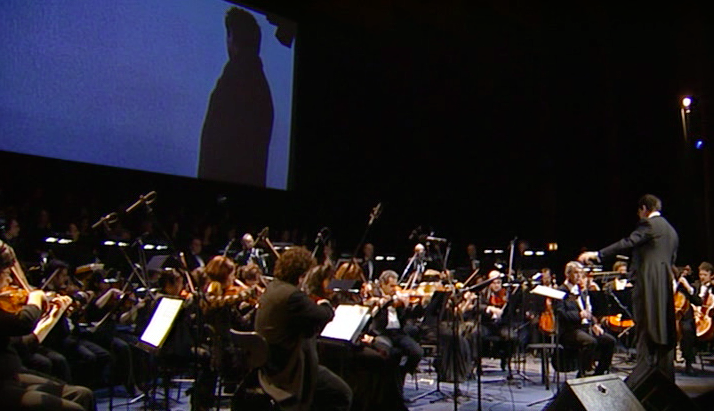
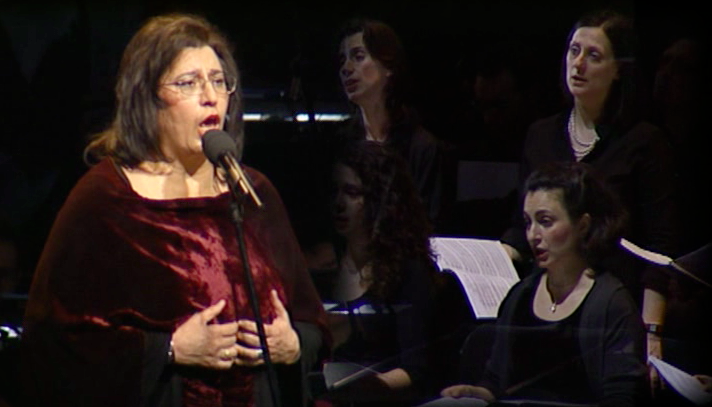
Elegy of the Uprooting condenses two decades of work by Eleni Karaindrou into what the Greek composer calls a “scenic cantata.” This is no mere retrospective, but a gravid musical statement in which the listener’s soul is carefully unfolded to reveal the sounds hidden within. Excerpting 13 scores for film and stage, this concert pulls out the red threads running through Karaindrou’s non-diegetic oeuvre with stunning video and audio clarity.

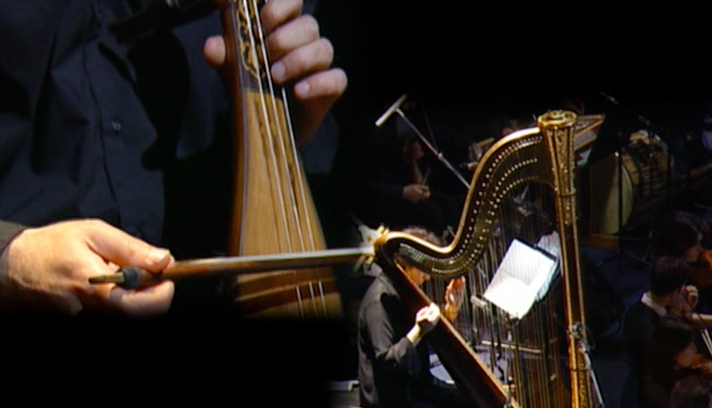
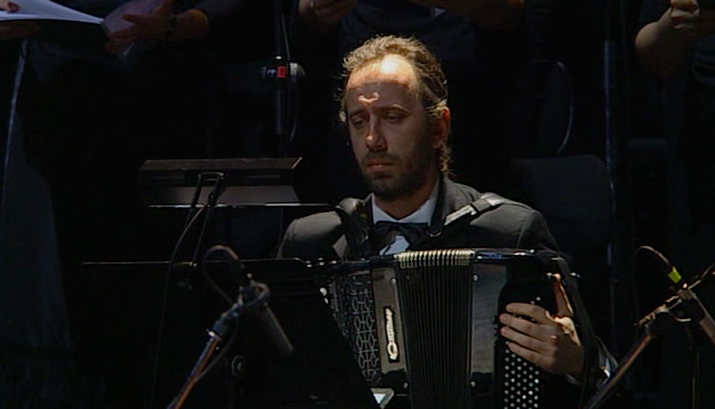
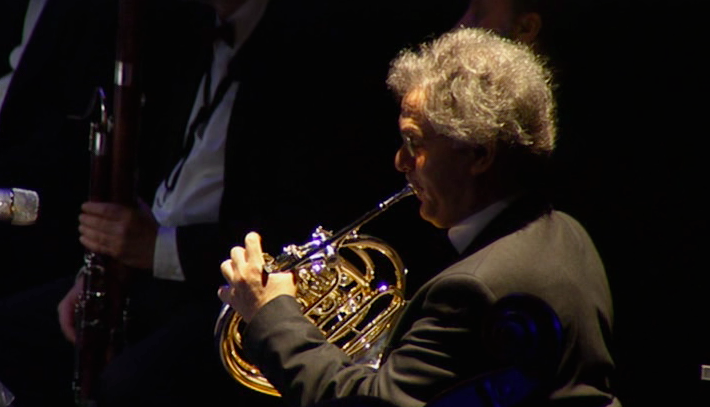
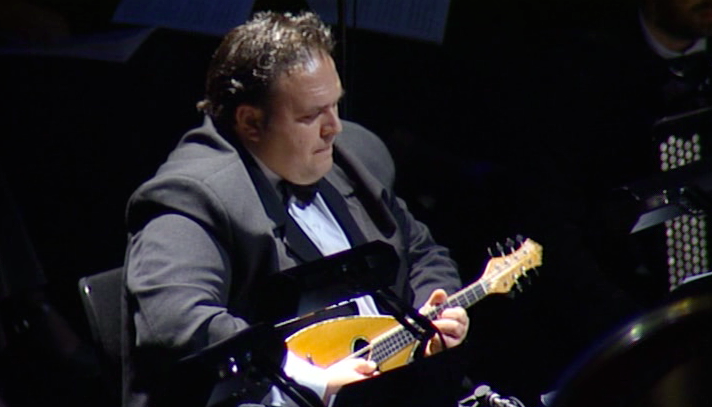
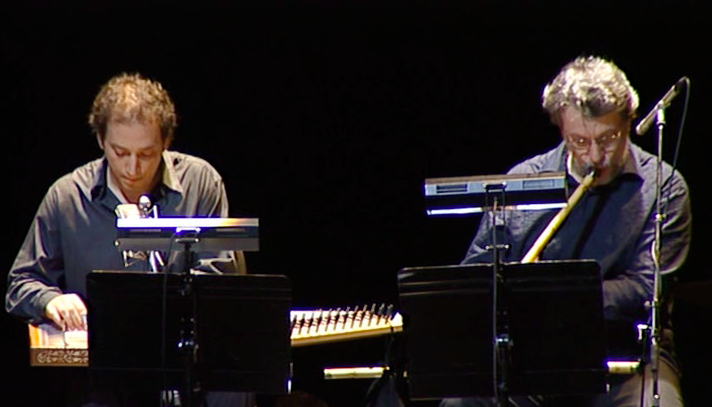
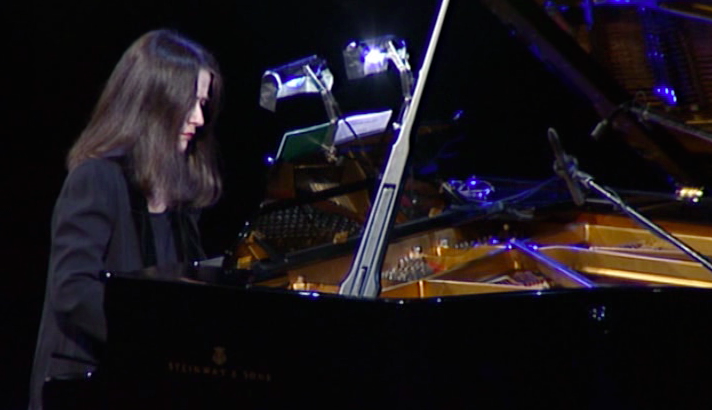
Of the 110 musicians seen in this live DVD—including an orchestra, chorus, and ensemble of traditional instruments—many of the soloists have been working with Karaindrou for many years, and their dedication shows. Of note are…

Vangelis Christopoulos on oboe:

Socratis Sinopoulos on the Constantinople lyra/Maria Bildea on harp:

Konstantinos Raptis on the bayan:

Vangelis Skouras on French horn:

Aris Dimitriadis on mandolin:

Panos Dimitrakopoulos on kanonaki/Christos Tsiamoulis on ney:

and the composer herself at the piano:

Much of the music will be familiar to ECM enthusiasts: Ulysses’ Gaze, The Suspended Step of the Stork, Eternity and a Day, The Weeping Meadow, and Euripedes Trojan Women feature heavily in this wide-ranging program, with the latter two in particular providing a larger thematic framework. Lesser known works such as the stunning Rosa’s Aria—from the film by Christoforos Christofis and reinterpreted here with total corporeal commitment by the legendary Maria Farantouri—should excite veteran and new listeners alike.

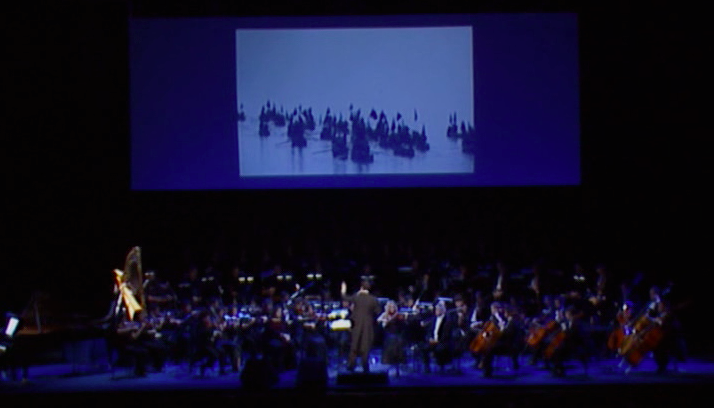
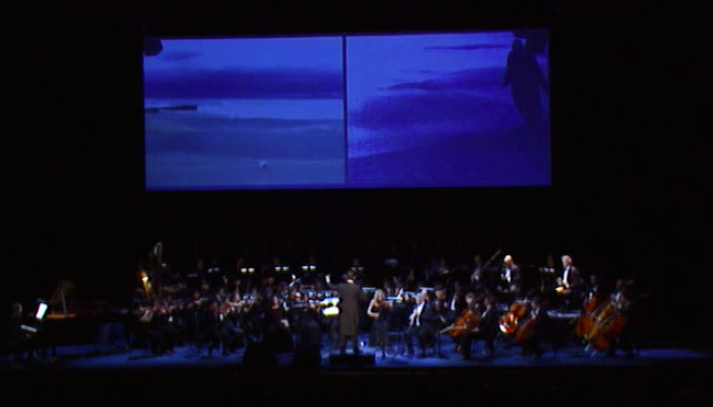
The staging was overseen by Manfred Eicher and is accordingly minimal. A large screen behind the musicians displays artfully arranged stills and clips from Angelopoulos’s films, as well as some computer generated imagery of swaying reeds, falling rain, and shooting flames.

It’s a joy and a privilege to see such a synergistic group of musicians banding together to share such doleful beauty, and to see the physical process of it all, the sheer assembly of talent and logistics required in putting together such a performance.

In all this rhetoric lately of carbon footprints and the detrimental impact of human activity on the physical environment, it’s easy to forget that our creativity often leaves the most “eco-friendly” impressions. Karaindrou has created for the world a statement without tangible shape, a visceral wave of melancholy into which we may project a semblance of ourselves. Like the water that figures so prominently in Angelopoulos’s films, her music ebbs and flows in spite of our foibles.

Elegy of the Uprooting is also available in this 2-CD set. I highly recommend both, for each is its own experience.

Kim Kashkashian: Neharót (ECM New Series 2065)


Neharót

Kim Kashkashian viola
Münchener Kammerorchester
Alexander Liebreich conductor
Boston Modern Orchestra Project
Gil Rose conductor
Kuss Quartett
Recorded between 2006 and 2008 in the USA, Poland, and Germany
Engineers: Peter Laenger, Lech Dudzik, Gabriela Blicharz, Joel Gordon, John Newton, Blanton Alspaugh
Produced by Manfred Eicher

Neharót Neharót (2006/7) for viola solo, accordion, percussion, two string ensembles and tape by Israeli composer Betty Olivero opens a haunting album from violist Kim Kashkashian. It is a slow awakening—not into light, but into twilight—and swells with the wounds of fresh tragedy. Kashkashian arrives as if by wind and with the raw imperfection of an unpreened bird. The tone and feeling are not unlike that of John Tavener’s The Protecting Veil at its tensest moments. The strings roil like turgid waters in which eddy the relics of an unseen war. Two women’s voices reach into the storm with tendrils of mimicry. This call and response blossoms into a profound moment of rupture, at which point the orchestra and percussion spill over one another. Fragments of the audible past come through as snatches of Monteverdi quoted from his Orpheus and eighth book of madrigals. These recycled motifs are like a dream that quickly consumes itself before waking again. The viola rises in their place, seeming to run around frantically in search of the voices that so enlivened it. When they are nowhere to be found, the outcast wallows in the hopes that nightfall will be her cloak. But then the voices come back: the viola prostrates itself, fearing to expend the ancestral legacy it breathes. It wants nothing more than to offer gratitude, but can only contort itself into a vowel of need.

After such a profoundly draining journey, the three Armenian selections that follow are a welcome rest, though one not without its internal travels. Tigran Mansurian gives us his Tagh for the Funeral of the Lord for viola and percussion, Three Arias (Sung out the window facing Mount Ararat) (2008), and Oror, a lullaby by Komitas (1869-1935) arranged and performed here by Mansurian at the piano. The “tagh” is an ancient Armenian song, and Mansurian’s breathes with organic vitality. Its lament echoes across cold plains, the percussion a mere accent to the viola-driven melody. The Three Arias are essentially a series of orchestral swells with viola interludes, an audio essay of the music’s own origins and possible futures. The viola acts like a lens over a film sheet, trying to find the one picture that most clearly articulates something that can only be remembered through image, but that can only be musically described. The viola struggles with an unseen force in spite of its orchestral inheritance. A dazzling ending is made all the more so for the effort required of us to get there. And this is precisely what the piece is about: seeking out those moments that, in a life remembered, also define that life most clearly. Mansurian’s interludes are like the passage between two days, a conduit between continents and cultures, a subtle diaspora of sound.

And so, by the time we return to Israel in Eitan Steinberg’s Rava Deravin (2003) for viola and string quartet (the tile means “Favor of Favors”), we feel more fully prepared for any and all emotional obstacles. The piece was originally scored for voice and a mixed chamber ensemble, but was transcribed as the current version at Kashkashian’s behest; hence the accordion-like opening harmonics that speak of bellowed breath. Yet even before the music begins, the instrumentation tells us so much about what we are about to hear. We know the viola soloist has a second self, a ghost presence amid its accompanying quartet, and yet here it is at once extracted and embedded in its periphery, singing with its own voice even while knowing it has been long aligned with the larger organism behind it. When the quartet takes a more syncopated stance, we never lose sight of the abstract milieu in which it is situated. The viola must resign itself to self-division, and toward the end it squeals and scatters snake-like through tall grasses of harmonics. The music dies not by lowering itself in volume, but by pushing us away so gradually that by the time we notice the music has gone, we are already too far away to catch up with it.

Were the orchestra to be analogized as body, the viola would most certainly be the throat, for the vibrations of song rattle its chambers more than those of any other. In this respect, Kashkashian has given more lucid breath to this recording than to any other she has made. She only seems to get better with every draw of her bow, and her dedication once again remains paramount. This is a cohesive program of some of the most original music to come out of ECM in a long time. Not to be missed.