Eberhard Weber: Later That Evening (ECM 1231)

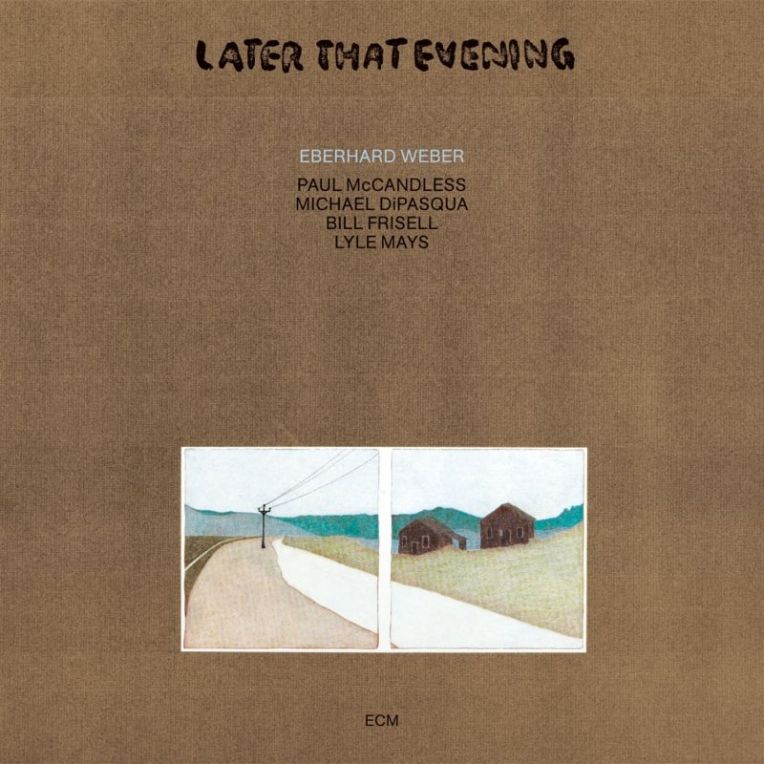
ECM 1231

Eberhard Weber
Later That Evening

Eberhard Weber bass
Paul McCandless soprano saxophone, oboe, English horn, bass clarinet
Bill Frisell guitar
Lyle Mays piano
Michael DiPasqua drums, percussion
Recorded March 1982 at Tonstudio Bauer, Ludwigsburg
Engineer: Martin Wieland
Produced by Manfred Eicher

If you’ve ever stared at a body of water and been entranced by the play of reflections on its surface, then your ears will appreciate the sonic equivalent thereof on Eberhard Weber’s Later That Evening. Though one misses on this date the unmistakable sweep of Rainer Brüninghaus’s keys, in his place we get the likeminded sensitivity of Lyle Mays alongside the various reeds of Paul McCandless and interstellar meows of Bill Frisell. Completing this sonic package are Michael DiPasqua on drums and of course Weber himself in a sweep of a different kind on his leading electro-bass. Over the course of four Weber originals, averaging nearly 11 minutes each, this never-repeated ensemble lays down some of his farthest-reaching tracks ever committed to disc.

Mays scrims his shaw within the first minute of “Maurizius,” one of two shorter extensions in the album’s liquid flow. Riding a foamy wave of cymbals and English horn, Frisell’s blurry curls find solace in the darkening sky, which pushes the sun down silently behind the middle horizon all the way to the title track, where Weber’s bass winds into its fleshiest expressions. Yet it is in that middle horizon where this set’s true richness is disclosed. The ghostly voices that open “Death In The Carwash” seem to approximate footsteps, each traced by soprano saxophone. Weber’s gorgeousness stretches this elastic band to a state of near-snap as Frisell and Mays weave their growing kinship into the trampoline from which Mays springs, arms spread. Back on the ground, “Often In The Open” finds piano and drums in a darkly grained dialogue. The drumming picks up quietly, suddenly, stringing soprano by spidery pulls from guitar, leaving us in a circular theme from McCandless, who finishes alone.

One can always expect fluidity from Weber, and the music on Later That Evening is no exception. It cages the air like waterspouts in the distance, kept at bay from their potential destruction through a screen of remembrance.

<< Don Cherry/Ed Blackwell: El Corazón (ECM 1230)
>> Chick Corea: Trio Music (ECM 1232/33)

Don Cherry & Ed Blackwell: El Corazón (ECM 1230)

Don Cherry
Ed Blackwell
El Corazón

Don Cherry pocket trumpet, piano, melodica, doussn’gouni, organ
Ed Blackwell drums, wood drum, cowbell
Recorded February 1982 at Tonstudio Bauer, Ludwigsburg
Engineer: Martin Wieland
Produced by Manfred Eicher

Two powerful proponents of the avant-garde—Don Cherry and Ed Blackwell—bare their tender souls on this set for trumpet and drums. While on paper this looks like an unusual combination, one thinks nothing of it once they start playing. Blackwell’s approach to his kit is melodic enough to carry its own, and the superb engineering gives him a wide berth, ensuring that every element has its place. Cherry’s sidelong glances into piano, melodica, and organ, meanwhile, provide plenty of traction in the duo’s more adventuresome tunes. Blackwell slips only into samplings of rat-a-tat-tat sumptuousness, favoring instead headlong flights into innumerable and equally favorable directions. The opening cluster of tunes is calm but never restrained. Allowed to go where it may, it swings and stomps in the same fluid motion. On trumpet, Cherry works in arcs, while on piano he finds solace in sharper angles. The melodica-infused “Roland Alphonso” carves its delicate reggae lines into a pathway toward the more monochromatic “Makondi,” a brief incantation led by kalimba, which sweeps silently under Blackwell’s solo in “Street Dancing” before reemerging in “Short Stuff.” The latter sets off another trio of interlocking themes, cinched by Cherry’s clear-as-day trumpeting, and bringing us to  “Near-In.” This enchanting kalimba solo, dedicated to Blackwell’s daughter, debunks the myth of thumb pianos as touristy curios left unplayed on our shelves by laying its potential thick across common misconception. Cherry ends on a high note, literally, with “Voice Of The Silence,” a gentle yet declamatory trumpet solo, drawn into trailing threads by a tasteful appliqué of reverb. A rather heavenward ending to an otherwise firmly rooted chain of scenes.

Like sugarcane stripped of its husk, this is immediate music, pared down to its fibrous core, and in some ways feels like a child of CODONA taking its first well-formed steps into a sonic life. In the end, it’s really Cherry who provides the rhythmic impetus for this collaboration, and Blackwell the lead. Such comfortable switching out of roles is central to their message of liberation and expression.

<< Keith Jarrett: Concerts – Bregenz/München (ECM 1227-29)
>> Eberhard Weber: Later That Evening (ECM 1231)

Gary Burton Quartet: Picture This (ECM 1226)

ECM 1226

Gary Burton Quartet
Picture This

Gary Burton vibraharp
Jim Odgren alto saxophone
Steve Swallow bass guitar
Mike Hyman drums
Recorded January 1982 at Columbia Recording Studios, New York
Engineer: Stan Tonkel
Produced by Hans Wendl

As I listened to Picture This for the first time, spring had just begun, and the music could hardly have been more fitting. Like an animal emerging from hibernation, its joyous frolics resonate in heart and mind with equal wit. Burton’s breath of fresh air is easy on the ears, never bogging us down with overly intellectual presumptions. For this transient quartet, he finds himself fronting a trio comprised of Jim Odgren on alto sax, Steve Swallow on bass, and Mike Hyman on drums. The mingling throughout from the two leads makes for some evocative motives and adds a curl to every letter written.

Burton never ceases to captivate, for here is a musician who is so—if you will excuse the pun—vibrant on his own terms, yet allows balance to flourish wherever he may be. Take, for instance, this new spin on the Carla Bley classic “Dreams So Real,” on which his presence is so integral yet so unassuming that at times one hardly notices, providing as he does only those key anchors needed for Odgren’s lithe restraint, only to unleash a primary force when soloing. This is the first of a few dips into the work of Burton’s favorite composers. Another, even deeper, plunge comes in the form of “Waltz.” This spindly Chick Corea tune cycles through far more rhythmic variations than its rudimentary title would indicate, and also sports a leapfrogging solo from Swallow that is by far the album’s highlight. Swallow also makes fine work of “Duke Ellington’s Sound Of Love” (Charles Mingus), where his lyrical sway is flexible enough to support both Burton’s superbly attenuated malleting and Odgren’s beautiful reed work. The latter makes a winner out of “Tanglewood ’63” and lends itself to the saxophonist’s own two offerings, “Tierra Del Fuego” and “Skylight,” both gifts of pure delight wrapped in bright melodic bows.

Burton has uncovered some of the most potent melodies in ECM’s dense and knotted trees. Every strike of his mallet is like a woodpecker, revealing that which only the most attuned ears can hear.

<< Dewey Redman Quartet: The Struggle Continues (ECM 1225)
>> Keith Jarrett: Concerts – Bregenz/München (ECM 1227-29)

Dewey Redman: The Struggle Continues (ECM 1225)

ECM 1225

Dewey Redman
The Struggle Continues

Dewey Redman tenor saxophone
Charles Eubanks piano
Mark Helias double-bass
Ed Blackwell drums
Recorded January 1982 at Columbia Recording Studios, New York
Engineer: David Baker
Produced by Robert Hurwitz

Somewhere along the way, Dewey Redman must have lost an “e” from his last name, for he was a reedman if ever there was one. A self-taught Texas boy, he was already playing with Ornette Coleman by his teens. Still reeling, I imagine, from the two Old and New Dreams joints produced by ECM just a few years before, listeners were sobered by an unforgettable experience with The Struggle Continues—an experience felt afresh when the album was at last reissued on CD in 2007, just one year after Redman’s death.

Those Coleman roots spring right from the soil and grab us in “Thren.” Bookended by a frolic and a march, its fancy footwork from bassist Mark Helias and edgy pianism from Charles Eubanks make sure we aren’t going anywhere. All of this is just a pretext, of course, to get us hooked before Redman presses a saxophonic iron into the wrinkles of “Love Is.” Like a new morning in suburbia, its speaks its promises in voices calm and familiar, the brushed drums moving our worries into the gutter like a street sweeper, the sun peaking over the distant hills and stretching its light to those less fortunate. Eubanks is as rosy as ever in a cut that, as the album’s longest, makes it clear where the band’s heart truly lies. Things get even steamier in “Turn Over Baby.” Raw and curvaceous equation that it is, it fronts smoldering lines above Ed Blackwell’s watery cymbals, further fueled by the passions of “Joie De Vivre.” Legato phrasings on tenor only heighten the punctilious quality of the rhythm section and its inspiring uplift into “Combinations,” the latter a tangled yet pleasing confection with a sweet bass center and drummed sprinkles on top. The not-so-secret ingredient is Redman himself, who samples every course before licking his plate clean in an upright rendition of Charlie Parker’s “Dewey Square.”

As someone so utterly attuned to everything going on, around, and within him, Redman was almost peerless for his time, and seemed only to grow in the context of this one-off combo. “At the top of their game” is not a phrase one need apply to these players, for by the time we encounter this music they’ve already scaled down the other side of the mountain and climbed another. One feels they could have easily extended each of these tunes to an album’s length. As it stands, the final set connects its dots in perfect time.

This is by far one of the swingingest albums in the ECM backlog, and is anything but a struggle. Its fluid, forward-looking, and stichomythic playing is its own history. Produced by the great Bob Hurwitz, then head of ECM’s American operations and now president of Nonesuch, this one will stand the test of age.

<< Enrico Rava Quartet: Opening Night (ECM 1224)
>> Gary Burton Quartet: Picture This (ECM 1226)

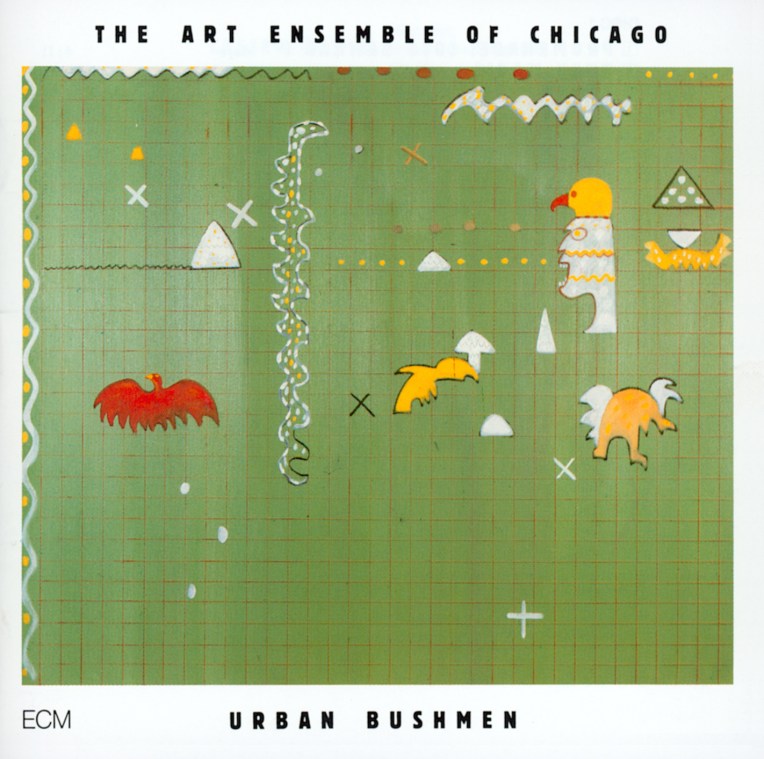
Art Ensemble of Chicago: Urban Bushmen (ECM 1211/12)

ECM 1211_12

Art Ensemble of Chicago
Urban Bushmen

Lester Bowie trumpet, bass drum, long horn, vocals
Joseph Jarman saxophones, vocals, clarinets, bassoon, flutes, percussion
Roscoe Mitchell saxophones, flute, percussion, clarinet, vocals
Malachi Favors Maghostus bass, percussion, melodica, vocals
Famoudou Don Moye sun percussion, vocals
Recorded May 1980, Amerika Haus München
Engineer: Martin Wieland
Produced by Manfred Eicher

While the breadth of the Art Ensemble of Chicago’s palette is certainly astonishing, what distinguishes the group from so many others is not a matter of quantity but of stride. Like its acronym, the heart of the 1980 performance recorded here is a trio of creative shapes: Lester Bowie, Joseph Jarman, and Roscoe Mitchell are wellsprings of improvisatory energy whose intermingling at times describes an entire album’s worth of material in a passing exchange.

Much of the concert’s first half moves in an uninterrupted chain, of which “Urban Magic” is the summit. With requisite edginess, Bowie contrasts piercing cries and caramel echoes as megaphone-enhanced incantations gnaw at the shadows. These postulations tighten into some sweltering hard bop from Don Moye and Jarman, all the while offset by a mousy squeak toy and Bowie’s raw acrobatics. “Sun Precondition Two” opens another vast suite, this one clocking in just shy of 22 minutes, with an incendiary storm from Moye. It is a fearless moment, springing forth like some giant clock unwinding itself in fast-forward, and will win you over if the journey so far has only ticked a few of your tocks. This then morphs into what I can only describe as a Civil War-era Sephardic carnival ride.

To start us off on the second half, Bowie breaks out a slice of heaven in “New York Is Full Of Lonely People.” Its smooth backing of bass and percussion would be enough to put any beatnik poetry reading to shame. Yet this does little to set the tone for the remainder, which is for the most part contemplative and cerebral. Though the weighty darkness of “Ancestral Meditation” and the snail-crawl of “Uncle,” the music develops like slow, studied breathing.

A glossary of shorter collaborations fills out this hefty package, which contains the most well-rounded portrait of a group at the height of its soothsaying powers. These include the two tinctured “Promenades” and “Peter And Judith.” The latter is at once swanky and mystical in that way only the AEC can be, while the concluding “Odwalla / Theme” shows us a no less powerful straight-laced side of things.

Out of a discography of nearly 50 albums, some of the AEC’s best work can be found on its handful of ECM recordings. An ideal place to start for those who like to jump right into the deep end, this is an affirmational experience that deserves your ears immediately.

<< Gary Peacock: Voice from the Past – PARADIGM (ECM 1210)
>> Steve Kuhn Quartet: Last Year’s Waltz (ECM 1213)

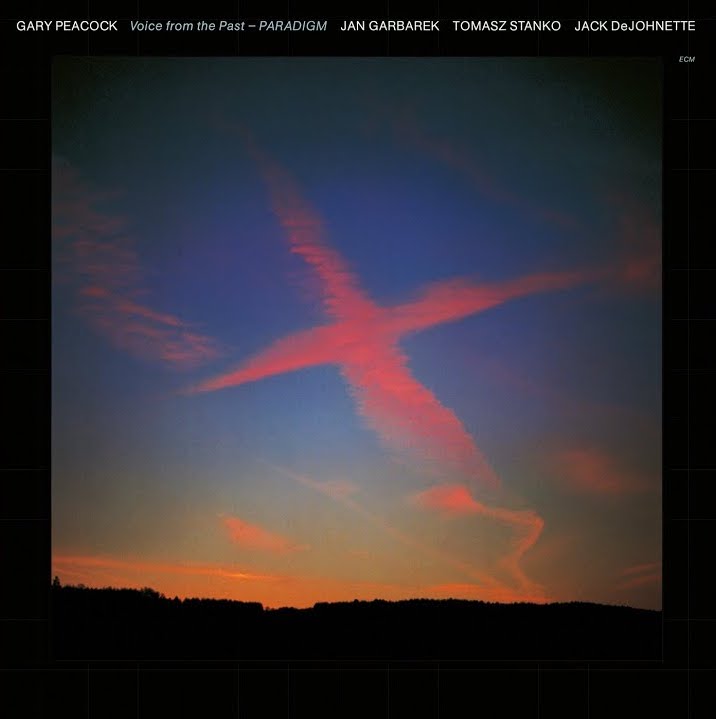
Gary Peacock: Voice from the Past – PARADIGM (ECM 1210)

ECM 1210

Gary Peacock
Voice from the Past ­– PARADIGM

Gary Peacock bass
Jan Garbarek tenor and soprano saxophones
Tomasz Stanko trumpet
Jack DeJohnette drums
Recorded August 1981, Talent Studio, Oslo
Engineer: Jan Erik Kongshaug
Produced by Manfred Eicher

Jazz, sometimes, is like acting: a group of performers starts with a script of prewritten material, which then must be spun into a convincing world of characters. This is not to say that the music isn’t genuine. Quite the contrary: through the art of improvisation, through the indeterminacies of creative interaction, these musicians reveal their ability to give themselves to the moment, at the same time expressing something so deeply personal that one could never mistake their diction for that of anyone else. Saxophonist Jan Garbarek (in one of his more creative sessions) and trumpeter Tomasz Stanko play their roles with gusto on this formative recording from bassist Gary Peacock, whose dialogues with Jack DeJohnette in tunes like “Ode for Tomten” give us shades of their upcoming journey in Keith Jarrett’s trio. Our two horns slink as easily into the opening saunter of “Voice from the Past” as they do into more honed territories like “Moor” and the album title’s second half. Stanko is on slow fire in “Legends,” which also sports a fascinatingly threaded solo from Peacock, while “Allegory” fills for us a deep, earthy caldron that bubbles with DeJohnette’s percolations.

Like the surname of its composer, this music surprises the more it unfurls. Come for Peacock’s mature writing, stay for the fantastic soloing, and leave knowing you’ve gained a new perspective. One not to be buried.

<< Lester Bowie: The Great Pretender (ECM 1209)
>> Art Ensemble of Chicago: Urban Bushmen (ECM 1211/12)

Jan Garbarek: Paths, Prints (ECM 1223)

ECM 1223

Jan Garbarek
Paths, Prints

Jan Garbarek tenor and soprano saxophones, wood flutes, percussion
Bill Frisell guitar
Eberhard Weber bass
Jon Christensen drums, percussion
Recorded December 1981, Talent Studio, Oslo
Engineer: Jan Erik Kongshaug
Produced by Manfred Eicher

December of 1981 was a magical month for ECM, producing such treasures as Psalm and Opening Night. On Paths, Prints, however, Manfred Eicher raised the bar yet again in bringing together another of his unique dream teams. Jan Garbarek, Bill Frisell, Eberhard Weber, and Jon Christensen in the same studio? Engineering complexities aside, one need only have hit Record, taken a nap, and awoken to masterful results. Throughout this session, Garbarek’s sharply defined reveries prove the perfect fulcrum for Frisell’s broadly sweeping clock hands. Garbarek also exposes a softer side, as in the whispered edges of “The Path” and “Arc,” and in the seesawing contours of “Still.” The painterly movements of “Kite Dance,” on the other hand, foreground Weber’s globules of sound against the blush and heartwarming soloing of Frisell’s omnipresent guitar. Not too far behind are “Footprints,” which shows Christensen in an especially colorful mood, and “The Move,” which pours on Garbarek’s signature lilt like heavy cream. Certainly his most effective passages are also the most intimate: “Considering The Snail” and “To B.E.,” the latter a duet with Frisell, are concave, while their surroundings are convex.

One can easily fall into the trap of painting ECM jazz as forlorn, breezy, and overwhelmingly lonesome. Yet one journey through Paths, Prints is all it takes to realize that the music is always our companion.

<< Paul Motian Band: Psalm (ECM 1222)
>> Enrico Rava Quartet: Opening Night (ECM 1224)

Mike Nock: Ondas (ECM 1220)

ECM 1220

Mike Nock
Ondas

Mike Nock piano
Eddie Gomez bass
Jon Christensen drums
Recorded November 1981, Talent Studio, Oslo
Engineer: Jan Erik Kongshaug
Produced by Manfred Eicher

How can one not marvel at Mike Nock’s Ondas? Drawing as much from Keith Jarrett as Bill Evans, and in the enviable company of Eddie Gomez and Jon Christensen no less, the sadly overlooked New Zealander left us with one of ECM’s most enduring documents at a time when the label was really getting its bearings. Nock’s pianism gives the illusion of distance, even when up close and personal, as if it were some long shadow, the feet of which are obscured by the horizon. It is also a magnifying glass of vast insight.

Central to this circumscribed detail is the 16-minute opener, “Forgotten Love.” Before a lacy ostinato it unfolds a sheet of paper as landscape, sketching fleeting affections and unrequited maybes. This sets Gomez up for a moth-like solo, as earthbound as it is winged, which then blends into the piano’s left hand. The right, meanwhile, stumbles off and returns with recollections of its travels, each framed by the thinnest of photographic borders. Christensen’s characteristic cymbals patter like rainfall across the title track and on through “Visionary,” in which he also foregrounds a touch-and-go snare. Yet against such a sweeping backdrop, these gestures forget their search for a groove and look more ponderously at where their feet are already planted. Plaintiveness thrives in “Land Of The Long White Cloud” and reveals the set’s most cinematic moments. Nock’s turns of phrase gnarl into a lichen-covered network of roots through which an insectile bass crawls, leaving a melodic honey trail for us to follow in its wake. With such a solemn road behind us, we open ecstatic “Doors” to our final destination.

While Nock may not carry the weight of some of ECM’s more widely recorded movers and shakers, one can hardly begin to quantify the wealth of impressions he leaves behind. This is not music to get lost in, but music that gets lost in you.

Another essential date from the 80s.

<< David Darling: Cycles (ECM 1219)
>> Adelhard Roidinger: Schattseite (ECM 1221)

David Darling: Cycles (ECM 1219)

ECM 1219

David Darling
Cycles

David Darling cello, 8-string electric cello
Collin Walcott sitar, tabla, percussion
Steve Kuhn piano
Jan Garbarek tenor and soprano saxophones
Arild Andersen bass
Oscar Castro-Neves guitar
Recorded November 1981, Talent Studio, Oslo
Engineer: Jan Erik Kongshaug
Produced by Manfred Eicher

Cellist David Darling has had a long, if sporadic, association with ECM, quietly forging—either under the guise of solo artist or buried in an album’s roster—some of the label’s most lyrical atmospheres. With Cycles, however, Darling magnified his sound-world through the inimitable talents of Jan Garbarek and Collin Walcott in a space both selfless and uniquely his own. Add to that the astonishing pianism of Steve Kuhn and the depth of Arild Andersen on bass, and you get what is, to this listener at least, one of ECM’s finest celestial alignments.

While I am tempted to give my usual track-by-track impressions, here the album’s title clues us in on another way me might listen to it: that is, as an ever-roving caravan without need of maps or guides. As it stands, Cycles is a bubble of possibility that only expands with every listen. In its opening strains, we kneel atop a cliff of unraveling. Darling’s needlepoint brings light to fullest dark, breathing through Walcott’s tabla and Garbarek’s shawm-like expectorations. Those fluid horsehairs sing like portals, beginning and ending in the same draw. Harmonies linger as afterthoughts of infinite space. From nebulae to star and back to billowing gauze, the music flows into rivers of light—quiet, intense, forgiving. Grooves flicker into life, voices settle into afterlife. Cello and sitar sing into one another, while Kuhn’s wafting fragrances remind us of what it felt like to be on Earth.

Were I to single out one track, however, from this multivalent exhalation, it would have to be “Fly,” a brooding intertwining of cello and saxophone that is a Mt. Everest in the ECM landscape. Garbarek emits some of his most satoric playing here, floating ever skyward. He is a lantern hung in the clouds, a riddle whose denouement only reveals further mystery.

The stellar playing throughout is only enhanced by the sound. The engineering on Cycles is pristine beyond measure and raised the bar of the label’s usual auditory standards. To prattle on any more would ruin the effect. Suffice it to say: don’t miss this one.

<< Steve Tibbetts: Northern Song (ECM 1218)
>> Mike Nock: Ondas (ECM 1220)