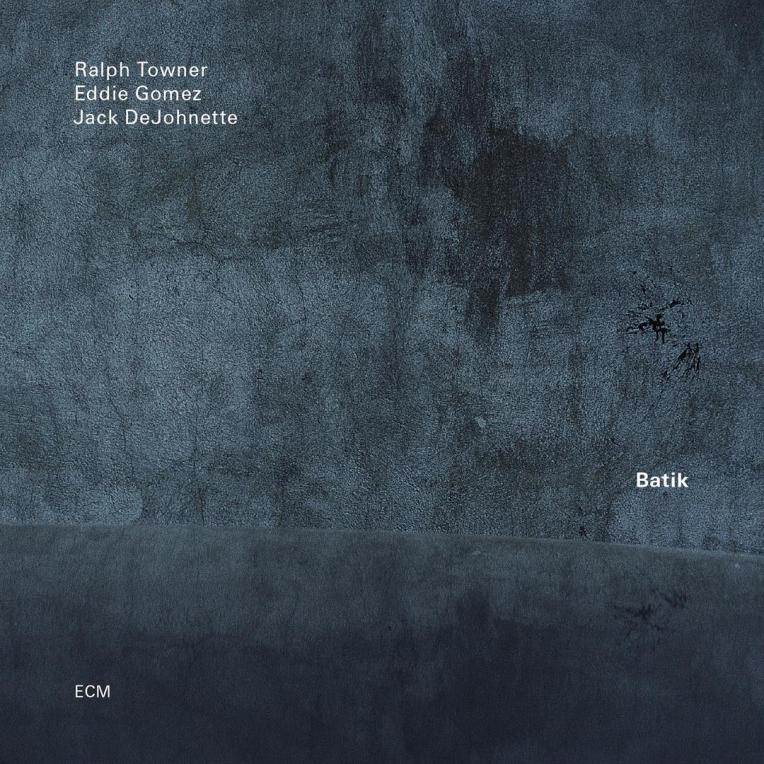
Ralph Towner: Batik (ECM 1121)

ECM 1121 CD

Ralph Towner
Batik

Ralph Towner 12-string and classical guitar, piano
Eddie Gomez bass
Jack DeJohnette drums
Recorded January 1978, Talent Studio, Oslo
Engineer: Jan Erik Kongshaug
Produced by Manfred Eicher

There are certain images that seem fail-proof when musically evoked. The “Waterwheel” that inaugurates us into guitarist Ralph Towner’s astonishingly beautiful Batik is one of them. Having since been painted for us by such varied talents as Hamza El Din (see the Kronos Quartet’s Pieces of Africa) and Marina Belica (former leader of the October Project, of which their self-titled debut is a personal all-time favorite), Towner’s particular configuration embodies the best of all worlds with the precision of his fingers magnified to great effect by Jack DeJohnette on drums and soothingly animated by the bass of Eddie Gomez. Towner’s democratic shifts in density allow for solos to shine through the haze unhindered, such as the enchanting bass that darts through his added splashes of 12-string. Towner rejoins in overdubbed costume, while amplified sustains peek like the sun from behind a cloud. Their passage through the sky is marked only by DeJohnette’s delicate metronome, allowing us one final glimpse of its thematic pool. “Shades of Sutton Hoo” is named for an Anglo-Saxon burial ground and haunts us with its reverberant lows and tinkling cymbals. A noticeably freer structure pervades, tracing every mound of earth with archaeological care. This delicate filler leads us up a “Trellis” of melody into ghostly afterthoughts. Gomez’s voice cuts with urgency through Towner’s ornamental stride. Their sumptuous counterpoint continues in the 16-minute title track and sets us down comfortably in Solstice territory. DeJohnette unleashes a noteworthy solo, while Gomez laces his quick fingers to support every hoisted footstep. We end in the “Green Room.” Painted with Towner’s mournful piano, it glows in a wash of potent commentary from bass and brushed drums, crumbling like spring snow into silence.

A classic to the nth degree.

<< Bill Connors: Of Mist And Melting (ECM 1120)
>> Enrico Rava Quartet: s/t (ECM 1122)

Paul Giger: Vindonissa (ECM 1836)


Paul Giger
Vindonissa

Paul Giger violin, violino d’amore, viola d’amore, footbells
Robert Dick c-flute, glissando flute, bass flute in c, bass flute in f, contrabass flute
Satoshi Takeishi percussion
Recorded June 1998 and 2000

Modern-day gypsy, musical traveler, melodic nomad: call him what you will, but Paul Giger has created some of the most haunting music to ever grace your ears. Adding yet another branch to the bold tree that began with Chartres and which was expanded in three subsequent projects, the Swiss violinist/composer beguiles us yet again with this more whimsical, though no less trenchant, collaboration. On Vindonissa, he is joined by two outstanding musicians. Robert Dick is a truly revolutionary American flutist and composer who has taken his instrument to new heights. A pioneer in extended techniques, design, and improvisation, he is a welcome presence on ECM. Percussionist Satoshi Takeishi is a kindred itinerant spirit, and has worked with a wide range of musicians, including Anthony Braxton and Joe Zeytoonian. A skilled improviser in his own right, his openness to the musical moment is a no-brainer for inclusion here.

Giger bookends this yawning chasm of life with a meditation on solo violin from which the album gets its name, distilling from the chromatic banality of open strings a potent tincture of dissonance and transcendence. Such lone signposts dot the album with moments of pause, as in the lilting Introitus and Kyrie. The group tracks contrast with open spaces and colorful mysticism. Starting with the pointillism of Oogoogajoo and ending on the likeminded An Ear On Buddha’s Belly, these intersections of time and circumstance seem to grow organically, as if in waves. Dick and Takeishi walk comfortably alongside Giger, bringing vital human energy to the untouchable center of Lava Coils and even greater earthly care to Fractal Joy, the most profound triangle therein. Gloria et Tarantella, in which Giger rocks the viola d’amore to the beat of his own foot bells, is the album’s masterpiece and builds to a frenzy of Tartini-like exuberance. With every note, it burns a root and follows its smoke ever skyward.

Giger is easily one of the greatest violinists of our time, not only because of his technical prowess, but more importantly for his ability to grab hold of a melodic handle and never let go until it asks him too. Such talent can take some getting used to, especially in the presence of other musicians, but I think this is an album in which one can rest assured that a meeting of three bodies, minds, and worldviews can indeed find harmony through sound’s untold alchemies.

Michael Galasso: Scenes (ECM 1245)

1245Michael Galasso
Scenes

Michael Galasso violin
Recorded October 1982, Tonstudio Bauer, Ludwigsburg
Engineer: Martin Wieland
Produced by Manfred Eicher

Born in Louisiana in 1949, Michael Galasso picked up his first violin at age 3. After debuting with the New Orleans Philharmonic at 11, he went on to forge a unique and fascinating career. As a longtime collaborator of Robert Wilson, he composed incidental music for a host of renowned productions, including an award-winning 1998 staging of Strindberg’s A Dreamplay, in addition to being involved in numerous sound installations in museums worldwide. Many will have encountered him as the film scorer for Wong Kar-wai’s In the Mood for Love, and most recently for Martin Provost’s Séraphine, but far too few have heard him on his own terms, divorced from the images he describes.

For his first solo album, Galasso gives us nine numbered “Scenes,” each the facet of an unfathomable jewel. It is an album to which I often played my violin by ear, trying to gain inner sight to its deeper complexities. And indeed, beyond its charming Philip Glassean veneer heaves a pair of expansive lungs that expel far more than they take in. The album has the feeling of a home recording, multi-tracked and with minimal processing applied. Despite being meticulously composed, it is also spontaneous in feel and refreshingly non-perfectionist. Some lines don’t quite sync up, as if what we hear were just a potent coincidence. From the hauntingly enigmatic (Scenes II and VI) to the whimsical (Scene III), we are privileged to stroll through this modest gallery of sound. Scene IV stands out with its boldly syncopated lead and subtle harmonizing. Others, like Scenes VII and VIII, tremble with incidental potential, seeming to spring forth from an as yet unrealized mise-en-scène. But it is the final Scene that remains closest to my heart, for its utter simplicity draws from a groundswell of bliss. Not unlike the solo work of Paul Giger, it has a magic all its own, an uncompromising sense of direction that can never be thwarted once it holds you.

Scenes is more than a soundtrack without images. Not unlike the shadow on the cover, its chapters are disembodied. We see only their negative selves, and hear only the sounds that animate them.

<< Jack DeJohnette’s Special Edition: Inflation Blues (ECM 1244)
>> Lester Bowie: All The Magic! (ECM 1246/47)

Everyman Band: s/t (ECM 1234)

ECM 1234

Everyman Band

Michael Suchorsky drums
David Torn guitar
Bruce Yaw bass
Marty Fogel saxophones
Recorded March 1982 at Talent Studio, Oslo
Engineer: Jan Erik Kongshaug
Produced by Manfred Eicher

What began as Lou Reed’s backing in the seventies stepped out on its own as Everyman Band, recording this self-titled debut for ECM in 1982. If a group is only as good as its musicians, then the name is a contradiction: not everyone possesses the firepower of Michael Suchorsky on drums, David Torn on guitar, Bruce Yaw on bass, and Marty Fogel on saxophones. The latter brings his idiomatic flair with three originals. Torn steals the show in “Lonely Streets,” a smoldering trek through nocturnal fires and other hidden conflagrations. Fogel spikes this punch with his own choice poisons. Yaw keeps up at every turn of phrase, and keeps us “On the Spot” with a memorable bass line, around which Fogel herds Torn’s flock in tight circuits. “Fatt Blatt” weighs in with a heavy tenor solo before the quartet pulls its best funk off the rack in a monochromatic swing. Yaw has his moment in the sun before diving back into the vamp with a vengeance.

Torn hones in with two clicks of his own. “Morals in the Mud” opens the album with a bang, his Strat popping the bubble of our attention with a neon pin, while “The Mummy Club” gives off an airier vibe. A slap bass distinguishes this wobbly palate-cleanser from the rest, as Fogel surfs Torn’s mighty chordal crashes with finesse. Suchorsky and Yaw churn out one tune apiece. “Japan Smiles” has a deeper, headier sound and features some fantastic bass/sax interaction. “Nuclear Suite,” on the other hand, is less direct, and speaks in tongues over a vast dynamic breadth. The appearance of a soprano sax lightens the load considerably. Playful, jaunty rhythms abound, overturning post-apocalyptic rubble for clues to a hidden past. Torn elbows his way through with an incisive solo. Like a slingshot of light into the evening sky for want of a meteor shower, it trails with unnaturally prolonged fire.

Everyman Band
(Photo by Ralph Quinke)

This album is an all-around solid effort brimming with guttural, after-midnight sounds that are iconic of the very era they tear to shreds. The band’s style is both distant and in our faces. The group shot on the back of LP jacket says it all: a relatively clear foreground lights the naked streets against an impossibly distorted backdrop in a single instantaneous image.

<< Chick Corea: Trio Music (ECM 1232/33)
>> Hajo Weber/Ulrich Ingenbold: Winterreise (ECM 1235)

Goodhew/Jensen/Knapp: First Avenue (ECM 1194)

ECM 1194

First Avenue

Denney Goodhew alto saxophone, flute, bass clarinet
Eric Jensen cello
James Knapp trumpet, fluegelhorn, waterphone
Recorded November 1980 at Tonstudio Bauer, Ludwigsburg
Engineer: Martin Wieland
Produced by Manfred Eicher

“Our procedure is to simply begin.”
–James Knapp

Bringing together reedman Denney Goodhew, cellist Eric Jensen, and horn player James Knapp, First Avenue is a ghostly outlier in the ECM backlist. The project germinated within the American Contemporary Dance Company, which paired spontaneous incidental music with indeterminate movement on stage. As the trio began to branch out and perform as a group, they soon made their way into the studio for this enigmatic session. The pieces have no titles outside of “Band One,” “Band Two,” etc., and perhaps anything more would only be a distraction.

The haunting cries of a waterphone make their first of two appearances on the label (the other courtesy of Marilyn Mazur on Elixir) by way of introduction. From this, we encounter a spacious flowering of alto sax, cello, and horn, sounding much like a Gavin Bryars ensemble piece in its developmental arc. Some tracks (Bands Two and Seven) employ an echo effect which, though dated, is put to utmost creative use here, swirling into a spiral in which the original utterance ceases to exist. Band Three boasts as many overdubbed cellos in a clustered, reactive agitation, while Five is a beautiful piece for two overdubbed saxophones. The latter’s chromatic and lively syncopation make for a most engaging interlude to the overall denser flow. Band Four is more playful, yet somehow regretful, feeling like the soundtrack to a mental breakdown, Darren Aronofsky-style—each hiccup from the cello another pill popped, each horn blast another memory compromised.

Loops and delays abound in the album’s second half. Band Six paints a particularly fluid image of fluted beginnings and muted menageries. Bass clarinet and fluegelhorn bleed darker hues into a cello’s growls and other subterranean minutiae. Each ascendant line drapes its shadow from a barely visible line in a modest exhibition of pellucid musicianship and seamless changes of register. The echoed sax in Band Eight almost sounds as if it were being played backward as undulating cello lines keep it airborne. Abandon builds to stratospheric heights before fading in a final dissolve.

These are supremely harmonic, spacious improvisations that ply the ear with questions that are their own answers. This is intimate, far-reaching, and supremely accessible music drawn from a synergistic wellspring of talent. A more than pleasant surprise as yet unburned in CD form.

<< Surman/DeJohnette: The Amazing Adventures Of Simon Simon (ECM 1193)
>> Shankar: Who’s To Know (ECM 1195)

Paul Giger: Alpstein (ECM 1426)

1426

Paul Giger
Alpstein

Paul Giger violin
Jan Garbarek tenor saxophone
Pierre Favre percussion
Musicians from Appenzell (Switzerland) silvesterchlauseschuppel, schellenschötter
Recorded 1990/91 at Rainbow Studio, Oslo; 1990 at Trogen
Engineer: Jan Erik Kongshaug
Produced by Manfred Eicher

The first time I heard Swiss violinist Paul Giger, my soul might well have wept. His is a spiritualism beyond the trappings of human politics, a stage populated by human-animal hybrids, faceless musicians, and dancers of many forms. For this, his follow-up album, Giger is joined by saxophonist Jan Garbarek and percussionist Pierre Favre in a sonic portrait of his homeland. Delving into living folk traditions, this trio gives us as wintry a feeling as possible without ever stepping foot in into the Alps. Yet this is no mere sonic postcard, but a concerted effort to flip the land inside out and expose, as from under the logs we overturned as children, the life teeming within.

Anita's Alpstein
(Photo credit: Anita Brechbühl)

This music came into my life when I still had a violin in my hands. At the time, I was struggling with the idea of expressing my inner voice through an external instrument. Hearing Giger showed me it was possible, and this album’s second piece, Karma Shadub (Dancing Star), is something I played quite often in my ultimately futile attempts to emulate a sound that was beyond me. I even performed it once with an interpretive dancer at a high school assembly. Though the violin soon faded from my grasp, I remain ever in its shadow, a humble and open listener of its masters, of which Giger is a nonpareil example. Every dissolve of Karma reveals new visual combinations, each so rudimentary, so fundamentally alive. Garbarek’s throaty call dovetails with Giger’s in a symbiosis of dance and darkness. Alpsegen introduces the album’s first percussive colors. A caravan of metallic nomads, ranging from tambura to cymbals, processes across an ever-widening sound palette. Cowbells recede like ancestors as Giger leaps in evolutionary pirouettes. On Chuereihe, Garbarek revisits the herding calls that enthralled on Dansere, and climbs the peaks into which the cover photography beckons us. Giger’s violin here is sometimes insectile, sometimes onomatopoetic, but always anchored by Favre’s deepening drums. Chlauseschuppel gives us a taste of the Appenzeller bells, rung at the end of every year to ward off foul spirits as the new one is welcomed.

Silvesterchläuse by Vera Rüttimann
(Photo credit: Vera Rüttimann)

When I first heard Trogener Chilbiläbe, which closes the disc, its backdrop of urban sounds led me to believe it had been recorded in a church with the door flung open. Its inspiring solo cycles of fast runs and soaring meditations end with a slam, as if shutting out the noise of the outside world. Only later did I discover that the door in question belongs to a prison cell, and that the piece was recorded in the jail where Giger must serve out a few days of each year for refusing to pay military tax. As insightful as these biographical minutiae are, it is the Zäuerli, a haunting yodel particular to the Alpstein region making three appearances here, that is the album’s lifeblood. In order to evoke its polyphonic splendor via a single instrument, Giger taps his fingers on open strings, eliciting harmonics from within. These hidden voices are his aesthetic soil. As we come to be wrapped in their atmospheric blankets, we are awakened even as we slumber.

Alpstein is a cosmic alignment. Like all of the violinist’s albums, it is markedly different from the rest but digs just as deeply. Giger may not always look to the same future, but he does draw from the same mythic past. His playing is only one step removed from breath, for every stroke of the bow enriches the universe like air to a lung.

<< Kim Kashkashian: Shostakovich/Chihara/Bouchard (ECM 1425 NS)
>> Stephan Micus: Darkness And Light (ECM 1427)

Michael Mantler: Review (ECM 1813)


Michael Mantler
Review (1968-2000)

Robert Wyatt voice
Susi Hyldgaard voice, accordion
Michael Mantler trumpet
Bjarne Roupé guitar
Per Salo piano
Mona Larsen voice
Kim Kristensen piano, synthesizers
Jack Bruce voice
Per Jørgensen voice
Don Preston voice, synthesizers
John Greaves voice, bass
Karen Mantler voice, piano
Alexander Balanescu violin
Rick Fenn guitar
Marianne Faithfull voice
Nick Mason drums
Mike Stern guitar
Carla Bley piano, synthesizers, voice
Steve Swallow bass
Larry Coryell guitar
Tony Williams drums
Kevin Coyne voice
Chris Spedding guitar
Ron McClure bass
Terje Rypdal guitar
Jack DeJohnette drums
Don Cherry trumpet
Pharoah Sanders tenor saxophone
Jazz Composer´s Orchestra
London Symphony Orchestra
Balanescu Orchestra
Danish Radio Concert Orchestra
The Danish Radio Big Band
Chamber Music and Songs Ensemble
Radio Symphony Orchestra Frankfurt

Every once in a while, an album comes along that changes our view of what jazz, or any genre for that matter, can be. Review isn’t one of those albums. It’s much better.

One of contemporary music’s most accessible provocateurs, Michael Mantler is like an old friend and an enigma in one. ECM’s vital retrospective compresses over thirty years of his coal-throated sounds into a gallery of jagged diamonds. With a roster to make even the most eclectic enthusiast blush with delight, Mantler assembles a powerful resume of musical forces, intentions, artifacts, techniques, and emotional ammunition. He is the sonic equivalent of a Robert Altman or Peter Greenaway. Like the latter, he works with pictures within pictures, splashes refractions of time and place across his screens, enhances images with the written word. He makes audible the diaries of our intellectual journeys, folds every page into a paper airplane, and launches it from heights far beyond what we ever imagined as children.

From the first moments of the piano-driven, brass-infused jewel of musical concentration that is “Unsaid,” we feel the broad strokes with which Mantler paints, and the perpetual reinvention that cloaks his every move. No single mood dominates from thereon out. “Introductions,” for example, is a scrapbook of varied histories, of dislocation and dying joys, the story of a war-torn world in which home no longer remains a stable category. Against its beautiful harp-infused orchestral background, a kaleidoscope of characters airs its grievances. It’s as if one were to throw into a pot the music of Meredith Monk and Heiner Goebbels and watch what results. As this broth comes to a boil, we get a most potent whiff of unknown spices. Each instrument is its own flavor, adding a dash of autobiography to the thickening brew. This is a stunning piece, one exemplary of Mantler’s genius. “Solitudine / Lontano / L’Illuminata Rugiada / Proverbi” is a chain of laments splashing in the limpid pool of self-awareness, threading circumstance with the wave of a drunken stroll. A mournful violin lays itself down before a pause brings us to the more resolute “Speechless.” An unspoken word rolling off the tongue only when it is too late, it leads us to one of the album’s many insightful instrumental pieces. Said excerpt from “Folly Seeing All This” (1992) lifts its weight as a foot from mud, with no other choice but to step down and repeat the process. “Movie Two” (1977) is another magnificent incident, marked by nimble drumming from Tony Williams, heading a tight rhythm section beneath a crunchy guitar solo from Larry Coryell, not to mention Mantler’s own vividly imaginary trumpeting. A few briefer interludes make their voiceless presences known. “Love Ends (excerpt),” a bittersweet duet for clarinet and piano, is a memory one can’t quite picture. A treat from the unpretentiously titled “Alien” (1985) sports the nostalgic synths of Mothers of Invention keyboardist Don Preston. “Twenty” brims with the youth of its eponymous age. It acerbic electric guitar and heavy bass almost tumble over one another in their search for gold. But then there is “One Symphony” (1998), from which he hear but one fascinating orchestral snippet. Characterized by vibrant energy and mallet-heavy percussion, its jaunty instrumentation titillates at an intersection of the bowed, the blown, and the struck. Echoing pizzicato strings transcend the music’s outer barriers, puncturing its paper-like firmament with simulacra of starlight. “Preview” (1968) is another bundle of archival explosives. Its incendiary tenor sax solo, courtesy of the legendary Pharoah Sanders, runs amok, incurring not a few brass concussions along the way. And as the drums bubble from the earth around him like a latent volcano, Sanders astonishes with the intensity of his (in)difference.

Of all the vocal talent represented here, Robert Wyatt is foremost. His incautious duet with Susi Hyldgaard in “I’m glad you’re glad” is its own wonder. Here, a relationship’s self-reflexivity is thrown in its protagonists’ faces with veiled exclamations of happiness and return. Wyatt reads from Harold Pinter’s play Silence in “Sometimes I See People” (1976), twisting morose obsessions with social growth and fallacies of identity twist into a complicated braid. Another effective reading, this time run through a flange, in “The Sinking Spell” (from Mantler’s 1975/76 The Hapless Child) offers an Edward Gorey tale to the morbid believer in all of us. Its terrestrial charm, set aloft by flights on electric guitar, slingshots its sentiments across the universe toward vocal ends. Backed by none other than Carla Bley, Terje Rypdal, Jack DeJonette, and Steve Swallow, Wyatt stretches until he leaves his own nebular mark in the evening sky. A trio of miniatures—“PSS,” an excerpt from “Comrade,” and “A l’Abattoir”—featuring the voice of Marianne Faithfull makes for some further incisive dramaturgy. Behind a thinly processed veneer, each is a micro-opera of galactic proportions. Jack Bruce lays down his own heavy tracks with the words of Samuel Beckett in “Number Six – Part Four” (1973), in which he is paired with trumpeter Don Cherry. Finally, the lilting strings that introduce “It makes no difference to me” fade into their reverberant chamber behind indecisive voices, wandering in the confusion of split paths like the accordion that continues their journey when they fall silent. A love for recitative underscores these narratively minded pieces in brightest neon.

The real meta-statement, however, lies in “Understanding.” A piece about and of transition, it achieves its resolution through the fallibility of the utterance and its audio redeployment. It is a Tower of Babel laid on its side and spread thin into an auditory crepe. Mantler manages to be both cinematic and literary here, further skirting an undefined space between the two. As a translator myself, I feel this piece reaches for my heart like no other.

Mantler is a musical treasure, a singular voice comprised of many. His is not music that simply speaks to the listener, but music that speaks and listens to itself.

Terje Rypdal: Undisonus (ECM 1389)

Terje Rypdal
Undisonus

Terje Tønnesen violin
Royal Philharmonic Orchestra, London
Christian Eggen conductor
Grex Vocalis
The Rainbow Orchestra

Carl Høgset
director

Recorded September 1986, St. Peter’s Church, Morden, London (Undisonus) and November 1987, Rainbow Studio, Oslo (Ineo)
Engineers: Arne Akselberg (Undisonus) and Jan Erik Konghaug (Ineo)
Produced by Arne-Peter Rognan

For as long as I’ve been listening to Terje Rypdal, I’ve known him to skirt idiomatic borders without presumption. I can only admire him for his dedication to jump headlong into such projects as this pairing of two classical pieces. As one who is so often present in the realization of his works, allowing the music to take on its own life isn’t always easy. Rypal, however, takes this step gracefully and with melodic integrity intact.

Undisonus, op. 23 is set for violin and orchestra, but it’s the brass section that first catches our attention with its subterranean rumblings. First seeded in 1979, the present version represents years of additions and fine-tuning, which one can hear throughout Terje Tønnesen’s fine playing. His tone is declamatory without being overbearing, lyrical yet more acrobatic than romantic, but always with the feel of a sketch running off the page. This puts the orchestra in a precarious position, taking on the role of caretaker at its haunts the aura of the soloist’s imagination. Silences are always heavy and felt like a remembered drone, ending on a shadowy slide in which double basses and violin circumscribe the entire musical space in a beautiful gesture of completion.

Where Undisonus skirts a dichotomy of call and response, Ineo, op. 29 (composed 1983) transcends that dichotomy into a more noticeably unified sound. Originally featuring Rypdal on guitar for its Danish Radio premier, here it has been reworked for choir and chamber orchestra. Lush writing for woodwinds and brass lends deeper poignancy to the choir’s memorial intonations. Constructed in gorgeous little cells drawn by near-silent threads, every utterance spreads into an overarching whole. A lyrical oboe solo recalls Rypdal’s formative meditations in his self-titled debut and in What Comes After, foreshadowing a glorious Alleluja that is as close to the spirit of Giya Kancheli’s Prayers cycle as I have ever experienced in another’s work.

Averaging 20 minutes each, these pieces make for a modest album in length that is anything but in scope. Rypdal clearly has nothing to prove, as the music drapes a blanket of sonic comfort over our prog rock expectations. It is best appreciated in half-slumber, where judgment is but a stepping-stone toward broader skies.

<< Ralph Towner: City Of Eyes (ECM 1388)
>> Abercrombie/Johnson/Erskine: s/t (ECM 1390)

Keith Jarrett: Sun Bear Concerts (ECM 1100)

ECM 1100

Keith Jarrett
Sun Bear Concerts

Keith Jarrett piano
Recorded November 1976 in Japan
Engineers: Okihiko Sugano and Shinji Ohtsuka
Produced by Manfred Eicher

Before beginning this review, I imagined writing one line and one line only: Let the music speak for itself. And while such a move does have a certain charm, if not arrogance, I can only hope that the following attempts to transcribe what Keith Jarrett’s Sun Bear Concerts say to this listener might convey even the humblest fraction of the wonders therein. Over the course of two weeks in November of 1976, Jarrett laid his hands to keys in seven major Japanese cities for an historic series of improvised concerts (not all of which are included in this recording). The result was a 10-LP set, now telescoped to six CDs, that must be heard to be believed. Within this modestly typographed grey box beats one of ECM’s profoundest creative hearts. In light of this, a more fitting line might read: Keith Jarrett is music itself. Let it only be the beginning.

Kyoto, November 5, 1976
Part 1 opens in absolute heaven with I daresay the most spellbinding music ever elicited from a piano. Like all such things, it grows all the more affecting as it transforms into something else entirely. Jarrett introduces some jazzier ornaments into these tectonic elegies until he reaches what sounds like a Philip Glass motif broken open, maps drawn from its essence in half-note rolls. Expulsive chording animates this newborn organism with premature self-awareness. This is music to make one weep, for like tears it drips from the eyes and tastes like the sea. With patience, it becomes ecstatically uplifting, scaling a virtual ladder of Steve Reichian phases before plunging into an exhilarating vamp over which Jarrett sings and dances his blissful way. Every rise and fall is vividly etched into our minds as he articulates the grace that so consumes him. He begins to tread water, taking in his aural surroundings like a compass simultaneously pointing in every direction. He dives deep into the notion of depth itself, where sounds are muted as much by the water as by the careful transparency that defines it. With every sweep of a cupped hand, every kick of a calloused foot, we are brought nearer a world where sound takes the place of air. His fingers seem to double their strength in numbers, spreading wide with ecstatic cause, all the while reliving a poignant memory in reverse.

Part 2 brings us into a noticeably more resonant space, and is like multiple radios broadcasting some morbid ragtime catharsis. This music is as good an example as any of how everything that Jarrett does is also done to us. We are flexed, tumbled, turned, and reconfigured at every moment, an endless series of resurrections throughout which one desires no particular body. Jarrett’s tender singing buoys every kinetic gesture. His fingers stretch like wisps of cloud and harden into a giant’s hands. Like Scrabble tablets knocked from their board, the numerical value of every letter becomes meaningless as it slips into a linguistic black hole, in which only the sound of applause echoes like a faceless totem in the audible universe.

Osaka, November 8, 1976
Part 1 is loosely enfolded in time, leaning nostalgically into the forgiving winds of its own recollection—running, tripping, falling, and pulled up every time by strings of hope. It is a persistent hunger that feeds on itself. It pauses to regroup and redeploy, coalescing like a breath into voice. The pianism here breathes organically, shaping itself through a bridge of chemical interaction that connects the physical and cosmological worlds. Jarrett rests in familiar territory while the lead runs off on its own scavenger hunt, bringing back one melodic treasure after another. His creative energy seems inexhaustible in such moments. One begins to appreciate the continuity of his art, for pauses stand out with such weighted clarity that they remind us we’ve been listening to an unbroken stream all along. The music develops into a rolling vamp in which Jarrett foils his own precision with that of chaos. His playing soon plateaus, shaving one hair-thin layer after another from his cartographic imagination as it falls into a Gurdjieff-like trance. From this delicate weave he tears out an image like some consonant idol, only to stagger on dissonant legs into solitude with the resoluteness of a vibrating string coming to rest. Like the vocal articulations that emerge toward the end, this music is guttural and scrapes deep inside a barrel of emotional reserves before ending on a luscious chord, one note suspended from every fingertip like a celestial ornament.

Part 2 begins with a parallel statement from both hands, spreading out ever so slightly like an infant fractal into its implied harmonies. After a cry-inducing peak, Jarrett falls into lilting runs that are variously robust and crumbling. With the quiet revelry of self-discovery, Jarrett crosses boundaries here like identities, each traversal bringing with it a new fear of discovery. It is the fear of the known over the unknown, the lighthouse beyond which one perseveres through adversity, and yet in which is encapsulated all possibilities of being lost. These gorgeous but terse meditations open like an ever-evolving gift before suddenly breaking into an airy enlightenment, bringing with them a hope one never knew existed. The end flutters like the wingtip of a bird loosed from the edge of our half-sleep.

Nagoya, November 12, 1976
In Part 1, not only does Jarrett draw upon his travels, it seems, but also creates new ones as they happen. This music begins in a tighter embrace, coalescing around the piano’s middle range, so that when high notes begin cutting through the fabric of our attention with solid ether, we feel them acutely: a tingle in the spine, a twinge at the back of the brain, a skip in our heartbeats. Jarrett traverses quieter waters, catching the errant melody in his net. The atmosphere is as meditative as that of Osaka and achieves this state through a buildup of energy, the release of which is found in its continual accumulation. With every layer peeled, we come closer to an anthemic center, through which is articulated an oceanic expanse of memories. Some of these are playful, others cumbersome, but all deeply informative of the present moment as a subjective portrait of the music personified. We emerge from this jaunty reverie clad in new aural garments, sewn by a melodic other.

Part 2 reclines with anticipatory passion in an extended introductory ballad. Jarrett is in particularly astute form here, finding in every note the potential for a thousand more. In his simplicity breathes a host of surrounding narratives, each more involved and more historically minded than the last. With this performance, Jarrett shows that even at his most contemplative moments he is all fire. As he seesaws between lower and higher registers, he lapses into transcendental flutters, as if to interrupt our rest with the promise of transmigration. It is a reserved and careful path, but one in which footsteps leave permanent marks of their passage. It is the stories that press them into the earth that are ephemeral, forever lost among the vestiges of diaristic instincts.

Tokyo, November 14, 1976
As if to mimic the geography of his travels throughout Japan, the music finds its own capital in Part 1, fleshing through a long and varied history the deepest heart of the metropole. From gentle beginnings Jarrett tells an inspiring tale of youth gone awry, of love cut short and most unexpectedly reformed, and of the undeniable art these tribulations birth through the performative moment. Over one of his most engaging ostinatos, which he pulls and stretches to its utmost capacity, Jarrett paints a forest of faces opening their mouths without speech. Over time, the trees blend into a more flirtatious musical energy, unfolding in what I can only describe as a passionate aggression into an ecstatic and heartwarming ending.

Part 2 unfolds like a vision and may very well change the way you look at the world, as it describes even the most familiar things with a profound sense of renewal and supreme awareness of the illusory nature of reality. Jarrett’s right hand is like a memory encroaching upon the present of the left, until both become unified in an invisible story. It is a story that can be told only once. Though Jarrett locks himself in a confined space, he flirts with anarchy through anthemic modalities, alternating between heavy arpeggios and even heavier punctuations, and ending in a chaotic resolution toward that last uphill climb.

Sapporo, November 18, 1976
Part 1 begins in flame, glowing like a candle in the window that is so far away it appears as a star. Jarrett locks himself into loops upon loops. These are not periods of indecision, but simply felt as they are felt. At once romantic and mechanical, his sound opens in a captivating sustain-pedaled passage. With equal ardor, it is arrested by a damper just as the intensity gels with magnificent density. It is knocked over like an ink bottle onto the parchment of a somber ballad. The ends of the piano curl in on themselves like a quantum leap through musical space-time as they fall into galactic slumber.

Part 2 paints a funkier sky, brimming with hope and lithe exuberance. Its bittersweet resolution is tempered by a premonition. Such are the moments in which Jarrett is at his most vocal. As the energy diffuses, it unleashes a selfless stream of consciousness. We become privy to a deeper current of animation. We ignore the stumbling blocks at our feet and touch the sky with our hands instead. And as our bodies dissolve into light, we become the sounds that shaped our physicality in the first place. All that’s left of us is a single image of childhood, balanced ever so precariously at a cognitive cusp. From it, we fashion a new one, repeating this process until we are spent.

Appended to these epic journeys are a few possible destinations in the form of three encores. Sapporo is another minimal yet meditative juggernaut. A constantly finger-pedaled C hardwires itself into every exaltation. Tokyo is a heartrending 8-minute experience, throughout which sadness becomes the most harmonious aspiration we can think of. One would be hard pressed to uncover a more magical moment in the Jarrett archive. Nagoya walks a similar path, taking a familiar chord progression and turning it into a ritual object, this time fading in a series of spaced chords, for which there is only stillness as altar.

This set is dearest to my heart, not only for the music it contains but also for having been performed in a country throughout which I have traveled extensively and which has dominated my creative and academic interest for years. I can almost feel the pulse of every city in which he performs (my feet have left their ephemeral prints on all but Sapporo), sharing in the unique atmosphere of each. A bit romantic, maybe, but a reaction I cannot help but nurture every time this music graces my ears. And while location need not necessarily inhere itself into any musical happening, I do feel there is a distinct quality to these Japan performances. One can feel it in the rapt silence with which Jarrett’s audience shows appreciation throughout, in the cathartic applause and appeals for encore.

The Sun Bear Concerts prove that not only is Jarrett an unparalleled improviser but a melodician of the highest order. These pieces are consistent in their striking differences, yet all seem couched in a palpable melancholy that is striated with joy. Despite the sheer volume of music that seems to reside in Jarrett’s entire physiological being, one gets the sense after listening to these six-and-a-half hours of brilliance that they comprise but a single molecule of creation dissected and slowed to discernible speeds. At least we, at this moment in time, can witness these atomic paths, knowing full well that their beauty lies in an allegiance to silence. Not a single note ever feels out of place, because it has no place to begin with, except as the emblem of that which is gone before it arrives.

If you ever buy only one recording of Keith Jarrett, look no further. Then again, why stop here?

<< Taylor/Winstone/Wheeler: Azimuth (ECM 1099)
>> Gary Peacock: Tales Of Another (ECM 1101)