Stenson/Andersen/Christensen: Underwear (ECM 1012)

1012

Underwear

Bobo Stenson piano
Arild Andersen bass
Jon Christensen percussion
Recorded May 18/19, 1971 at the Bendiksen Studio, Oslo
Engineer: Jan Erik Kongshaug
Produced by Manfred Eicher
Release date: September 15, 1971

With such a solid trio of musicians and a name like Underwear, you just know this one’s going to be good. And sure enough, Stenson kicks things off just right with the spirited title track, throughout which every instrument bubbles in a witches brew of fine flavors. Exuberant drumming, flurried bass lines, and a tightly knit sense of composition make this one of the great openers of ECM’s extensive jazz lineup. Hot on its heels is “Luberon,” the album’s requisite ballad, the placement of which both emphasizes the liveliness of the opener while also bolstering its own lyrical sensibilities. “Test” lays on a more organic sound of percussion and scraped piano strings. This delicate backdrop continues as Stenson breaks into a clearly defined melodic improvisation, prompting cries of ecstatic joy before succumbing to a forced fadeout. “Tant W.” brings us into more laid-back territory with its alluring conversation between piano and drums. Once the bass joins in, the groove becomes certifiably infectious. After this block of Stenson originals, we are treated to a pair of fine closers. Ornette Coleman’s “Untitled” runs with reckless abandon through frenzied pyrotechnics, priming us for the comforting “Rudolf” (Andersen). The latter’s fluid piano intro becomes the heart of the piece, echoing in an otherwise bass-dominant space.

Stenson is entirely on point, as if he were inborn with a finely attuned sense of melody and articulation. His playing is democratic and guides with a gentle hand, always managing to cover so much of the keyboard in a single cut. Andersen’s busy fingers provide the album’s backbone, while his gorgeous vibrato and twang-ridden charm work wonders in the softer moments. And Christensen’s drumming never fails to excite. Triply inspired soloing and a synergistic core make Underwear a prime choice for the ECM newbie and veteran alike. A simply fantastic album, this is one for the ages.

<< Dave Holland/Barre Phillips: Music From Two Basses (ECM 1011)
>> Dave Holland/Derek Bailey: Improvisations for Cello and Guitar (ECM 1013)

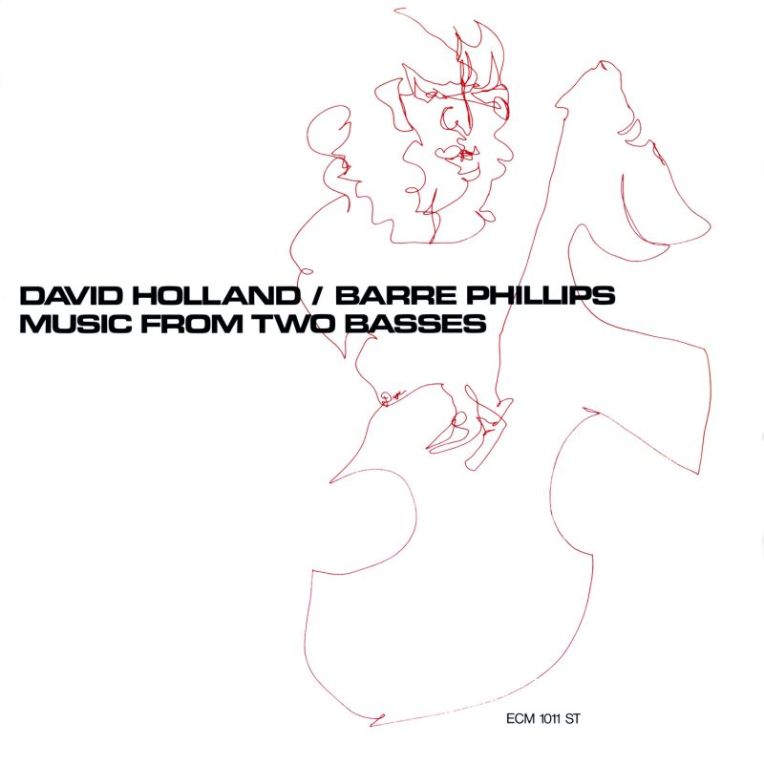
Dave Holland/Barre Phillips: Music From Two Basses (ECM 1011)

1011

Music From Two Basses

Dave Holland double-bass, violoncello
Barre Phillips double-bass
Recorded February 15, 1971 at Tonstudio Bauer, Ludwigsburg
Engineers: Kurt Rapp and Martin Wieland
Produced by Manfred Eicher
Release date: May 1, 1971

If you know the work of Barre Phillips, Music From Two Basses will be familiar, if not tame, territory. The more recent Dave Holland fan, however, may be in for an intriguing surprise. Through a mounting cluster of clicks, flutters, scrapes, and plucks, two bassists who now seem to inhabit rather different ends of the improvisatory spectrum find common ground here, and the results are extraordinary.

“Improvised Piece I” is dry and cracked around the edges, while “Improvised Piece II” is more like the genesis of a dream. The technique in both is phenomenal, covering a wide range of extended gestures, but always with an emphasis on the miniscule. “Beans” (Phillips) introduces us to the album’s first composed material, and is an exquisite journey laced with drones and bowed harmonics. The heavily applied reverb adds a cool distance. It is a celestial moment in an otherwise terrestrial program, and gone too soon. “Raindrops” (Holland) brings us in the opposite direction, plummeting toward earth in a gentle precipitation. “May Be I Can Sing It For You” (Phillips) is the most straight-laced piece on the album, and therefore the shortest, while the vague “Just A Whisper” (Holland) brings us back into a more delightfully abstract interaction. “Song For Clare,” another Holland piece, closes the set on an affectionate note and leaves us hungry for more.

This is free jazz of the most intimate persuasion. These two bassists may be household names, but here we really get a profound early glimpse into the microcosmic hearts of their instruments. This is an engaging album from start to finish, and one that could easily fail in so many other hands as it skips, sings, and chortles its way through a surprisingly vast program. There are no grand sweeping gestures, no complete sentences, nothing lost or gained. A taxing listen for some, but sure to delight the rest with its whimsical, focused atmospheres.

<< Paul Bley: Ballads (ECM 1010)
>> Stenson/Anderson/Christensen: Underwear (ECM 1012)

Paul Bley: Ballads (ECM 1010)

1010

Paul Bley
Ballads

Paul Bley piano
Gary Peacock bass
Mark Levinson bass
Barry Altschul drums
Recording engineered by Tommy Nola, Nola Studios, NYC
Recorded 28 July 1967 (Side 1) and 31 March 1967 (Side 2)
Mixing engineer: David Baker
Produced by Paul Bley
Executive production by Manfred Eicher/ECM
Release date: 1971

As an early ECM release, this all-Annette Peacock set already demonstrated the crystal clear recording and wide open spaces for which the label would come to be so well known. Throughout the long opener, ironically titled “Ending,” pianist Paul Bley handles most of the thematic legwork, while bassist Gary Peacock and drummer Barry Altschul skitter across his ivory surface like ice skaters so skilled they can stumble on cue. The title is multifarious. It’s the ending of a turn; the ending not of a life, but of the fallacy of its fulfillment; an ending of circumstance; an ending of watersheds; an ending of all the things in this world that buy us freedom, only to spit it back in our face. Altschul steals the show, soloing in slow-moving surroundings. The lagging pace lends further prominence to his playing, underscoring far more than mere virtuosity. As the piece goes on, it trickles like water, perhaps cluing us in on the title’s central meaning: that is, the music’s own loss of energy and creative source, a broken dam letting out its final drops. This is restrained music-making by a trio we know can swing with the best of them. Next is “Circles,” which seems to sweep up the mess of a long-waged battle, all the while showing an immense amount of fortitude in dealing with the prospect of an unclear future. Lastly, “So Hard It Hurts” gives a vivid sense of Annette Peacock’s compositional audacity and her unique way of turning gentility into pain, and vice versa. This time, Altschul is less cymbal-oriented and more focused on hitting the skins, providing ample room for bassist Mark Levinson’s own inspired finger work.

A delicate ridge rises between the musicians like a pyramid in every song, casting a moving triangular shadow as the sun marks its passage through time. The adlibbing is insightful and melodically well-aged. There is a crunchiness to this music, like biting into a confection filled with ever-changing flavors.

In 2019, this album was at last given the new life it needed through an ECM Touchstones reissue.

<< Corea/Holland/Altschul: A.R.C. (ECM 1009)
>> Dave Holland/Barre Phillips: Music From Two Basses (ECM 1011)

Jan Garbarek Quartet: Afric Pepperbird (ECM 1007)

1007

Jan Garbarek Quartet
Afric Pepperbird

Jan Garbarek tenor and bass saxophones, clarinet, flutes, percussion
Terje Rypdal guitar, bugle
Arild Andersen bass, african thumb piano, xylophone
Jon Christensen percussion
Recorded September 22/23, 1970 at the Bendiksen Studio, Oslo
Engineer: Jan Erik Kongshaug
Produced by Manfred Eicher
Release date: January 1, 1971

Saxophonist Jan Garbarek has changed with time and age, but already in Afric Pepperbird, his first album for ECM and one that would instigate an unbreakable association with the label, he invites us into a world that is playful yet mature. Half of the album is made up of miniatures, “Skarabée” and “Mah-Jong” the most precise and delicate among them, laced as they are with drummer Jon Christensen’s distinctive cymbal work and overall compositional sensibility. “MYB” and “Concentus,” for their part, drop like seeds into the album’s fertile soil. Bassist Arild Andersen’s steady bass line assures us the title track can swing with confidence, pouring on Saharan charm like fresh honey, while “Blow Away Zone” features an adventurous Terje Rypdal on guitar and an ether-wrenching solo from Garbarek, who squeezes his way through an opaque tornado of bass and drums. Clocking in at twelve-and-a-half minutes is “Beast Of Kommodo,” a rewarding romp of gargantuan proportions. Garbarek gives his all, mixing roars with fluted reveries with equal conviction. The set bows out with “Blupp,” a smile-inducing froth of percussion and vocals that doesn’t so much describe its title as demonstrate it.

This may very well be the quintessential Garbarek album for those who normally don’t care for his style. Whatever your taste in jazz, whatever your opinion on Garbarek and the label he calls home, this is a spirited and robust effort worthy of your attention.

<< Wolfgang Dauner: Output (ECM 1006)
>> Robin Kenyatta: Girl From Martinique (ECM 1008)

Wolfgang Dauner: Output (ECM 1006)

1006

Wolfgang Dauner
Output

Wolfgang Dauner piano, effects (ring modulator), keyboards (Hohner Electra-clavinet C)
Eberhard Weber bass, cello, guitar
Fred Braceful percussion, voice
Recorded September 15 and October 1, 1970 at Tonstudio Bauer, Ludwigsburg
Engineer: Kurt Rapp
Produced by Manfred Eicher
Release date: December 1, 1970

An early outlier in the ECM catalog, Output convulses with as much originality as it did when it was first released. Wolfgang Dauner, perhaps better known as founder of the United Jazz + Rock Ensemble (which saw ECM greats Eberhard Weber, Kenny Wheeler, and Charlie Mariano pass through its doors), assembles a modest trio of talent for this classic 1970 studio free-for-all. The end result is humor, brilliance, and chaos rolled into one. Most of the album flirts with any number of possible paths, the sole exception being “Nothing To Declare,” a straight-laced tangent into jazzy territory in which Dauner has a field day with his modulator. “Mudations” and “Brazing The High Sky Full” are cryptic bookends, while tracks like “Abraxas” whet our appetite with provocative flavors.

Output

Superb, if jumbled, musicianship and strong attention to detail are the order of the day. Dauner does wonders with limited means, Braceful sheds his skin whenever possible, and this is a far cry from the Weber of languid orchestral suites. Not an easy listen for the faint of heart, but one that will give back what’s put into it and, like the fully opened cover, gathers its power from another dimension.

<< The Music Improvisation Company: s/t (ECM 1005)
>> Jan Garbarek Quartet: Afric Pepperbird (ECM 1007)

The Music Improvisation Company: s/t (ECM 1005)

1005

The Music Improvisation Company

Derek Bailey electric guitar
Evan Parker soprano saxophone
Hugh Davies live electronics
Jamie Muir percussion
Christine Jeffrey voice
Recorded on August 25-27, 1970 at Merstham Studios, London
Engineer: Jenny Thor
Produced by Manfred Eicher
Release date: November 1, 1970

Derek Bailey is a pioneer of British free improvisation, and although this is one of his earliest recordings, it houses much of what he would come to be known for: microscopic precision, a love of empty space, a supremely fractured aesthetic, and a subtle disregard for the rules. As with his later solo outings and fruitful collaborations with John Zorn and other bastions of the avant-garde, Bailey brings full commitment to the table in this early, digitally reissued ECM recording. Yet how to describe it? A possessed duck call tripping down a flight of stairs into a pile of discarded instruments? A broken jack-in-the-box heavily amplified on cheap speakers? A radio being tortured to give up its innermost secrets? None of these comes close to mapping the album’s rambling course. Still, the results are consistent. So much so that track titles like “Packaged Eel” do nothing to deepen our understanding of the goings on. As can be expected from the roster, the musicianship is of indisputable quality. Evan Parker awes with his outbursts of indiscernible melody while Bailey cultivates an anonymous approach, cutting in and out from behind a surgeon’s mask.

The Music Improvisation Company is nothing more or less than what one makes of it. Its difficulties are also what make it go down smoothly. A mysterious morsel that yields a new flavor with every taste.

<< Marion Brown: Afternoon Of A Georgia Faun (ECM 1004)
>> Wolfgang Dauner: Output (ECM 1006)

Marion Brown: Afternoon Of A Georgia Faun (ECM 1004)

1004

Marion Brown
Afternoon Of A Georgia Faun

Marion Brown alto saxophone, zomari, percussion
Anthony Braxton alto and soprano saxophones, clarinet, contrabass clarinet, Chinese musette, flute, percussion
Bennie Maupin tenor saxophone, alto flute, bass clarinet, acorn, bells, wooden flute, percussion
Chick Corea piano, bells, gong, percussion
Andrew Cyrille percussion
Jeanne Lee voice, percussion
Jack Gregg bass, percussion
Gayle Palmoré voice, piano, percussion
William Green top o’lin, percussion
Billy Malone African drum
Larry Curtis percussion
Recorded August 10, 1970 at Sound Ideas Studio, New York City
Engineer: George Klabin
Produced by Manfred Eicher
Release date: November 15, 1971

A subtle congregation of clicks, pops, breaths, and whistles eases us into this challenging yet rewarding recording from a mobile group of musicians, many of whom—Jeanne Lee, Anthony Braxton, Chick Corea, Bennie Maupin, and Marion Brown himself—are now household names in the avant-garde circuit. Over 35 minutes we are treated to a distilled experience that jumps, flies, and slithers its way through a forest of sounds. The arrangements are heavy on reeds and percussion, with star turns from one severely abused piano and a smattering of aphasic human voices who seem bent on reducing all communication to wit and circumstance. The music is indeterminate and uncompromising and unleashes its full torrent only in the second movement, “Djinji’s Corner.” Slide whistles, snares, and bass join in the cacophony as a voice intones, “Listen to me. Can you hear?”—at last giving us some vocabulary to latch on to as we suffocate under a voracious avalanche.


Original cover

Not an album for the faint of heart, Afternoon is indicative of the brave decisions ECM was already making on its fourth release, and on it one begins to hear inklings of the space for which ECM would soon come to be known. It is also meticulously recorded. Every detail comes through (for example, when a percussionist picks up bell and rings it, we clearly hear it being returned to a cloth-dampened surface). Describing the sound of this album is, I imagine, as difficult as it was to lay it down in the studio. The sheer range of implied space is impressive, made all the more so for its organic textures. A masterpiece of free jazz and well worth the chance for the adventurous listener.

<< Paul Bley Trio: Paul Bley with Gary Peacock (ECM 1003)
>> The Music Improvisation Company: s/t (ECM 1005)

Just Music: s/t (ECM 1002)

1002

Just Music

Peter Stock bass
Franz Volhard cello
Thomas Stöwsand cello, flute
Johannes Krämer guitar
Thomas Cremer percussion, clarinet
Alfred Harth tenor saxophone, clarinet, trumpet
Dieter Herrmann trombone
Recorded on December 13, 1969 at the Nettekoven Studios, Frankfurt am Main
Produced by Just Music and Manfred Eicher
Release date: May 1, 1970

Just Music was the moniker for a rotating West German collective whose musical “happenings” were a nascent challenge to mainstream sociopolitical strictures. Although the classical training of these musicians is readily apparent from their technical prowess, the opening outburst tells us we’re in for something less rule-bound. Alfred Harth tears the ether with his sax amid wordless chanting as a cornucopia of musical ideas is thrown into our ears. That said, these two 20-minute free-for-alls weave a quietude broken only by the occasional peak of intensity.

Just Another Music
Alternate cover

Released in 1969, this self-titled date was the second for ECM Records and is still out of print. It remains a veritable zoo of musical languages in which each dialect is its own animal: caricature of an impossible ideal. Sax and trombone roar like elephants; the flute is a bird that would just as soon go into feathery convulsions as fly; the cellos are reptilian; the bass lumbers like a lion from its den; drums trip over themselves like a drowsy bear; and a guitar chatters with the insistence of an agitated monkey. This leaves only the human voices, a mockery in and of themselves. Just Music flips through a mental file of everything learned at the academy, scribbling in addendums of extended techniques for good measure. Where one moment finds us in our comfort zones, the next proves our power of direction to be fallible, forcing us to wander everyday streets as if for the first time.

I hesitate to call this controlled chaos, for it is no less illustrative of the chaos of control. We may not understand what we have just witnessed, but can’t help sifting through the wreckage with curiosity.

<< Mal Waldron: Free at Last (ECM 1001)
>> Paul Bley Trio: Paul Bley with Gary Peacock (ECM 1003)

Keith Jarrett: Tokyo Solo (ECM 5501)

Keith Jarrett
Tokyo Solo

Keith Jarrett piano
Recorded October 30, 2002, Metropolitan Festival Hall, Tokyo
Directed by Kanama Kawachi

Over a career spanning nearly 70 recordings for ECM alone, Keith Jarrett has established himself as one of the world’s most inimitable and revered musicians. We marvel at his music-making, at his technical prowess and innovation, but rarely do we get to experience the physiological creativity so vital to what he does. For this concert, Jarrett’s 150th in Japan, the one and only has given us a primary source in video form, a clearer glimpse into the complexity of his craft. On the surface Jarrett is a lone pianist whose humble frame elicits some of the more towering improvisations one is ever likely to hear, and here we get to see what lies beyond that surface to the fiery core that sustains him. As he quietly takes the stage the house lights dim to circumscribe the piano, leaving Jarrett and his instrument suspended in darkness.

He blows on his hands and draws an abstract veil over our eyes and ears. What we hear is serial, boastful yet self-deprecating, and, while not entirely accessible, betrays total commitment to a challenging trajectory. Jarrett works his way through a dense cloud of notes, as if searching for the perfect one, which he finds and intones as his face contorts in mimicry of the depths plied with every repetition.

This instigates an ecstatic passage of finger pedaling, which eventually brings Jarrett to the piano’s outermost reaches. He plays a single high and low tone together before returning to the center, as if he were gently embracing every note available to him before singling out a privileged few.

We then enter the most emotional portion of the concert. Jarrett cannot help but sing along, as much in deference as we are to the sounds flowing through him. At this point we come to realize that the opening jumble was nothing more than a search for any fragment he might be able to expand into a larger narrative, and that this is the tale we are about to hear. As Jarrett begins the next section, someone claps. He stops and listens carefully before scrapping everything in favor of a new idea. What follows is an agitated catharsis that gradually beats itself into a more elegiac shape. So ends Part 1.

Part 2 is more like what we have come to expect from a Jarrett solo concert: protracted, pastoral bliss. With lips puckered and brow furrowed, Jarrett dives headfirst into a quiet maelstrom of beauty, precursor to a grinding tangent that stops as suddenly as it develops. In spite of the serious approach he manifests in his performance style, Jarrett is not without his lighter moments. He even flirts with the audience’s attentions at one point during the concert. He has just played a delicate high note to close an epic improvisation. Applause begins, but he signals silence, only to play that same note a final time. He smiles and says, “That’s it.”

From this laughter he emerges with a brilliant cascade to close. Not wanting to leave his audience without something familiar, he returns to the stage for three encores: Danny Boy, Old Man River (Jerome Kern), and Don’t Worry ‘Bout Me (Art Tatum/Count Basie)—all of them pulled off with unparalleled intuition.

Those wanting to get more out of the Keith Jarrett experience need look no further than this DVD. The camerawork and recording are simple and direct, capturing the full range of expressions and contortions at Jarret’s disposal, and the crisp sound ensures that we hear every surrender. Jarrett shows a profound respect for what he plays, be it a standard or something composed on the spot. The image of his spotlit piano is the perfect metaphor: the musical alchemist toiling over his crucibles while his admirers fall awestruck into shadow. That being said, it’s easy for us to over-romanticize Jarrett’s process, to wonder where he goes when he improvises with such fluidity. Thankfully in Tokyo Solo we no longer need to wonder, for in a performance such as this we share the same space.