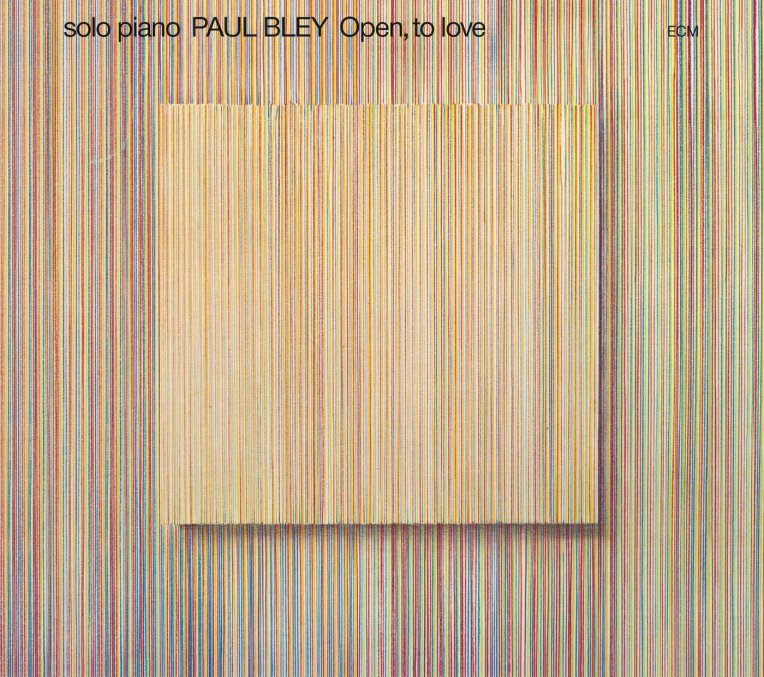
Paul Bley: Open, to love (ECM 1023)

ECM 1023

Paul Bley
Open, to love

Paul Bley piano
Recorded September 11, 1972 at Arne Bendiksen Studio, Oslo
Engineer: Jan Erik Kongshaug
Produced by Manfred Eicher

Hot on the heels of Chick Corea’s diptych for ECM, and certainly not to be outdone, Paul Bley offers up this sizable helping of solo jazz piano. For lack of a better analogy: if Corea’s improvisations were a large family dinner, Bley’s arrangements would be the lemon meringue to follow. Each track doesn’t so much tell a story as try to make us savor its finer details. Bley seems to channel Keith Jarrett at times (or is it the other way around?), as occasionally his voice will creep in with hints of the latter’s seemingly unbounded ebullience. He also directly plucks and strums the strings inside the piano selectively and with tact, adding a fine metallic ring to his otherwise crystalline playing. Bley coaxes our willing ears and leaves us wanting more of his sweet sounds. The album never seems to stray, even if linear melodies are sometimes difficult to pick out. These pieces are duly heartfelt and his version of Carla Bley’s “Ida Lupino” here is stunning.

If ever the word “lovely” was at risk of going out of style for its kitschy implications, let me make a case for this music as a means of reclaiming its validity. Bley’s intimacy is refreshing and comes across beautifully in the present recording. And while one might make a case for Corea’s improvisations as being “dated” (and this is not a bad thing, for its archival value is only heightened as such), Open feels somehow timeless. It is an album that one grows into. The music is for the most part calm and reflective, but ends with “Nothing Ever Was, Anyway” on a bit of an aggressive note; a catharsis, if you will. So does Bley leave the listener with an intriguing question mark that can only be erased with another listen.

<< Chick Corea: Return To Forever (ECM 1022)
>> Gary Burton/Chick Corea: Crystal Silence (ECM 1024)

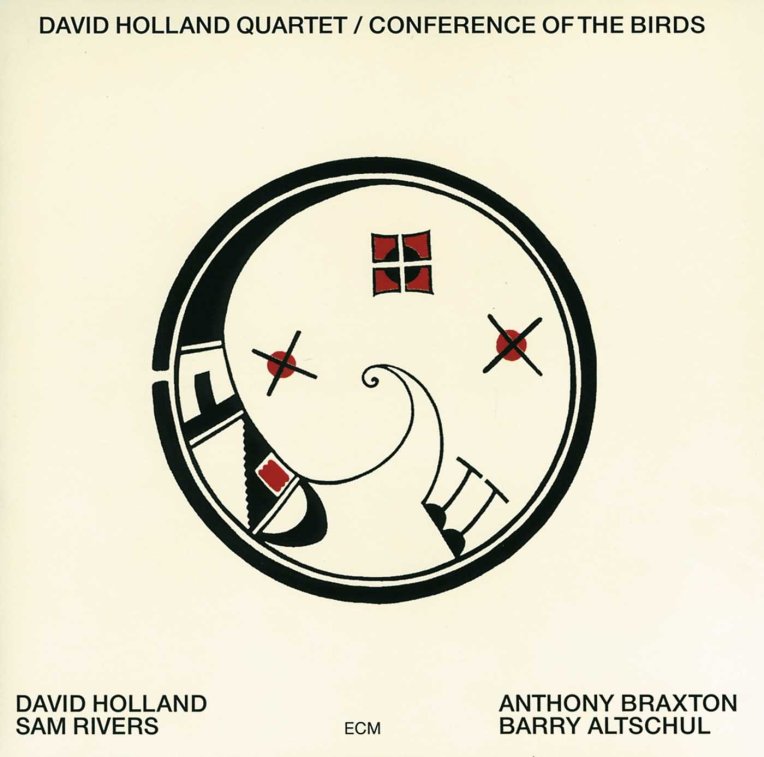
Dave Holland Quartet: Conference Of The Birds (ECM 1027)

1027

Dave Holland Quartet
Conference Of The Birds

Dave Holland bass
Sam Rivers reeds, flute
Anthony Braxton reeds, flute
Barry Altschul percussion, marimba
Recorded November 30, 1972 at Allegro Studio, New York City
Engineer: Tony May
Produced by Manfred Eicher

As someone who began with ECM New Series releases long before easing into the world of ECM proper, my initial explorations of the latter led me to decidedly contemporary avenues of jazz and to a particular fondness for the many Norwegian projects represented by the label. Only in recent years have I begun to pan for gold in the massive back catalog that was produced before I was born, and among the many fine nuggets to emerge from the sediment is this most splendid effort.

Phenomenal wind work from Braxton and Rivers makes this a decadent studio treat, grinding out equally captivating solos, whether over a tight rhythm section or in the throes of a looser backdrop. Though easily billed as a “free jazz” album, Conference Of The Birds remains a fine testament to a relatively accessible strand of the form. A child of the post-bop generation, Holland takes the back seat for the most part and lets his reedmen take center stage. Whimsical elements such as the unexpected coach’s whistle in “Q & A” comingle with the solid relay races of “Four Winds” and “See-Saw.” The title track provides the most delicate textures on the album with its effortless flourishes and gorgeous bass intro, acting as a fragrant palate-cleanser before launching us into the ecstatic free-for-all that is “Interception.” Each cut has its own distinct flavor, lending a vibrant anticipation to every break.

Conference Of The Birds is special to me for at least three reasons: (1) It evokes an important period of musical and political transition that I will never experience directly. Moods are wrought in iron and blown glass, so that no matter how many times the structure is destroyed, one can always melt the pieces down again into something new. This was a time in which the entire world was either on its knees or throwing off the shackles of normalcy in favor of unrestricted forms of expression. This duplicitous spirit of oppression and liberation is embodied perfectly in the sounds. (2) One can trace a dark and lasting thread from Holland’s early work to the present. This set in particular allows us to see his foundational strength, the whimsical order for which he has become so well known. (3) This album is, for me at least, one example of what makes jazz so uplifting: a spirit of shared knowledge, a hermetic seal ruptured for the sake of communal awareness, and the letting go of one’s own inhibitions amid an unforgiving social order.

Offer it your hand, and you may be surprised where it leads.

<< Stanley Cowell Trio: Illusion Suite (ECM 1026)
>> Paul Motian: Conception Vessel (ECM 1028)

Manu Katché: Neighbourhood (ECM 1896)

Manu Katché
Neighbourhood

Jan Garbarek saxophones
Tomasz Stanko trumpet
Marcin Wasilewski piano
Slawomir Kurkiewicz double-bass
Manu Katché drums, percussion
Recorded March and November 2004, Rainbow Studio, Oslo
Engineer: Jan Erik Kongshaug
Produced by Manfred Eicher

Neighbourhood is an astounding, if subdued, meeting of minds. Like other ECM projects of its ilk, this congregation feels as if it arose out of a fundamental and inescapable desire to create music for the sheer enjoyment of it. There is no showing off here. This is laid back, burnished, melt-in-your-mouth jazz perfect for a quiet evening or a rainy afternoon. That being said, this is a far cry from what might elsewhere derogatorily pass for “smooth.” In spite of its overall delicacy the album is not without solid grooves (how can we not bob our heads to the piano-driven ride that is “Number One” or to the swinging horns of “Take Off And Land”?), effectively concise solos (cf. Garbarek’s gorgeous outburst in “Good Influence” and titillating turns from Wasilewski and Stanko in “Lovely Walk”), and enough stellar moments overall to turn any depressing day into a blissful mental excursion. The ensemble plays us out beautifully with “Rose.”

As the brainchild of Manu Katché and producer Manfred Eicher, Neighbourhood is essentially a rhythmic enterprise. Katché’s percussion work provides the crowning motifs to which his compatriots are each a shining jewel. Multiple listenings reveal new nuances of texture and interaction every time. A very fine but impermeable thread connects these musicians and Katché never dominates, waiting in the wings as his motifs take shape of their own volition. The title of the sixth cut says it all: “No Rush.” Take your time with this one and it will reward you greatly. Just press PLAY and you’re there.

Collin Walcott: Grazing Dreams (ECM 1096)

ECM 1096

Collin Walcott
Grazing Dreams

Collin Walcott sitar, tabla
John Abercrombie electric and acoustic guitars, electric mandolin
Don Cherry trumpet, flute, doussn’gouni
Palle Danielsson bass
Dom Um Romão berimbau, chica, tambourine, percussion
Recorded February 1977 at Talent Studio, Oslo
Engineer: Jan Erik Kongshaug
Produced by Manfred Eicher

A plaintive, leisurely journey from Collin Walcott, North American pioneer in the art of the jazz sitar and ECM visionary whose life ended all too soon at the age 39. To anyone put off by this summary, I cannot stress enough the soulfulness of his playing. Walcott, who studied with the inimitable Ravi Shankar, does not treat his instrument as a mere substitute. Rather, he awakens the sitar to a whole new method of understanding, constructing a viable world around it rather than simply tossing it into the mix as a gimmick or afterthought.

Like the previously reviewed Survivors’ Suite from Keith Jarrett, Grazing Dreams is structured as long-form whole in which individual tracks blend into the overarching power that binds them. “Song Of The Morrow” starts things off right with flirtatious sitar riffs appearing and disappearing against a reverberant wash of guitar and trumpet while subtle and varied percussion sections sneak past in the background. “Jewel Ornament” is a personal favorite here, unfolding like a child’s raga. The hold and release of Cherry’s flute and Abercrombie’s insect-like guitar mesh beautifully with Walcott’s tabla stylings. By the time we get to the title track, which plays out like the folk tune of some undefined diaspora, we begin feel the weight of travel on our shoulders. And so, the final “Moon Lake” stretches out like a diffuse reflection across its titular surface, providing rest and replenishment beneath the sheltering sky of our nocturnal wanderings.

The engineering of this album is ahead of its time. Considering the way each track evolves, an attuned sensibility was clearly required to bring out the music’s full breadth. Case in point: the way the buzzing solitude that opens “Gold Sun” gradually develops into a honeyed elaboration of sitar and bass is nothing short of astonishing. Each tune is spun from the same cloth, dyed in real time with the languid syncopation of improvisers who feel what they hear. Gentility through strength is the backbone of Grazing Dreams, a poignant and timeless statement spun from the ether of dreams.

<< Ralph Towner’s Solstice: Sound And Shadows (ECM 1095)
>> Pat Metheny: Watercolors (ECM 1097)

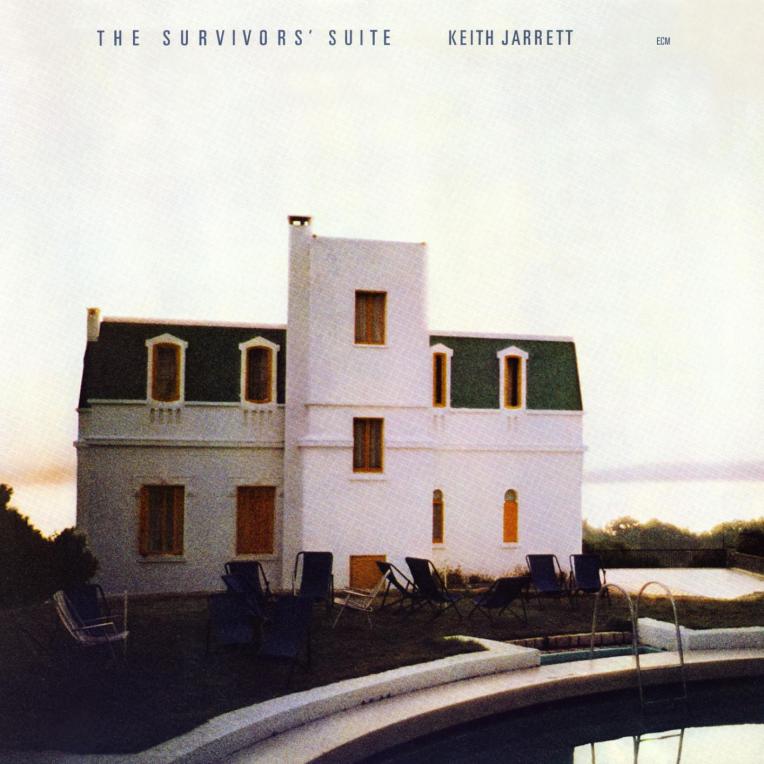
Keith Jarrett: The Survivors’ Suite (ECM 1085)

ECM 1085

Keith Jarrett
The Survivors’ Suite

Keith Jarrett piano, soprano saxophone, bass recorder, celeste, osi drums
Dewey Redman tenor saxophone, percussion
Charlie Haden bass
Paul Motian drums, percussion
Recorded April 1976 at Talent Studio, Oslo
Engineer: Martin Wieland
Produced by Manfred Eicher

A quick perusal of the personnel and mechanics of this album is practically all one needs to get an idea of the tonal colors and moods with which its imagery is composed. The Survivors’ Suite finds Jarrett in a multi-instrumental role along with the all-star cast that makes up his American Quartet. The sheer synergy of the playing truly makes this music shimmer. For this reason, I hesitate to single out particular solos and motifs. Suffice it to say each member has his moment of glory in the concisely knit fabric of the album’s 49-minute duration.

The music shifts dramatically from soulful dirges to upbeat thematic variations in a vibrant flow of ideas. A sense of control reigns. One never feels lost while listening (or is, in fact, lost but doesn’t care), for the surroundings are so resplendent with life. This is a supremely evocative experience and the similarity of associations it has inspired in so many listeners is striking to say the least (peruse a few other reviews, and you’ll see what I mean). The Survivors’ Suite reaches beyond jazz, even if firmly rooted in jazz’s soil. Its sound is vast yet intimate, breathing with the sheer life force of its music-makers. There is a marked difference between its two sections, simply titled “Beginning” and “Conclusion.” They are not polar opposites and are more than complementary. They walk the same trails, perhaps pointing out different sights along the way, all the while knowing they will soon meet again. Where the former is timid yet progressive, the latter is democratic and viscous.

This is, without a doubt, a high point among Jarrett’s many ECM outings. It is expertly recorded (as evidenced by its superb balance of warmth and coolness), fluidly played, and widely cherished, as I am sure it will continue to be for decades to come.

<< Eberhard Weber: The Following Morning (ECM 1084)
>> Keith Jarrett: Hymns/Spheres (ECM 1086/87)

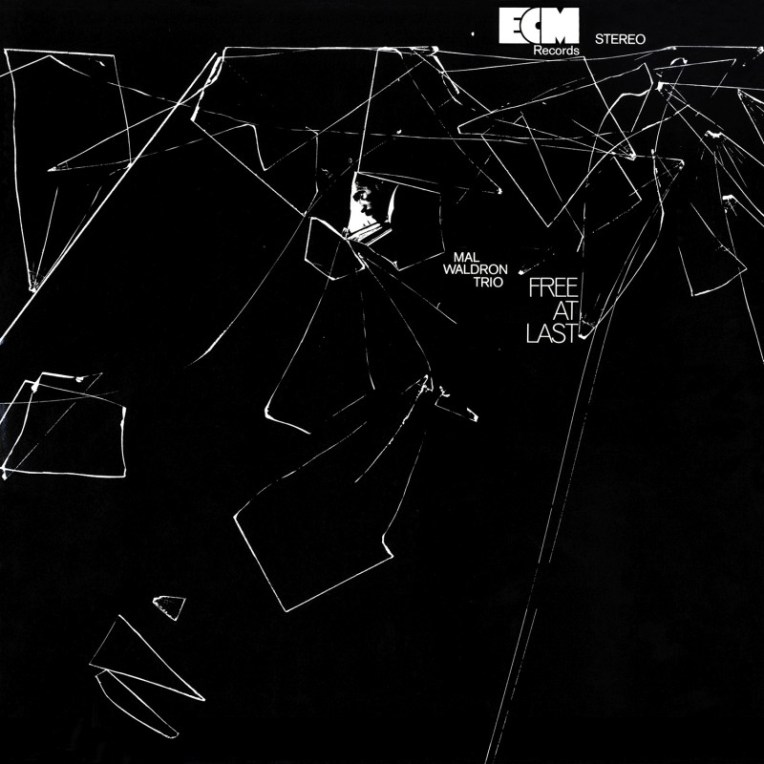
Mal Waldron Trio: Free at Last (ECM 1001)

1001

Mal Waldron Trio
Free at Last

Mal Waldron piano
Isla Eckinger bass
Clarence Becton drums
Recorded November 24, 1969 at Tonstudio Bauer, Ludwigsburg
Engineer: Kurt Rapp
Supervision: Manfred Eicher
Produced by Manfred Scheffner* + Jazz by Post
Release date: January 1, 1970

A cymbal riff from Clarence Becton introduces this respectable outing from Mal Waldron and company as bassist Isla Eckinger and the bandleader jump in for some enjoyable interplay. Yet what begins as an energetic ride turns somber through Eckinger’s rumination. Such solos lend deeper insight into the goings on, underscored by Waldron’s staccato mastication. Ballads are the album’s ventricles. A sweltering slog through love and darkened streets, “Balladina” shines with a hardened beauty all its own, while “Willow Weep for Me” is therapeutic like a good long cry. Both tracks have been strategically placed as penultimate bookends and serve as two-way doors into the struggles on either side. Others, like “1-3-234,” center the listener with needed uplift from these brooding asides, culminating in the concise and playful “Boo.”

This recording, ECM’s first, represents what was to become the label’s defining edge: namely, the allowance for (and foregrounding of) space in the recording of jazz. Seeing as this was already part of Waldron’s base approach, selectively pulling at roots while grafting on new ones, this disc was a suitable vehicle for his raw aesthetic. Its melodies may not stick in your head, but are stepping-stones toward a careful melancholy. And while ECM would vastly improve and enlarge its recording repertoire in the decades to come, there remains something comforting—just shy of innocent—about this album. If anything, this is a jazz of introversion, an intimate and myopic exposition of fleeting interactions that neither invites nor pushes away.

As Peter Rüedi has it, “free” meant something quite different to Waldron than it did to the more overtly anarchic figureheads of the waning sixties. It was, rather, “a quality that starts with structure and comes back to structure.” In light of this, Free at Last is the point of departure for a label that has since never looked back, even as it carries these sounds in its heart.

*Scheffner’s name is incorrectly spelled as “Scheffnfr” on the original LP.

For my thoughts on the 2019 vinyl reissue, click here.

>> Just Music: s/t (ECM 1002)

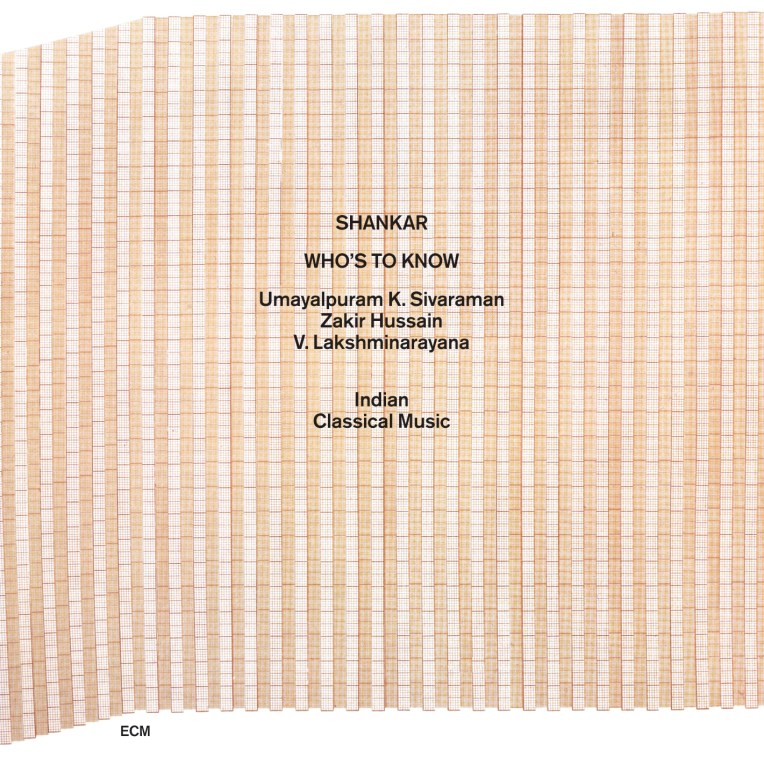
Shankar: Who’s To Know (ECM 1195)

ECM 1195

Shankar
Who’s To Know

Shankar 10-string double violin, tamboura
Umayalpuram K. Sivaraman mridangam
Zakir Hussain tabla
V. Lakshminarayana conductor (tala keeping)
Recorded November 1980 at Tonstudio Bauer, Ludwigsburg
Engineer: Martin Wieland
Produced by Shankar and Manfred Eicher

Tamilian violinist Lakshminarayana Shankar offers listeners a beautiful and powerful experience in this, his first outing for ECM. Shankar plays a 10-stringed instrument of his own design, and his personal hand in its construction is as deeply evident as his playing of it. Over a steady drone of tamboura and attuned rhythmic support from Zakir Hussain and Umayalpuram K. Sivaraman, Shankar’s flights of improvisation are free to soar. His melodies are driven by deep recognition of intent, visceral and immediate.

We are treated here to two long-form pieces, averaging 23 minutes each. Though distinct in form and mood, they are unified by an overarching sense of commitment and, I daresay, surrender. The first, Ragam-Tanam-Pallavi, introduces its theme with fluid precision. Shankar’s fingers seem never to rest on any single note for long, carried as they are by the as-yet-unspoken rhythms lurking just beyond the horizon. And so, when those rhythms do at last come to be articulated, the listener is salved by the comfort of a promise fulfilled. Ananda Nadamadum Tillai Sankara, on the other hand, carries itself forward with a touch of vulnerability, offering itself to the fate of its own musical environment. This is a more somber companion piece that slips into more adventurous registers and changes of key, and with a determination all its own. Eventually the violin turns in on itself, leaving our percussionists to play us out in an intimate call and response, culminating in the violin’s lilting swan song before the tamboura fades into silence.

Those familiar with Carnatic music will find much to admire in Shankar’s signature style and inexhaustible virtuosity. This is arguably his least “fusionesque” album to date, drawing its borders with reliable pigments that clearly serve its musicians well. Brimming with inspired playing, effortless execution, and a singular melodic sensibility, this is an impassioned and vivid record from start to finish and will ever remain an ECM jewel.

<< Goodhew/Jensen/Knapp: First Avenue (ECM 1194)
>> Thomas Demenga/Heinz Reber: Cellorganics (ECM 1196 NS)