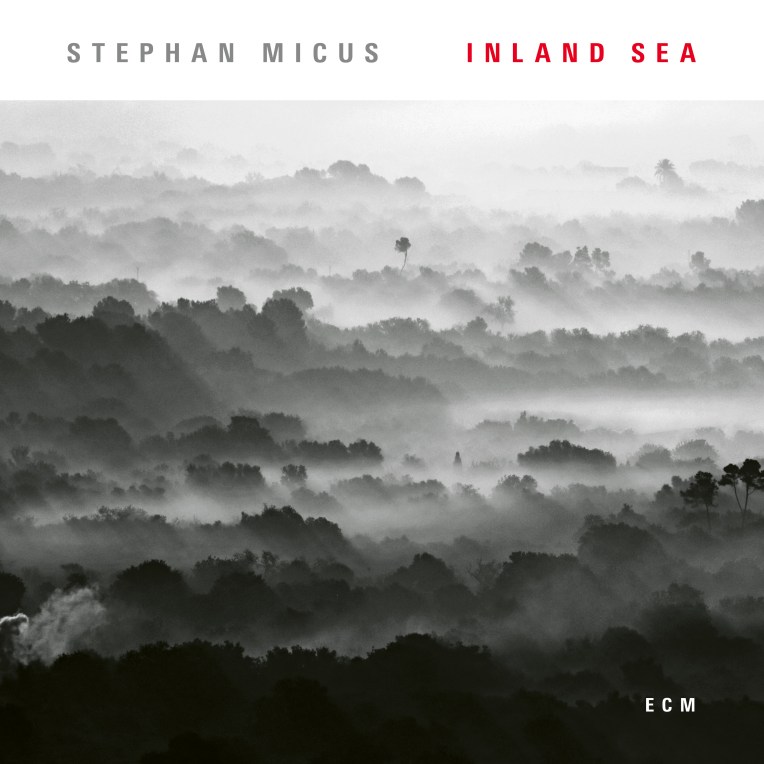
Stephan Micus: Inland Sea (ECM 2569)

2569 X

Stephan Micus
Inland Sea

Stephan Micus balanzikom, nyckelharpa, chord and bass zithers, shakuhachi, voice, steel-string guitar, genbri
Recorded 2014-16 at MCM Studios
An ECM Production
Release date: June 16, 2017

When talking about differences between cultures, it’s tempting to uphold products such as food, art, and music as foci of distinction. On the latter point, Stephan Micus has dedicated his life to that without which music would not exist: the instruments themselves. From the staggering amount in his repertoire, he draws stories that could never have been written by any other means. Take the duo, for example, which makes its first appearance in his milieu via the opening “Haze.” The balanzikom, an obscure seven-stringed lute from Tajikstan, feels so much like the mountains and open plains of its origins that it could never have come from anywhere else. The very land is its womb, as also of the wordless gestures projecting life into being. The nyckelharpa, a Swedish bowed instrument keyed like a hurdy gurdy, is as crisp as the climate of which it was born, accordingly grounded. Micus listens to these instruments much more than he plays them, and through his performances allows them to learn new languages by the same tongue and teeth. As the only one-on-one conversation between them, “Haze” sets a precedent of civil and spiritual exchange for all to follow. The nyckelharpa, for its part, glows in triplicate in “Dawn” and “Dusk.” Their combined song is more than diurnal; it’s life and death.

Likewise, the shakuhachi is more than a conduit for breath. For while Micus has rewritten its futures many times over, its ancestral home is unalterable. In “Sowing Wind,” he matches this Japanese bamboo flute with the chord zither, a 68-string instrument of his own design. The arc thereof is a primordial one, along which feelings of mutual regard flow as if they were a mythology to which we’ve blinded ourselves. This relationship deepens in “Reaping Storm,” switching chord zither for its bass counterpart. Now the mood is fragile and of a different season, fragrant of a world humbled by nature.

The balanzikom delineates further circles for Micus’s singing in “Flor del Sur.” Radiating along cardinal axes as if to hold continents in its embrace, the solo voice welcomes five percussive nyckelharpa, chord zither, and shakuhachi in “Nuria,” and among that assembly enacts a tale of disparate peoples brought together by tragedy. For “Virgen de la Mar,” Micus choruses his voice fifteen times over, and to it adds three genbri, a three-stringed bass instrument from Morocco. Treading the same soil packed by the feet of “Dancing Clouds” (plucked nyckelharpa, 6 percussive nyckelharpa, 3 bowed nyckelharpa, steel string guitar, genbri, bass zither) and laid to rest by “For Shirin and Khosru” (2 bass zithers, 2 nyckelharpa, 3 steel string guitars, genbri), it treats melodic resolution as the caress of a loving parent who dispels fears of darkness. Thus we are protected, hoped for, and fortified to face new days, bringing our own children to the well of mortality, that they might also see the reflections of all who came before them.

Craig Taborn: Daylight Ghosts (ECM 2527)

Daylight Ghosts

Craig Taborn
Daylight Ghosts

Craig Taborn piano, electronics
Chris Speed tenor saxophone, clarinet
Chris Lightcap double bass, guitar
Dave King drums, electronic percussion
Recorded May 2016 at Avatar Studios, New York
Engineer: James A. Farber
Assistant: Tim Marchiafava
Produced by Manfred Eicher
Release date: February 3, 2017

In the footsteps of two successful leader dates for ECM, pianist Craig Taborn rolls the die of paradigm once again and hits a solid four with Chris Speed on tenor saxophone and clarinet, Chris Lightcap on bass and guitar, and Dave King on drums and electronic percussion. Opener “The Shining One” is sure to delight fans of label mate Tim Berne, whose penchant for complex geometry is echoed here. Comparison aside, there’s a DNA helix all its own down which these musicians slide toward endings as abrupt as their beginnings. Speed navigates the bandleader’s genetic code as if it were his own back yard, while Lightcap and King engage in sequencing that feels at once parasitic and parthenogenetic.

“Abandoned Reminder” unravels its story from whispering electronics, as Taborn narrates a ballad-turned-trip down a stairway of psychological proportion. Such changes are indicative of an overall constitution, which by suggestion of an unusual fluidity activates proteins in underused listening muscles. The title track and “The Great Silence” are remarkable in this regard. Their enmeshment of soft virtue and hard truth is the quartet’s calling card. Like the arpeggios that thread both in their final phases, they treat predictability as a springboard for its own undoing.

Says Taborn of working with such widely accomplished musicians, “This music trades on transparency. I wanted all the elements to be crystalline, so that the layers of the music work like a prism.” Indeed, prismatic effects abound throughout“New Glory,” in which Taborn and Speed exchange unveiled conversation, and “Ancient.” The latter’s transition from bass monologue to ritual confluence shows a band working with patience and detail. As the parts, so the whole. Whether in the resonant piano-drums duet of “Subtle Living Equations” or the cosmic textures of “Phantom Ratio,” which floats Speed’s tenor on an ocean of nostalgic loops, the effect is consistently appropriate to the theme at hand. And while Taborn’s writing tends to pay homage to those themes at microscopic levels, his nod to Roscoe Mitchell’s “Jamaican Farewell” sees the jewel for the facets, and shines a methodical light of appreciation through a heart whose every beat is musical gospel. This is good news indeed.

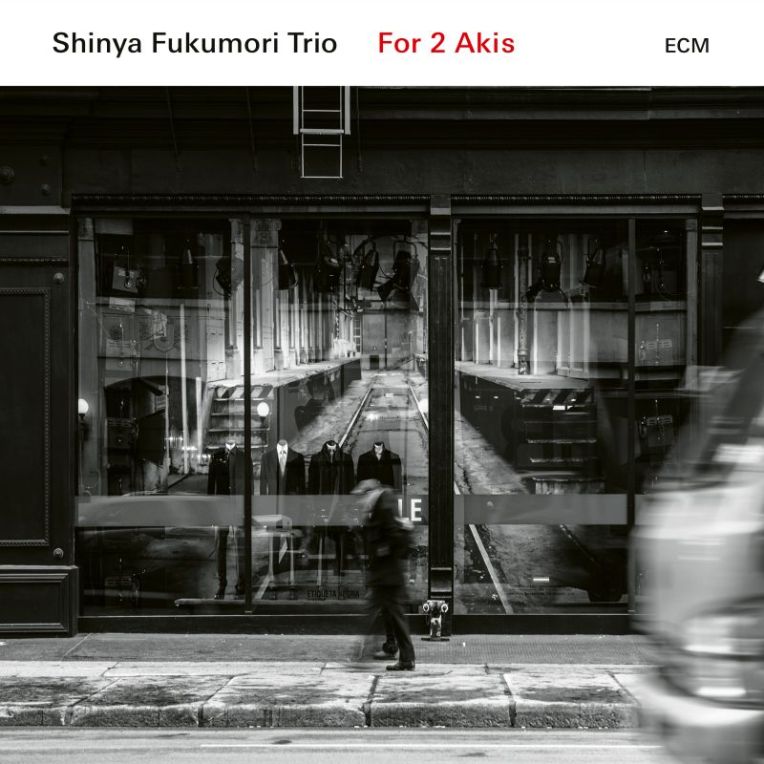
Shinya Fukumori Trio: For 2 Akis (ECM 2574)

For 2 Akis

Shinya Fukumori Trio
For 2 Akis

Matthieu Bordenave tenor saxophone
Walter Lang piano
Shinya Fukumori drums
Recorded March 2017, La Buissonne, Pernes-les-Fontaines
Engineer: Gérard de Haro
Produced by Manfred Eicher
Release date: February 16, 2018

When the sun shines, birds sing,
the oak woods here and there
grow hazy,
I’ll have dirty palms
that make a gritty noise.
–Kenji Miyazawa, “Spring” (trans. Hiroaki Sato)

For 2 Akis presents the ECM debut of drummer Shinya Fukumori. Born and raised in Osaka, he learned to play violin, piano, and guitar before relocating to the United States at 17 to pursue the drums. Yet after graduating from Berklee College of Music and immersing himself in the jazz canon, he became so inspired by classic ECM recordings, including Eberhard Weber’s Silent Feet and Keith Jarrett’s My Song, that he resolved himself to one day record for the label. Toward realizing that goal, he moved to Munich—a risky decision encouraged by this album’s dedicatory Akis, both affiliated with Osaka’s Interplay8 jazz club. In a categorically unmatched trio with fellow itinerant spirits Walter Lang (piano) and Matthieu Bordenave (tenor saxophone), Fukumori reimagines history as a process of ongoing revision.

Much of that revision is drawn through evocation of Japan’s Shōwa era (1926-89), a time marked by economic collapse on either end, between which unthinkable traumas transitioned into golden-age prosperity. Although his own life overlaps it a mere five years, he understands its nostalgic power as if through firsthand experience, expressed in his introverted approach to virtuosity. Such restraint indicates an artist unafraid to humble himself in silhouette against the movie screen of time on which montages of compassion flicker by. Thus, each tune of Fukumori’s selected corpus extends a narrative devoid of antagonists and bound by regressive politics of interpretation.

During the interwar period (1918-39), a concerted emphasis on delineation and preservation of folk customs infused all aspects of Japanese cultural life, including crafts, farming, and music. And it is perhaps with this timeline in mind that Fukumori begins his artful set with “Hoshi Meguri No Uta” (The Star-Circling Song). Written by literary icon Kenji Miyazawa, its original lyrics depict Polaris guiding readers on a tour of the visible universe. Fukumori likewise takes listeners by the gentlest of hands on a journey through bygone eras, along the way establishing a precedent of communication with his bandmates. In this context, Lang’s lyrical curiosity and Bordenave’s vulnerable yet integral tone are nothing less than the light to his stardust.

By the 1960s, Japan had recovered from World War II and poured renewed effort into rural development as a means of reforming national identity. It was also a time when nihon-chō kayōkyoku, or Japanese-style popular songs, infused public consciousness with their airs of better times. Presciently enough, the solitude and hardship so commonly examined in those songs foreshadowed the bubble whose burst would mark the end of the Shōwa, ushering in an era of hypermodernism and recovery. Before that key transition, however, songwriter Kei Ogura planted his “Ai San San” in the popular imagination. Its evocation of perseverance through rough times gifted an anthem of recovery before one was even needed. Made famous by actress and enka queen Hibari Misora when she released it as a single in 1986, it continues to feel premonition-worthy at a time when we could use a little calm from the storm.

The oldest song here is Rentarō Taki’s “Kōjō No Tsuki” (The Moon Over the Ruined Castle). Written in 1901, it’s a timeless meditation on the fleeting nature of things. As people and their traces come and go, it seems to say, only their love lingers, reflected in the waters of mortality. Jazz aficionados will recognize the tune by way of Thelonious Monk, who arranged his own version as “Japanese Folk Song” on 1967’s Straight, No Chaser. Says Fukumori of the version at hand: “Every Japanese child learns this song at school. The melody of the song is very Japanese, so it stands out and still sounds very authentic even though I have re-harmonized it and arranged it.” So begins a three-part suite, in which mallets elicit a soft vocabulary from the drums, shifting into pianistic shadow cast by a glowing saxophone before blending into Fukumori’s “The Light.” Like the title track, it showcases his compositional ability to activate dense reactions from delicate chemicals, proving that he and his trio are no strangers to urgency when needed. In that precise regard, the rounded peaks of emotional transference in “Silent Chaos” and “Spectacular” are emblematic of his optimism and gratitude.

All the more reason for listeners to hold in mind the timeline being explored therein. What appears to be another beauty in the form of “Mangetsu No Yube” (Full Moon Night) reveals itself to be a prayerful reaction to tragedy. Composed by Takashi Nakagawa and Hiroshi Yamaguchi in response tothe Great Hanshin earthquake of 1995, it speaks the very language of connection that makes this band so transfixing. Lest we forget the potency of said language, we find two offerings by Lang (“No Goodbye” and “When The Day Is Done”) and one by Bordenave (“Émeraude”). All three are memories folded and unfolded, each more soulful than the last, as part of a collective dream.

It’s impossible to regard Fukumori as anything less than a rightful heir to Paul Motian’s legacy. His attention to detail, unflinching musicality, and penchant for understatement are rare in a musician so young (being 33 at the time of this recording). As when encountering Motian, this is music that demands the night. Anything less than total darkness would obscure its poetry against a market too often shouting with exposition.

Easily among ECM’s finest of the decade. Don’t miss it.

Björn Meyer: Provenance (ECM 2566)

Provenance

Björn Meyer
Provenance

Björn Meyer 6-string electric and acoustic bass guitars
Recorded August 2016, Auditorio Stelio Molo RSI, Lugano
Engineer: Stefano Amerio
Produced by Manfred Eicher
Release date: September 15, 2017

Björn Meyer is perhaps best known to ECM listeners as bassist for Nik Bärtsch’s Ronin before leaving the band in 2012, and by his appearances on albums of Anouar Brahem, notably 2014’s Souvenance. But the kaleidoscope he has assembled for this 2017 solo album is as surprising as it is fated. Each of its twelve vignettes acts as a window not into but out of Meyer’s singular approach to his six-string electric and acoustic basses. Through their diurnal dialogues, he elicits a sundial’s worth of possible directions, transforming reveries into grounded experiences.

In the opening “Aldebaran,” exquisite suspensions of disbelief bleed into a space where contact of flesh on metal leaves traces of communication, and where the barest whisper of a string is also its credo. Its evocations of wind and water are shared by “Trails Crossing,” which finds Meyer riding a current of arpeggios, which by their changes of direction imply a crossing not only of trails but also of those traveling along them, as if at that meeting point one might witness souls jumping from body to body in search of blessed purpose.

The title track is a spectrum of emotional transference, a series of genetic equations spliced and sequenced into chains of melodic integrity. Here, as elsewhere along the album’s trajectory, tasteful applications of electronic delays and reverb magnify what is already felt spiritually. Where “Pendulum” and “Pulse,” for example, are linked to rhythms of movement, “Garden Of Silence” and “Three Thirteen” achieve their impact through understatement.

Against such fullness of expression, the acoustic bass provides ever-expanding possibilities, spanning the gamut from funky (“Squizzle”) to descriptive (“Merry-Go-Round”) and, when combined with electric (“Dance”), sonic origami in reverse. Just as the electric resonates through harmonic comet tails in “Traces Of A Song,” so does the acoustic seek an origin story to unite them both. And in “Garden Of Silence,” by harpist and singer Asita Hamidi (1961-2012), to whom this album is dedicated, he activates a trail of molecules from instinct to action that by the end leads us back to where we began, hopeful and with all the necessary gear intact.

Chris Potter: The Dreamer Is The Dream (ECM 2519)

The Dreamer Is The Dream

Chris Potter
The Dreamer Is The Dream

Chris Potter tenor saxophone, soprano saxophone, bass clarinet, clarinet, flute, ilimba, samples
David Virelles piano, celeste
Joe Martin double bass
Marcus Gilmore drums, percussion
Recorded June 2016 at Avatar Studios, New York
Engineer: James A. Farber
Assistant: Luke Klingensmith
Mixed December 2016 by James A. Farber, Manfred Eicher, and Chris Potter
Produced by Manfred Eicher
Release date: April 21, 2017

Chris Potter’s third leader date for ECM reshuffles the reedman and composer’s deck into yet another brilliant stack. This ace of spades is joined by brothers of hearts (pianist David Virelles), clubs (bassist Joe Martin), and diamonds (drummer Marcus Gilmore) for a set of six road-tested originals that only seem to grow with repeat listening.

While Potter is known for his forthright tenor playing, “Heart In Hand” facilitates a soft landing into hard-won territory. In a relationship with piano that’s almost blood-related, Potter’s primary instrument fits itself into the valleys between the keys while bass and cymbals populate the land with flora and fauna of lush detail. As in the set’s closer, “Yasodhara,” the bandleader’s tone is the voice of a fertile crescent alive with constant invention. Not a breath feels wasted, nor does a single note from Virelles, whose sonic archaeology is equal parts fire and earth.

“Ilimba,” named for the Tanzanian thumb piano heard therein, locks Potter and Martin in step, while Virelles and Gilmore paint crosswise: the water to their wind. Amid Gilmore’s superlative patterning, Potter plants himself in enlightened soil. “Memory And Desire” is another surprise for its artful samples and folk-like soprano. Mind-melding with Virelles, it treats air as a surface to write across. The title track is the willow tree resulting from this natural assemblage. Featuring Potter on bass clarinet in a fronded system of branches, and an extended bass solo from Martin, who dismantles and rebuilds his ladder to the top until its structural integrity is infallible, it regards us from above as the sun dances on its own reflection. Squinting our eyes into its glare is all we can do to open our hearts and minds to its message. Not only is the dreamer the dream; the dream is also the dreamer.

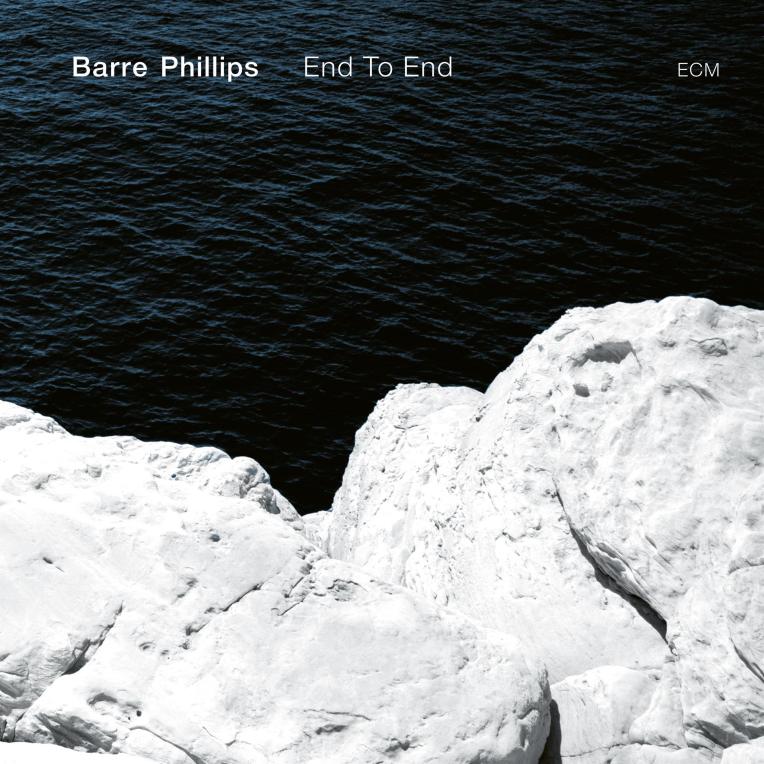
Barre Phillips: End To End (ECM 2575)

End To End

Barre Phillips
End To End

Barre Phillips double bass
Recorded March 2017, La Buissonne, Pernes-les-Fontaines
Engineer: Gérard de Haro
Produced by Manfred Eicher
Release date: September 7, 2018

When bassist Barre Phillips began his diaristic exploration of the double bass in 1968 with Journal Violone (the sequel to which found its way onto ECM in 1980), little did anyone know it would reach its destination half a century later. This album’s title, End To End, thus signals the closing of a circle filled by one of the instrument’s most stalwart innovators. Divided into three retrospectively titled sections, the program is reflective of both his ability to say so much with so little and of producer Manfred Eicher’s to understand the grander narrative of which that little is a part.

Quest
From the first pizzicato strains, it’s clear that Phillips is one who thinks not only through the bass, but also from it. Every note belongs. When he applies bow to strings, there’s a confident vulnerability to its pulse. It moves like windblown leaves with just enough sunlight peering through to bring a childhood memory into focus. His breathing, when audible, imbues glissandi with sentience. When not audible, it curls up as if in hibernation for melodic spring. In that dream state, it embraces the possibilities of dissonance, harmonics, and other subtly applied contacts. Part 4, in which he taps out a Morse code of mortality, is especially moving for its urgency. So, too, is his own quest for unspooling page after brilliant page, each awaiting the caress of post-production ink.

Inner Door
Phillips takes out a metaphorical microscope and through it shows his art to be a parthenogenetic wonder. Double stops resound with all the power of a mantra, and by their appearance activate particles of moonlight. Here his bow is the wand of a master storyteller, one whose choice of words is as organic as the imagery they describe. The rhythms of an aging body, creaking joints and all, reveal a greater force at work.

Outer Window
From that introversion we get the sunbeams of this final section. Although similar in spirit to what preceded it, it takes the most intimate turns yet, and by those paths draws an equation of visceral extroversion. Now the microscope is swapped for a telescope. He peers through it, only to see a twin figure with the exact same setup looking back at him. In those last moments, flesh dies and stars are born, never to be captured again by glass and curious regard.

Elina Duni: Partir (ECM 2587)

Partir

Elina Duni
Partir

Elina Duni voice, piano, guitar, percussion
Recorded July 2017, Studios La Buissonne, Pernes-les-Fontaines
Engineers: Gérard de Haro and Nicolas Baillard (mastering)
Produced by Manfred Eicher
Release date: April 27, 2018

We are all departing, bound to be torn away,
one day or another, from what we love.
Here are scenes of departure sung in nine languages.
All we are left with is the unknown ahead of us.

So does Elina Duni describe this intimate new collection of songs. As on her previous outings for ECM, if by different register in being alone, the Albanian singer grabs hold of her roots and squeezes them until tears of personal significance drip into the vessels of her guitar, piano, frame drum, and voice itself.

Domenico Modugno’s “Amara Terra Mia” (Bitter Land of Mine) opens as many doors as the song has words. It’s a film reduced to a single camera and actor, a memory that finds its protagonist severing the umbilical cord of her ancestral home in favor of itineracy. But while there’s as much to be gained as lost from this endeavor, the uncertainty of it all looms over her like a cloud of darkness, her only companion the guitar that gives her a ground upon which to place her vocal step.

On the surface of this and all songs to follow there is a fracture, from which issues a ribbon of nostalgic patterns and color schemes, but which in its unraveling signals an end to things. Such mortality is felt with deep urgency in Alain Oulman’s “Meu Amor” (My Love) and Duni’s own “Let Us Dive In.” In the latter, she holds the piano close to her chest, as if to transfer some of her heartbeat to its material assemblage in the hopes of illuminating something common to both. In the fleshly conflict of Muhammad Abd al Rahim al Masloub’s “Lamma Bada Yatathanna” (When He Was Swaying) and solace-seeking litany of Jacques Brel’s “Je Ne Sais Pas” (I Don’t Know), she dismantles façades of expectation to expose the shadows slumbering behind them. With these she dances in defiance of human contact.

The album’s most resonant chambers house its traditional selections, intersecting with cultural touch-points in Kosovo, Armenia, Macedonia, and Albania. From the separation anxieties of “Vishnja” (The Cherry Tree) and “Lusnak Gisher” (Moonlit Night), both of which share metaphorical affinity with Philip Laskowsky’s “Oyfn Veg” (On the Road), to the dolorous strains of “Vaj Si Kenka” (How) and fleet images of “Schönster Abestärn” (Beautiful Evening Star), Duni broadens her wingspan to ensure total protection when night falls. But few beats of those feathers are as powerful as those sung without accompaniment in “Kanga e Kurbetit” (The Exile Song). Therein, her illustration of exile is itself a form of exile, dividing the self into as many components as possible before putting them together anew, minus the broken pieces.

John Surman: Invisible Threads (ECM 2588)

2588 X

John Surman
Invisible Threads

John Surman soprano and baritone saxophones, bass clarinet
Nelson Ayres piano
Rob Waring vibraphone, marimba
Recorded July 2017 at Rainbow Studio, Oslo
Engineers: Peer Espen Ursfjord and Jan Erik Kongshaug
Produced by Manfred Eicher
Release date: January 19, 2018

John Surman is one of those rare reed players whose tone is so recognizable that it contributes to an ever-expanding autobiography with every aural stroke. In this unusual new trio, he joins forces with pianist Nelson Ayres, who he met while recording in Brazil, and vibraphonist Rob Waring. The program consists largely of material written for this studio occasion, and by its dovetailed aesthetic renders one image after another of cinematic integrity. The most vivid tracks in this regard include “The Admiral” (a dream of maritime proportions), “Pitanga Pitomba” (the marimba of which reveals a Southeast Asian influence), and Ayres’s folky “Summer Song” (the only track on the ballot not written by Surman). The pianist adds even deeper grooves to “Autumn Nocturne,” a picturesque scene that glides easily into the soul. He dashes Latin flavor into the music’s broth, thereby encouraging a fragrant symbiosis of ingredients.

The interplay of the band is cosmic, as in the airy “Within The Clouds” and the more haunting “On Still Waters.” From the latter’s bowed vibraphone, Surman’s bass clarinet emerges as lava in search of a place to form an island, while the former spans the gamut from amphibian sermon to avian reverie and compresses the most beautiful parts of summer into five minutes of bliss. “At First Sight” is one among a handful of diurnal excursions in which Surman’s soprano cuts the air like a bird threading the needle of time. Both this and “Another Reflection” are built around the harmonies of “Byndweed,” an album highlight for the communion of Ayres and Waring, and Surman’s lilting poetry. His baritone (viz. “Concentric Circles”) flexes the broadest muscles of all and, not unlike “Stoke Damerel,” lushly reimagines memories of what came before.

As the album’s title implies, these threads may be invisible, but they’re nevertheless easy to detect in what amounts to one of Surman’s most vital sessions to date. Buy it now, and it will make up for whatever you spend on it a hundredfold in your first listen.

Keith Jarrett Trio: After The Fall (ECM 2590/91)

After The Fall

Keith Jarrett Trio
After The Fall

Keith Jarrett piano
Gary Peacock double bass
Jack DeJohnette drums
Producer: Keith Jarrett
Recorded live in concert
November 14, 1998
at New Jersey Performing Arts Center (NJPAC),
Newark, New Jersey
Engineer: Alain Leduc
Mastering: Rainbow Studio, Oslo
Executive producer: Manfred Eicher
Release date: March 2, 2018

After playing his last concerts in 1996, documented as A Multitude of Angels, Keith Jarrett was stricken with a bout of chronic fatigue syndrome that kept his hands away from the piano for two years. Only after that period of mystery and debilitation did he try to revive his trusted band with bassist Gary Peacock and drummer Jack DeJohnette. After a few rehearsals in the studio, he decided it was time to take a chance on the concert stage, doing so on November 14, 1998 for a performance at Newark, New Jersey’s new Performing Arts Center. If not for a touch of restraint, one might never know the difference, as Jarrett unpacks a formidable intro to their nearly 16-minute version of “The Masquerade Is Over” to kick off the evening’s revival. In addition to his obvious joy, one can bask in Peacock’s buoyancy and DeJohnette’s flowering metronome. Jarrett’s fingers are even more alive in the Charlie Parker standby “Scrapple From The Apple.” With the blessed assurance of this longstanding relationship, Jarrett gives us metaphysical nourishment of the highest archival order.

Jarrett Trio

“Old Folks” dips his hands into a font of balladic wonders. As well in “When I Fall In Love” and Noel Coward’s “I’ll See You Again,” he builds emotional castles brick by meticulous brick, giving his all to the integrity of the entire proverbial kingdom. A characteristically luxurious take on the live staple “Autumn Leaves” offers 13 minutes of polished bliss. No signs of fatigue, physical or otherwise, can be read into this ecstatic rendition, especially as Peacock and DeJohnette offer surprises of their own in a brilliant triangulation of spontaneous invention. The concert’s upbeat excursions, in fact, offer some of its most head-nodding rewards. These include Bud Powell’s “Bouncin’ With Bud,” which unfurls a robust scroll of creativity; an exuberant take on “Santa Claus Is Coming To Town,” in which DeJohnette and Peacock blaze around every corner; and a muscular interpretation of John Coltrane’s “Moment’s Notice.” Neither does Jarrett concede anything close to fatigue in the denser geometry of Sony Rollins’s “Doxy” or Pete La Roca’s “One For Majid,” in which the trio flies high and swings low. And Jarrett’s sensitivity shines as brightly as ever in Paul Desmond’s “Late Lament,” for which he opens another eye for every one that he closes.

No one could have known what this concert would bring, that it would usher in a freer, more unrestricted era, or that it would unshackle Jarrett’s chains in favor of rebirth. But with this piece now restored for all to place into the puzzle of their appreciation, we find proof that old endings are only new beginnings in disguise.