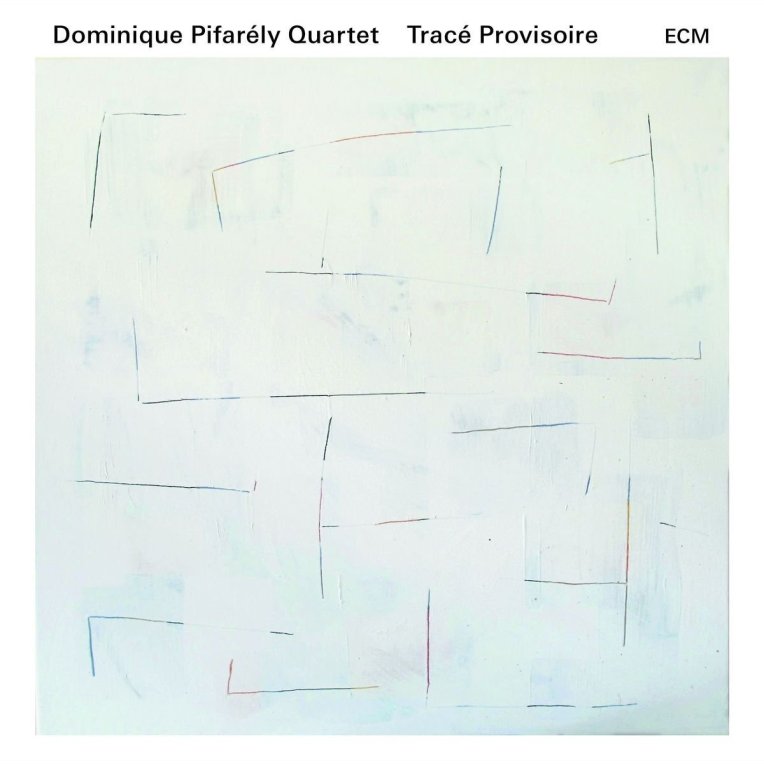
Dominique Pifarély Quartet: Tracé Provisoire (ECM 2481)

Tracé Provisoire

Dominique Pifarély Quartet
Tracé Provisoire

Dominique Pifarély violin
Antonin Rayon piano
Bruno Chevillon double bass
François Merville drums
Recorded July 2015, Studios La Buissonne, Pernes-les-Fontaines
Engineers: Gérard de Haro and Nicolas Baillard
Produced by Manfred Eicher
Release date: June 3, 2016

In the immediate wake of his solo album Time Before And Time After, violinist Dominique Pifarély returns to ECM leading a fearless quartet with pianist Antonin Rayon, bassist Bruno Chevillon, and drummer François Merville. The album’s title, which translates into English as “Provisional Layout,” is at once accurate and a misnomer. Accurate because Pifarély’s stoic humility allows no leeway for ego. Misnomer because this music is anything but provisional, archived as it is for posterity in this crisp recording.

The album is mostly populated by three diptychs, each split throughout the program. “Le peuple effacé” opens the ears to an honest exploration of space, Pifarély’s bow trembling like the feeler of an insect. Its second part extends a steadier hand, hennaed with designs and motifs that, despite having lost their original meanings, take on new ones by virtue of clinging to flesh. With rhythmic acuity in spades, Pifarély navigates every twist without so much as grazing his instrument along the way. Just as forthrightly, he settles into a lethargic meditation.

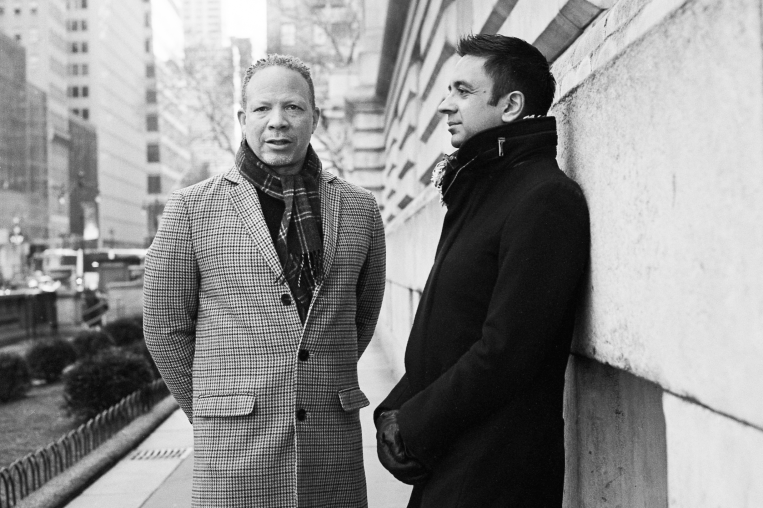
DPQ
(Photo credit: Jean-Baptiste Millot)

The title dyad abides by an even more exploratory grammar, wherein orthography is found lurking in every pause. The groovier settlement into which once-nomadic impulses find themselves collapsing is as haunting as it is energizing. The rhythm section is on point here, transitioning from robust to delicate maneuvers with nary a blink to be sensed. Part II is Rayon’s realm. Here the pianist diverts attention to shadow with light, and vice versa, before leaving the other three to dance until their bodies disappear.

“Vague” is a rich soundscape of breathy violin and percussive details, a progression from womb to tomb that consumes philosophies as if they were food. This leaves two standalones. Where “Le regard de Lenz” is an exploded geometry of pent-up force, and as such is the album’s fulfillment of rupture, “Tout a déjà commencé” is a thirteen-and-a-half-minute mosaic of elegiac and celebratory influences. Chevillon ups the bassing quotient significantly, leaving room for a ripple effect to sing. In this regard, the band’s willingness to go as deep as they need to in order to unearth what it is they’re searching for is admirable, and leaves us feeling filled to the brim.

Markus Stockhausen/Florian Weber: Alba (ECM 2477)

Alba

Alba

Markus Stockhausen flugelhorn, trumpet
Florian Weber piano
Recorded July 2015, Auditorio Stelio Molo RSI, Lugano
Engineer: Stefano Amerio
Produced by Manfred Eicher
Release date: April 1, 2016

Markus Stockhausen has walked a jagged path through the annals of ECM, but the German trumpeter can always be counted on to provide an experience that is unique, unforced, and above all genuine. On Alba, he presents for the first time in studio his collaboration with pianist Florian Weber. Six years in the making, this music and the interactions built around it are vessels of experiential intensity rounded by currents of thoughtfulness.

Weber Stockhausen

The album’s 15-track program shuffles originals and improvisations from both musicians in a stacked deck of melodic beauty. Weber’s end of the spectrum is concerned with honor and past reflections. In the latter vein, his opener “What can I do for you?” is dedicated to the late John Taylor, a vital ECM presence under whom he first studied as a young piano student. Like Taylor, he realizes that, in order to access the piano’s inner voice, those playing it must be willing to let go of their own.

Weber is a painter in sound. Whether evoking shifting granules of sand in “Emergenzen” or fantastical impressions in “Die weise Zauberin,” he wields every key as one would a brush. He’s also more prone to playfulness, as in “Surfboard,” a tune that precisely illustrates the duo’s creative process. As musical surfers, they know firsthand the value of a reliable board and choice wave, but use those parameters as prerequisites for joyful freedom. Weber’s “Emilio” is a highlight for turning a familiar arpeggio into a surprising vehicle for Stockhausen, who reaches expansively across intimate geographies.

Stockhausen Weber

Stockhausen’s universe combines the theoretical and the spontaneous. His “Mondtraum,” “Synergy Melody,” and “Zehpir” have their genesis in classical contexts, but here are pared to their base elements. His own whimsy emerges in “Befreiung,” albeit in a more cleanly predetermined vein, while “Better World” serves as a poignant expression of hope, transitioning from mournful reflection to twirling dance in a masterful turn of phrase.

Scattered improvisations round out the proceedings. Of these, the duetted “Ishta” is heartfelt to the extreme. In “Resonances,” Stockhausen plays directly into the piano, wherein untouched strings reverberate sympathetically, while “Barycenter,” “Possibility I,” and “Today” finds Weber alone with nothing but intuition to lead the way.

In addition to the richly flowing music, Alba is significant for being Stockhausen’s first for ECM in 16 years and for being Weber’s label debut. A release to be treasured.

Wolfert Brederode Trio: Black Ice (ECM 2476)

Black Ice

Wolfert Brederode Trio
Black Ice

Wolfert Brederode piano
Gulli Gudmundsson double bass
Jasper van Hulten drums
Recorded July 2015, Auditorio Molo RSI, Lugano
Engineer: Stefano Amerio
Produced by Manfred Eicher
Release date: April 1, 2016

It wasn’t the notes, it was the silences between the notes. Some music is the very enemy of silence, keeping the sounds coming so that the listener has no time to reflect. But other music, the music she played for herself, was different…
–Simon Mawer, The Glass Room

Following his quartet outings, Currents and Post Scriptum, pianist Wolfert Brederode dips into the font of trioism, joining forces with bassist Gulli Gudmundsson and drummer Jasper van Hulten. It’s a setting in which Brederode feels very much at home, despite the varied ensembles of which he has been a part, both within and without the ECM stable.

Given the vast amounts of energy put out by those preceding albums, “Elegia” involves as a tender welcome. Brederode’s sound-world is no less clearly defined, but here maps its crisp shoreline by the waves rolling onto it. A strum along the piano strings lands us softly into the arid “Olive Tree,” for which the band sidesteps that slow-motion crash in favor of utter restraint. In that restraint, however, lurks the ever-present possibility of fractures, so that every groove courts rupture. That everything holds together is due to fierce communication between the musicians, best expressed in the evocative title track: a smooth, glassine surface across which melodies glide without fear of falling through.

WBT

The patient unfolding of “Cocoon” proves just how dedicated Brederode and his crew they are to keeping their vessel afloat. Solos are few and far between, as they should be, as no voice is intended to dominate. Gudmundsson’s shaded “Conclusion,” the only non-Brederode original of the set, foregrounds its composer in one of few exceptions. The bassist’s presence throughout “Curtains” and “Rewind,” both highlights, is also notable. Likewise van Hulten’s snare in “Fall,” another oceanic mooring.

As with anything Brederode touches, however, primary focus is on message over medium. Where “Bemani” is a tapered ligament connecting soil and sky, “Terminal” is an unsettling illustration of horizontal anxieties. Meant to evoke an airport after hours, its brevity is proportional to its experiential vividness. But nowhere does the candle of evocation burn so brightly as in “Glass Room,” which by its architectural sensitivity treats windows not as portals but as palimpsests of our deepest desires.

Another glorious example of why ECM is the world’s most significant trio archive.

Golfam Khayam/Mona Matbou Riahi: Narrante (ECM 2475)

Narrante

Narrante

Golfam Khayam guitar
Mona Matbou Riahi clarinet
Recorded July 2015, Auditorio Stelio Molo RSI, Lugano
Engineer: Stefano Amerio
Produced by Manfred Eicher and Ramin Sadighi
Release date: May 20, 2016

With Narrante, Iranian musicians Golfam Khayam (guitar) and Mona Matbou Riahi (clarinet) make their ECM debut. The Naqsh Duo, as they’re also known, became known to producer Manfred Eicher through earlier tapes before he invited them to record at Lugano’s Auditorio Stelio Molo RSI with Stefano Amerio engineering. Thus welcomed into a pristine studio under the auspices of this hallowed label, the Naqsh Duo offer a program of nine originals.

Although a liner note describes the album as “a unified piece that traverses different stages and variations of a dialogue, each related to a formal structure with open sections for improvisation,” one may point to self-contained highlights therein. Of those, the concluding “Lamento-Furioso” shows the duo at its freest, raw and rich with ideas. As in “Battaglia” a handful of tracks before, Khayam and Riahi elicit an artfully controlled restlessness. Labored breathing in the latter lends relevance as commentary on today’s geopolitical malaise. “Lacrimae” is another standout, not only for its evocative trembling but also because beneath it is an acknowledgment of life, as if having the ability to grieve were confirmation of perseverance. In this sense, the music rightly claims that emotions are never uniformly made, but born of many disparate strands.

Narrante Duo
(Photo credit: Hessam Samavatian)

Such openness percolates through “Testamento,” in which Riahi purifies the space for Khayam’s guitar. Like a pair of hands opening a window outward onto a wave-caressed shore, it conveys a message of solitude—one that, despite emerging from the interactions of a duo, represents parts of the same psyche. That same two-in-one feeling is magnified in “Arioso,” throughout which trills in both instruments float and sink simultaneously, leaving a melodic body suspended between them. Other moods range from dreamlike (“Sospiro”) to reflective (“Silenzio”), but always with an ear attuned to the larger picture at hand.

The title track is the most intimate of all, making effective use of spaces between notes. This is, in fact, what the duo does best: mold resonance as substance into sculptures of resistance. Like the colors of “Parlando,” it shapes wind and time into a cherished memory, as this program is certain to become once it finds a home in your heart.

Ferenc Snétberger: Titok (ECM 2468)

Titok

Ferenc Snétberger
Titok

Ferenc Snétberger guitar
Anders Jormin double bass
Joey Baron drums
Recorded May 2015 at Rainbow Studio, Oslo
Engineer: Jan Erik Kongshaug
Produced by Manfred Eicher
Release date: April 21, 2017

Hungarian guitarist Ferenc Snétberger returns to ECM after an enchanting solo concert debut, now exploring 13 originals with an expansive trio. In that sense, bassist Anders Jormin and drummer Joey Baron are more than mere allies called upon to flesh out skeletal tunes, but musicians whom Snétberger has clearly admired from afar and who now mesh seamlessly with his acoustic nexus. The centering of a nylon-string classical guitar where normally an electric might be creates conversational sonorities with Jormin, while Baron acts as interpreter for their linguistically variant modes of expression.

The album opens and closes with a total of five spontaneous tracks, each exploring a unique plane of the trio’s many-sided synergy. The last of these ends with the bandleader by his lonesome, slinking off into the night with great expectations in tow. Between those exes on the map, the listener is treated to a dotted line winding along superbly thought-out terrain. Both “Kék Kerék” and “Rambling” reveal an artist who lives by that frequent traveler’s credo: anything goes. That said, their paths are anchored by wholesome melodies that feel predictive of their course.

From here, the set develops in stages, moving from the intimacy of “Orange Tango” (noteworthy for Jormin’s song-like bassing) and “Fairytale,” through the sun-kissed foliage of “Álom” and the lullaby of “Leolo” (dedicated to Snétberger’s grandson), and on to the jauntier “Ease,” in which the trio moves so effortlessly as to seem blood-related. All of these gestures come together in the dance that is “Renaissance,” wherein ancient and future impulses find common ground.

Titok is yet another of those albums that would never have existed without the faith of producer Manfred Eicher, whose choice of musicians, sequencing of tunes, and encouragement of freedom are felt from start to finish, making it one of the most indispensable releases of 2017.

Iro Haarla: Ante Lucem (ECM 2457)

Ante Lucem.jpg

Iro Haarla
Ante Lucem

Iro Haarla piano, harp
Hayden Powell trumpet
Trygve Seim soprano and tenor saxophones
Ulf Krokfors double bass
Mika Kallio drums, percussion
NorrlandsOperans Symfoniorkester
Karin Eriksson
concertmaster
Jukka Iisakkila conductor
Recorded October 2012 at the Concert Hall of NorrlandsOperan, Umeå, Sweden
Tonmeister: Lars-Göran Ulander
Engineer: Torbjörn Samuelsson
Mixed in Stockholm by Torbjörn Samuelsson, Manfred Eicher, and Iro Haarla
Executive producer: Manfred Eicher
Release date: August 26, 2016

Finnish pianist, harpist, and composer Iro Haarla is the only artist to have made that triangle of talents an equilateral one. Five years separate this and her last ECM project, Vespers, carrying over from it a certain allegiance to cold landscapes while erasing a break into the clouds above it to let through spiritual sunrays. Described by Haarla as “the struggle between darkness and light,” Ante Lucem is a house unto itself, inhabited by figures frozen in time yet harboring thoughts of fire. Its doorway is “Songbird Chapel.” Although scored for symphony orchestra and jazz quintet—the latter including trumpeter Hayden Powell, saxophonist Trygve Seim, bassist Ulf Krokfors, drummer/percussionist Mika Kallio, and Haarla herself—this inaugural section treats the orchestra not as a backdrop for improvised cartographies but rather as a body wholly comprised of individual voices. The effect is such that even the distinct soloing of Seim’s tenor feels connected by ligaments to its surroundings.

Cellular metamorphoses abound in “Persevering with Winter,” wherein Krokfors draws an arco thread through icicle-rich forest (an effect recreated by Kallio’s synesthetic percussion) and Powell swells in and out of focus as if caught between perceptions of reality. The third section—“…and the Darkness has not overcome it…”—opens with Seim’s duduk-like tone flexing its bones in the stillness of a setting sun. Here the quintet takes center stage, fleshing out internal conflicts with the fortitude of a theological assembly. Thus we come to “Ante Lucem – Before Dawn…” For this, the orchestra and quintet occupy different bands of the audible spectrum, in what amounts to a musical representation of the Passion, beginning in the garden of Gethsemane and ending with the glory of resurrection.

Throughout, whether on harp or piano, Haarla brings a cinematically binding force to every shift of terrain. Her sense of drama is realistic, of timing precise, and of divinity barely veiled. All of which makes Ante Lucem a resonant statement of faith in a time of faithlessness.

Trygve Seim: Rumi Songs (ECM 2449)

2449 X

Trygve Seim
Rumi Songs

Tora Augestad vocal
Frode Haltli accordion
Svante Henryson violoncello
Trygve Seim soprano and tenor saxophones
Recorded February 2015 at Rainbow Studio, Oslo
Engineer: Jan Erik Kongshaug
Produced by Manfred Eicher
Release date: August 26, 2016

A natural intersection of musicians, bound by the mysticism of Rumi, Rumi Songs is saxophonist and composer Trygve Seim’s love letter to a poet whose influences broke the world wide open when rendered into English by Coleman Barks, whose translations are used almost exclusively throughout. For this project Seim welcomes accordionist Frode Haltli and cellist Svante Henryson, both members of his larger ensemble, alongside vocalist Tora Augestad.

The introductory “In Your Beauty” sounds like breathing itself. It also establishes the melding of accordion and cello, the purity of Augestad’s singing, and the aching lyricism of Seim’s reed. From this bud emerges the petals of “Seeing Double,” which checks off love, borders of the flesh, and self-questioning: all constant themes in Rumi’s poetry. Although the instrumentation stays the same in number, it widens in scope, as Seim allows his freedom to shine forth without hesitation.

Rumi Portrait
(Photo credit: Knut Bry)

Where “Across The Doorsill” is more playful, detailed, and surreal in that way children might usually be, “The Guest House” has a mature and mournful tinge, as underscored by Henryson’s bow. Linguistically, it speaks in right angles and architectural forms, much like its titular structure, at the same time rounding its back with the skill of an experienced yoga practitioner into one methodical pose after another.

While there are jewels of optimism to be unearthed here, such the droning lullaby of “Like Every Other Day” and the latticed groove of the tango-esque examination of desire that is “When I See Your Face,” the general mood floats somewhere between dreaming and brooding. “Leaving My Self” is the most haunting song of the collection in this respect. A curious rendering of parental sacrifice and interstitial love, its accordion acts as drone for the cello’s snaking lines. Seim is noticeably absent this time, taking in the wind. Even “Whirling Rhythms,” an instrumental inspired by Seim’s pilgrimage to Konya to see Rumi’s tomb for himself, has about it an air of darker contemplation.

In the closing “There Is Some Kiss We Want,” Seim switches to soprano. An enchanting creation, it yields a stanza that best expresses the relationship at hand of sound and text:

At night, I open the window
and ask the moon to come
and press its face against mine
“Breathe into me”

Ketil Bjørnstad: A Suite Of Poems (ECM 2440)

2440 X

Ketil Bjørnstad
A Suite Of Poems

Anneli Drecker voice
Ketil Bjørnstad piano
Recorded June 2016 at Rainbow Studio, Oslo
Engineer: Jan Erik Kongshaug
Produced by Ketil Bjørnstad
Release date: May 18, 2018

Following his song cycles Vinding’s Music and Sunrise, pianist and composer Ketil Bjørnstad expands his ECM presence once again with new settings, this time of words by Norwegian-Danish author Lars Saabye Christensen. Christensen’s verses, written in different hotel rooms and sent to Bjørnstad from around the world, seem destined to take form as the humbly titled A Suite Of Poems presented here.

Bjørnstad’s characteristic feel for texture, mood, and atmosphere is in peak form. In contrast to, say, his duo albums with cellist David Darling, which despite their sparse instrumentation speak of vast landscapes, now the spaces offered to us are astonishingly intimate. Quintessentially so is program opener “Mayflower, New York,” which paints a city recently kissed by rain and the lone tourist moving his pen in its sprawl. Like “Kempinski, Berlin,” it’s filled with small moments, each more personal than the last, as our proverbial traveler balances depth and weightlessness through the music itself. A perennial theme of travel is, of course, explored throughout the album, but so is its inextricable relationship to temporality. In “Duxton, Melbourne,” a tender musing on life’s unstoppable progression, vocalist Anneli Drecker winds her voice around hesitations, missed opportunities, and empty calendars to insightful effect.

A Suite Photo
(From left to right: Lars Saabye Christensen, Ketil Bjørnstad, Anneli Drecker; photo credit: Maria Gossé)

The fatigue of travel is also likened to time passages, and nowhere so poignantly as in “Palazzo Londra, Venice.” Here the narrator looks at his own unrecognizable face in the mirror, unable to connect with the self as he used to. Similar anxieties, as fed through fantastical imagery, haunt “Vier Jahreszeiten, Hamburg.” Ultimately, however, the focus is on details: the lost umbrella of “Mayday Inn, Hong Kong,” the forgotten ashtrays of “Lutetia, Paris,” and the handkerchiefs of “Savoy, Lisbon.”

On the somber end of the spectrum are “L’Hotel, Paris” and “Palace, Copenhagen.” The latter tells of Christensen’s (?) first time stepping into a hotel—on June 23, 1963, to be precise—and finds the boy scared and uncertain of the future. The piano writing is especially passionate, drifting from minor to major as Drecker sings of “the Danish sun behind us whipping up the rain from the cobblestones.” This contrastive dynamic is repeated in “The Grand, Krakow,” the suite’s most hopeful yet shaded turn. Other selections reveal a playful side to Christensen’s wordcraft, and Bjørnstad’s evocation of it. “Astor Crowne, New Orleans” is one whimsical example, in which Drecker navigates a bluesy drinking song.

The suite ends with “Schloss Elmau,” a piano solo that acts as both vessel of remembrance and farewell, a bidirectional portal that inhales the past and exhales the future, all the while praying for respite beyond the reach of any clock.

Glauco Venier: Miniatures (ECM 2385)

Miniatures

Glauco Venier
Miniatures
Music for piano and percussion

Glauco Venier piano, gongs, bells, metals
Recorded December 2013, Auditorio Stelio Molo RSI, Lugano
Engineer: Stefano Amerio
Produced by Manfred Eicher
Release date: June 10, 2016

On Miniatures, pianist and composer Glauco Venier, heard most often on ECM among his trio with Norma Winstone and Klaus Gesing, makes a solo debut for the label. In the album’s press release, Venier references his childhood in northern Italy, from where an abiding tranquility and love of church music (heard here in arrangements of the 13th-century Ave Gloriosa Mater Salvatoris and Guillaume Dufay’s Ce jour de l’an) took root in his soul and to which he adds green branches in this diaristic and largely improvised (re)collection for piano and percussion. Under that latter designation are included tuned sculptures of Udine artist Giorgio Celiberti and the “somnambient” sculptures of Harry Bertoia.

“Ritual” opens with an unmistakable Bertoia, proving that ruptures in the space-time continuum, regardless of what science fiction would have us believe, are in reality subtle events comprised of countless micro-portals. From them issues not the dark matter of another universe but rather melodies of light that have been growing within us all along. “Byzantine Icon” is thus more than a metaphor, but a liturgical truth polished until it becomes a reflective surface. Here, as elsewhere, the percussion is barely noticeable, an organic part of the environment in which we hear these sounds taking shape. “Prayer” likewise glimpses from behind closed eyes at the state of the world around itself and suspends its judgment in favor of spiritual description. The effect is such that the piano-only “Serenity” feels like a distant memory, while the gong-like “Abstractio,” in which the keyboard stands untouched, pulls a prophetic shadow into view.

The composed pieces stem from a variety of sources, including Gurdjieff, Komitas, and singer-songwriter Alessandra Franco. The latter’s “Gunam” reveals a boundary-crossing heart at the center of this music, inscribed by the grace of unknowability. Thus is confirmed a higher power for the lowly interpreter, whose footprints cross over into the vast continent of “Madiba” and the intimate chamber of “Visible Spirit” with comparable trust: in the listener, in the producer, and in the gifts made possible by both.

Although Miniatures is dedicated to Mauro Valoppi, a Friulian poet who took his own life in 1993, its quiet vivacity moves onward, clutching friendship as if it were a photograph to be taken out when sadness requires a vessel. Only then does joy have room to stretch.