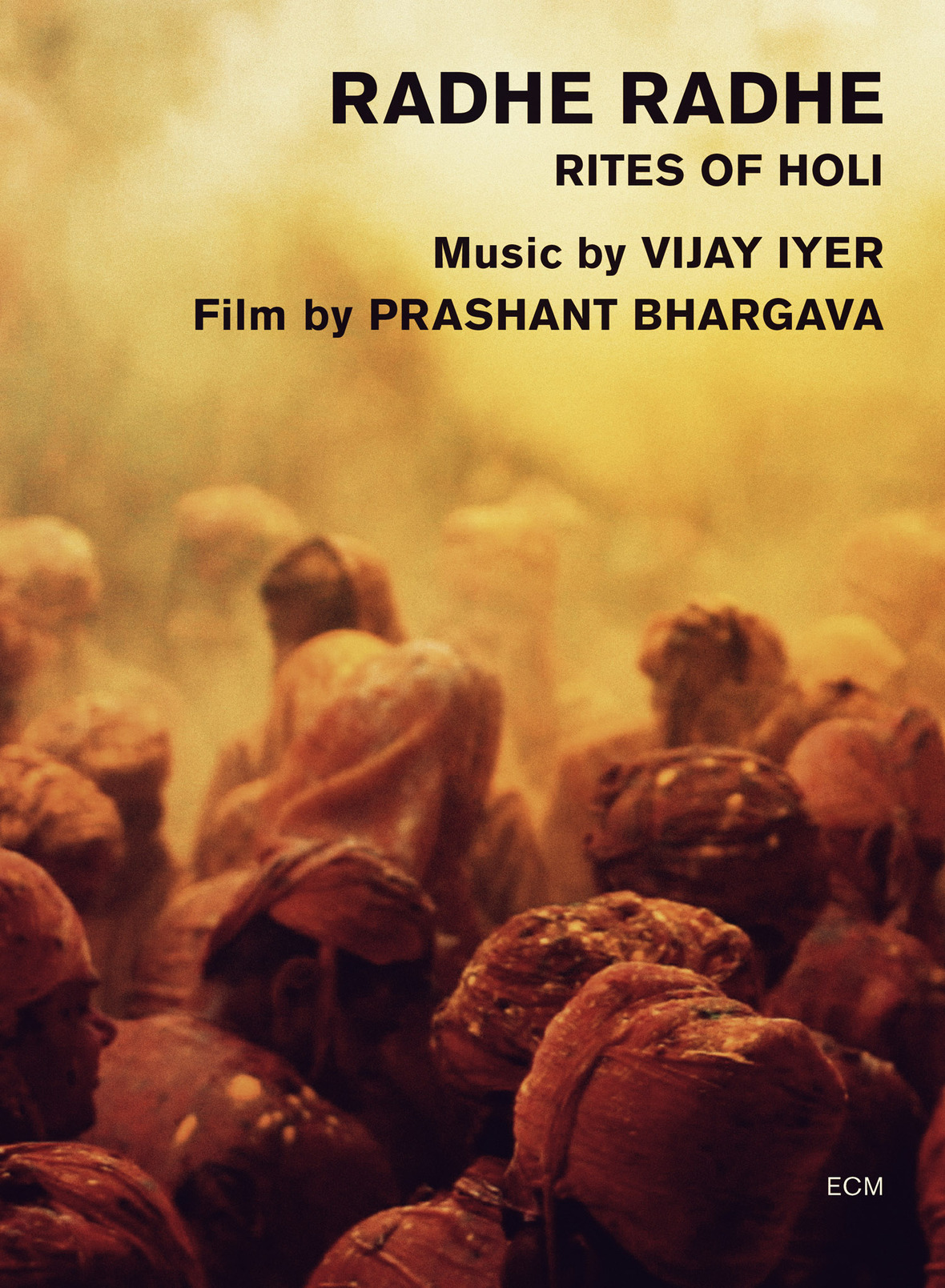
Prashant Bhargava & Vijay Iyer: Radhe Radhe – Rites of Holi (ECM 5507)

Radhe Radhe

Radhe Radhe: Rites of Holi

Vijay Iyer composer
Prashant Bhargava film director, editor
Anna George actor
Craig Marsden director of photography
International Contemporary Ensemble
Eric LambLaura Jordan Cocks: flute, alto flute, piccolo
Joshua Rubin: clarinet, bass clarinet
Rebekah Heller: basoon, contrabasoon
Gareth FlowersAmir Elsaffar: trumpet
Jennifer Curtis: violin
Kyle Armbrust: viola
Kivie Cahn-Lipman: cello
Cory Smythe: piano
Ross Karre: percussion
Tyshawn Sorey: percussion, drum set
Adam Sliwinski: conductor
Vijay Iyer: piano, electronics
Soundtrack produced by Vijay Iyer and Manfred Eicher.
Recorded live at Memorial Hall, UNC Chapel Hill, March 26, 2013
Engineer: Frank Martin/Media Production Associates
Live concert sound engineer: Levy Lorenzo
Additional recording at The Bunker Studio, April 20, 2014
Engineer: John Davis
Mixed at Avatar Studios, NYC by James Farber, Vijay Iyer, and Manfred Eicher
Assistant: Aki Nishimura
Additional engineering, editing, and consultation: Liberty Ellman

Bird

Ron Fricke’s 1992 classic Baraka endures as one of the most consummate examples of non-narrative cinema. Its montage of images from around the world was even more eclectic than the soundtrack that went along with it. But despite the many ceremonies, creative arts, and labors that Fricke documented—including death pyres and ritual baths in the river Ganges—he never captured the Hindu religious festival known as Holi. Had he done so, it might have looked something like Radhe Radhe.

Opening Shot

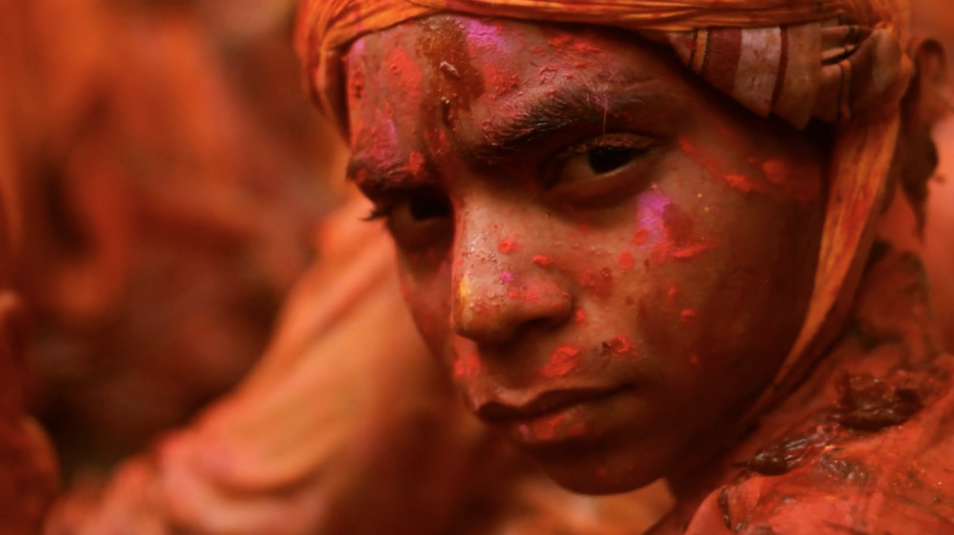
Filmmaker Prashant Bhargava’s ode to this so-called “festival of colors” traces the eight-day celebration back to Mathura, mythic birthplace of the supreme deity Krishna and his lover (in the strongest sense) Radha. Hence the film’s title, a term of praise and greeting often exchanged in the streets of Mathura, where she is believed to be a gateway to true understanding of Krishna. Her power is a central theme, an explosion of devotion far more vivid than the human-made pigment sold on the streets in the weeks leading up to this cathartic event.

Given the film’s subtitle, “Rites of Holi,” and the fact that Holi is practiced in the spring may put one in mind of Igor Stravinsky. This is no coincidence. Although not a direct homage to Stravinsky, Radhe Radhe was the result of a commission for the 100th anniversary of the Russian composer’s Rite of Spring, and one of a dozen projects freshly created in its honor. It is still a ballet of sorts, not least of all for the dialogic contributions of Indian-American pianist Vijay Iyer. In a manner of speaking, he and Bhargava met halfway—the director boiling down over 30 hours of footage into a 35-minute film and the composer expanding molecular impressions into a fully integrated score—so that the finished product was a narrative duly rendered. Iyer’s task was to match Bhargava’s rhythms, taking the listener through what he calls a “series of energies.”

Crowd 3

Bhargava first gained international attention with his debut feature Patang (The Kite) in 2011. That his roots grabbed their soil in hip-hop and graffiti art should come as no surprise, for his gifts of rhythm, poetry, and color were likeminded in their urban respect. But with Radhe Radhe he went further underground, mining deeper traditions of those same creative registers. The film is, then, as much a musical as it is a visual tour de force, building like a raga to near-ecstatic heights. Indeed, before a single image graces our retinas, Iyer’s pianism sets the stage over a dark title screen. Slight dissonances therein betray something of the chaos about to unfold, but obscure enough of it so that we might experience it anew, even in multiple viewings. Along with the young musicians of the International Contemporary Ensemble, Iyer creates a mood that is beautifully unsettling, and all the more organic for it.

Face 1

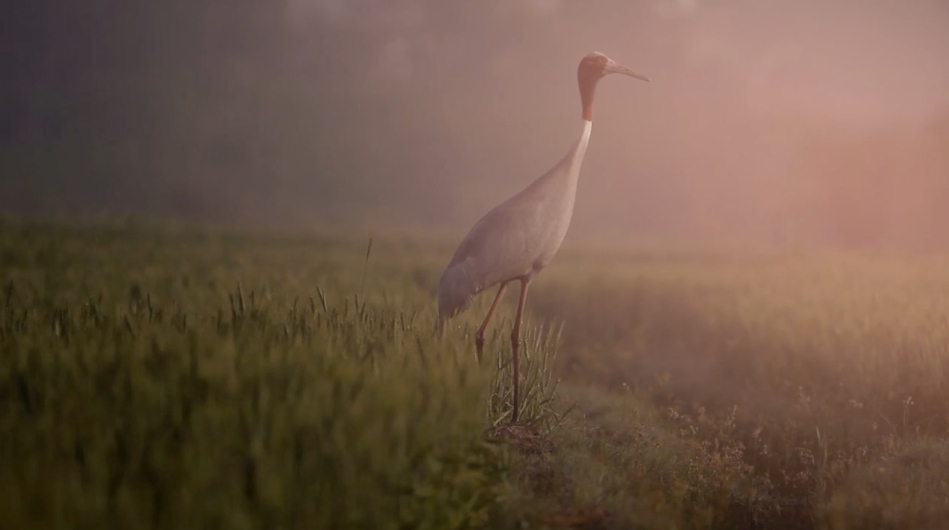
The film’s first part, “Adoration,” builds its intimacies one stratum at a time. The stage is set in a misty landscape. We see only details: boatmen preparing for the days’ revelry, a bare back, a glimpse of braided hair. The streets then come to life as food vendors ready their meals and women wash their garments in the river. The soundtrack is restless, anticipatory. A cargo train passes by, as if to underscore the film’s narrative drive. More fragments: a face half-reflected in a mirror, candles burning on an altar, a gossamer veil. As crowds thicken and the dance begins, Iyer’s pianism brightens. Even the birds in the field seem to join in. Flute and brass contrast one another with purpose. Their notes flower and wither, changing focus like the lens that guides them. Strings and percussion add color streamers of their own as the iconic powder hits the air.

Crowd 2

Part 2, “Transcendence,” puts further emphasis on Bhargava’s footage of an imaginary Radha played by actress Anna George. He spins from these scenes, shot in the US and woven throughout the film, a primal and sexual interplay that signals the true emergence of spring. It’s a bold move, as the director himself is first to admit in the DVD’s “Making Of” segment, but he wanted to bring that “everyday magic, that intimacy that we share as people to the narratives of the gods.” He believes that the push and pull of Radha and Krishna exists in all of us, as it does also in the increasingly inseparable relationship between sounds and scenarios. A trumpet, for example, works its melodic overlay during a long shot of Radha’s face, implying an environment far vaster than the immediate contrivance of the studio.

Radha 2

As the cinematography becomes more contemplative, the music subdues itself in solidarity. In the same way that Bhargava seems to have eyes in many places at once and flits between them by changing cognitive channels, so too does Iyer’s complementary switching take every movement into account. A sensual flowering of street noise enters the mix, as if bleeding of its own volition, leaving us wanting to shed our inhibitions and dive into that sea of color.

Dancing 2

In May of 2015, Bhargava died at the age of 42 from cardiac arrest after a history of heart disease. But the tragedy of this death is so graciously balanced by the exuberance of his small yet vivid oeuvre that one can focus on the latter in a state of pure invigoration. In this respect, we do well to read Radhe Radhe in the spirit for which it was made. In a world where the rites of Holi have spread to unlikely corners (I witness its rainbowed aftereffects on my American university campus every year), it’s nice to know that one artist’s vision can bring us anytime to the source with just the press of a PLAY button.

Field

(See this article as it originally appeared in RootsWorld online magazine here.)

Robin Williamson: Trusting In The Rising Light (ECM 2393)

Trusting In The Rising Light

Robin Williamson
Trusting In The Rising Light

Robin Williamson vocals, Celtic harp, guitar, hardanger fiddle, whistles
Mat Maneri viola
Ches Smith vibraphone, drums, gongs, percussion
Recorded January 2014, Rockfield Studios, Monmouth
Engineer: Steve Lowe
Assistant engineer: Tim Lewis
Mastering: Christoph Stickel and Steve Lake
Produced by Steve Lake

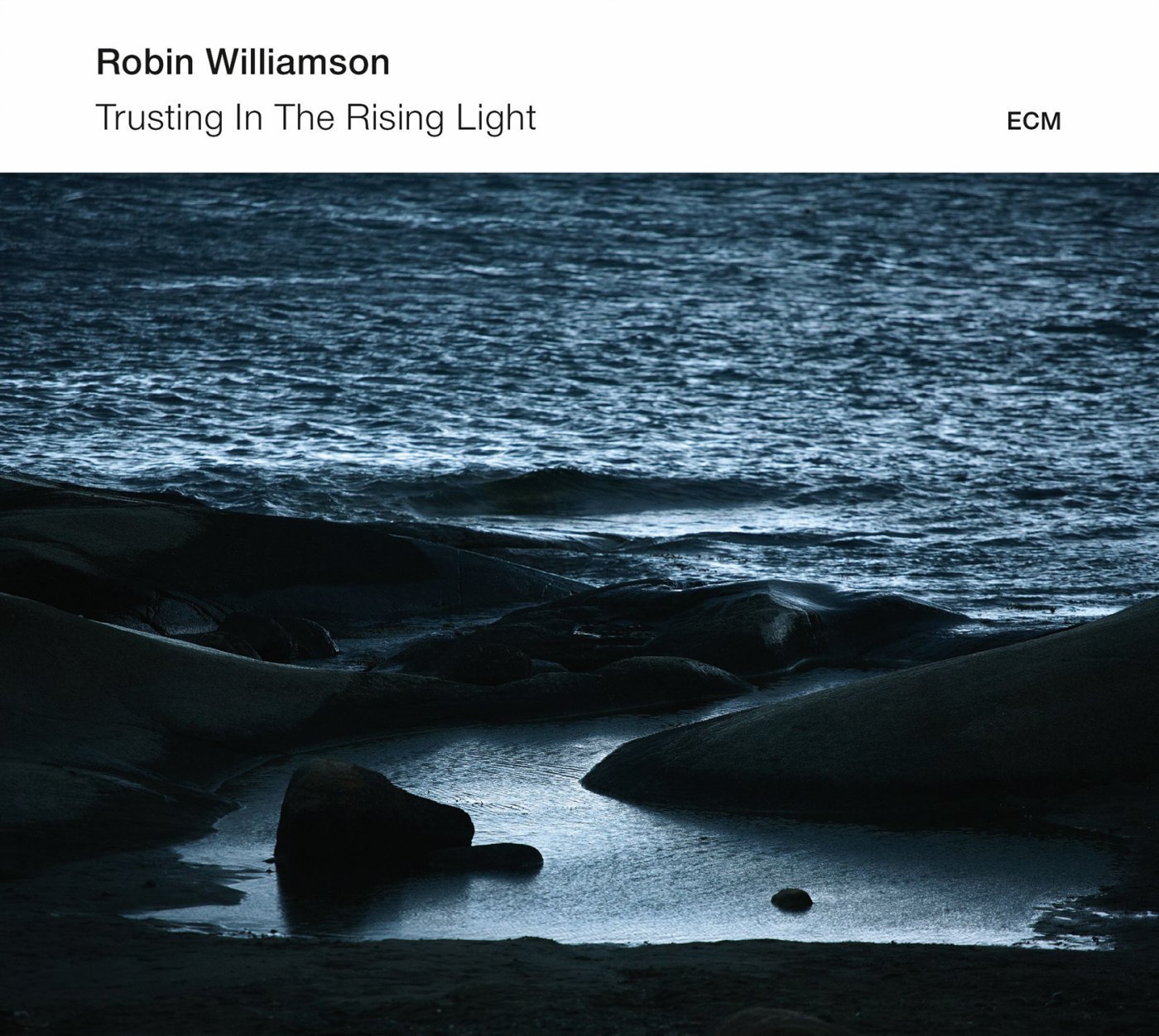
Robin Williamson, perhaps the last true bard on earth, returns with Trusting In The Rising Light. Following a string of intimate programs setting the words of famous poets to music (among them Dylan Thomas, Walt Whitman, and William Blake), he now dips a quill into his own inkwell and scrawls a masterful new ream of originals. Ten years separate this recording from its predecessor on ECM, The Iron Stone, but the wait has been well worth it, not least of all for the contributions of his fellow session musicians. From that last album he retains violist Mat Maneri and to this nexus adds drummer-percussionist Ches Smith. The result is an attuned, free jazz-folk session that feels at once long overdue and just right for its time.

RW

I caught up via e-mail with the album’s producer, Steve Lake, who described how the project came together:

“I’d been in touch with Robin over the years, and hadn’t realized that so much time had elapsed since The Iron Stone—the clichés about time moving faster as we age are true. In autumn 2013 he said he was in a period of writing lots of songs and read me the lyrics to ‘Trusting In The Rising Light’ and ‘Swan’ over the phone. It seemed like the moment for a new album. Robin said he wanted to work with Mat Maneri again, which of course was fine with me. I talked with [ECM head] Manfred Eicher about a possible vibraphone player for the session and Ches Smith’s name came up. It struck me as a good idea since I knew that Ches had formed a new trio with Mat and Craig Taborn. So inside the Williamson line-up there were two proven associations, Robin/Mat and Ches/Mat. With this as a basis we could confidently get to work.”

Where some voices crack and smolder with age, Williamson’s is like a fine sword: it only gets stronger the more it’s folded in its malleable state. And while he has always engaged larger questions of conviction, politics, love, and sense of place, on Trusting he seems far more content to dwell on the little things: spending time with a loved one, the fundamental pleasures of observation, and, as the album’s title implies, faith in life’s givens and regularities. As a romantic, he is lyrical yet realistic. He seems well aware that the limits of his control extend not much farther beyond his own body and the words and music it produces.

Nowhere is this clearer than in the title song, which turns on a movie with no opening credits. Here is one who stands at harbor, watching the rise and fall of the waves and knowing that some things are better left to their own rhythm:

In every man-hewn stone
The anchored voices murmur
Long long
What they have always to say
As to what of our life
When whence and whither
We born of woman
Born of the Great Mystery

Being a relatively new yet enthusiastic fan, I asked Lake to place the album in the larger context of Williamson’s decades-long career. “It’s a high point,” he answered, “but if I look at Robin’s discography there are a lot of high points, including albums on his own Pig’s Whisker label which too few people have heard (if you can find them I recommend Ring Dance, At The Pure Fountain, and Dream Journals). Robin’s been a working musician for almost sixty years but has never been exactly career-minded. His musical and literary interests carry him forward and as a result he has had, I would guess, a richer and more interesting life than many who have made the career a priority. Trusting in the way of the waves, as he says in the title track…”

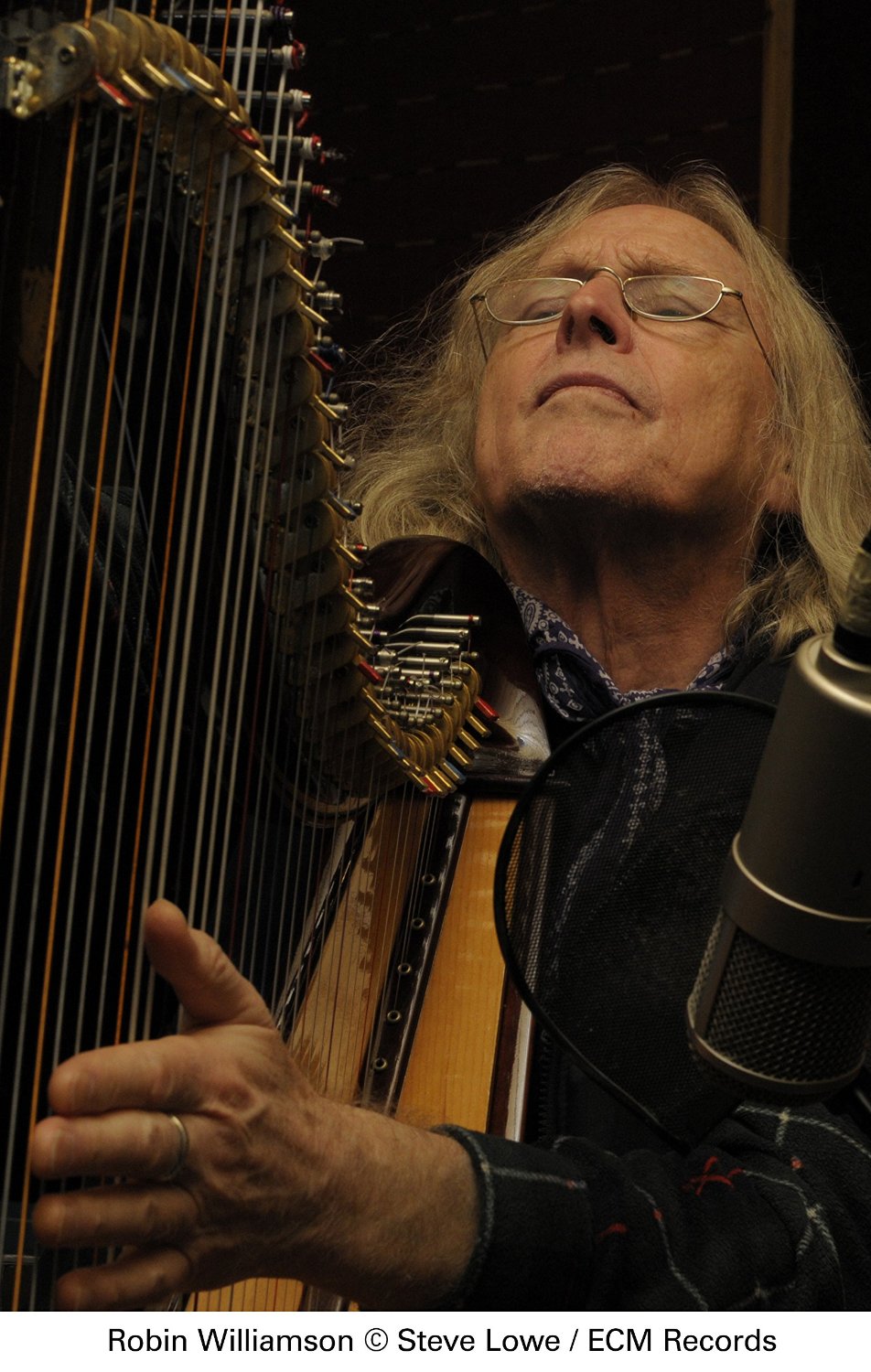
Accompanying these sentiments—in truth, embodying them—is Williamson’s trusty harp. Despite being prone to putting on magical airs, at his fingertips it is not an instrument of spells and incantations. Over the years it has become burnished like a well-worn table at which countless meals have taken place. And there, among the dishes and scratched spoons are those same rhythms of life, having left their hieroglyphics behind for deciphering. As he blossoms in a wave of strings, crashing on the shores of a dawn not so far away, he provides confirmation that in the good work one can be grateful for the opportunity to engage with land and sea, to know that it will all be waiting on the other side of slumber.

Whether through the droning raga of “Our Evening Walk,” in which love begets love, or the heartfelt wonder of “Alive Today,” in which Williamson takes comfort in something as insignificant as the flap of a bird’s wings, such assurances thread every song that follows with the knowledge that all those things we rely on will be there for us, in light or darkness. Sometimes, as in “Falling Snow,” his romance is with the universe at large, pulling together time and space like a massive proof of emotional and spiritual relativity. At others, it is undeniably close to home, calling his wife Bina by name as he does in the sensuously realized “Your Kisses.” For the most part, however, Williamson looks either down at “These Hands Of Mine” or back along the “Roads” that led him to where he stands. The former tune features a jaunty guitar while the latter’s commentating viola weaves in and out of the loom. In both, the feeling of departure is constant, arrival questionable. And in “The Cards,” a song loosely based on a traditional Irish air “The Coolin” but otherwise ad-libbed in the studio, he offers a cautionary tale against prediction, trusting in reality instead of relying on dreams or elusive signs. Accompanied only by guitar, elastic and supportive of any and all possibilities, he contemplates this dance in what he calls the “soul of souls.” It’s as if he were at a bar alone, the last dart thrown along with last call, but it’s the kind of draft of which every sip tastes as good as the first.

Sitting with this album is like traveling somewhere for a while, much as the musicians did just to bring it all together. Lake sets up the scene:

“Rockfield is a residential studio deep in the Welsh countryside with a long history of recording especially rock music. When we arrived, Mott The Hoople were just finishing a mixing session. We spoke briefly with them. It was slightly odd, almost time-warp inducing, to be in the same room with Mott and Mat Maneri, but strange juxtapositions belong to the journey. I liked living at the studio and had some interesting talks with its owner Kingsley Ward about his early life as a session musician working for Joe Meek in London. There’s a lot of idiosyncratic recording knowledge concentrated at Rockfield. For the session with Robin the mood was positive, friendly and committed. Robin had some songs mapped out on which Mat and Ches were given directives and specific things to play, mostly with some improvisational freedom. And there were some pieces that were wide open to improvising, particularly ‘Just West Of Monmouth,’ ‘Night Comes Quick In LA,’ ‘Swan’ and ‘Islands Of The Inner Firth.’”

The latter songs rest somewhere between speech and singing and flower in freely improvised settings. “Youth burns brighter than neon,” he sings in “Night Comes Quick In LA,” a cynical, bird’s-eye view of superficiality gone rotten in the valley. The beat poetry aesthetic only adds to the acuteness of his poet’s eye. In “Just West Of Monmouth,” Williamson nestles himself in a gravelly accompaniment of percussion, whistles, and bows, unspooling his tale of creation in the rustle of underbrush and thirsty plains. Next is a sojourn into “The Islands Of The Inner Firth,” where awaits the mirror into which we must all someday look:

Now in the October of my life
I trace
Beloved and well remembered shore
Your stony verge
You cold and turbulent Scots water
In memory I trace
My kindly haunted past

So begins a summation of a creation and a new beginning of memory strung like a bead on a necklace that is forever growing to fit the thickening neck of experience. And before him is the pond where swims the eternal “Swan,” who joins her “world self / Where air and water meet.” Let us hope that Williamson’s swan has a long time yet before it sings.

(See this article as it originally appeared in RootsWorld online magazine, where you can also hear sample clips. To hear more of Trusting In The Rising Light, click here.)

Keith Jarrett: Creation (ECM 2450)

Creation

Keith Jarrett
Creation

Keith Jarrett piano
Produced by Keith Jarrett
Recorded April, May, June and July 2014
Engineers: Martin Pearson and 
Ryu Kawashima (Tokyo)
Mastered at MSM Studios by Christoph Stickel and Manfred Eicher
Executive Producer: Manfred Eicher

Keith Jarrett’s second of two recordings released in 2015 is his most recent vintage, and a first in his discography for being a compilation of solo improvisations handpicked by the pianist from concerts in Toronto, Tokyo, Paris, and Rome the year before. As with all of the best solo recordings, this one develops patiently and with a sense of something so grandiose yet so intimate—the universe in a drop of ocean—that it’s all one can do to stay afloat in the sheer expanse of it all. Then again, Jarrett offers these pieces with such solemnity that we cannot help but feel invited to share in their rituals as equal partners.

Keith at the keyboard

Part I opens in deepest pulse, notes circling around one another like magnets that cannot decide whether they are polar complements or opposites. During the unfolding, it becomes clear that Jarrett was ready to pick up right where he left off on Rio, unraveling time through heart and fingers. The plodding nature of its construction does nothing to obscure a filament of light, which is then singled out by the nostalgic purview of Part II. In a promotional interview with NPR’s Rachel Martin, one of a few marking his 70th birthday, Jarrett stressed his new role as producer: the creation of Creation was indeed his first attempt at sequencing. Once he had settled on the first track, this second one followed, and so on. If the emerging narrative feels intentional, it’s only because it has a will of its own.

Lyricism reigns in Part III, which sounds like every ballad you’ve never heard. Its clarity is also its mystery. That such a fully formed openness could crawl out of any human being is astonishing to consider—that is, unless you count the birth of a child, which may just be the only wonder in this world to surpass it. Part IV nourishes this theme of growth from infancy, tracing as it does the wide-eyed expression of new parenthood even as it prunes back the shadowy branches of mortality sprouting foliage overhead. As so often happens when these emotions become too concentrated to keep inside, Jarrett’s voice makes its tender emergences. “It’s potential limitlessness,” he says in the aforementioned interview of that singing. “My main job is listening.” And rightly so, for we may feel him listening as intently as we are to Part V, which helicopters to the ground like a flurry of maple seeds in summer before wiling away the heat under the shade of a less threatening tree. Impressions of the prairie, of undying wilderness and civilization in kind, intermingle with anthemic signatures until the piano seems an open font.

Part VI marks a turning point in the program from the merely soulful to the fully sacred. Its every hue is captured with archaeological precision before it is set free. As the album’s widest vista, it encompasses the fewest impulses, and only magnifies them to the point of such scope that they feel more populous than they are. Every rolling hill becomes a puff of dandelion before us, the dream of a gentle giant with no harm in its past…or future. Part VII chooses one path among many and follows it as far as it will go. The river’s flow of its desperation is strangely tempered by solitude and leads to the angular way station of Part VIII. Here the slumber is more fitful, but nevertheless unbroken by violence. Indeed, peace is the order of the day in the final Part IX, which by virtue of its placement is destined to speak in the language of departure.

With such an extensive archive as yet unrendered, one may no longer speak of “classics” in the plural when referencing Keith Jarrett’s output. It’s all part of one ongoing song to which our attention is as mandatory as breathing.

(To hear samples of Creation, click here.)

Mathias Eick: Midwest (ECM 2410)

Midwest

Mathias Eick
Midwest

Mathias Eick trumpet
Gjermund Larsen violin
Jon Balke piano
Mats Eilertsen double bass
Helge Norbakken percussion
Recorded May 2014 at Rainbow Studio, Oslo
Engineer: Jan Erik Kongshaug
Produced by Manfred Eicher

So many of ECM’s finest trumpeters also happen to be skilled travelers. Tomasz Stanko and Enrico Rava in particular have hopped the globe in search of inspiration, life experience, and musical expansion. Yet few, among the possible exceptions of Nils Petter Molvær and Per Jørgensen, have gone so deeply inward and emerged with such painstaking lyricism as Mathias Eick. Midwest was inspired by a North American tour, during which time Eick recalls feeling very homesick: “Then we reached the area called the Rural Midwest and I suddenly had the strange feeling that I was home. It occurred to me that some of the early settlers must have felt this way, when they looked at the rich soil of the plains and saw that this was wonderful land for farming. Parts of the Midwest remind me strongly of parts of Norway including the southeast of Norway where I grew up.” Even with this, and the migratory tunes that comprise this album, in mind, the journey on which we are led is far more psychic than geographic. Joining his caravan are violinist Gjermund Larsen (last heard on the Christian Wallumrød Ensemble’s Outstairs), pianist Jon Balke, bassist Mats Eilertsen, and percussionist Helge Norbakken: a continent unto themselves.

ME

The word “lyrical” gets rehashed a lot to distinguish jazz that is “pretty” versus that which is “raw.” Yet no rule says that the two must be exclusive. In fact, Eick has forged just such an alloy on this album, and you can hear it in everything from his tone to his soulful interactions in and among the band. Eick has clearly worked hard to establish an identity on the trumpet, because we can hear it the moment he sounds his first note. In this vein the title track pans us into the emotional thick of things, blessing the land with the gentle rain of cymbals and the tilling of piano. Eick and Larsen set an album precedent by way of their give and take, threading the ether with a sound so lucid it’s almost dreamy. Larsen’s folk inflections do, in fact, make Midwest as much of what it is as its bandleader. Their harmonizing in “Hem” is just one example of this successful blend. The latter tune further epitomizes the sheer magnification of detail that has overlaid Eick’s playing and composing since his leader debut, The Door. More than ever, he is like the master photographer, who puts his eyeglass to every questionable grain and tinkers behind the scenes to get just the right emulsion before presenting the finished, developed image. That said, his pictures are often moving than still. Much of this movement can be found in either the emotional journeys at hand (cf. “March”) or in the contributions of individual musicians. Eilertsen pulses through “At Sea” like the power of recollection incarnate in one of two more straightforward thematic vehicles. The other, “Dakota,” also emphasizes the wonderment and space Balke brings to the palette, while Norbakken sends harmonic minnows into the periphery.

“Lost” is, along with the title tune, an emblematic one. Its evocation of slippage across space and time heightens Eick’s apparent dislocation even as it deepens his newfound connections to faraway soil. A lovely solo from Balke, nestled in a reed-bed of cymbals and bass, adds to the feeling. So, too, does “November,” by which we arrive at the bittersweet yet inevitable farewell, a taking stock of things learned and gained, those things long left behind and others soon to be, and still others waiting for return. It is the realization that the pleasure of going home is always darkened by the sadness of departure.

If Eick has so far crafted a distinct melodic solar system on ECM, Midwest is a galaxy unto itself. Fresh, spiraled, and classic to the core, it’s sure to be one of the label’s most enduring statements of all time.

(To hear samples of Midwest, click here.)

Jormin/Willemark/Nakagawa: Trees Of Light (ECM 2406)

Trees Of Light

Lena Willemark voice, fiddle and viola
Anders Jormin double bass
Karin Nakagawa 25-string koto
Recorded May 2013, Konstepidemin, Göteborg
Engineer: Johannes Lundberg
Executive producer: Manfred Eicher

Angels
Childangels
Opportunities come with the rainbow
and the children
Sing to us
so our hearts come back to us!

Anders Jormin returns to ECM with yet another surprising blend of multi-genre elements. The Swedish bassist welcomes folksinger Lena Willemark and, in her ECM debut, virtuoso of the 25-string koto Karin Nakagawa in settings and improvisations around Willemark’s poetry, sung in her native Älvdals dialect. Jormin has always been one for self-reinvention, and on Trees Of Light he has stepped into some of his most ambitious territory yet. Not because of any sense of scope (although the trio does evoke some rather expansive scenery), but because the import of every gesture is magnified in such an intimate setting.

Yet it’s Willemark, absent from the label since Jormin’s 2004 In winds, in light, who crafts the center of the current project. Her words and melodies inform every song of the program, with the sole exception of Jormin’s instrumental “Hirajoshi.” The latter piece’s title refers to the hirajōshi mode of pentatonic (plus semi-tonal) tuning in which it is played and foregrounds the koto’s dry-wing rasp, percussive accents, and open field. When Nakagawa sweeps her hands over its waters as Willemark’s viola and Jormin’s arco bass sing their way into union, the trio captures something ancient in its hands.

Around this wordless center flows a veritable ecosystem of dreams, recollections, and impressions. It’s not simply that jazz, Swedish folk, and traditional Japanese music are melding into something new. Rather, it’s that they are speaking to one another in the interest of honest friendship. Both the title and music of “Krippainggler” (If you listen) best exemplify this philosophy, as each musician occupies her or his place. Where Willemark’s voice is like the reed and Jormin’s bass is the riverbed, Nakagawa draws the waterline between them in a song of angels and resuscitation of life forces.

TOL

Pairings occur naturally throughout. Nakagawa and Jormin sometimes beckon their vocal traveling companion as if she were the sun itself, while at others koto and voice share ululations and whispers. Spotlight moments also abound, as when Nakagawa proves her improvising strengths in “Urbanus” or Willemark sings alone on “Minni” (Memories), an arresting segment of horizon. Whatever the mood, the listener can be sure to feel it wholeheartedly. “Ogadh Dett” (Your eye), for one, opens with a bass solo that is muscular yet somehow gentle, giving way as it does to the koto’s fairytale strains and taking lyric comfort in the warmth of unbroken regard. “Uoruo” (Worry), for another, walks the way of sorrow as if it were the clearest path of all.

And perhaps there is some truth here: that which leaves the deepest scar is also the easiest to follow, so that even when we are dancing, as in the title track or the “Slingerpolska” (Winding polska), somewhere in the back of our minds we know that we will end up alone, and all the stronger for it.

I am still standing where I left me
I walk on as another
See that the earth is still there
Still there
That I must remember
I have loved

(To hear samples of Trees Of Light, click here.)

Gary Peacock Trio: Now This (ECM 2428)

Now This

Gary Peacock Trio
Now This

Marc Copland piano
Gary Peacock double bass
Joey Baron drums
Recorded July 2014 at Rainbow Studio, Oslo
Engineer: Jan Erik Kongshaug
Produced by Manfred Eicher

After decades of sharing a legendary board with Keith Jarrett and Jack DeJohnette, bassist of bassists Gary Peacock rides a choice wave of his own with pianist Marc Copland and drummer Joey Baron. Now in his 80th year, Peacock needs no introduction except to those who’ve been living with their hands over their ears. He’s the pioneer of a lyrical and dynamically inflected style, a consummate player who knows no boundaries of expression, and, let us not forget, an influential composer to boot. The latter point finds appropriate stress on Now This, which nestles a few featherless tunes among the fully plumed.

GPT
(Photo credit: Eliott Peacock)

Perennial classics such as “Moor,” which here achievements the wonderment of renewal, and “Gaia,” which opens the set, confirm the breadth of Peacock’s abilities. Copland’s lyricism is a most welcome addition to their unfolding, peering into the heart of this music and making it crystalline. Yet the unforced feeling of emergence is shared by all, perceivable in a glint off Baron’s cymbals and in Peacock’s own forthright intimacy. Even at his most cautious, as in “Shadows,” the bassist is so sure of where he is going. Not because he sees the end in sight, but because he knows he will always arrive where he is meant to arrive. It’s one thing to trust your bandmates so wholeheartedly; quite another to trust yourself. Such commitment is a lifetime in the making.

“Christa” melts like a candy in the summer sun and finds Peacock humming through his instrument like someone newly in love. There’s also “Vignette,” a set highlight—not least of all for Copland’s beautification. The pianist’s elucidations are such that it’s all one can do to fend off surrender. That being said, his two composition credits elicit some of the most balanced playing on the record. Between the eddying, watercolor world of “And Now” and the slippery “Noh Blues,” there’s much to savor in the currency of their exchange. Baron, for his part, contributes one in turn: “Esprit de Muse.” What begins as an enigmatic tune, however, gains traction midway through and rides the rails into some concentrated swing. Another gem comes by way of Scott LaFaro’s well-polished “Gloria’s Step.” Lithe and limber as ever, Peacock navigates its familiar corridors with eyes closed and heart open, while Copland and Baron provide equally percussive support into interlocking bliss.

As epitomized by “Requiem,” last of the Peacock originals and of the set as a whole, Now This is marked by the sheer maturity of its players. To be sure, so long as you walk into this album without expectations of dramatic flourishes, you will walk out of it with something much longer-lasting: grace.

(To hear samples of Now This, click here.)

Savina Yannatou & Primavera en Salonico: Songs of Thessaloniki (ECM 2398)

Songs of Thessaloniki

Savina Yannatou
Primavera en Salonico
Songs of Thessaloniki

Savina Yannatou voice
Kostas Vomvolos qanun, accordion
Yannis Alexandris oud, guitar
Kyriakos Gouventas violin
Harris Lambrakis nay
Michalis Siganidis double bass
Kostas Theodorou percussion
Recorded February 2014 at Sierra Studios, Athens
Engineers: Yiorgos Kariotis and Yannis Paxevanis
Produced by Manfred Eicher

Songs of Thessaloniki marks the fourth appearance of Greek singer Savina Yannatou and her second-nature ensemble Primavera en Salonico. Characterized by the artists as “canvases for our imagination to create contemporary narratives on old myths,” the songs gathered here make for an appropriately multicultural portrait of Thessaloniki, a city where Orient and Occident have long blended at a crossroads of actions, peoples, and politics—a city, incidentally, Yannatou’s band calls home. Most importantly for the purposes documented here, it was a place where music could always be heard and can now be heard again.

When the first strains of “Apolitikion Agiou Dimitriou” caress your ear— strings, bellows, and lungs yielding Yannatou’s lullaby out of time— you may just feel at home as well. As a Greek hymn of St. Demetrius, patron saint of Thessaloniki, it paints a door deepest blue and welcomes us as we are. Ironically enough, and with exception of this hymn (and its instrumental variation which concludes the album), the Greek material on this album is tepid by comparison to its extra-cultural counterparts, even as it draws vital connective tissue between the same.

SY

Thessaloniki’s historical influx of Sephardic Jews (Thessaloniki was, in fact, once known as the “Jerusalem of the Balkans”) is reflected in a formidable assortment. These songs especially reflect the arranging skills of Kostas Vomvolos, who also plays accordion and qanun throughout the recording. Yannatou’s chameleonic abilities have rarely sounded so organic as they do here. Whether in the childlike whispers of “A la scola del Allianza” or the qanun-accompanied “Una muchacha en Selanica,” she finds rawness of emotion in the simplest phrase and, by contrast, treads ever so lightly on danger—as in “La cantiga del fuego,” which tells of a great fire that swept the city in 1917.

More intense theatrics wait in the wings of “Dimo is Solum hodeshe,” a Bulgarian example that finds accordion, violin, and nay in artful concert. Two Turkish tunes, one as hymn and the other as folksong, give further context to Yannatou’s intrepid singing. In “Iptidadan yol sorarsan,” voice and nay practically become one, Yannatou sounding more like the flute, and vice versa, while halting rhythms and surreal beauties in the violin make “Çalin Davullari” a standout sojourn. There’s even an Irish folksong, “Salonika,” which dances, tongue-in-cheek, in the midst of war.

Yet few moments can approach the mastery of “Inchu Bingyole mdar?” and “Qele-qele,” both collected by the great Armenian composer Komitas. In both, the oud makes grander statements of purpose as it sweeps away the sand at Yannatou’s feet, allowing her to process into the distance, where, like the ancient Serbian tree of “Jelena Solun Devojko,” she stands until she dispels specters of violent pasts by virtue of her keening ways.

(To hear samples of Songs of Thessaloniki, click here.)