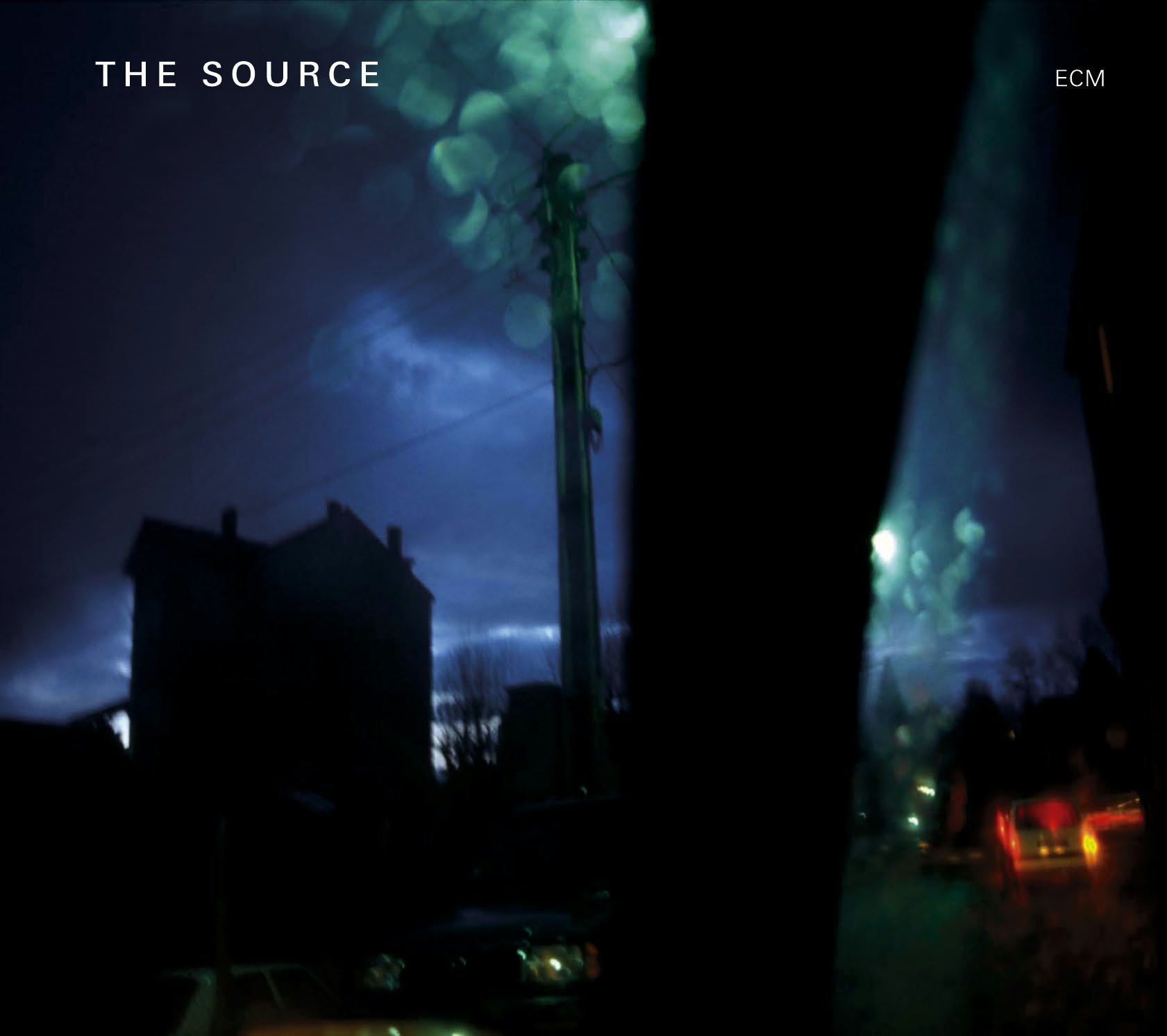
The Source: s/t (ECM 1966)

The Source

The Source

Trygve Seim tenor and soprano saxophones
Øyvind Brække trombone
Mats Eilertsen double-bass
Per Oddvar Johansen drums
Recorded July 2005 at Rainbow Studio, Oslo
Engineer: Jan Erik Kongshaug
Produced by Manfred Eicher

Trygve Seim offers a second helping of his eponymous group. True to form, the egalitarian collective redefines parameters, shedding the string quartet from 2002’s The Source and Different Cikadas and focusing instead on the Norwegian saxophonist’s core quartet with trombonist Øyvind Brække, bassist Mats Eilertsen, and drummer Per Oddvar Johansen.

The lion’s share of the writing comes from Brække, who embraces extremes of mood and register. Approaching the set list from the outside in, one encounters the slow burn of midnight oil in “Caballero” (the title, of course, a reference to Don Quixote) and, one layer in, “Water Glass Rhapsody.” Both tracks go down like cold coffee, Eilertsen either flying high or growling, tiger-like, in the depths of abstraction as the horns ready their wings. Deeper mining reveals more upbeat ends of the spectrum, as in the Johansen-centered “Alle Blå De Er.” The drummer, too, shows range in his “Tamboura Rasa.” Through misty cymbals, singing bass, and the crackling kindling of horns, this highly descriptive track paints itself one stroke at a time. Although Seim contributes a single tune (the kinetically astute “Un Fingo Andalou,” a play on Buñuel and Dalí’s 1929 masterpiece Un Chien Andalou), he often carries the full weight of the band in his bell, particularly in Brække’s “Prelude To A Boy.”

The Source furthermore pays tribute to the label it calls home. ECM’s output has been of lasting influence among the band members, and it shows. “Libanera” gives props to its composer, drummer Edward Vesala, in whose last group Seim played. To that fortunate collaboration he gives soulful deference, digging some of his strongest trenches yet. The rhythm section is aptly attuned to his stubborn prosody all the while. The trombonist’s other themes cross even more hatches. “Life So Far” means to evoke Keith Jarrett’s Belonging lineup and comes as a welcome surprise after the quicksand of the album’s first half (it’s also where Seim takes a match to his tenor and reveals the fire behind the smoke). The funkier “Mail Me Or Leave Me” might easily be mistaken for a Dave Holland joint, while the concluding “A Surrender Triptych” is an homage to the golden age of Triptykon. The band even references itself with the Johansen-penned “Mmball,” reprised from its appearance on Cikadas. The resolution of Seim and Brække’s slight dissonances into smooth becomings, in combination with the rhythm section’s lyrical sway, makes for some quintessential soundings.

This is music in primary colors that looks to light and shadow for variation, and crafts along the way a warm welcome for any who might chance to sit down for a spell and listen.

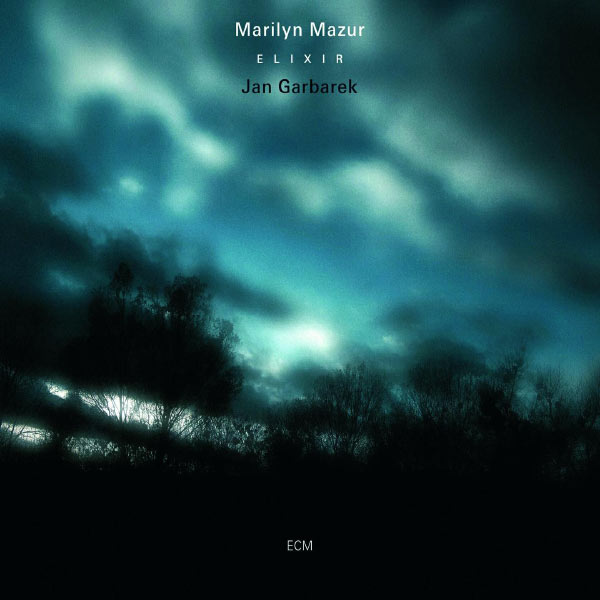
Marilyn Mazur/Jan Garbarek: Elixir (ECM 1962)

Elixir

Elixir

Marilyn Mazur marimba, bowed vibraphone and waterphone, hang, bells, gongs, cymbals, magic drum, log drum, sheep bells, Indian cowbells, udu drum, various drums and metal utensils
Jan Garbarek tenor and soprano saxophones, flute
Recorded June 2005 at Sun Studio, Copenhagen
Engineer: Bjarne Hansen
Produced by Manfred Eicher

As resident percussionist of the Jan Garbarek Group for 14 years, Marilyn Mazur enlivened every path set before her with dynamism and panache. On Elixir, she delineates her own compass and invites Garbarek on a journey of organic play, thus yielding a composite sketchbook of improvised solos, duos, and multitracked collages.

Each of the album’s 21 tracks is an iceberg’s tip. Only the penultimate “Winter Wish” exceeds four minutes, and with it the waterline. This and other such evocative titles as “The Siren In The Well,” “Mountain Breath” (which sounds like an eagle dreaming of a whale), and “Bell-Painting” afford imaginings for the wayward listener fortunate to wander into these territories. The latter title is especially appropriate, for Mazur is very much a painter whose palette is her instrument. From a kit that spans the globe, she chooses only the most appropriate pigment for each image. Be it the splash of a Chinese gong (cf. “Creature Walk” and “Talking Wind”), the pulse of hand on taut skin (“Mother Drum”), or the resonant metals of “Pathway,” she reverse engineers gold into its base components and treats each as if it were just as precious. Her solos speak to the heart because they speak to the earth: the two are one in the same.

Her duets with Garbarek both open (“Clear”) and close (“Clear Recycle”) the program. The Norwegian saxophonist’s rasp brings out the light of Mazur’s subterranean designs and with it illuminates their innermost dances. Colors reveal themselves accordingly in the sheer variety of instruments. Whether by hang drum or waterphone, cymbals or flute, their groove magnifies the great within: foot to earth as soul to sky. Through them run the ley lines of the plains, singing and free. Like the track from which the album gets its name, they feed an incantation of which verses come and go like clouds, if only to remind us that the sky above never goes away, for that is where we will go when our bodies bend over in silence.

Miroslav Vitous Group w/Michel Portal: Remembering Weather Report (ECM 2073)

Remembering Weather Report

Miroslav Vitous Group
Remembering Weather Report

Miroslav Vitous double-bass
Franco Ambrosetti trumpet
Gary Campbell tenor saxophone
Gerald Cleaver drums
Michel Portal bass clarinet
Recorded fall 2006 and spring 2007 at Universal Syncopation Studios
Recording producer and engineer: Miroslav Vitous
Assistant engineer: Andrea Luciano
Executive producer: Manfred Eicher

After the challenging yet ultimately rewarding experimentalism of Universal Syncopations II, Remembering Weather Report comes as a breath of fresh air for bassist Miroslav Vitous, who preens previously undetected feathers in this warped look back. Indeed, similarities to the titular fusion band with which Vitous once played (and which he co-founded with Wayne Shorter and Joe Zawinul) are glancing at best. Here that original band’s fiercely democratic approach takes on new hues as individual instruments click through the front line like a roulette of alter egos in the form of Americans Gerald Cleaver on drums and Gary Campbell on tenor, and Swiss trumpeter Franco Ambrosetti.

In addition, French clarinetist and new music advocate Michel Porter joins the quartet on half of the album’s six hefty tunes. His involvement unleashes the firmest successes thereof, as in an aching set of variations on Ornette Coleman’s “Lonely Woman” (the only track not from the bandleader’s pen) and “Surfing With Michel,” a spirited duet between Vitous and Porter that is the missing capstone to the core quartet’s great pyramid. Another set of variations on Wayne Shorter material finds the bassist shuffling between arco and pizzicato modes, all the while navigating a flurry of drums with a papercutter’s feel for negative space. A surreal and frenetic sense of control reigns, skipping with assurance.

The tripartite “Semina” is Vitous at his most honest, although this time Cleaver divulges heart and soul, inciting as he does calligraphic brilliance from Campbell and, in the concluding “Blues Report,” a swift kick to the stratosphere, where soars the album’s pièce de résistance, “When Dvořák Meets Miles.” Fine arco playing connects blats of muted trumpet, and all with a percussive finish that lingers sweetly on the palate. As ever, the interactions are subtle yet naked, each element brimming with snap, crackle, and pop.

Remembering Weather Report is not for the jazz tourist. Its highly evolved messages comprise a raw manifesto on what it means to be progressive in a regressive climate. Motifs run the gamut from static to ballistic, but quickly dissolve in favor of broader improvisational paths, each a vein to some distant thematic artery. The album is further notable for being recorded in Vitous’s own Italian studio. His direct involvement in not only the elicitation but also the rendering of these sounds lends remarkable immediacy to the space in which they unfold.

Quercus review in RootsWorld

Another new review for RootsWorld online magazine. This one details the self-titled ECM debut of Quercus, a trio consisting of folksinger June Tabor, pianist Huw Warren, and saxophonist Iain Ballamy. Click the cover to read the article and hear a sample track.

2276 X

Marilyn Crispell: Vignettes (ECM 2027)

Vignettes

Marilyn Crispell
Vignettes

Marilyn Crispell piano
Recorded April 2007, Auditorio Radio Svizzera, Lugano
Engineer: Stefano Amerio
Assistant engineer: Lara Persia
Produced by Manfred Eicher

In the light of her successful trio albums for ECM, pianist-composer Marilyn Crispell brings jazz to its knees with a solo album of such shadow that descriptors run dry. Nominally, the reduction would seem to be just that: a paring of musicians from three to one, a nakedness of melody, a sparser palette. And yet, when “Vignette I”—the first of seven such improvisations strewn among a field of selectively prewritten material—casts its handful of stars into the night sky, the ripple effect is anything but restricted. Rather, this foray builds a grand emotion as only Crispell’s intersections of personal experience and growth can accommodate. Grounded by the occasional bass note, a floor to every ceiling, her introduction inhales as deeply as possible before draping its breath across the horizon. The six remaining vignettes capture details such as Crispell has never revealed before or since. Whether plucked like harp strings in rhythm with veiled footsteps (“Vignette II”) or tracing a vine’s path up an old stone wall (“Vignette VII”), she attends to every cell, reaching through muddy waters and touching the riverbed with her resolute sunbeams.

Above all, Crispell’s integrity is integral. As she labors between discomfort and resolution through the rubato oscillations of “Valse Triste,” navigates the pedestrian paths of “Sweden,” and places cross-sections of reminiscence under the dual microscope of “Ballade” and “Time Past,” an origin story begins to emerge. In “Gathering Light,” too, her mystical touch reigns. By the eddying currents of her left hand, she guides the school of fish evoked by her right, that its spiritual purpose might break shore and take root on land. Even in her most abstract moments (cf. “Axis”), Crispell’s feel for geometry is so genuine as to be irrefutable, and at her most somber (“Little Song For My Father”) she chains whispers of respect and love, allowing empty spaces to do most of the talking.

Rounding out the set are two artfully placed interpretations of others’ works. “Stilleweg” is by Norwegian trumpeter Arve Henriksen, and is an airy dance with a folkish quality. It is the other, however, to which I would focus your attention, for “Cuida Tu Espíritu” (Take Care of Your Spirit), by flutist Jayna Nelson, is one of the most transcendental piano works ever recorded for ECM. Crispell inhabits its every architectural nook and cranny, the staggered relationship between her fingers serving to magnify the holy vision at their tips.

Vignettes is both pure Crispell and Crispell at her purest. It holds its own alongside any Keith Jarrett album and is just as indicative of genius. An ECM “Top 10” candidate, for sure. Do yourself a favor and find out if you agree.

Stefano Bollani: Stone In The Water (ECM 2080)

Stone In The Water

Stefano Bollani
Stone In The Water

Stefano Bollani piano
Jesper Bodilsen double-bass
Morten Lund drums
Recorded October 2008 at Avatar Studios, New York
Engineer: James A. Farber
Produced by Manfred Eicher

Italian pianist Stefano Bollani, last heard alongside mentor Enrico Rava on The Third Man, leads a hip Danish rhythm section of bassist Jesper Bodilsen and drummer Morten Lund for this colorful trio outing.

“Dom de iludir” is one of two Brazilian songs featured in the set and a personal favorite of Bollani. Written by Caetano Veloso, it intros with a pianistic staircase that leads us into the album’s mosaic of light and shadow. As brushed drums and bass saunter their way into frame, Bodilsen’s heartfelt solo giving early tell of the trio’s balladic core, we know we’ve come home. Antonio Carlos Jobim’s “Brigas nunca mais” closes the South American circle with fluted, martini-glass contours. Between these tunes are two more by Bodilsen, whose sweeping “Orvieto” channels Chick Corea, with whom Bollani would of course collaborate on an album of the same name. Contrasting this waterfall of sparkle and shine is the bar-lit “Edith,” which folds and unfolds a promise of love until it dissolves. In both tracks, the composer burns in the atmosphere by means of a deep pyrography, all the while retaining an optimistic sheen.

Aside from the trio’s fluid take on “Improvisation 13 en la mineur” by the (in Bollani’s estimation) underappreciated French composer Francis Poulenc and notable for Lund’s tactile engagement, the remaining tracks mine original Bollani ore exclusively. Much to this listener’s delight, the Latin undercurrent established at the outset colors the tender drivenness throughout, particularly in the nostalgia-laden “Asuda” and the concluding “Joker in the village,” prime vehicles both for bassist and drummer, respectively, who mix colors with such integrity that even Bollani’s textural authority can seem but sand to their waves.

That said, the leader elicits the album’s deepest moments by far in the aerial flyby that is “Un sasso nello stagno,” for which he soars and descends with the kind of precision that only years of flying experience can entail, and above all in “Il cervello del pavone,” one of the most fascinating trio cuts in the entire ECM catalogue. With its elliptical riffs and pointillist segues, it fills in the all the right gaps with tactful charm and understands that mastery comes only through a balance of groundedness and letting go.

(To hear samples of Stone In The Water, click here.)

Vassilis Tsabropoulos: The Promise (ECM 2081)

The Promise

Vassilis Tsabropoulos
The Promise

Vassilis Tsabropoulos piano
Recorded January 2008 at Dmitri Mitropoulos Hall, Megaron, Athens
Engineer: Nikos Espialidis
Produced by Manfred Eicher

Vassilis Tsabropoulos’s sixth ECM disc proves that less is indeed more. The Greek pianist-composer offers 11 pieces of original and improvised material, most of it sketched just weeks before the recording session. As solo piano records go, this has none of the fire of a Keith Jarrett or the richness of a Richie Beirach, but what it foregoes in flourish it supplements with emotional fluency.

The album is tented by the first iteration and two equidistant variations of a song called “The Other,” the repetition of which links bed sheets like a child scaling from an orphanage’s high window. Enjoying the feeling of cool, damp grass between his toes, he looks around before taking that first fateful step into new life. Starlit and sweet, his face draws curtains with a single gaze, whispering a ghostly farewell. Between these support beams thrives an effective garden of ruminations, each with its own part to play. “Tale Of A Man” perhaps sees that same child grown into someone who has never forgotten the way his escape has shaped the here, the now, and the ever after. The left and right hands run parallel along opposite riverbanks, never touching across the watery path until they at last reach the ocean into which that river empties.

“Smoke And Mirrors” overlooks that calm, moonlit sea. Hints of dance drop their anchors and hold their vessel true in the afterglow of moonset, which registers as but a glimmer on the water. In “Pearl” Tsabropoulos jumps from that vessel seeking the titular jewel. He finds it not between two shells, but growing of its own desire to be held. And so he plucks it from the sandy floor, cradling it in a calloused palm to the surface, where eyes await to behold its beauty.

One might easily read such evocative associations into the program’s whole, but the music holds its own without them. Despite the fact that much of it follows the same formula, laying melodic improvisations over flowing ostinatos, one also feels spoken to in an honest, reflective way. In this regard, the title track is the heart of Tsabropoulos’s art. Other key moments emerge by way of the crystalline geometry of “Djivaeri” and the intensely cinematic “Promenade.” And Tsabropoulos’s ECM tenure bears traces on “The Insider,” which recalls Ketil Bjørnstad at his solitary best, while “Confession” moves mountains with its G. I. Gurdjieff-like meditation.

These are as much pieces of literature as of music, their language as vivid on the wind as it would be on the page. The recording is distant, seemingly on the verge of floating away, and suits the sounds as the sun suits the moon. At the risk of over-comparing, fans of Eleni Karaindrou’s soundtracks—indeed, The Promise reads like a book of lost dances from an Angelopoulos film—will not want to pass this one by. It’s a melodic oracle. In hearing it for the first time, we know that we’ve heard it before.

Trygve Seim and Frode Haltli: Yeraz (ECM 2044)

Yeraz

Yeraz

Trygve Seim soprano and tenor saxophones
Frode Haltli accordion
Recorded June 2007 at Rainbow Studio, Oslo
Engineer: Jan Erik Kongshaug
Produced by Manfred Eicher

Saxophonist Trygve Seim and accordionist Frode Haltli, both children of the Norwegian jazz scene and frequent collaborators who have grown into some of that scene’s most genre-defying proponents, pair up for an intimate songbook of frequencies that wraps the duo’s minds around an erudite program of mostly Seim-composed pieces. Exceptions include the haunting and windswept Armenian traditional song, from which the album gets its name, and the seemingly bipartite “MmBall,” penned by Seim’s go-to drummer, Per Oddvar Johansen. Seim and Haltli further explore two melodies—“Bayaty” and “Duduki”—by spiritual guru G. I. Gurdjieff (1866-1949), who, since Keith Jarrett’s 1980 Sacred Hymns, has been a ghostly presence on a handful of ECM projects.

Seim Haltli
(Photo credit: Morten Krogvold)

Compared to past recordings, Haltli treads more carefully across the accordion’s polar ice caps, his touch as pliant as ever. With the slightest pitch bend or intervallic quaver, the accordion’s inner heart speaks with utmost profundity, especially in the lower range, which despite a seemingly tenuous hold on notes lays foundations of its own. Seim proves an ideal partner, not only sonically—both are reedmen of sorts—but also in musicality. Nowhere more so than in their interpretation of Bob Marley’s “Redemption Song,” for which the instruments blend so well they sound like extensions of one another, regressions and evolutions linking toward plush, resolute skies. In the Gurdjieff pieces, too, the duo feels like a splitting of the same consciousness. Seim’s duduk-like sound reveals tonal mastery, painting a cathedral from the steeple down to Haltli’s throaty bedrock.

As for Seim’s pieces, each is possessed of its own physical property. From the slow-moving liquid of “Airamero” to the cinematic grain of the Tom Waits-inspired “Waits for Waltz,” his writing engenders a joyous but never boisterous sense of play and understated virtuosity. Other Seim notables: the less inhibited brushwork of “Fast Jazz” and the accordion solo “Bhavana,” for which Haltli’s transcendent highs evoke the Russian bayan or, perhaps, the Japanese shō.

Holding the disc together are the freely improvised “Praeludium” and “Postludium,” each a beginning and an end in and of itself, waiting to redraw the circle. Thankfully, the PLAY button allows us to do just that.

Julia Hülsmann Trio: The End of a Summer (ECM 2079)

The End of a Summer

Julia Hülsmann Trio
The End of a Summer

Julia Hülsmann piano
Marc Muellbauer double-bass
Heinrich Köbberling drums
Recorded March 2008 at Rainbow Studio, Oslo
Engineer: Jan Erik Kongshaug
Produced by Manfred Eicher

The more I get of you
The stranger it feels
And now that your rose is in bloom
A light hits the gloom on the gray
–Seal

From a long shoreline gentrified by Scandinavian jazz outfits, Julia Hülsmann’s all-German piano trio indeed hits the gloom on the gray with this sharp, lyrical ECM debut. The pianist tracks a robust set of ten tunes, most from her pen. Along for the journey are bassist Marc Muellbauer and drummer Heinrich Köbberling, both of whom contribute equally to the trio’s refreshing democracy. To that democracy the opening title track pays express deference, coming into being like Rachmaninoff’s Second Piano Concerto before settling into a balanced conversation between inner and outer voices.

The focus of Hülsmann’s writing is matched only by her playing. Whether navigating the upbeat geometries of “Quint” (in which the unity achieved with her rhythm section is a wonder to behold) or floating on the breeze of the Jobim-inspired “Sepia,” she attends to every motivic bend in the road without need of compass. She is just as comfortable turning out stunning fractals of improvisation as she is flitting like a butterfly through nonetheless dense crosswinds (to wit: “Senza” and “Gelb,” respectively). Yet despite her independent spirit, she is most at ease forging on-the-spot connections with her bandmates. Exemplary in this regard is “Not The End Of The World,” which pulses behind a scrim of shadow and draws unity between Muellbauer and Hülsmann’s left hand (foiling the soft-focus sparkle of her right) while Köbberling works gorgeous curlicues at the snare’s rim.

Bassist and drummer also contribute material. Muellbauer’s relatively brief yet smooth nocturnal lines make “Last One Out” a memorable aside. Köbberling’s two offerings, “Konbanwa” and “Where In The World,” both speak in softer poetries, yet with majesty of emotion.

The latter track ends the album with a song for those who cannot sing, a love letter for those who cannot love. Its flow pulls at the heartstrings with a Midas touch, a kiss of the hand that follows wherever you may travel. Speaking of such, one can hardly ignore the trio’s evocative take on Seal’s iconic “Kiss From A Rose,” given new life for all its bareness. Likewise stripped is the engineering, which by the grace of the great Jan Erik Kongshaug mikes the musicians nakedly while also bringing out their inner ability to read the wind.

A must.