Dave Holland Quintet: Not For Nothin’ (ECM 1758)

Not For Nothin

Dave Holland
Not for Nothin’

Chris Potter saxophones
Robin Eubanks trombone, cowbell
Steve Nelson vibraphone, marimba
Billy Kilson drums
Dave Holland double-bass
Recorded September 21-23, 2000 at Avatar Studios, New York
Engineer: James Farber
Assistant engineer: Aya Takemura
Produced by Dave Holland

Dave Holland has done for the modern jazz quintet what Keith Jarrett has for the standards trio. Balancing utter control with democratic reverence in a carefully assembled team, he pushes an open agenda of bold yet affectionate creation. In this third and final ECM record of his most proper quintet, he, along with saxophonist Chris Potter, trombonist Robin Eubanks, vibraphonist Steve Nelson, and drummer Billy Kilson cut some of the group’s most flawless diamonds yet. As much a unit as one could ever hope for, their connection as such is more than telepathic—it’s downright genetic. This is all the more astonishing when you think that by the year 2000, when this album was laid down, the group had only been together for three years (even less, seeing as Potter replaced Steve Wilson in 1998).

Of the album’s nine tunes, five have felt the scratch of Holland’s pen. Vital and varietal, they boast the quintet’s signature joy in spades. Unique among them is the reflective “For All You Are,” which begins in a loose weave and proceeds to lay the love on thick. For this one Potter has an especially soulful turn on tenor, gray as a storm cloud and as rainbowed as its aftermath. “What Goes Around” is this session’s vehicle of choice for the horns and also titles the follow-up big band album. This hot ticket is a master class in listening to one’s band mates. The symmetry has to be heard to be believed. The title track is an equally hip penultimatum and finds Nelson shining over break-beat support from the rhythm section. Potter’s soprano adds further bite on two tracks, running like a shawm’s great-great-granddaughter through “Shifting Sands” in anticipation of new settlements and cracking eggs of phenomenal cast in “Cosmosis.” Almost flippant but ever genuine, he charts a magnetic course indeed.

Into Holland’s five the set list shuffles one tune by each remaining member. Eubanks’s “Global Citizen” bolts straight out of the gate freshly laminated. Nelson takes an early lead by a head and carries the quintet swiftly around every bend. Holland navigates this game of Snakes and Ladders all the while, marking a turning point midway through into breezier denouements, which, iced by Kilson’s semisweet drumming, provide plenty of skating surface for the composer’s gliding valves. Potter’s offering is “Lost And Found,” which finds Holland in especially muscled form. Eubanks cuts the cloth with precision, leaving Kilson to rev up the energy to interlocking heights. The drummer’s own “Billows Of Rhythm” dovetails into Holland’s love of jagged syncopation and throws the bassist into an early solo. This gives plenty of breathing room for Potter’s upbeat tenoring in what amounts to the set’s most youthful track. This leaves only Nelson and his sardonically titled “Go Fly A Kite,” which is actually quite forgiving in execution. It paints an evocative picture of sky and cloud, giving the horns more than enough room to soar.

Whether it’s bass and vibes, bass and drums, or sax and trombone, the combinations turn on a dime in constant organic relay. All of which puts the humble reviewer to task in picking sides. For just when Kilson seems to steal the show, Holland overwhelms with its virtuosic flair. When Nelson seems buried under Potter’s effervescent rides, he resurfaces with glittering treasure in hand. Eubanks preens his fair share of feathers as well. All the more reason to just sit back and shake one’s head in wonder at the plenitude.

<< Stephan Micus: Desert Poems (ECM 1757)
>> Enrico Rava: Easy Living (
ECM 1760)

Enrico Rava Quintet: The Words And The Days (ECM 1982)

The Words and the Days

Enrico Rava Quintet
The Words And The Days

Enrico Rava trumpet
Gianluca Petrella trombone
Andrea Pozza piano
Rosario Bonaccorso double-bass
Roberto Gatto drums
Recorded December 2005 at Artesuono Recording Studio, Udine, Italy
Engineer: Stefano Amerio
Produced by Manfred Eicher

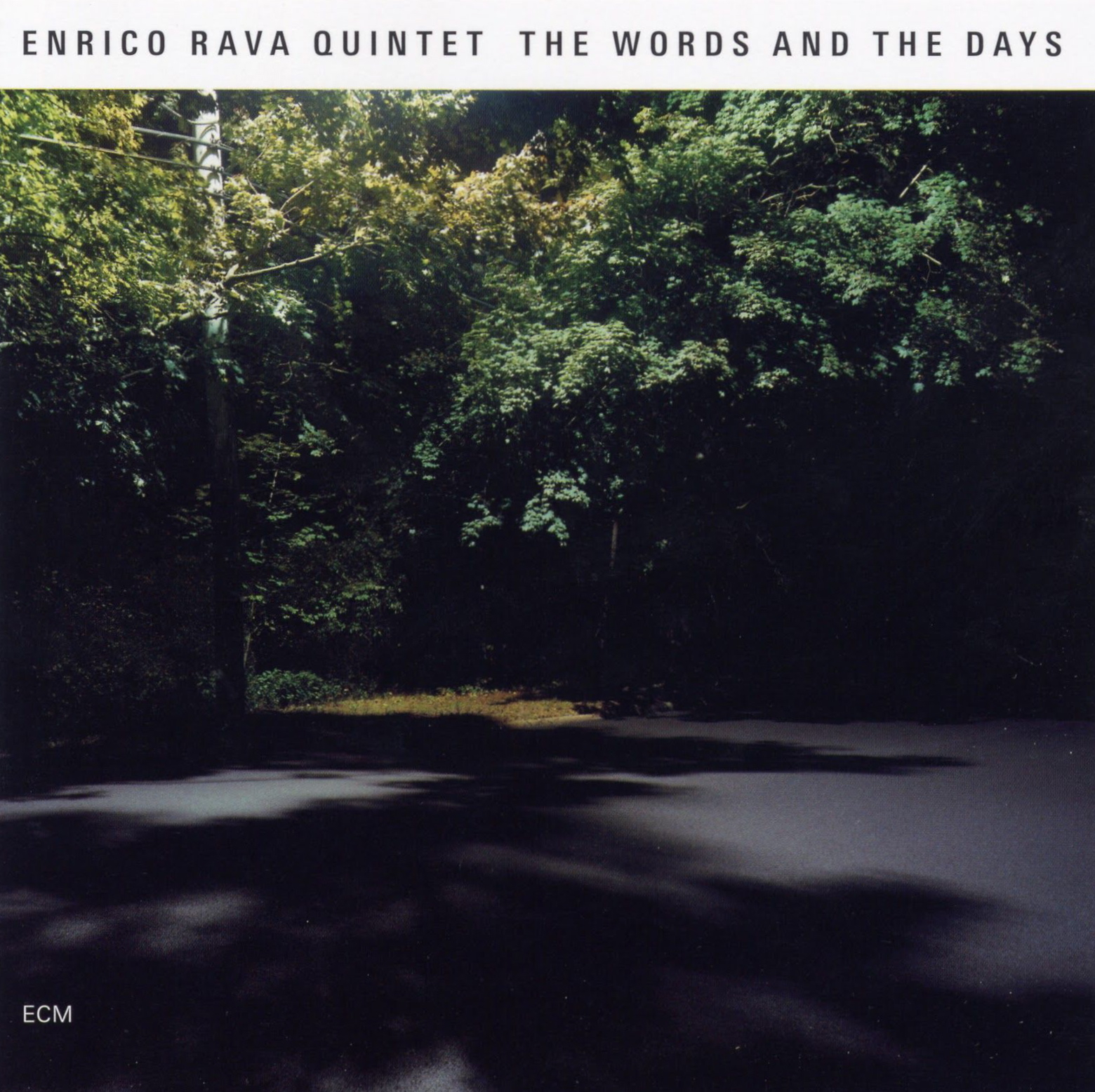
The Words And The Days follows Easy Living, which marked the studio return of Italian trumpeter Enrico Rava after a 17-year hiatus. More than the continuation of a comeback, it constitutes a self-contained entity with its own dreams. It is only natural, then, that the title tune should flow like a soundtrack to those dreams. Verdant and sincere, it hangs, as might a contended hand over the side of a boat, cutting a path through the water. Rava seems to paint that vessel’s wake while the intuitive drumming of Roberto Gatto renders every glint of sun thereafter with photorealistic detail. Yet despite these sundrenched beginnings, where Easy Living was warm and fuzzy all over, we generally encounter a cooler sound in this mostly Rava-penned program.

Gatto and bassist Rosario Bonaccorso hold fast to their formidable dual role, at once supportive and pace-setting. Rava is happy to follow wherever they may lead, with often-joyful results. In “Secrets,” for instance, some of his formative Brazilian influences jump from the woodwork. Meanwhile, trombonist Gianluca Petrella puts his enigmatic stamp of things. Although his language can be fiercely chromatic, this time around he moves under the table in search of forgotten crumbs. He works a quiet magic in the Russell Freeman standard “The Wind,” engendering a chain of lilting calls, while in “Serpent” he preens his feathers to the tune of a slick, rubato synergy. Most of that synergy he shares with Rava, reigning clearest in “Art Deco,” a three-minute duet that crosses the straight and the curved and pays tribute to its composer, the great Don Cherry. Petrella and Rava trade more brass arrows in Gatto’s “Traps,” evoking a big band on an intimate scale, balancing the pans with its breezy concentration. As a player, Gatto’s adaptive panache figures centrally in “Bob The Cat.”

Pianist Andrea Pozza, replacing Stefano Bollani from the last session, marks a shift in the group’s sound. His reflective approach adds monochromatic atmospherics to “Echoes Of Duke,” taking the session’s feet from its picturesque murk and washing them anew with a more classically rendered style. Rava digs deepest on this expedition, unearthing a plethora of finely preserved artifacts. In this regard, the bandleader excels highest when he is cut loose, as in the cinematic veils of action and soft-focus drama of “Tutù” and the stretch of empty road that is “Todamor,” which unrolls its horizon after a viscous monologue from Bonaccorso entitled “Sogni proibiti” (Forbidden dreams). Although unpopulated, that horizon is filled with stories. Rava is confident behind the wheel in taking us there, navigating an echoing corridor with superb control of every gear. And as he pulls us into the driveway of “Dr. Ra And Mr. Va,” of which the strangely somber exterior only thinly veneers a fiery heartbeat within, it is clear that the journey has only just begun.

Dave Holland Big Band: What Goes Around (ECM 1777)

What Goes Around

Dave Holland Big Band
What Goes Around

Antonio Hart alto saxophone, flute
Mark Gross alto saxophone
Chris Potter tenor saxophone
Gary Smulyan baritone saxophone
Robin Eubanks trombone
Andre Hayward trombone
Josh Roseman trombone
Earl Gardner trumpet, flugelhorn
Alex Sipiagin trumpet, flugelhorn
Duane Eubanks trumpet, flugelhorn
Steve Nelson vibraphone
Dave Holland double-bass
Billy Kilson drums
Recorded January 2001 at Avatar Studios, New York
Engineer: James Farber
Assistant engineer: Aya Takemura
Produced by Dave Holland
Co-produced by Louise Holland
Executive producer: Manfred Eicher

Bassist Dave Holland widens the span of his guiding hand for his first big band album. At the heart of this defiant session is Holland’s peak quintet with saxophonist Chris Potter, trombonist Robin Eubanks, vibraphonist Steve Nelson, and drummer Billy Kilson, all of whom nestle among an extended family of brass and reeds. Representing nearly two decades of original compositions, What Goes Around dives headfirst into the deep end with a choice tune from 1988’s Triplicate. “Triple Dance” tips its hat into a savvy introductory groove that immediately fronts the delectable baritone of Gary Smulyan. The music tops a perfect pint before sliding it down the bar into “Blues for C.M.” This sweet, low swing evokes the ebony moods of its namesake, Charles Mingus, while yielding half-pikes for Nelson’s self-propulsions and Potter’s compact swing. A tender solo from the bandleader caps off the proceedings with soul. Also from The Razor’s Edge is that 1987 record’s title track, which now unfolds in denser, slicker brilliance, duly reminding us that the effectiveness of a razor’s cut is nothing without the gap in its center, which allows its anchorage and turns danger into utility. Next is the 17-minute title track, which comes to us via the 2001 release Not For Nothin’. As the album’s deepest fantasy, it puts Holland’s bass lines on full display, jumping out as they do from gentle persuasion to grounding digs, the latter inspiring some uninhibited cloudbursts from the horns. Potter unleashes some fierce tenorism early on, outdone only by Eubanks’s proud frenzy. After passing through dense checkpoints of passion along the way, a cathartic spate from Kilson works us into the breakdown. Phenomenal. “Upswing” serves up more hearty baritone, sharing a plate with the crisper articulations of Duane Eubanks on trumpet the tang of gumdrop vibes. Duane flashes back to 1984’s Jumpin’ In with the blush of “First Snow,” which above all spawns a truly masterful solo from Antonio Hart on alto that is worth the price of admission ten times over. Hart sheds his skin again in the sway of “Shadow Dance,” adding flute to the mixture. Amid a palette of rich ochre and lemon highlights, Holland’s ear-catching artery and Potter’s acrobatic embouchure trip us over an explosive drum solo into the final weave of horns and magic.

Get this.

<< Valentin Silvestrov: leggiero, pesante (ECM 1776 NS)
>> Valentin Silvestrov: Requiem for Larissa (
ECM 1778 NS)

Dino Saluzzi & Jon Christensen: Senderos (ECM 1845)

Senderos

Senderos

Dino Saluzzi bandoneón
Jon Christensen drums, percussion
Recorded November 2002 at Rainbow Studio, Oslo
Engineer: Jan Erik Kongshaug
Produced by Manfred Eicher

If you’ve ever wanted to know what thinking musicians sound like, then you won’t want to pass on Senderos. This one-of-a-kind album pairs bandoneón maestro Dino Saluzzi with Norwegian drummer Jon Christensen for a session as spontaneous as it is fascinating. Putting both free improvisations and Saluzzi originals to the test, each of its 14 excursions pushes the limits of disclosure. On the one hand, Saluzzi’s playing is already so rhythmically multifaceted that to expand on it seems as futile as trying to add facets to a perfectly cut diamond. By the same token, Christensen is so sensitive to its surroundings that Saluzzi’s quietude becomes a suitable foil for the drummer’s whispering melodies, and vice versa. Granted, the combination may take some getting used to, less successful as it is in “Vientos” and “Todos los recuerdos,” each a playful scouring of fragmented cities and construction sites. That being said, there is good reason to hold on to these experiments, to trace in their sounding a line of thought developing in real time. We can relate to them as mirrors of vulnerability, of honesty.

The album thus follows a direct chronology, so that by the time they near the halfway point at “Los ceibos de mi pueblo…” Saluzzi and Christensen have begun to realize that rather than try to fill in each other’s spaces, it fares them better to let those spaces breathe. Christensen in particular knows the value of emptiness. The more of it he enables, the more it sings, as is clearest in his solo introduction to “Aspectos.” Saluzzi’s patient entrance unfolds its map without prematurely dancing toward the treasure it indicates. As well in “Huellas…,” where the drums seem to break off from the bellows—never muscling their way onward but marking all that came before. Such selflessness is inspiring to behold and achieves its most organic geometries in “Formas.”

The most lucid moments, however, are in Saluzzi’s four intermittent solos. Each is a soft spot, a blend of yearning and resolution that contorts disarmingly in “Fantasia” yet finds deepest traction in “Allá!… en los montes dormidos.” With an openness to expression that only decades can bring, it breathes, takes pause, reflects and self-reflects. So moved is Saluzzi that he sings toward the end, reminding us that all music begins and ends within.

Dino Saluzzi/Anja Lechner: Ojos Negros (ECM 1991)

Ojos Negros

Ojos Negros

Dino Saluzzi bandoneón
Anja Lechner violoncello
Recorded April 2006, Kulturbuehne AmBach, Goetzis
Engineer: Markus Heiland
Produced by Manfred Eicher

There’s no better way to describe the wondrousness of Ojos Negros than to quote dance historian Sally Sommer: “Tango is self-transformation.” This groundbreaking debut of a duo nearly a decade in the making smacks of Sommer’s insight, works its fingers raw with the labor of its fluid intuition. Tango would be nothing without memory. That bandoneonista Dino Saluzzi and cellist Anja Lechner bring such a level of awareness to every note and space between alike is graspable enough. Less so are the whispers behind their collaboration, the linking impulse through which they sing as one. This can be neither taught nor so adroitly articulated, but can only be imbibed through the music of life itself. The album’s title is therefore no coincidence—black eyes hold in their pools the truth behind all that moves us.

Anyone familiar with Saluzzi’s work will know his skill for shaping a melody so heartwarming it hurts, and know also that his creative wellspring is itself a dark iris floating in red-veined expanse. Except for the title track, an alluring tango by Vicente Greco, all of the material on Ojos Negros is Saluzzi’s. That being said, once Lechner weaves her spirit into the quivering bandoneón of “Tango a mi padre,” it’s clear that it is just as much hers. The rare partnership established at the outset is, like Ryuichi Sakamoto’s pairing with Morelenbaumin Casa, an unusual idea with organic results, so that one can hardly imagine the sonic landscape without their tangent. Thus caught in the lilting kinesis they so delicately render, we move with them, taking on the elasticity of gently disturbed water.

Dino and Anja
(Photo by Luca d’Agostino)

Saluzzi and Lechner tread foregrounds and backgrounds, stage left and stage right, interiors and exteriors with equal resonance, ever aware of the destinations at the heart of their storytelling regardless of whoever takes the lead. This constant give and take is the light in their prism, which shines brightest in the masterful “Duetto.” Its ashen beginnings ignite slumber before drifting back into peace, as if lazing beneath the swaying tendrils of the willow (each a necklace of time) evoked in the album’s title track. Elsewhere, the duo turns the lens a few clicks into softer focus. “Minguito,” for one, offers a stone rounded by decades of water’s passage as it relays pizzicato arpeggios to Saluzzi’s sustained builds. “El títere,” for another, invokes these contrasts afresh. A handful of especially contemplative pieces whittles the session into completion. Among them, the closing “Serenata” stands out for the depth of its emotion, pliant and mountainous.

The music of Ojos Negros is spoken for by the night. True to ECM standards, it is superbly recorded to boot, giving the bandoneón extraordinary breadth to enfold the cello at its center. As one of the label’s finest recordings and a highlight of Saluzzi’s ongoing travels, it simply deserves to be heard. It was also my first encounter with either musician, and if you have yet to open your ears to their command, I hope it may also be yours.

Anouar Brahem: Le pas du chat noir (ECM 1792)

Le pas du chat noir

Anouar Brahem
Le pas du chat noir

Anouar Brahem oud
François Couturier piano
Jean-Louis Matinier accordion
Recorded July 2001 at Radio DRS, Zürich
Engineer: Martin Pearson
Produced by Manfred Eicher

Oud virtuoso and composer Anouar Brahem returns to ECM with an inspired trio. In the company of pianist François Couturier and accordionist Jean-Louis Matinier, he emerges more as guiding wind than guiding light, forging a quietly original program that feels at once unprecedented and timeless. Brahem’s writing is especially intuitive on this outing, teetering from stream-of-consciousness currents to insightful themes in the steady arc of a summer fan.

Le pas du chat noir brings a desert’s clarity to the night air, exposing an intricate carpet of stars against cloudless sky. The color schemes are simple, but their constellations sway with deep mythology. The opening title track lacquers a table for all the puzzle pieces that follow: raindrops turned images, fragments of a whole. As in the concluding “Déjà la nuit,” its surface trembles ever so slightly from the weight of a nearby spirit’s footsteps. Of this small mountain of twelve pieces, “Leila au pays du carrousel,” which appears once properly and again in variation, is the apex. Its arpeggios tip a quill’s inkwell, pregnant with potential words. Accordion and piano configure every fractal edge, a galaxy in miniature. With their turning comes forgiveness, the unerring stare of divinity that clasps its fate around all life and breathes until it shimmers. A Philip Glass-like ostinato from Couturier lends similar regularity to “Les ailes du Bourak,” forming with the others a caduceus of song. Both tunes reveal a distinct new edge to Brahem’s instrument. Be it an effect of the playing or the engineering, its tone is prominently exposed—all the more wondrous when one considers just how shadowy Brahem’s presence is throughout. He lifts the veil, only to reveal another, this made of refraction, prisms of selfless, creative spark.

Notable also are Brahem’s duets. With Couturier he achieves clearest solidarity in “De tout ton cœur,” while in “Pique-nique à Nagpur” he and Matinier skip through the album cover’s trees, their shadows pulling the sky like an eyelid, neither sleeping nor awake. Couturier casts lighter magic in “C’est ailleurs” (which, with its broad strokes and intimate pairings, says much with little) and reads the ether like a sacred book of Gurdjieff in “Toi qui sait.” Such are the nomadic ways of these travelers, each evoking a staggering range of topographies in his fleet passage. As in the first high notes of “L’arbre qui voit,” their leaves fall in slow motion, blown from settlement to settlement in search of a branch.

All the above being said, I might not recommend this as your first Brahem experience. A cup of tea at the Astrakan Café might be in order before taking a stroll down this leisurely, though undeniably beautiful, thoroughfare.

<< Heinrich Ignaz Franz Biber: Unam Ceylum (ECM 1791 NS)
>> Zehetmair Quartett: Robert Schumann (
ECM 1793 NS)

Louis Sclavis Quintet: L’affrontement des prétendants (ECM 1705)

L'affrontement

Louis Sclavis Quintet
L’affrontement des prétendants

Louis Sclavis clarinet, bass clarinet, soprano saxophone
Jean-Luc Cappozzo trumpet
Vincent Courtois cello
Bruno Chevillon double-bass
François Merville drums
Recorded September 1999, Studios La Buissonne, Pernes-les-Fontaines
Engineer: Gérard de Haro
Assistant engineer: Sylvain Thevenard
Produced by Louis Sclavis
Executive producer: Manfred Eicher

Multi-reedist Louis Sclavis unveils a new quintet with L’affrontement des prétendants, retaining only bassist Bruno Chevillon from his previous ECM sessions. Along for the ride are newcomers Jean-Luc Cappozzo on trumpet, Vincent Courtois on cello, and François Merville on drums. With them, he forges a distinctive jazz that never fails to titillate with its artful blend of composed and free elements. Like the wonderful Acoustic Quartet disc before it, this date immerses the listener in a refreshing, driven sound.

Despite the album’s title (one might translate it as “The clash of contenders”), the dynamics within the band are anything but contentious. Sclavis’s staid formula of spiraling, precisely notated bookends only serves to foil the brilliant unraveling occurring between them. Take the 17-minute “Hommage à Lounès Matoub,” for example. The masterpiece of the set, it honors its eponymous protest singer through an epic development of mourning into celebration. Bass shadows the solo cello that begins the piece before trumpet threads an alluring stretch of politics. Merville takes an indulgent look at the landscape before paving the way for Sclavis’s soprano. Like Dalí’s famous moustache, which the artist is said to have reserved for only the minutest detail, that pliant reed renders individual leaves, glints of sunlight, and footprints in the sand. Also indicative of the band’s unity is the opening title track, in which Cappozzo is the glue that binds. From growling catharsis to klezmer touches, its idiomatic merry-go-round hinges an exemplary doorway.

Despite the sometimes-dire associations, Sclavis surrounds himself with an eminently joyful milieu. The listener may feel this especially in brightness of “Possibles” and “Contre contre.” The latter’s groove-laden vista is a particularly fluid feature for Sclavis, who over a light percussive backdrop sparks a noteworthy exchange between cello and bass. Even more memorable is that between Sclavis and Courtois in “Distances,” as outgoing as it is crumpled to a pliant core. Yet another duet, this of clarinet and bass, develops full-bodied dances from merest whispers in “Le temps d’après.” Chevillon goes rogue in “Hors les murs,” a packed solo that stomps and pirouettes in turns, and links chains of forward-thinking energy into the stratosphere. Sclavis offers his own monologue via soprano, introducing the swinging “Maputo,” for which he switches to bass clarinet, running along a distinctly swinging backbone with fortitude and oddly graceful sibilance. Last is “La mémoire des mains,” a freely improvised spate he shares with Merville and Courtois: three birds in a cage chattering themselves to sleep.

<< Stockhausen/Andersen/Héral/Rypdal: Kartā (ECM 1704)
>> Jean-Luc Godard: Histoire(s) du cinéma (
ECM 1706-10 NS)

Stockhausen/Andersen/Héral/Rypdal: Kartā (ECM 1704)

Karta

Kartā

Markus Stockhausen trumpet, piccolo trumpet, flugelhorn
Terje Rypdal electric guitar
Arild Andersen double-bass
Patrice Héral drums, percussion, live electronics
Recorded December 1999 at Rainbow Studio, Oslo
Engineer: Jan Erik Kongshaug
Produced by Manfred Eicher

Although the title of Markus Stockhausen’s Kartā is Sanskrit for “higher power,” the music serving it suggests a path of regression from bird to egg. The trumpeter-composer fronts a superb trio that includes Arild Andersen and Patrice Héral (a percussionist whom Andersen characterizes as “a European equivalent to Nana Vasconcelos” and who can also be heard the bassist’s concept album, Electra). Guitarist Terje Rypdal guests, adding swirls of Technicolor to the band’s monochrome. True to collective spirit, much of the pre-arranged material was jettisoned in favor of the spontaneous improvisations that ensued for the recording session’s first ninety minutes. From this came the lion’s share of an 11-part set list. Of the four composed pieces that made the final cut, Andersen and Stockhausen each contributed two.

Looking out from “Legacy” (a sweet breaking of bread that evokes late-night Miles) at the album’s center, one sees Andersen’s pieces at the farthest reaches. Where “Sezopen” allures with its droning cries and floats Rypdal’s autumnal heart murmurs with ease, “Lighthouse” draws powerful arco lines, evoking not the structure itself but the rays of promise it emits and the vessels they rock to sleep. The resulting traction leaves us with a time-lapse photograph to cherish. One layer inward, in either penultimate position, are Stockhausen’s tunes, which between the rubato “Flower Of Now” and the amorphous “Choral” open various doorways of possibility into the ad-libbed nexus.

In said nexus reside creatures of great dexterity (viz: Andersen’s fingerwork in “Wood And Naphta” and Rypdal’s in the fiercely programmatic “Wild Cat”) and natural girth (“Sway”). Yet it is in freer tracks such as “Auma,” “Invocation,” and “Emanation” where the musicians’ sacred touchstones appear. Together they form the weight of a Foucault’s pendulum spun in resourceful filament. At times they reach fevered pitch at the suggestion of Andersen’s ebony ululations, while at others they slip into ghostly blur. Whatever the climate, they hold fast to their timekeeping in constantly shifting clockwork with admirable constancy.

Stockhausen is a player who bathes in outer space, finding freedom in the darkness between the stars. With Kartā he has crumpled a nebula back to its planetary state.

<< Gianluigi Trovesi/Gianni Coscia: In cerca di cibo (ECM 1703)
>> Louis Sclavis Quintet: L’affrontement des prétendants (
ECM 1705)