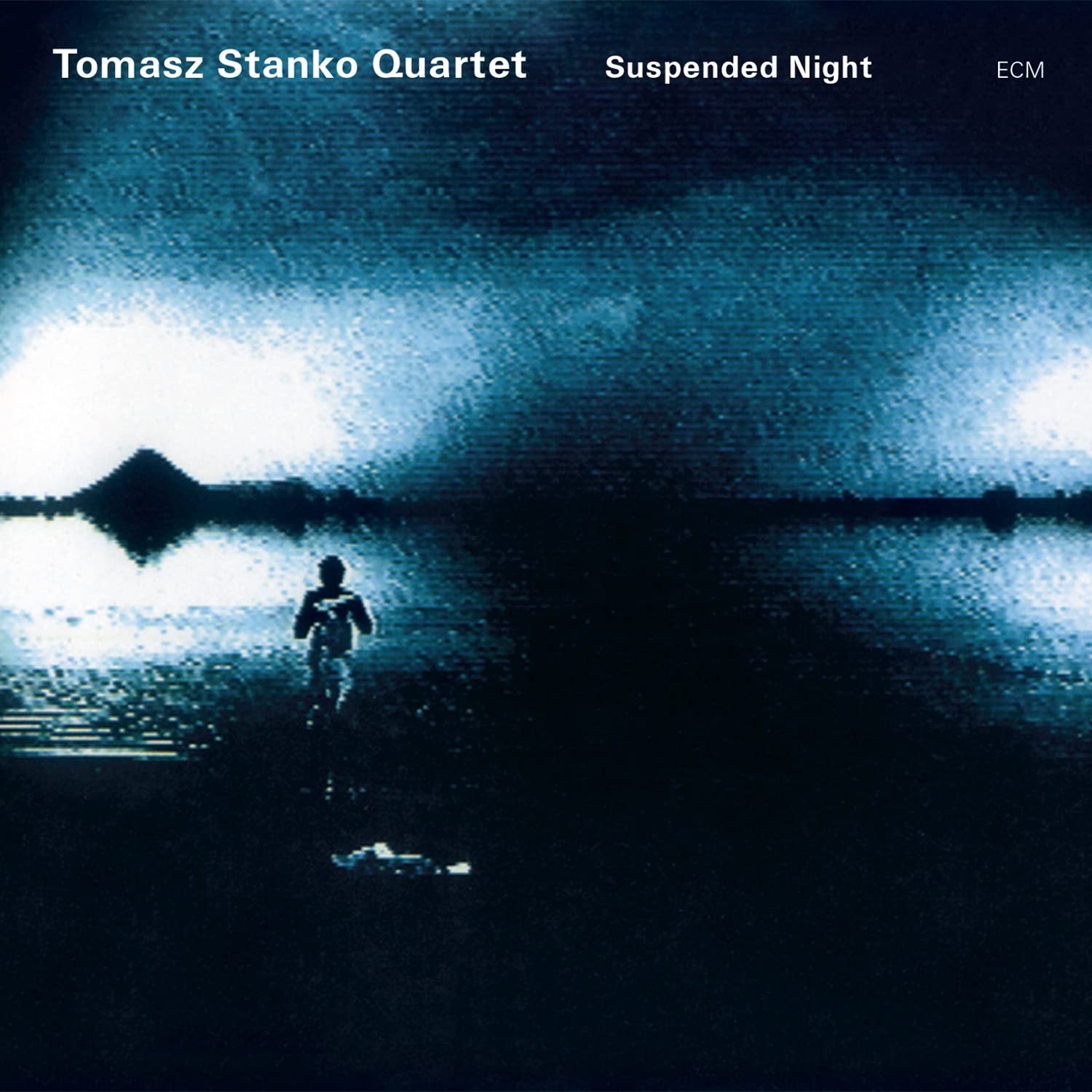
Tomasz Stanko Quartet: Suspended Night (ECM 1868)

Version 1.0.0

Tomasz Stanko Quartet
Suspended Night

Tomasz Stanko trumpet
Marcin Wasilewski piano
Slawomir Kurkiewicz double-bass
Michal Miskiewicz drums
Recorded July 2003 at Rainbow Studio, Oslo
Engineer: Jan Erik Kongshaug
Produced by Manfred Eicher

Two years after the classic Soul of Things, trumpeter Tomasz Stanko and his young Polish sidekicks took things to the next level—by going deeper into the night. Stanko’s uniqueness comes through his ability to be at once atavistic and novel. He turns an ear to those spaces in between notes and shows us just how musical they truly are. This is to say nothing of the fact that his tone only seems to get more fluid as he ages, sometimes burrowing its way through a thickly described sentiment, at others swooning from the percolations of its discovery. He is sly and cool, and with the committed trio at his side there is nothing to fear on either end of the brass.

“Song for Sarah” spreads its roots into an earthy prologue for the ages. Like “Nicolette” (from a different classic, Angel Song), it sinks its teeth into a cloud, one that finds absorbent life here through the ten “Suspended Variations” that follow. In the first there is already an album’s worth of material to unpack. As he has done before, pianist Marcin Wasilewski brings the rain, only now its colors speak as much as they sing. Set aloft on Michal Miskiewicz’s popcorn snare and with Slawomir Kurkiewicz’s netted bass, Stanko’s subtle panoply of pops and whispers turns the ingredients of the solo into a home-cooked soliloquy.

The more you get to know this music, if not the other way around, the more its gradations clarify. What at first, for instance, feels like a tracing of that indefinable border between flying and falling in Variations III and IV reveals more domestic light with every listen. It is the kind of playing one can only dream about, wrapped as it is in a cloak of lens flare to stave off the half-hearted imitators of the world. The seemingly straightforward groove aesthetic of II and V pulls another curtain to the dawn, finding in every crosscurrent a decodable sigh. The responsive playing from the rhythm section here is something of a marvel. The pianism of VI wraps around us like skin and for the first time brings palpable darkness to the album’s palette. Stanko’s restraint is such that we can’t help nodding our heads and squinting our eyes into the billowing smoke that welcomes us.

Variation VII just might be the jewel of the set. Short and sweet, it reveals the breadth of the quartet’s subtleties in a sleek and compact package. VIII is likewise studded with microscopic touches from Wasilewski. Stanko, meanwhile, threads the needle with a hand so intuitive that his fingernails blur into the inlay of the valves until X fulfills the promise of suspension at last.

There is a veiled spirit to Suspended Night. Touched by the hesitations of a melancholy philosophy, it dispels the myth of origin and creates one for itself. This is the scar of maturity, the infant’s cradle chopped into firewood and burned until smoke and a few lullabies are all that’s left to prove its having been here.

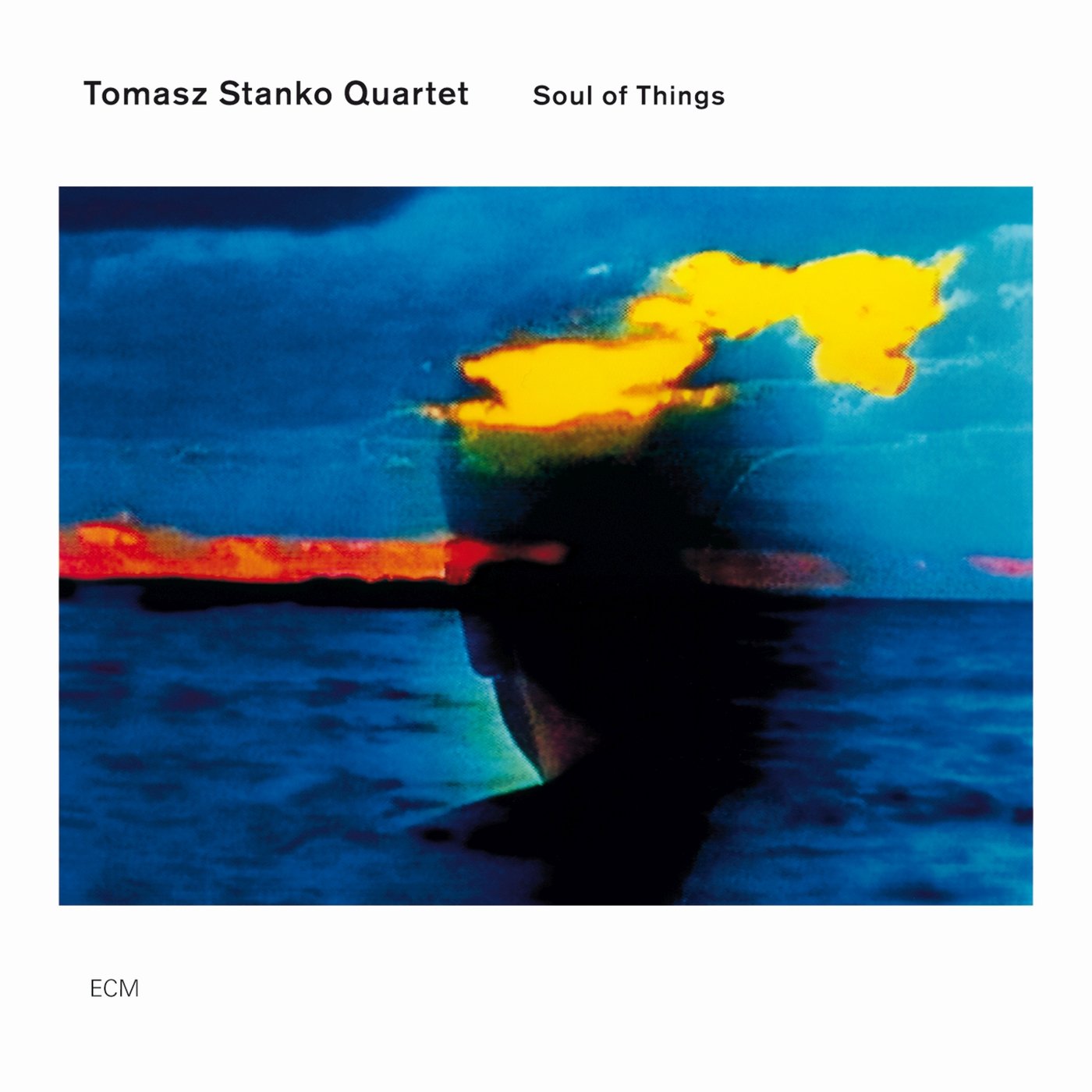
Tomasz Stanko Quartet: Soul of Things (ECM 1788)

Version 1.0.0

Tomasz Stanko Quartet
Soul of Things

Tomasz Stanko trumpet
Marcin Wasilewski piano
Slawomir Kurkiewicz double-bass
Michal Miskiewicz drums
Recorded August 2001 at Rainbow Studio, Oslo
Engineer: Jan Erik Kongshaug
Produced by Manfred Eicher

“I’ve been playing the same song my whole life,” says trumpeter Tomasz Stanko, who puts his claim to the test in thirteen numbered tracks under the title Soul of Things. Together they are not variations on a theme, but are a “balladesque suite” built around the theme of variation. And who better to weigh this theory than the all-Polish backing of Marcin Wasilewski (piano), Slawomir Kurkiewicz (bass), and Michal Miskiewicz (drums)? For perhaps no one else has internalized every aspect of Stanko’s career with such commitment and chased it down with a healthy ECM diet to boot. Being in the legendary space of Oslo’s Rainbow Studio, under Manfred Eicher’s careful and deepening guidance no less, stirred their blood to permeating, concerted action in a timeless document.

Even if I wanted to resist contextualizing Stanko’s music against a silver screen, one can almost feel the tick of raindrops on gabardine as Variation I bathes us in film noir atmosphere. Stanko’s protagonist is recognizable from the first curl of fog that precedes him. The band’s attunement, down to the molecular level, is also palpable in Kurkiewicz’s attention to space, finding in Wasilewski’s pianism fertile ground for unmitigated ideas beneath a sprinkling of drummed dew. Variation II glides along with an ice-skaterly flow. Stanko’s gentility here astonishes, though even the more upbeat variations like III and X maintain an elasticity of time that softens our ears. From lullabies of empathy (IV) to heart-wrenching spotlights on closed curtain (XII), we feel every hidden thing as if it were already inside us.

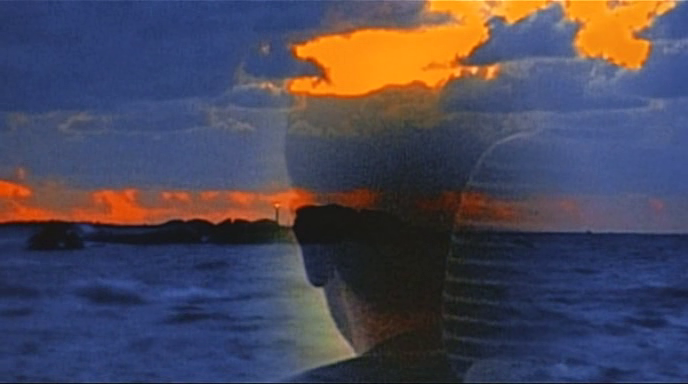
Wasilewski, in his first ECM appearance, is the session’s golden child, spreading out every wrinkle with iron fingers. He paints a forest one branch at a time in VI, drums quivering like the wind-touched foliage. Likewise in VII. Billowing like a curtain in a summer breeze, it manifests the flexibility of our well-being and weaves its thread count to translucent density. The contemplative solo from Miskiewicz here is something of a transition point, a hidden portal through which Stanko breathes his undying love for the unspoken lyric. Like the cover image—a still from Jean-Luc Godard’s 2001 masterpiece Éloge de l’amour—it opens a sky in the mind’s eye, a rift of flame and critical reasoning.

In Praise of Love

So often Stanko comes close to the edge, hanging only by a finger, but pulls himself up just in time, filling every chasm with hope before stepping confidently on his way to the next. We hear this in IX, when after an ascending line he waits for the implications to settle before auguring their full-blown fate. Such profundity abounds also in XI. It is filled sublime moments, as when Stanko unleashes a raspy cry and Miskiewicz responds not with a rise in intensity but a flowering of cymbals, gentle yet sure. From a long solo intro, the final variation plies the studio’s reverberant space as one might a deity with questions that are their own answers.

Soul of Things only grows more ponderous as it develops, trail-marking its passage not with breadcrumbs but with delicacies far more edible by heart. This quartet, while formidable, is never confrontational, even when Stanko is blatting his golden song across the stratosphere. His titles may always come after the fact, but the soul of these things has been there from the start.

<< Yves Robert: In Touch (ECM 1787)
>> Helmut Lachenmann: Schwankungen am Rand (
ECM 1789 NS)

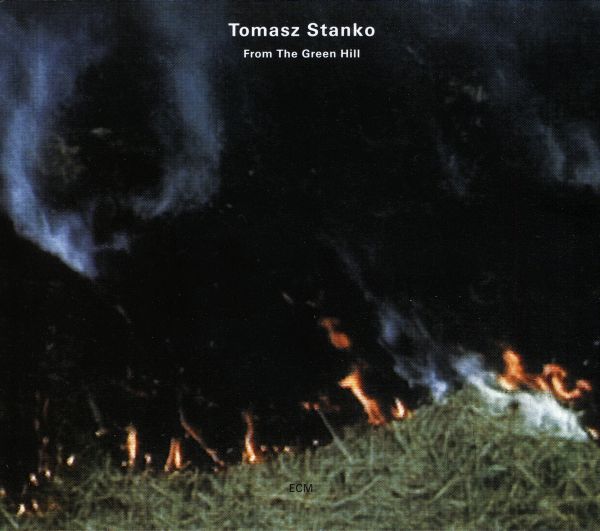
Tomasz Stanko: From The Green Hill (ECM 1680)

From The Green Hill

Tomasz Stanko
From The Green Hill

Tomasz Stanko trumpet
John Surman baritone saxophone, bass clarinet
Dino Saluzzi bandoneón
Michelle Makarski violin
Anders Jormin bass
Jon Christensen drums
Recorded August 1998 at Rainbow Studio, Oslo
Engineer: Jan Erik Kongshaug
Produced by Manfred Eicher

A burning ridge. Gills of flame in the dark. Smoke rises; ashes sink. This is the visual manifestation of all that resounds From The Green Hill, yet another leap of profundity from Tomasz Stanko after the Polish trumpeter’s four-album ECM panorama. To achieve this, he couldn’t have asked for a more appropriate band: John Surman (dipping into his characteristic low reeds), bandoneón maestro Dino Saluzzi, violinist Michelle Makarski, bassist Anders Jormin, and drummer Jon Christensen decode the cover photograph as a meta-statement of Stanko’s bite and his underlying deference to the spirits lurking within his instrument. Of those, the ghost of Krzysztof Komeda opens its mouth most widely and unleashes its lachrymose glow at 24 frames per second in two versions of “Litania.” Saluzzi plays each alone, keying from them a vital thematic thread of Stanko’s sound-world, a floating lily with no destination but its will to bloom. Saluzzi thus adopts a narrative voice, without which the story would lack a vital organ.

Surman contributes the album’s frame tale in the form of “Domino,” which opens the set and also makes a penultimate reappearance. In the former incarnation, it constitutes a viscous introduction in which the free considerations of the band’s rhythm section (to which the bandoneón is bonded) are the matchbook strip to Stanko’s strike. “Stone Ridge,” also by Surman, puts his bass clarinet in the spotlight. Flowering from a solo violin before Stanko’s muted strains pull up the others in his net, the ensuing groove gives plenty of hooks for its chain of soliloquys, of which Makarski’s is utterly remarkable.

The compositional skin that keeps this all embodied is writ large by Stanko, despite the fact that he seems relatively absent. What he lacks in airtime, however, he makes up for with a honed improvisatory laser that etches every nook of this shadowy house in which we find ourselves. It all reaches a nadir in “Love Theme from Farewell to Maria” and in the title track. The level of attunement to every change in both offers hope against the somber charge. Not to be ignored, Jormin stands out for his restless solo in “…y despues de todo” and for the inversions of “The Lark In The Dark.” Christensen’s drumming, too, with its microscopic and sparkling current, sets off a halting sort of poetry. (Note also his free talk with Saluzzi in “Buschka.” Brilliant.) We end in “Argentyna,” which confirms the presence of a magnifying glass in Stanko’s Swiss Army knife, though with no loss of intensity—if anything, more of it. Stripped to the core of their melodic undertaking, his powers of recollection gnaw at the arbitrariness of intellectual border zones. His are not cerebral toys, but direct methods of communication, their raw rubato the touchstone of an unrelenting lyricism…and all of this with hardly a trace of aggression.

The genesis of From The Green Hill can be traced back to ECM’s May 1997 Whitsun concerts at the Hotel Römerbad in Badenweiler, Germany. It was there that Stanko found himself performing at the behest of producer Manfred Eicher, who dropped his weight into new and exciting pools. Several performances and one all-night jam session later (oh, to have been there…), we arrive in this masterfully interwoven place, where ebb and flow have only one name: you.

<< Alexei Lubimov: Messe Noire (ECM 1679 NS)
>> Paul Giger: Ignis (ECM 1681 NS
)

Keith Jarrett: La Scala (ECM 1640)

La Scala

Keith Jarrett
La Scala

Keith Jarrett piano
Recorded February 13, 1995 at Teatro alla Scala, Milano
Remixed at Rainbow Studio by Jan Erik Kongshaug and Manfred Eicher
Executive producer: Manfred Eicher

February 13, 1995 marks an historic event. It was the first time that Milan’s Teatro alla Scala allowed a jazz musician to headline. Yet Keith Jarrett is, of course, more than his moniker and brings a wealth of music that is no less operatic that what normally graces its stage. For in the same way that opera embodies a flowering intersection of text, acting, and sound, Jarrett unapologetically translates vibration, feeling, and commitment through the lens of the body until their collective prism opens like an eagle’s tail. So begins another of his improvised piano concerts, which in this case augurs a twitch in the skin of space-time until it bleeds.

The melodious unfolding of Part I is a self-fulfilling wish. I cannot help but read shades of childhood into its 45-minute sweep that materializes before our ears. I feel it in the parental awe of the more delicate moments; in the expulsion of air that, with the flick of a pedal, comes tumbling forth with sepia; in the self-referential diamonds sparkling within: shades of Köln, of Gurdjieff (though here he seems to be doing more “writing” than “reading”), of monuments yet to be discovered. Jarrett keeps his hands close together at first, as if to embrace the intimacy taking shape between them, caging a bird whose flight is still a dream. His fingers move in gradations in much the same way that sunlight changes its constitution according to the passage of clouds. As the density grows into a veritable corn maze, Jarrett wraps his mind around a solution and strains that path through the voice. He mixes his breath into those of everyone in attendance, rotating on an axis of love. The feeling of pasture is profound. Like sand between the toes, it is rare and welcome. Finger rolls paint window boxes with the lingering light of day, planting a summer’s worth of flowers in a single cluster. When they wilt, they are but one stem. Caught in the pondering flame that borrows them from sight and reworks their scent into something audible, their continuity is a magic unto itself, a sutra without words. Part I ends in stasis, flipping by gentle degrees the plane of its existence until a full and impenetrable sphere is left behind, which, while translucent, steels itself against the vagaries of interpretation, spinning until it can sing again.

Part II holds a microscope to an eddy of schisms. Brief touches from pedal and tight flowering runs culminate in a fast-forward ball bounce. The music accelerates, is compressed. Meticulously detailed explorations of the piano’s upper register unchain a host of fresh impressions. Particle by particle Jarrett builds a raincloud and flicks its contents in fingerfuls of inspiration. Ever so gradually, his left hand bespeaks a deeper gravity, tumbling over rocks and smoothing into the glassine surface of a faraway lake. There something of life lingers and the kiss of death feels as far away as the horizon. This melts into one of Jarrett’s deepest tunnels of light. He soars in a Gershwinian mode, coating the land with stardust before playing us out to stealthy footsteps, the wake of an unbridled tide.

Jarrett paints worlds of transitions, if not transitions of worlds. Each moment is the fragment of a larger meteorite, whose face can only be heard yet never seen, whose tears can be tasted but never shed. This makes his decision to conclude with a rendition of “Over the Rainbow” far beyond touching. And a rendition is what it truly is, for it must be worked through the body like breath itself until it expands. It is all the more heartwarming for the storm of bravos that drenches its fields before they’ve even had a chance to dry.

La Scala stands out in the Jarrett archive for becoming more absent as its intensity builds. He flushes out unspoken rhythms with stomping feet, painting not external vistas but intimate anatomical diagrams, so that when the chording becomes denser and the music more fully resolved, it feels like dissolution. The relationship between sound and effect, then, is not causal. Just because these styles inhabit the same music doesn’t mean they inhabit the same body. It’s more that Jarrett allows himself to be attuned to their shuffling, inscribing things in real time as if they were self-evident

The brilliance of these solo events manifests not only through the sheer volume of material that flows through him, seemingly translated from some ethereal source, but also through the potency of his melody-making, which at his touch produces a songbook that is timeless and can only be accessed from a place of wonder.

<< John Surman: Proverbs and Songs (ECM 1639)
>> Brahem/Surman/Holland: Thimar (ECM 1641
)

John Surman: Proverbs and Songs (ECM 1639)

Proverbs and Songs

John Surman
Proverbs and Songs

John Surman baritone and soprano saxophones, bass clarinet
John Taylor organ
John Surman
Howard Moody conductor
Recorded live at Salisbury Cathedral, 1 June 1996
Engineer: Mike Walter
Produced by Derek Drescher and Manfred Eicher

Multi-reedist John Surman returns to his chorister roots and lays bare his compositional prowess with this oratorio commissioned by the Salisbury Festival and premiered in June of 1996. The Salisbury Festival Chorus, founded in 1987 by Howard Moody (of whose compositions the Hilliard Ensemble and Trio Mediaeval have been strong proponents) approaches its Old Testament sources as the composer sets them: that is, with panache, a flair for syncopation, and raw intensity. Add to this pianist John Taylor in an unexpected turn on cathedral organ, and you’ve got a recipe for one of Surman’s most intriguing catalogue entries to date.

Despite the forces assembled, it is he who dominates the palette. The “Prelude” immediately places his cantorial baritone amid a wash of organ in a free-flowing Byzantine mode, thereby establishing a rich narrative quality from the start. Our first foray into choral territory comes in the form of “The Sons,” a robust piece that works men’s and women’s voices in an iron forger’s antiphony toward genealogical harmony. At first, the thicketed singing feels more like a shoreline along which reed and pipes crash in pockets of light and bas-relief. Yet as the “The Kings” soon proves, it is capable of the jaunty togetherness at which Surman excels. “Wisdom” has its finger most firmly on this pulse of greater fellowship, for there is a wisdom of Surman’s own in the brushwork of his soprano, which dances for all the world like the world.

This being a live BBC Radio 3 recording that was later mixed down at Oslo’s Rainbow Studio, the quality is rather compressed. Then again, so is the music, the message of which is as dense as its King James texts. The album’s space is left to Taylor, its images to the voices, its method to Surman’s winds. There is a rusticity to the album’s sound that matches the unadulterated emotions of the music. We hear this especially in “Job,” which like its scripture upholds divine reason in the face of hardship. The chanting here is a form of punctuation, the snaking baritone lines its restless grammar.

“No Twilight” continues to unravel the sopranic weave in what amounts to the heart of the album, both in spirit and in execution, and places the voices at the slightest remove to haunting effect. Surman’s streaks of sunlight—here the voices of reason—add depth of field to this vision, so that the whimsical shallows of “Pride” emphasize the frivolity and fragility of their eponym. The truth comes out in the ruminative organ solo that epilogues the piece. “The Proverbs,” with its ominous recitation, is the freest and builds eddies of judgment and self-reflection (note Surman’s brilliant evocation of the dissenter) until the rays of sacrifice blind with “Abraham Arise!”

In light of the stellar body of choral work that ECM has produced, Surman’s forays into the same are not life-changing, if only because they are about unchanging life. True to the lessons at hand, it is more descriptive than it is aesthetic. Its juxtaposition of distinct sonic color schemes is pure Surman, and represents not a detour from but a dive into the kaleidoscope of his discography…and one well worth taking, at that.

<< Dino Saluzzi/Rosamunde Quartett: Kultrum (ECM 1638 NS)
>> Keith Jarrett: La Scala (ECM 1640
)

Food: Mercurial Balm (ECM 2269)

2269 X

Food
Mercurial Balm

Iain Ballamy saxophones, electronics
Thomas Strønen drums, electronics
Christian Fennesz guitar, electonics
Eivind Aarset guitar, electronics
Prakash Sontakke slide-guitar, vocal
Nils Petter Molvær trumpet
Recorded 2010 and 2011 at Rainbow Studio, Oslo, Cheltenham Jazz Festival and Victoria National Jazz Scene, Oslo
Mixed at Rainbow Studio by Jan Erik Kongshaug and Manfred Eicher
Produced by Manfred Eicher and Food

Mercurial Balm is not only the second ECM outing for saxophonist Iain Ballamy and percussionist Thomas Strønen, a.k.a. Food, but is also the continuation of an exciting new direction begun in the outfit’s Quiet Inlet. Lest these musicians get roped in by their instruments, they also bring an assortment of technology to the table to expand the possibilities of their immediate means. With trumpeter Nils Petter Molvær and electronics stalwart Christian Fennesz at their sides once again, along with new guests Prakash Sontakke on slide-guitar and vocals and Eivind Aarset (recently of Dream Logic) on guitar and electronics, their sound takes a leap of evolution.

As if to drive this analogy home, the malleted gongs of “Nebular” trace the helix of a tense and creaking code, building a genetic slide for the tenor’s slow awakening. Samples of those same gongs slip in and out of earshot, blending ash and ore into the traction of “Celestial Food,” which overlays bright reed lines over a subtly propulsive beat. It is the language of travel personified, the depth of communication demonstrated, the uplift of flight conveyed. Those distant drums brush forward in a digital splash, adding contrast to Fennesz’s temperate climates in “Ascendant.” Solace need not apply, for Ballamy’s is an elemental divination, casting its oracle bones into the ether in hopes they might never land.

“Phase” can therefore be seen as a living segue, wormhole into the deeper biology of “Astral.” From its percussive swamp arises a more naked guitar, its pacing humming with ancient energy. This sets off the tenor and soprano in tradeoffs of augury toward an echoing finish. “Moonpie” unravels fairytale synth textures, over which Molvær breathes his sepia song. Sontakke looses his pliable self in “Chanterelle” and in the title track. He inspires Ballamy to more extroverted heights in the former, and in the latter offsets the ticking of cymbals with spider-webbed guitar. “Magnetosphere” glows with paler fire, an aurora borealis compressed to the size of a match head and lit by the mere act of gazing upon it. Echoes of the opening gongs return and pose us for the “Galactic Roll” that ends the album with Strønen’s own magnetosphere, sparked to life with a gallery of thoughts, each hooked by a god’s pinky and sworn to shine. Glittering and tumbling like a billiard ball dropping into a black hole, it sinks without sound.

In this flowing landscape there are distant footsteps. Plunging and resonant, they cry for sun, forever separated from the giants that produced them. There is in this atmosphere indeed a nourishment of which to be partaken, a diary to be coveted. Its clasp may be gold, its binding weathered, but its text is transparent and fresh.

(To hear samples of Mercurial Balm, click here.)

Iro Haarla Quintet: Vespers (ECM 2172)

Vespers

Iro Haarla Quintet
Vespers

Iro Haarla piano, harp
Mathias Eick trumpet
Trygve Seim tenor and soprano saxophones
Ulf Krokfors double-bass
Jon Christensen drums
Recorded February 2010 at Rainbow Studio, Oslo
Engineer: Jan Erik Kongshaug
Produced by Manfred Eicher

Out of her long association as arranger and orchestrator for Edward Vesala, harpist Iro Haarla showed listeners the breadth of her compositional powers in Northbound, which was but the springboard to all that awaits us in Vespers, her second leader date for ECM. Joined again by bassist Uffe Krokfors of Vesala’s influential Sound & Fury ensemble, saxophonist Trygve Seim, drummer Jon Christensen, and trumpeter Mathias Eick, she offers a set of nine originals.

Haarla

Haarla’s harp is like the clip of wing we see on the album’s cover, which lends context for the perspective we are so humbly granted. Her presence is equally atmospheric, every sweeping arc of light bringing us closer to the romantic blood that nourishes her themes. She combs our fears of flying from tangled minds, eschewing outright virtuosity for melodic integrity. The slowly turning mobile of “A Port On A Distant Shore” is a fine example in this regard. Seim’s tenor heightens the aerial sensibilities, each turn a children’s song resurrected by the lips of memory. The title track in the singular is more of the same. Dedicated to Haarla’s father, it stews in the nocturnal air of its eponym and unfolds the art of travel as if it were an accordion book. Both horns are a touch mournful here and through the keys link a chain of paper and ink, of action and word. Seim stretches his throaty limits and wails across the sky, ever the nomad holding his possessions to a body as slim as they are. Eick cries as if singing, sliding down a slope of ice and forgotten temptations into the view of “A Window Facing South.” Plush swells of harp strings accented by spark of cymbal and wick of bass breed color in the brass. The dialogue between Haarla and Eick here is remarkable—one a watery shimmer, the other a mermaid frolicking beneath. Meanwhile, Krokfors plays the part of a transient artist who commits bold lines to his sketchbook, drawing us into “The Warm Currents Of The Sea.” Much of that warmth is found in Haarla’s skeletal pianism. She paints impressionistic waves of sorrow and fondness in equal measure, lingering on notes as if they were incantations, the horns rolling over one another in foamy tide. The album’s highlight is by far “Satoyama.” The title is a Japanese term that refers to the area between mountain and flat land, and symbolizes the meeting of topographies at work in the album’s every tune. Seim now converts to soprano, trading flight patterns with trumpet over a snowy landscape. “The Shimmer Of Falling Stars” is a time-lapse photograph given life through music and shares the throne with its predecessor. Strained highs from Seim create a plangent emotional effect. Yet the journey must end, “Returning Home” in a slow drizzle nonetheless stirred by a need to move forward. The luscious, John Taylor-esque pianism and diaristic bass solo exhale the final “Adieux,” as much beginning as end. Eick carries us out, if not down, returning us to Earth for a soft and bittersweet landing.

Vespers feels like a winter’s morning. When you first walk into it, the air is frigid and still. One deep breath, however, and its crisp freshness invigorates. You are awakened. You are ready.

(To hear samples of Vespers, click here.)

Trygve Seim/Andreas Utnem: Purcor (ECM 2186)

Purcor

Trygve Seim
Andreas Utnem
Purcor

Trygve Seim tenor and soprano saxophones
Andreas Utnem piano, harmonium
Recorded May 2008 at Tøyen Kirke, Oslo
Engineers: Jan Erik Kongshaug and Peer Espen Ursfjord
Mixed at Rainbow Studio, Oslo by Jan Erik Kongshaug, Manfred Eicher, Trygve Seim, and Andreas Utnem
Produced by Manfred Eicher

After a 13-year odyssey of collaboration, the duo of saxophonist Trygve Seim and keyboardist Andreas Utnem at last plays under ECM’s microphones in Purcor. Dubbed “Songs for Saxophone and Piano,”  Utnem calls more rightly calls it a program of “improvised church music.” In 1997, Utnem, a practicing liturgical composer, invited Seim to participate in select services under the auspices of Norway’s Church City Mission foundation. The result was a relationship that persisted and which manifests an intimate knowledge of context and practice in this session of 14 pieces that include settings of the Mass Ordinary, music for the stage, improvisations, and a reimagining of “Bhavana,” originally of Seim’s Different Rivers.

A beautiful and intimate album that belongs right alongside Stella Malu, Purcor strains its sentiments through a reductive mesh that distills only the purest extract of each melody. Seim’s breathy tone carries experience in its pockets, which it drops in methodical, dripping handfuls in the opening “Kyrie.” Feathered like the edge of an avian dream, it lisps at the edge of a time when mouths wandered in search of tongues. The album’s splintered Mass is therefore less a structural element than it is the air that gives said structure meaning to begin with. It is the space it inhabits, the climate from which it shelters its inhabitants, the words spoken in its chambers. From the beautiful counterpoint of the “Credo,” through the John Surman-esque sopranism of the jubilant “Gloria,” and on to the heartwarming gentility of cause in the “Agnus Dei,” the duo establishes a devotional yet ecumenical atmosphere, a shroud that reaches forth like arms of light and wraps its sacred conscience around secular means. A “Responsorium” switches piano for harmonium, lending the feeling of an organ hymn. Along with the “Pater Noster,” it is a reflecting pool of the soul whose contemplation is naked before all in Heaven. Such are the wounds that give weight to the meaning of struggle—not threads but veins: vast internal networks, compact and held together by the skin of the Word.

One almost hears the bending of a bass note at the start of “Nu Seglar Vi Inn,” a whalebone of time stretched to its snapping point. The album’s folk roots are first fleshed here, though nowhere so deeply as in the “Praeludium,” which untangles those roots and partakes of the celebratory nectar that flows through them. Likewise in the “Postludium,” for which Seim elicits a bamboo sound from his instrument, a specter of the earth walking toward a horizon aflame. The album ends on a likeminded note with “Når Mitt Øye Trett Av Møye,” laying us like lanterns on the water and splashing us into dusk.

Intensities of contrast abound, moving from whisper to exultation in a few sweeps of a grandfather clock’s second hand. Seim and Utnem’s playing, more akin to painting than to performing, blurs color as if by brush of dream. Like the title track, the program as a whole is a fleeting, primordial lament, a fusion tears into laughter, diamonds into coal, coal into dust, and dust into prayer.

From cover to engineering to sequencing (note especially the placement of the solo harmonium “Solrenning”), this is a quintessential ECM production.

(To hear samples of Purcor, click here.)

Nik Bärtsch’s Ronin: Llyrìa (ECM 2178)

Llyrìa

Nik Bärtsch’s Ronin
Llyrìa

Nik Bärtsch piano
Sha alto saxophone, bass clarinet
Björn Meyer bass
Kaspar Rast drums
Andi Pupato percussion
Recorded March 2010, Studios La Buissonne, Pernes-les-Fontaines
Engineers: Gérard de Haro and Nicolas Baillard
Produced by Manfred Eicher

Sometimes philosophies are not written but sounded. Nik Bärtsch and his renegade Ronin quintet demonstrate an assemblage of both. In taking the art of jazz to such internal heights, the Swiss pianist and band mates Sha (reeds), Björn Meyer (bass), Kaspar Rast (drums), and Andi Pupato (percussion) autopsy the body of the score and turn it into a netted form of improvisation: with each element carefully measured and weighed, one cell osmoses into the next. Thus are Bärtsch’s numbered “Moduls” nurtured through understated rhythms and potent denouements. This third album for ECM establishes new precedent in Ronin’s ongoing development, working seedlings into a softer mush.

Ronin

Cycles of extro- and introversion are ingrained into every motive. And while their overall structure has loosed its seams in comparison to past efforts, the spaces within it allow wider avenues of un-driven soil. The modular approach still applies, now more germinative than prescriptive. The contrapuntal flavors of “Modul 48” between reed and keys draw moods with parallel lines, while the walking bass adds nostalgic perpendiculars, holding each tick of the metronome like a gumdrop on the tongue and letting it dissolve just a little bit before biting into its sweetness. Subliminal reed work diagrams a dance that is too old to be forgotten yet too new to be remembered. The subtle crosshatching that marks every tune is particularly apparent in “Modul 52.” In this more playful piece, the interactivity that Bärtsch shared with Sha in the previous track now grafts onto Meyer in similar fashion. Threading the needle with neon, peaks shine all the more against whispering strings and other delicate infusions.

Llyrìa is a marked departure, for while it still lays into the hipness that brought the band to such prominent attention, there’s an almost quantifiable level of development and maturity, especially in “Modul 55,” of which drums and bass mark the passage of time with affectionate, cinematic quality. “Modul 47” embodies another transformation, for while most carry over briefly into sparkling fulcrums, here the fulcrum becomes the introductory drop and poises us immediately at the lip of a melodic abyss, which rather than staring back at us listens back at us, gauging our reactions in real time and pressing our faces into the illusions we so dearly know. With a propulsive grace, the group flowers forth in “Modul 53” with a gentle, sauntering gravity that lets go until all that’s left is suspension. A remainder of balladic energy seeps into “Modul 51” with darkened edges. Things take a more propulsive turn a third of the way through and betray new percussive synapses at every turn. “Modul 49_44” ends the set with a redux of Holon’s Model 44. Its contrast of density and sparseness works a veiled magic with light intact, despite its reliance on shadows.

In case you’re wondering, the album’s title refers to a bioluminescent deep-sea creature that has so far defied biological classification, but which nevertheless thrives on currents dark and far from our ken. Like Ronin’s moniker, it is masterless and carves its own path of dedication beyond death. Although the pieces are for the most part precisely notated under Bärtsch’s pen, here they take on aquatic lives of their own. The slightest twitch blossoms from within each instrument, making for a picturesque flip of the postmodern tail. With such soulful and intimate chaos reigned in by shifts of regularity, the tessellation can do naught but sing.

(To hear samples of Llyrìa, click here.)