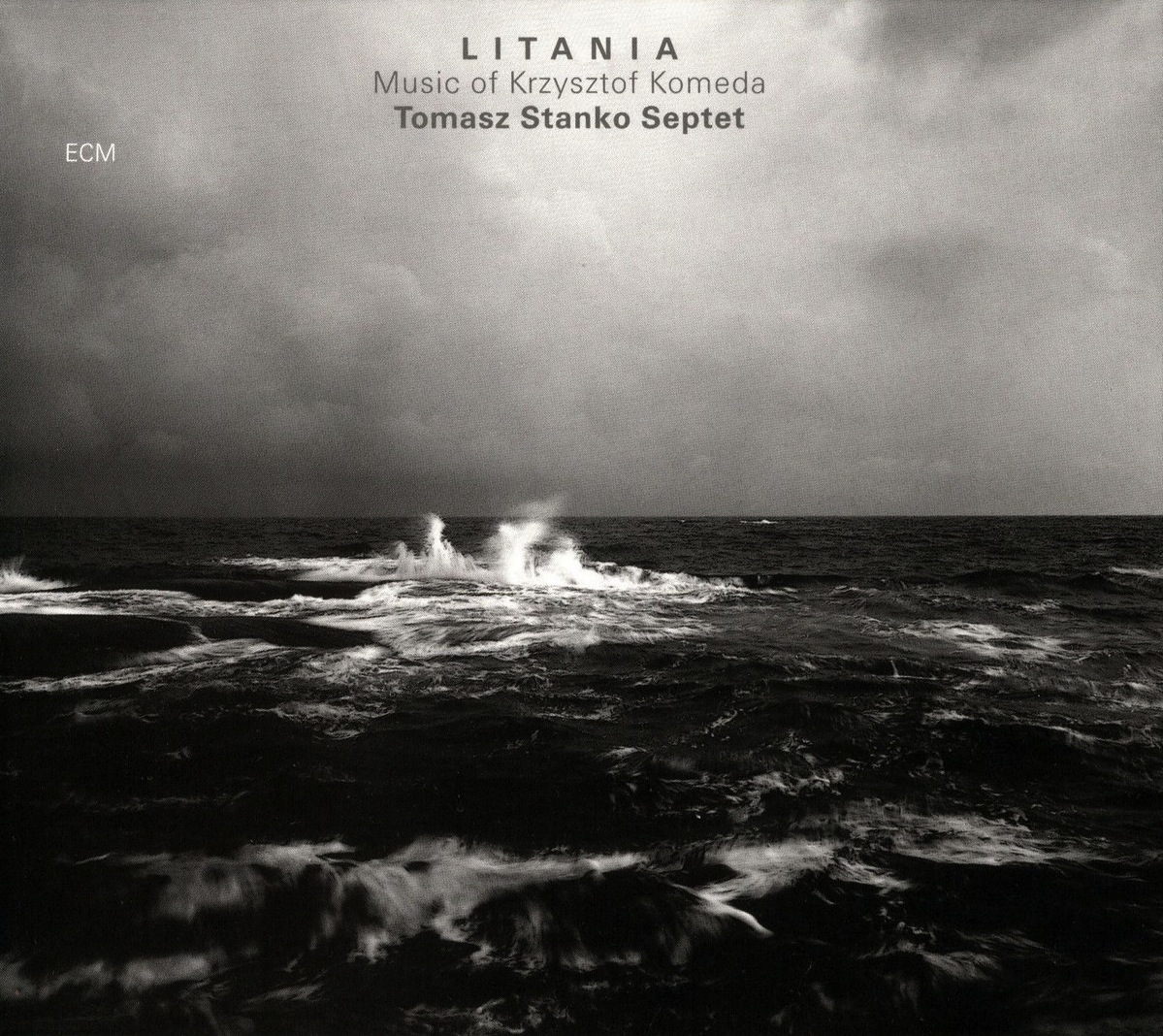
Tomasz Stanko: Litania (ECM 1636)

Litania

Tomasz Stanko
Litania – Music of Krzysztof Komeda

Tomasz Stanko trumpet
Bernt Rosengren tenor saxophone
Joakim Milder tenor and soprano saxophones
Terje Rypdal electric guitar
Bobo Stenson piano
Palle Danielsson double-bass
Jon Christensen drums
Recorded February 1997 at Rainbow Studio, Oslo
Engineer: Jan Erik Kongshaug
Produced by Manfred Eicher

Film composer and jazz pianist Krzysztof Komeda (1931-1969) is the subject of trumpeter Tomasz Stanko’s fourth ECM date as leader, following BalladynaLeosia, and Matka Joanna. The latter’s nod to cinema is further defined on Litania. Best known stateside for his collaborations with Roman Polanski, scoring such classics as Rosemary’s Baby and Knife in the Water, Komeda was more importantly one of the great pioneers of Polish jazz. Developing his music at a time when the Communist government condemned such “bourgeois” activity, Komeda—incidentally, a protective stage name—brought his fascinations into reality with the Komeda Sextet, whose performances paved the way for modern jazz in Poland and soon caught the attention of filmmakers. The festival circuit, however, was where his ideas truly fomented—so much so that a young Stanko would form the Komeda Quartet with saxophonist Zbigniew Namysłowski, bassist Roman Dyląg, and percussionist Rune Carlsson, each of whom took Komeda’s inspiration duly to heart. Before that, however, Stanko would collaborate with Komeda himself for the 1965 album Astigmatic, considered one of the most important in European jazz history. This record seeks to revive the Komeda of apartment jams and night club gigs, the Komeda who set the hearts of Stanko and so many of his generation aflame with a love of free expression, the Komeda both on and off the silver screen.

The Litania project is the result of producer Manfred Eicher’s abiding interest in music-cinema connections more broadly, in Komeda’s sound-world more specifically, and in seeing it realized by the composer’s closest musical associate. The fit couldn’t be better, as Komeda was one similarly interested in expanding the sound of jazz in ways typically reserved for classical music and its instruments.

His compositions have the distinct quality of retaining a somber edge at their most upbeat and a sparkling hope at their most ponderous. Case in point: the heavy yet pliant theme of “Svantetic,” (dedicated to Svante Foerster, friend and Swedish poet) which opens the program with a flirtatious eye. The group’s legato nodes of thought speak through some healthy soloing on keys (Bobo Stenson) and tenors (Bernt Rosengren and Joakim Milder). An intimate drum solo from Jon Christensen engenders squealing final words from Stanko, who leads the band to a brighter, more tumultuous sea and establishes a palette for all to follow. After a viscous intro, “Night-Time, Daytime Requiem” (dedicated to John Coltrane) floats the piano down a river of its own resonance. Horns and drums to take up the call, wavering with dark urban energy before opening into a tenor solo that flicks like a lighter, a flint to stone. Notable here is the interaction between Stenson and bassist Palle Danielsson, their hearts aflutter with the dedication of their charge, if not the charge of their dedication. The album’s most cinematic moments come from Stenson, especially in the latter half of this epic track, dark and roiling yet somehow captured in stasis like the cover photograph. Stanko’s pointillist exchange with tenor foils a peaceful, ruminative finish. The breezy rhythm section of “Ballada” (Knife in the Water) makes for another memorable Stanko vehicle, while the title track, its edges tinted like the pages of a well-read book, features more powerful understatements from both tenors. But Stenson’s waves just keep returning and his breakers of “Repetition” dissolve on shores of stagnant memories, given voice through wind and reed. With Charles Lloyd-esque contemplation, “Ballad for Bernt” carries its melodies across fuzzy dreams and even fuzzier borders of intimation. This tune is dedicated to Bernt Rosengren, a pivotal figure in Sweden, where he and Don Cherry invigorated the local jazz scene.

Although the album header says “Tomasz Stanko Septet,” this is in fact a sextet album, with guitarist Terje Rypdal guesting only on the last two tracks. That being said, he adds a mosaic of haunt to “The Witch,” which begins like a Jan Garbarek excursion before Rypdal drizzles his electric in reams of sparkling shadow. He adds dedicatory color also to “Sleep Safe And Warm” (Rosemary’s Baby), the last of three versions that anchor these waters.

Stanko enters these waters not like a diver, but rather like a crocodile, sinking unawares and peeking above the surface only when necessary. Unblinking, alive, and considered, his heartfelt arrangements ensure that the Komeda legacy breathes afresh. The result is muscular jazz with a crystal-clear sense of direction. It knows exactly where it’s going, because it’s already been there. Says Stanko of Komeda, “He showed me how simplicity is vital, how to play the essential. He showed different approaches, using different harmonies, asymmetry, many details. I was very lucky that I started out with him. Would he have approved of this record? I hope so.”

As you will know once you listen to it, no hope is needed.

<< Charles Lloyd: Canto (ECM 1635)
>> Jack DeJohnette: Oneness (ECM 1637
)

Arild Andersen: Hyperborean (ECM 1631)

Hyperborean

Arild Andersen
Hyperborean

Tore Brunborg soprano and tenor saxophones
Bendik Hofseth tenor saxophone
Kenneth Knudsen keyboards
Arild Andersen double-bass
Paolo Vinaccia drums, percussion
Cikada String Quartet
Odd Hannisdal violin
Henrik Hannisdal violin
Marek Konstantynowicz viola
Morten Hannisdal cello
Recorded December 1996 at Rainbow Studio, Oslo
Engineer: Jan Erik Kongshaug
Produced by Manfred Eicher

“What was I to do when I saw him soar through the air in broad daylight and walk on water and go through fire slowly in foot?”
–Cleodemus

If you think the title of Hyperborean sounds enchanting, wait until you hear the music. Arild Andersen’s evocation of the Greek mythological race plies the shimmering backdrop from which its thread comes unraveling and weaves an entirely new one in its place. Like the chariot of Apollo, who rides to the north three months out of the year to join the Hyperboreans, it marks the sky with seasonal precision. Such is the backstory of this 1995 Norwegian Molde Festival commission, which sought a large-scale suite from the bassist. Andersen took the opportunity to expand his sound, writing for string quartet for the first time. After the success of the concert, Andersen returned to the material and appended “Patch Of Light,” which introduces the album. Andersen: “In general, the role of the strings in the music was strengthened and improved by Manfred Eicher’s input. He had a lot to add in terms of phrasing, dynamics and emphasis, and in the relationship of the string writing to the jazz improvising in the mix.” Eicher’s fingerprints are apparent every step of the way and represent a particularly successful marriage of engineering, behind-the-scenes thought, and performance. He also brought in the Cikada String Quartet for the first of many label collaborations. Saxophonists Tore Brunborg (longtime member of Andersen’s Masqualero outfit) and Bendik Hofseth (who appeared on his earlier Sagn) make for an organic counterpoint of styles. Italian-born but Oslo-based drummer Paolo Vinaccia, who replaced Nana Vasconcelos in Andersen’s “folk” group in 1993, has also made notable appearances on Terje Rypdal’s Q.E.D. and Skywards. Danish pianist Kenneth Knudsen is a longtime friend of Andersen and draws on his background both with Miles Davis and Palle Mikkelborg.

“Patch Of Light” is indeed a thread, a hand-span of strings that exposes its core as would a Gavin Bryars chamber work. Welcoming the night as if it were its own body, it sheds starlight in place of skin. So it is with the title track, which draws finer alloys from these beginnings and holds them like tuning forks to Andersen’s bass, which though contemplative brings meteoric streaks of implicit fervor. Meanwhile, Vinaccia’s delicate patter is the tick of a train whose tracks are laid by the art of soliloquy. And just when you think this landscape might not be populated, in strides “Duke Vinaccia” with saxophonic servants in tow. The heights are stratospheric, yet we feel them in the gut, hanging from the jungle gyms of our rib cages like children. Pianistic echoes from Knudsen, microtonal and gentle, blow off the foam of life’s new quaff before sipping the ale beneath. “Infinite Distance” is a more upbeat affair, delightfully syncopated and brimming with soul from tenor, a robust link in a minimal chain of solos. “Vanishing Waltz” evokes a fadeout into the distance, as if it were the train of the Duke’s procession, a band of merry subjects floating into the sunset. The plush beginnings of “The Island” cradle a heavy tenderness from Andersen, whose instrument has by now become a cognizant body. Trembling and untouched, it bids us to listen to its “Invisible Sideman,” to see things through a translucent veil in the window, billowing to the rhythm of dreams. “Rambler” is Hofseth’s purview. Quivering with lovely agitation and tunefulness (one may feel tempted to compare him to Garbarek, but we find here a more restless brilliance), it dances among Vinaccia’s pincushioned plains. These curves continue their journey in “Dragon Dance” and on through to “Stillness,” where we get the album’s most soulful saxophonism. Last is the heartfelt “Too Late For A Picture,” a forlorn and credit sequence, an epilogue for the ends of the earth.

The strings are our ever-present reminder of peace, rungs on a ladder of light that must be scaled and descended simultaneously to reach any sort of destination. The prevalence of space and “unbeing” names Hyperborean as an intangible reality where perhaps all music begins and ends. Like a jellyfish, it needs ocean to express its proper shape. And what better place to swim than in our hearts?

(Incidentally, since making this record, Andersen formed a trio with Brunborg and Vinaccia improvising on this album’s material. You can see my review of the latest incarnation of that trio, with Tommy Smith in place of Brunborg, here.)

<< Brahms: Sonatas for Viola and Piano (ECM 1630 NS)
>> Stephan Micus: The Garden Of Mirrors (ECM 1632
)

Julia Hülsmann Trio: Imprint (ECM 2177)

Imprint

Julia Hülsmann Trio
Imprint

Julia Hülsmann piano
Marc Muellbauer double-bass
Heinrich Köbberling drums
Recorded March 2010 at Rainbow Studio, Oslo
Engineer: Peer Espen Ursfjord
Produced by Manfred Eicher

For its sophomore ECM outing, the Julia Hülsmann Trio looks deeper into the mirror. The eponymous pianist dovetails with bassist Marc Muellbauer and drummer Heinrich Köbberling for a set of 12 introspective, but never indifferent, tunes. Hülsmann’s past experience with vocalists shows in her composing, as well as in the restraint (engendered by producer Manfred Eicher’s presence) to let lines sing in the absence of extraneous color. Her “Rond point” introduces the lush sound-world before us with a pianism that is gently insistent and provides a soothing sky for some early bass flights. The forested tenderness thereof primes us for the powerful considerations of “Grand Canyon,” which features some of Köbberling’s finest drumming early on in the set. Yet just when we think we’ve found our hook, the attractive spin between Hülsmann and Muellbauer hooks us back. Hülsmann’s stony chords etch a river’s path through eons of thematic searching, settling on an almost prayerful style. Such gives-and-takes characterize a session brimming with sense and unanimity (though nowhere more so than in “Juni”). Even the playful dissonances of “A Light Left On,” coming together and apart like shadows in drawn window shades, feel plush with logic in the wake of their unexpected ending. And while Hülsmann’s blossoms of creativity are bright in “Lulu’s Paradise,” a veritable children’s illustration come to life, it is her Thelonious Monk tribute, “Who’s Next,” that expresses her intuition for thematic mazes to the utmost: the start is also the finish. Another highlight from her pen is “(Go And Open) The Door.” Glowing like embers in a fireplace whose name is youth, it whispers hints of “Frère Jacques” over the music’s surface. With an undeniably oceanic energy, it crashes over shoreline rocks, leaving Muellbauer’s loveliest solo of the set in full lighthouse view before transitioning seamlessly into another from Hülsmann, who stokes the band’s locomotive furnace to heightened momentum. Even at such relative peaks of focus, the trio maintains such depth of control that the full landscape never once fades from view.

JHT
(Photo by Volker Beushausen)

Whether or not because of his history with the instrument, Eicher has culled an especially skillful roster of bassists over the years, to which we can emphatically add Muellbauer. While I hesitate to pick a star out of such a democratically arranged date, it is he who shines with the most varicolored light. Aside from the fluid soloing referenced above, he contributes two originals, of which “Ritual” is the album’s smoothest. It is a masterful track on all counts, and one that would fit hand-to-glove into any Bobo Stenson Trio record. Hülsmann’s gorgeous grounding and engagingly jagged paths make this the standout of the album. Köbberling also offers two of his own, contrasting the heartfelt “Storm In A Teacup” with the porous renderings of “Zahlen bitte,” filled gap for gap by Hülsmann’s unerring ear.

The set is rounded out by an Austrian-German show tune entitled “Kauf dir einen bunten Luftballon.” This 1940s ditty piles on the nostalgia tenfold, wafting through the years like mist after rain. Its abbreviated denouement speaks to the ephemeral nature of life—a subtle and perhaps intended theme, as the song was a favorite of Hülsmann’s late mother. The crystalline recording, courtesy of engineer Peer Espen Ursfjord (whose attention to detail also gives Purcor is breathy edge), allows everything from the brush of dampers on strings to the shifting of the very air to resonate with purpose.

One can interpret the title of Imprint in a variety of ways, but I choose to see it in the psychological sense, whereby living organisms are shaped and influenced by their environment and interactions with others: a fitting analogy for the fulfillment of the piano trio as an emblematic combination of the genre, and for the label that has boiled it down to a science.

(To hear samples of Imprint, click here.)

Enrico Rava: On the Dance Floor (ECM 2293)

On the Dance Floor

Enrico Rava
Parco della Musica Jazz Lab
On the Dance Floor

Enrico Rava trumpet
Andrea Tofanelli trumpet, flugelhorn
Claudio Corvini trumpet, flugelhorn
Mauro Ottolini trombone, tuba
Daniele Tittarelli alto saxophone, flute
Dan Kinzelman tenor saxophone, clarinet, bass clarinet
Franz Bazzani keyboard
Giovanni Guidi piano, Fender Rhodes, toy piano
Dario Deidda bass
Marcello Giannini electric guitar
Zeno de Rossi drums
Ernesto Lopez Maturell percussion
Recorded live 20 May and 30 November 2011 at Auditorium Parco della Musica, Rome by Massimiliano Cervini and Roberto Lioli, respectively
Mixed by Stefano Amerio, Enrico Rava, Mauro Ottolini, and Manfred Eicher
Produced by Manfred Eicher

The story of On the Dance Floor is destined to be a highlight of ECM apocrypha. Following the extensive media coverage of Michael Jackson’s death in 2009, Enrico Rava immersed himself in the King of Pop’s unparalleled songbook. “It became clear to me that for years I had ignored one of the great protagonists of 20th-century music and dance,” says the Italian jazz trumpeter. “A total artist, a perfectionist, a genius.” Going against the grain of mainstream opinion, he discovered an affinity for the relatively recent albums, notably HIStory (1995) and Invincible (2001). All of which makes this set of whimsical arrangements by Mauro Ottolini that much more heartfelt for being rough around the edges and, at times, obscurely chosen. Gone are the autotuned drones of studio-only memorials. In their place is an incendiary performance, recorded live at Rome’s Auditorium Parco della Musica, from which Rava’s backing band gets its name. And in this respect we have something more than a tribute. Indeed, it is a cannonball dive into the popular pool.

Rava“I felt the necessity to delve deeper into Jackson’s music
by adding something of myself to it.”

There is a telling sequence in Spike Lee’s 2012 documentary, Bad 25, during which one interviewee after another is moved to wordless tears when asked about MJ’s sudden passing. It is this poignancy, this inability to express an overwhelming sadness, that keys us into the importance of one man’s contributions to musical art. In light of this, what better way to begin the Rava program than with “Speechless”? The almost funereal piano intro would seem to indicate as much and gives us some moments to reflect on the legacy we are about to encounter, albeit in big band form. Somber horns weave a floating pyre, from which Rava sounds his dedication, accompanied only by harp before Dario Deidda’s bass draws a pliant line of tenderness. Gorgeous, breathy alto work from Daniele Tittarelli forms the lifeblood of a song that in its original form begins and ends with MJ alone:

Your love is magical, that’s how I feel
But I have not the words here to explain
Gone is the grace for expressions of passion
But there are worlds and worlds of ways to explain

Ottolini’s present version dutifully preserves these bookends, only now as a web of brass. This is followed by a sparkling rendition of “They Don’t Care About Us” (also off HIStory), which begins like an Art Ensemble of Chicago excursion before sliding into the Double Dutch chants that so distinctly mark the original. It brings a range of sounds to fruition, from an airy, orchestral sensibility via synth strings (which allude briefly to “Who Is It” from 1991’s Dangerous, otherwise unrepresented) to Dan Kinzelman’s spate of enraptured tenor discourse, and all of it threaded by Rava’s triumphant charge in a steep of delightful Reggae flavor.

From an icily evocative opening, “Privacy” (Invincible) launches into a potent chord progression that recalls Nine Inch Nails’ “Closer” and flows with a swanky grittiness around a thread of electric guitar. The latter provides pulse and vocality to “Blood On The Dance Floor,” from the eponymous 1997 remix album. Yet here is where the project begins to reveal its true character in the lightness of approach, which at moments detracts from the feelings with which seasoned fans will be readily familiar. The rather straight-laced syncopations also eject a few nuances from the original song. Another curious thing happens with “Little Susie,” which, to one who doesn’t know the original, might seem a slow but nevertheless swinging tune, all the while missing out on both its lyrical power and controversial artist Gottfried Helnwein’s accompanying image in the HIStory CD booklet:

Little Susie

Somebody killed little Susie
The girl with the tune
Who sings in the daytime at noon
She was there screaming
Beating her voice in her doom
But nobody came to her soon…

Hints of this tragedy remain in the music box intro before giving way to Rava’s caramel tone, which unleashes washes of sepia and bleeding watercolor. Despite the gothic waltz-like qualities and sensitive subject matter, it breathes here with a far more positive life. Its pairing with “Blood On The Dance Floor” is a clever one, for both feature a Susie as protagonist. In one, she is victim; in the other, she is predator. The obligatory nod to “Thriller” suffers from a similar lack of context, while also acting as a prime vehicle for Rava’s superbly considered acrobatics. The fluidity of his virtuosity—at age 72, no less—is a wonder to behold, as is the trombone solo from the arranger himself. And one can’t help but revel in the free-for-all that erupts before the fanfare.

A surprising turn comes in Deidda’s solo bass rendition of “I Just Can’t Stop Loving You.” This intimate yet playfully inflected look at a classic tune from 1987’s Bad is remarkable, if abbreviated (it elides the middle 8), and paves the on-ramp to a rollicking “Smooth Criminal.” As the song that finally won Rava over to the MJ ethos, it delivers vitality in the soloing, yet one is hard-pressed to explain the blatant note change in the chorus. “History” provides a fitting summation, leaving us with a pleasant aftertaste as we go our separate ways to the tune of Rava’s impassioned extroversion.

Nestled among all of these is his favorite: the Charlie Chaplin-esque “Smile,” which finds the trumpeter at peak soul. One can almost feel the grain of black and white, its old-time charm lifting from the screen in a nostalgic dance. This tune works best of all, if only because it and its source pay homage to something that is beyond them both.

Although I grew up with Thriller in my veins, I concede to Rava insofar as MJ’s later work is far better than it is often made out to be. That being said, it is difficult to oust Bad from the throne it occupies in my listening heart. For lifelong fans like myself, Rava’s redux requires a few spins in order to take the album on its own terms, if only because the originals are so ingrained into our very DNA through years, and countless more to come, of experiential listening. Here one must encounter them anew.

It’s easy for us to talk about artists who lived long ago as if they were somehow among us. And yet, how do we evoke an artist whose absence is still fresh, whose life and work continues to intersect with so many millions of others? With all the MJ tribute albums already out there and those sure to come, drawing compilations of his preexisting or unfinished work, this one takes a newfound love for what drove him and turns it into something passionate and fun.

In the end, On the Dance Floor lacks the voice. By this I mean not only MJ’s phenomenal pipes, but also the words behind them. What distinguishes his later work is its mounting critique against an unforgiving media that searched for every possible opportunity to lambaste one of the most important artists of our time, as well as a more daring interest and insight into the darker corners of the human psyche (“Little Susie” being a prime example). By the same token, in spite of the many tributes which, ethically or not, have capitalized on his passing, here we have something joyous, uplifting, affirmative.

One can therefore see these as translations of a vibrant canon. Like translations, they are enjoyable enough on their own terms, yet how fortunate that the originals are accessible beyond all language barriers, for MJ will forever be a language unto himself.

(To hear samples of On the Dance Floor, click here.)

MJ
R.I.P. (1958-2009)

Christian Wallumrød Trio: No Birch (ECM 1628)

No Birch

Christian Wallumrød Trio
No Birch

Christian Wallumrød piano
Arve Henriksen trumpet
Hans-Kristian Kjos Sørensen percussion
Recorded November 1996 at Rainbow Studio, Oslo
Engineer: Jan Erik Kongshaug
Produced by Manfred Eicher

Of course it hurts when buds burst.
Otherwise why would spring hesitate?
–Karin Boye (trans. Jenny Nunn)

Pianist Christian Wallumrød makes his ECM debut with No Birch, an album of uncompromising melodic integrity and further proof that ECM’s mining of Nordic jazz ore continues to yield sonic jewelry like no other. The press release places the album somewhere between Morton Feldman minimalism and Paul Bley free play, and certainly we can feel a likeminded appreciation for negative space throughout. Yet beyond this lies an active, fluttering heart that is so full of expressivity that it must pace itself in lieu of bursting.

Wallumrød

Wallumrød is the youngest member of the group. From humble beginnings playing piano accompaniment at church (hence the reflective track “Before Church”) to intensive studies at Norway’s famous Trondheim Conservatory, where he developed an abiding interest in composition, he has found under producer Manfred Eicher’s purview the appropriate balance of space and atmosphere to open his emotional floodgates.

Henriksen

Freelance trumpeter Arve Henriksen has collaborated with a number of ECM stalwarts, including Jon Balke, Anders Jormin, and the great Misha Alperin, the latter of whom remains a touchstone of inspiration for this trio.

Sørensen

Take special note that Hans-Kristian Kjos Sørensen is credited as percussionist and not drummer, and you begin to imagine the group’s flavors before note one. Conservatory trained and much sought-after in contemporary jazz and classical scenes, he adds the subtlest edge, his palette elemental in the truest sense.

As a unit, these three friends have been playing since 1996, but what we hear in “She Passes The House Of Her Grandmother” implies generations of affect. Touching its feet to tundra soil as if it were the sun, it is the breath of blood and memory made manifest in the here and now. The unspoken becomes the flower of reality, plucked from the “Royal Garden.” This solo from Sørensen unravels a single cathartic and metallic cry, bowed at the edge of sibilance and time and carried across a landscape that was once pasture, since bordered and named under the banner of rule. It is the pulse of the soil, given light above ground in “Somewhere East,” a representative track that describes its directions only so that we might be aware of the center from which our perspective is realized. So locating us in the moment’s energy, the music sways, rooted. Next is “Travelling” in three parts, and which features some of the most delicate trumpet playing I’ve heard in a long while. Breathy, almost shakuhachi-like, it curls its fingers one at a time around a full glass, which is then tipped and spilled through the veins of “Ballimaran” and “Watering.” In the wake of these flowing sketches, the halting pianism of “Two Waltzing, One Square And Then” and “Fooling Around” cleanses the palette before “The Gardener,” the most somber of the set, refills with bittersweet aperitif.

Wallumrød’s “The Birch” is the album’s red thread, a four-tiered refrain that wipes its theme with the nostalgia of a hand across a foggy window. Tender and seasonally inflected, it brings liturgical wonder to the trio’s sanctity, as deferential as the day is long.

<< Crispell/Peacock/Motian: Nothing ever was, anyway (ECM 1626/27)
>> Rosamunde Quartett: Webern/Shostakovich/Burian (ECM 1629 NS
)

Giya Kancheli: Themes from the Songbook (ECM 2188)

Themes

Giya Kancheli
Themes from the Songbook

Dino Saluzzi bandoneón
Gidon Kremer violin
Andrei Pushkarev vibraphone
Recorded and mixed May 2010 at Rainbow Studio, Oslo
Engineer: Jan Erik Kongshaug
Additional recordings at Latvijas Radio, Riga
Engineer: Varis Kurmins
Final editing, mastering at MSM Studios by Christoph Stickel and Manfred Eicher
Produced by Manfred Eicher

Giya Kancheli’s first album for ECM’s flagship label is a major event. The Georgian composer will be more than familiar to New Series aficionados, who’ve had ample opportunity to acquaint themselves with his uncompromising sonorities, rich dynamic spreads, and recurring themes. Yet few of us will ever have known that he also developed a sideline—as did other (former) Soviet Bloc composers like Dmitri Shostakovich and Arvo Pärt, though none so prolifically—as scorer for theatre and cinema. One can see hear album as companion to the 2009 publication of Kancheli’s Simple Music for Piano: 33 Miniatures for Stage and Screen. The subtitle betrays little depth of his subsidy, which exceeds 100 unique productions. Although Kancheli humbly says in his preface of these songs, “Time will tell if they can survive outside their original context,” it is clear from this album that they already have. Their realization brings together an intimate cast, with producer Manfred Eicher as director. Bandoneón master Dino Saluzzi, violinist Gidon Kremer, and vibraphonist Andrei Pushkarev indeed move as if from behind a curtain, if not in front of a lens, bringing their sharp wit and live “editing” skills to an immediate yet highly polished sound-world. The inclusion of Pushkarev was a masterstroke, and his willingness to explore these themes is reflected in his collaborations with Saluzzi and Kremer in kind. Having recorded Themes as a surprise 75th birthday gift at Eicher’s suggestion, they bring lovingness to every motive and thus emphasize the preservation that flows by and within the art they share. And on that note, we have to thank, as does Kancheli’s son Sandro in his heartfelt liner notes, ECM for championing this music and its aftereffects, as might a cartographer love the land.

“Herio Bichebo” from Earth, This Is Your Son (1980, dir. Revaz Chkheidze) establishes a defining combination of vibraphone and bandoneón. The feeling is inevitably watery, its passage a boat adrift toward a mountain rife with ancestral longings. This atmosphere also sets the tone for the program’s careful use of pauses and suspensions. There is a forlorn quality, if not a sweet tenderness, to this introduction, wherein lurks the elegiac wave of Bear’s Kiss (2002, dir. Sergei Bodrov) and the grinding lows of When Almonds Blossomed (1972, dir. Lana Gogoberidze). Other cinematic highlights include the themes from Don Quixote (1988, dir. Chkheidze), which features an overdubbed Kremer and at once expresses the story’s inherent sadness and innocence, and the nostalgic disclosure of Mimino (1977, dir. Danelia and Gadriadze), for which Kremer joins Pushkarev. The latter draws out some of the deepest emotion in the main theme from Kin-Dza-Dza (1986, dir. Georgi Danelia and Revaz Gadriadze), shuffling characteristically Kanchelian bursts of exaltation into somber tiers.

All seven plays represented on Themes rose out of collaboration with renowned Georgian theatre director Robert Sturua, whose musicality marries well with Kancheli’s dramaturgy. The main theme from The Crucible (1965, play by Arthur Miller) marks Kremer’s first album entrance, his raspy bowing complementing the click of bandoneón keys to delectable effect. Saluzzi and Pushkarev reprise their chemistry in a carefree rendition of The Role for a Beginner (1979, play by Tamaz Chiladze), I daresay reaching subtle genius in As You Like It (1978). Memorable enough to be a jazz standard, it is a ballad that looks backward and forward as it spins in place to the rhythm of its heartbeat. And in fact, Shakespeare provides some of the deepest inspiration of the program, as in Saluzzi’s shadowy Hamlet (1992) and Pushkarev’s dynamic Twelfth Night (2001), which illustrates its story in flashes of light.

Jansug Khakidze, the late singer/conductor who was one of the composer’s closest friends, leads the Tbilisi Symphony Orchestra in an archival encore. His “Herio Bichebo,” warmly engineered by Mikhail Kilosanidze, is so iconic that many believed him to have written it. Listening to it here, one can understand why. Jan Garbarek fans will recognize his inimitable voice as the same behind “The Moon Over Mtatsminda” on 1998’s RITES.

Interestingly enough, Kancheli’s pieces for the stage sound the most cinematic, and vice versa. Together they comprise a daydream paginated and bound for travel. It is sure to please Kancheli veterans and newcomers alike, and will, I hope, inspire the latter to explore further.

Craig Taborn: Avenging Angel (ECM 2207)

Avenging Angel

Craig Taborn
Avenging Angel

Craig Taborn piano
Recorded July 2010, Auditorio Radiotelevisione Svizzera, Lugano
Engineer: Stefano Amerio
Produced by Manfred Eicher

Avenging Angel marks Craig Taborn’s solo debut, this after a string of fine appearances on joints with Roscoe Mitchell, Evan Parker, Michael Formanek, and David Torn. Being an ardent Bill Laswell fan, however, my first encounter with the Minneapolis-born keyboardist came by way of his smooth electric piano stylings on Dub Chamber 3 (released 2000 on ROIR). Incidentally, that classic underground session also featured future ECM label mate Nils Petter Molvær on trumpet—perhaps a sign of things to come. The present album finds Taborn concentrating, as he has been in recent years, on the art of unaccompanied improvisation. The formula will sound familiar to anyone who has picked up a Keith Jarrett record in the last three decades, but the results, while likeminded, are starkly Taborn’s own. For whereas it is easy to read transcendence into Jarrett’s epic exegeses, Taborn wants us to dive into his instrument and nest in it for awhile. In his words, “This music is not about ‘transcending the piano’ as much as it is about working with what is possible within it.” Thus taking the dynamics of physical means, environment, and atmospheric context into account, he crafts a sound that appears structured yet which allows centuries of air to flow through its architecture.

Taborn
(Photo source: flickriver)

Like a tap on the shoulder from a shaded past, “The Broad Day King” introduces us to a watercolor-bleed of feeling. The effect is skeletal and tented by fingers of dawn. We can guess said king’s name. The music might even tell us. But ultimately his identity can be written only by hammers and strings, his reign as fragile as their tuning. If such titles mean anything to us, it is only because the Escherian landscape in which they are situated is so faithfully rendered. In the spontaneity of creation, Taborn locks us into the spirit not only of the elusive moment, but also of the many directions its ancestors have traveled to get here. We hear this in the sparkling eddies of “Glossolalia” and “Neverland,” and in child-like wonder of “Diamond Turning Dream,” which spins a bracelet of the former’s starlight.

This album is yet another benchmark for engineer Stefano Amerio, who posits Taborn’s intimate storytelling in a reverberant universe. The touch is just enough to spin an expansive backdrop while keeping the foreground crystal clear. This is truest in the title track, which dances uncannily at the edge of our firelight, and in “This Voice Says So.” The latter plays like a lullaby stretched into the slumbering pathos it inspires, making for one of the most beautiful tracks in ECM history. It is the illusion of stillness magnified, a glassine reflection, and all the deeper for its minimalism. And though Taborn does stir up the sediment, he is careful to end on the same delicacy with which the piece begins, ever attentive to the space(s) he inhabits. “True Life Near” is an example of the pianist’s uncanny ability to elicit tenderness from the often-sharp attack of his right hand. If any Jarrett parallels must be drawn, let them find purchase on this morsel of cinematic wonder. “Gift Horse / Over The Water” is a jauntier diptych with tight, 90-degree syncopations, and detailed riffs over a head-nodding ostinato. Its mechanical aspirations are more fully realized in “A Difficult Thing Said Simply,” while the bubbling “Spirit Hard Knock” exploits even more the capabilities of the studio’s Steinway D in epic waves. “Neither-Nor” is, as its title would seem to imply, the most “grammatical” of the set and has the quality of rainfall. Another highlight is “Forgetful,” a lost jazz standard trickling in from the other side of a dream, and which takes on some of the grandeur of that dream in its mellifluous resolution. “This Is How You Disappear” is a clever way to both say and realize fadeout. Drawing the curtain one fold at a time, until all that remains is the cover photograph’s sliver of backstage light, Taborn sets off a tender fuse with his finger roll, even as stars crash earthward, leaving only splashes of faraway nebulae to show for their sacrifice.

No matter how out of focus these images become, you can always count on Taborn to leave at least one focal point crisp. The focal point is paramount, for it invites us not only to listen but also to become. It is our hovel of transformation. As to what the listener might turn into, that’s as unpredictable as the paths his fingers take. If this angel avenges anything, it is the bane of expectation.

(To hear samples of Avenging Angel, click here.)

Charles Lloyd/Maria Farantouri: Athens Concert (ECM 2205/06)

Athens Concert

Charles Lloyd
Maria Farantouri
Athens Concert

Charles Lloyd tenor saxophone, flute, tárogató
Maria Farantouri voice
Jason Moran piano
Reuben Rogers double-bass
Eric Harland drums
Socratis Sinopoulos lyra
Takis Farazis piano
Recorded in concert June 2010 at Herod Atticus Odeon, Athens
Recording engineer: Nikos Espialidis
Assistant engineer: Kostas Kyriakidis
Equipment by Logothetis Music
Mixed by Manfred Eicher and Jan Erik Kongshaug at Rainbow Studio, Oslo
Produced by Manfred Eicher and Dorothy Darr

Where are we
that the wind won’t blow?

“The human voice can capture the heart more swiftly and directly than any other instrument,” writes Charles Lloyd in the liner notes for Athens Concert, an historic live event given the permanence it more than deserves through this landmark recording. Lloyd goes on to relate how, as a child growing up in Memphis, he would fall asleep to the sound of Billy Holiday’s voice from the radio under his pillow, and how years later that same magic revealed itself in contralto Maria Farantouri (Greece’s Edith Piaf, if you will), who he later befriended and who introduced him to the songs of Mikis Theodorakis after he’d invited her to sing one of his own. Farantouri’s heart is ancient, and her desire to introduce Lloyd to her culture is manifest in the depth of his playing. She characterizes the tenor master as “a shaman of jazz who dominates the stage with the power of the mystic and the innocence of a child. The sound of his music can have the weight of a stone or the lightness of the air. With his improvisations he weaves an imaginary but so familiar world, a mirage constantly disintegrating and reforming.” We might say, then, that Lloyd is a singer, channeling his breath through a weathered metallic throat and bidding the very stars to dance. The bridging of these two worlds spawns a third, one where voices of time sing like parents to a child.

And what is “Kratissa ti zoi mou” (I Kept Hold of My Life), which opens the program, if not a voice churning in the tide of darkness from which we all are born? George Seferis’s words (from the poem, “Epiphany, 1937”) blossom from an unmistakable tenor branch, smooth yet weighted as if by the buckshot of self-awareness and sliding like honey down an enviable backdrop: Jason Moran on piano, Reuben Rogers on bass, and Eric Harland on drums. Curtains part to reveal Farantouri’s husky swirls. Moran elicits sweet noise, mixing Ketil Bjørnstad-like textures with idiosyncratic spectral twists. An emblematic introduction into this forested sound-world, it is the concert’s Rosetta Stone. Lloyd’s classic “Dream Weaver” continues in the same flowing vein, his remarkably sunlit reed gathering enough thread to make even the most sedentary marionette nod in a groovy and somehow freer turn. Harland is also notable here, buoying a rich solo from Moran, who maintains epic contrast between the left and right hands throughout. Lloyd brings a classic edge to the denouement, further picked up by Rogers with intimacy. Our bandleader continues to regale us with his storytelling in “Blow Wind.” The original song finds Farantouri channeling Sheila Jordan, the lyrical star to an instrumental sky. Her voice indeed blows off into the distance, leaving Lloyd to shape those tendrils of dust left in her wake before she returns to stir them anew. Lloyd also pens “Prayer,” which features still more wonders from Moran. Farantouri’s full-throated, wordless song emerges from the bass, reedy like the muse that calls to her. A click away finds Lloyd setting words by politicist Agathi Dimitrouka in “Requiem.” A surprisingly buttery song that finds groove in the tragic, in it Farantouri’s tenderness clears the way for Moran’s more diffuse considerations, as microscopic as pollen and just as fragrant. The music of ECM mainstay Eleni Karaindrou also makes an appearance with “Taxidi sta Kythera” (Voyage to Cythera), which against a low and sultry swing allows gorgeous exchanges between the two bill headers, their voices filling the same crucible with variations of the same alloy.

LM 1

Pianist Takis Farazis joins for the performance’s remainder: the three-part Greek Suite, which he also arranged. Part I is the most ancient, shifting the sands with “Hymnos stin Ayia Triada,” an early Byzantine hymn to the Holy Trinity. Interweaving Lloyd’s flute and Farantouri’s flutedness, its song is its vow. “Epano sto xero homa” (In the Dry Soil) and “Messa Stous paradissious kipous” (In the Pradise Gardens) come from The Sun and Time by Theodorakis and as such unearth the greatest strengths of Farantouri’s gifts. Yet it is only when the strains of the lyra, played by Karaindrou regular Socratis Sinopoulos, touch the sky in Part II that the clouds weep rain. Amid its assortment of traditional tunes, “Thalassaki Mou” (My Little Sea) stands out to me. Although quite different from the version I grew up on the timeless Songs of the Earth by The Pennywhistlers, it nevertheless brings its own enchantment and stirs the musicians to invigorating levels. Part III boasts tunes from the Epirus region. Among the more moving are “Epirotiko Meroloi,” a lament of war and death told from a mother’s point of view, so well evoked by Lloyd’s uncanny intro and by the jangling folkways that ensue, and the intuitive digressions of lovesick souls in “Mori kontoula lemonia” (Little Lemon Tree). Harland grabs his fair share of the spotlight in “Alismono kae haeromae” (I Forget and I Am Glad), as does Sinopoulos in “Tou hel’ to kastron” (The Castle of the Sun), a traditional song from the Black Sea that is the band at its most attuned.

The encore also comes from a mother’s lips, as love pours through “Yanni Mou” (My Yanni) with more permanence than the bravery it mourns. The stichomythia between Farantouri and Lloyd discloses an oceanic world where the rhythms of fins and tails are the only music that remains. And if its mournful cast seems a somber note on which to end, it is only because the invigorations leading up to it linger like a childhood that refuses to let go. Such is the power of this music: it is memory incarnate.

(To hear samples of Athens Concert, click here or watch the video below.)

Judith Berkson: Oylam (ECM 2121)

Oylam

Judith Berkson
Oylam

Judith Berkson voice, piano, Wurlitzer and Rhodes pianos, Hammond organ
Recorded April 2009 at Artesuono Studio, Udine
Engineer: Stefano Amerio
Produced by Steve Lake

Oylam marks the ECM debut of singer/composer/keyboardist Judith Berkson. Although the title denotes “world, universe, creation, reality, realm,” the music seems to append the word “inner” to each of these notions. As a cantor and teacher of liturgical music at New York’s Old Westbury Hebrew Congregation, Berkson is rooted in tradition, but also in the atonal composers that moved her in her teens. She also studied theory and composition with Joe Maneri, thus teasing out a label connection through this recording. Her solo work is a more recent development, the fruit of her time spent in various group contexts. Since 2003, she has focused her energies on her own accompaniment: “I’ve been trying to redefine, for myself, what that might mean, exploring new ways in which voice and piano can be combined and performed by one person, working on all the different possibilities of rhythm, melody, harmony, texture and so on.” Berkson employs a modest range of keyboards and effects, lending a distinctly personal cast to this set of mostly originals, with a stroll down Standards Lane for good measure.

Berkson
(Photo by Luca d´Agostino)

The solo piano “Goodbye Friend No.1” sets the tone for a program that is equal parts resignation and resentment, an honest and brooding look at the air of separations that binds us. Such are the ironies we ecnounter. In the insistence of Berkson’s right hand—especially in songs like “Brute” and “Mi Re Do,” where flashes of dissonance and curlicues of loss reside in every unanswered question—turns the tarnished crystal of experience through which not all light may pass. That same right hand also flits in and out of sync with the lead of “Inside Good Times.” Uncanny in its imagery of children, offerings, and vapor, this song is smoothly contradictory, the first in a peppering of aural sticky notes (see “Little Arrows,” “Fallen Innocent Wandering Thieves,” and “Burnt”) filled with poetic shorthand.

The piano more often takes on a vocal role, while the words, expressed through the inadequacies of lips and tongue, are the beggar’s accompaniment. The supposed angst of urban living lays the bedrock of a bond that almost screams: Labels of praise are their own opposites. Between the wordless flexion of “Clives” and the rounded phrasings of “All Of You,” Berkson echoes, not quite morosely, the feeling of that praise on keys. This Cole Porter classic, along with the jazzier “They Can’t Take That Away From Me” of George a& Ira Gershwin, drops like a stone in the liquid of its surroundings. The cantorial “Ahavas Oylam” and “Hulyet, Hulyet” (a Yiddisdh folk song from the Polish-born poet Mordekhai Gebirtig) betray the capacity of Berkson’s chest voice. Whether floating on a warm wave of organ or nestled a cappella, it needs no mirrors to know its expressions. Berkson’s English lyrics to “Der Leiermann” from Franz Schubert’s Winterreise provide a fairytale turned sour by the heat of retelling, superseded only by the touch of “Goodbye Friend No.2,” which brings the album full oval, not to where it started but to where it will speak.

This is certainly an eclectic program, so those on the fence about buying it would so well to sample it first. Oylam fits snugly beside Sidsel Endresen’s So I Write, ever its idiosyncratic sibling. Yet in spite of the lines one might draw from Berkson to such iconoclasts as Lydia Lunch, Diamanda Galas, Maggie Nicols, and even Shelley Hirsch, this is not a game of shadows. It is, rather, a diary that recognizes our mortal limitations.

A perfect one for a rainy day, for it illuminates the rain that drips in all of us.

(To hear samples of Oylam, click here.)