Stephan Micus: Athos (ECM 1551)

Stephan Micus
Athos: A Journey To The Holy Mountain

Stephan Micus Bavarian zither, sattar, shakuhachi, suling, ney, flowerpots, voice
Recorded November 1993–February 1994 at MCM Studios

If true meditation is not a centering but a shedding of the self into a plane where the ego no longer speaks under the illusion of a proper name, then Stephan Micus has walked some of the most meditative paths on disc. Inspired by a visit to the holy Greek mountain of Athos, his album of the same name bears traces of just such a traveler, one whose artistry sees medium and message as one. Those looking for anything close to the Byzantine chant that surely nourished his ears during this pilgrimage may feel disappointed. Then again, the Micus experience has never been about total re-creation, but rather about the ways in which the lens of his soul refracts all it comes in contact with during its itinerancy.

Athos takes a diurnal structure, with days marked by flutes of varying origins and nights woven in 22-part choruses, all sung by a multi-tracked Micus. The latter serve as touchstones in the fullness of his narrative, which takes its histrionic steps in voices mineral, unaffected, spun from the wood, clay, and strings of another time and place. In these drones is where the true indeterminacy of life takes shape, shifting from circle to ellipse and back again like a full moon stared at for too long. “The First Day,” a shakuhachi solo, rests on a sibilant edge and awakens like an animal from winter slumber, even as it cranes its neck, heron-like, back toward memory, now hazed by the passage of the seasons. “The Second Day” hangs a suling (Indonesian bamboo flute) above a garden of flowerpots. And in “The Third Day” Micus offers a ney solo, wavering like a reflection across molten rock and shaped by the lips of a divine glassblower who fashions from it a teardrop in the cosmos, forever crystalline and unshattered. Such music turns the sun inside out and shows us that its heart is nothing but shadow, for otherwise it would never know the generative power of fire.

This cosmic passage is bookended by a prologue and epilogue. “On The Way” pairs cascades of Bavarian zither with the tinny laments of sattar (long-necked bowed instrument of the Uyghur people). In its depths we weep at the fallacy of what we have created, but know that within the distorted memories of those tears lies something far more meaningful: constant change. This and more we hear in these moments, in the total dedication that engenders them. “On The Way Back” pulls those evening voices from the clothing of their afterlife, vibrating like a reed in the core of something devoid of song.

Athos is the diary of a sacred space whose pages are born in the siren that calls everyone into the stillness of eternity. It tugs your heart until it merges with Micus’s own, so attuned is his playing to the spirit of all that moves us to listen. He reaches through the veil of distance holding a broken watch, asking us to breathe time back into its silent circle.

<< hr-Jazzensemble: Atmospheric Conditions Permitting (ECM 1549/50)
>> Heiner Goebbels: Ou bien le débarquement désastreux (ECM 1552)

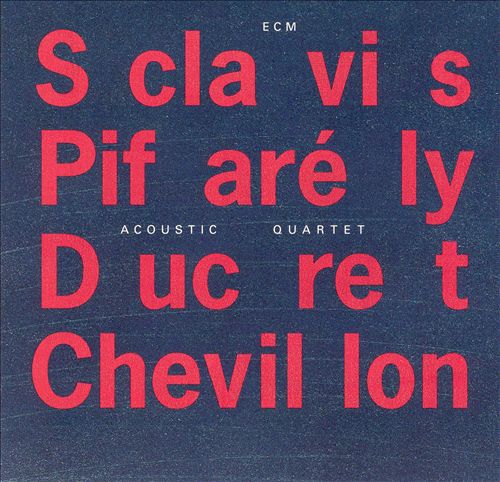
Louis Sclavis/Dominique Pifarély: Acoustic Quartet (ECM 1526)

Louis Sclavis
Dominique Pifarély
Acoustic Quartet

Louis Sclavis clarinet, bass clarinet
Dominique Pifarély violin
Marc Ducret 6- and 12-string guitars
Bruno Chevillon double-bass
Recorded September 1993 at Rainbow Studio, Oslo
Engineer: Jan Erik Kongshaug
Produced by Manfred Eicher

After debuting with his quintet on Rouge, reedist Louis Sclavis returned to ECM with French jazz violin phenom Dominique Pifarély to front this trend-setting session. Joined by guitarist Marc Ducret and bassist Bruno Chevillon, the so-called Acoustic Quartet snaps right into action with “Sensible,” the first of four pieces by Sclavis. It is, like every track that follows, an astute blend of composed and improvisatory elements that pairs instruments cleverly and with panache. Pifarély and Chevillon work particularly well together here, and Ducret’s jangly asides make a nice match for Sclavis’s clarinet. Ducret provides notable glue in “Elke,” in which bass harmonics cut through the darkness like a whale song, and elicits some oud-like tones in the playful “Rhinoceros.”

Pifarély delights with a handful of his own compositions. Of these, the guitar-propelled romp of “Abrupto” speaks loudest. The violinist strings a Christmas tree’s worth of ornaments across its conical surface, practically toppling it into the cutting lead of “Hop!” where he lays out the album’s most astonishing solo against a crunchy bass. Not to be outdone, Sclavis dots his every i and lends brilliant inflection to a substantial monologue in “Seconde.” The group also shines in its cinematic rendition of Alain Gibert’s “Bafouée.” Its nods range from Django Reinhardt to klezmer, each stretched and refracted behind a veil of sparkling melancholy.

Pifarély boggles the mind with his rhythm and slide in a group overflowing with virtuosity. Yet it is Sclavis who seems most comfortable in his skin, weaving in and out of narrow spaces with the grace of an eel. The composed material, while on the surface pedantic, provides a frame to see the fullness of every picture. The resulting Sturm und Drang atmosphere when the musicians discard prewritten material in favor of all-out storytelling makes for some intriguing music-making. All in all, a real gem.

<< Jan Garbarek/The Hilliard Ensemble: Officium (ECM 1525 NS)
>> Steve Tibbetts: The Fall Of Us All (ECM 1527)

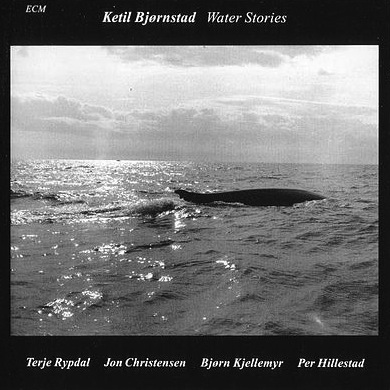
Ketil Bjørnstad: Water Stories (ECM 1503)

Ketil Bjørnstad
Water Stories

Ketil Bjørnstad piano
Terje Rypdal guitar
Bjørn Kjellemyr bass
Jon Christensen drums
Per Hillestad drums
Recorded January 1993 at Rainbow Studio, Oslo
Engineer: Jan Erik Kongshaug
Produced by Manfred Eicher

Ketil Bjørnstad made a splash, if you will, with this, his first of many collaborative projects for ECM. Water Stories puts the Norwegian pianist, composer, and novelist in fine and familiar company, sharing the studio with guitarist Terje Rypdal, drummers Jon Christensen and Per Hillestad, and bassist Bjørn Kjellemyr. Though billed as a jazz album, Water Stories is folk music for the ocean floor. Bjørnstad swishes through his motives with the surrender of a sliver of driftwood on the waves, bowing to his band mates in unobtrusive postures. With the first stirrings of “Glacial Reconstruction,” he thus sets a career-defining formula. Christensen’s unmistakable cymbals brighten in the album’s opener as if from the dark phase of a solar eclipse, stirring where only there was stillness and awe. Christensen again sets the mood in “Levels And Degrees,” now with toms, moving from the sparkle of wave-tips to rumblings from the deep as Bjørnstad and Rypdal paint swaths of marine life in dripping color. From this hails the piano ostinato of “Surface Movements” amid glints and plunks of bass. This bubbling evocation of the album’s namesake is a softly beating heart shrouded in time. “The View I” and “The View II” are astonishingly beautiful, featuring some of Rypdal’s tenderest playing on record. Melting the piano’s subtle undertows, it presages the beauties of The Sea, even as it tears a page from the book of the sky with a solo of pastel fire. Worth the album alone. “Between Memory And Presentiment” indeed rests its head on a liminal pillow, dreaming even as its casts its nets back to a childhood marked by Kjellemyr’s thoughtful solo. Bjørnstad cuts the light in “Ten Thousand Years Later,” in which Rypdal springs an electric flower from the bass’s hollow stem. The brief “Waterfall” and “Riverscape” provide the most programmatic moments of the set, crashing and flowing on their respective paths toward eddying afterlife. “Flotation And Surroundings” is another slice of bleeding pictures, leaving only the synergistic “Approaching The Sea” and the aptly titled “History,” thereby ending another defining label session of the nineties.

<< John Abercrombie: November (ECM 1502)
>> The Hilliard Ensemble: Codex Speciálník (ECM 1504 NS)

Aparis: Despite the fire-fighters’ efforts… (ECM 1496)

Aparis
Despite the fire fighters’ efforts…

Markus Stockhausen trumpets, fluegelhorn
Simon Stockhausen keyboards, soprano saxophone
Jo Thönes acoustic and electronic drums
Recorded July 1992 at Rainbow Studio, Oslo
Engineer: Jan Erik Kongshaug
Produced by Aparis

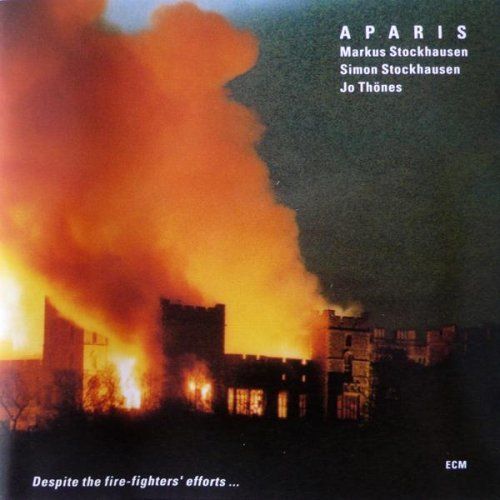
Three years after a self-titled debut, the trio known as Aparis set out for its second of two albums for ECM. Much of the sweep of the first can be found slithering throughout Despite the fire-fighters’ efforts…, only here trumpeter Markus Stockhausen’s lines swim eel-like in an even deeper ocean of electronics, courtesy of brother Simon (who also plays soprano sax). Drummer Jo Thönes is gorgeously present at key moments, as in the high-octane intensity that concludes the opening track, “Sunrice.” Before this we are surrounded by dawn-drenched ruins. We see a hilly landscape licked bare by a forest of orange tongues. A sequencer describes the tragedy with shape-shifting rhetoric, opening like the rainbow bridge to Valhalla. A flanged voice spreads its song over the ashen fields and brings with it the promise of new sustenance before closing its eyes amid the drone and swizzle of cymbals. With the tastes of this 13-minute paean still lingering on the tongue, we pass through the botanical portal of “Waveterms.” This scurrying and colorful portrait of the forest floor eases us into “Welcome,” which drops a liquid soprano into a laid-back and sultry groove, night music for the Blade Runner demimonde. The call of sirens oozes from the city’s skin like plasma in search of closure. Trumpet joins soprano in chorus, as if bonding to the truth of reality, in which swims the slippery little fish of our alienation from hands that were never designed to grasp it. From trickle to flood, this music pairs shadows and swords of light in an epic masquerade, paling at last into “Fire.” The jazziest grape on this vine, it recalls the classic strains of ECM’s heyday, modish synth and all. The electronics do take a more environmentally sound position, however, in “Green Piece.” Markus’s precise underlining gives weight to the fleeting and imprints the biodiversity of “Orange,” in which Simon’s keyboards achieve operatic ecstasy. Last is “Hannibal,” which runs through ages of underbrush like the pads of a dreaming dog. Markus’s mournful song carries across burning trees and anthemic drumming with the conviction of a fantasy made real, drunk out of sight like fresh water from a spring.

In this soundscape we are but eyes on the walls, blinking into the glare of a solar heart. It is a light show of the mind, a sonic doily laced into radial perfection. If, by the album’s conclusion, its title is not clear, we need only listen again.

<< Bowers-Broadbent/Leonard: Górecki/Satie/Milhaud/Bryars (ECM 1495 NS)
>> Peter Erskine Trio: You Never Know (ECM 1497)

Edward Vesala/Sound & Fury: Invisible Storm (ECM 1461)

Edward Vesala
Sound & Fury
Invisible Storm

Jorma Tapio alto saxophone, bass clarinet, flute, percussion, bass flute
Jouni Kannisto tenor saxophone, flute
Pepa Päivinen tenor, baritone and soprano saxophones, flute, alto flute
Matti Riikonen trumpet
Iro Haarla piano, harp, keyboards
Jimi Sumen guitar
Edward Vesala drums, percussion
Marko Ylönen cello
Recorded May/June 1991 at Sound & Fury Studios, Helsinki
Engineer: Jimi Sumen
Produced by Manfred Eicher and Edward Vesala

The late drummer and musical visionary Edward Vesala was a strange bird. As one of the few whose records became less accessible the more composed they were, he marked his path by leaving not breadcrumbs but entire loaves, piping hot and ready to serve. His was a fresh sound, a living sound that, as the moniker of his ensemble implies, thrived also on the richness of fury.

Invisible Storm is a suite of sorts. I see it as existing in two diurnal parts, though the split and its nature, assuming any, may rightly lie elsewhere for every listener. The first half opens the album’s daytime musings, shooting its eyes wide open from the start with the guttural menagerie of “Sheets and Shrouds” before a lachrymose violin and soprano sax woo us in “Murmuring Morning.” Next is “Gordion’s Flashes,” which lays a pleasant tangle of horns and electric guitar over an infectious savannah beat from Vesala, who further shows an aptitude for color as he adds samples of jackhammer and other mundane sounds from an eyedropper filled with chants and stale rituals. Harpist Iro Haarla threads gentler promises throughout “Shadows on the Frontier,” only to have them taken away by children smelling of patchouli and innocent observation. It is they who weave the set’s most masterful narrative, a cinematic flipbook of ghost towns and gravelly dreams that unfolds with the grace of a Philip Glass opera scarred by backstage secrets.

Which brings us to “In the Gate of Another Gate,” a transitory palindrome that opens us to the courtyard of “Somnamblues.” The latter is a ponderous matrix of distortion and metallic whispers that plunges us into the album’s nighttime anxieties. “Sarastus” lumbers through its porous moods riding the back of a roller rink organ, while “The Wedding of all Essential Parts” and the title track offer even more ponderous reflections, given shape by Haarla’s needlework and Vesala’s snare. Reprieve comes in “The Haze of the Frost,” a chain of snow owl talon-prints, rendered by flutes alone, which unearths a slab of mockery in the concluding “Caccaroo Boohoo.”

Because nearly every moment of Invisible Storm (with the possible exceptions of Vesala’s constant hitting and some of the reed work) feels carefully written out, one is confronted with the fullness of his philosophy. In the less straightforward projects like Nan Madol we encounter a sound-world so extraterrestrial that we cannot help surrendering ourselves to its rules. Here, however, Vesala draws much from personal, earthly experiences, choosing from a shoebox filled with hard-won postcards. For this reason, I recommend giving the earlier out-to-lunchers a taste test before downing this fiber-rich brew.

<< Veljo Tormis: Forgotten Peoples (ECM 1459/60 NS)
>> Ralph Towner: Open Letter (ECM 1462)

Hal Russell/NRG Ensemble: The Finnish/Swiss Tour (ECM 1455)

Hal Russell
NRG Ensemble
The Finnish/Swiss Tour

Hal Russell tenor and soprano saxophones, trumpet, vibraphone, drums
Mars Williams tenor and soprano saxophones, didgeridoo
Brian Sandstrom bass, trumpet, guitar
Kent Kessler bass, bass guitar, didgeridoo
Steve Hunt drums, vibraphone, didgeridoo
Recorded November 1990 at the Tampere Jazz Happening and the Internationales Jazz Festival Zürich
Finnish recording: Antti Sjöholm, Finnish Broadcasting Company
Swiss recording: Martin Pearson, Radio DRS
Norwegian mix: Jan Erik Kongshaug, Rainbow Studio, Oslo
Album compiled/produced by Steve Lake

Hal Russell deserves an entry in the dictionary under the word free, for how can the mindful listener feel anything else when steeped in the incendiary playing of the late Renaissance man. The Finnish/Swiss Tour, recorded during his first European tour in November of 1990 at a tender 64, was my second Hal Russell experience, after The Hal Russell Story. Looking back on this discovery, which as of this review can be counted in days, I wonder how I never encountered Hal Russell until only recently. Then again, often the most perspective-altering music seeks us out only when the time is ripe, does it not?

Russell famously picked up his first saxophone at age fifty: pure happenstance but love at first play. As a drummer he beat along with the greats: John Coltrane, Miles Davis, Benny Goodman, Sarah Vaughan…the list goes on. With a songbook of over 400 original compositions and a spirit to match, Russell seems a veritable John Zorn of creative genius. Yet that genius lies as much in his demeanor as in his explosive tendencies on stage. Thankfully, if almost impossibly, he shares that stage here with the NRG Ensemble, a brilliant quartet consisting of Mars Williams on reeds, Brian Sandstrom and Kent Kessler on basses and guitars, and Steve Hunt on vibes. With this support network shining his guillotine at every turn, Russell is sure to leave not a few heads rolling in his wake.

Such metaphorical language might leave one under the false impression, however, that this is confrontational music meant to baffle and alienate. Nothing could be further from the truth. What we have is an ethos that thrashes with flailing but open arms, welcoming all who would listen into an amusement park of thrilling rides. We encounter, for example, the ecstatic tenors of “Hal The Weenie,” which according to our illustrious leader shoot the breeze in honor of Halloween, thus slicing up a most twisted Jack-o’-lantern of free jazz brilliance that has the crowd in gleeful awe, and us before our stereos in envy for not having been there when it all went down.

Rusell is, without a doubt, the center of attention, if not always in the playing (Williams’s blasting tenor siphons much of that credit; just spin “Ten Letters Of Love” and know) then in the writing, for his name lies behind every shattered tune. His dialoguing with Williams in “Raining Violets,” an acrid romp through some intense melodic flowers indeed, is strangely comforting and proof positive of the irresistible nature of these goings on. For go on we do, lost in the labyrinth of a didgeridoo’s darkest visions in “For MC” (featuring Russell on a lovely muted trumpet) and found dreaming a “Dance Of The Spider People.” Williams beguiles us in this web of wonders with a luscious soprano, Kessler providing the ostinato before the whole thing cracks like stressed glass in slow motion to the tune of its own masochism. “Linda’s Rock Vamp,” on the other hand, skewers its kabobs one instrumental morsel at a time and roasts them over raging conflagration of attention. Russell’s deft solo on vibes opens the floor in “Temporarily.” The ensuing debate gets raucous fast, rivaling even the British Parliament with its overwhelming tenors.

Yet one moment above all defines the Finnish/Swiss experience in the blink of an eye. It occurs after Russell and Williams have just finished the introductory crosstalk of “Monica’s Having A Baby,” tumbling like a jellyroll aflame into a pile of abstraction. Though we are breathless, a quick “thank you” from Russell is all it takes for him to dive headfirst into the incredible aliveness of “Aila/35 Basic.” The offhandedness of this transition speaks, actually, to the seriousness of his humor, and betrays an artist totally comfortable in his skin.

No survey of this record would be complete without a bow before the totem of “Mars Theme.” For this hot ticket, Russell jumps from drums to tenor to trumpet to soprano faster than you can say “Red Bats With Teeth” (cf. David Lynch’s Lost Highway), for Bob Sheppard’s solo in that classic fever dream is precisely what comes to mind. It is a bridge into the high-octane menagerie of a castle scarred by barbed wire, its towers reaching an apex of intensity so bright that we cannot help but close our eyes and dream of what Russell might still sound like on the other side.

Heiner Goebbels: Hörstücke (ECM 1452-54)

Heiner Goebbels
Hörstücke
based on texts by Heiner Müller and featuring the talents of:
David Bennent
Peter Brötzmann
Peter Hollinger
Kammerchor Horbach
Alexander Kluge
René Lussier
Megalomaniax
Heiner Müller
Walter Raffeiner
Otto Sander
Ernst Stötzner
We Wear The Crown
Die Befreiung des Prometheus recorded and edited by Walter Brüssow, Heiner Goebbels, Peter Jochum, Gisbert Lackner, Gerlind Raue, Rainer Schulz, and Martha Seeberger
Produced 1985 by Hessischer Rundfunk and Südwestfunk
Verkommenes Ufer edited by Peter Jochum, Martha Seeberger, and Heiner Goebbels
MAeLSTROMSÜDPOL recorded 1987/88 at F.T.F. and Unicorn Studios, Frankfurt/Main
Engineers: Peter Fey and Jürgen Hiller
Mixed at Rainbow Studio, Oslo
Engineer: Jan Erik Kongshaug
Produced 1984 by Hessischer Rundfunk
Wolokolamsker Chaussee recorded at Unicorn Studio, Frankfurt/Main and Südwestfunk Baden-Baden
Engineers: Thomas Krause and Alfred Habelitz
Mixing engineer: Alfred Habelitz
Produced 1989/90 by Südwestfunk, Hessischer Rundfunk and Bayerischer Rundfunk
Album produced by ECM

My respect for Heiner Goebbels only increases with each work I encounter. Yet while his art, not least through frequent collaborations with linguistic wizard Heiner Müller, has always had its heart in drama, from this collection of radio plays that drama emerges—in the wake of German reunification, no less—with a fresh, genuine voice.

The first of this massive collection’s four plays, Die Befreiung des Prometheus (The Liberation of Prometheus), will sound familiar to those who’ve followed Goebbels in chronological order, for its themes had already made an appearance on Herakles 2 two years before. Both are based on a chunk of text from Müller’s Cement, only here we actually come to know that text amid a filmic montage of others. This process of splicing places, spaces, and times for new mythology will be familiar to any Goebbels listener, but it rings more intensely than ever. From the opening nod to Laurie Andersen we feel right at home. Like her Superman, Müller’s Prometheus is deconstructed from the inside out. Rather than carrying the flame of knowledge, he roasts over that flame his own sustenance at the gods’ table, where he is doomed to eat himself in an eternal circle of hunger and release. Though freed by Heracles, he is plagued by a waning remembrance of godliness, chewed and spat by the rock of the earth. Where Goebbels excels is that, in setting all of this, he manages to evoke a wealth of environmental details that his mosaic of voices can only hint at. Through the bubbling crude of his electronic interventions, he unpacks intimations of the zeitgeist with enviable intelligibility. Incidental sounds turn and tumble, grasping at the enamel-hidden scraps of mastication in hopes of picking off a morsel, ending up instead with a fist full of weeds, and it is these we must weave into a basket if we are ever to catch a sense of things. Metallic edges, heavily serrated and rusted over with time, melt in our gaze. Goebbels marks these rhythms with clips and starts. Snatches of the everyday butt up against unpredictable and sometimes-confrontational turns, but always with a uniquely organic energy.

Verkommenes Ufer (Despoiled Shore) takes its seed from an early (1955) play by Müller. For this project, Thorsten Becker asked fifty strangers in Berlin to read the text in question, thus yielding the raw material for Goebbels’s subsequent mash-up. Because none of the readers were familiar with the text, their renderings bring out inner truths. What begins as a writhing and inarticulate being in the final product resolves itself into a landscape of hesitations, loops, and, above all, porous communication. The Argonaut’s promise kisses the face of chance too many times, leaving only the corpses of a onetime progeny swinging in the wind of manipulation. Poison seeps through the ground in reverse, seeking out those vials from which it was poured, but finding only the fullness of adolescent laughter wafting across the urban sprawl. A masterstroke in the Goebbels/Müller canon.

The album’s cover photo is taken from its third play, MAeLSTROMSÜDPOL (MAeLSTROMSOUTHPOLE). If its blood-red wash of solitude is any indication, we might easily know its fascination with reality and disconnect before a single word grabs us. The continuity of the text, inspired by Edgar Allan Poe’s The Narrative of A. Gordon Pym, is its own contradiction, carving out of those syllables a subterranean world. Speech stores hidden desires in its vowels, misted by white noise and the song of an open cataract: drones and queens, reeds and marshes, all blended into a smoothie only a ghost might drink. It is a photograph that grows blurrier the more it develops. The only way to discern it is to drink the vat of chemicals that brought it to visible life. Echoes turn into birds, the shimmering backdrop of an open mike emceed by the mistress of our deepest nightmares. “OH KEEP THE DOG,” she croons, as if to cut the running line that binds us to everything. She overwhelms us with the responsibilities of liberation.

Last is Wolokolamsker Chaussee (Volokolamsk Highway). Based largely on motives from writers Alexander Bek and Anna Seghers, this self-reflective look at social change in the DDR’s last gasps is vitriolic through and through. Part I, “Russian gambit,” introduces the voice of stage actor Ernst Stötzner and music by heavy metal band Megolomaniax. The combination is a fortuitous one, for the sheer theatricality of the language almost screams for these experienced thespians of two not-so-different stages (though, as Verkommenes shows, this needn’t be so across the board). Bloodshed and total recall dance with one another, spinning their way to “Forest near Moscow.” Stötzner continues his tirade, only now with gentler guitar accompaniment. Death still looms in every pregnant pause, given just enough room to spread a pair of wings which, though flightless, can at least move enough to remember flight. Some preparatory shuffling in Part III, “The Duel,” opens a 20-minute call and response between Stötzner and men’s choir, all of whom join lungs to blow the dust off the mood of German Arbeiterlieder. Behind the scenes, the musc underscores an important truth: namely, that no matter how robust we spin our sentiments regarding human existence on paper, they would all burst into ashen death at the touch of a match. Part IV, “Centaurs” (the title of which, a booklet note reminds us, comes from the Old Greek for “red tape”), recasts Kafka’s Gregor Samsa in a world ordered by totalitarianism, a theme finds blatant traction in a recycling of Shostakovich’s (in)famous Symphony No. 7. The narrative is even more localized in the mouth, which bites a desk in order to prevent its screams from tearing out the still-beating heart of resistance. The fifth and final part, “The Foundling” (after Kleist), is perhaps the most unusual, if only for being backed by hip-hop group We Wear The Crown. Stötzner’s “rapping” is a mélange of generic signatures that transcends its surroundings even as it relies wholly on them. In this prison of madmen speaking in “MARXANDENGELSTONGUES” there is only room for forgetting.

German speakers and/or those up on their German history (I can count myself among neither) will surely get the most out of this recording whose booklet forgoes translating every word (especially in Prometheus)—a real shame considering the parodic depths awaiting our swan dive of relish. The language is visceral in the deepest sense, at times vulgar but always self-aware. Completists wanting the most unfettered glimpse into the architecture of Goebbels’s craft would do well to track down this invaluable set. Though the sentiments throughout are as complex as their politics, certain common themes exploit the connections between songs and conflicts. Through songs we can hide in the foxholes of life and cover our heads against any aerial assault, but in the end all of their lyrics flow through us, be they of the enemy, of our mothers, or of ourselves.

<< Barre Phillips: Aquarian Rain (ECM 1451)
>> Eleni Karaindrou: The Suspended Step Of The Stork (ECM 1456)

John Abercrombie: November (ECM 1502)

John Abercrombie
November

John Abercrombie guitar
Marc Johnson bass
Peter Erskine drums
John Surman baritone and soprano saxophones, bass clarinet
Recorded November 1992 at Rainbow Studio, Oslo
Engineer: Jan Erik Kongshaug
Produced by Manfred Eicher

Named for both the month its was recorded in and for the mood it maintains, November is a cogent record from guitarist John Abercrombie’s trio with bassist Marc Johnson and drummer Peter Erskine, along with special guest John Surman. The English reedman lends his fluid considerations to the album’s deepest moments, and nowhere so engagingly as in “The Cat’s Back,” thus opening a cloudy and sometimes pensive set of mostly group originals. Abercrombie’s quiet sparkle ushers in the gravid quartet sound of this improvised prelude, Surman tipping the scales with bass clarinet against the weight of Erskine and Johnson’s joyous communication. Those timeworn ululations scramble themselves in “Rise And Fall,” a veritable Rubik’s Cube of baritone utterances. The legato soprano of “Ogeda” also inspires particularly soulful picking from Abercrombie, who pulls from the gumdrop strums of “Come Rain Or Come Shine” and “Prelude” a scroll of ideas. These come to life inside rings of celestial fire, each a meteorite in freefall. Meditation throbs at the heart of “J.S.,” a lavish piece boasting starry turns all around. After this look inward, we get something more extroverted in the foot-tapping beats of “Right Brain Patrol.” Despite small beginnings, it ends up spitting pale fire as if it were breath itself into “John’s Waltz.” Over Erskine’s calm ripples, Abercrombie grabs the tail of Johnson’s solo for one of his own, deploying a parachute held by chromatic tethers. “To Be” reprises Surman’s bass clarinet, played here as if it were the last of its kind. Its voice paints the night with that gentle resignation only loneliness can bring, a heartening and mournful sound that recedes from “Big Music,” which finishes the album with ice-skating melodies and tight syncopations.

While everyone on November listens to the others with equal acuity, I find this outing all the more enjoyable for what Johnson does to its sound. After having only encountered him in denser projects like Bass Desires, it was a real pleasure to hear—in the title track, for example—the intimacy of his craft. His duet with Erskine on “Tuesday Afternoon” is a real gem in this regard and provides a guiding lens for this exquisite studio date.

<< Bach: 3 Sonaten für Viola da Gamba und Cembalo (ECM 1501 NS)
>> Ketil Bjørnstad: Water Stories (ECM 1503)

Hal Russell: Hal’s Bells (ECM 1484)

Hal Russell
Hal’s Bells

Hal Russell tenor and soprano saxophones, trumpet, musette, drums, vibraphone, bass marimba, congas, gongs, bells, percussion, voice
Recorded May 1992 at Rainbow Studio, Oslo
Engineer: Jan Erik Kongshaug
Produced by Steve Lake

Hal’s Bells is a rare thing: an artist’s first solo recording made in his last year. This astonishing statement is a panorama of Hal Russell’s succinctly indefinable career (for the best attempt at such, look no further than The Hal Russell Story), which the hapless listener finds realized in the breadth of his one-man band abilities. From drums (his starter instrument) to bass and horns, his kit has room for no other. A congregation of marimba and bells in “Buddhi” speaks with childlike innocence before cracking open an egg of reeds and Chinese gongs. Such contrasts prove quotidian in a space where the fuel-engaged tenor of “Millard Mottker” and “Strangest Kiss” can hug the muted trumpet goodness of “Portrait Of Benny” without a blink of hesitation. Soprano skills are on full tap in “Susanna.” Even as he twists himself into all manner of contortions, Hal maintains an astounding level of precision in the highs and sets off a lovely spate of vibes against some thread-through-needle drumming. “Carolina Moon” has much to say in 390 seconds, howling like a pack of wolves in desperate need of attention but which instead converges on “Kenny G.” While the latter’s endearing abandon is as far from its patron saint as can be, it nevertheless rings with a relatively free and breezy timbre. The enticing solo of “I Need You Now” furthers the album’s mission from restlessness to meditation and unmasks a deceptive repose in “For Free” (which might as well be Russell’s motto). The great vibes—in all respects—of this track work toward a blubbering finish sure to leave you breathless and in want of the elixir that is “Moon Of Manakoora.” This vocally blessed excursion into outer space is a straight shot to that marsh in the sky where, no doubt, Russell’s squealing energies continue to mount, ever amphibious and slithering their way through territories unclean yet oh so stunning.

The rewards of Hal’s Bells might never have been known to us were it not for Steve Lake, who has seen fit to produce a selective body of work for ECM in the interest of preserving sometimes-underappreciated artists, and we have him and Manfred Eicher to thank for believing in Hal, now immortal in the digital afterlife.

<< Heiner Goebbels: La Jalousie (ECM 1483 NS)
>> Michael Mantler: Folly Seeing All This (ECM 1485)