Stephan Micus: Darkness And Light (ECM 1427)

Stephan Micus
Darkness And Light

Stephan Micus dilruba, guitar, kortholt, suling, ki un ki, ballast-strings, tin whistle, balinese gong, sho
Recorded January/February 1990 at MCM Studios and Studio Giesing, München
Engineer: Tom Batoy

Listening to a Stephan Micus album is always like taking a journey through darkness and light, and so it is no wonder that his fourth album for ECM should bear that very title. The sarangi-like tones of the dilrubi of Part 1 open up a pathway that is indeed by turns bright and shaded. The path is circular, leading forever back to where it began, as if to say, “Birth and death issue from the same step.” From this mouth agape we get the insular sutras of guitar. Its chain of arpeggios carries in its arms a bouquet of memories and rests it in the crook of a tree, where it plays for the sake of Nature. From that whispered cove arises a mermaid holding a bow at the edge of a string. With every splitting of voice we are veiled in deeper solitude. Mournful songs shape a still heart, hanging on to certain threads longer than others. The guitar helps us to nourish ourselves with what remains in its chamber, stenciling the periphery with every pluck and unearthing in the afterlife all that is yet to come. Even in the absence of a bow, we feel our voices continuing to spin novel draws in the ether.

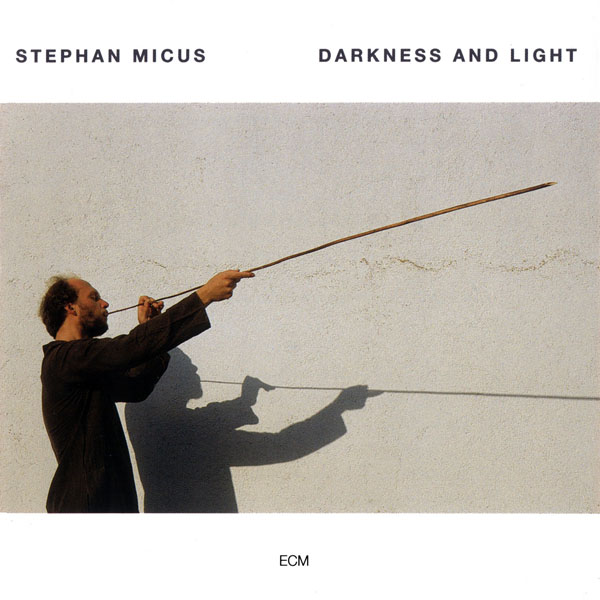
Part 2 takes a rawer approach to the dilrubi, giving rise to the call of the ki un ki, the Siberian cane trumpet pictured on the album’s cover. Played by inhaling, it sounds like a combination between a Theremin, a split and blown grass blade, and an elephant calling out to the cosmos. Part 3 scrapes the edge of darkness on its climb toward a trembling song. A flute cries as if in dialogue, two lovers parted on either side of the Milky Way unifying at last in a hopeful vein, tracing light back to the nebula that birthed them both.

Darkness And Light is as fleeting as its message, transparent as water and betraying its presence only through reflections. Still, its elemental forces sweep us away in the depth of Micus’s human touch, such that when they stop, one feels they might linger forever.

<< Paul Giger: Alpstein (ECM 1426)
>> Egberto Gismonti Group: Infância (ECM 1428)

Keith Jarrett Trio: Tribute (ECM 1420/21)


Keith Jarrett Trio
Tribute

Keith Jarrett piano
Gary Peacock bass
Jack DeJohnette drums
Recorded October 15, 1989, Philharmonie, Köln
Engineers: Jan Erik Kongshaug and O. Fries
Produced by Manfred Eicher

No one makes live records quite like the Keith Jarrett Trio, whose inimitable skills and synergy ensure us that every tune breathes with all the life it deserves. As one of the few groups that can draw in a crowd thousands of miles and years away into that indefinable moment of expression, it transcends the confines of the concert hall, of the jazz club, of the audience’s adoration. All of these recede the moment you put this music on and let it fill your own space and time with the love and passion what bore it. We hear this especially in the balladry, of which Jarrett proves an adept exponent in “Lover Man.” Dedicated (as all pieces on Tribute are to those who once performed them, hereafter in parentheses) to Lee Konitz, the piece expands such notions of genre to begin with, unraveling from characteristically somber piano intros a world of sentiment. Peacock is especially notable in his first solo of the night, tracing an outline that DeJohnette is more than happy to color in. Jarrett maintains enviable subtlety in his improvisations, working in a clever nod to “The Girl from Ipanema.” He dances on air, even as he plunges his hands into a watery keyboard and mixes the sediments until they shine. DeJohnette, meanwhile, works wonders with his snare, unfolding a ponderous yet somehow buoyant solo: a drop of melancholy in an otherwise joyful sea. All this in the opening number? Yes, it’s that good.

Such things are de rigueur in Jarrett Land. One could expound at great length, for example, on “I Hear A Rhapsody” (Jim Hall). From the fluid intro and swinging groove it dovetails to DeJohnette’s popcorn bursts, there’s so much to acknowledge for fear of doing the music injustice. DeJohnette and Peacock generally keep the flame low and steady as Jarrett turns all manner of somersaults, each a storm cloud waiting to burst, yet which instead couches rainbows. Down one of these Jarrett slides into a pot of golden applause. “Little Girl Blue” (Nancy Wilson) turns with the grace of a plumed bird bowing into the wind. Peacock again walks that fine line between heartbeat and fluster. The more up-tempo “Solar” (Bill Evans) finds Jarrett working his usual eddies into relief. One really notices the acoustics of the concert space, linking Jarrett’s submissions to the rhythm section’s stellar flip-flopping and moving us seamlessly into the exhilarating, sparkling piece of music-making that is “Sun Prayer.” A quintessential Jarrett tune if ever there was one, one feels in its shape a musical life lived to its fullest. DeJohnette flashes his powers as Jarrett weaves some of his densest pianism yet before baying into a translucent cove, where floats the detritus of a promise so enormous that it cannot help but embrace the world. “Just In Time” (Charlie Parker) delights with its odd timing, which sends Jarrett on a simply unstoppable journey as Peacock rides the DeJohnette train to Smoothville. The trio digs even deeper in quiet stunners like “Smoke Gets In Your Eyes” (Coleman Hawkins), “All Of You” (Miles Davis), “It’s Easy To Remember” (John Coltrane), and “Ballad Of The Sad Young Men” (Anita O’Day), the latter graced by DeJohnette’s steam-engine brushes. A highlight in the album’s second half.

From the buoyant piano intro, “All The Things You Are” (Sonny Rollins) puts one in mind first of Gary Burton at the vibes before unleashing a rhythm section aflame, making for one of the trio’s most exhilarating tracks anywhere. More pure Jarrett follows in “U Dance.” This joyous romp seems porous, but would withstand even the sharpest bullets of criticism. A spirited turn from DeJohnette bridges us into the tune’s closing half, where we find ourselves still dancing even as the music recedes into the distance from which it spoke.

I typically don’t read other reviews before writing mine, but in my gathering of information for this one I took a look at the comments on Amazon, only to be shocked at one customer who proceeds to tell us how, listening to “Ballad Of The Sad Young Men” while driving, he (?) became so fed up with DeJohnette’s drumming that he rolled down his window and threw the CD onto the highway. Everyone is, of course, entitled to personal opinion, and my reviews are never meant to be prescriptive, but I find it baffling that anyone could react against DeJohnette so strongly on the basis of such an exhilarating album. Chalk it up to my drumming ignorance, but I daresay that DeJohnette’s is some of the best around. Among other things, on this recording he seems to have upped his snare work to something special in the grammar of his kit. I underscore this point only to prevent potential listeners from missing out on a tremendous experience.

Gorgeous to the last drop.

<< Jan Garbarek: I Took Up The Runes (ECM 1419)
>> Gesualdo: Tenebrae (ECM 1422/23 NS)

Jan Garbarek: I Took Up The Runes (ECM 1419)

Jan Garbarek
I Took Up The Runes

Jan Garbarek soprano and tenor saxophones
Rainer Brüninghaus piano
Eberhard Weber bass
Nana Vasconcelos percussion
Manu Katché drums
Bugge Wesseltoft synthesizer
Ingor Ántte Áilu Gaup voice
Recorded August 1990 at Rainbow Studio, Oslo
Engineer: Jan Erik Kongshaug
Produced by Manfred Eicher

By 1990, Jan Garbarek had for decades been searching for that one key, navigating a landscape of peaks and valleys, only to find it slumbering within the runes which, with this album, he eponymously took up. A snaking version of Mari Boine Persen’s “Gula Gula” outlines the album’s perfectly proportioned ritual space for a sound that has come to define the Norwegian saxophonist’s output since. With Runes his tone had achieved a luminescence that fell like liquid onto the keyboard of Rainer Brüninghaus.

Balancing note and movement, Garbarek hones something truly special in the five-part “Molde Canticle,” which draws out the album’s deepest anatomies. Above all, the piece is about time. It speaks in a language that moves us. The gyroscopic quality of Part 2 hums around the centrifugal force of Garbarek’s lyricism as he scales ever higher. Part 3 features a singsong solo from bassist Eberhard Weber, who elicits bird-like harmonics from the soft glide of his bow. These enchantments are but a prelude to a round of wind and pianistic musings. Part 4 is a more rhythmic showcase (percussionist Nana Vasconcelos’s influence is also clear on tracks like “Buena Hora, Buenos Vientos”), and features some heavy blowing from Garbarek, at once whimsical and weighty, while Part 5 finds him weaving a simple wave over a harp-like ostinato.

These melodies all have the makings of folk songs (sometimes the other way around, as in “His Eyes Were Suns”), so vivid is each in its evocation of peoples and traditions. The title track is a more groove-oriented spectacle and finds Garbarek freeing himself even further. This leaves only “Rahkki Sruvvis,” another chanting piece with some overdubbed saxes for a final skyward glance.

Many have criticized Garbarek for going soft. I Took Up The Runes proves that he has simply channeled that dynamic energy through different rivulets of intensity. Like smoke, they need fire to soar, but fire in its natural state requires time and care to catch.

A masterpiece.

<< John Surman: Road To Saint Ives (ECM 1418)
>> Keith Jarrett Trio: Tribute (ECM 1420/21)

John Surman: Road To Saint Ives (ECM 1418)


John Surman
Road To Saint Ives

John Surman bass clarinet, soprano and baritone saxophones, keyboards, percussion
Recorded April 1990 at Rainbow Studio, Oslo
Engineer: Jan Erik Kongshaug
Produced by Manfred Eicher

Although we might feel tempted to take Road To Saint Ives, one of John Surman’s most stunning solo albums to date, as a portrait of its titular coastal town, Surman states in his liner notes that such is not the case. Aside from the peppering of folk-inspired melodies in the soprano solos, the music breaks its own ground on the way toward unique improvisatory continents. Among those solos, “Polperro” makes for a transportive opener, while the echo effect of “Perranporth” dances on a cloud of whimsy. These solos are the heart of everything that makes Surman such a listeners’ gift. Their quality of tone and pitch speaks of the supremely nuanced command he has over his instruments. Each has the makings of antiquity blown through its core, as if webs of time were being pulled into all-encompassing songs. Surman is likewise a master of the miniature, as exemplified by the album’s shortest track, “Trethevy Quoit,” in which a crunchy flock of low reeds sounds one of the most memorable congregations in the program. Building up from these are the ensemble pieces in which he overdubs a chain of settings. From Michael Nyman-esque forest walks (“Rame Head”) to flirtations with his favored sequencer (“Mevagissey”), he explores the contours of the most lyrical baritone one can imagine. One moment we are gliding through a classic sci-fi cityscape while the next finds us skirting the edge of a piano-infused drone (“Bodmin Moor”). And one can hardly ignore the multifaceted sound of his bass clarinet, which floats playfully on every ripple of “Piperspool” but which weeps liquid gold against the prayerful organ of “Tintagel.” Surman’s lyricism seems to mourn the extent of its own beauty in this, his deepest nod. So too may we lose ourselves in gamelan feel of “Bedruthan Steps,” where that unmistakable soprano darts in and out of every temple as if the entire complex were but an ocean reef, every note a fish that swims its coves as nature itself must breathe.

Like all of Surman’s solo albums, this is a dream made real.

<< Kenny Wheeler Quintet: The Widow In The Window (ECM 1417)
>> Jan Garbarek: I Took Up The Runes (ECM 1419)

Kenny Wheeler Quintet: The Widow In The Window (ECM 1417)

Kenny Wheeler Quintet
The Widow In The Window

Kenny Wheeler fluegelhorn, trumpet
John Abercrombie guitar
John Taylor piano
Dave Holland bass
Peter Erskine drums
Recorded February 1990 at Rainbow Studio, Oslo
Engineer: Jan Erik Kongshaug
Produced by Manfred Eicher

One month after the crowning success of his Music For Large & Small Ensembles, trumpeter/composer Kenny Wheeler gathered a handful of stars therefrom—namely, guitarist John Abercrombie, pianist John Taylor, bassist Dave Holland, and drummer Peter Erskine—into this more succinct yet equally classic date. Abercrombie lays down a particularly soulful beauty in the opening “Aspire,” the first in a program of six Wheeler originals, and sends the frontman’s uncompromising insights into thoughtful ether with the stretch of a trampoline. A solo of sweeping intimacy from Taylor showcases further sensitivity among a quintet so attuned that it might as well be doing this while asleep. We do, of course, find ourselves wide awake in the dazzling light of “Ma Belle Hélène.” One by one, Abercrombie unwraps his charms like the sonic candies they are. Wheeler, meanwhile, adds feathers to the session’s growing wings, uncorking a rush of unbridled melody that elicits one of Holland’s most heartfelt solos on record against some of the cleverest cymbals in the business. A graceful pass from Taylor puts the waxen seal on this love letter to sunlit streets and alleyways. The title track begins with a longing cry from Wheeler, who finds in its descending motives a narrative of spun of cloth and time. Profundity abounds in this solo-sphere, Holland especially drawing inimitable shapes into the fogged mirror of memory, wiping away melancholy away as if it were a dust bunny blown out of sight by a sigh. “Ana” receives a more nuanced treatment here than it did on Wheeler’s outing with the Berlin Contemporary Jazz Orchestra. That same modal intro speaks, sounding more than ever like a soundtrack to a film yet to be made. After a theme articulated in shadows, Erskine and Taylor turn to the light. Abercrombie positively dances on air and, along with Wheeler, carries us into the depths of hope. The swinging “Hotel Le Hot” finds the latter at his bubbling best, cresting the flames of surrender with every squeal. This cut is also noticeable for Erskine’s dizzying flavors. “Now, And Now Again” ends things in a gently rocking cradle for which Wheeler lays on the lyricism thick. Taylor charts the earth where once he stepped, where in his place now hovers only a sonorous ghost of what used to be.

Those who count themselves a fan of Wheeler, ECM, or boundary-crossing jazz in general can chalk this one as unmissable.

<< Kenny Wheeler: Music For Large & Small Ensembles (ECM 1415/16)
>> John Surman: Road To Saint Ives (ECM 1418)

Kenny Wheeler: Music For Large & Small Ensembles (ECM 1415/16)

Kenny Wheeler
Music For Large & Small Ensembles

Kenny Wheeler fluegelhorn, trumpet
John Abercrombie guitar
John Taylor piano
Dave Holland bass
Peter Erskine drums
Norma Winstone vocal
Derek Watkins trumpet
Henry Lowther trumpet
Alan Downey trumpet
Ian Hamer trumpet
Dave Horler trombone
Chris Pyne trombone
Paul Rutherford trombone
Hugh Fraser trombone
Ray Warleigh saxophones
Duncan Lamont saxophones
Evan Parker saxophones
Julian Argüelles saxophones
Stan Sulzmann tenor saxophone, flute
Recorded January and February 1990 at CTS Studio, London (Large Ensembles) and Rainbow Studio, Oslo (Small Ensembles)
Engineer: Jan Erik Kongshaug
Produced by Manfred Eicher

Canadian trumpeter Kenny Wheeler had been writing for jazz orchestra for three decades before this recording, criminally the only of its kind widely available at the time, was released. With a cast list (mostly veterans of the London jazz scene) to make one swoon, ECM’s first release of the 1990s raised the bar on production, arrangement, composition, and musicianship that had been the label’s prime tenets since its inception in 1969.

It’s easy to praise Wheeler as player, but on Music For Large & Small Ensembles we are given a smorgasbord of his delectable talents as composer. This massive two-disc set begins with The Sweet Time Suite in eight parts. While the cradle of horns in which it opens sounds more like a closing, it is nevertheless coaxing and lovely. In Part II, however, we are introduced to the album’s major running thread: namely, the voice of Norma Winstone, who provides a crystal lining to every motif and, along with guitarist John Abercrombie, adds a Pat Metheny-like charm to many of the darker hues. The roundedness thereof is offset by the added punch of horns, giving us something doubly engaging. Stan Sulzmann’s heady tenor floats up and down the improvisatory ladder with unbound attention and primes us for Winstone’s unparalleled tintinnabulations in Part III. Although Part IV bears dedication to baritone saxophonist Pepper Adams, it’s Evan Parker’s tenor that gets all the attention. Walking a fiery tightrope woven of guitar and cymbals, he navigates a swinging rhythm section toward Dave Holland’s quiet solo at the bass—an exemplary display of dynamic control into the sultry ending. Part V is another audible smile that features fine commentary from pianist John Taylor. Abercrombie’s own sensitive turn opens like an embrace warmed by sunshine. Winstone fashions Part VI into a lullaby, wafting through the air like a folk song into the thermals of altoist Ray Warleigh’s stunning flight. Part VII starts with what at first appears to be unnecessary distraction, only to reveal a profound dialogue between Peter Erskine’s drumming and the round of solos that embraces it. Wheeler’s fluegelhorn is especially engaging here and carries us with quiet confidence into a plush finish.

The second disc is a hefty selection of standalone originals. Of these, the opening “Sophie” is perhaps Wheeler’s finest. The pianism here shines like the sun alongside the joyous cymbal work. But it is the gorgeous baritone solo from Julian Argüellas, along with Wheeler’s own distinctive song, that truly makes this a standout in the collection. It is heavy yet flowing, dancing like fire without the threat of destruction. “Sea Lady” awakens with Parker’s avian reeds, sounding like a Philip Glass riff gone beautifully awry, and brings Winstone’s tender words into the mix at last. Through these she unties a knot with unrequited love and steeps its expectations in shadow. Abercrombie’s own ruminations presage Sulzmann’s forlorn twittering on flute and Wheeler’s vivid narrative. “Gentle Piece” is exactly that, all the more so for Holland’s soft spots and Taylor’s unobtrusive wanderings. Winstone’s lilting motives, wordless yet ever meaningful, speak like the voice of the sun in a dream without light. Another memorable alto solo from Warleigh promises wakefulness before the outro. The album’s remainder is taken up by two phenomenal trio conversation pieces with Wheeler, Holland, and Erskine, and a series of duets between Erskine and Taylor before closing out on the 10.5-minute masterpiece, “By Myself.” Abercrombie jumps through every hoop spun before him, setting off an enlivening round of solos that brings us into Wheeler’s final gesture of exuberance, by which he successfully concludes one of the most ambitious projects of his career.

Music For Large & Small Ensembles offers lush insight into one of jazz’s most exciting musical minds. This is music at the peak of ripeness, bearing fruit for all. It also boasts some of Steve Lake’s best liner notes, which make the physical product worth far more than any digital download available.

<< Edward Vesala: Ode To The Death Of Jazz (ECM 1413)
>> Kenny Wheeler Quintet: The Widow In The Window (ECM 1417)

Edward Vesala: Ode To The Death Of Jazz (ECM 1413)

Edward Vesala
Ode To The Death Of Jazz

Matti Riikonen trumpet
Jorma Tapio alto saxophone, bass clarinet, flute
Jouni Kannisto tenor saxophone, flute
Pepa Päivinen soprano, tenor and baritone saxophones, flute, clarinet, bass clarinet
Tim Ferchen marimba, tubular bells
Taito Vainio accordion
Iro Haarla piano, harp, keyboards
Jimi Sumen guitar
Uffe Krokfors bass
Edward Vesala drums
Recorded April/May 1989 at Sound and Fury Studio, Helsinki
Engineer: Jimi Sumen
Produced by Manfred Eicher and Vesala

If jazz is a body, then Edward Vesala is its ligament of fascination. Flexing and creaking with the passage of emotion into life and life into silence, the drummer’s disarming soundscapes never fail to intrigue, to say something potent and new. In spite of its tongue-in-cheek title (I cannot imagine Vesala trying to make a grand statement here), Ode To The Death Of Jazz is, strangely, one of his more uplifting exercises in sonic production.

The title of “Sylvan Swizzle” sets the bar in both tone and sentiment, opening in a smooth and winding road of flute, woodwinds, percussion, and harp. Textural possibilities bear the fruit of the ensemble’s explorations in somatic sound: an exercise in pathos, to be sure, if only through the eyes of something not human. The space here is dark yet flecked with iridescence, sporting yet bogged down by infirmity, vivacious yet weak in the eyes. With every change of title comes a change of scenery. “Infinite Express” thus moves us out of those caves and onto an evening dance floor populated by the demimonde of the upper crust. As the big band plays, each socialite shares with the other what it does not have in itself. The pliant reed work and watery splash (the album’s greatest moment) make for an unexpected give and take. “Time To Think” is both a question and its answer. Vesala constantly redefines its brooding atmosphere with subtle commentary. A mystical solo piano works its way through these tides, giving us pause for reflection. The bizarre call and response that opens “Winds Of Sahara” gives way to a distorted train ride through landscapes both electronic and acoustic, its Elliott Sharp vibe on point. The metallic drones and throated horns of “Watching For The Signal” thread tree branches whose leaves rustle like detuned guitars in the forest’s harp music. This beautiful track is one of Vesala’s finest and should reward the listener who has struggled thus far. “A Glimmer Of Sepal” is another fascinating detour. Featuring an accordion wrapped in the embrace of a tango dipped in the consequence of regret, it harbors in its nest of shadows not eggs but glimmers of light in a time when desperation calls for sanity. “Mop Mop” is the set’s requisite dose of whimsy and comes off like an Art Ensemble of Chicago outing, replete with percussive asides and an electronic seasoning packet thrown in for good measure. Last is “What? Where? Hum Hum,” which drops us headfirst into an old jazz scene, where lace and bowties shed their skins as the night presses on. The sax solo wrenches out its emotional hang-ups and throws them to the dance floor to bleed, wither, and go still.

Whether or not Ode signals the death of jazz or any other genre is moot, for it has been speaking its own language the entire time. That being said, and despite the evocative associations the album has inspired in me, it does seem somewhat restrained as Vesala efforts go (and maybe this is the point). The real strength here, though, is the fine interweaving of electronics in a relatively large group setting. Vesala newbies will want to start with the masterful tides of Nan Madol before holding this conch shell to their ears.

<< Walter Fähndrich: Viola (ECM 1412 NS)
>> Kenny Wheeler: Music For Large & Small Ensembles (ECM 1415/16)

John Abercrombie: Animato (ECM 1411)

John Abercrombie
Animato

John Abercrombie guitar, guitar synthesizer
Jon Christensen drums, percussion
Vince Mendoza synthesizers
Recorded October 1989 at Rainbow Studio, Oslo
Engineer: Jan Erik Kongshaug
Produced by Manfred Eicher

Despite the fact of John Abercrombie headlining this curious little album called Animato, the finished product is a real showcase for drummer Jon Christensen and synthesizer virtuoso Vince Mendoza. The latter, who wrote the bulk of the album’s music (the only exceptions being the group improv that begins the set and the Jon Hassell-esque strains of Abercrombie’s “Bright Reign”), fleshes out some of the strokes Abercrombie was already beginning to paint with his synth augmentations in years past. Still, the guitarist is a major melodic force on this date. Where “Right Now” rises from the depths with the torch in his hands, swirling around a fiery center, self-contained yet extroverted, “Single Moon” floats his tenderness over a bass of electronic goodness. Like a skilled R&B singer, he plumbs the ballad to new depths, each new stratum accentuated by the warmth and timeless energy of Mendoza’s tasteful atmospheres. In this vein, the sequencer qualities of “Agitato” make for a bed of ashes from which the guitar rises like a phoenix and duets with drums in powerful conversation amid gorgeous synth lines and a classically inflected refrain. After the swelling interlude of “First Light” we come into the bubbling abstractions of “Last Light,” in which Abercrombie dances like fire on water. The darkly anthemic “For Hope Of Hope” is an audible mirage throughout which Christensen proves a fantastic painter of colors, even as Mendoza deepens them in a continuous pall of time and narrative experience. We end with a lullaby in “Ollie Mention.” This is perhaps Abercrombie at his most sensitive yet somehow spirited as he tumbles over comforting waves into the final recession of the tide.

The inclusion of Mendoza on this album was a stroke of genius. On the one hand he is an extension of what Abercrombie already implies, while on the other he emotes with such distinctness that one feels the session pushed to new territories with every touch. Together these musicians bring a storyteller’s art to wordless songs, hollowing a vein of shadow through which the blood of dreams runs bright.

<< Dave Holland Quartet: Extensions (ECM 1410)
>> Walter Fähndrich: Viola (ECM 1412 NS)

Dave Holland Quartet: Extensions (ECM 1410)


Dave Holland Quartet
Extensions

Dave Holland bass
Steve Coleman alto saxophone
Kevin Eubanks guitar
Marvin “Smitty” Smith drums
Recorded September 1989, Power Station, New York
Engineer: James Farber
Produced by Manfred Eicher

If you’re like me, then you’re most familiar with this album’s rhythm section from The Tonight Show with Jay Leno. From 1995 to 2006, guitarist Kevin Eubanks and drummer Marvin “Smitty” Smith were the anchors for said program’s house band. I always knew that Eubanks was a talented musician but felt that his insights were often lost in the muddled acoustics of the NBC studio in which they were situated. These conditions also boded ill, in most cases, for the show’s musical acts. In addition, for the most part Eubanks had his distortion turned high in order to achieve a certain brand of punctuation in his bantering with Leno, but I sometimes noticed that when returning from a commercial break he would be finishing a smooth jazz number, the brilliance of which I could only guess at. It wasn’t until I heard Extensions that I realized just how deep that brilliance goes.

Eubanks astounds at every turn of Extensions. Having penned the opening and closing tracks, he has the first and last word on things and brings to the in-between a certain majesty to the scope of his improvisatory paths. His “Nemesis” starts things off just right, giving way from barely plucked stirrings to the controlled vigor of altoist Steve Coleman’s left side drive. Not to be outdone, of course, are Smith and the album’s leader (though you wouldn’t know it from Holland’s many gracious nods to these younger trailblazers), whose interactions give Coleman just the lift he needs to soar with a blistering yet somehow nonabrasive sound. A toffee crisp solo from Eubanks paints here in leaps and somersaults, each a tight circle of deftly contained energy.

Holland himself gives us two tracks, of which “Processional” is the most sumptuous. This arid groove finds the bassist stepping lightly, making way for a starlit solo from Eubanks. Holland opens “The Oracle” with a line so delicate, it almost sounds like a classical guitar. The subtlety of Smith’s stylings at the kit and Eubanks’s bird-like calls work themselves through the curling plumes of windswept dunes, leaving a sonorous trail of footsteps that is redrawn as quickly as it is buried. This nearly 15-minute cut is the highlight of the album and should make a Eubanks believer out of anyone. Holland’s almost spiritually minded solo, detailed like a prayer, still conveys an unparalleled wanderlust before Coleman draws a trail of fire into the refrain. His two tunes, “Black Hole” and “101° Fahrenheit (Slow Meltdown),” are respectively funky and sultry, the latter unveiling fan-chopped smoke and alleys littered with wasted opportunities, singing of a time when one could forget them all in an amber bottle.

The closer, “Color Of Mind,” sports one of Holland’s catchiest bass lines and another astonishing dialogue from Eubanks. It also gives us some downtime with Holland along with Smith, who turns up the heat a notch or two into a sparkling close.

This album is a coming of age in an age of becoming. If ECM’s Touchstones series, of which this is a part, had its own Touchstones, this would be one of them.

<< Berlin Contemporary Jazz Orchestra: s/t (ECM 1409)
>> John Abercrombie: Animato (ECM 1411)