

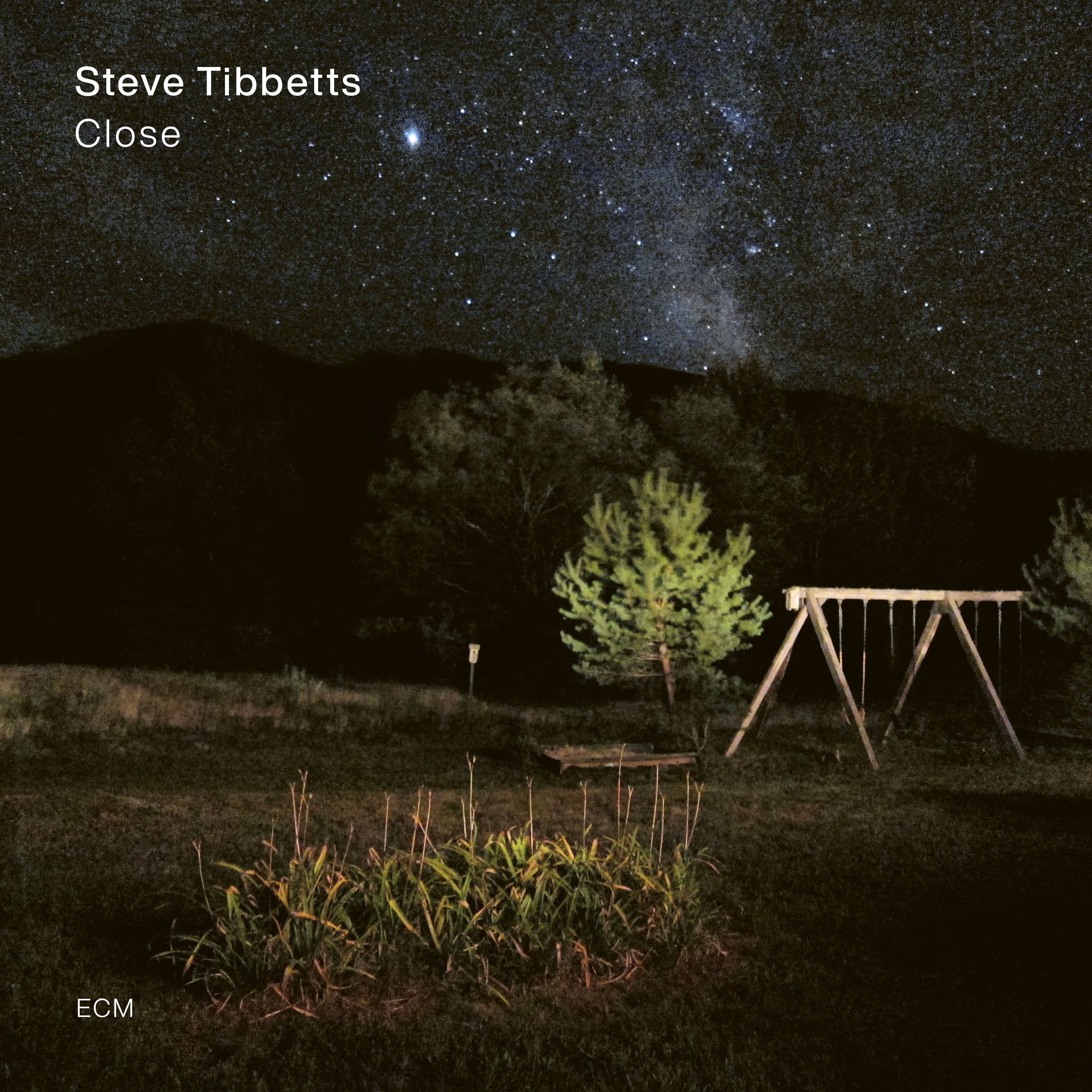
Steve Tibbetts
Close
Steve Tibbetts guitar, percussion, piano
Marc Anderson percussion, gongs, handpan, loops
JT Bates drums
Recorded 2021-2024 in St. Paul by Steve Tibbetts
Drums recorded at 8vb Studio, Minneapolis by JT Bates
Mastered by Greg Reierson at Rare Form Mastering
Cover photo: Joel and Norris Tibbetts
An ECM Production
Release date: October 24, 2025
“Music is a twilight language.
The job is to translate some shadow into sound.”
–Steve Tibbetts
On his 11th album for ECM, guitarist Steve Tibbetts returns with his ever-present ally, percussionist Marc Anderson, joined by drummer JT Bates for a session of immense intimacy. If long-standing classics like Exploded View and Big Map Idea have attuned your ears in a certain direction, you can safely put those expectations aside. This time around, Tibbetts offers us imploded views and small map ideas. And while these are meticulously yet organically crafted as per usual, to appreciate their full potential requires meditation, repeat listenings, and an openness to disconnecting oneself from the FOMO of our digital lives in service of something far more subliminal and enduring.
All the more appropriate, then, that the album should take its first steps with “We Begin,” wherein a deep and sinuous sound stretches from horizon to horizon. Like many of the pieces here, it unfolds in multiple numbered parts, each embodying an interlocking experience that builds on the last. In Part 2, for example, the introduction of hand drumming gives traction and earthiness to the proceedings, even as Tibbetts morphs from one register to the next, swapping terrains with the ease of a fox changing the color of its fur without even thinking. The seasons are his compass, trudging through the underbrush as winter approaches. The delicate patter of canine footsteps is audible now and then, marking the forest floor with rhythms older than all of us put together.
In “Away,” another tripartite wonder, hints of distant thunder begin to encroach on our audible view. Without an umbrella, Tibbetts constructs one out of the materials at hand: his strings provide the metal spines, the percussion the webbing between them, and the melodies themselves the rod and handle where they meet. And even though the rain never comes, that’s okay. The beauty was in the anticipation of the downpour.
Not all is ferns and fronds, as “Remember” offers some grittier textures, recalling the solo work of Andy Hawkins. What’s fascinating here is how the title can be read as a metaphor for listening: both require a certain sensitivity to sounds and movements beyond one’s control. There is a sense of flow that exists just outside of time, especially in the piano Tibbetts adds to Part 2, lending an even more nostalgic tinge to the whole.
“Somewhere,” “Anywhere,” and “Everywhere” are something of a triptych in their own right. Consisting mostly of short intakes of breath, they cradle within them the slowest of burns in Part 3 of “Somewhere.” (It’s also a literal burn, as the tubes in Tibbetts’s amp catch fire at the 4’06” mark—listen for their satisfying decay!) Beyond that, one encounters hints of whale song, death knells, and other dark turns, all finding their final rest in “We End.” It’s a flower without a vase, gifted instead to the water’s surface.
Throughout this mellifluous journey, we are guided by two distinct voices. One is the 12-string, which Tibbetts strings in double courses rather than the standard octaves; the other, his acoustic and electric six-strings, on which he drops the low A and E down to G and C, respectively. “There’s always a bass drone available,” he notes of the effect. “That tends to keep all the tunes in the same key. I’m comfortable with that, having spent some time around gamelan ensembles, Tibetan longhorns, court music from Java, Hardangar fiddle from Norway. Most of the world’s music stays in one key or another.” True, and all the more reason to appreciate the yearning, keening quality of his touch. Like the sitar, so much happens after contact has been made.
This is by far the most delicate of Tibbetts’s albums, but for that reason, it speaks more directly to the heart. There is something uniquely tensile here such as only he can articulate. He is a master of suspensions: even in silence, one feels the slack in his gut. The cumulative effect borders on an autonomous sensory meridian response, where the creaking of strings and frets makes the very spine of the universe tingle. A shooting star in slow motion, it possesses time-lapse qualities. And just when you think Tibbetts will lift off and leave you behind, he touches down back on the soil and ensures your safe travels.





 Between Sound and Space: ECM Records and Beyond