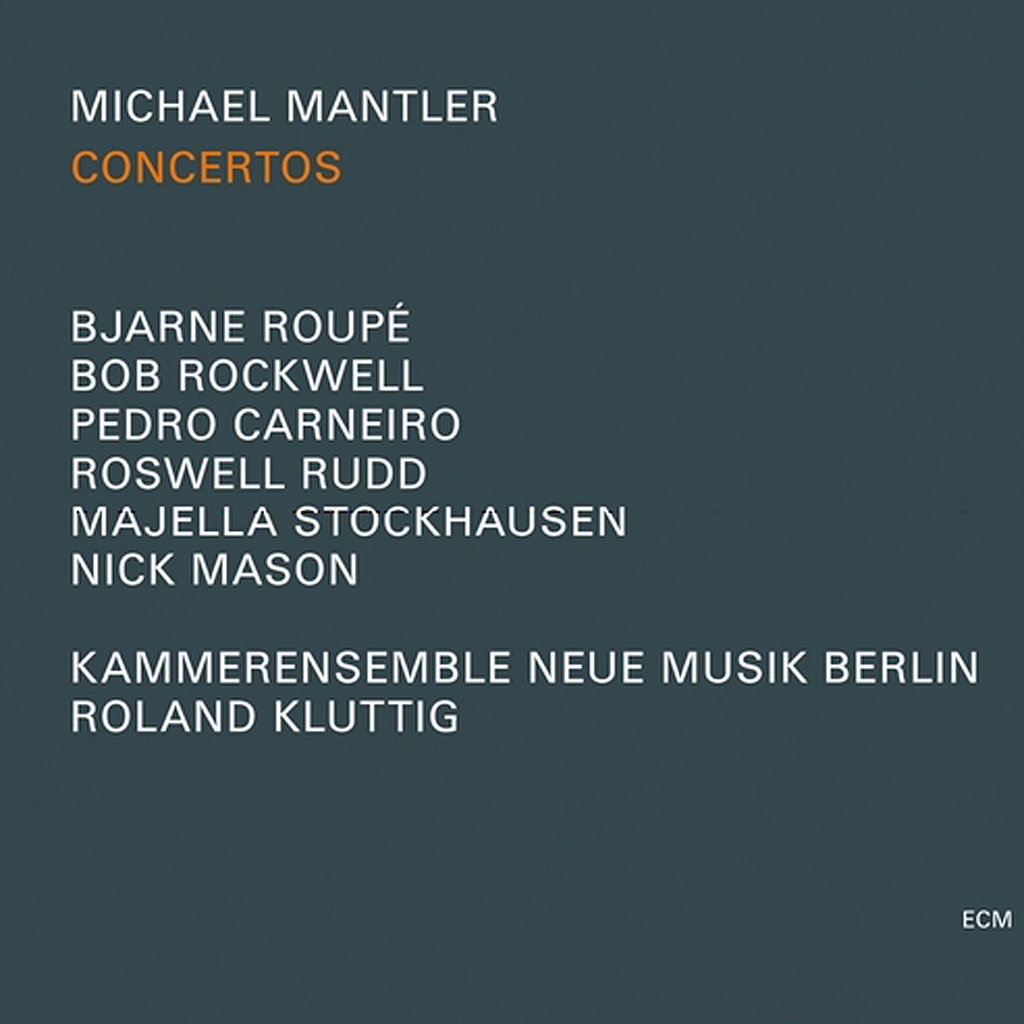
Michael Mantler: CONCERTOS (ECM 2054)


Michael Mantler
CONCERTOS

Michael Mantler trumpet
Bjarne Roupé guitar
Bob Rockwell saxophone
Pedro Carneiro marimba, vibraphone
Roswell Rudd trombone
Majella Stockhausen piano
Nick Mason percussion
Kammermusikensemble Neue Musik Berlin
Roland Kluttig conductor
Recorded November 2007
Kaleidoscope Sound, Union City, NJ
RBB Radio Studio 2, Berlin
Studios La Buissonne, Pernes-Les-Fontaines

As one who grew up in the polarized Vienna music scene, journeyed at 19 to New York (where he founded the Jazz Composers’ Orchestra and the WATT music label), and returned to Europe in 1991, Michael Mantler is, writes Bert Noglik in his liner notes, “truly nowhere at home, a drifter seasoned in the role of creative outsider, uniting the perspective of two continents and two cultures. He views music from the twin vantage points of the elaborated European tradition and the American rebellion in jazz—a rebellion that sought to topple every convention applicable to date.” This is Mantler’s first album of new material since 2000’s Hide and Seek and a lively testament to an ever-productive musical mind. Like the far-reaching constructions of Heiner Goebbels, Mantler never fails to work his indiscriminate way into our attention, even if his expressive quirks thrive on a rather different brand of theatricality.

The present album is a series of seven self-styled “concertos,” each scored for a different soloist along with a chamber ensemble under the direction of Roland Kluttig, whom Eberhard Weber listeners may remember from his Stages Of A Long Journey. All of the solo instruments are included (with the possible exception of the saxophone) in the ensemble at large at some point throughout the album, each surfacing like a jazz soloist in a protracted suite.

The first concerto, Trumpet, features Mantler himself as soloist. His improvisations are clear, acute, and vocal in character, acting with the confidence of a seasoned performer (somewhat ironic, given that Mantler is known for his reticence in this regard). Any agitation to be found in this piece is undercut by whimsy. Compelling Rypdal-like strains from Bjarne Roupé temper Mantler’s jagged lines while also providing a lovely segue into the guitar concerto that follows. The latter is a far more delicate piece relative to its surroundings. Brass and winds clamber for a view on the sidelines as piano and guitar frolic in the center toward a transcendent finish. Saxophone feels confined at first, but opens up as the violins gather clout. A marimba warms the air before taking center stage. MarimbaVibe is the most disturbed turn of phrase, caroming uncontrollably between disparate spheres of influence. It ends on another enigmatic note, made all the more ethereal for its indifference. Jazz Composers’ Orchestra veteran Roswell Budd is phenomenal in Trombone. His soulful sound cries with an almost street-savvy flair in the narrative of a life lived on the margins, yet which is anything but marginal in the centrality it occupies here. Its bursts of energy, always co-opted by a certain dismal zeitgeist, make for an honest though hard-to-swallow tale. Piano brings our attention to a voice that has been an integral presence for most of the album thus far. It is the instrument from which all of this music has sprung, yet which now desires its own liberation from acoustical symbiosis. It’s a rather “messy” piece, like a sharp image evenly smeared with finger-paints that attains its own abstract cohesion: an impossible kaleidoscope, devoid of symmetry. The dynamic performance here comes from Majella Stockhausen, daughter of the late Karlheinz. The final concerto, Percussion, is no less musical than its predecessors. Pink Floyd’s Nick Mason provides the beat, ringing out his snare with the conviction of a melodic battalion and bringing the album to a fine close with his delicate cymbal work.

Listening to Mantler is an experience that only grows with time. His music is fully invested in its own knowledge production and is never afraid to flaunt it in a world in which resonance has become a long-lost dream. It speaks in poetry, but moves in prose. Or is it the other way around?

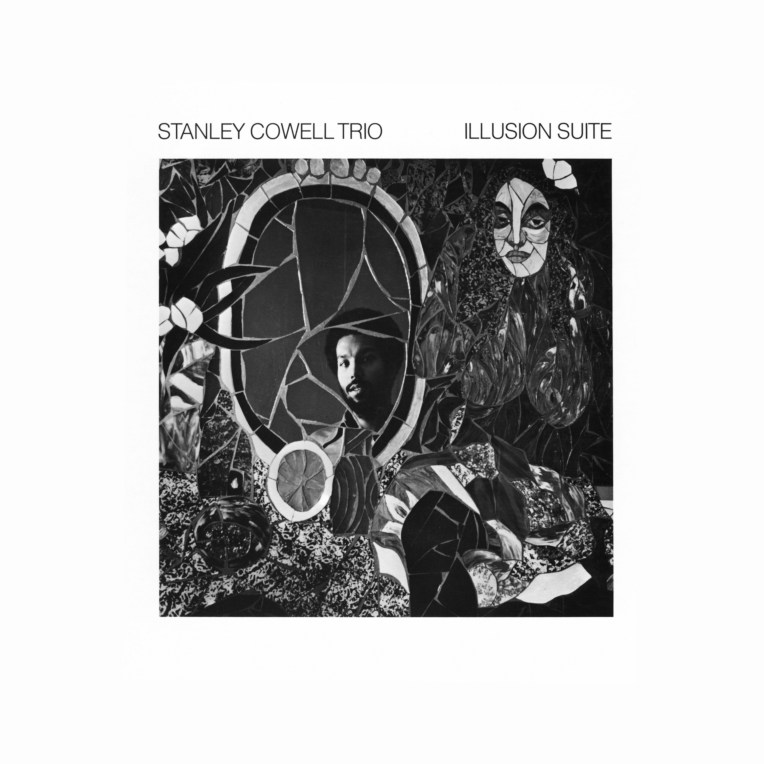
Stanley Cowell Trio: Illusion Suite (ECM 1026)

ECM 1026

Stanley Cowell
Illusion Suite

Stanley Cowell piano
Stanley Clarke bass
Jimmy Hopps drums
Recorded November 29, 1972, Sound Ideas Studio, New York
Engineer: George Klabin
Produced by Manfred Eicher

Human beings are adventurous eaters. We are constantly trying new things, loving some and hating others. We change our diets drastically, watching our calories and tallying every morsel we ingest. But sometimes, in the throes and woes of a food culture gone horribly awry, we just want to sit down to a good plate of comfort food, for nothing seems able to replicate the psychological benefits it provides. Stanley Cowell’s Illusion Suite is like that: a heaping portion of comfort food.

Backed by steady support from Stanley Clarke on bass and Jimmy Hopps on drums, Cowell delivers the goods and then some. The timid opening strains of “Maimoun” betray none of the album’s subsequent drive. A confident beat and bowed bass ease us into Cowell’s denser style, made all the more elegiac for its frequent use of octaval doublings in the right hand. (Incidentally, an alternate version of this track worth checking out can be found on Marion Brown’s 1975 Vista.) Cowell kicks off “Ibn Mukhtarr Mustapha” with a sporadic run across the piano before making a deft switch to his electric. Before long, this arid groove quiets into a percussion-heavy outro, bristling with African thumb piano. “Cal Massey” brings us into bop territory, with a great drum kick and deliciously twangy bass line to boot. Smooth is the name of the game is “Miss Viki.” Its fluid bass and wah-pedaled electric piano show off a cool sense of style and finesse. “Emil Danenberg,” named for a former director of the Music Conservatory at Oberlin College in Cowell’s home state of Ohio, is the album’s only ballad to speak of. Its raw, complex chords run straight into the darkest alleys of our internal cities. “Astral Spiritual” is a bit more straightforward, and features some quick turns and fancy musicianship all around. Spectacular drumming and astute pianism abound, ending unexpectedly on a downtempo turn, like an abandoned swing coming to rest. Nostalgic, thought-provoking, and tender, this is fantastic music from a gifted composer and performer that is now easily available thanks to an ECM digital reissue.

<< Ralph Towner with Glen Moore: Trios/Solos (ECM 1025)
>> Dave Holland Quartet: Conference Of The Birds (ECM 1027)

Terje Rypdal: s/t (ECM 1016)

ECM 1016

Terje Rypdal

Terje Rypdal guitar, flute
Inger Lise Rypdal voice
Ekkehard Fintl oboe, English horn
Jan Garbarek tenor saxophone, flute, clarinet
Bobo Stenson electric piano
Tom Halversen electric piano
Arild Andersen electric bass, double-bass
Bjørnar Andresen electric bass
Jon Christensen percussion
Recorded August 12 & 13, 1971, Bendiksen Studio, Oslo
Engineer: Jan Erik Kongshaug
Produced by Manfred Eicher

Terje Rypdal’s first ECM effort as frontman is a bewitching look into the Norwegian guitarist’s formative years. With a bevy of talented musicians in tow, he forges a mercurial portrait of late-night melodies and hidden desires. “Keep It Like That – Tight” is stifling and seedy, buffeted by cooling fans and laced with the fumes of an alcoholic haze. It’s a desolate hotel room where more than evening falls, a cigarette put out on the skin, incoherent words spilling from warm lips. The atmosphere is acutely palpable, oozing with film noir charisma and slurred speech. Garbarek spins a notable solo here, only to be overtaken all too soon by Rypdal’s drunken swagger. One might think this would be a taste of things to come, but Rypdal surprises with “Rainbow,” a most ethereal track laden with reverb and stratospheric beauty, dominated by oboe for a more classical sound. The background clinks and hums with a variety of percussion, bowed electric bass, and flute. The third track, “Electric Fantasy,” lies somewhere between the first two, a jazz suite with symphonic flavor. Rypdal’s former wife Inger Lise adds some moody vocals as an English horn expands the sound even further. Illusive drumming from Christensen and the occasional wah-wah guitar add dynamic touches of their own. The ambient crawl of “Lontano II” reverses the opening effect by leading into the more blues-oriented “Tough Enough,” leaving a grittier aftertaste.

The striking differences in instrumentation between tracks may be off-putting to some, while others may see it as part of a larger concept. Either way, this self-titled album is thematically rich and more than worth the listen.

<< Jan Garbarek Quintet: Sart (ECM 1015)
>> Keith Jarrett: Facing You (ECM 1017)

Food: Quiet Inlet (ECM 2163)

Food
Quiet Inlet

Thomas Strønen drums, live-electronics
Iain Ballamy tenor and soprano saxophones
Nils Petter Molvær trumpet, electronics
Christian Fennesz guitar, electronics
Recorded live in Norway, 2007/08
Produced by Food and Manfred Eicher

The earth is very still, like an infant asleep. Into a quiet inlet, a streamlet is falling. It is singing to the sleeping earth, telling it of the days to come when the great silence shall be broken by the voice of man, and life shall fill alike the darkling wave and the sunlit field.
–T. A. Rickard, “A Story in Stone”

Considering the distinct lyrical path Food has been forging since 1998, it was perhaps only a matter of time before the group would migrate into ECM territory. The guest appearance of Nils Petter Molvær is therefore a no-brainer. Fans of Molvær’s work will feel like they are slowly falling into the Norwegian trumpeter’s waking dreams. The results are an undeniably unique blend of nu jazz sensibilities and ritual melodic power.

“Tobiko” opens with metallic percussion against a cascade of synths and muted beats. A radio dial is tuned, reaching through the airwaves as if for a familiar voice to latch onto. Only then does Ballamy’s sax rise to the surface of this oceanic passage: if our ears are vessels, then here is the dolphin swimming silently alongside them. Before long, live drums make their presence known and lead us out of the fog. Having shown us the way, our guides then recede into the darkness, where light and sonar dare not venture. “Chimaera” is a gentler number. Sax lines continue their passage as percussion and electronics cocoon them with deep thematic threads, free-flowing and heavenly. “Mictyris” is distinguished by Strønen’s intense rhythmic drive, over which we encounter some fantastic electronics that sound as if a sax were being torn apart and rebuilt as a train whistle. Tight drumming, combined with the protracted ambient wash in the background, meshes wonderfully with Ballamy’s constellate reed work. “Becalmed” builds itself around a repetitive leads motif, its aftereffects ever ghostly and omnipresent. Whether intentional or not, this track also contains oblique references to Eleni Karaindrou’s “Parade” from the film Happy Homecoming, Comrade. “Cirrina” and “Dweller” both flow with Molvaer’s distinct sound, seeming to revel in their grace and liberation from formulaic constraints, while “Fathom” ends the album bittersweetly, as if the music were looking into a mirror, unsure of what it sees.

The electro-acoustic sound honed on Quiet Inlet works wonders at every turn. And on that note, it’s inspiring to see a wonderful artist like Fennesz crossing over into the ECM circuit. Let’s hope this is a sign of things to come.

(To hear samples of Quiet Inlet, click here.)

Gary Burton: The New Quartet (ECM 1030)

1030 X

Gary Burton
The New Quartet

Gary Burton vibraphone
Mick Goodrick guitar
Abraham Laboriel bass
Harry Blazer drums
Recorded March 5/6, 1973 at Aengus Studios, Fayville, Massachusetts
Engineer: John Nagy
Produced by Manfred Eicher

One needs only to catch the first few licks of “Open Your Eyes, You Can Fly” to know this album represents an era that can never be recaptured. Burton does wonders with the Chick Corea tune, lifting its upbeat soul to the greatest heights of creative pleasure. One can almost taste the freshness of his sound, the sheer newness of vision and synergy of musicianship ingrained into every moment of this phenomenal record. This was another early disc that managed to fall under my radar until I sought to review it. Burton is always a supreme joy to listen to, and with this, his second ECM appearance, he certainly made a profound statement. Burton himself contributes one composition, the enchanting “Brownout,” which takes full advantage of the rhythmic precision of his backing trio for a deft volley of restraint and abandon. Two Gordon Beck tunes provide the most robust flavors in this thickening stew, balancing the smooth full-ensemble nosh of “Tying Up Loose Ends” with the infectious full course of blistering key changes and nimble flair that is “Mallet Man,” the album’s centerpiece. The ballads are haunting and moody. “Coral” (Keith Jarrett) proves just how soulful vibes can be, while “Olhos De Gato” (Carla Bley), with its seedy undercurrent and humid climate, slinks like its namesake, stalking the edges of the night. Two Mike Gibbs tunes, “Four Or Less” and “Nonsequence,” round out the set on a more playful note, making dramatic use of pauses and a wider variety of textures.

Gary Burton is synonymous with the vibes. And while I had long been one of countless admirers of his technical and melodic acuity, this album was nothing short of a revelation for me. The technique is flawless all around and glistens with Burton’s Midas touch. He contacts his instrument like fingers walking up a spine, never missing a single nerve along the way. Yet one cannot commend this album without also praising Goodrick’s phenomenal guitar work, Laboriel’s quick-witted ornaments, Blazer’s unrelenting dedication to the moment, and the astounding unity the ensemble as a whole manages to uphold. The overall balance comes across as joyously democratic, and all with a fresh-off-the-boat sound that surprises at every turn. There isn’t a single errant note, gesture, or idea to be found on The New Quartet. From start to finish, an inimitable achievement.

<< Garbarek/Andersen/Vesala: Triptykon (ECM 1029)
>> Terje Rypdal: What Comes After (ECM 1031)

Marilyn Crispell/David Rothenberg: One Dark Night I Left My Silent House (ECM 2089)


One Dark Night I Left My Silent House

Marilyn Crispell piano, soundboard, percussion
David Rothenberg bass clarinet, clarinet
Recorded March 2008 by Chris Andersen at Nevessa Production, Woodstock
Produced by Marilyn Crispell and David Rothenberg

In the dark I the bird can pretend, in light I am overdoing it,
pretending to be what I’m not, like art, like imagination.
–David Rothenberg, Always the Mountains

Having only been familiar with David Rothenberg through my own interest in animal studies, which had already led me to his unique book Why Birds Sing, imagine my delight when his name showed up on the latest release from my favorite label—and alongside one of its most singular talents, no less. His meditative improvisations with Marilyn Crispell have produced one of the most delightful surprises of 2010.

This album is fluid yet abstract, often devoid of melodic traction, but is bound by a certain poignancy that I find utterly engaging. Take, for example, “Stay, Stray,” which begins with airy chords but quickly turns introspective, even regretful, but is nevertheless boldly committed to its indeterminate purpose. Goal-oriented is what this music most certainly is not. Rather, it surrenders to the dynamics of the moment, to the gravity of performance, and to the possibilities of material interaction. In the latter vein, a number of tracks feature Crispell playing an old upright piano soundboard, from which she elicits a playful metallic accompaniment. It is part of her attempt, in Rothenberg’s words, to “get away from the keyboard, more into the realm of pure sound.” In tracks like “Still Life With Woodpeckers,” these sounds are blatantly foregrounded, while in others they linger like ghosts. “The Way Of The Pure Sound (for Joe Maneri)” begins with low-blown notes, sounding almost like a didgeridoo, and walks its line faithfully over Crispell’s exploratory ruminations on the very innards of her chosen instrument. “Tsering” lies somewhere between the two, featuring strings plucked with the fingertips and a few carefully placed notes on the keyboard proper. The unspoken communication between the two musicians is always clear, especially in “What Birds Sing,” “Companion: Silence,” and “Owl Moon.” Even in the more adventurous moments found in “The Hawk And The Mouse,” “Motmot,” “Grosbeak,” and “Snow Suddenly Stopping Without Notice” maintain a mutual delicacy that binds them as a whole. And it’s hard not to be won over by the frailty of “Evocation,” which sets the album adrift on a most dreamlike reverie.

Despite the nocturnal imagery implied by its title and cover art, One Dark Night fills my imagination with summer. The opening “Invocation” in particular drips like molasses in sunlight, evoking a hot and humid environment, somewhere rich in agriculture. The piano is like a planted seed, resting quietly in the soil, and the clarinet its first shoots, caressed by the wind, fed by the rain, and pulled from silence by the unblinking eye of the sun. Rothenberg always seems to be putting on a severe frown, like that of a tragedy mask—which is to say his sound is carefully sculpted and symbolic of a long dramatic history. His approach is rooted in nature and survival and rests comfortably on the organic foundation Crispell so lovingly provides. Both of them seem to grasp every ribbon of sound and to blindly follow wherever it might lead. If anywhere, this is where the darkness comes in, forging through that blindness a light of one’s own making, a certain sense of being that is internally of the night, even as it basks in the nourishing glare of its harvest. This may not be the most versatile music, but I think for the right mood and occasion it captures something that cannot be expressed any other way.

Dave Holland/Derek Bailey: Improvisations for Cello and Guitar (ECM 1013)

1013

Improvisations for Cello and Guitar

Dave Holland cello
Derek Bailey guitar
Recorded live at the Little Theater Club, London, January 1971
Release date: October 15, 1971

One’s not half two. Its two are halves of one… All lose, whole find.
–e. e. cummings

If you’ve ever picked up a guitar and played those short strings between the end of the neck and the pegs and wondered if one could make viable music with that kind of sound, then look no further, for that is precisely the pinpoint aesthetic captured on this rare recording. These improvisations are miniscule and entomological, whispering with the nocturnal regularity of a cricket. Holland and Bailey shift from pops and plucks to more sustained tones at the drop of a hat, but always with an ear keenly tuned to the other player. The two take full advantage of extended techniques to create a wide palette of sounds. These are delicate pieces, but no less full of verve and character for their utter precision. Sometimes the music is incredibly expansive. Other times it seems to implode, by turns galactic and subterranean. Because both musicians are so skillful at what they do, one can truly appreciate the spontaneous dynamics of their playing, the ways in which they react and prompt each other into action. They are never afraid to take separate paths, for they always seem to rejoin, and in doing so they add seemingly endless variety as the energy flows and ebbs. It’s always fascinating to hear Dave Holland’s earlier work, and this meeting with Bailey is certainly an archival treat.

<< Stenson/Anderson/Christensen: Underwear (ECM 1012)
>> Chick Corea: Piano Improvisations Vol. 1 (ECM 1014)

Adelhard Roidinger: Schattseite (ECM 1221)

ECM 1221

Adelhard Roidinger
Schattseite

Adelhard Roidinger bass
Heinz Sauer tenor saxophone
Bob Degen piano
Harry Pepl guitar
Werner Pirchner vibraharp, marimba
Aina Kemanis voice
Michael DiPasqua drums, percussion
Recorded November 1981 at Tonstudio Bauer, Ludwigsburg
Engineer: Martin Wieland
Produced by Manfred Eicher

It’s unfortunate that Adelhard Roidinger only cut this one record for ECM. The Austrian-born Renaissance man seems to have been a perfect fit for the label, which by the time of this release (1982) had firmly established its aesthetic hold on the jazz market. Schattseite has a lush, airy sound that is always appealing, and what better way to draw us in than with the slow-moving “Fü Pfü.” The soloing is crisp all around: gorgeous vibe work from Pirchner, Pepl’s soft guitar licks, DiPasqua’s tender drumming, a fluid run from Sauer on tenor sax, and an alluringly pianistic turn from Degen all make for a crystalline opener, and Roidinger’s plaintive accompaniment pulls it all together with humility. There is much stopping and starting, as if the music were afraid to latch on to a memory it knows could be self-destructive. Next is “Lufti,” a delightfully overdubbed bass duet, interrupted by occasional glissandi for a playful effect. “Loveland” fades in on a sweet piano riff doubled by Aina Kemanis’s brassy vocals, evoking the distinctive sound originally forged on Return to Forever. Roidinger harmonizes with the lead motif, blending into another mercurial leap from Pirchner, this time on marimba, supported by a delicate repeat of the same progression sans voice. The fantastic sax solo and Metheny-esque picking lend even more elegance to the track’s progressive sound. “Stress” begins with a bowed electric bass, caressing the air like whale songs. Sauer introduces the main line, again doubled by Kemanis, before Roidinger steps in to offer some regularity, thereby allowing Deger more room to flex his fingers. “Ania” starts with laughter, or something like it. Out of this abstract pointillism comes an engaging chant, throughout which Pepl jauntily strums his way along. The album closes with its longest track, “When Earth Becomes Desert,” which steadily moves from haunting drones to an all-out improv-fest. The marimba is unusually present here, and I wouldn’t be surprised if it was miked differently, if not added in postproduction. The final minute brings us slowly back down with a gorgeous melody in tutti.

Although Schattseite does take a while to find its groove, whatever it may lack in drive it makes up for in atmosphere and melodic robustness. This is an album of exceptional sound and quality, and is like the audio equivalent of a scenic route: it may get you to the same destination, maybe even less efficiently, but its allure is such that by the time you near the end, you no longer care where you were going. In dire need of a reissue.

<< Mike Nock: Ondas (ECM 1220)
>> Paul Motian Band: Psalm (ECM 1222)

Stenson/Andersen/Christensen: Underwear (ECM 1012)

1012

Underwear

Bobo Stenson piano
Arild Andersen bass
Jon Christensen percussion
Recorded May 18/19, 1971 at the Bendiksen Studio, Oslo
Engineer: Jan Erik Kongshaug
Produced by Manfred Eicher
Release date: September 15, 1971

With such a solid trio of musicians and a name like Underwear, you just know this one’s going to be good. And sure enough, Stenson kicks things off just right with the spirited title track, throughout which every instrument bubbles in a witches brew of fine flavors. Exuberant drumming, flurried bass lines, and a tightly knit sense of composition make this one of the great openers of ECM’s extensive jazz lineup. Hot on its heels is “Luberon,” the album’s requisite ballad, the placement of which both emphasizes the liveliness of the opener while also bolstering its own lyrical sensibilities. “Test” lays on a more organic sound of percussion and scraped piano strings. This delicate backdrop continues as Stenson breaks into a clearly defined melodic improvisation, prompting cries of ecstatic joy before succumbing to a forced fadeout. “Tant W.” brings us into more laid-back territory with its alluring conversation between piano and drums. Once the bass joins in, the groove becomes certifiably infectious. After this block of Stenson originals, we are treated to a pair of fine closers. Ornette Coleman’s “Untitled” runs with reckless abandon through frenzied pyrotechnics, priming us for the comforting “Rudolf” (Andersen). The latter’s fluid piano intro becomes the heart of the piece, echoing in an otherwise bass-dominant space.

Stenson is entirely on point, as if he were inborn with a finely attuned sense of melody and articulation. His playing is democratic and guides with a gentle hand, always managing to cover so much of the keyboard in a single cut. Andersen’s busy fingers provide the album’s backbone, while his gorgeous vibrato and twang-ridden charm work wonders in the softer moments. And Christensen’s drumming never fails to excite. Triply inspired soloing and a synergistic core make Underwear a prime choice for the ECM newbie and veteran alike. A simply fantastic album, this is one for the ages.

<< Dave Holland/Barre Phillips: Music From Two Basses (ECM 1011)
>> Dave Holland/Derek Bailey: Improvisations for Cello and Guitar (ECM 1013)