Ralph Towner: Diary (ECM 1032)

1032 X

Ralph Towner
Diary

Ralph Towner 12-string and classical guitar, piano, gongs
Recorded April 4 and 5, 1973
Engineers: Kurt Rapp and Martin Wieland
Produced by Manfred Eicher

This is about as intimate as music gets. Diary features Towner on guitars and piano via overdubs, creating a layered sound that is at once dialectical and univocal. The recording gives Towner vast space in which to work, pushing his reach ever skyward. His guitar lines drip like liquid mercury, beading apart and reforming in continually novel ways. As with much of Towner’s work, Diary gives us a series of pictures, or perhaps even an array of lenses through which to view the same scene from different perspectives or times. “Icarus” is a resplendent duo for 12-string guitar and piano that erupts into a stunning passage of plucked harmonics accompanied by bursts of piano improvisation. Though one of Towner’s most beloved compositions, nowhere else does it sparkle with such effervescence. “Mon Enfant,” a traditional tune and the only non-original in this set, is lovingly arranged for the temperate give of nylon. “Ogden Road” is another 12-string/piano number, the scope and feel of which seem to presage the epic tendencies of Steve Tibbetts. “Erg” is an invigorating piece for two guitars, one of which Towner scrapes, jangles, and taps to furnish a uniquely rhythmic backdrop. As coda we have the lovely “The Silence Of A Candle” for piano alone. Overall, Diary stays true to its subtle convictions. And while more abstract tangents like “Images Unseen” may feel somewhat less realized than other pieces, they never fail to welcome the listener into their frustrations and fears. That being said, an intriguing indifference coheres the album, as if born of the thrill of charting new territory: the explorer’s heart is struck with such awe that all people and circumstances leading up to that moment seem to fade into the most unreachable recesses of memory. Yet once the discovery has been made, all of it comes rushing back. This is precisely what a diary does, turning the past into the present through the act of inscription (recording) so that one can uphold that past later as a tangible object of scrutiny or validation, a log of one’s journey to “getting there.”

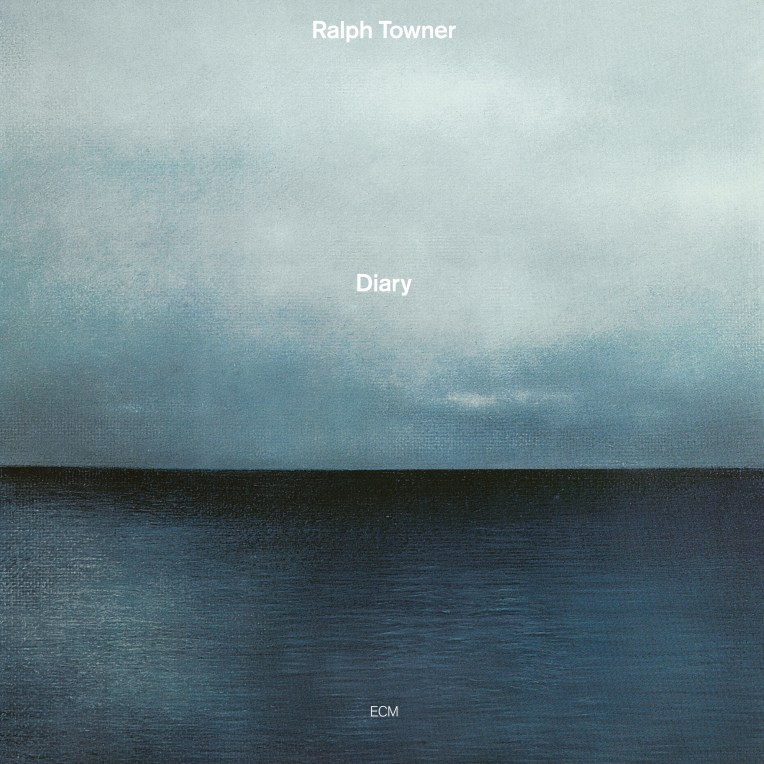
As the cover art would imply, this music is two-thirds stratospheric, one-third oceanic, and accordingly played with grace and undulation. Every instrument and sound is the result of careful thought and choice, and the deeply considered arrangements are delectable. The 12-string is a mainstay of Towner’s repertoire, and what he does with the instrument is nothing short of inspiring. Having first discovered Towner through his solo guitar music, I was pleasantly surprised by how suitably well his duly inspired piano riffs complement this album. Towner has everything he needs at his fingertips: a full-fledged percussion section, lead voice, and accompaniment. The one thing missing in his ensemble is you, the listener.

<< Terje Rypdal: What Comes After (ECM 1031)
>> Keith Jarrett: In The Light (ECM 1033/34)

Art Lande/Jan Garbarek: Red Lanta (ECM 1038)

ECM 1038

Red Lanta

Art Lande piano
Jan Garbarek flutes, soprano and bass saxophones
Recorded November 19 and 20, 1973 at Arne Bendiksen Studio, Oslo
Engineer: Jan Erik Kongshaug
Produced by Manfred Eicher

Normally, I eschew from making the kind of comparison I am about to make, but here it goes: What do you get when you take Edvard Grieg, throw in a little jazz, some improvisatory flair, a touch of abstraction, and blend until smooth? Why, the delightful record that is Red Lanta, of course.

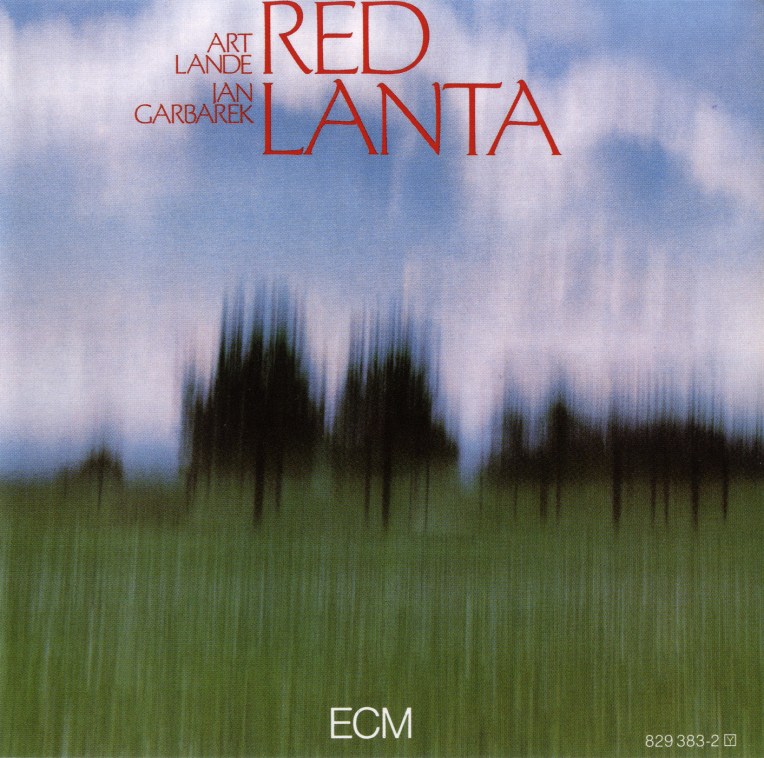
While a set of pieces for piano paired with either flute or reed may not sound like everyone’s cup of tea, for those who like tea this should do the trick just fine. Constructed around the compositional talents of Art Lande, the music seems to cry for larger arrangements, but still sounds beautiful as it is represented here. The atmosphere is verdant and open, as blearily pastoral as its cover. The playing is top-notch throughout, though the tracks featuring Garbarek’s flute playing stand out for me, especially “Waltz for A” and, of course, the eclectically beautiful 11-minute “Awakening, Midweek.” The combination is superb and perfectly embodies ECM’s penchant for recording jazz with a chamber music sensibility. A piano-only medley in the second half serves as a nice breather from the intense reed work before plunging us into the galactic final act.

This is diurnal music of the highest order and is suitable both for deep listening and as the soundtrack for any leisurely activity. Garbarek is all a-glitter in as coaxing a performance as I have ever heard from him. Certainly not one to be missed if “mellow” is your preferred mode of operation.

<< Keith Jarrett: Solo Concerts Bremen/Lausanne (ECM 1035-37)
>> Dave Liebman: Lookout Farm (ECM 1039)

Keith Jarrett: The Köln Concert (ECM 1064/65)

ECM 1064-65

Keith Jarrett
The Köln Concert

Keith Jarrett piano
Recorded January 24, 1975 at the Opera in Köln, Germany
Engineer: Martin Wieland
Produced by Manfred Eicher

I have a confession to make. One that borders on blasphemy for a professed ECM fanatic such as myself: before writing this review I had never heard The Köln Concert. What is perhaps the most highly revered, and certainly the best-selling, album in the ECM catalog has managed to escape my ears all these years. Part of me wanted to save the experience for the right moment, while another had possibly been afraid that I might not like the album. Whatever the reason, I am happy to say that the wait is over…and it has been more than worth it.

The story behind this recording has, of course, already become the stuff of legend. On a dreary January day in 1975, Jarrett arrived at the Köln (Cologne) Opera House fatigued and malnourished and was bid to play on an inferior piano designed for rehearsals and not for live performance. As a result, the concert was almost never recorded. One can read about Köln lore ad nauseum elsewhere, not least in the album’s liner notes, so let’s have nothing more to do with it. The Köln Concert deserves to be listened to as it was created: without borders and without assumptions. And so, last night, as I lay awake in bed unable to sleep, I decided that it was time to fill this gaping hole in my listening life. With the lights already off, I put on the album and let the music take me wherever it wanted to take me. All I can offer in return is the following “travel diary” in honor of Jarrett’s achievement.

The opening chords of Part I set us upon an almost otherworldly path, providing gospelly signposts along the way to remind us of home. The music brims with the need for release, but Jarrett seems to want to hold onto it for as long as he can before its messages are lost forever. There is a persistence to his playing that speaks of countless internal dialogues all vying for attention. Delicate phrasing is suddenly punctured by a rhythmic depressing of the sustain pedal before flowering into an open exposition of higher energy. The music cascades as Jarrett’s voice careens off its towering contours when, just as suddenly, the majesty is swapped for an intimate chamber within its walls. Shadows of a former empire loom large, tethered by ecstatic cries.

Jarrett picks up the pace during the second act, moving from the elegiac to the frantic. Everything “fits,” joined by the same threads: a patchwork in which every seam is uniformly sewn. The progression is as lush as can be. It is as dense as a forest, and just as ordered in its own way. Jarrett brings us to a clearing, only to make us aware of the silence we left behind. So we turn around and jump right back into the thick of things as he expands his architecture to greater depths, carving out a subterranean labyrinth of cavernous sound that will never be charted again. The encore (labeled “Part IIc”) is both a montage of what came before and a preview for that which has yet to arrive.

It might seem clichéd to write this, but sometimes there are moments in one’s musical life that are simply magical. Clearly, Jarrett experienced over an hour’s worth of such moments here, and we are fortunate enough to be able to experience them ourselves, if only vicariously through the mediation of technology. Jarrett seems to know the piano’s vocabulary as well as his own speech, which might very well explain the involuntary vocalizations for which he is so often criticized. Structurally, the album could hardly be simpler: a series of vamps provide ample ground for floating improvised lines that stick primarily to the piano’s middle range. And yet, the scope of his vision is staggering in its implications. Jazz is Jarrett’s anchor, even if the voyage does carry him far beyond its generic boundaries. The applause only heightens the spell, reminding us that what we have just heard is indeed of this world, and was shared spontaneously with a crowd of our peers.

Despite what some might have you believe, by no means should this be anyone’s only Keith Jarrett experience. It needn’t even be one’s introduction. As sublime as it is, it is but one of many formative and breathtaking examples of his prolific output. This album is a lullaby for anyone who has no need for slumber, and Jarrett’s heartfelt voice explicitly conveys the rapture of living in the moment, his vocal interjections enhancing the “live” feel considerably and making for an even more visceral document.

<< Enrico Rava: The Pilgrim And The Stars (ECM 1063)
>> Eberhard Weber: Yellow Fields (ECM 1066)

Corea/Holland/Altschul: A.R.C. (ECM 1009)

A.R.C.

A.R.C.

Chick Corea piano
Dave Holland bass
Barry Altschul percussion
Recorded January 1971 at Tonstudio Bauer, Ludwigsburg
Engineer: Kurt Rapp
Produced by Manfred Eicher
Release date: April 15, 1971

A.R.C. documents Chick Corea at the cusp of a major leap of intuition. Whether that transition was worthy of being recorded is debatable. The Wayne Shorter tune “Nefertitti” (sic) kicks things off to a grand start. Unfortunately, with the next tune, that spark seems to fade as quickly as it is ignited. With the exception of “Vedana” (Holland), the rest of the album is filled out by Corea originals which, while they may not have the same panache, do provide plenty of joyful moments…just not enough of them.

This cursory set churns out some gritty work from Holland, with Corea and Altschul also in fine form, yet overall the album lacks structure. There is little progression from one cut to the next. For instance, “Thanatos” intrigues at first with its slow fade-in until one gets a handle on the rather disjointed goings on. The subsequent fadeout comes across as formulaic and feels more like an afterthought in the studio than part of the original spirit of the piece.

1009
Original cover

Considering the shoes these three musicians had to fill, not only of their own mounting reputations but also those of the established greats with whom they had played in the recent past, their timing or energies simply may not have been on the same wavelength when this session was recorded. Still an album worth checking out, if not for its historicity, then at least for its stellar opening.

<< Robin Kenyatta: Girl From Martinique (ECM 1008)
>> Paul Bley: Ballads (ECM 1010)

Keith Jarrett: Facing You (ECM 1017)

ECM 1017

Keith Jarrett
Facing You

Keith Jarrett piano
Recorded November 1971 at Arne Bendiksen Studio, Oslo
Engineer: Jan Erik Kongshaug
Produced by Manfred Eicher

Keith Jarrett will always be something of an enigma to me. Not because he is more than human, but because he plays with an honesty that is practically unfathomable. His melodies have a way of spiraling in on themselves and the effect is intoxicating.

This seminal album (his first for ECM) arguably finds Jarrett at his most focused and at his most transparent. Every note seems perfectly placed. His intuition is on fire here and we are only too happy to be engulfed along the way. “In Front” establishes a flavorful and scintillating mood from the get go before taking things down a notch with a requisite set of ballads. Of these, “My Lady, My Child” is achingly beautiful and gets only more so as it unspools. “Starbright” lifts the spirits with a shade of whimsy and gushes with the natural force of a breached dam, with “Vapallia” comprising its final trickles. Last but not least is “Semblence,” which rolls and bounces with the sheer exuberance Jarrett is known for.

What can one say about Jarrett’s performance style? Words like “fluid” and “unbridled” don’t even begin to capture it. His fingers seem to have minds of their own, anticipating each and every note before the next key is struck. Jarrett transcends the rubric of improvisation into something else entirely: improvisition. By this, I mean that his ability to call upon the music to speak is so compositionally disguised that it can only occur when one surrenders oneself to the freedom of the empty score. This produces not objective music, but rather the utmost subjective experience one can have with an instrument.

While Jarrett has been given all the credit for instituting the solo piano as a viable instrument beyond the confines of classical music, let us not forget his wonderful predecessors on ECM (and whose work I have previously reviewed on this blog). This disc is, I daresay, downright groovy. A real discovery to be treasured. Just listening to it makes me want to contort my face and screech along as if I were the one at the keys.

Essential.

<< Terje Rypdal: s/t (ECM 1016)
>> Circle: Paris Concert (ECM 1018/19)

Chick Corea: Return To Forever (ECM 1022)

Chick Corea
Return To Forever

Chick Corea electric piano
Joe Farrell flutes, soprano saxophone
Flora Purim vocal, percussion
Stan Clarke basses
Airto Moreira drums, percussion
Recorded February 2 and 3, 1972 at A & R Studios New York City
Engineer: Tony May
Produced by Manfred Eicher

I fist heard Chick Corea when a jazz pianist friend of mine, knowing how much I loved ECM (I was mainly listening to New Series releases at the time), lent me a copy of this album. For whatever reason, it did not make much of an impression on me. In retrospect, I don’t feel like I was at the right point in my life to welcome such music into my heart. Fast forward some ten years later, and now I can hardly listen to it at all without being overwhelmed by its magic. Fresh from his work with Miles Davis et al., Corea forged a new personal direction with this “electrifying” album, the title of which later spawned a super group of the same name that would become a lasting institution, albeit with a roving lineup, through the late 1970s.

One can hardly listen to Return To Forever without first noting its distinctive mesh of sound. Stan Clarke keeps things running smoothly on bass, and Brazilian jazz singer Flora Purim gives us evocative (sometimes wordless) vocals throughout while her husband Airto Moreira provides ample rhythmic springboards for Corea’s electric piano acrobatics and Joe Farrell’s windy passages on sax and flute. Each instrument is like a voice in a small choir, and the album has been recorded accordingly. Certain passages, like the well-known “Crystal Silence,” dim the lights with a more trio-like aesthetic, but overall the sound is vast and unified. “What Game Shall We Play Today” puts the spotlight on Purim and is a lovingly arranged song that adds just the right amount of color to the album’s palette. Bookending the album are two epic pieces. The opening title track is actually a series of shorter numbers that flow into one another with such continuity that one almost doesn’t notice the pauses, and closes with some impassioned ad-libbing from Purim. At the other end of the spectrum is “La Fiesta” which, after an improvisatory intro, once again features Purim at the helm, leading the way for some inspired solos from Farrell and Corea.

Of all the fine musicians on this set, I cannot help but single out Clarke for his sumptuous bass playing. Never rushed and never forced, his lines thread every needle with unfailing intuition; quite a feat for someone who was only 20 years of age at the time of this recording.

Gorgeous cover art + gorgeous music + gorgeous engineering = a truly definitive experience. What more could one ask for?

This might be as good a place to start as any for those who are new to ECM.

<< Keith Jarrett/Jack DeJohnette: Ruta And Daitya (ECM 1021)
>> Paul Bley: Open, To Love (ECM 1023)

Paul Bley: Open, to love (ECM 1023)

ECM 1023

Paul Bley
Open, to love

Paul Bley piano
Recorded September 11, 1972 at Arne Bendiksen Studio, Oslo
Engineer: Jan Erik Kongshaug
Produced by Manfred Eicher

Hot on the heels of Chick Corea’s diptych for ECM, and certainly not to be outdone, Paul Bley offers up this sizable helping of solo jazz piano. For lack of a better analogy: if Corea’s improvisations were a large family dinner, Bley’s arrangements would be the lemon meringue to follow. Each track doesn’t so much tell a story as try to make us savor its finer details. Bley seems to channel Keith Jarrett at times (or is it the other way around?), as occasionally his voice will creep in with hints of the latter’s seemingly unbounded ebullience. He also directly plucks and strums the strings inside the piano selectively and with tact, adding a fine metallic ring to his otherwise crystalline playing. Bley coaxes our willing ears and leaves us wanting more of his sweet sounds. The album never seems to stray, even if linear melodies are sometimes difficult to pick out. These pieces are duly heartfelt and his version of Carla Bley’s “Ida Lupino” here is stunning.

If ever the word “lovely” was at risk of going out of style for its kitschy implications, let me make a case for this music as a means of reclaiming its validity. Bley’s intimacy is refreshing and comes across beautifully in the present recording. And while one might make a case for Corea’s improvisations as being “dated” (and this is not a bad thing, for its archival value is only heightened as such), Open feels somehow timeless. It is an album that one grows into. The music is for the most part calm and reflective, but ends with “Nothing Ever Was, Anyway” on a bit of an aggressive note; a catharsis, if you will. So does Bley leave the listener with an intriguing question mark that can only be erased with another listen.

<< Chick Corea: Return To Forever (ECM 1022)
>> Gary Burton/Chick Corea: Crystal Silence (ECM 1024)

Dave Holland Quartet: Conference Of The Birds (ECM 1027)

1027

Dave Holland Quartet
Conference Of The Birds

Dave Holland bass
Sam Rivers reeds, flute
Anthony Braxton reeds, flute
Barry Altschul percussion, marimba
Recorded November 30, 1972 at Allegro Studio, New York City
Engineer: Tony May
Produced by Manfred Eicher

As someone who began with ECM New Series releases long before easing into the world of ECM proper, my initial explorations of the latter led me to decidedly contemporary avenues of jazz and to a particular fondness for the many Norwegian projects represented by the label. Only in recent years have I begun to pan for gold in the massive back catalog that was produced before I was born, and among the many fine nuggets to emerge from the sediment is this most splendid effort.

Phenomenal wind work from Braxton and Rivers makes this a decadent studio treat, grinding out equally captivating solos, whether over a tight rhythm section or in the throes of a looser backdrop. Though easily billed as a “free jazz” album, Conference Of The Birds remains a fine testament to a relatively accessible strand of the form. A child of the post-bop generation, Holland takes the back seat for the most part and lets his reedmen take center stage. Whimsical elements such as the unexpected coach’s whistle in “Q & A” comingle with the solid relay races of “Four Winds” and “See-Saw.” The title track provides the most delicate textures on the album with its effortless flourishes and gorgeous bass intro, acting as a fragrant palate-cleanser before launching us into the ecstatic free-for-all that is “Interception.” Each cut has its own distinct flavor, lending a vibrant anticipation to every break.

Conference Of The Birds is special to me for at least three reasons: (1) It evokes an important period of musical and political transition that I will never experience directly. Moods are wrought in iron and blown glass, so that no matter how many times the structure is destroyed, one can always melt the pieces down again into something new. This was a time in which the entire world was either on its knees or throwing off the shackles of normalcy in favor of unrestricted forms of expression. This duplicitous spirit of oppression and liberation is embodied perfectly in the sounds. (2) One can trace a dark and lasting thread from Holland’s early work to the present. This set in particular allows us to see his foundational strength, the whimsical order for which he has become so well known. (3) This album is, for me at least, one example of what makes jazz so uplifting: a spirit of shared knowledge, a hermetic seal ruptured for the sake of communal awareness, and the letting go of one’s own inhibitions amid an unforgiving social order.

Offer it your hand, and you may be surprised where it leads.

<< Stanley Cowell Trio: Illusion Suite (ECM 1026)
>> Paul Motian: Conception Vessel (ECM 1028)

Manu Katché: Neighbourhood (ECM 1896)

Manu Katché
Neighbourhood

Jan Garbarek saxophones
Tomasz Stanko trumpet
Marcin Wasilewski piano
Slawomir Kurkiewicz double-bass
Manu Katché drums, percussion
Recorded March and November 2004, Rainbow Studio, Oslo
Engineer: Jan Erik Kongshaug
Produced by Manfred Eicher

Neighbourhood is an astounding, if subdued, meeting of minds. Like other ECM projects of its ilk, this congregation feels as if it arose out of a fundamental and inescapable desire to create music for the sheer enjoyment of it. There is no showing off here. This is laid back, burnished, melt-in-your-mouth jazz perfect for a quiet evening or a rainy afternoon. That being said, this is a far cry from what might elsewhere derogatorily pass for “smooth.” In spite of its overall delicacy the album is not without solid grooves (how can we not bob our heads to the piano-driven ride that is “Number One” or to the swinging horns of “Take Off And Land”?), effectively concise solos (cf. Garbarek’s gorgeous outburst in “Good Influence” and titillating turns from Wasilewski and Stanko in “Lovely Walk”), and enough stellar moments overall to turn any depressing day into a blissful mental excursion. The ensemble plays us out beautifully with “Rose.”

As the brainchild of Manu Katché and producer Manfred Eicher, Neighbourhood is essentially a rhythmic enterprise. Katché’s percussion work provides the crowning motifs to which his compatriots are each a shining jewel. Multiple listenings reveal new nuances of texture and interaction every time. A very fine but impermeable thread connects these musicians and Katché never dominates, waiting in the wings as his motifs take shape of their own volition. The title of the sixth cut says it all: “No Rush.” Take your time with this one and it will reward you greatly. Just press PLAY and you’re there.