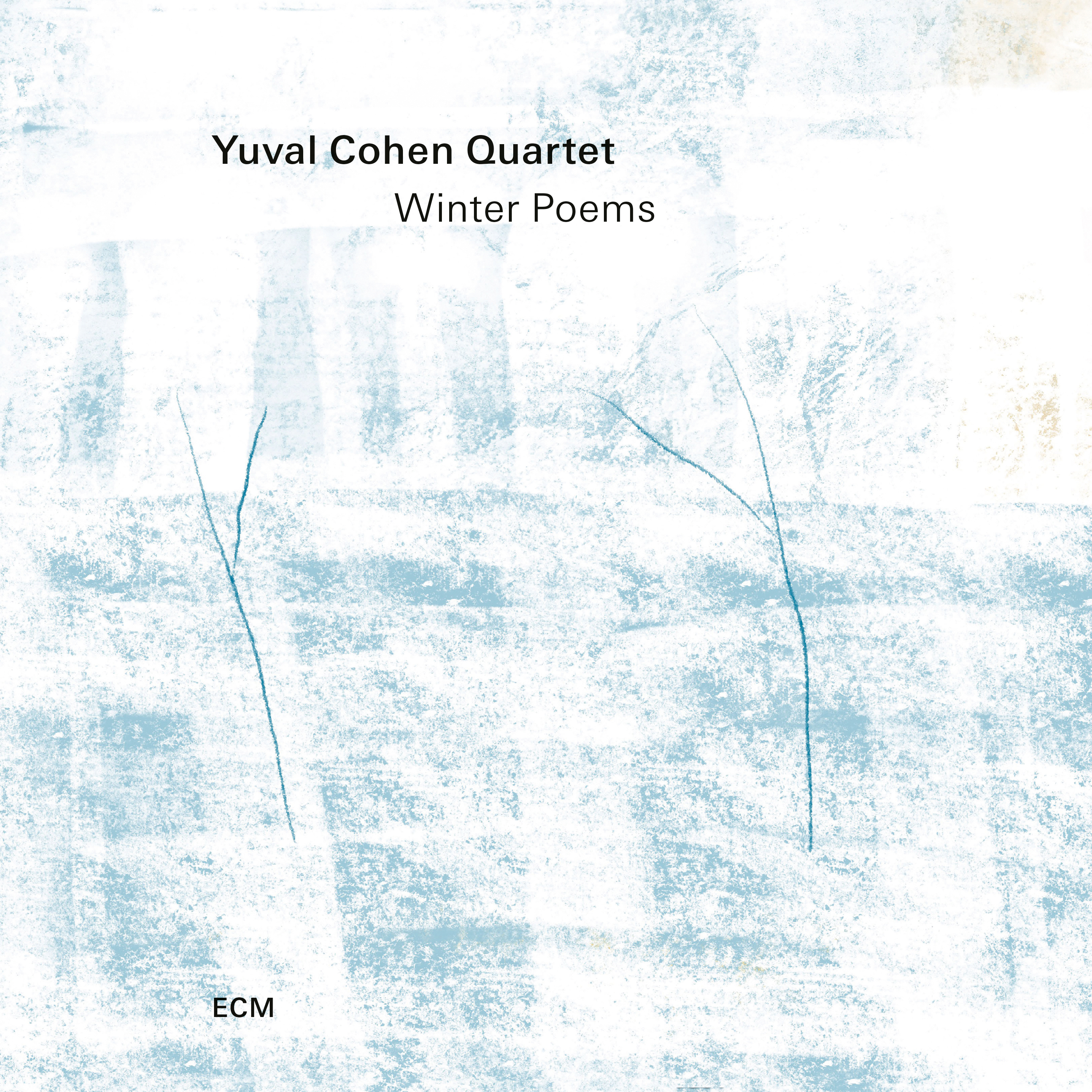
Yuval Cohen Quartet: Winter Poems (ECM 2818)

Yuval Cohen Quartet
Winter Poems

Yuval Cohen soprano saxophone, melodica
Tom Oren piano
Alon Near double bass
Alon Benjamini drums
Recorded September 2023
Studios La Buissonne
Engineer: Gérard de Haro
Mixed April 2024
by Manfred Eicher and Gérard de Haro
Cover: Fidel Sclavo
Produced by Manfred Eicher
Release date: February 14, 2025

Yuval Cohen, brother of ECM veteran Avishai Cohen, makes his debut for the label with Winter Poems. Over the course of eight originals, he elicits a flowing and unsettled realm with pianist Tom Oren, bassist Alon Near, and drummer Alon Benjamini. As the opening “First Meditation” indicates, the quartet’s interplay is one of loosely sewn borders, of bonds just strong enough to offer a sense of cohesion while allowing for expressive individuality in the afterglow of stated themes.

The soprano saxophonist attributes his clean tone and sense of attunement to his classical training. In tracks like “The Dance of the Nightingale” and “Avia,” each the emotional opposite of the other, he showcases the breadth of his technical precision in creating blossoming narratives with minimal means. But where the former tune’s smoky balladry and the latter’s childlike exuberance seem worlds apart on paper, in execution, they share that special form of veracity that only freedom within constraints allows.

The title track is anchored by a river’s current of an arpeggio in the piano. At the same time, the bass and cymbals provide an all-encompassing mesh through which the air of Cohen’s reed can pass without obstruction to fuel a gorgeous collectivity that tugs at the heart. Speaking of heart, “Song for Lo Am” takes its influence from the playing of Charles Lloyd, whose unadulterated songcraft comes through. At Cohen’s fingertips, the saxophone communicates without fear, letting its bluesy shades speak for themselves across the night. “For Charlie” references Chaplin. It examines the film icon’s inner charm, the tender way about him that viewers can’t help but connect with on an empathetic level. Oren’s pianism is golden, and Near’s bassing lumbers in that same endearing way, all enhanced by Cohen’s nostalgic turns on the melodica.

“The Unfolding Nature of Iris” is another affectionate scene, this one perhaps more rooted in the present, as if being written in real time. Near’s solo is pure poetry and a highlight of the session, while the delicacy of Benjamini’s brushed drums adds detail only where needed. Lastly, “Helech Ruach” draws inspiration from Sasha Argov’s “Hu Lo Yada Et Shma,” adopting an open approach as the band sways telepathically into a joyful rest.

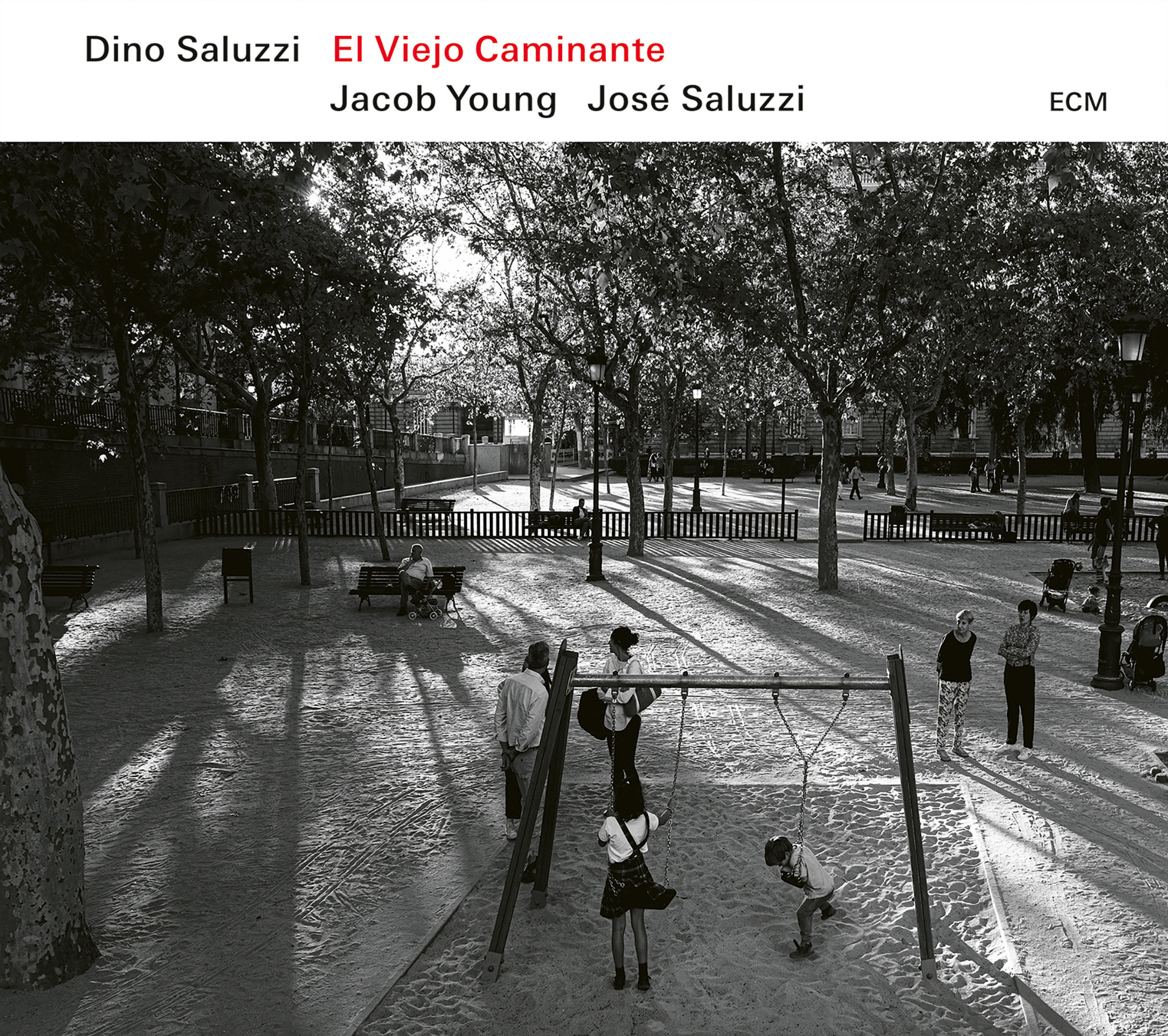
Dino Saluzzi/Jacob Young/José Maria Saluzzi: El Viejo Caminante (ECM 2802)

Dino Saluzzi
José Saluzzi
Jacob Young
El Viejo Caminante

Dino Saluzzi bandoneón
Jacob Young acoustic steel-string guitar, electric guitar
José Maria Saluzzi classical guitar
Recorded April 2023
at Saluzzi Music Studio, Buenos Aires
Recording engineers: Néstor Diaz and Lobo Zepol
Mixed February 2025 by Néstor Diaz
at La Montaña Studio, Madrid
Cover photo: Woong Chul An
Executive producer: Manfred Eicher
Release date: July 11, 2025

I can think of few souls who exude such innate musicality as Dino Saluzzi. At his fingertips, the bandoneón turns photographs into cinema, working its way into corners of the heart one never knew existed—or, more accurately, those we’ve long forgotten but only now recall. That he still has so much to say at age 90 is a testament not only to his endurance but also to the infinite power of music to link the lives of performers and listeners in an unbroken chain. The appropriately titled El Viejo Caminante (The Old Wanderer) finds him in the company of his son, José Maria Saluzzi (on classical guitar), and Jacob Young (on acoustic steel-string and electric guitars).

The project was seeded in 2022 when Young came to Argentina to perform a series of concerts with José. After hearing them on stage in Buenos Aires, Dino invited the Norwegian guitarist to come back the following year, resulting in the present record. But if the opening strains of “La Ciudad De Los Aires Buenos” are any indication, their sound is far deeper in the making than a chance encounter would have us believe. Father Saluzzi primes this canvas with a yielding gesso before the guitarists render their scenery in real time, never missing a single stroke in their duetting. The color contrasts between steel and nylon are a sunflower and its shadow swaying in unison with the wind. As the bellows return, the clouds cast their veil against the sun so that we can till the land just a little longer. 

From this inward reflection, we expand into outward travels in “Northern Sun.” Without a hint of coercion, the guitars glide and tumble as if they were made for the terrain of this Karin Krog classic. At the whim of a creative gravity, they move in concert with every change. Like the standard “My One And Only Love” that closes out the set, the tune lays down its cards with a twinkle of the eye.

Dino contributes a broad selection of pieces, including the nostalgia-laden “Buenos Aires 1950” and the title track. The fullness of the latter’s inner dialogue is made possible only by the space its composer allows. Even more heartfelt moments are to be found in “Mi Hijo Y Yo,” a duet with José that speaks in a language born of shared triumphs and tribulations. The son’s muted touch lends an air of reverence for the father. Their tenderness continues in “Someday My Prince Will Come,” turning this standard into a mellifluous anthem. Between them is “Tiempos De Ausencias,” which adopts a slightly abstract form of hindsight. As Young joins in, what began as a private conversation turns into the delicate banter of old friends. More of the same flows into “Y Amo A Su Hermano,” in which every line plays an equal role. With the utmost empathy, it ebbs and flows with the tide.

Young adds his own touch to the proceedings with three originals. In “Quiet March,” his electric adds nocturnal depth. “Dino Is Here” was written for the occasion and provides ample room for the musicians to coalesce into a dynamic tango. Meanwhile, “Old House” epitomizes the art of listening, each player given time to say exactly what they need to say.

As freely flowing as this music is, it is by no means carefree. Indeed, great attention to detail has gone into every turn of phrase, and not a single note feels wasted. Such economy of expression is what elevates the session as a wonder. Through the lens of personal experience, it brings forth truth, knowing that when we look back on things, certain details inevitably cut into frame. Though painful at the time, they become a necessary part of the landscape of our lives, songs waiting to be sung when we are old enough to handle them without fear.

Louis Sclavis/Benjamin Moussay: Unfolding (ECM 2831)

Louis Sclavis
Benjamin Moussay
Unfolding

Louis Sclavis clarinet, bass clarinet
Benjamin Moussay piano
Recorded March 2024 at Studios La Buissonne, Pernes-les-Fontaines
Engineer: Gérard de Haro
Mastering: Nicolas Baillard
Cover photo: Péter Nádas
Produced by Manfred Eicher
Release date: September 13, 2024

The pairing of clarinetist Louis Sclavis and pianist Benjamin Moussay, born of larger group collaborations on past work for ECM (including 2019’s Characters on a Wall), yields a program of fresh material penned by both musicians. Moussay’s writing, which comprises the lion’s share, comes into its own with smooth confidence from the start in the title track. Its invocational sound lends an air of providence to all that follows, which is indeed an unfolding of creative impulses into a grander narrative that takes shape one track at a time.

Extending the pianist’s signature is “Loma del Tanto.” A whispering keyboard introduces itself before the clarinet writes the names of faded others across a foggy window, breathing warm air to obscure them. This process repeats, each time a little bit differently, in a cycle of self-reflection. “None” has a more free-flowing quality. It seeks to spread anxieties until they are transparent enough to walk through. The slightly abstract and dissonant touches always return to harmonic resolutions, and the theme’s restatement assures us that all is well in the end. Other highlights from Moussay include the mysterious distortions of “L’heure du loup” and “Snow,” the latter an empathetic benediction that touches the past as if it were a physical substance.

If Sclavis’s voice, especially as spoken through the bass clarinet, is a multifaceted presence in these pieces, then so much more as a composer. Whether in the extradimensional fantasies of “L’étendue” or the phenomenally reactive improvising of “Somebody Leaves,” he is a master at delineating expressive space. In this and other respects, the album’s pinnacle is “A Garden in Ispahan.” Its piano arpeggios trace a wall of protection around the clarinet, whose lucid dreaming gives rise to an organic state flow. Like the set as a whole, it is a viewfinder into itself, ad infinitum.

Palle Mikkelborg/Jakob Bro/Marilyn Mazur: Strands (ECM 2812)

Palle Mikkelborg
Jakob Bro
Marilyn Mazur
Strands

Palle Mikkelborg trumpet, flugelhorn
Jakob Bro guitar
Marilyn Mazur percussion
Recorded live at the Danish Radio Concert Hall
Copenhagen, February 2023
Engineer: Thomas Vang
Cover photo: Jan Kricke
An ECM Production
Release date: November 24, 2023

Recorded in February 2023 at the Danish Radio Concert Hall, this live performance convenes trumpeter Palle Mikkelborg, guitarist Jakob Bro, and percussionist Marilyn Mazur in what Bro has described as a “homecoming.” The trio’s free exploration of original material leaves the faintest of fingerprints on the air, so all we are left with are impressions, memories, and instincts to hold on to. And yet, for all their ephemerality, they are undeniably indelible.

Bro contributes most of the tunes, although to call them that risks undermining the quasi-physical stretching each undergoes before it coalesces into something recognizable. All the while, there is something familiar about even the most abstract passages of examination. The first proof of this theorem is Bro’s “Gefion,” an eponymous nod to his ECM leader debut. It opens with echoing horn, sparkling percussion (including bowed metals for added shimmer), and a web of dreams strung across the night to catch as many falling stars as possible in the afterglow. “Oktober” waters the same seeds, unfolding as a piece of paper, each rectangle a scene waiting to be sketched in by the writing instruments of memory. Mikkelborg is like a ghost in the background while Mazur’s hand drums flutter in search of a body to house it. The feeling of stasis is so profound as to hold the listener suspended between materiality and immateriality. By contrast, “Returnings” (co-written by Mikkelborg and Bro) brings a more wrought-iron sound to bear. Speaking in the language of guttural distortion, while electronics flash through the foreground, it brings plenty of fuel to keep it burning. Mazur’s ritualistic beatings imbue an ancient charge, finishing in gossamer stretches of wisdom.

The title track and the concluding “Lyskaster” find their composer weaving his guitar into a hammock. Its gentle sway gives life to the dreams of his bandmates, melting into a swath of desert where forces not only align but also pass through each other. Between them is Mikkelborg’s “Youth.” Mazur’s understated fervency gives color, while Bro expands the view beyond the stage to reveal a world without borders.

Fans of Jon Hassell will find much to admire in this album, which, of course, has its own feel for texture and storytelling. A special document for fans of any of these three musicians, if not all.

François Couturier/Dominique Pifarély: Preludes and Songs (ECM 2819)

François Couturier
Dominique Pifarély
Preludes and Songs

Dominique Pifarély violin
François Couturier piano
Recorded October 2023, Historischer Reistadel, Neumarkt
Engineer: Markus Heiland
Mixed April 2024 by Manfred Eicher and Michael Hinreiner (engineer)
at Bavaria Musikstudios, Munich
Cover photo: Woong Chul An
Produced by Manfred Eicher
Release date: January 24, 2025

What threw us
together,
shrieks apart,
a worldstone, sun-distant,
hums.

–Paul Celan

The last duo session for ECM from pianist François Couturier and Dominique Pifarély was recorded in 1997 (Poros). Since then, these musicians have paved roads uniquely their own in span and material across the label’s catalog, but always with each other in sight. For this reunion, they explore an absorbing melange of originals and standards. Of the latter, we are treated to characteristically shifting interpretations of Jacques Brel’s “La chanson des vieux amants” and George Gershwin’s “I Loves You Porgy.” Pifarély’s instrument cuts a figure struggling to hold its shape in the wavering heat, its microtonal plasticity yielding haunting textures. Equal parts lyrical and contortional, both tunes find kindred company in Manning Sherwin’s “A Nightingale Sang in Berkeley,” which manages to stay soulful throughout every twist and turn. With a touch of rain and softness on the horizon, it sings of clearer and brighter days before giving way to Pifarély’s “Les ombres II,” a spiral staircase turned inside out. Its counterpart, “Les ombres I,” begins the album with string-forward resolve, morphing into a reflective take on J. J. Johnson’s “Lament,” which barely disturbs the water’s surface before it fades. Further highlights abound in the violinist’s “Vague” and “What Us.” By turns brooding and whimsical, they prove that contemplation isn’t always pretty—nor must it be, until the decorations of hindsight fall into hand. Couturier’s colorations are astute and adaptive throughout. From pressing chords to baptismal sprinklings, there is much to savor. His own “Le surcroît I” and “Le surcroît II” cut against the grain of reality in the most intriguing way, time capsules of impressions saying only what needs to be said, while “Song for Harrison” (co-composed with Pifarély and named for Couturier’s cocker spaniel) playfully breaks into Duke Ellington’s “Solitude” for an artful contrast of layers. Each is a cipher that also serves as its solution, spinning the cryptex into new possibilities with every listen.

Benjamin Lackner: Spindrift (ECM 2832)

Benjamin Lackner
Spindrift

Benjamin Lackner piano
Mathias Eick trumpet
Mark Turner tenor saxophone
Linda May Han Oh double bass
Matthieu Chazarenc drums
Recorded March 2024 at Studios La Buissonne
Engineer: Gérard de Haro
Mastering: Nicolas Baillard
Cover: Fidel Sclavo
Produced by Manfred Eicher
Release date: January 17, 2025

After leaving a sizable footprint in ECM soil with Last Decade, pianist Benjamin Lackner takes us one step further with a fresh quintet, bringing us closer to a vision of identity. Although the music is more through-composed in the present context, it lends itself to the spontaneous inventions of trumpeter Mathias Eick, saxophonist Mark Turner, bassist Linda May Han Oh, and drummer Matthieu Chazarenc (a member of Lackner’s trio prior to ECM). From all of this emerges a moving picture that is equal parts brooding and hope.

The title track bids welcome with a reed-forward introduction, as the piano sweeps up and down its registers in the twinkling of cymbals before a flowing denouement ensues. Lackner’s pianism is revelatory yet humble, never appropriating center stage. Rather, he lets his allies speak—and speak they do. Whether it’s Turner’s forthright turns of phrase or Oh’s chameleonic acuity, this brew remains communal to the last drop.

The breezy beginning of “Mosquito Flats” shifts into an even breezier theme, where the wishes of an entire generation fade in favor of a timeless desire for harmony amid a slow-motion urban swing. The two horns forge tempered fire in exchange for the final recapitulation. Their duetting continues in “More Mesa,” another unassuming tune that is nevertheless robust in its way.

Chazarenc contributes “Chambary,” a track smothered in upbeat textures and wild (yet subtle) leaps, without a shred of pretension. It’s a highlight for being as deep as it is concise. It finds a genuine companion in “See You Again My Friend,” an especially tender vehicle for Eick, who later converses with Oh in safe seclusion from the dissonant strains of “Murnau.” By contrast, the feeling of anticipation in “Fair Warning” is almost unsettling, as if the fabric of reality could tear at any moment, revealing a nightmare.

I so appreciate Lackner’s willingness to blow-dry notes before they become too wet. This holds the listener’s attention and enlivens mid-tempo pieces like “Anacapa,” which also elicits my favorite solo on the album from the bandleader (neither can one forget Oh on “Ahwahnee,” where her touch sings of the very earth). And yet, no matter how much shadow clouds our vision, “Out Of The Fog” leaves behind an intimation of light. As it resolves into a collective hymnody, we see that the characters in this story have been seeking healing individually, only to find it in one another.

Spindrift is a screen lit by a single projector in an otherwise dark room. By focusing on the narratives before our eyes, it gives us the luxury of ignoring what lies behind them. Many of the films that repeatedly run through our minds are traumatic reflections of the media we consume daily. Here, we have an opportunity to engage with stories of wholesome reflection in which the soul needs no likes counter to validate itself.

Oded Tzur: My Prophet (ECM 2821)

Oded Tzur
My Prophet

Oded Tzur tenor saxophone
Nitai Hershkovits piano
Petros Klampanis double bass
Cyrano Almeida drums
Recorded November 2023 at Studios La Buissonne, Pernes-les-Fontaines
Engineer: Gérard de Haro
Mastering Nicolas Baillard
Produced by Manfred Eicher
Release date: June 7, 2024

For his third ECM album as leader, following the shadowy Here Be Dragons and the short but sweet Isabela, saxophonist Oded Tzur returns alongside pianist Nitai Hershkovits and bassist Petros Klampanis, plus drummer Cyrano Almeida (replacing Johnathan Blake from the previous lineup). A few years ago, I interviewed Tzur but neglected to incorporate our conversation into a review. However, I find that his answers remain as relevant to the present session as they were when he so graciously offered them, so I felt it appropriate to include his insights to enhance our regard for this latest star in his emerging constellation.

Rather than try to put his music into a rigid box—Is it Raga? Is it Jazz?—I asked whether Tzur would ever ascribe a “genre” to his musical style. His response:

“I call it ‘Deep Structure,’ which is a reference to Noam Chomsky’s theory of linguistics. Chomsky claims all languages share certain features that are concealed by surface elements, which he calls ‘Surface Structure.’ Sometimes, it does seem a little limited to put things in categories, especially when a work’s influence spectrum ranges from South Asia to North America. However, it isn’t completely false to place a piece of music in a continuum so people have a frame of reference. It’s just that those continuums are getting trickier nowadays because the world moves in the direction of unification, at least if we compare it to 100, 500, or 1000 years ago. My personal journey has led me to feel strongly that all musical traditions share certain elements, and while they also have distinct features and differences, those shared elements are crucial and often hidden. Joseph Campbell’s views on religion make the same point, in a way, where the commonalities between different mythologies are simply too precise and striking to be dismissed as coincidence. What Raga—the Indian melodic universe—shows us about sound and melody can be seen in synagogue prayers as well as the Blues.”

Taking these reflections to heart empowers us to hear the alpha in every omega, as embodied in “Epilogue,” which happens to initiate the set. Tzur’s uniquely vocal tone elicits a brief and resounding call to gather the remnants of our speech as an offering to something so deeply communicative that we can only resort to the fluid intensities of “Child You.” The second of six intimate tracks casts his metaphysical virtuosity as an inevitability rather than a choice. He finds a graceful interplay with Klampanis, whose inner feelings correlate one by one. Furthermore, his entanglement with Hershkovits provides ample room for our ears to breathe, building tone upon tone as a gradual monument of stones.

With so much focus on his sound, it’s only natural to ask about the many years of discipline and refinement (or is it unrefinement?) that go into it. How has it, I wonder, changed over time, and how does he see it possibly changing in the future?

“The process certainly began in Jazz for me, transcribing Dexter Gordon, John Coltrane, and many others. The encounter with Indian classical music and my time with Hariprasad Chaurasia was a pivotal turn because I didn’t want to play an Indian instrument; I felt like the sound I was hearing was another way or another version of the saxophone sound. The influence of Indian instruments, for which the octave is a continuous spectrum rather than 12 dots, has had on me is very significant. I followed Chaurasia’s sound as closely as possible for a number of years and didn’t want to give myself the excuse of ‘I’m playing the saxophone.’ For the future, I hope to continue to work on ways in which microtonality can be accessed on the saxophone, as well as aligning those techniques efficiently with the more traditional sound of the instrument.”

Consider that goal embraced in “Through A Land Unsown,” where that same human timbre arises into waking. Despite the softness of articulation, it reveals a hard-won truth that can only be possible when shedding enough desire to block the past from assaulting the flesh. The brilliance of his playing is that it never forgets the past, either, taking what it has learned without succumbing to its temptations of self-glorification. Klampanis’s solo here draws inspiration from that spirit. Again, Hershkovits carries this basket down a river of unexpected turns and textural currents, ultimately landing in the reeds where it was meant to be discovered. Throughout, Almeida conveys an uncanny ability to foresee every move the others make. His drive continues in “Renata,” forging a pulse within a pulse that lends itself to the heart without force while Tzur’s tenor navigates all of this with purposeful intuition. The drummer’s brushes are flashes of heat lightning in the title track, a muscular gift from above that works its way through nocturnal shades of meaning.

With so much to interpret in these inward gazes, what is Tzur’s greatest wish for his listener?

“Music is a way to learn about ourselves because music can create experiences that are revelatory in their nature. Learning history is also an excellent—and perhaps more urgently needed—way to learn about ourselves. Music is a more abstract form, like prayer or meditation. If I can create music that would reveal to people things that they didn’t know before—or, even better, knew and forgot—I would have fulfilled an important musical goal.”

And in the concluding “Last Bike Ride In Paris,” we find that ethos in full display. With a joyful sound, sunlit and smiling, the rhythm section connects telepathically as a cage for Tzur’s bird to sing and—eventually—transcend in flight to the next journey beyond the mountains. Some of his most inspired playing is to be found here, watering every root with an inspired future.

Although nothing about My Prophet necessarily implies a trilogy, the progression of album covers suggests otherwise. Whereas Here Be Dragons features standard typography and photography, Isabela shows a bordered image with black and blue typography. And now, we get only the latter against a white background. It’s as if the ornaments have been stripped away with every iteration. All of which proves that even with the flurry of notes, there is stillness to be savored. Like a hummingbird, Tzur’s playing works hard and at great expense of energy to hover in place.

Arild Andersen: Landloper (2826)

Arild Andersen
Landloper

Arild Andersen double bass, electronics
Recorded live June 18, 2020, Victoria Nasjonal Jazzscene, Oslo
Engineer: Espen Høydalsvik
Mixed June 2024 at Rainbow Studio, Oslo
by Arild Andersen and Martin Abrahamsen (engineer)
“Peace Universal” recorded at home
Cover photo: Jean-Guy Lathuilière
Executive producer: Manfred Eicher
Release date: November 29, 2024

Even after an ECM recording career spanning half a century, Arild Andersen continues to surprise and does so brilliantly with his first solo album. Recorded live at the 2020 Victoria Nasjonal Jazzscene in Oslo, the program is as varied as the Norwegian bassist’s influence is wide. Despite being alone on stage, he is accompanied by an application of electronic loops in real time (courtesy of a Gibson Echoplex Pro Plus loop machine and a TC Electronic M 2000 signal processor). In that sense, it makes the album a sublime companion to Eberhard Weber’s Once Upon A Time and is just as important as a latter-day document.

The marriage of live electronic treatments isn’t new to Andersen, whose ensemble recordings have featured it in various contexts. With nothing else but the road ahead to guide—and the road behind to encourage—he makes classics from his own and others’ songbooks feel as relevant as when they were first committed to memory. From his canon, we get the sturdy “Dreamhorse,” a tune that arose from a solo improvisation he performed at the Kongsberg Festival in 1994 (and which has appeared on ECM on his trio album, Live At Belleville). With tapping providing the rhythmic undercurrent it needs to gallop, a fluid overlay gives us an ever-expanding image of travel and landscapes. “Mira” (a nod to another trio album of the same name) boasts a comparable wingspan.

Andersen always has a way about him that makes us feel duly situated, making the title track (harking all the way back to 1981’s Lifelines) all the more lucid as a lens of interpretation. The playful dissonances therein emerge from two interconnected pieces: “Ghosts” by Albert Ayler and “Old Stev,” a traditional Norwegian folk song that Arild learned in his Sagn project with singer Kirsten Bråten Berg. In both, we find a soul perfectly at home in stretches of atmosphere where ends and beginnings become indistinguishable. His instrument represents points in time, while the electronics are the horizon in which they rise and fall like briefest lights of life.

The overall effect is such that even evergreens like “A Nightingale Sang in Berkeley Square” (written by Manning Sherwin for the 1940 musical, New Faces) and Ornette Coleman’s “Lonely Woman” find kinship at the touch of fingers and strings. The latter meshes beautifully with Charlie Haden’s “Song for Che,” where con legno tracings ring forth as a call to action. However, as I alluded to at the beginning of this review, we must look to where we came from to know where we are going, which is why I close with where the album opens: in “Peace Universal.” Ra-Kalam Bob Moses’s timeless hymn gives rise to birds, animal calls, and forest stirrings, its mist alive with intimations of ancestors whose lives were never recorded in the annals of history yet whose legacy lives on in the very earth. Each reverberation gives up the ghost even as it downloads a melody for the ages from the ether.

Tord Gustavsen Trio: Seeing (ECM 2820)

Tord Gustavsen Trio
Seeing

Tord Gustavsen piano, electronics
Jarle Vespestad drums
Steinar Raknes double bass
Recorded October 2023 at Studios La Buissone
Engineer: Gérard de Haro
Mastering: Nicolas Baillard
Cover photo: Fotini Potamia
Produced by Manfred Eicher
Release date: September 20, 2024

Thy word is a lamp unto my feet, and a light unto my path.
–Psalm 119:105

Each new recording by the Tord Gustavsen Trio constructs an unassuming waystation for the ECM listener, and on Seeing, we are given the most rustic lodging yet. In addition to the usual attention to detail one has come to expect from this venture, there is a certain plasticity to the sound that, while always humming at the core, now rises to the surface after patiently compressing its diamond light beneath the earth. Thus, the album’s title is more than an equation of listening with how the eyes take in the world around them; it is also an expression of the music’s indefinite state of being.

From the stained glass scintillations of “Jesus, gjør meg stille” (a Norwegian traditional) to the bass-driven road trip of the bandleader’s own “Seattle Song,” we find ourselves in territories at once familiar and freshly rendered for the soul. Soul is precisely what the band has more than enough to spare in its artful blend of gospel pastels and jazzier charcoal. “The Old Church” is a prime example of how beautifully these mesh together and is distinct for bassist Steinar Raknes’s solo, which stands out in an album largely focused on the group’s collective vibe. It’s also a running spiritual theme in a context where such classic hymns as Lowell Mason’s “Nearer My God, To Thee” (rendered so beautifully alone at the piano) and the Bach chorales “Christ lag in Todesbanden” and “Auf meinen lieben Gott” feel just as much of the here and now as Gustavsen’s originals feel curated from some old codex. The lushness of Johann Sebastian’s creations is matched only by their brevity. Like Bible verses that cut right to the core when one needs them, each lays sins bare on the altar of forgiveness, cutting them into smaller and smaller pieces until they disappear from view. Thus, faith is shown also to be creative, so that touch becomes a way of life.

Among the remaining selections by Gustavsen, if “Piano Interlude – Meditation” is made of stone and wood, then the title track travels on the wind, knowing one’s place in the world by dislocation. As in “Extended Circle,” we know this embrace the moment we feel it, having encountered it in dreams, in memories, and in hopes for the future. And here they are before us, welcoming and forgiving, waiting for life to unfold with philosophical humility. This leaves us only with “Beneath Your Wisdom,” which is the heart of the band, in which opens a door to whatever may burn in the depths of human regard.

The pianist notes a theme of “cherishing” in this music. Thus, as a return to form, Seeing proves itself to be an affirmation. The quieter the play, the more we feel revived, ready to take on the demons of this world. As the psalmist says above, God shows us only a few steps ahead. The rest is for Him to know.