Nik Bärtsch’s Ronin: Holon (ECM 2049)

Holon

Nik Bärtsch’s Ronin
Holon

Nik Bärtsch piano
Sha bass clarinets, alto saxophone
Björn Meyer bass
Kaspar Rast drums
Andi Pupato percussion
Recorded July 2007, Studios La Buissonne, Pernes-les-Fontaines
Engineer: Gérard de Haro
Produced by Manfred Eicher

“A band should mature into an integral organism—then it is alive, like an animal, a biotope, an urban space.”
–Nik Bärtsch

With the release of its ECM debut, Stoa, Nik Bärtsch’s Ronin hit the air flying with its meticulous brand of Zen-funk. Two years and eons of experience later, we have Holon, the title of which reveals the band’s underlying ethos: that which is simultaneously part and whole. The beats of this sophomore studio effort are no less regular than those of their predecessor, but now there is something more unitary and, as Bärtsch himself observes above, downright biological going on. Such wording is no mere metaphor, but a lived reality helped along by the decidedly acoustic mix (only Björn Meyer’s bass is plugged), as well as by the fearless integration the group has honed over countless hours of playing as one.

“Modul 42” is where Ronin’s openness comes most explicitly into play. It is an aural body built around contrasting elements. Sparkle and shadow, peace and unrest, freshness and decay—all of these intermingle in recurring dreams, inflected slightly differently with each repetition. Here and elsewhere on the album, Bärtsch’s contact inside the piano reveals a percussive, resonant core less obvious in previous recordings: a staple of his performance style since.

“Modul 41_17” is the first of two transfusions, this one offsetting the same earlier Modul 17 that was dovetailed with 38 on Stoa. Set atop a spinning plate of two notes, Meyer’s contemplative spirals join with others in the fray, cohering into a veritable golem of groove. One can almost feel the platelets conjoining in renewed life as the elements shift and sway to the pulse of some physiological alterity, which marks by its upward chromatic swings the flexion of something divinely ordered. Bärtsch’s dampened finger tapping looses sonic sponges, which soak up all the surrounding water until nothing is left. The second pairing, “Modul 39_8,” is among Bärtsch’s most enchanting. A delicate chemical infusion, it strikes the ether as if it were a matchbook.

“Modul 46” is a blush of autumnal nostalgia that proceeds by delicate propulsions. From the enchanting pianism to the underlay of rhythmatists Kaspar Rast and Andi Pupato, Meyer’s rounded spine and reedist Sha’s tender pocket, this especially jazzy module builds to a luminescent peak.

Rhythmic stacking continues to be a leitmotif of Bärtsch’s vocabulary, and the corridors of “Modul 45” are noteworthy in this regard. Anchored by a rubbery bass and smoothed by interplay between piano and saxophone, it slows into utter transcendence, balancing the piano’s reflective highs with Meyer’s twangs of reconciliation before opening into a stretch of desert music. Sha’s yodeling saxophone cleaves the night with rifts of ebony, while Bärtsch’s solo epilogue reveals nakedness beneath an outer skin.

“Modul 44” tells the story of the former’s slumber, not a dream but a sleepwalk through vestiges of time and space. This is a skeletal creation, a constellation that maps an intergalactic railroad ridden by remnants of ethers whose tickets have yet to be punched.

Call the music of Ronin whatever you will. I call it a jamming of dark matter that abides by its own string theory, and which through self-absorption finds an alternate identity waiting in the wings. One flap, and its echo is felt galaxies away.
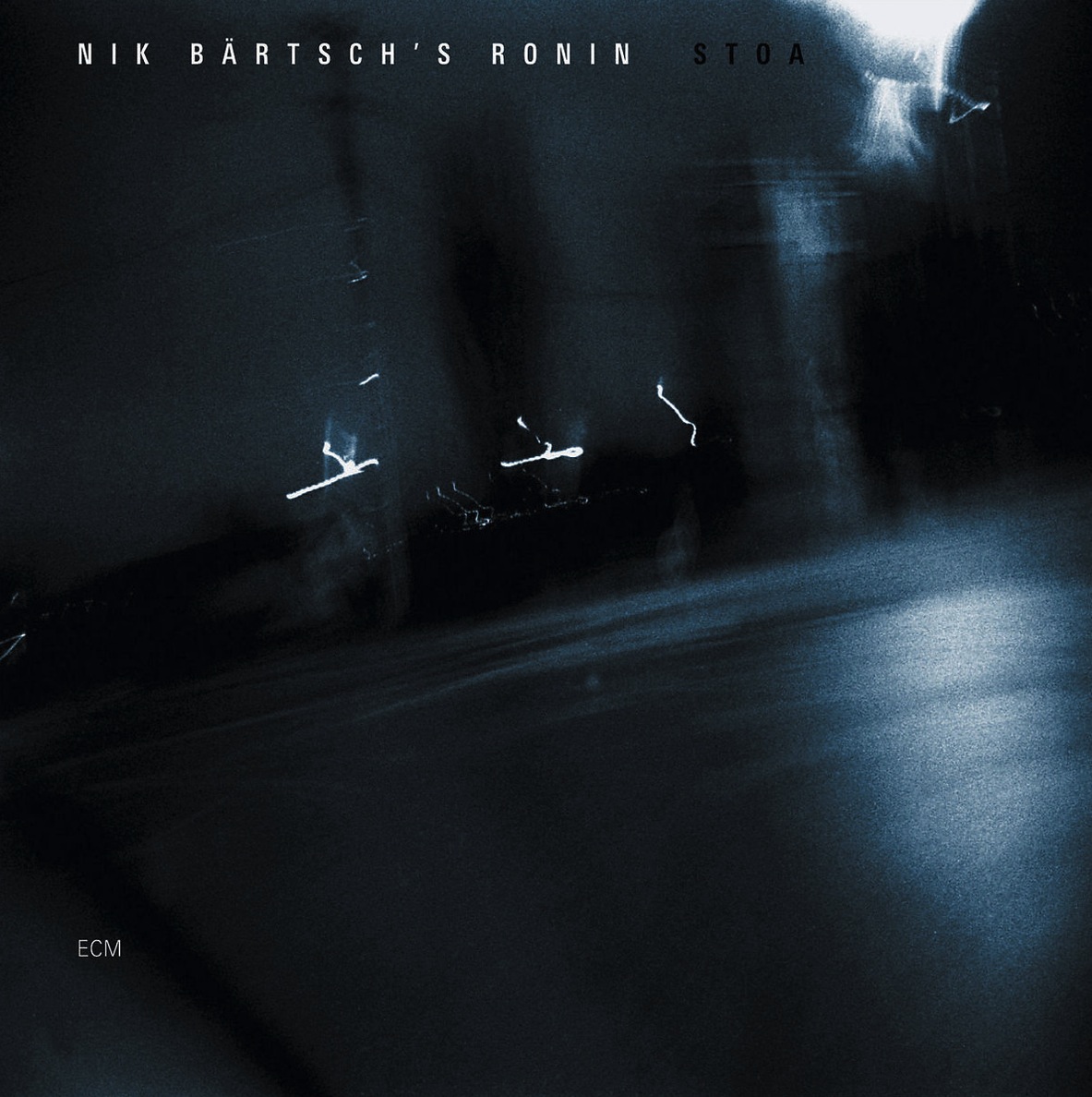
Nik Bärtsch’s Ronin: Stoa (ECM 1939)

Stoa

Nik Bärtsch’s Ronin
Stoa

Nik Bärtsch piano
Sha contrabass and bass clarinets
Björn Meyer bass
Kaspar Rast drums
Andi Pupato percussion
Recorded May 2005, Studios La Buissonne, Pernes-les-Fontaines
Engineer: Gérard de Haro
Produced by Manfred Eicher

“The rule of Japanese martial arts is: think with your body.”
–Nik Bärtsch

With Stoa, Nik Bärtsch’s Ronin dropped into the pond of ECM—indeed, of the world—with profoundly concentric ripples. Listeners can be thankful the effects of those ripples have yet to dissipate, and can only hope decades’ worth more from this nonpareil collective awaits. Pianist Bärtsch drafted the architecture of Stoa while in Japan, the enigmatic and fiercely vivid culture of which had long been the philosophical foundation of his work, yet which remained distant to him until fortune brought him there during the rainy season of 2003.

The formula of Ronin is rooted in the “module,” a molecular prism of being through which Bärtsch’s headstrong quintet splashes light. “Modul 36” thus opens the program with the intermittent glow of a harmonic piano hit, tolling the hour with fallacies of salutation. The only things tangible in these inaugural stirrings are those lone hands at the keyboard. Divorced from body, they step even as they hold themselves against the chill. Wrists plant themselves in the first patches of soil they come to, glowing like eyes in the black ice. Their fingers stretch into branches, from which scatter the blossoms of Ronin’s melodic art proper.

More than any Ronin album since, Stoa measures its respiration in clear-cut rhythmic overlay—this courtesy of drummer Kaspar Rast and percussionist Andi Pupato—with phenomenally engaging results. The stealthy bass of Björn Meyer in “Modul 33” sets off the deepest chain reaction in this regard, followed in kind by the piano’s upper register, Rast’s careful flurry, and the popping bass clarinet of reedist Sha. Overlapping circles, squares, and triangles—each the essence of a different spiritual idea—dance in lockstep toward densities in the latter half. A solid bass line muscles through the smog with finesse. Even subtler syncopations abound in “Modul 32.” Phasing heart rates with magical depressions, it braids the air of the studio with timelessness. From planetary to nebular, its hip-rocking moves evoke the gait of a tireless nomad who has found that middle ground by which to renounce any claims to territory.

“Modul 35” is classically urban Ronin, a world of revolving doors and robotic drones, whose mouths open and close to the tune of cash registers and credit swipes. Yet hovering around these bar-coded souls is a guardian angel of repose, one that counts not tender but connections on its fingers and who speaks through Bärtsch’s own fingers in pylons of light. Microtonal lifts from Meyer add spongy evanescence. Similar contrasts abound in the finishing “Modul 38_17,” another mechanistic fantasy that cuts a line through landscape like a bullet train—which is to stay, smoothly and with barest indications of its actual speed. Winds follow, rolling like the hills in denser chord voicings here. A gorgeously minimal flavor laces the proceedings with tension, urgency growing like a beard on the face of change. Before long that sense of speed catches up with us and tousles our hair, keeping sleep at bay with the sheer energy of self-realization and pulsing through to silence, as resolute as it is fragile.

What we have, then, is not a journey, per se. Instead, a flame rejuvenating itself with every flicker. It travels down the match, edging ever closer to bare fingertips until a gasp of pain and shaking hand offer its ashen frame to the water. But its smoke trails upward yet, the final tether between flesh and firmament.

Martin Speake: Change of Heart (ECM 1831)

Change of Heart

Martin Speake
Change of Heart

Martin Speake alto saxophone
Bobo Stenson piano
Mick Hutton bass
Paul Motian drums
Recorded April 2002 at Rainbow Studio, Oslo
Engineer: Jan Erik Kongshaug
Produced by Manfred Eicher

Saxophonist Martin Speake makes his first—and so far only—ECM appearance in a dream quartet rounded out by pianist Bobo Stenson, bassist Mick Hutton (who debuted for the label with another English reedman, Ken Stubbs, on Eréndira), and drummer Paul Motian. The group’s account of eight Speake originals is as poetic as his titles.

Being made aware of the river that is “The Healing Power of Intimacy” as if we’d already had a toe in its waters is a startling way to introduce us to the session’s flow. Speake’s free-blowing ways fill the covers of Lee Konitz’s signature sweetness with pages all his own, on each of which is written a day in the life of a melodic sage. In the latter sense, we might also reference Charles Lloyd, whose tender drive seems to lurk in the altoist’s dream-weaving. Stenson offers some of his loveliest improvisatory reparations ever committed to disc as sideman. In this regard, the title track shuffles its feet by candlelight, in the soft illumination of which Speake puts pen to paper and lets the muses sing.

Hutton and Motian play catch and release throughout the set, gelling rather swingingly on “Barefaced Thieves” and spreading their fingers wider on “Venn,” into which Stenson and Speake interlace their own. The latter cut contains top-flight thematizing and shows the band at its most aligned. Speake’s golden hour comes in “Buried Somewhere.” This balladic tour de force casts its spell without thinking, lures the muses closer and grazes their palms with methodical freedom.

The rhythm section’s tailwind is that of a comet: vivid yet distant enough to seem frozen in time. And on the question of time, “In the Moment” has much to say. Its sweep is generous, allowing each member’s breath to circulate in the warmth of elegy. Here the flame flickers, never losing hold of its wick. Motian’s charcoal turns to pastel in “Three Hours” with no loss of blend. The steadiness of this tune gives it arms with which to hug, legs with which to move, and a mind with which to lower the cerebral to relatable levels. Listeners can appreciate the respect of this move, hard to come by in a sometimes far too intellectual business. All of which might help to explain why the album ends “In Code”—not for want of secrecy but for honesty of message. Encryptions take place at the very moment of creation. And even as Speake’s alto careens across the night, we can be sure that its soul will stay behind, awaiting further instructions.

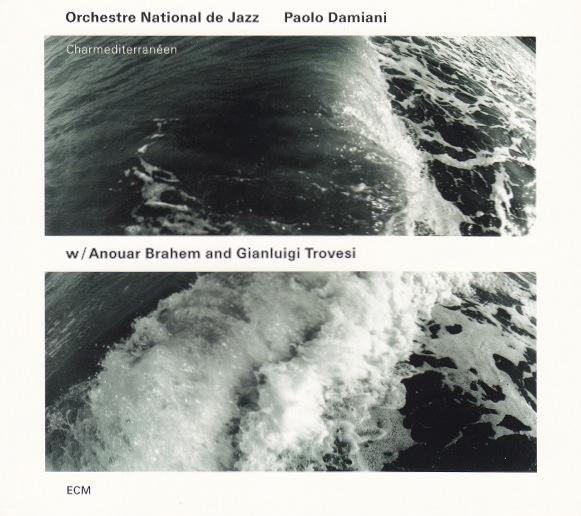
Orchestre National de Jazz: Charmediterranéen (ECM 1828)

Charmediterranéen

Orchestre National de Jazz
Charmediterranéen

Paolo Damiani cello
Anouar Brahem oud
Gianluigi Trovesi piccolo clarinet, alto saxophone
François Jeanneau soprano sax, flute
Thomas de Pourquery soprano, alto and tenor saxophones
Jean-Marc Larché soprano, alto and baritone saxophones
Médéric Collignon pocket trumpet, fluegelhorn, voice
Alain Vankenhove trumpet, fluegelhorn
Gianluca Petrella trombone
Didier Havet sousaphone
Régis Huby violin
Olivier Benoit guitar
Paul Rogers double-bass
Christophe Marguet drums
Recorded October 15 & 16, 2001 live in concerts at Scene Nationale de Montbéliard, Palot/L’Allan
Mixed at Studios La Buissonne, Pernes-les-Fontaines
Engineer: Gérard de Haro
Assisstant: Gilles Olivesi
Produced by l’Association pour le Jazz en Orchestre National

The seeds for the Orchestre National de Jazz were planted in 1982, when France’s Ministry of Culture set out to promote non-classical forms of music in general, and jazz in particular. The ONJ was at the forefront of this movement and, since its establishment in 1985, has cut across musical divides with utmost professionalism and slick telepathy. In the spirit of developing and exploring fresh repertoire, the ONJ takes on a new director every few years. This album comes from a period under the artistic vision of cellist and double-bassist Paolo Damiani, who spearheaded the ensemble between 2000 and 2002. Although Damiani had previously appeared on ECM as part of the Italian Instabile Orchestra (see Skies Of Europe), his presence here gains frontline recognition. Guesting with him are Tunisian oudist and Anouar Brahem and Italian reed maestro Gianluigi Trovesi.

The album begins with a suite composed around the myth of Orpheus. Told in four chapters, plus a prologue and epilogue, they key to this revisionist narrative lies in its array of psychological insights. The journey into the underworld, for example, feels as if it begins the moment the music exhales with its playful mélange of modern classical touches and eclectic flourishes. Yet rather than a torturous slog through fire and brimstone, we get a swinging gait through the pits of human despair toward the reflected light of Eurydice’s mirror. As much Godard as it is Cocteau, the resolve of this mise-en-scène blisters across a free jazz landscape. Electronic enhancements to the horns render ghostly faces that swirl in and out of focus. Such infusions align this album more closely to Evan Parker’s Electro-Acoustic Ensemble than to more conventional outfits. This isn’t your grandmother’s big band.

One suite follows another in the form of “Estramadure.” This three-parter is attuned to overtly compositional impulses, overlaying jagged themes onto smooth backings of winds and brass. Rhythms are tight but spongy, absorbing all that comes their way. Damiani glows in a superb solo turn, making way for a rainy montage cut to ribbons by the sharp relief of Trovesi’s altoism.

Those expecting to hear more of Brahem and Trovesi will either be disappointed or pleasantly surprised. Still, enthusiasts can bask in the warm light of “Montbéliard Trio,” in which the heroes of the hour spend twenty luxurious minutes in various stages of audibility eliciting gorgeous, elliptical themes toward rapture. Brahem also gilds the title track—which translates to “Mediterranean spell”—with appropriately dream-like patterns. Equally deserving of attention are the contributions of violinist Régis Huby, whose restless technical precision recalls that of Mark Feldman. Huby gives especial vibrancy to this 14 and a half-minute epic and elicits a memorable performance in the first of two iterations of “Argentiera.” The fluid stylings of electric guitarist Olivier Benoit also deserve special note.

All told, this is a consistently detailed and sometimes surprising effort that is sure to reward repeated listening.

Gianluigi Trovesi Ottetto: Fugace (ECM 1827)

Fugace

Gianluigi Trovesi Ottetto
Fugace

Gianluigi Trovesi alto saxophone, piccolo, alto clarinets
Beppe Caruso trombone
Massimo Greco trumpet, electronics
Marco Remondini cello, electronics
Roberto Bonati double-bass
Marco Micheli double-bass, electric bass
Fulvio Maras percussion, electronics
Vittorio Marinoni drums
Recorded June 2002 at Next Officine Meccaniche Studios, Milan
Recording engineer: Marti Jane Robertson
Assistant engineer: Guido Andreani
Mixed at Rainbow Studio, Oslo
Engineer: Jan Erik Konshaug
Produced by Manfred Eicher

Gianluigi Trovesi is a maverick in ECM’s stable. His ear for melody and, above all, aesthetics makes him a perfect fit for the label and a standout among its crowded roster. The Italian multi-reedist and composer has, it seems, always had his fingers in many pies, yet consistent to his flavor has been the acidity of celluloid. Indeed, Trovei’s penchant for cinematic atmospheres is a running theme throughout his work on all scales, but nowhere more so than on Fugace. The album’s tasteful admixture of noir, new wave, and expressionist “imagery” enables a deep journey to take place for the open-minded listener. Black-and-white figures shake hands with old-time jazzmen and sultry Technicolor beauties alike—all of them bound to a code of traditional and popular European elements. The latter serve to clear all distractions and highlight the diasporic nature of each genre sampled therein. These elements and more come together in what essentially amounts to a fantasy soundtrack, for it needs no film in order to find focus. Rather, moving pictures would be a hindrance to this music, already so robust in its evocativeness that a screen would be just that: something in the way.

The psychedelic electronic refrain of opener “As strange as a ballad” smacks of a dream sequence, Trovesi’s clarinet the psychoanalyst with an ulterior motive hovering at its periphery. Between this and the follow-up, “Sogno d’Orfeo,” there is already much to admire. The latter’s swanky air opens wispily before floating along the avenues of times past in vintage clothing, clutching worn-out hopes all the while. Sampled harpsichord runs add clink and spatter to this astute rollick, as also to the four “Siparietti,” or entr’actes, that pepper the album’s second act. Each turns a similar motif into a corkscrew of Baroque energy just waiting for the right moment to spawn. The title track performs the same trick, replacing one impact with another.

The “African Triptych” is an indisputable highlight of the program, moving across swaths of landscape in smooth and easygoing melodies. The musicianship is at once careful and carefree, the composing likewise. The second section, “Scarlet Dunes,” unveils a refreshing turn from alto, plying that middle range with all the depth of a sailor dropping anchor. Trovesi manages to scrape the horizon with his fingernails and reveal the gessoed backing. His screeching works wonders here and hereafter, and enhances the band’s subconscious qualities.

Of said band, one can hardly say enough. With Trovesi in the lead, it includes two bassists, two percussionists, a cellist, trombonist, and trumpeter. Its recipes expand upon the minimal ingredients of Trovesi’s chamber projects, and the decade of experience that comes to the table here is detectable in every course. The incorporation of electronics is an ingenious touch, resulting in a hybrid that is as much nu jazz (cf. the dancing breakbeats of “Clumsy dancing of the fat bird”) as Vivaldi; at times haunting (“Canto di lavoro”) and at others parodic. “Blues and West” fits squarely in the vein of parody. Fronting gritty electric guitar work over a smooth bass line and hip blowing from the horns, it gives off whimsical pheromones to be sure. Trovesi’s nod to W. C. Handy, “Ramble,” is another fascinating mélange of eras and styles, shifting John Zorn-like from Dixieland to free jazz in the blink of an eye. The rhythms are totally on point and keep us locked into every chameleonic change. Further along, the whitewash of “Il Domatore” dovetails the beauteous desolation of a William Basinski loop with the hard post-bop of a Dave Holland joint. Its arc goes into hiding until it touches ground in “Totò nei Caraibi,” which pulls the mournful final credits like a curtain in reverse.

Of all possible genres to have been referenced here, neo-realism remains unacknowledged, perhaps in fear of its own reflection. That its hard-won lessons might jump out and startle us at any time is part of the appeal of Fugace, which quells those urges with tightly wound lyricism and colorful appeal. Another masterstroke from Trovesi and his circle.

Andersen/Vinaccia/Smith: Live At Belleville (ECM 2078)

Live At Belleville

Live At Belleville

Arild Andersen double-bass, live-electronics
Paolo Vinaccia drums
Tommy Smith tenor saxophone
Recorded September 2007 at Belleville, Oslo and Drammen Theatre
Engineers: Svyer Frøyslie and Asle Karstad
Edited and mixed June 2008 at Rainbow Studio
Produced by Arild Andersen

Hearing and seeing bassist Arild Andersen, tenorist Tommy Smith, and drummer Paolo Vinaccia will be one of the last memories to fade if and when I ever go senile. The concert was proof positive that these musicians have hit on something special and drove home the point that together they are no mere trio, but a triangle, each side as vital as the others in maintaining the shape of its overall purpose: to emote in a clear and focused way across landscapes at once ethereal and ridden with earthly histories.

The lion’s share of the set is consumed by Andersen’s four-part “Independency.” The infusions of bow taps and fluid pizzicato that open the suite betray nothing of its muscle power. Smith’s bronzed melody-making and Vinaccia’s tremors hold restrainedly yet fiercely to thematic resolve. The reedman’s no-nonsense kaleidoscope foils his increasingly entrenched bandmates with robust ingenuity. Andersen casts a multifaceted shadow across the center of all this, each string of his bass a solitary voice that lives for harmony. Smith carries much of the weight of Part 2, opening with a protracted improvisation that skirts multiphonic edges and catapults its voice across the valley stretched out before him like a royal carpet. Yet where the latter would yield to the touch of uncalloused feet, here the footprints are erratic, as much animal as human, and uninterested in the rules of dominion. Rather, its complexities lie in the simple act of giving in to the glorious potential for jazz to turn the moon like the dial of some cosmic safe and let the magic of spontaneous interpretation come spilling out as stars. Bass and drums connect on yet another level, swinging so hard that the chain wraps full circle until the inertia of Smith’s frenzy gives way to the polyglot freedom of his cohorts. Part 3 works a spell of pretty desolation. For every skyward step, it falls two inward and settles into the comfort of dreams. Part 4, though anchored only by a mid-tempo swing, actually fans the suite’s brightest flames. The band evokes every gradation of color: Smith’s free-blowing soul is the white-hot core, Andersen’s chromatic dance the outer orange and yellow, and Vinaccia the ephemeral sparks kicking the light fantastic out into ether. All the while, the tenor’s gritty squeals add shots of fuel to every indication of waning oxygen. Phenomenal.

To this magnum opus are appended three tunes. First is a flexible take on Duke Ellington’s “Prelude to a Kiss.” Like a heavy marionette, it responds to the pull of Smith’s sax to slog through alleyways of hunger, finding at last the promise of a love supreme in the singsong music of the city, of which only a screen holds the line between desolation and consummation. Vinaccia sets the mood of “Outhouse” with his distinctly bundled sound. Smith joins the theme tentatively at first, Andersen more forthcoming, before they trip into a poised, full-on groove. This skittering jive is the album’s shining beacon toward which all surrounding vessels sail with confidence. And there, on the shore, they dance like they never have before while Smith unearths mounds of treasure onto the sands. Their prized offering is “Dreamhorse,” in which Andersen’s methodical and alluring bass line invites some fast-fingered antiphony with Smith, thereby ending with a touch of the sacred in view.

Even with such a rich (and enriching) career behind him, it’s heartening to discover that in some ways Andersen is just getting started. He is, quite simply, making the best music of his life, made possible through a life of music.

Jon Balke & Magnetic North Orchestra: Diverted Travels (ECM 1886)

Diverted Travels

Jon Balke & Magnetic North Orchestra
Diverted Travels

Magnetic North Orchestra
Per Jørgensen trumpet, vocals
Fredrik Lundin bass flute, saxophones
Jon Balke piano and keyboards
Bjarte Eike violin
Peter Spissky violin
Thomas Pitt bass violin
Helge Andreas Norbakken percussion
Ingar Zach percussion
Recorded September and November 2003 at La Buissonne Studios, Pernes-Les-Fontaines and Rainbow Studio, Oslo
Engineers: Gérard de Haro and Jan Erik Kongshaug
Mixed at Rainbow Studio by Jon Balke, Manfred Eicher, and Jan Erik Kongshaug
Produced by Jon Balke and Manfred Eicher

For his third Magnetic North Orchestra release (following Further and Kyanos), pianist Jon Balke pools together a new band of Scandinavian talent under the same name in the project’s most focused iteration to date. With only trumpeter Per Jørgensen retained from the original lineup, the overall effect is that of a watchmaker and his apprentices turned composers. Such attention to detail has always been part and parcel of Balke’s recognizable approach, but nowhere more so than in the facets of Diverted Travels, where it manifests in shorter pieces, a few of which hover on either side of the one-minute fence. The reconfigured roster reveals itself in the album’s wealth of intimate sub-combinations. The breathy horns and electric piano of “Sink,” for instance, turn ice into water and set a climatic precedent for its companions.

“Machinery” sets the clockwork beat to which the band tunes its heart. The chamber aesthetic so vital to Balke’s aural psyche sings with vibrancy here. Indications of his encounters with West African music are already apparent, clarifying themselves in such pieces as “Nutating,” “In Patches,” and “River,” in which the pulse becomes the melody. The latter’s muted trumpet is especially organic and foils the waterwheel motions of its backing with genuine augury. “Climb” is another energizing walkabout with all the makings of a nervous breakdown yet with none of the weak spots. Agitations darken into a lullaby beneath a giant eyelid closing to reveal the starlit canopy of its inner surface.

“Columns” boasts the unmistakable vocal stylings of Jørgensen, whose tense histrionics slalom like an aria from a lost Michael Mantler opera through spokes of arid strings. The trumpeter reveals further mysteries in “Deep,” working his craft through the prism of saxophonist Fredrik Lundin amid a smattering of percussion. Likewise, the mysterious “Downslope” is an album highlight. Rendering molecules of horns within a sul ponticello fringe, it turns air into breath and breath into bodies, footsteps audible on the plains as they balance a hunter’s lance atop the scalp of the setting sun. In the shadow of this piece is “The Drive,” a drone of stunning capacity.

At nearly seven minutes, “And On” is the longest selection, a storm that utilizes the full force of the MNO to evoke changes in atmospheric pressure. Balke’s pianism is wondrously compact, running tighter and tighter circles until it expends itself with jouissance. How else to deal with this than by “Falling,” which brings together the three violinists and Jørgensen’s recorder-like throat in ashen harmony, signing off this love letter to cloudy skies with a taste of antiquity.

Jon Balke & Magnetic North Orchestra: Kyanos (ECM 1822)

Kyanos

Jon Balke & Magnetic North Orchestra
Kyanos

Magnetic North Orchestra
Per Jørgensen trumpet
Morten Halle saxophones, flute
Arve Henriksen trumpet
Svante Henryson cello
Jon Balke piano, keyboards
Anders Jormin double-bass
Audun Kleive drums, percussion
Recorded November 2001 at Rainbow Studio, Oslo
Engineer: Jan Erik Kongshaug
Produced by Jon Balke and Manfred Eicher

For Kyanos, Jon Balke continues the journey begun on Further with an assembly of likeminded label mates—among them trumpeters Per Jørgensen and Arve Henriksen, bassist Anders Jormin, and drummer Audun Kleive—under the moniker Magnetic North Orchestra to ply the glaciers of the Norwegian pianist’s nostalgic compositional approach. Many permutations of the album’s title (which means “blue” in Greek) find purchase in the album’s intimate geography. “Mutatio,” for one, unpacks the depressing implications of the color, trading piano-heavy gestures with soft punctuations from the MNO, each a hope sidestepped in favor of seclusion. “Katabolic” tells the same story but reverses the formula, fronting Jørgensen and Henriksen against intermittent swells of synth. “In vitro” seems to speak in the language of the color itself, as if it were an entire species with specific taxonomic histories and genetic signatures.

Balke’s introduction to opener “Phanai” is the most evocative of them all, dancing like sunlight between tree branches. Sudden intakes betray a drama waiting to leap out into the wider world, finding instead the slow entry of percussion and brass. The feeling is one of a giant sleepwalking through forest as if it were underbrush. Balke and Jormin’s rhythmically savvy interplay bleeds contrast. With insectile harmonics and trembling heart, Jormin bounces along the inner walls of “Zygotos” with a string of genetic possibilities while the surface around him glows to the horns’ intervals, though nowhere no delicate as in “Ganglion,” a masterful conversation between Balke, Jormin, and Kleive that is the most microscopic portion of the set. Haunting accents from flutist Morten Halle and cellist Svante Henryson indicate a world much farther away, a place where the eddying winds cease only for the fearless.

The second half of Kyanos consists of miniatures in more ways than one. The intimate details of “Plica” and “Nano”—mostly percussive expressions and dream-tracings—intensify the magnification. Clicks on piano strings and sibilant fluting designate especially fruitful cells of intent. “Karyon” is the album’s truest groove and packs huge emotion into barest gestures. Its evolution from blind wandering to keen-eyed flight reaches its peak in the form of Jørgensen’s unique vocal edge. Henryson duets enigmatically with Jormin in the concluding “Apsis.”

A prevalence of biological imagery in the song names characterizes this album as a mapping of bodily spaces, thus clarifying the ultimate nuance of blue: namely, as the stain beneath a cover slide. The title track is the most concentrated solution to be found on this laboratory bench, enhancing as it does the emotional details of everything around it. Just turn up the volume as you would a focus knob, and it will all become clear.

Keith Jarrett: Concerts – Bregenz/München (ECM 1227-29)

Concerts

Keith Jarrett
Concerts – Bregenz/München

Keith Jarrett piano
Recorded May 28, 1981 in Festspielhaus Bregenz (Austria) and June 2, 1981 in Herkulessaal München (Germany)
Engineer: Martin Wieland
Produced by Manfred Eicher

Concerts may just be the brightest star in the galaxy of Keith Jarrett’s live solo improvisations. Where previously one could get only a third of the nearly two-and-a-half-hour experience on CD (the entire experience was, of course, always available on vinyl), it has at last been restored to its celestial glory in digital form. Indeed, form is what this recording is all about, for its spins, seemingly from nothing, a fibrous body of sound. The first of the album’s concerts took place in Bregenz on 28 May 1981, the second in Munich on the 2nd of June that same year. Though markedly different, their kinship is overwhelming.

Bregenz is the meatier of the two, and comes into being, as Jarrett’s improvisations so often do, as if midstream, a reverie from which attention has been diverted by the circadian rhythms of life. A quiet and reverential tone pervades its initial stirrings, which sometimes dart into the sky like meteors in reverse. Yet one gets the feeling as Jarrett lays into jazzier motives that he is neither floating nor falling but emotes in softest paralysis. He intensifies urgency, stomping to a drum only he can hear. Within each solemn depression of key and spirited cluster alike, there is constant medi(t)ation. Like fingers uncurling, his music melts through tension and ego. Shostakovichian flourishes enable ecstatic transition into Part II, where the clockwork of his instrument further opens his performing self. He is a reflection of the interior, eliciting rolls that hum their way along the edges of unforeseeable futures into the stillness of bated breath. Were it not for the applause, the spell might never be broken. “Untitled” is terse and brightly syncopated, trail-marked by Jarrett’s paroxysms. These get a deservedly strong reaction from the crowd before ending on a soulful note with the anthemic, and iconic, “Heartland.”

Munich swaddles with its porous sound. Part I is likewise born to humble beginnings. Individual droplets spread into sheets of rain, in which one tastes a bittersweet concoction of trial and transcendence. Fingers slide into Gurdjieff-like homage, Jarrett grunting with intense joy between pauses, where breathes the generative energy that sustains his brilliance long into the enigmatic Part II. With this savory swing he mortars fractured arcs of time by way of uncontainable expectorations, every note emoting the staying power of a keystone. He breaks the stillness with his feet, easing into a liquid ostinato. Gently at first, then with more insistence, Jarrett gilds the frame with increasingly frenzied ornaments. At their center are the gospel sounds of Part III. Threaded by Jarrett’s singing on and off the keys, these bustle with a deep commitment to pastoral resolution, evoking the majestic patchwork of clouds as well as that of the land below them. This switches to rich ascending phrases and chord voicings, taking pleasure in the therapy of an unobstructed view, which Jarrett manages to describe to us as if we were blind. The little staircase of Part IV burrows deeper into the ear, opening into a full-blown lighthouse of sound before jumping off into the sparkling horizon. Abstract touches inside the piano break the monochromatic spell and pour us into the colorful world of “Mon Cœur Est Rouge,” in which Jarrett achieves such poignant balance that it might just be his most astonishing solo ever recorded. Running with the abandon of a child yet marked by experience, it beams a laser into a reprise of “Heartland.” The latter is the perfect title for Jarrett’s emotional geographies, inspired as they are by the terrain of love and photosynthesis that sustains them.

Most compelling about these solo concerts is that, no matter how epic their tales become, they never seem more than flecks of dew, noticeable only because Jarrett angles the sunlight on them just so. What stands out in these oceans of technical flourish, therefore, are those carefully rendered single notes. Whether finger-pedaled or hanging in space like gongs, each mitochondrial curlicue recedes into another life. That life may be yours or a stranger’s. Or maybe it’s trying to tell us that those lives are one and the same, and that a need for music has all along been the eternal chain of being from which we all swing and of which we all will one day let go.

<< Gary Burton Quartet: Picture This (ECM 1226)
>> Don Cherry/Ed Blackwell: El Corazón (ECM 1230)