Globe Unity Orchestra: Improvisations (JAPO 60021)

Improvisations

Globe Unity
Improvisations

Gerd Dudek soprano saxophone, tenor saxophone, flute
Paul Lovens drums
Günther Christmann trombone
Paul Rutherford trombone
Tristan Honsinger cello
Peter Kowald bass, tuba
Kenny Wheeler trumpet
Evan Parker soprano saxophone, tenor saxophone
Albert Mangelsdorff trombone
Peter Brötzmann alto saxophone, tenor saxophone, bass clarinet
Buschi Niebergall bass
Michel Pilz bass clarinet
Manfred Schoof trumpet
Derek Bailey guitar
Alexander von Schlippenbach piano
Recorded September 1977 at Tonstudio Bauer, Ludwigsburg
Engineer Martin Wieland
Produced by Thomas Stöwsand

Ashes, ashes, we all fall…up? Yes, says the Globe Unity Orchestra. The autonomous improvisation collective was formed in 1966 and has shifted ever since with as much openness to the unknown as the music it unleashes. Over the years, it has seen a veritable who’s who of modern jazz flit through its cage, including Anthony Braxton, Steve Lacy, Enrico Rava, and Toshinori Kondo. Because of the wealth of riches at its employ, the GUO’s eponymous unity undermines the need to dwell on individual talents. All the same, this early JAPO release, recorded in 1977, is an endearing document for, among other reasons, so nakedly marking the early careers of its great improvisers. Whether through Michel Pilz’s visceral baying, Peter Brötzmann’s gurgling of midnight oil, Derek Bailey’s jangly aphorisms, Kenny Wheeler’s playful fancy, or Evan Parker’s sopranic emulsions, the character of every voice remains prominent—astonishing when one thinks of just how many are involved.

Together these musicians are something greater than the sum of their parts, each an integral element in an alchemy that espouses the new by tapping into something that predates all of us. Throughout the album’s four numbered improvisations, the GUO sharpens ears as if they were pencils. With the epic concentration and polar range of Kubrick’s 2001: A Space Odyssey, “Improvisation 1” clings to some alien monolith in pure instinctual discovery, while “Improvisation 2” teeters in the sonic equivalent of a groggy yawn. It pulls every limb from the muck of dreams until it pops with renewed life. The feeling of tension is palpable: plucking, striking, and exhaling into infinity. Yet where the first half seems chained to an alternate reality, “Improvisation 3” taps into those cortical implosions sooner and measures their perimeter before diving headlong into the resulting froth. It is a brilliant percussive mash of banshees and waterfalls.

“Improvisation 4” is the album’s pièce de résistance. Longer than the first three combined, it teases with jazzy beginnings. Like the third, however, it locates the problem early on and unpacks it with guttural aptitude. The more one surrenders to this music, the more it splits into pieces and slides down vocal tracts like children at a playground. The depth of color and texture—of sustained light flecked with disturbing rhythmic shadows—dwarfs all that came before. The intimacy, too, with which it ends is arresting: only cello and bass overlapping to the clatter of a teapot without a whistle, burying themselves as deeply as they can until the bulldozers arrive.

A worthy curio for your cabinet.
Michael Mantler: Songs and One Symphony (ECM 1721)

Songs and One Symphony

Michael Mantler
Songs and One Symphony

Mona Larsen voice
Michael Mantler trumpet
Bjarne Roupé guitar
Marianne Sørensen violin
Mette Winther viola
Gunnar Lychou viola
Helle Sørensen cello
Kim Kristensen piano, synthesizers
Radio Symphony Orchestra Frankfurt
Peter Rundel conductor
Songs recorded October 11, 1993, Danish Radio, Copenhagen
Recording engineer: Ronald Skovdal
Mixing engineer: Lars Palsig
One Symphony recorded November 13/14, 1998, Hessischer Rundfunk, Frankfurt
Recording engineer: Thomas Eschler
Mixing engineer: Rainer Schwarz
Album produced by Michael Mantler

I don’t know
anything darker
than the light.

Whatever your spiritual inclinations, you can be thankful that people like Michael Mantler have walked this earth and left behind a sonic trail so intuitively drawn it almost hurts. The Austrian-born composer delivers a subtle yet nonetheless smashing twofer in Songs and One Symphony, pairing his settings of poems by Ernst Meister with the titular symphony.

Songs is performed by the Chamber Music and Songs Ensemble, a group Mantler formed in 1993. Last heard in his masterpiece The School of Understanding, its instrumental signatures are uniquely Mantlerian, including the composer himself on trumpet, Bjarne Roupé on guitar, Kim Kristensen on keyboards, and a string quartet. For the present recording singer Mona Larsen assumes the throne, her wrapping of words the perfect disguise for Meister’s bare bones. Mantler’s ability to draw out melodies from the texts as if they’d always been there is uncanny. The cycle’s smoothness of execution is uniquely moving in this regard, finding traction in every negative space on the page. The connective tissue between “For ever” and “Nothing more,” for example, breathes in the fumes of just-sung sentiments and exhales the fearless drug of circumstantial evidence. Indeed, each slide on the projector roulette bears its own exhibition letter, submitted to the scrutiny of an invisible jury. Their shifting and murmuring implies conclusions but them lets them go in the interlude “How Long Are Our Nights,” from which the cello espouses lachrymose verdicts in kind. Larsen slips through words like a snake through the knotholes of an abandoned shed, carrying in her mouth the minimal shadows required to bleed warmth and misery. She embodies Meister’s “stir of solitude” so unpretentiously that one need know nothing of her pop music roots. Rather, she unearths her art for the first time with every stanza.

One Symphony is the result of a German radio commission. It takes the concept of a symphony in its most rudimentary form—which is to say, as a large meeting of musicians—and represents Mantler’s mounting interest in explicitly notated material. Consisting of four numbered movements, it finds its voice early on with the establishment of a characteristic flow. The harp flirts with the water’s surface like a sunlit dragonfly in Part 1, sucking inkblots from paper as if water from a glass. The shifting rhythms and textures achieve perfect kilter in the final origami fold, looking deeply into the mirror where its cinematic fantasy moves on. Part 2 opens poised before an oncoming train: it hears the signals but heeds them not in the widening funnel of light. The clouds offer little solace, dark and gnarled as their manner is. The feeling of locomotion never completely recedes. It touches the piano keys, flicks its hair in the wind, and swings from brass branches. The honeycombed Part 3 unloads a relatively mechanical shipment of dots and dashes, leaving the aftermath to spawn life of its own will in Part 4. This self-tending garden sustains some of the symphony’s darkest wounds and presses its palm to a cold window until an ephemeral handprint is all that’s left of its ever having been here.

<< Karl Amadeus Hartmann: Funèbre (ECM 1720 NS)
>> Nils Petter Molvær: Solid Ether (
ECM 1722)

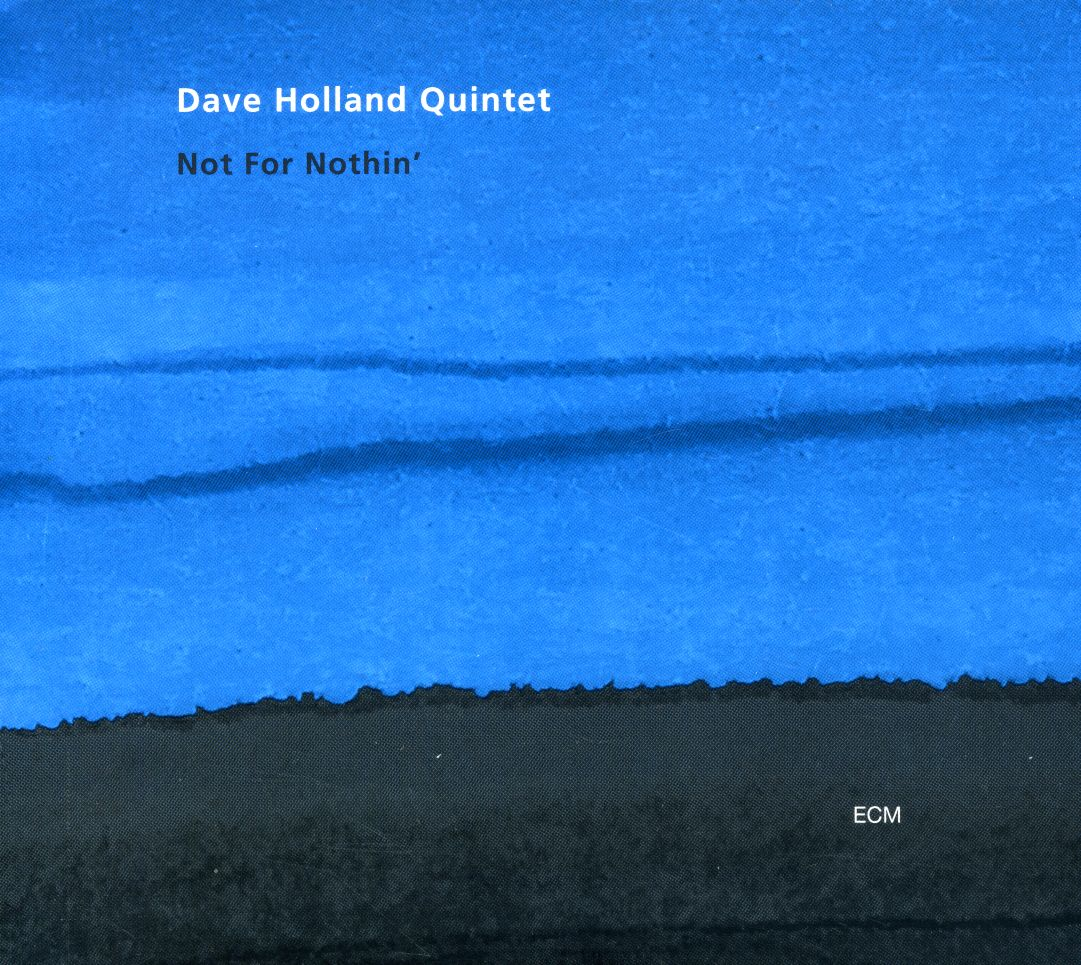
Dave Holland Quintet: Not For Nothin’ (ECM 1758)

Not For Nothin

Dave Holland
Not for Nothin’

Chris Potter saxophones
Robin Eubanks trombone, cowbell
Steve Nelson vibraphone, marimba
Billy Kilson drums
Dave Holland double-bass
Recorded September 21-23, 2000 at Avatar Studios, New York
Engineer: James Farber
Assistant engineer: Aya Takemura
Produced by Dave Holland

Dave Holland has done for the modern jazz quintet what Keith Jarrett has for the standards trio. Balancing utter control with democratic reverence in a carefully assembled team, he pushes an open agenda of bold yet affectionate creation. In this third and final ECM record of his most proper quintet, he, along with saxophonist Chris Potter, trombonist Robin Eubanks, vibraphonist Steve Nelson, and drummer Billy Kilson cut some of the group’s most flawless diamonds yet. As much a unit as one could ever hope for, their connection as such is more than telepathic—it’s downright genetic. This is all the more astonishing when you think that by the year 2000, when this album was laid down, the group had only been together for three years (even less, seeing as Potter replaced Steve Wilson in 1998).

Of the album’s nine tunes, five have felt the scratch of Holland’s pen. Vital and varietal, they boast the quintet’s signature joy in spades. Unique among them is the reflective “For All You Are,” which begins in a loose weave and proceeds to lay the love on thick. For this one Potter has an especially soulful turn on tenor, gray as a storm cloud and as rainbowed as its aftermath. “What Goes Around” is this session’s vehicle of choice for the horns and also titles the follow-up big band album. This hot ticket is a master class in listening to one’s band mates. The symmetry has to be heard to be believed. The title track is an equally hip penultimatum and finds Nelson shining over break-beat support from the rhythm section. Potter’s soprano adds further bite on two tracks, running like a shawm’s great-great-granddaughter through “Shifting Sands” in anticipation of new settlements and cracking eggs of phenomenal cast in “Cosmosis.” Almost flippant but ever genuine, he charts a magnetic course indeed.

Into Holland’s five the set list shuffles one tune by each remaining member. Eubanks’s “Global Citizen” bolts straight out of the gate freshly laminated. Nelson takes an early lead by a head and carries the quintet swiftly around every bend. Holland navigates this game of Snakes and Ladders all the while, marking a turning point midway through into breezier denouements, which, iced by Kilson’s semisweet drumming, provide plenty of skating surface for the composer’s gliding valves. Potter’s offering is “Lost And Found,” which finds Holland in especially muscled form. Eubanks cuts the cloth with precision, leaving Kilson to rev up the energy to interlocking heights. The drummer’s own “Billows Of Rhythm” dovetails into Holland’s love of jagged syncopation and throws the bassist into an early solo. This gives plenty of breathing room for Potter’s upbeat tenoring in what amounts to the set’s most youthful track. This leaves only Nelson and his sardonically titled “Go Fly A Kite,” which is actually quite forgiving in execution. It paints an evocative picture of sky and cloud, giving the horns more than enough room to soar.

Whether it’s bass and vibes, bass and drums, or sax and trombone, the combinations turn on a dime in constant organic relay. All of which puts the humble reviewer to task in picking sides. For just when Kilson seems to steal the show, Holland overwhelms with its virtuosic flair. When Nelson seems buried under Potter’s effervescent rides, he resurfaces with glittering treasure in hand. Eubanks preens his fair share of feathers as well. All the more reason to just sit back and shake one’s head in wonder at the plenitude.

<< Stephan Micus: Desert Poems (ECM 1757)
>> Enrico Rava: Easy Living (
ECM 1760)

Barre Phillips: For All It Is (JAPO 60003)

For All It Is

Barre Phillips
For All It Is

Barre Phillips bass
Palle Danielsson bass
Barry Guy bass
Jean-François Jenny-Clark bass
Stu Martin percussion
Recorded March 12, 1971 at Alster Film-Tonstudios, Hamburg
Engineer: Klaus Bornemann
Produced by Barre Phillips

This unusual meeting of minds pits bassists Barre Phillips (who also penned the proceedings), Palle Danielsson, Barry Guy, and Jean-François Jenny-Clark with percussionist Stu Martin in a tactile playoff with mixed results. It’s remarkable to think that four behemoths could sound so open, and so one shouldn’t be surprised to encounter a few tangles in “just 8.” For the most part, however, this introductory track maintains the clarity of separation that characterizes the album’s latter remainder. Either way, it’s a jaunty ride into an unprecedented sound-world. Martin anchors “whoop” with his engaging loops amid a menagerie of pizzicato signifiers. Along with “few too” it evokes a jack-in-the-box weeping for want of exposure. From that unrequited lament comes a bright promise, skewed by a hope that the world turns not even for itself. It’s a melancholic hope, to be sure, but hope nonetheless. Martin’s absence here makes the track an early standout: just the rocking of bows pressed into myriad shapes by insistent fingertips. “la palette” and “y en a” form another pair, taking a decidedly architectural approach to this most warped string quartet. Together, they form a cycle of destruction, pain, and healing.

The album only really comes together in the final two tracks. Where “dribble” proves an apt title for its dotted ritual, “y. m.” dances like an anonymous car alarm stripped of its batteries and given new acoustic life. The latter is a particularly complex, anchored piece that spits out some utterly brilliant turns of phrase.

For All It Is, for all it is, is above all an exercise in linguistics. Its cognates are familiar, even if the grammars are not. Although I’d likely recommend this one least out of Phillips’s otherwise astonishing ECM outings, for the completist it will be an intriguing blip on the radar of all four bassists’ careers.

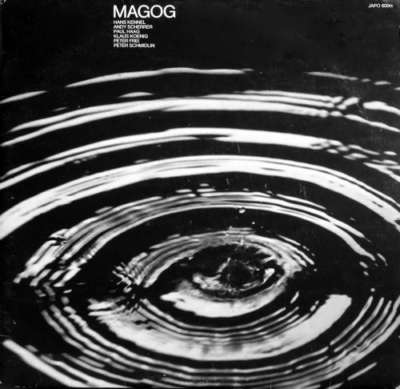
Magog: s/t (JAPO 60011)

Magog

Magog

Hans Kennel trumpet, fluegelhorn, perussion
Andy Scherrer soprano and tenor saxophones, flute, percussion
Paul Haag trombone, percussion
Klaus Koenig piano, e-piano, percussion
Peter Frei bass
Peter Schmidlin drums, percussion
Recorded November 1 and 2, 1974 at Tonstudio Bauer, Ludwigsburg
Engineers: Martin Wieland and Carlos Albrecht
Produced by Solitron Productions, S.A.

Magog was the brainchild of trumpeter Hans Kennel, who made a name for himself in the 1960s as a hard-bop king of the Swiss jazz scene. After earning his chops with the likes of fellow countryman Bruno Spoerri and American bassist Oscar Pettiford, he continued to work with other brilliant outliers, including Mal Waldron, George Gruntz, and Pierre Favre. The band documented here arose in the mid-seventies and was something of a stepping-stone as he grew into his own as a purveyor of “New Alpine Music” (including an alphorn quartet outfit called Mytha), combining now the traditional music of his ancestors with modern jazz idioms.

As it stands, this self-titled album from the short-lived Magog is a worthy JAPO outing. There is plenty to admire in the sounds forged by Kennel and his cohorts. Reedman Andy Scherrer, trombonist Paul Haag, pianist Klaus Koenig, bassist Peter Frei, and drummer Peter Schmidlin round out a sometimes-formidable sextet in this program of as many cuts. Haag pens opener “Lock.” It’s the album’s weakest, building a loose groove from base (read: bass) elements to Kennel’s breezy adlibbing. Despite the pleasant jam aesthetic, it feels like a studio warm-up in comparison to the sprawling entity that is Scherrer’s “Gogam.” This bubbling spring promises stronger themes and realizes them with a tuck and a roll into swinging traction. The big-band-on-a-shoestring sound achieved here is remarkable, as is the steamy action between the composer and the rhythm section.

Koenig counters with two. Haag’s trombone is a prominent voice in “Rhoades,” threading the piano’s claustrophobic maze of needles with ease. This and Kennel’s visceral squeals, not to mention the sleepwalking bass solo, make for some inspiring journeying toward the final pop. “Der Bachstelzer” finds Koenig plugged in, providing somber introductory remarks to the smoothly paced excursion that ensues. More inspired, erratic brushwork from Kennel (whose musicianship stands a head above the others) and lithe sopranism from Scherrer lay a rough yet fluid track. The group really hits its stride, however, in the closing tunes from Kennel. Between the hauntingly atmospheric beginnings of “Summervogel,” replete with ancestral ululations, and the solid groove of “New Samba,” there is much to warrant return fare.

Magog doesn’t seem to have been afraid to test the waters on tape. Their honesty is apparent throughout and makes for a transparent listening experience. The group flicks through dreams like a Rolodex, working fingers to the bone in search of closure. Although said closure never quite materializes, it leaves us free to interpret the sounds however we choose.

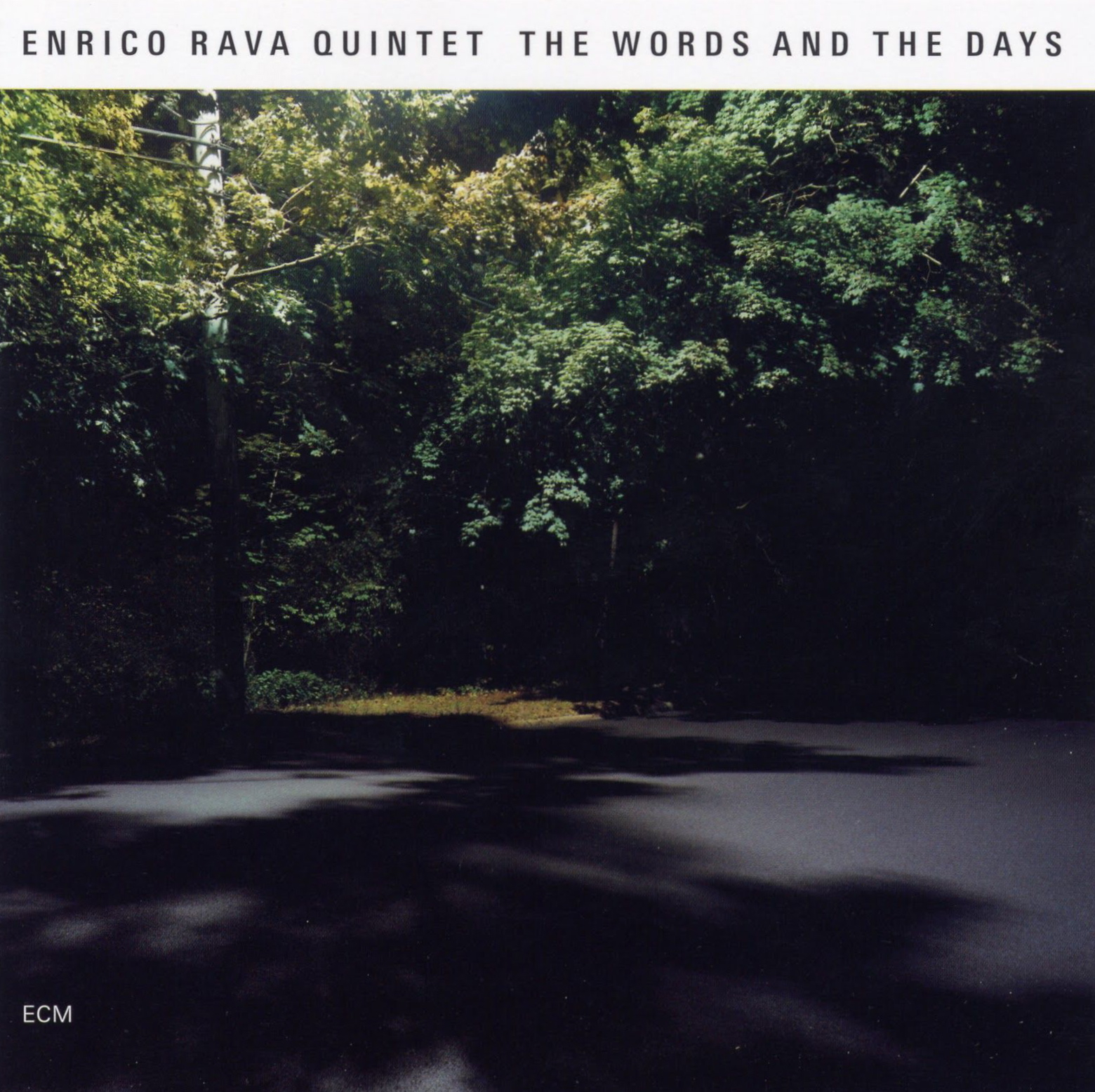
Enrico Rava Quintet: The Words And The Days (ECM 1982)

The Words and the Days

Enrico Rava Quintet
The Words And The Days

Enrico Rava trumpet
Gianluca Petrella trombone
Andrea Pozza piano
Rosario Bonaccorso double-bass
Roberto Gatto drums
Recorded December 2005 at Artesuono Recording Studio, Udine, Italy
Engineer: Stefano Amerio
Produced by Manfred Eicher

The Words And The Days follows Easy Living, which marked the studio return of Italian trumpeter Enrico Rava after a 17-year hiatus. More than the continuation of a comeback, it constitutes a self-contained entity with its own dreams. It is only natural, then, that the title tune should flow like a soundtrack to those dreams. Verdant and sincere, it hangs, as might a contended hand over the side of a boat, cutting a path through the water. Rava seems to paint that vessel’s wake while the intuitive drumming of Roberto Gatto renders every glint of sun thereafter with photorealistic detail. Yet despite these sundrenched beginnings, where Easy Living was warm and fuzzy all over, we generally encounter a cooler sound in this mostly Rava-penned program.

Gatto and bassist Rosario Bonaccorso hold fast to their formidable dual role, at once supportive and pace-setting. Rava is happy to follow wherever they may lead, with often-joyful results. In “Secrets,” for instance, some of his formative Brazilian influences jump from the woodwork. Meanwhile, trombonist Gianluca Petrella puts his enigmatic stamp of things. Although his language can be fiercely chromatic, this time around he moves under the table in search of forgotten crumbs. He works a quiet magic in the Russell Freeman standard “The Wind,” engendering a chain of lilting calls, while in “Serpent” he preens his feathers to the tune of a slick, rubato synergy. Most of that synergy he shares with Rava, reigning clearest in “Art Deco,” a three-minute duet that crosses the straight and the curved and pays tribute to its composer, the great Don Cherry. Petrella and Rava trade more brass arrows in Gatto’s “Traps,” evoking a big band on an intimate scale, balancing the pans with its breezy concentration. As a player, Gatto’s adaptive panache figures centrally in “Bob The Cat.”

Pianist Andrea Pozza, replacing Stefano Bollani from the last session, marks a shift in the group’s sound. His reflective approach adds monochromatic atmospherics to “Echoes Of Duke,” taking the session’s feet from its picturesque murk and washing them anew with a more classically rendered style. Rava digs deepest on this expedition, unearthing a plethora of finely preserved artifacts. In this regard, the bandleader excels highest when he is cut loose, as in the cinematic veils of action and soft-focus drama of “Tutù” and the stretch of empty road that is “Todamor,” which unrolls its horizon after a viscous monologue from Bonaccorso entitled “Sogni proibiti” (Forbidden dreams). Although unpopulated, that horizon is filled with stories. Rava is confident behind the wheel in taking us there, navigating an echoing corridor with superb control of every gear. And as he pulls us into the driveway of “Dr. Ra And Mr. Va,” of which the strangely somber exterior only thinly veneers a fiery heartbeat within, it is clear that the journey has only just begun.

Dave Holland Big Band: What Goes Around (ECM 1777)

What Goes Around

Dave Holland Big Band
What Goes Around

Antonio Hart alto saxophone, flute
Mark Gross alto saxophone
Chris Potter tenor saxophone
Gary Smulyan baritone saxophone
Robin Eubanks trombone
Andre Hayward trombone
Josh Roseman trombone
Earl Gardner trumpet, flugelhorn
Alex Sipiagin trumpet, flugelhorn
Duane Eubanks trumpet, flugelhorn
Steve Nelson vibraphone
Dave Holland double-bass
Billy Kilson drums
Recorded January 2001 at Avatar Studios, New York
Engineer: James Farber
Assistant engineer: Aya Takemura
Produced by Dave Holland
Co-produced by Louise Holland
Executive producer: Manfred Eicher

Bassist Dave Holland widens the span of his guiding hand for his first big band album. At the heart of this defiant session is Holland’s peak quintet with saxophonist Chris Potter, trombonist Robin Eubanks, vibraphonist Steve Nelson, and drummer Billy Kilson, all of whom nestle among an extended family of brass and reeds. Representing nearly two decades of original compositions, What Goes Around dives headfirst into the deep end with a choice tune from 1988’s Triplicate. “Triple Dance” tips its hat into a savvy introductory groove that immediately fronts the delectable baritone of Gary Smulyan. The music tops a perfect pint before sliding it down the bar into “Blues for C.M.” This sweet, low swing evokes the ebony moods of its namesake, Charles Mingus, while yielding half-pikes for Nelson’s self-propulsions and Potter’s compact swing. A tender solo from the bandleader caps off the proceedings with soul. Also from The Razor’s Edge is that 1987 record’s title track, which now unfolds in denser, slicker brilliance, duly reminding us that the effectiveness of a razor’s cut is nothing without the gap in its center, which allows its anchorage and turns danger into utility. Next is the 17-minute title track, which comes to us via the 2001 release Not For Nothin’. As the album’s deepest fantasy, it puts Holland’s bass lines on full display, jumping out as they do from gentle persuasion to grounding digs, the latter inspiring some uninhibited cloudbursts from the horns. Potter unleashes some fierce tenorism early on, outdone only by Eubanks’s proud frenzy. After passing through dense checkpoints of passion along the way, a cathartic spate from Kilson works us into the breakdown. Phenomenal. “Upswing” serves up more hearty baritone, sharing a plate with the crisper articulations of Duane Eubanks on trumpet the tang of gumdrop vibes. Duane flashes back to 1984’s Jumpin’ In with the blush of “First Snow,” which above all spawns a truly masterful solo from Antonio Hart on alto that is worth the price of admission ten times over. Hart sheds his skin again in the sway of “Shadow Dance,” adding flute to the mixture. Amid a palette of rich ochre and lemon highlights, Holland’s ear-catching artery and Potter’s acrobatic embouchure trip us over an explosive drum solo into the final weave of horns and magic.

Get this.

<< Valentin Silvestrov: leggiero, pesante (ECM 1776 NS)
>> Valentin Silvestrov: Requiem for Larissa (
ECM 1778 NS)

Dino Saluzzi & Jon Christensen: Senderos (ECM 1845)

Senderos

Senderos

Dino Saluzzi bandoneón
Jon Christensen drums, percussion
Recorded November 2002 at Rainbow Studio, Oslo
Engineer: Jan Erik Kongshaug
Produced by Manfred Eicher

If you’ve ever wanted to know what thinking musicians sound like, then you won’t want to pass on Senderos. This one-of-a-kind album pairs bandoneón maestro Dino Saluzzi with Norwegian drummer Jon Christensen for a session as spontaneous as it is fascinating. Putting both free improvisations and Saluzzi originals to the test, each of its 14 excursions pushes the limits of disclosure. On the one hand, Saluzzi’s playing is already so rhythmically multifaceted that to expand on it seems as futile as trying to add facets to a perfectly cut diamond. By the same token, Christensen is so sensitive to its surroundings that Saluzzi’s quietude becomes a suitable foil for the drummer’s whispering melodies, and vice versa. Granted, the combination may take some getting used to, less successful as it is in “Vientos” and “Todos los recuerdos,” each a playful scouring of fragmented cities and construction sites. That being said, there is good reason to hold on to these experiments, to trace in their sounding a line of thought developing in real time. We can relate to them as mirrors of vulnerability, of honesty.

The album thus follows a direct chronology, so that by the time they near the halfway point at “Los ceibos de mi pueblo…” Saluzzi and Christensen have begun to realize that rather than try to fill in each other’s spaces, it fares them better to let those spaces breathe. Christensen in particular knows the value of emptiness. The more of it he enables, the more it sings, as is clearest in his solo introduction to “Aspectos.” Saluzzi’s patient entrance unfolds its map without prematurely dancing toward the treasure it indicates. As well in “Huellas…,” where the drums seem to break off from the bellows—never muscling their way onward but marking all that came before. Such selflessness is inspiring to behold and achieves its most organic geometries in “Formas.”

The most lucid moments, however, are in Saluzzi’s four intermittent solos. Each is a soft spot, a blend of yearning and resolution that contorts disarmingly in “Fantasia” yet finds deepest traction in “Allá!… en los montes dormidos.” With an openness to expression that only decades can bring, it breathes, takes pause, reflects and self-reflects. So moved is Saluzzi that he sings toward the end, reminding us that all music begins and ends within.