John Abercrombie Trio: Speak Of The Devil (ECM 1511)

John Abercrombie Trio
Speak Of The Devil

John Abercrombie guitars
Dan Wall hammond B3 organ
Adam Nussbaum drums
Recorded July 1993 at Rainbow Studio, Oslo
Engineer: Jan Erik Kongshaug
Produced by Manfred Eicher

Following up on 1992’s While We’re Young, guitarist John Abercrombie and his trio with Hammondist Dan Wall and drummer Adam Nussbaum returned one year later with Speak Of The Devil. A much looser date than its predecessor, it showcases three talents shunning restriction for want of a freer flow. As before, Wall defines the soundscape, drawing a sturdy mesh with the charcoal of his still-glowing coals. Sounding like some long lost voice given life in the creature comforts of the studio, his solos arc like rainbows into improvisatory gold. The heat distortion of that organ in the two opening tracks sets the mood against distant considerations found in strings and skins. Abercrombie’s smooth tractions grow magical, reaching high licks in “Mahat” against soft yet propulsive drumming, and later in “BT-U,” for which his octane triples in grade as Wall hands the reigns to Nussbaum, who gets his moment to dance on the pyre. Despite these virtuosic flourishes, it’s the group’s tender side that reveals most face. Between the rugged jewel that is  “Chorale” and the glittering susurrations from Nussbaum in “Farewell,” we can almost feel the sunlight through the trees, carving shadows at our feet before Abercrombie waxes nostalgic in “Early To Bed” and lures us into the monochrome fantasy of “Dreamland.” Ironically, “Hell’s Gate” is the coolest track on the album, with a smoothness of execution that makes the journey more than worthwhile, capping off a dynamic sophomore effort.

<< Giya Kancheli: Abii ne Viderem (ECM 1510 NS)
>> William Byrd: Motets and Mass for four voices (ECM 1512 NS)
Keith Jarrett: Sleeper (ECM 2290/91)

Keith Jarrett
Sleeper

Keith Jarrett piano
Jan Garbarek tenor and soprano saxophones, flute, percussion
Palle Danielsson double-bass
Jon Christensen drums, percussion
Concert produced by AI Music (Toshinari Koinuma) in collaboration with Trio Records/ECM/Bose
Recorded live April 16, 1979 at Nakano Sun Plaza, Tokyo
Engineer: Jan Erik Kongshaug
Mixed 2012 at Rainbow Studio, Oslo by Jan Erik Kongshaug and Manfred Eicher
Produced by Manfred Eicher

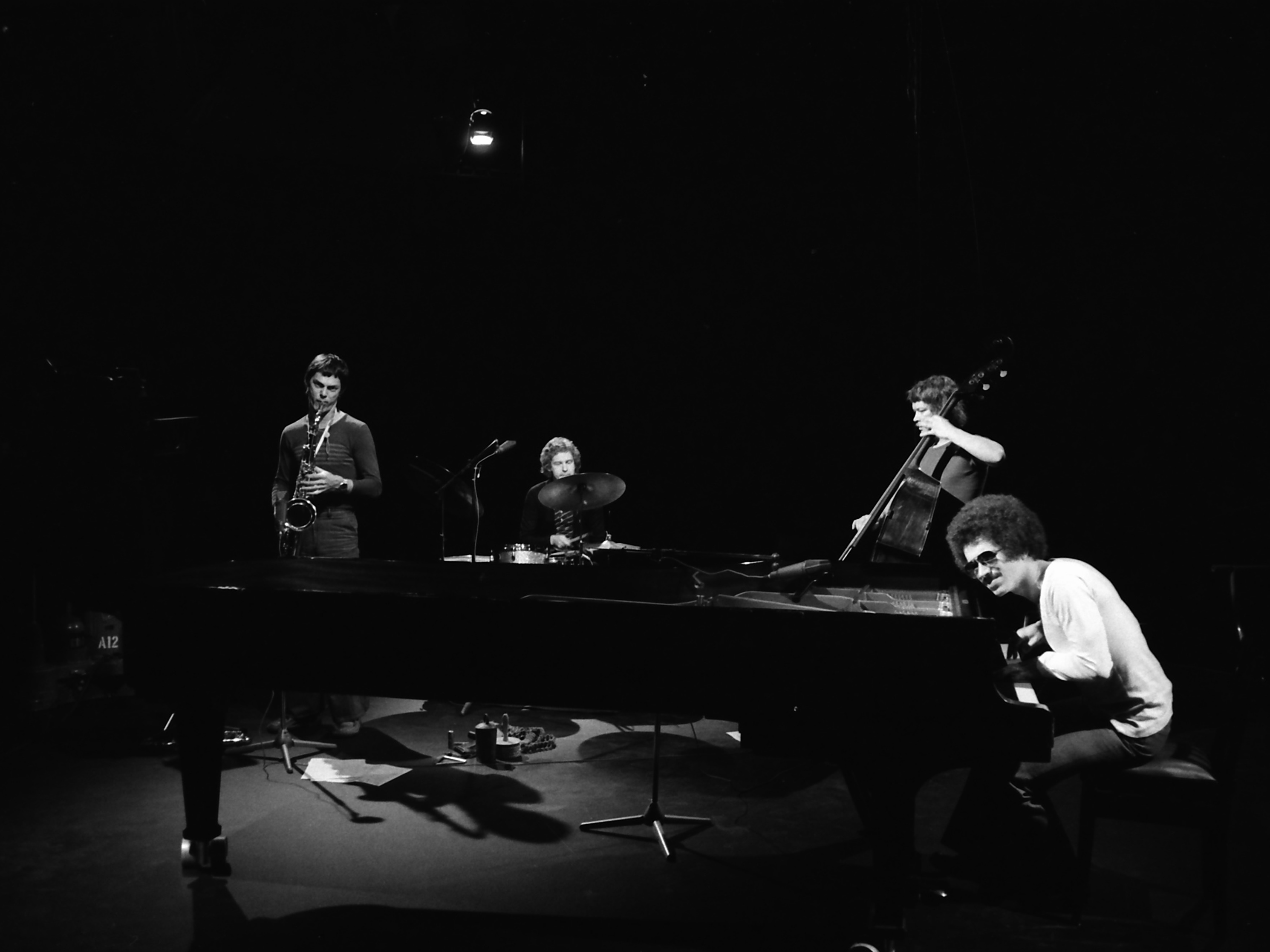
Keith Jarrett’s European quartet—with Scandinavian cohorts Jan Garbarek of the reeds, Palle Danielsson of the strings, and Jon Christensen of the sticks—was the missing link to his trio endeavors with Gary Peacock and Jack DeJohnette, finding a happy medium between the latter’s standards-based approach and his marathon improvised performances alone at the keyboard. The quartet boasted not only fine technique and dovetailed sense of timing, but also the fruit of its leader’s compositional labors during a period of career-defining development. Representing the pinnacle of five sporadic years, Sleeper documents a 1979 Tokyo show from the same tour that brought us Personal Mountains. That very tune kicks off this set of amethyst originals, Jarrett and Garbarek comprising the perfect hand-tooled leather for D&C’s riffling pages. Their Niagara pulse splashes this April canvas with blistering watercolor, Garbarek close behind as he leads us by the ear into “Innocence.” For this he adopts a folkish quality against support so synchronous, it’s as if it were responding to something as elemental as wind. And Jarrett likewise, as he pours on the syrup of “So Tender.” This unexpected travelogue proceeds at an inviting clip and features resplendent emoting from Jarrett, who manages to brighten even Christensen’s characteristic glitter. Garbarek both shouts and whispers, riding a wave so robust that every lick feels thematic while also trembling at the threshold of Jarrett’s spontaneous pulchritude. So do we proceed, funneling romance into an “Oasis” that can only be filled by a lifetime of love for music. The nearly half-hour take given here is reason enough to celebrate this record. From the opening Spirits-like incantations, infused with wooden flute and gamelan-like percussion, to the uplifting procession with which they end, Garbarek and Jarrett draw shades of gut-wrenching intensity. Despite its length, this track walks an intimate, ritualistic space. Majestic without being magisterial, it touches us like the energy that sustains it and flavors the waters of its namesake with the promise of restoration. “Chant Of The Soil” locks early and doesn’t let go. Bass and drums work like dolphins to keep us from drowning, enlivening Garbarek’s soulful phrasing with conviction, while “Prism” (another highlight from Personal Mountains) finds itself resurrected here in flowing dialogue before the invigorating circle of “New Dance” gives fresh meaning to the encore.

If ever it were possible for a recording to be even more alive than the day it was laid down, this is it—such is the value of its release. In addition to the symbiotic rhythm section, Garbarek naysayers may find themselves knocked on their rears by the exuberant, life-affirming themes issuing from his bell, each fitting snugly in Jarrett’s pianistic relief. A classic before it ever hit the shelves, Sleeper may just be the ECM event of the year and is, as its title implies, a dream to hear at long last.

Listen to samples here.


(Photo by Terje Mosnes)

Heiner Goebbels: SHADOW/Landscape With Argonauts (ECM 1480)

Heiner Goebbels
SHADOW/Landscape With Argonauts
with words by Edgar Allan Poe and Heiner Müller

Sussan Deyhim vocals
René Lussier guitar
Charles Hayward drums, tipan, hand-percussion
Christos Govetas clarinet, chumbush, gardon
Heiner Goebbels keyboards, programming, accordion
Recorded September/October 1990 at Outpost Studio, Stoughton, Massachusetts
Engineer: G. B. Hicks
Produced by Heiner Goebbels

In the annals of the written word, there are chambers of suffering and chambers of joy, but in the mind of Edgar Allan Poe those chambers were one and the same. It is this twisted contradiction that Heiner Goebbels wrings out from the sodden towels of the human body’s myriad expectorations in SHADOW/Landscape With Argonauts. Following the same concept as its German radio play counterpart (only this time in English), for which random people on the street were asked to read a text aloud for later studio manipulation, this fully realized project draws even deeper connections between public and private spheres of communication. Because people’s hesitations and misunderstandings remain lucid in the final mix, we can relate immediately to the balance of confrontation and collaboration that ensues. From these initial unscripted stirrings arises the brilliance of Iranian singer and performance artist Sussan Deyhim, whose voice is a periodic touchstone in the work. “Ye who read” is the first of a handful of exquisite songs, glinting like a metal pushpin holding up the tapestry at large. A backgrounded organ trades plectrum musings with fluttering recitations of Poe, treading a Jon Hassell-like carpet of swampy electronics. Sirens of emergency echo in the distance, accompanied by laughter. Public transportation carries us away into the field of indecision that plagues these expressions and the honesty of their disavowal. As impossible as water that burns, it trickles along the throats of fever dreams into vessels shaped like literature. Firecrackers give up themselves in ecstatic pops, marking a year of terror against the celestial auguries of the urban sprawl, each a line on a star map drawn in subway routes. Machines disgorge loose change, grasped by sweaty fingers and thrown into the pockets of the itinerant. Deyhim, ever our internal guide, resolves from a klezmer shadow in “Over some flasks” into messages of many histories. In this environment, happiness is suffocation. And as the sky goes hunting in search of dawn, a distorted hotline breathes its empty promises into the wind. “A dead weight” stencils that rich contralto onto an ululating ocean of ill measure. Acrid squeals echo with the incisiveness of a razor. “No arrival no parking” levels a mocking energy, self-absorbed and self-reflected, spawning the delicate propulsions of “And lo” in a relay of echo and night. A radio dial arches its back toward a faraway jazz session, only to drown in the light of a caravan moon. Shrouded in the smoke of faraway dreams, a clarinet bubbles over into the as-yet-unwritten page.

Fascinating to contemplate are the ways in which Goebbels’s subjects read themselves into the text, as if the sounds of words dictated the constitutions of their bodies, the comportments of their quotidian selves blended into the wing-beats of farewell birds. I can no longer read myself, the music seems to say, so I will let others read in place of me. Anything spoken at the whim of the predetermined will always be at a distance removed.

The rest is poetry.

<< Jens-Peter Ostendorf: String Quartet (ECM 1479 NS)
>> Keith Jarrett: Vienna Concert (ECM 1481)

Wadada Leo Smith: Kulture Jazz (ECM 1507)

Wadada Leo Smith
Kulture Jazz

Wadada Leo Smith trumpet, fluegelhorn, koto, mbira, harmonica, bamboo notch flute, percussion, vocal
Recorded October 1992, Hardstudios, Winterthur
Engineer: Martin Wieland
Produced by Steve Lake

To characterize Wadada Leo Smith as a genuinely musical soul would be a gross understatement. Having shunned the spotlight that might so easily have blinded him, he continues to draw thread after thread between the world’s many shadows and the sustaining fire within (if you haven’t heard his 4-hour magnum opus, Ten Freedom Summers, you don’t know what you’re missing). We have Manfred Eicher to thank for first bringing Smith to ECM among the company of Dwight Andrews, Bobby Naughton, Charlie Haden, Lester Bowie, and Kenny Wheeler on 1979’s Divine Love, and further Steve Lake for bringing the label’s touch a second time to this subtly profound solo meditation on the energies that make the world turn. Wrapped in the strains of “Don’t You Remember,” which depicts with mbira and voice a traveler’s view of atrocity and victory, we find ourselves swept in less than four minutes through a tide of earthen histories and cotton-scented tribulations. To express such depth with such minimal means speaks not only to the talents of Smith as a musician, but also to the inherent power of the individual to affect change at the galactic level. We feel this power in the visceral bite of his trumpet solos. The muted “Song Of Humanity (Kanto Pri Homaro),” to choose but one, speaks the language of those same celestial energies, climbing down ladders of starlight into the pitted chambers of our hearts, where the strains of a koto in “Mississippi Delta Sunrise (for Bobbie)” and “Seven Rings Of Light In The Hola Trinity” intimately skirt the edge of a bandwagon’s trail, popping heritage like candy. “Fire-Sticks, Chrysanthemums And Moonlight (for Harumi)” is the album’s central ceremony (one, if the reader will allow a comparison, in the vein of Keith Jarrett’s Spirits). It haunts coves turned red by ancestral blood, into which Smith dips a fluted brush. He spreads his aural calligraphy in the fire of dawn and begins to fashion from it a love letter to those who have given him courage and life: through the celebratory braid of trumpeted strands in “Louis Armstrong Counter-Pointing,” the forested song of “The Healer’s Voyage On The Sacred River (for Ayl Kwel Armah),” and the porous dronescape that is “The Kemet Omega Reigns (for Billie Holiday),” we come to know the spirit of a friend, lover, and acolyte. And in the unitary transmissions of “Love Supreme (for John Coltrane)” and “Uprising (for Jessie and Yvonne)” Smith shields an essential and unwavering flame.

Kulture Jazz is a body of dedication with two extroversions for every intro. Unafraid to marvel at the rawness of creation, Smith plays as one might write in a diary or sketch on newsprint, sanding the figurines of his past into a rounded family of novel ideas. An album of such sparseness may not appeal to everyone, but with such indelible spiritual truth suffused into every moment, how can we keep ourselves from adding our adoration to its melodious font?

Truth, crushed to the earth, shall rise again.

<< Kim Kashkashian: Lachrymae (ECM 1506 NS)
>> György Kurtág: Hommage à R.Sch. (ECM 1508 NS)

Garbarek/Brahem/Hussain: Madar (ECM 1515)

Madar

Jan Garbarek tenor and soprano saxophones
Anouar Brahem oud
Ustad Shaukat Hussain tabla
Recorded August 1992 at Rainbow Studio, Oslo
Engineer: Jan Erik Kongshaug
Produced by Manfred Eicher

Following in the footsteps of Ragas and Sagas, which found Jan Garbarek in the seemingly unlikely company of Ustad Fateh Ali Khan to uplifting effect, the Norwegian saxophonist continued to expand his horizons with Tunisian oud virtuoso Anouar Brahem and tablaist Ustad Shaukat Hussain on Madar. The three bond naturally in the lengthy “Sull lull,” a nearly 17-minute prayer of keen and sensible interaction for which Hussain brings constant airflow and foils Garbarek’s chameleonic talents superbly. It is one of two tracks based on folk melodies of Garbarek’s native land. The other is the saxophone/oud duet “Joron.” Madar serves in this vein as an internal conversation between the two instruments, their sounds speaking to one another like rocks from a river’s touch. Together they become a pair of hands etching stories into a stretch of hide, twisting incantations until they bleed light (“Sebika”) and dark (“Ramy”). As they continue to circle overhead, surveying a landscape of withering sin, they bring out something unknown in one another.

Despite the loveliness of these interactions, the album works best in solitary. Brahem’s contemplative solo, “Bahia,” treks over twilit mountains with aching footsteps, carrying us as if by palanquin into a vale of lost intentions. The wind of his percussiveness shakes the boughs of leafless trees and sends their dead seeds clicking to the ground like sand against a window. And in the rhythmic cast of “Jaw,” Hussain emotes lifetimes in a single beat of his tabla, thus offering some intensely lucid moments. He returns to the fold in “Qaws,” giving voice to those waiting eyes at last with solid excitement. An odd piano “Epilogue” (sounding like a chord outline for a studio track left behind) leads us out.

A word to the wise: Garbarek reaches some of his most piquant levels ever here, so intense that you may find yourself needing to lower the volume at peak moments. This may antagonize some, but in the end couldn’t we all do with a little awakening?

<< Bach: The French Suites (ECM 1513/14 NS)
>> Bobo Stenson Trio: Reflections (ECM 1516)

Egberto Gismonti Group: Música de Sobrevivência (ECM 1509)

Egberto Gismonti Group
Música de Sobrevivência

Egberto Gismonti piano, guitar, flute
Nando Carneiro synthesizers, guitar, caxixi
Zeca Assumpção bass, rainwood
Jacques Morelenbaum cello, bottle
Recorded April 1993 at Rainbow Studio, Oslo
Engineer: Jan Erik Kongshaug
Produced by Manfred Eicher

One can always look forward to a fresh experience with every Egberto Gismonti encounter. This promise is deeply fulfilled on Música de Sobrevivência (Music of Survival), which designates the title of his group’s sophomore ECM outing as much as it does the genre under which it creates. The opening arpeggios of “Carmem” earn our trust at once with a timeworn and familiar comfort. The pebbles of Gismonti’s plunking notes sink into nostalgic waters, pulled by arco threads into the hands of light that loosed them. “Bianca” picks at those same threads, frayed like the edge of a carpet in a childhood home through which pass only the ghosts of revolt. Such backward glances are ever-present in Gismonti’s world, whether they are charting the skyward paths of “Lundú #2” or dancing with joy in “Alegrinho #2.” His fingers flutter across piano keys as adeptly as they walk a fingerboard, escorting the group’s cultured sound through a gallery of moods. Children’s feet map the gray streets of “Forró,” cracked yet held in shape like the shells of hardboiled eggs, and continue to run through “Natura, festa do interior,” a 33.5-minute masterpiece of eroded landscapes. With a sweep as cinematic as it is prosaic, it inscribes a scroll’s worth of love for all things just and familial.

The group members blend like a metal alloy, each a shade of bark in the same forest, with cellist Jacques Morelenbaum adding notable fire to Gismonti’s cool motives. The result is a sonic scrapbook of travels and shades of innocence guaranteed to enrich your listening life.

<< György Kurtág: Hommage à R.Sch. (ECM 1508 NS)
>> Giya Kancheli: Abii ne Viderem (ECM 1510 NS)

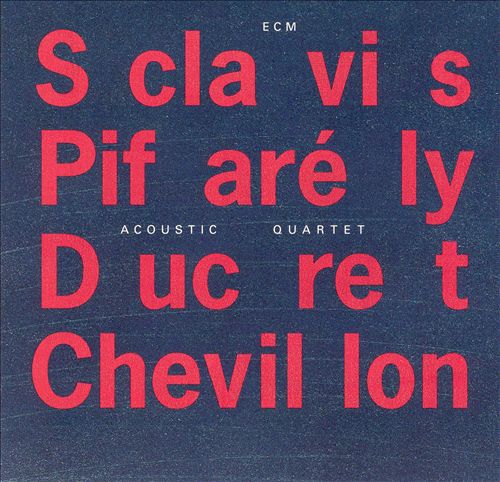
Louis Sclavis/Dominique Pifarély: Acoustic Quartet (ECM 1526)

Louis Sclavis
Dominique Pifarély
Acoustic Quartet

Louis Sclavis clarinet, bass clarinet
Dominique Pifarély violin
Marc Ducret 6- and 12-string guitars
Bruno Chevillon double-bass
Recorded September 1993 at Rainbow Studio, Oslo
Engineer: Jan Erik Kongshaug
Produced by Manfred Eicher

After debuting with his quintet on Rouge, reedist Louis Sclavis returned to ECM with French jazz violin phenom Dominique Pifarély to front this trend-setting session. Joined by guitarist Marc Ducret and bassist Bruno Chevillon, the so-called Acoustic Quartet snaps right into action with “Sensible,” the first of four pieces by Sclavis. It is, like every track that follows, an astute blend of composed and improvisatory elements that pairs instruments cleverly and with panache. Pifarély and Chevillon work particularly well together here, and Ducret’s jangly asides make a nice match for Sclavis’s clarinet. Ducret provides notable glue in “Elke,” in which bass harmonics cut through the darkness like a whale song, and elicits some oud-like tones in the playful “Rhinoceros.”

Pifarély delights with a handful of his own compositions. Of these, the guitar-propelled romp of “Abrupto” speaks loudest. The violinist strings a Christmas tree’s worth of ornaments across its conical surface, practically toppling it into the cutting lead of “Hop!” where he lays out the album’s most astonishing solo against a crunchy bass. Not to be outdone, Sclavis dots his every i and lends brilliant inflection to a substantial monologue in “Seconde.” The group also shines in its cinematic rendition of Alain Gibert’s “Bafouée.” Its nods range from Django Reinhardt to klezmer, each stretched and refracted behind a veil of sparkling melancholy.

Pifarély boggles the mind with his rhythm and slide in a group overflowing with virtuosity. Yet it is Sclavis who seems most comfortable in his skin, weaving in and out of narrow spaces with the grace of an eel. The composed material, while on the surface pedantic, provides a frame to see the fullness of every picture. The resulting Sturm und Drang atmosphere when the musicians discard prewritten material in favor of all-out storytelling makes for some intriguing music-making. All in all, a real gem.

<< Jan Garbarek/The Hilliard Ensemble: Officium (ECM 1525 NS)
>> Steve Tibbetts: The Fall Of Us All (ECM 1527)

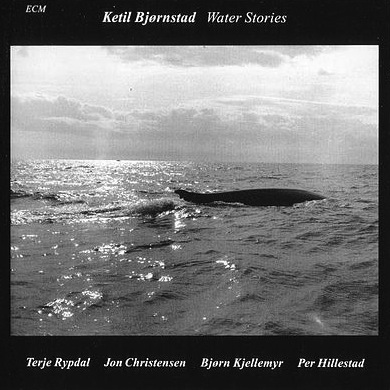
Ketil Bjørnstad: Water Stories (ECM 1503)

Ketil Bjørnstad
Water Stories

Ketil Bjørnstad piano
Terje Rypdal guitar
Bjørn Kjellemyr bass
Jon Christensen drums
Per Hillestad drums
Recorded January 1993 at Rainbow Studio, Oslo
Engineer: Jan Erik Kongshaug
Produced by Manfred Eicher

Ketil Bjørnstad made a splash, if you will, with this, his first of many collaborative projects for ECM. Water Stories puts the Norwegian pianist, composer, and novelist in fine and familiar company, sharing the studio with guitarist Terje Rypdal, drummers Jon Christensen and Per Hillestad, and bassist Bjørn Kjellemyr. Though billed as a jazz album, Water Stories is folk music for the ocean floor. Bjørnstad swishes through his motives with the surrender of a sliver of driftwood on the waves, bowing to his band mates in unobtrusive postures. With the first stirrings of “Glacial Reconstruction,” he thus sets a career-defining formula. Christensen’s unmistakable cymbals brighten in the album’s opener as if from the dark phase of a solar eclipse, stirring where only there was stillness and awe. Christensen again sets the mood in “Levels And Degrees,” now with toms, moving from the sparkle of wave-tips to rumblings from the deep as Bjørnstad and Rypdal paint swaths of marine life in dripping color. From this hails the piano ostinato of “Surface Movements” amid glints and plunks of bass. This bubbling evocation of the album’s namesake is a softly beating heart shrouded in time. “The View I” and “The View II” are astonishingly beautiful, featuring some of Rypdal’s tenderest playing on record. Melting the piano’s subtle undertows, it presages the beauties of The Sea, even as it tears a page from the book of the sky with a solo of pastel fire. Worth the album alone. “Between Memory And Presentiment” indeed rests its head on a liminal pillow, dreaming even as its casts its nets back to a childhood marked by Kjellemyr’s thoughtful solo. Bjørnstad cuts the light in “Ten Thousand Years Later,” in which Rypdal springs an electric flower from the bass’s hollow stem. The brief “Waterfall” and “Riverscape” provide the most programmatic moments of the set, crashing and flowing on their respective paths toward eddying afterlife. “Flotation And Surroundings” is another slice of bleeding pictures, leaving only the synergistic “Approaching The Sea” and the aptly titled “History,” thereby ending another defining label session of the nineties.

<< John Abercrombie: November (ECM 1502)
>> The Hilliard Ensemble: Codex Speciálník (ECM 1504 NS)

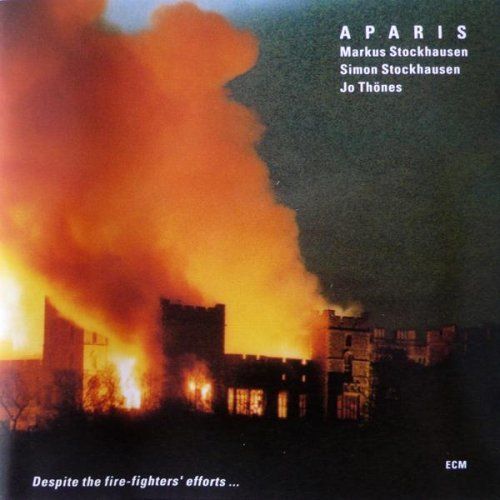
Aparis: Despite the fire-fighters’ efforts… (ECM 1496)

Aparis
Despite the fire fighters’ efforts…

Markus Stockhausen trumpets, fluegelhorn
Simon Stockhausen keyboards, soprano saxophone
Jo Thönes acoustic and electronic drums
Recorded July 1992 at Rainbow Studio, Oslo
Engineer: Jan Erik Kongshaug
Produced by Aparis

Three years after a self-titled debut, the trio known as Aparis set out for its second of two albums for ECM. Much of the sweep of the first can be found slithering throughout Despite the fire-fighters’ efforts…, only here trumpeter Markus Stockhausen’s lines swim eel-like in an even deeper ocean of electronics, courtesy of brother Simon (who also plays soprano sax). Drummer Jo Thönes is gorgeously present at key moments, as in the high-octane intensity that concludes the opening track, “Sunrice.” Before this we are surrounded by dawn-drenched ruins. We see a hilly landscape licked bare by a forest of orange tongues. A sequencer describes the tragedy with shape-shifting rhetoric, opening like the rainbow bridge to Valhalla. A flanged voice spreads its song over the ashen fields and brings with it the promise of new sustenance before closing its eyes amid the drone and swizzle of cymbals. With the tastes of this 13-minute paean still lingering on the tongue, we pass through the botanical portal of “Waveterms.” This scurrying and colorful portrait of the forest floor eases us into “Welcome,” which drops a liquid soprano into a laid-back and sultry groove, night music for the Blade Runner demimonde. The call of sirens oozes from the city’s skin like plasma in search of closure. Trumpet joins soprano in chorus, as if bonding to the truth of reality, in which swims the slippery little fish of our alienation from hands that were never designed to grasp it. From trickle to flood, this music pairs shadows and swords of light in an epic masquerade, paling at last into “Fire.” The jazziest grape on this vine, it recalls the classic strains of ECM’s heyday, modish synth and all. The electronics do take a more environmentally sound position, however, in “Green Piece.” Markus’s precise underlining gives weight to the fleeting and imprints the biodiversity of “Orange,” in which Simon’s keyboards achieve operatic ecstasy. Last is “Hannibal,” which runs through ages of underbrush like the pads of a dreaming dog. Markus’s mournful song carries across burning trees and anthemic drumming with the conviction of a fantasy made real, drunk out of sight like fresh water from a spring.

In this soundscape we are but eyes on the walls, blinking into the glare of a solar heart. It is a light show of the mind, a sonic doily laced into radial perfection. If, by the album’s conclusion, its title is not clear, we need only listen again.

<< Bowers-Broadbent/Leonard: Górecki/Satie/Milhaud/Bryars (ECM 1495 NS)
>> Peter Erskine Trio: You Never Know (ECM 1497)