Gary Peacock/Ralph Towner: Oracle (ECM 1490)

Gary Peacock
Ralph Towner
Oracle

Gary Peacock double-bass
Ralph Towner 12-string and classical guitars
Recorded May 1993 at Rainbow Studio, Oslo
Engineer: Jan Erik Kongshaug
Produced by Manfred Eicher

With so much virtuosity living inside bassist Gary Peacock and guitarist Ralph Towner, one might expect from this duo a showcase of lively showmanship. And while this it most certainly is at heart, on the whole we are given an understated album recorded out of deepest respect for its listeners. The improv is robust yet tender and marked by a distinct patina around the edges. Above all, however, I find the playing to be forward thinking and worldly. Peacock and Towner bring a cartographer’s care to tracks like “Gaya” and “Inside Inside.” Programmatic energies abound in “Flutter Step” and “Burly Hello,” each speaking as if behind cupped hands into the ears of a secret joy, while the turns of “Empty Carrousel” resolve into a hazy picture that blurs even as it develops. “Hat And Cane” gives us a happy-go-lucky reprieve, its effervescent licks crossing the postcard of “St. Helens” into the title track. What begins as a quiet breathing exercise turns full somersaults for the album’s most intense unions. Finishing with “Tramonto,” we find the duo at its emotive best.

Oracle is like the ocean: we know its overall shape but the movement of every wave is at the whim of something unseen that flows through all of us.

<< John Abercrombie Trio: While We’re Young (ECM 1489)
>> Meredith Monk: Atlas (ECM 1491/92 NS)

John Abercrombie Trio: While We’re Young (ECM 1489)

John Abercrombie Trio
While We’re Young

John Abercrombie guitars
Dan Wall Hammond organ
Adam Nussbaum drums
Recorded June 1992 at Power Station, New York
Engineer: James A. Farber
Produced by Manfred Eicher

John Abercrombie fronts the first of his trio recordings with Dan Wall on Hammond organ and Adam Nussbaum on drums. This sumptuous combination of instruments, cradled in ECM’s enabling acoustics no less, is candy for the ears. Dividing the record into two halves, one finds the first bubbling with excitement. One might not know it from the all-consuming gaze of “Rain Forest,” in which Wall takes center stage. Bathed in a rough and dimly lit spotlight, he listens to his own stories as if someone else was telling them, but gives way to the swell of “Stormz.” Abercrombie takes slow but steady shape, ringing like the edge of a coin blown and held to the edge of an ear, now tumbling, now sprinting, with an eye ever-trained to some distant point that holds his attention by a thread of perspective from pick to horizon. In “Dear Rain,” Nussbaum’s drumming indeed evokes the patter of precipitation as Wall’s tender strains waft through the humid air. All of this seems but fuel to “Mirrors,” which turns up the flames on this gas stove to a deep and lively blue. Fantastic playing abounds on this one, but particularly from Nussbaum, who keeps us on our toes.

“Carol’s Carol” links a chain of memories toward the album’s darker side. Erskine’s cymbals form the peak of some mountainous drumming, sending us over into the neighboring valley of “Scomotion.” This down-tempo tribute to John Scofield tones the remainder down to a quiet smolder. Abercrombie finds sentimental breadth in “A Matter Of Time,” kindling to Wall’s probing sparks, while “Dolorosa” ends on a tearful note, made all the more so by the guitar’s lovely sound, setting us down from a beautiful and reflective effort before going on its silent way.

<< Bley/Peacock/Oxley/Surman: In The Evenings Out There (ECM 1488)
>> Gary Peacock/Ralph Towner: Oracle (ECM 1490)

Bley/Peacock/Oxley/Surman: In The Evenings Out There (ECM 1488)


In The Evenings Out There

Paul Bley piano
Gary Peacock bass
Tony Oxley drums
John Surman baritone saxophone, bass clarinet
Recorded September 1991 at Rainbow Studio, Oslo
Engineer: Jan Erik Kongshaug
Produced by Manfred Eicher

This wondrous date finds pianist Paul Bley, reedman John Surman, bassist Gary Peacock, and drummer Tony Oxley in a blissful state of affairs. Not since the deeply felt Fragments had a quartet so honestly captured the spirit of free jazz at its most humbling. The music on In The Evenings Out There, punning on the Carla Bley tune “In The Mornings Out There,” is a canyon in ECM’s vast improvisatory continent. “Afterthoughts” sets the tone with a voice that whispers like memory yet speaks of the here and now. It moves from somber tears to insistent runs, from horizontal planes to sharp and rugged inclines, in the space of a heartbeat. With “Portrait Of A Silence,” we find that the album is more about space than time, for each facet of this misted jewel is made of various combos. This, the first of two solos from Peacock, reveals a player who knows his instrument like his own body. He explores architectural details of jazz that others too often neglect and grinds them down into handfuls of prayers.

Some of the titles seem arbitrary. “Soft Touch,” for one, brings out some of the album’s sharpest points. Yet one doesn’t listen to such music for track listings. One surrenders instead to the lovely geometric exercise of “Speak Easy” or the full quartet musings of “Interface.” Surman’s timeworn baritone seeks nourishment in the latter’s shadows, bringing us into “Alignment,” which recalls his self-referential solo work elsewhere. His bass clarinet in “Article Four” speaks that same nocturnal language, tracing its own demise like a shooting star. “Fair Share” is a buoyant duet between Bley and Peacock that breathes by the edge of understanding and drops us into a bog of sentiment. Bley offers the album’s final words. The solo “Married Alive” crosses over into explorations with Oxley in “Spe-cu-lay-ting” before ending with “Note Police,” breaking through the clouds at last with unfettered light.

This is an intuitive sort of music-making, brimming with lessons of hardship. Utterly remarkable.

<< Paul Giger: Schattenwelt (ECM 1487 NS)
>> John Abercrombie Trio: While We’re Young (ECM 1489)

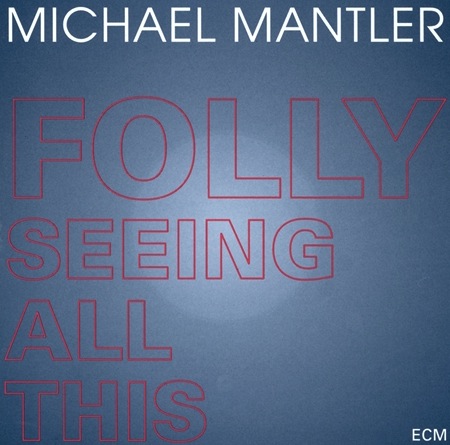
Michael Mantler: Folly Seeing All This (ECM 1485)

Michael Mantler
Folly Seeing All This

Alexander Balanescu violin
Clare Connors violin
Bill Hawkes viola
Jane Fenton cello
Michael Mantler trumpet
Rick Fenn guitar
Wolfgang Puschnig alto flute
Karen Mantler piano, voice
Dave Adams vibraphone, chimes
Jack Bruce voice
Recorded June 1992 at Angel Studios, London
Engineer: Ben T. Reese
Produced by Michael Mantler

Folly Seeing All This must have been something of a dream project for Michael Mantler. Working with the Balanescu Quartet opened up a vital portal in this phenomenal composer. The ensemble also includes guitarist Rick Fenn and a handful of talented chamber musicians. Alexander Balanescu’s unmistakable vibrato ushers us into the title piece’s shifting moods, which speak for themselves. Mantler’s trumpet pulls from this genesis a peak for every valley. Fenn draws thick sentiments with thin lines as a piano (played by Karen Mantler) rises from below the water’s surface to test the nets of time in hopes they might hold the revelations to come. Though nearly a half hour long, the music ends all too soon, imploding into a single white dwarf of energy.

News makes for an airy companion. It undulates with the tide of politics and is every bit as vocal as Mantler’s more operatic configurations. Some beautiful seashell rolls from Wolfgang Puschnig on alto flute make sense of the knotty background, where invisible talking heads are drowned by Fenn’s guitar, more insistent now in its cause. An insightful lead-in to What Is The Word. This meditation on the words of Samuel Beckett joins the voices of Karen Mantler and Jack Bruce to speak as if from within our collective ribcage, swinging from those branches of marrow and calcium with deftly slung words. Strings in the background cycle like an air raid siren in slow motion, lending finality to this brief, tender observation.

Mantler is that rare composer in whose music every instrument, every voice, rings with an equal truth. Folly Seeing All This is one of his most reflective albums to date and serves, along with Review, as an honest introduction to one of ECM’s greatest.

<< Hal Russell: Hal’s Bells (ECM 1484)
>> Stephan Micus: To The Evening Child (ECM 1486)

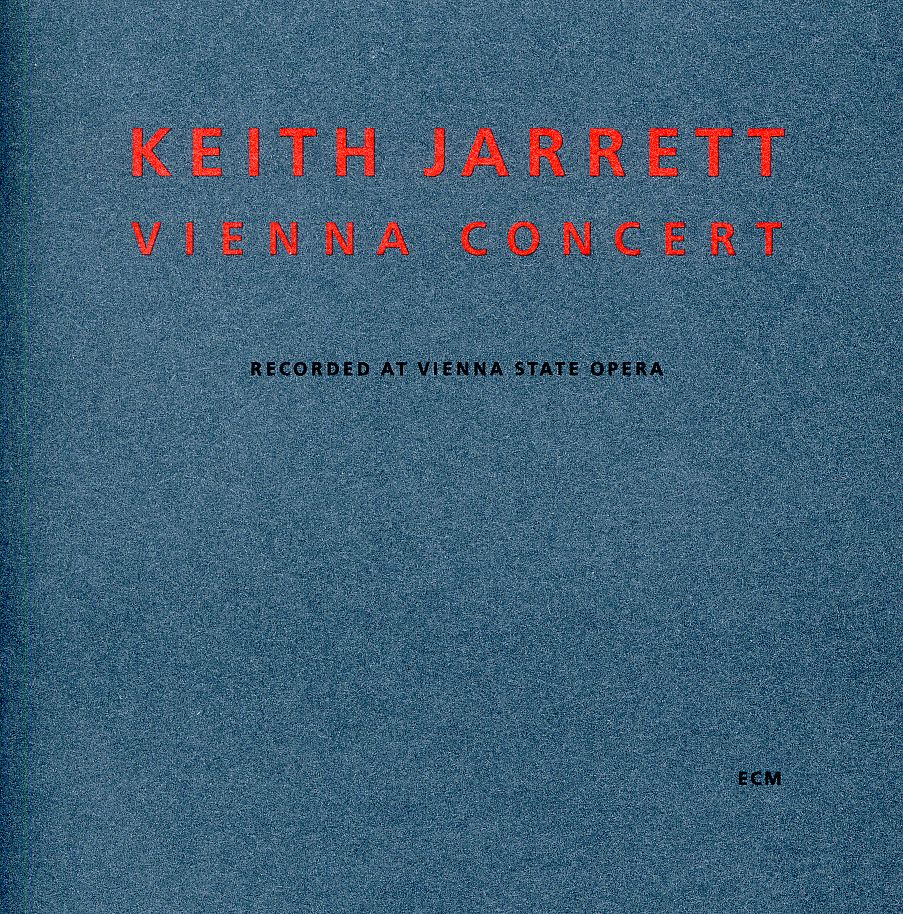
Keith Jarrett: Vienna Concert (ECM 1481)

Keith Jarrett
Vienna Concert

Keith Jarrett piano
Recorded July 13, 1991 at the Vienna State Opera
Engineer: Peter Laenger
Produced by Manfred Eicher and Keith Jarrett

“I have courted the fire for a very long time, and many sparks have flown in the past, but the music on this recording speaks, finally, the language of the flame itself.” So writes Keith Jarrett in the liner notes to a stunning account of his solo improvised performance at the Vienna State Opera in July of 1991. In expressing as much, Jarrett articulates what is so difficult to articulate: that intangible source from which he gathers the energy to emote so freely at the keyboard.

Part I begins in solitude before a clearly rapt audience. Its sweet and comforting lullaby draws a paternal curtain around a prelude for the rolling dream to come. Jarrett digs his left hand into the soil, planting with his right a prairie’s worth of flowers, weeds, and wildlife. It is a plodding journey whose trail is brought about by many feet pulled from the muddy undertow and spun from threads of almost obsessive reflection. The comportment of this music plunges deeper even as it arches its neck ever skyward, arms lost and wings gained. Knowledge of how to use those wings is what Jarrett seems after, for the moment he sets feet to ground, he makes of the world a runway for the soul, tumbling his way into learning. His fingers dance in circles, kicking up a cyclone of activity and opening into a sweeping aerial view. He breaks apart the sun and shows us its inner shadows. In the end: only triumph and rapture, a body torn in two to unify the above and below, showing a harp-like touch in those final breaths. Like an expertly shucked cob of corn, it owes its life to weathered hands and grains hungry for mineral earth.

Part II is more suspended, forlorn and characterized by a watery, Byzantine touch. Jarrett plays the piano here as if strumming it, weaving a fairytale’s spell, light through a window whose glass is molten and alive. Tracing smiles through the sky in a swing built for tintinnabulation, he brands a sunset dotted and dashed by recollection. Quiet houses on the horizon, children’s laughter long-faded between them. Sticks that once were swords hunch into gnarled canes. Jarrett’s unfolding flower reaches its peak of sonic pollination and blends into a folk song from afar, from deep within, from inside and outside, from no one and all of us.

At some point, I’ve learned to stop comparing every Jarrett solo concert to the Köln. If the imagery it inspires in me is any indication, each is its own story. His is not a creative life spent climbing a single peak, but one that, by its end, will have left a landscape filled with them for as far as the eye can see.

<< Heiner Goebbels: SHADOW/Landscape With Argonauts (ECM 1480)
>> Meredith Monk: Facing North (ECM 1482 NS)

John Surman/John Warren: The Brass Project (ECM 1478)


John Surman
John Warren
The Brass Project

John Surman saxophones, alto and bass clarinets, piano
Henry Lowther trumpet
Stephen Waterman trumpet
Stuart Brooks trumpet
Malcolm Griffiths trombone
Chris Pyne trombone
David Stewart bass trombone
Richard Edwards bass trombone
Chris Laurence bass
John Marshall drums, percussion
John Warren conductor
Recorded April 1992 at Angel Studios, London
Engineer: Gary Thomas
Produced by John Surman and Steve Lake

John Surman makes an indelible statement with The Brass Project, for which conductor John Warren leads a fine set of ensemble interpretations of the English saxophonist’s engaging compositions. The result is an album of many moods, beginning with the pensive horns and bass clarinet mesh of “The Returning Exile” and ending with the likeminded haunts of “All For A Shadow.” The filling is equally rich, boasting such deftly realized swings as the Wheelerian “The New One Two,” of which Part 2 showcases Surman’s uplifting soprano work. With the grace of a falcon, he navigates the great brass divide, casting a far-reaching shadow with his outstretched wings. That same soprano mesmerizes in “Mellstock Quire/Tantrum Clangley,” which despite its quiet sheen enables the album’s most spirited playing. The Brass Project is not without its surreal moments, as in the burnished drones of “Spacial Motive,” but for the most part we get such groovier shades as “Wider Vision” (a.k.a., baritone chocolate) and some straightforward balladry in “Silent Lake.”


Original cover

As with the last, the arrangements here explore the full benefit of Surman’s music with the musicians at hand and give us unique insight into the mind of an artist who never ceases to grow. Fans of his solo work wanting to branch out: look no further.

<< Thomas Demenga: J. S. Bach/Sándor Veress (ECM 1477 NS)
>> Jens-Peter Ostendorf: String Quartet (ECM 1479 NS)

Miroslav Vitous/Jan Garbarek: Atmos (ECM 1475)

Miroslav Vitous
Atmos

Miroslav Vitous double-bass
Jan Garbarek soprano and tenor saxophones
Recorded February 1992 at Rainbow Studio, Oslo
Engineer: Jan Erik Kongshaug
Produced by Manfred Eicher

For me, Jan Garbarek excels in his more intimate and intensely collaborative settings, and this date with Miroslav Vitous makes for some fine synergy indeed. Vitous takes light steps, if with heavy intent, through the introductory “Pegasos.” Garbarek, meanwhile, is content in hanging his throaty songs from high rafters. Like its eponymous animal, this music and all that follows is a mythic blend of strength and finesse, joining feathery appendages to a robust body that soars wherever it may. “Goddess” treads more carefully and seems to regress even as it grows, achieving a balance of proportion between body and mind, transcending the plains even as it plants its feet to the earth’s core. Vitous elicits some lovely percussiveness here, drumming his bass to send Garbarek on a lyrical scouting journey. The rhythmic ruminations continue in “Forthcoming,” giving the saxophonist all the inspiration he needs to dig deep and pluck out the ponderous jewel that is the title track. Here we encounter some beautiful thoughts from soprano, threading the ever-growing loom of Vitous’s strings. A captivating track that takes a delicate swing of its melodic compass into a direction of utter stillness. Unfortunately, “Time Out” (Parts I and II) detracts from the album’s tender atmosphere. Its horn-blasted interjections are grossly out of place. In between them, however, is “Dirvision,” a heart-tugging solo from Vitous that precludes two meditative numbers to close.

All in all, despite a brief misstep, a fascinating and worthy excursion from two far-reaching talents. How fortuitous to have them both here, telling stories timeless and sincere.

<< Terje Rypdal: Q.E.D. (ECM 1474)
>> The Hilliard Ensemble: Walter Frye (ECM 1476 NS)

Terje Rypdal: Q.E.D. (ECM 1474)

Terje Rypdal
Q.E.D.

Terje Rypdal electric guitar
Borealis Ensemble
Christian Eggen conductor
Recorded August (Q.E.D.) and December (Largo) 1991 at Rainbow Studio, Oslo
Engineer: Jan Erik Kongshaug
Produced by Manfred Eicher

Quod erat demonstrandum (Latin: “which was to be demonstrated”) traditionally denotes the completion of a mathematical proof or philosophical argument. As Terje Rypdal’s opus 52, however, it seems to mark the start of one. The 36-minute work for electric guitar and chamber ensemble is, on the surface, a hard sell. Jazz purists may be perplexed by its chamber music abstractions, while the classical side of the fence may find it lacking in innovation. In the absence of expectation, however, one encounters an unpretentious and atmospheric work of sometimes startling beauty. The 1st movement sets a deceptive tone. Its abstract conglomeration of strings and winds flits through the trees like a Cheshire cat. The 2nd movement, however, introduces Rypdal’s electric, which sings amid a brassy swell of delirium into the 3rd movement. His labyrinthine keening works especially well here while the insistent strings build tension. The deep rumblings of the 4th, however, open like the gates of an alluring netherworld, where orientation is a bluff, grained like a hoarse voice in the echo chamber of time. This seems to be the center of all the activity we have endured—all the more so when we contrast it with the hulking 5th movement, which juxtaposes edges rounded and serrated, cacophonous and nearly silent, gilded by Rypdal’s reversed guitar and flung into a molten pit of scrapes and scrambles. To this, Rypdal appends his Largo, op. 55, a 17-minute stretch that further maps the subterranean concerns of Q.E.D.’s 4th movement. The composer’s ever-mournful song blasts its heat waves through the chest with the insistence of a dragon yet the gentility of a feather caressed against the cheek of one’s preconceptions.

A curious and multifaceted thing, Q.E.D. is filled with mysterious rewards for those patient enough to seek them out. By no means where one should start with Rypdal, but nevertheless a competent blip on ECM’s eclectic radar.

<< Heinz Holliger: Scardanelli-Zyklus (ECM 1472/73 NS)
>> Miroslav Vitous/Jan Garbarek: Atmos (ECM 1475)

Keith Jarrett Trio: Bye Bye Blackbird (ECM 1467)

Keith Jarrett Trio
Bye Bye Blackbird

Keith Jarrett piano
Gary Peacock bass
Jack DeJohnette drums
Recorded October 12, 1991 at Power Station, New York
Engineer: Jay Newland
Mastered by Jan Erik Kongshaug
Executive producer: Manfred Eicher

Seeing that Keith Jarrett, Gary Peacock, and Jack DeJohnette all once shared a stage with Miles Davis early on in their careers, it’s no wonder that they should step into New York’s Power Station studio, where the trio first took shape, for this classic tribute session. Recorded just 13 days after the Prince of Darkness’s passing, Bye Bye Blackbird sits above the rest for its sheer profundity of expression. The Keith Jarrett Trio is, of course, not an outfit to take itself lightly: with an average track length of over eight minutes, we can rest assured that every tune will be carried to conclusions far beyond our reckoning.

The title opener welcomes us into a nostalgic world, glimpses of what it must have been like to work with Miles. The high-end musings into which the music evolves speak to the ecstasy that any such musician must have felt at those moments of ethereal access. One cannot help but notice how energetic, for the most part, this session is. Between the swinging “Straight No Chaser” and “Butch And Butch,” there’s more than enough to get excited about. Jarrett is as fine as ever, singing his way through every spiraling change like a child skipping into the magic of “Summer Night.” Here, Peacock plays with a more consolatory air, allowing a tear or two before the 18.5-minute group improv “For Miles” lifts wheels from tarmac. After a spate from DeJohnette and a lush pianistic flowering, the cloud cover of our lingering grief fades with each new shift. The inescapable “I Thought About You” then brings us into the excerpted “Blackbird, Bye Bye,” closing us out with a kiss and a sigh.

Yet for me, the brushed beauties of “You Won’t Forget Me” ring most authentically. A reflective solo from Peacock buoys Jarrett, who stretches his own veils across the stars, cupping an entire city in his hands and keeping all who dwell within it warm against the chill of remorse. We will indeed not ever forget him.

A note on production. The sound of this recording is distinctive—compressed and sere. I imagine it was recorded with very little preparation, and the fact that it was later mastered by Jan Erik Kongshaug indicates an absence of engineers when the tracks were laid down. This gives the music an archival ring, reaching back to the atmosphere of the 60s, without which nothing on this heartfelt album would have existed. Whether calculated or not, I appreciate the throwback. One can feel this music on the verge of exploding, looking respectfully, distantly, and with deference to the past. Suitably recorded for a moment-in-time sort of feel, it is like the capsule of a bygone era unearthed in a silent world.

<< Krakatau: Volition (ECM 1466)
>> Dmitri Shostakovich: 24 Preludes and Fugues (ECM 1469/70 NS)