Terje Rypdal & The Chasers: Blue (ECM 1346)

Terje Rypdal & The Chasers
Blue

Terje Rypdal electric guitar, keyboards
Bjørn Kjellemyr electric and acoustic bass
Audun Kleive drums, percussion
Recorded November 1986 at Rainbow Studio, Oslo
Engineer: Jan Erik Kongshaug
Produced by Manfred Eicher

Terje Rypdal, Bjørn Kjellemyr, and Audun Kleive continue where they left off on Chaser with this equally memorable set. Blue is not a companion album, however. It is the yin to the other’s yang: on the surface they are solid teardrops of color, but closer listening reveals an eye of one in the other. Swiveling in at a mere 90 seconds, “The Curse” provides an alluring introduction that fades all too quickly into the bass-driven groove of “Kompet Går.” Rypdal may run like a melodic rat with his tail on fire at first, but soon paints the sky with cool winds in a free anthem of strings and rhythms. These last are ever an audible undercurrent to what’s going on above the surface. Their analog warmth lends particular comfort to “I Disremember Quite Well,” where it is enhanced by a hum of bass. Rypdal’s inescapable lyricism is the calm before a quiet storm that rains liquid flame into the cauldron of “Og Hva Synes Vi Om Det.” Every utterance of the bass is like a bubble of lava popping, every echo a dying bird going down in smoke. Even the drum machine in “Last Nite” somehow enchants us, holding on to Rypdal’s feathered back as he peaks above the clouds in denial of the deserts below. The title track lowers us slowly on the bass’s thickly wound strings, Rypdal the melodic bait on this hook, twirled like a ribbon around the finger of a forgetful deity. “Tanga” gets us back into the swing of things with a catchy vamp, even as Rypdal works a magical mood far away. This excursion grinds to a halt in a crunchy solo before “Om Bare,” a solo punctuated by outbursts from synth, casts us into the sea.

Essential for the Rypdal fan.

<< Keith Jarrett: Book Of Ways (ECM 1344/45)
>> Gidon Kremer: Edition Lockenhaus Vols. 4 & 5 (ECM 1347/48 NS)

Shankar/Caroline: The Epidemics (ECM 1308)

The Epidemics

Shankar/Caroline
The Epidemics

Shankar vocals, violin, synthesizer, drum machine
Caroline vocals, synthesizer, tamboura
Steve Vai guitar
Gilbert Kaufman synthesizer
Percy Jones bass
Recorded February 1985 at Stickwork Studios, New York
Engineer: Chris Richards
Produced by Shankar/Caroline

Full moon on Friday
watch out for the werewolf

Who’s next – who’s next
who’s next
Close the windows – pull the curtains
who knows – what may happen

When I first slid this CD into my computer, the Gracenote Media Database upped my anticipation by filling in its genre as “Traditional.” Which is exactly what this album is not. But if you’re looking for a quirky lollipop that has baffled ECM and Shankar enthusiasts for decades, by all means lick away. With endearing vocals by Caroline, not to mention the collaborative edge of having guitar legend Steve Vai and bassist Percy Jones (of Brand X fame) in the same studio, one can only imagine the possibilities of throwing Shankar’s astounding virtuosity into such a milieu.

On that note, the musicianship is healthy and the record not without its charm, which may or may not convince you by the third track, “Situations.” I just find myself yearning for Shankar’s violin, which only makes a few lilting, if fiery, appearances on tracks like “Don’t I Know You.” Vai also has his moments in the sun (check his solo in “You Don’t Love Me Anymore”). I imagine this music may have nostalgic value for some, and far be it from me to criticize what might for them be a very real attachment. All I can say is that I’m jealous they can see what I cannot. With inane lyrics like those from the last song (“Full Moon”) quoted above and a lackluster mix that all but drowns Jones’s snaking lines, it’s difficult to gauge the artists’ intentions. Tongue-in-cheek experiment? Worldly statement? Either way, I feel lost, and welcome anyone who knows better to help me find my way.

Although the album is quite beyond me, I surmise that the artists were jumping at what was then an exciting opportunity for musical crossovers. Yet not even the crossover potential is there, as Jones himself notes in a 2004 interview:

It’s very different from most other things you’ve played on. I was expecting something maybe a little Eastern sounding.

Well that’s what I was expecting. He kept saying that he was going to be doing some Indian music, and maybe doing some gigs in India, and I was really up for that, because I love Indian music and it would’ve been a good chance to learn. But it never happened, it just continued in this sort of Western pop format, and that never went anywhere.

Interesting musicians on that record, he had Steve Vai….

Steve Vai played on the record but another guy did all the gigs. It was an unusual record for ECM I thought. I haven’t heard anything else on ECM even approaching that. I was disappointed that I never got to do any Indian stuff with him.

I don’t see myself returning to this one anytime soon, if ever. It’s simply not for me. An intriguing detour on the label’s path through a sonic territory as vast as it is varied, it is the only ECM album I would never recommend. And out of a catalogue of well over 1000 releases, that’s saying a lot more about the quality of the label than about the substandard cumulations of this single outlier.

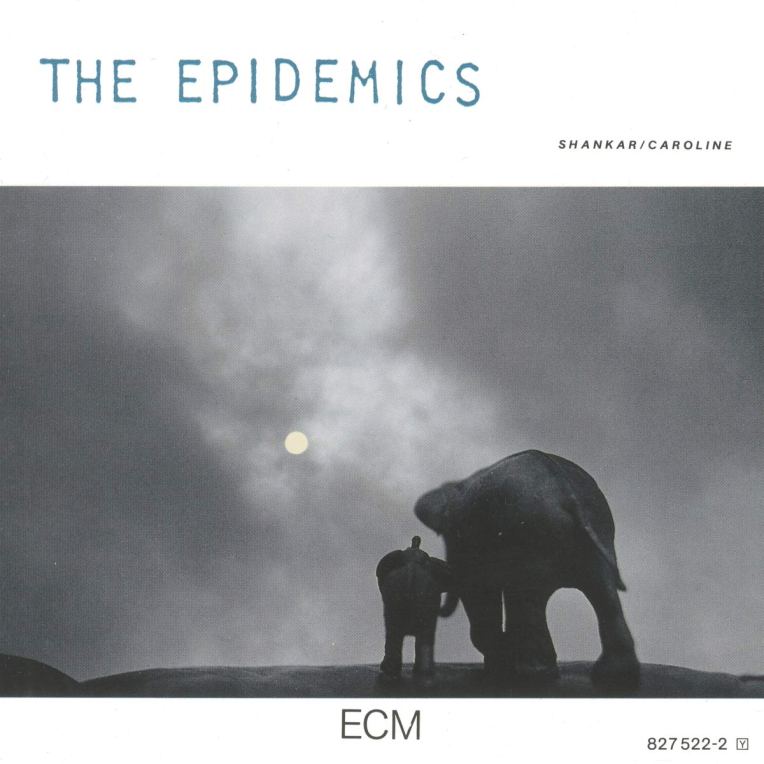
Endearing cover, though.

Incidentally, a rare promotional single of “Give An Inch” released that same year (1986) includes a remix of the song. Heavier on the drum machine and electronic framing than its album mix, this iteration has the quality of background music to some lost 80s film about teenagers on the run. For extra frustration, we get some phenomenal violin playing from Shankar, but only during the fadeout, leaving us to wonder what might have been had his bow been the point of an album otherwise without one. Listening to it again now, I can’t help approaching it like an alien encountering our planet for the first time and wondering what it is about our own creations that holds our attention.

<< First House: Eréndira (ECM 1307)
>> Dino Saluzzi: Once upon a time – Far away in the south (ECM 1309)

Norma Winstone: Somewhere Called Home (ECM 1337)

Norma Winstone
Somewhere Called Home

Norma Winstone voice
John Taylor piano
Tony Coe clarinet, tenor saxophone
Recorded July 1986 at Rainbow Studio, Oslo
Engineer: Jan Erik Kongshaug
Produced by Manfred Eicher

After her stunning contributions to ECM via the enigmatic outfit known as Azimuth, jazz vocalist Norma Winstone broke out, or should I say broke in, her solo career with Somewhere Called Home. Joined by pianist John Taylor and Tony Coe on clarinet and tenor saxophone, she lends her sympathetic draw to the canonic tree while also hanging it with her own lyric adornments to the music of Egberto Gismonti, Ralph Towner, and Kenny Wheeler. The finished session is burnished to a dim reflection of yesteryear.

From the first measured steps of “Café,” Taylor’s gentle snowflakes and Coe’s fluted reeds are perfect companions. This is a song, like so many, of people and places intersecting in romances as fleeting as the words they’re built upon. The title track is a geodesic shape of ebony and ivory, splashed with the prismatic light of Winstone’s lilting phrasings. Patterns of loneliness emerge, seeking in the human voice the solace from which our pain also arises, and through which we purge the very same. Taylor and Coe run off, hand in harmonic hand, rushing through the wilds of memory, leaving Winstone to paint the veil of winter in “Sea Lady” with a translucent river of spring, where love flows into an ocean of forgetfulness. “Some Time Ago” opens with a mournful cry from Coe, dropping us talon-first into a sky of childhoods. Every chord from Taylor is a wisp of cloud, gone too soon in a dragon’s breath. Winstone spins the mythology of love into a jewel of hope that shines only in the sunlight of the future. She waits, breathing in the world so that she might exhale the promise of another morning, of another kiss, of another embrace. The delicate impressionisms of “Prologue” and “Out Of This World” recall at once the French symbolists and Manuel de Falla’s Psyche. Coe enchants with every flap of his virtuosic wings, lending his ethereal tenor to “Celeste.” This bittersweet exploration of songcraft catches up to us like an ancestral figure. Every breath of the sax is like that figure’s movements, by turns flesh and shadow, and brought to active life by the erosion of the high note, which chips away like a welding torch at the resolve of our solitude. “Hi Lili Hi Lo” takes comfort in the fact that in order to fall in love, one must jump, blindfolded, from a great height indeed. With “Tea For Two,” we at last get the assurance of a lover’s arms cradling not just our bodies, but also our souls. That gorgeous tenor returns for a final heave, ending where it all began, folded in the origami of time.

Winstone washes away the clothing of every sentiment, exposing the naked flesh of words. Her melodies swim in life’s tormented sea, compressing the universe into a salty teardrop of pure expression. While this date may not be for everyone, it is for me another candidate for inclusion in ECM’s Top 10. A profound, meditative masterpiece that will grow as you do.

<< Meredith Monk: Do You Be (ECM 1336 NS)
>> Mark Isham/Art Lande: We Begin (ECM 1338)

Keith Jarrett Trio: Standards Live (ECM 1317)

Keith Jarrett Trio
Standards Live

Keith Jarrett piano
Gary Peacock bass
Jack DeJohnette drums
Recorded July 2, 1985 at the Palais dis Congrès Studios de la Grand Armée
Engineer: Martin Wieland
Produced by Manfred Eicher

Take one look at the thoughtful cover art of this seminal Keith Jarrett release, and you’ll gain immediate insight into what makes his trio click. Each curvaceous line brings a lifetime of movement, of study, and of passion to bear on the music at hand. And with these six standards resurrected to such profound levels, there’s nothing not to like.

Just let the groove of “Falling In Love With Love” have its way, and the quicksand of the trio’s genius has you by the heart. Jarrett is in his element, crying his way through sibilant improvisatory arcs. Peacock surfaces for an engaging solo, Jarrett watching from the sidelines with duly attentive chording before sharing an intuitive stichomythia with DeJohnette. Peacock grabs the spotlight again in “The Old Country,” in which piano and drums spread a subtle launching pad for his low yet adroit flights. Jarrett builds on these, dancing on air through every motivic change before putting the starlight back into “Stella By Starlight.” Ever the sonic chameleon in a world of primary colors, he achieves the musical equivalent of alchemy once his ever-faithful rhythm section dashes in its own mysterious elements. A magnetic bass solo draws DeJohnette’s cymbals like iron filings before ending in a forgiving embrace. “Too Young To Go Steady” receives an absorbing treatment, the band whipping up a soft peak that melts smoothly into resolution. Next is a spirited version of “The Way You Look Tonight,” which unpacks oodles of bliss and shows the trio form at its finest. A whoop-worthy solo from DeJohnette forms an enlivening bridge to the vamp, playing us out into “The Wrong Blues,” which does everything oh so right.

While all the tunes on this album are classic, the untouchable performances make them doubly so.

Beyond recommended.

<< Kim Kashkashian/Robert Levin: Elegies (ECM 1316 NS)
>> Stephan Micus: Ocean (ECM 1318)

First House: Eréndira (ECM 1307)


First House
Eréndira

Ken Stubbs alto and soprano saxophones
Django Bates piano
Mick Hutton bass
Martin France drums, percussion
Recorded July 1985 at Rainbow Studio, Oslo
Engineer: Jan Erik Kongshaug
Produced by Manfred Eicher

A session like the one documented on Eréndira can easily made or broken by a saxophonist, and I’m happy to say that Ken Stubbs succeeds with plenty of inspiration to spare. His soloing is at once ponderous and restless, constantly moving in and out of shadow, adding just the right amount of cursive to his flowing script. With the help of Bill Bruford’s Earthworks double agents Django Bates and Mick Hutton on keyboards and bass, along with drummer Martin France, he leads this young fusion outfit’s debut with stylish, mature writing and deft exchanges all around.

“A Day Away” starts as if awakening, those first rustlings of the morning flittering across France’s kit, Bates opening his eyes as butterfly’s wings to sunlight, while Hutton takes our first steps, breathing in the saxophone’s crisp air. Stubbs carries a gentle tune in “Innocent Eréndira,” lilting over bass and a gentle tat of cymbals. Like an airborne serpent falling to the ground with that final breath, he slithers into a dark hole before opening the thematic radar of his cobra fan for “The Journeyers To The East.” This touch-and-go excursion finds the album’s surest traction, and seems to wink at us, knowingly. The rhythm section excels, launching Stubbs into a backflip that allows the soles of his feet to graze the underbellies of the clouds. Pay particular attention to Bates here, and you’ll know why he was already one of the hottest jazz pianists of the 1980s. “Bracondale” and “Grammenos” lull us into surrender with promises that Hutton and Stubbs fulfill with grace. The latter tune swirls with wondrous enervation, Stubbs scaling a mountain of tight hooks and crashing improv before sliding back into a forlorn back (v)alley. The brief wave that follows in “Stranger Than Paradise” washes us onto the shores of “Bridge Call,” a lonesome dove spreading its melodic feathers over rivers and islands. Another brief teardrop falls in “Doubt, Further Away,” trickling down the face of one who is about to smile for the first time in ages.

Thus ends a beautiful, seemingly forgotten album from a quartet of musicians who tended to involve themselves in more progressive acts. Here, they take it back home. Don’t pass this one by.

<< Ralph Towner/Gary Burton: Slide Show (ECM 1306)
>> Shankar/Caroline: The Epidemics (ECM 1308)

Gary Burton Quartet: Real Life Hits (ECM 1293)

Gary Burton Quartet
Real Life Hits

Gary Burton vibes, marimba
Makoto Ozone piano
Steve Swallow bass guitar
Mike Hyman drums
Recorded November 1984 at Tonstudio Bauer, Ludwigsburg
Engineer: Martin Wieland
Produced by Manfred Eicher

Vibraphonist Gary Burton was one of the hottest things around in the 1980s, his quartet a springboard for up-and-comers like Japanese pianist Makoto Ozone, who shines alongside bassist Steve Swallow and drummer Mike Hyman as if he’d grown up with the guys. A sparkling talent, Ozone adds color where there is only monochrome, and vice versa. He is at once ethereal and down to earth, emotes with a sweeping grandeur yet regales us with his intimacy at the keyboard. The syncopations he adds to the album’s two Carla Bley tunes are head-on wondrous. These include the complex title number, with its deft interweaving of vibes and keys, and the sprightly “Syndrome.” Like its eponym, this opener is an inescapable groove of activity, a fiery yet clean spring to concerted action. Swallow is in his usual leapfrog mode here, jumping from one palette of energy to another with ease. Ozone also grounds us deeper than we’d ever expect in the bassist’s “Ladies In Mercedes,” a groovy montuno exercise that features marimba in place of vibes.  Burton makes the normally muted instrument sparkle with his pointillism, which also boggles us with its precision in German Lukyanov’s “Ivanushka Durachok” (a rare dip into Russian jazz). With its catchy bass line and effervescent vibes, this piano-driven head nod is right where you want to be. Three slices of nostalgia round out the set, including the gorgeous seesaw of Duke Ellington’s “Fleurette Africaine” and John Scofield’s “The Beatles” (John Scofield). These quiet vessels carry us into the waters of Ozone’s own balladic contribution, “I Need You Here.” Bubbling with Burton’s exceptional mallet work, this tearjerker hits us where it hurts.

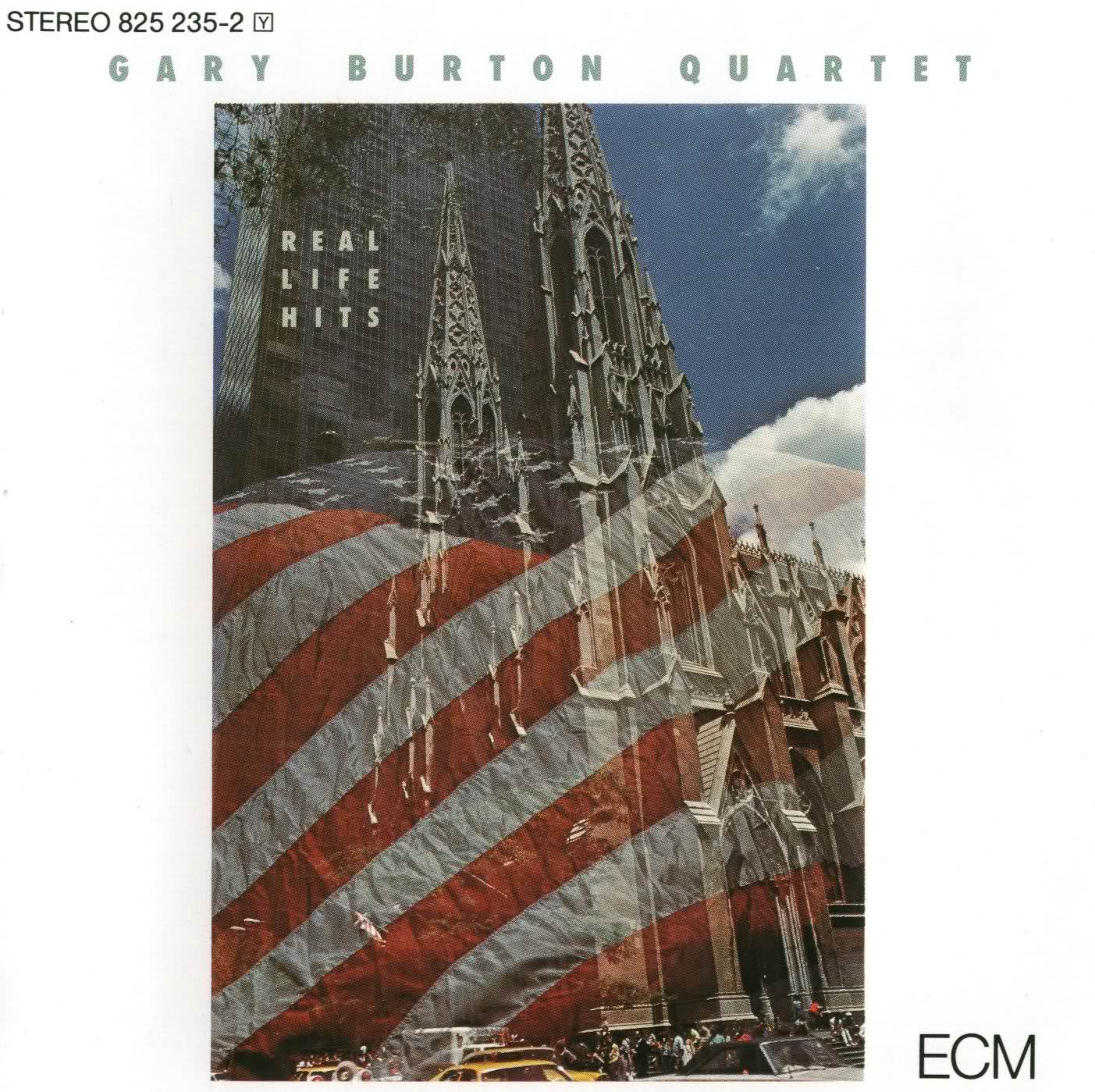
This is yet another solid outing from Burton and company. Like the cover art, it is something of a collage that makes for a complete portrait of a time and place, a snapshot with a living soundtrack. This is real life.

<< Dave Holland Quintet: Seeds of Time (ECM 1292)
>> Jan Garbarek Group: It’s OK to listen to the gray voice (ECM 1294)

Terje Rypdal/David Darling: Eos (ECM 1263)

Terje Rypdal
David Darling
Eos

Terje Rypdal electronic guitar, casio mt-30
David Darling cello, electric cello
Recorded May 1983 at Talent Studio, Oslo
Engineer: Jan Erik Kongshaug
Produced by Manfred Eicher

Once more the old mysterious glimmer steals
From thy pure brows, and from thy shoulders pure,
And bosom beating with a heart renewed.
–Alfred Lord Tennyson

Eos. Greek goddess of the dawn. Aurora to the Romans. She of the rosy fingers and golden arms. A welcome companion as we take in these private explorations from Norwegian guitarist Terje Rypdal and American cellist David Darling. Although further collaborations would reveal themselves on The Sea and Skywards, it was on Eos that they first tested the former’s mettle against the latter’s fluid tensions. The session begins where you might, depending on your temperament, least or most expect: in the solar eclipse of “Laser.” Rypdal sharpens his tools alone, raining sparks and molten glass. From this lit match burns a slow and epic fuse in the 14-and-a-half-minute title improvisation. Here the unlikely duo charts its deepest waters, covering our expectations in a muslin screen. Like a dream, it pulls at our feet with heartrending pathos, Rypdal bleeding coronas as he croaks into life. After this graft of spiritual skin, we continue our slumber in “Bedtime Story,” where an angelic drone cradles Darling’s plaintive acoustic and finds a willing partner in Rypdal’s amplified warble. Yet the skies begin to pale in “Light Years,” where the promise of interstellar travel becomes a fantasy for the lonely. As the stars wash into a white blanket around us, we see in the eyes of the cosmos a dire reflection. The world as we know it has vanished, and we are the only ones left with any concept of time. Our guide is the “Melody” that follows. Its wrists are frail, dusted like Saturn’s rings, and equally impossible to grasp. Still they lead, bringing to bear a false promise in “Mirage.” Rypdal’s snaking lines burrow into this pizzicato landscape without ever looking back, shaking off the residue of memory in favor of an enlightened solitude. This leaves us in the sweetness of “Adagietto,” where loving arms grow from dark matter like dandelions, blown into countless galaxies by the breath of Theia herself.

<< Kenny Wheeler: Double, Double You (ECM 1262)
>> Alfred Harth: This Earth! (ECM 1264)

Hajo Weber/Ulrich Ingenbold: Winterreise (ECM 1235)

ECM 1235

Hajo Weber
Ulrich Ingenbold
Winterreise

Hajo Weber guitar
Ulrich Ingenbold guitars, flutes
Recorded March 1982 at Tonstudio Bauer, Ludwigsburg
Engineer: Martin Wieland
Produced by Manfred Eicher

I came as a stranger; as a stranger now I leave.

I know nothing of Hajo Weber and Ulrich Ingenbold beyond the incandescent duets these two guitarists buried in the snowy recesses of Winterreise (Winter Journey), one of ECM’s greatest forgotten treasures. The title, of course, evokes Schubert, and the comparison may not be so arbitrary, for like the famous song cycle it speaks with hushed clairvoyance. Weber and Ingenbold bring distinct flavor to this session, dividing themselves at four compositions apiece.

Weber’s are meandering. Filled with pauses and reflections, they measure the passage of time in breaths. Ingenbold gilds the wood-grained lily of “Der wundersame Weg” (The Miraculous Way) with a trembling flute. Gentle footsteps trade places with an unfamiliar cry, meditating on a horizon which, once distant, is now close enough to pluck and make music out of. “Zweifel” (Doubt) plays like its shadow, dancing through dreams as if this were the only possible means of expressing itself. The tides shift with “Drehung in der Luft” (Rotation in the Air), a floating reverie insulated from the cold, while the flamenco kiss of “Filmmusik” washes up on Aegean shores. The air is moist, glowing in the moon’s lantern light.

Ingenbold’s sound-world is more continuous, treating Weber’s backdrops as canvases for a virtuosic appliqué. His “Karussell” is the session’s masterstroke, and puts me in mind of the early cinematographs, spun into impossible animation through a gallery of slits, each the promise of an ephemeral life. The title cut teeters on a whisper. Amid a rustling of wings and tail feathers, the blade of uncertainty falls from the throat of time behind a shining veil of recollection. A child dances where children cannot be seen, but is safe beneath the snow, where spring hides from all. “Sommerregen” (Summer Rain) fulfills the promise made at the album’s outset. It is the Golden Fleece without curse, the light of better days without the pain of absence. We feel the wind on the rims of our ears, hoping for sunlight, but instead experience something far more invigorating: the song of melting ice. Ingenbold dons a flute’s clothing again in “Son’s Song.” A lullaby wrapped in dawn’s brittle skin, it wishes away evil even as Weber chases away the nightmares with his light. The music becomes flesh, the flesh becomes music, and the music becomes love.

Winterreise is a poetic diary that deserves only poetry in return, and ranks alongside Bill Connors’s Theme To The Gaurdian and Ralph Towner’s Solo Concert as one of ECM’s most evocative guitar dates. As long as a reissue seems unlikely, make this your first vinyl rediscovery.

<< Everyman Band: s/t (ECM 1234)
>> Arild Andersen: Molde Concert (ECM 1236)

Keith Jarrett: Spirits (ECM 1333/34)

Keith Jarrett
Spirits

Keith Jarrett piano, flutes, soprano saxophone, guitar, percussion
Recorded May through July 1985 at Cavelight Studios, New Jersey
Engineer: Martin Wieland
Produced by Keith Jarrett and Manfred Eicher

Spirits is more than a jewel in the rough. It is the rough of a jewel. By this, I mean to say that through its hard-won journey Keith Jarrett has peered into the heart of darkness that is life and compressed it into a diamond so honest that no amount of polishing will wear away its blemishes. Recorded at his home studio, then post-processed by ECM engineer Martin Wieland, this is a most personal album of boundless expression. Then again, so is every Jarrett album. The difference is in the instrumentation: an unusual array of flutes, keys, and percussion, overdubbed in various combinations and densities (Jarrett even picks up a guitar, which he treats more like a sitar). Jarrett also sings, wails as if in and of the earth, finding in Nature a single feather plucked from nowhere. Bird-less, it has no recourse to flight, and can only call to a sky it will never know.

Though splashed over two discs in 26 parts, this heartrending session takes breath into the same pair of lungs throughout. Moods range from jubilation to a burrowing pensiveness, but always with an ear attuned to catharsis. The nearly two-hour purge turns repression into a path, beginning deep in the heart of ritual, where drums and flutes tread in place of feet and throats, and ending in the recesses of a Renaissance dream, where shepherds, troubadours, and shamans share their slumber. Jarrett’s occasional chants flirt with the exigencies of articulation, all the while forming steady yet somehow ungraspable touchstones along the way. The expected pianism is kept to a graceful minimum, giving way instead to wondrous ruminations on soprano saxophone and other suspended airs.

In so many other hands, such an album would come across as a trite exercise in tribalism, but in Jarrett’s it emotes with full transparency. By far his most colorful release, it marks a shift in method. Where before he charted every possible recess of the structure at hand, here he allows that structure to build itself around him in a shelter of the psyche. The result is a freestanding insight into the pathos of creation. Probably not the one you’ll want to start with, but by no means a prism to bar from the light of your curiosity.

<< Paul Hindemith: Viola Sonatas (ECM 1330-32 NS)
>> Steve Tibbetts: Exploded View (ECM 1335)