Terje Rypdal: What Comes After (ECM 1031)

ECM 1031

Terje Rypdal
What Comes After

Terje Rypdal guitars, flute
Barre Phillips basses
Jon Christensen percussion, organ
Erik Niord Larsen oboe, English horn
Sveinung Hovensjø electric bass
Recorded August 7/8, 1973 at Arne Bendiksen Studio, Oslo
Engineer: Jan Erik Kongshaug
Produced by Manfred Eicher

Terje Rypdal’s What Comes After, his second for ECM as frontman, is more about what came before. An exquisite diversion from the dustier billows of his later work, it charts much of the same territory as its self-titled predecessor, only this time with a tighter supporting roster. Sveinung Hovensjø lays down the dominant bass line that is “Bend It,” an atmospheric 10-minute opener that lulls us into its nocturnal crawl. The bowed bass of Barre Phillips and Jon Christensen’s subtle drum work adorn long-form improvisations from Rypdal as he wrenches out an ever-changing dialogue from the repetitive core. “Yearning” reprises the sinewy oboe (played here by Erik Niord Larsen) of Rypdal’s self-titled effort and features him in a rare acoustic turn. The jangly percussion makes for a mystical, if all too brief, experience. The see-sawing melodies and tender bass solo of “Icing” extend this feeling of isolation and memory before the delicate rimshot of the title track slinks metronomically through Rypdal’s mounting ruminations. “Séjours” marks the oboe’s standout return in one of the album’s most thoroughly realized tracks, while “Back Of J.” leaves us with a sparse final word, Rypdal unplugged and unhurried.

Albums like this allow us to appreciate the ways in which artists grow. ECM’s consummate electric guitarist has worn many hats, and perhaps none so many as in his formative years. Here, he feeds off his surroundings, even as he strays in equally fruitful directions, always harboring an innate awareness of where he is grounded. A wonderful place to start for initiates and strangers alike.

<< Gary Burton: The New Quartet (ECM 1030)
>> Ralph Towner: Diary (ECM 1032)

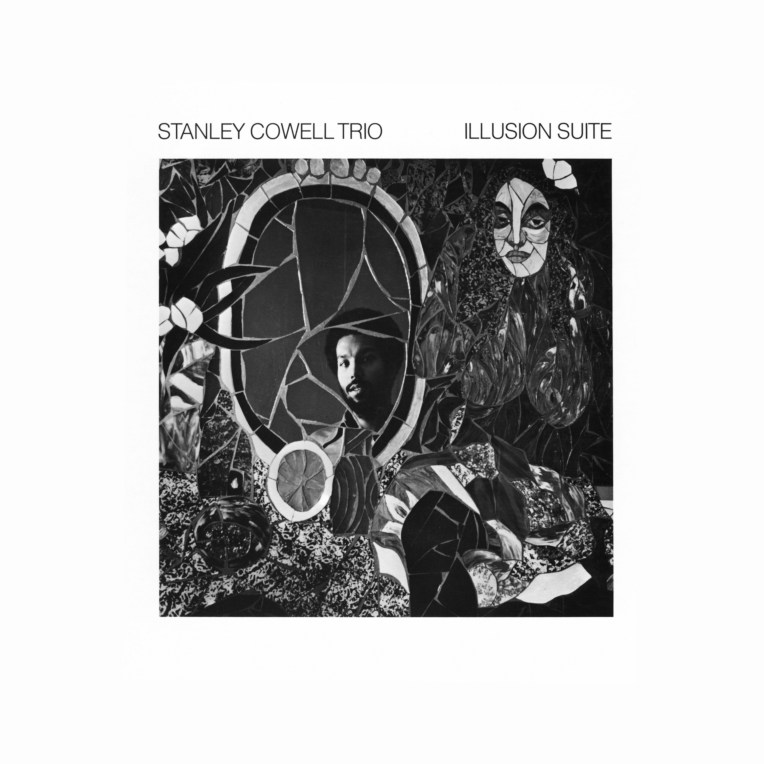
Stanley Cowell Trio: Illusion Suite (ECM 1026)

ECM 1026

Stanley Cowell
Illusion Suite

Stanley Cowell piano
Stanley Clarke bass
Jimmy Hopps drums
Recorded November 29, 1972, Sound Ideas Studio, New York
Engineer: George Klabin
Produced by Manfred Eicher

Human beings are adventurous eaters. We are constantly trying new things, loving some and hating others. We change our diets drastically, watching our calories and tallying every morsel we ingest. But sometimes, in the throes and woes of a food culture gone horribly awry, we just want to sit down to a good plate of comfort food, for nothing seems able to replicate the psychological benefits it provides. Stanley Cowell’s Illusion Suite is like that: a heaping portion of comfort food.

Backed by steady support from Stanley Clarke on bass and Jimmy Hopps on drums, Cowell delivers the goods and then some. The timid opening strains of “Maimoun” betray none of the album’s subsequent drive. A confident beat and bowed bass ease us into Cowell’s denser style, made all the more elegiac for its frequent use of octaval doublings in the right hand. (Incidentally, an alternate version of this track worth checking out can be found on Marion Brown’s 1975 Vista.) Cowell kicks off “Ibn Mukhtarr Mustapha” with a sporadic run across the piano before making a deft switch to his electric. Before long, this arid groove quiets into a percussion-heavy outro, bristling with African thumb piano. “Cal Massey” brings us into bop territory, with a great drum kick and deliciously twangy bass line to boot. Smooth is the name of the game is “Miss Viki.” Its fluid bass and wah-pedaled electric piano show off a cool sense of style and finesse. “Emil Danenberg,” named for a former director of the Music Conservatory at Oberlin College in Cowell’s home state of Ohio, is the album’s only ballad to speak of. Its raw, complex chords run straight into the darkest alleys of our internal cities. “Astral Spiritual” is a bit more straightforward, and features some quick turns and fancy musicianship all around. Spectacular drumming and astute pianism abound, ending unexpectedly on a downtempo turn, like an abandoned swing coming to rest. Nostalgic, thought-provoking, and tender, this is fantastic music from a gifted composer and performer that is now easily available thanks to an ECM digital reissue.

<< Ralph Towner with Glen Moore: Trios/Solos (ECM 1025)
>> Dave Holland Quartet: Conference Of The Birds (ECM 1027)

Dave Holland/Derek Bailey: Improvisations for Cello and Guitar (ECM 1013)

1013

Improvisations for Cello and Guitar

Dave Holland cello
Derek Bailey guitar
Recorded live at the Little Theater Club, London, January 1971
Release date: October 15, 1971

One’s not half two. Its two are halves of one… All lose, whole find.
–e. e. cummings

If you’ve ever picked up a guitar and played those short strings between the end of the neck and the pegs and wondered if one could make viable music with that kind of sound, then look no further, for that is precisely the pinpoint aesthetic captured on this rare recording. These improvisations are miniscule and entomological, whispering with the nocturnal regularity of a cricket. Holland and Bailey shift from pops and plucks to more sustained tones at the drop of a hat, but always with an ear keenly tuned to the other player. The two take full advantage of extended techniques to create a wide palette of sounds. These are delicate pieces, but no less full of verve and character for their utter precision. Sometimes the music is incredibly expansive. Other times it seems to implode, by turns galactic and subterranean. Because both musicians are so skillful at what they do, one can truly appreciate the spontaneous dynamics of their playing, the ways in which they react and prompt each other into action. They are never afraid to take separate paths, for they always seem to rejoin, and in doing so they add seemingly endless variety as the energy flows and ebbs. It’s always fascinating to hear Dave Holland’s earlier work, and this meeting with Bailey is certainly an archival treat.

<< Stenson/Anderson/Christensen: Underwear (ECM 1012)
>> Chick Corea: Piano Improvisations Vol. 1 (ECM 1014)

Adelhard Roidinger: Schattseite (ECM 1221)

ECM 1221

Adelhard Roidinger
Schattseite

Adelhard Roidinger bass
Heinz Sauer tenor saxophone
Bob Degen piano
Harry Pepl guitar
Werner Pirchner vibraharp, marimba
Aina Kemanis voice
Michael DiPasqua drums, percussion
Recorded November 1981 at Tonstudio Bauer, Ludwigsburg
Engineer: Martin Wieland
Produced by Manfred Eicher

It’s unfortunate that Adelhard Roidinger only cut this one record for ECM. The Austrian-born Renaissance man seems to have been a perfect fit for the label, which by the time of this release (1982) had firmly established its aesthetic hold on the jazz market. Schattseite has a lush, airy sound that is always appealing, and what better way to draw us in than with the slow-moving “Fü Pfü.” The soloing is crisp all around: gorgeous vibe work from Pirchner, Pepl’s soft guitar licks, DiPasqua’s tender drumming, a fluid run from Sauer on tenor sax, and an alluringly pianistic turn from Degen all make for a crystalline opener, and Roidinger’s plaintive accompaniment pulls it all together with humility. There is much stopping and starting, as if the music were afraid to latch on to a memory it knows could be self-destructive. Next is “Lufti,” a delightfully overdubbed bass duet, interrupted by occasional glissandi for a playful effect. “Loveland” fades in on a sweet piano riff doubled by Aina Kemanis’s brassy vocals, evoking the distinctive sound originally forged on Return to Forever. Roidinger harmonizes with the lead motif, blending into another mercurial leap from Pirchner, this time on marimba, supported by a delicate repeat of the same progression sans voice. The fantastic sax solo and Metheny-esque picking lend even more elegance to the track’s progressive sound. “Stress” begins with a bowed electric bass, caressing the air like whale songs. Sauer introduces the main line, again doubled by Kemanis, before Roidinger steps in to offer some regularity, thereby allowing Deger more room to flex his fingers. “Ania” starts with laughter, or something like it. Out of this abstract pointillism comes an engaging chant, throughout which Pepl jauntily strums his way along. The album closes with its longest track, “When Earth Becomes Desert,” which steadily moves from haunting drones to an all-out improv-fest. The marimba is unusually present here, and I wouldn’t be surprised if it was miked differently, if not added in postproduction. The final minute brings us slowly back down with a gorgeous melody in tutti.

Although Schattseite does take a while to find its groove, whatever it may lack in drive it makes up for in atmosphere and melodic robustness. This is an album of exceptional sound and quality, and is like the audio equivalent of a scenic route: it may get you to the same destination, maybe even less efficiently, but its allure is such that by the time you near the end, you no longer care where you were going. In dire need of a reissue.

<< Mike Nock: Ondas (ECM 1220)
>> Paul Motian Band: Psalm (ECM 1222)

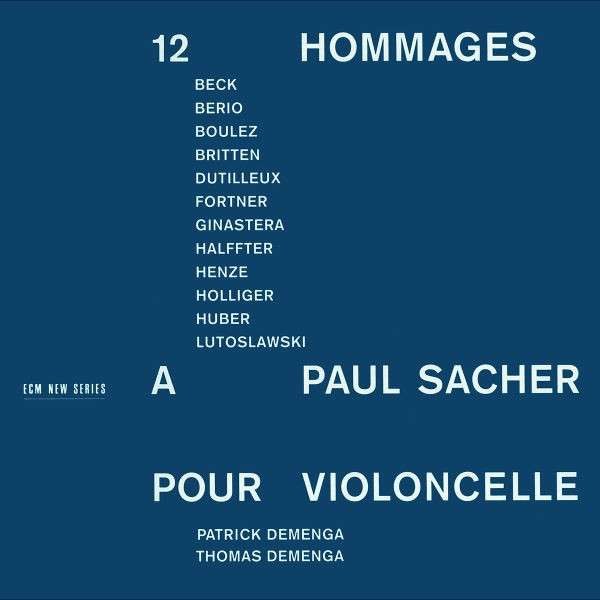
12 Hommages A Paul Sacher (ECM New Series 1520/21)

12 Hommages A Paul Sacher

Thomas Demenga
Patrick Demenga
Jürg Wyttenbach Conductor
Recorded June 1993, Kirche Blumenstein, CH
Engineer: Teije van Geest
Produced by Manfred Eicher

Before first encountering this recording, Paul Sacher was an unfamiliar name to me. Now that the album has been with me for fifteen years, it is a name I cannot forget. Sacher (1906-1999) was a Swiss conductor and patron of the arts who championed all of the composers represented in this 2-CD tribute. His wealth and musical acuity led him to commission some of the most defining works of the twentieth century. Without him we wouldn’t have, for example, Bartók’s Music for Strings, Percussion, and Celesta or Stravinsky’s Concerto in D. For this project, realized in commemoration of his 70th birthday, a choice group of composers were commissioned to write pieces for cello around the so-called “Sacher hexachord,” a tone row derived from Sacher’s name: Eb=Es A C B=H E D=Re. The concept is similar to that of the B-A-C-H motif (Bb=B, A, C, H=B natural), which has been incorporated into works by, among many others, Liszt, Busoni, Pärt, Webern, and Bach himself (see ECM’s Ricercar for a creative juxtaposition of the latter two). The project was originally spearheaded by Mstislav Rostropovich, but has been recorded here with requisite flair by Thomas and Patrick Demenga.

At the heart of this project is Benjamin Britten’s Tema, the most straightforward iteration of the Sacher theme. Originally, the other composers were asked to simply write variations thereof, but their ideas soon developed into full-fledged pieces in their own right. Alberto Ginastera’s Puneña No. 2, Op.45 immediately draws us in with its keening melody, crying out like a hawk losing sight of its prey. The majestic bird tears at the sky as it would the earth, eliciting a flurry of virtuosic leaps and plucked asides. Each whispered harmonic lifts the bird with the silent power of a thermal. But then the prey is spotted, and falls as if pierced by an arrow from its hunter’s very gaze. Agitated pizzicati scamper like the rodent’s ghost into a dense thicket of trees as the hawk raises calls of revelry and tears its meal limb from limb. To my ears, this is one of the most technically demanding pieces on the album, sometimes requiring the cellist to pluck with the left hand while bowing with the right. Wolfgang Fortner’s Zum Spielen für den 70. Geburtstag – Thema und Variationen für Violincello solo is a more somber affair, its flashes of consonance piercing the surrounding dissonant fabric with divine light. The Capriccio by Hans Werner Henze is among the more cryptic pieces. Its complex narrative and subtle details beg repeated listening. This is followed by a string of vignettes. Of these, Henri Dutilleux’s 3 Strophes sur le nom de Sacher and Witold Lutosławski’s Sacher-Variationen are remarkable. Both give us a “conversational” portrait, perhaps reflective of the relationship either composer may have had with the man behind the music, for like a conversation among friends these pieces are fraught with conflict and agreement in equal measure. They are also very “alphabetic” and are perhaps the most committed to the their morphological assignment. Cristóbal Halffter seems to take a similar tack in his Variationen über das Thema eSACHERe, while Conrad Beck and Luciano Berio opt for a more concise approach that favors melodic dissection over prosody. By far the longest piece is Klaus Huber’s Transpositio ad infinitum – Für ein virtuoses Solocello, another compelling delineation of attenuate character and detail. Following this, Heinz Holliger yet again flexes his brilliant compositional muscle with the Chaconne für Violoncello solo. This rather enumerative piece makes apt use of the acoustics of the recording space and exploits the incidental sounds of the strings against the fingerboard as a sort of parallel dialogue. And just when we begin to suspect all possibilities have been exhausted, Pierre Boulez, ever the nonconformist, throws us for a loop with his Messagesquisse for seven cellos, which seems to blend all that came before until smooth.

Even though all of this music inhabits the same landscape, each piece digs up its own relic and turns it into music. The album is passionately performed, and recorded in clear and present sound. It is a unique testament to a unique individual, one that unlocks Sacher in a way those of us who will never know him cannot ever experience otherwise. Essentially, it is the Sacherian equivalent of A Hilliard Songbook, for just as the latter would not exist without the Hilliard Ensemble, so too is this album a timeless memorial to a figure whose absence might have effectively erased an entire generation of masterworks.

<< David Darling: Dark Wood (ECM 1519)
>> Charles Lloyd: The Call (ECM 1522)

Stenson/Andersen/Christensen: Underwear (ECM 1012)

1012

Underwear

Bobo Stenson piano
Arild Andersen bass
Jon Christensen percussion
Recorded May 18/19, 1971 at the Bendiksen Studio, Oslo
Engineer: Jan Erik Kongshaug
Produced by Manfred Eicher
Release date: September 15, 1971

With such a solid trio of musicians and a name like Underwear, you just know this one’s going to be good. And sure enough, Stenson kicks things off just right with the spirited title track, throughout which every instrument bubbles in a witches brew of fine flavors. Exuberant drumming, flurried bass lines, and a tightly knit sense of composition make this one of the great openers of ECM’s extensive jazz lineup. Hot on its heels is “Luberon,” the album’s requisite ballad, the placement of which both emphasizes the liveliness of the opener while also bolstering its own lyrical sensibilities. “Test” lays on a more organic sound of percussion and scraped piano strings. This delicate backdrop continues as Stenson breaks into a clearly defined melodic improvisation, prompting cries of ecstatic joy before succumbing to a forced fadeout. “Tant W.” brings us into more laid-back territory with its alluring conversation between piano and drums. Once the bass joins in, the groove becomes certifiably infectious. After this block of Stenson originals, we are treated to a pair of fine closers. Ornette Coleman’s “Untitled” runs with reckless abandon through frenzied pyrotechnics, priming us for the comforting “Rudolf” (Andersen). The latter’s fluid piano intro becomes the heart of the piece, echoing in an otherwise bass-dominant space.

Stenson is entirely on point, as if he were inborn with a finely attuned sense of melody and articulation. His playing is democratic and guides with a gentle hand, always managing to cover so much of the keyboard in a single cut. Andersen’s busy fingers provide the album’s backbone, while his gorgeous vibrato and twang-ridden charm work wonders in the softer moments. And Christensen’s drumming never fails to excite. Triply inspired soloing and a synergistic core make Underwear a prime choice for the ECM newbie and veteran alike. A simply fantastic album, this is one for the ages.

<< Dave Holland/Barre Phillips: Music From Two Basses (ECM 1011)
>> Dave Holland/Derek Bailey: Improvisations for Cello and Guitar (ECM 1013)

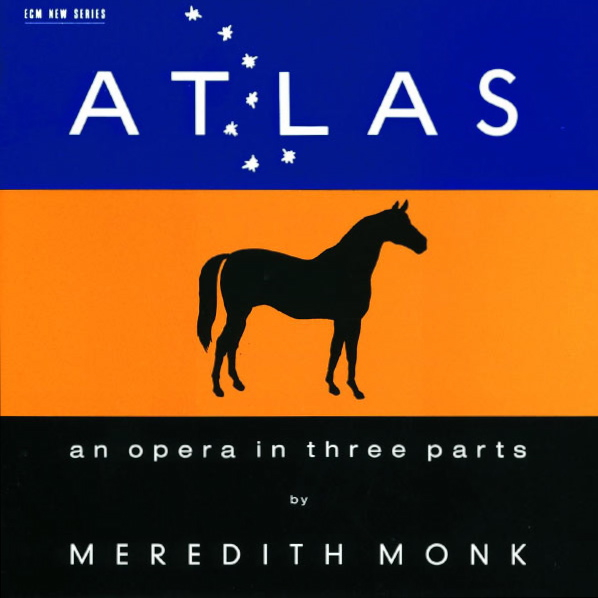
Meredith Monk: Atlas (ECM New Series 1491/92)

Meredith Monk
Atlas

Carlos Arévalo voice
Thomas Bogdan voice
Victoria Boomsma voice
Janis Brenner voice
Allison Easter voice
Robert Een voice
Emily Eyre voice
Katie Geissinger voice
Dana Hanchard voice
Wendy Hill voice
Meredith Monk voice
Ching Gonzalez voice
Dina Emerson voice
Robert Osborne voice
Wilbur Pauley voice
Radall Wong voice
Shi-Zheng Chen voice
Stephen Kalm voice
Susan Iadone violin
Darryl Kubian violin
Kathleen Carroll viola
Anthony Pirollo cello
Meredith Monk cello
John Cipolla clarinets
Wayne Hankin shawm, sheng, recorder
Wayne Hankin conductor
Steve Lockwood keyboards
Cynthia Powell keyboards
Thad Wheeler percussion
James F. Wilson french horn
Recorded June 1992 at Power Station, New York
Engineer: James A. Farber
Produced by Manfred Eicher

Meredith Monk’s first opera Atlas received its premier at the Houston Grand Opera in February of 1991 and is by far one of her most beautifully realized works. Much of the opera came to the studio in sketches, only to be solidified through improvisation and the synergy of performing with a handpicked group of singers. Inspired by Alexandra David-Néel’s classic book Magic and Mystery in Tibet, the opera’s three acts trace the personal quest of its heroine, also Alexandra, through a life rich in material and spiritual experience. The libretto is so scant that it fits snuggly into this review in its entirety. And while the lack of words certainly challenges operatic norms, it is to no ill effect. If anything, it heightens the work’s profundity.

I. Personal Climate
A young Alexandra takes solace in the domestic comforts of her girlhood, all the while dreaming of what awaits her once she goes out in the world. A minimal overture opens into the comely “Travel Dream Song.” Keyboard arpeggios and a small instrumental ensemble cradle Alexandra’s yearning in a tender embrace. She looks skyward on her swing, running through the majestic details of a life lived in transit:

Mountains…cities…steamships…grass skirts…canyons…cinnabar.

After the haunting overtone singing of “Rite of Passage A,” we come to a crucial intersection in the opera’s crossroads. “Choosing Companions” presents Alexandra’s recruitment of the travelers who will help make her dream a reality. A knock at the door introduces each potential companion, who arrives with a résumé of attributes. The first knock reveals a man who speaks in Mandarin before continuing in English:

Wǒ hěn jiānqiáng.
I am strong.
My heart is broken.
I am a good cook.

The Chinese translates to “I am strong,” and the repetition in English opens a linguistic crack in the opera’s already fragile edifice. Another knock, and in walks a boastful, well-seasoned adventurer:

I own my own equipment.
I’ve got a strong stomach.
I’m good looking.

The last knock introduces the practical explorer:

I have desire.
I have a dry sense of humor, good hiking boots.

Each of these spoken lists is followed by a bit of singing meant to convey the constitution of each character, and takes a rather humorous turn when the egotist sings terribly off key despite his most valiant efforts. “Airport” is the most complex section of the opera, and builds to a fiery climax as a man intones, “Three, Four, One,” until silence overtakes him.

II. Night Travel
This central section features some of the most eclectic sounds in the opera. From the exquisite introductory melody to the apocalyptic “Possibility of Destruction,” we are treated to a sort of aural travel by which the listener is transported along with its subjects. Of note here are the working songs of “Agricultural Community,” and of course Janis Brenner’s brilliant banshee-like vocals and Shi-Zheng Chen’s fearful tremors in “Hungry Ghost.” A glass harmonica introduces a major climate shift in “Ice Demons,” carrying on with laughter and thematic resolution. “Explorer #5” brings more spoken text into the fray:

She can hear for miles.
She is very patient.
She has royal blood.
She drives both shift and automatic.
She has a green thumb.
She can read Sanskrit.

Soon after, the supremely evocative “Forest Questions” bubbles with turgid vocabularies, wailing sirens, and lupine howls. Here, the travelers happen upon the world’s oldest man, of whom they ask:

Has anything changed?
Can I find love?
But I still hear noise.
What is pain?
Will all this last?

If any answers are given here, they are lost in the music, for in being asked they are already gone. “Desert Tango” and “Treachery (Temptation)” provide the opera’s most frivolous moments. The latter in particular is an amusing, almost Heiner Goebbels-like gallery of fools that takes pleasure in drowning in its own vanity:

Finish by five, by five.
Finish by five.
By five, finish by five.
You know you have to, you know you have to do it.
If you put the first one here, and the second there, well then the third…

III. Invisible Light.
The final act is all about reflection, as Alexandra looks back on her life and recounts the ups and downs of her journey. This act works more as a cohesive whole, and in “Explorers’ Junctures” provides a detailed aural map of its entire musical landscape. “Earth Seen From Above” is the most divine portion of the opera, melting into “Rite of Passage B,” which leaves us floating in the upper atmosphere.

Although the staging of Atlas adds a vital component of movement, the “incidental” soundtrack is no less powerful here for its absence. This is motion personified in sound, the poetry of life’s easily forgettable details wrapped in a cloud of human contact. Behind closed eyes we can feel the primordial depth of these performances and of the final destination they seek to illuminate, so that by the time we open them we are already there.

<< Gary Peacock/Ralph Towner: Oracle (ECM 1490)
>> Andersen, et al.: If You Look Far Enough (ECM 1493)

A Hilliard Songbook (ECM New Series 1614/15)


The Hilliard Ensemble
A Hilliard Songbook: New Music For Voices

The Hilliard Ensemble
David James countertenor
Rogers Covey-Crump tenor
John Potter tenor
Gordon Jones baritone
Barry Guy double-bass
Recorded March/April 1995, March 1996 at Boxgrove Priory, Chichester
Engineer: Peter Laenger
Produced by Manfred Eicher

Those who approach this album like I did—that is, only after listening to the Hilliard Ensemble’s many early music recordings—may be in for a surprise. Whether that surprise is a pleasant one or not may depend on the listener’s openness to new sounds. The opening convulsion that is Barry Guy’s aphasic Un coup de dés would seem to foreshadow a bumpy ride. Its whirlwind of extended double bass techniques and choral acrobatics leaves us hard pressed to find our bearings. The score, Guy tells us, encourages improvisation and even the modification of what has already been written. Using a section from a Mellarmé poem, which likens the process of thought to a mere dice-throw, the piece works its way into our ears like a dwarfing star. It is abstract, agitated, and unsettling, yet full of gracious detail we cannot help but enjoy. The Hilliards demonstrate that they can execute a piece of such technical difficulty and “modern” sensibility with as much fluidity as they approach their more familiar repertoire—at least insofar as their recordings are concerned, for they have always been known for juxtaposing contemporary works with those of bygone ages in their live performances. And then we get the short and sweet Only, the earliest published composition of Morton Feldman. In less time than it takes to microwave a frozen dinner, we are utterly transported by Feldman’s visceral melodic rendering of a Rilke sonnet, brought to its fullest fruition through the angelic voice of Rogers Covey-Crump. It is a folk song for its own sake, a funereal hymn for the living. This sets off a spate of shorter pieces by Ivan Moody and Piers Hellawell. Moody’s viscous miniatures live up to the composer’s name, taking us through a range of emotional colors. Endechas y Canciones sets Arabic-Spanish poetry from the 15th and 16th centuries. The second of these, “Endechas a la muerte de Guillén Peraza,” is a dirge from the Canary Islands that pulls at the heartstrings with a pace slow and focused, like moderated speech. The Hilliard Songbook by Hellawell, on the other hand, is a whimsical journey through A Treatise Concerning the Arte of Limning by Nicholas Hilliard (1547-1619), the celebrated Elizabethan portraitist. This is the centerpiece of the album, both in title and in song. The treatise’s idiosyncratic descriptions of color inspired the composer to recreate those very colors with voices. Regulating the piece is a refrain taken up each time by one member of the ensemble: “True beautie of each perfect cullor in his full perfection in perfect hard bodies and very transparent.” Through this many-hued ode we are given valuable insight into not only the Hilliards’ vocal art, but also into the visual mind of their namesake.

Of the longer pieces represented here, Paul Robinson’s Incantation is textually the broadest. The words are adopted from Byron’s poem of the same name—what Robinson calls a “vitriolic curse”—through which the composer sought to foreground the Hilliards’ sonority over the work being performed. As the music marks its slow path through a rather morbid text, we feel the voices blend into a single destination. Kullervo’s Message, by Estonian composer Veljo Tormis, recounts a dramatic episode from The Kalevala, Finland’s nineteenth-century national epic. From a line of skillfully harmonized textual lifts, Tormis hangs a series of messages by which the eponymous tragic hero is informed of the deaths of his loved ones, even as he prepares to exact his revenge upon those whose ridicule led him to such self-destructive fervor. Tormis’s melodic and programmatic colors are ideally suited to their source material, moving with the virtuosity of a master storyteller. Scottish composer James MacMillan offers his own epic statement in the form of …here in hiding…, a deceptively simple mesh of the poem “Adoro te devote” by St. Thomas Aquinas in both its Latin and English forms.

The remaining pieces comprise a flavorful mixture of words and musical ideas. Two exemplary statements from Arvo Pärt, And One Of The Pharisees… and the splendid vocal version of Summa, make fine company of Elizabeth Liddle’s Whale Rant, which takes its cues from Moby-Dick, and works its music like clock hands, with one arm counting the hours while another traces a faster, larger circle. The second hand becomes invisible, implied only in the vocal gestures of the sensitive performance, and is forever lost in the ocean of its source. Joanne Metcalf’s Music For The Star Of The Sea, is a thinly veiled meditation on the words “O ave maris stella” (“O hail star of the sea”) that extends the possibility of a single utterance into a vast Marian fabric. Sharpe Thorne by John Casken paints an image of Christ impaled, while Michael’s Finnissy’s Stabant autem iuxta crucem praises the one who bore him. And in Canticum Canticorum Ivan Moody again dazzles with this setting of verses from the Song of Songs and its loving incorporation of Byzantine chant.

Those wishing to hear the range of the Hilliards’ technical prowess will want to check out this collection for sure. This humble quartet sings with such clear articulation of phrase that one accepts every note like the nourishing morsel it is. While the music is for the most part contemplative and lovely, never ceasing to fascinate even at its least accessible moments, much of it feels spun from the same thread. The pieces by Ivan Moody stand out here as being the most well thought out and textually aligned, while the Hellawell, Tormis, and Guy enchant with their distinctive flair. That being said, it seems a shame to think that cultures outside a Eurocentric Judeo-Christian context should be shunted here. Considering that nearly all of these pieces were written for the Hilliard Ensemble, and that some of their composers were involved in the Hilliard Summer School led by the ensemble in residency, a narrow scope is perhaps understandable. Geographical limitations aside, the traveling instinct is still there in the Hilliards’ adventurous spirit, captured in every flawless phrase, in every committed performance that continues to issue from their very throats.

<< Evan Parker EAE: Toward the Margins (ECM 1612 NS)
>> Dino Saluzzi: Cité de la Musique (ECM 1616
)

Wolfgang Dauner: Output (ECM 1006)

1006

Wolfgang Dauner
Output

Wolfgang Dauner piano, effects (ring modulator), keyboards (Hohner Electra-clavinet C)
Eberhard Weber bass, cello, guitar
Fred Braceful percussion, voice
Recorded September 15 and October 1, 1970 at Tonstudio Bauer, Ludwigsburg
Engineer: Kurt Rapp
Produced by Manfred Eicher
Release date: December 1, 1970

An early outlier in the ECM catalog, Output convulses with as much originality as it did when it was first released. Wolfgang Dauner, perhaps better known as founder of the United Jazz + Rock Ensemble (which saw ECM greats Eberhard Weber, Kenny Wheeler, and Charlie Mariano pass through its doors), assembles a modest trio of talent for this classic 1970 studio free-for-all. The end result is humor, brilliance, and chaos rolled into one. Most of the album flirts with any number of possible paths, the sole exception being “Nothing To Declare,” a straight-laced tangent into jazzy territory in which Dauner has a field day with his modulator. “Mudations” and “Brazing The High Sky Full” are cryptic bookends, while tracks like “Abraxas” whet our appetite with provocative flavors.

Output

Superb, if jumbled, musicianship and strong attention to detail are the order of the day. Dauner does wonders with limited means, Braceful sheds his skin whenever possible, and this is a far cry from the Weber of languid orchestral suites. Not an easy listen for the faint of heart, but one that will give back what’s put into it and, like the fully opened cover, gathers its power from another dimension.

<< The Music Improvisation Company: s/t (ECM 1005)
>> Jan Garbarek Quartet: Afric Pepperbird (ECM 1007)