The Music Improvisation Company: s/t (ECM 1005)

1005

The Music Improvisation Company

Derek Bailey electric guitar
Evan Parker soprano saxophone
Hugh Davies live electronics
Jamie Muir percussion
Christine Jeffrey voice
Recorded on August 25-27, 1970 at Merstham Studios, London
Engineer: Jenny Thor
Produced by Manfred Eicher
Release date: November 1, 1970

Derek Bailey is a pioneer of British free improvisation, and although this is one of his earliest recordings, it houses much of what he would come to be known for: microscopic precision, a love of empty space, a supremely fractured aesthetic, and a subtle disregard for the rules. As with his later solo outings and fruitful collaborations with John Zorn and other bastions of the avant-garde, Bailey brings full commitment to the table in this early, digitally reissued ECM recording. Yet how to describe it? A possessed duck call tripping down a flight of stairs into a pile of discarded instruments? A broken jack-in-the-box heavily amplified on cheap speakers? A radio being tortured to give up its innermost secrets? None of these comes close to mapping the album’s rambling course. Still, the results are consistent. So much so that track titles like “Packaged Eel” do nothing to deepen our understanding of the goings on. As can be expected from the roster, the musicianship is of indisputable quality. Evan Parker awes with his outbursts of indiscernible melody while Bailey cultivates an anonymous approach, cutting in and out from behind a surgeon’s mask.

The Music Improvisation Company is nothing more or less than what one makes of it. Its difficulties are also what make it go down smoothly. A mysterious morsel that yields a new flavor with every taste.

<< Marion Brown: Afternoon Of A Georgia Faun (ECM 1004)
>> Wolfgang Dauner: Output (ECM 1006)

Just Music: s/t (ECM 1002)

1002

Just Music

Peter Stock bass
Franz Volhard cello
Thomas Stöwsand cello, flute
Johannes Krämer guitar
Thomas Cremer percussion, clarinet
Alfred Harth tenor saxophone, clarinet, trumpet
Dieter Herrmann trombone
Recorded on December 13, 1969 at the Nettekoven Studios, Frankfurt am Main
Produced by Just Music and Manfred Eicher
Release date: May 1, 1970

Just Music was the moniker for a rotating West German collective whose musical “happenings” were a nascent challenge to mainstream sociopolitical strictures. Although the classical training of these musicians is readily apparent from their technical prowess, the opening outburst tells us we’re in for something less rule-bound. Alfred Harth tears the ether with his sax amid wordless chanting as a cornucopia of musical ideas is thrown into our ears. That said, these two 20-minute free-for-alls weave a quietude broken only by the occasional peak of intensity.

Just Another Music
Alternate cover

Released in 1969, this self-titled date was the second for ECM Records and is still out of print. It remains a veritable zoo of musical languages in which each dialect is its own animal: caricature of an impossible ideal. Sax and trombone roar like elephants; the flute is a bird that would just as soon go into feathery convulsions as fly; the cellos are reptilian; the bass lumbers like a lion from its den; drums trip over themselves like a drowsy bear; and a guitar chatters with the insistence of an agitated monkey. This leaves only the human voices, a mockery in and of themselves. Just Music flips through a mental file of everything learned at the academy, scribbling in addendums of extended techniques for good measure. Where one moment finds us in our comfort zones, the next proves our power of direction to be fallible, forcing us to wander everyday streets as if for the first time.

I hesitate to call this controlled chaos, for it is no less illustrative of the chaos of control. We may not understand what we have just witnessed, but can’t help sifting through the wreckage with curiosity.

<< Mal Waldron: Free at Last (ECM 1001)
>> Paul Bley Trio: Paul Bley with Gary Peacock (ECM 1003)

Robin Kenyatta: Girl From Martinique (ECM 1008)

1008

Robin Kenyatta
Girl From Martinique

Robin Kenyatta flute, alto saxophone, percussion
Wolfgang Dauner Clavinet, piano
Arild Andersen bass
Fred Braceful drums
Recorded October 30, 1970 at Tonstudio Bauer, Ludwigsburg
Engineers: Kurt Rapp and Karl-Hermann Hinderer
Produced by Manfred Eicher
Release date: March 15, 1971

One night, after a gig in Harlem, a budding saxophonist by the name of Robin Kenyatta was approached by none other than Bill Dixon, who expressed an admiration for the young reedman’s skills and would soon introduce him to the likes of John Coltrane. Thus began a colorful and fascinating career that intersected with ECM for this album alone. The currently out-of-print Girl From Martinique shows Kenyatta at his most experimental, and the results are a mixed bag. The title track is the weakest, laden as it is with a hackneyed “psychedelic” reverb, though Kenyatta’s flute skills are in fine form here and are a joy to hear. So much so that I would have been happier listening to him play unaccompanied, perhaps in a more naturally resonant space. And while the piece does come into its own in the home stretch, it feels like too little too late. Thankfully, “Blues For Your Mama” is more straightforward with its heavy Clav bassline, priming a killer sax solo. “Thank You Jesus” sounds like a gospeller’s good dream turned bad, spicing things up with such brilliant chaos during the fadeout that one wonders where the session continued to travel after the mixing knob was turned down. The Caribbean-flavored “We’ll Be So Happy” is groovy and understated, a beautiful track that might easily have been extended to fill the entire album with no loss of interest. Kenyatta returns to the flute as an echoing Clav leads out with a mystical touch.

Kenyatta, who passed away in 2004 at the age of 62, was a standout player in the 1970s free jazz scene, and his intuition and improvisatory chops are in full evidence here. Yet in some ways this recording leaves something to be desired. The dated electronics and paltry arrangements question the need for support in its first half. The album is overproduced and, while archivally significant, shows a label (and a musician) still trying to find its voice. That all being said, the album grows with every listen as its nuances come to the fore, and rewards the patience put into it. Anyone without access to the original vinyl may want to check out Stompin’ at the Savoy (1974) or the funk-infused Gypsy Man (1972) for a taste of Kenyatta’s more commercially successful (and thereby more readily available) projects before plunking down a few bills for this blast from the past.

<< Jan Garbarek Quartet: Afric Pepperbird (ECM 1007)
>> Corea/Holland/Altschul: A.R.C. (ECM 1009)

Gavin Bryars: Three Viennese Dancers (ECM New Series 1323)

Gavin Bryars
Three Viennese Dancers

Pascal Pongy French horn
Charles Fullbrook percussion
Gavin Bryars percussion
Arditti String Quartet
Recorded February 1986, Tonstudio Bauer, Ludwigsburg
Engineer: Martin Wieland
Produced by Manfred Eicher

The opening moments of this seminal disc encapsulate Bryars in a nutshell: restrained yet so full of life. A murky prologue drags us through reverberant waters, never quite breaking the waves of percussion above. Like the tides, sustained tones caress the coasts of our attention with invisible rhythm. If one were to record a wind chime, slow it down to a languid crawl, and submerge it in a tank, and if we were outside that tank with our ears pressed against the glass, straining to feel the vibrations with every inch our bodies, we might approach an analogous sound. Despite the lack of discernable melody, the mood is thick, fading into the silence whence it came.

String Quartet No. 1 (“Between the National and the Bristol”)
The result of a 1985 Vienna Festival commission, this quartet allowed Bryars to look beyond the insular world of his main instrument (the double bass) and into new territory. Having never written for string quartet, Bryars was faced with the task of both expanding upon the intricacies of his instrument while being faithful to the dynamics of this new medium. On the title, Bryars says:

During the time that I was working with Robert Wilson on The CIVIL WarS I undertook research into the life of Mata Hari in order to find text for an aria. One night in 1906, unknown to each of them, the three most famous dancers of the period were staying in Vienna. Maud Allan was at the National, Mata Hari was at the Hotel Bristol, and Isadora Duncan, another reference within the quartet, was staying in a hotel “somewhere between the National and the Bristol”.

While one might easily dismiss the anecdotal underpinnings of the quartet, they do add a splash of color to its monochromatic canvas. The instruments seem to enter in procession, with the violins in the lead. Each layer of the quartet is clearly introduced, as if each were its own string in a larger instrument, speaking as one story between worlds. The music here is fairly minimal and at moments puts me in mind of Michael Galasso’s wonderful album Scenes, also available on ECM. With the same grace that embodies so much of his work, Bryars traces his path in arcs. The quartet evokes a European city in pastiche. Violins raise a call to arms and, with one foot firmly planted in the arid terrain of imperialism, sound an alarm of imminent histories. We become privy to the sentiments of a young girl who has grown up in an oppressive regime and who must now choose between life and death, between family and freedom. She wanders the lamp-lit streets, glistening with a fresh spate of rain, and she despairs because she has lost something more than her grounding: her identity. The state does not beat her with its fists, but oppresses her with its presence of mind, even as her not-so-distant memories haunt her with promises of a better life. But then, we are suddenly lifted away from this scene in a swish from cello to violins, whereupon the narrative slips into a bizarre sort of dance—one that sways and tilts in conversation with gravity. It is the twirl of slippered feet dotting the landscape with steps as yet undiagrammed. The passage of time becomes contested as strings ascend once more into new harmonic possibilities.

First Viennese Dance
This third piece nears the 20-minute length of its predecessor and is scored for French horn and percussion. Again, we get a broad swell of gongs and liquid tones. Tubular bells resound in our ears as metallic clusters glitter like handfuls of coins dropped into a fountain. Like the prologue, this music is murky—so much so that even the trebly glockenspiel is diffused in a haze of post-production. Unlike the first string quartet, the structure of this first dance is so amorphous that all potential themes are stretched to the point of misrecognition. By the time we get to the end of any melodic line, we are so far from the beginning that we forget it. This music is more atmosphere than motive, flickering somewhere between an unknown future and nostalgia. Bryars is able to elicit from these acoustic ingredients a sound that is almost electronic in taste. In contrast to Bryars’s earlier The Sinking of the Titanic, however, the music represented on this album seems to have no specific vessel. It is, rather, the aura of a war-ravaged city yet to be built, much less destroyed.

The album ends where it began, plumbing the depths of clouded waters, leaving us to recede ever downward into a heavy darkness. This is an album to be experienced with closed eyes.

<< David Torn: cloud about mercury (ECM 1322)
>> Jan Garbarek: All Those Born With Wings (ECM 1324)

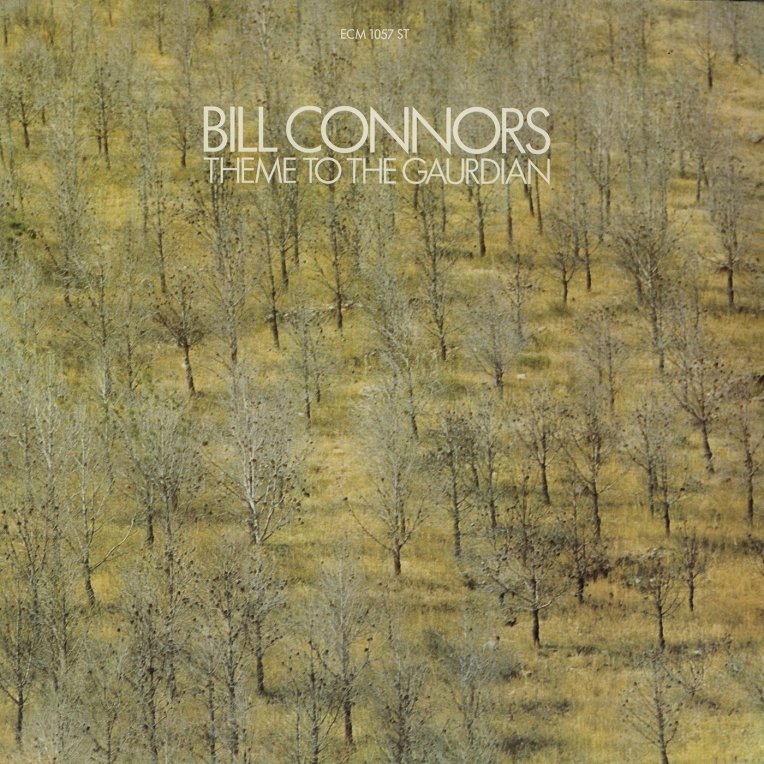
Bill Connors: Theme To The Gaurdian (ECM 1057)

ECM 1057

Bill Connors
Theme To The Gaurdian

Bill Connors guitar
Recorded November 1974 at Arne Bendiksen Studio, Oslo
Engineer: Jan Erik Kongshaug
Produced by Manfred Eicher

Guitarist Bill Connors famously left Chick Corea’s Return to Forever outfit (for which he had provided dynamic electric stylings) in 1974, making the switch to acoustic and recording this, his first solo album. Not one year later he would launch into an intensive period of self-directed study, making Theme To The Gaurdian an even more remarkable effort for the fact that he had had virtually no classical training to speak of before stepping into the studio. Using a technique and mood all his own, Connors overdubs his way through a soothing and soulful set of guitar-scapes. With a gossamer sound, he works his strings with gentle assurance. The melodic lines are purpose-driven and secure, all the while elastic enough to bear the weight of their implications. The rhythms are generally laid back, the leads as bright as they are ephemeral. Time seems to slow down, waiting for a chime that never sounds to snap itself back into awareness. While listening to this album, every track bleeds into the next, so that the end leaves one with a blurry memory of something beautiful. The recording is buttery soft, just close enough to hear every finger scraping on strings while far enough away to court reverb’s gentler incarnations. Connors’s legato stylings are sure to sooth and inspire and will complement any Ralph Towner solos in one’s collection in need of some righteous companionship.

At only 40 minutes long, this is an album you will want to listen to again the moment it ends.

<< Ralph Towner/Gary Burton: Matchbook (ECM 1056)
>> Steve Kuhn: ECSTASY (ECM 1058)

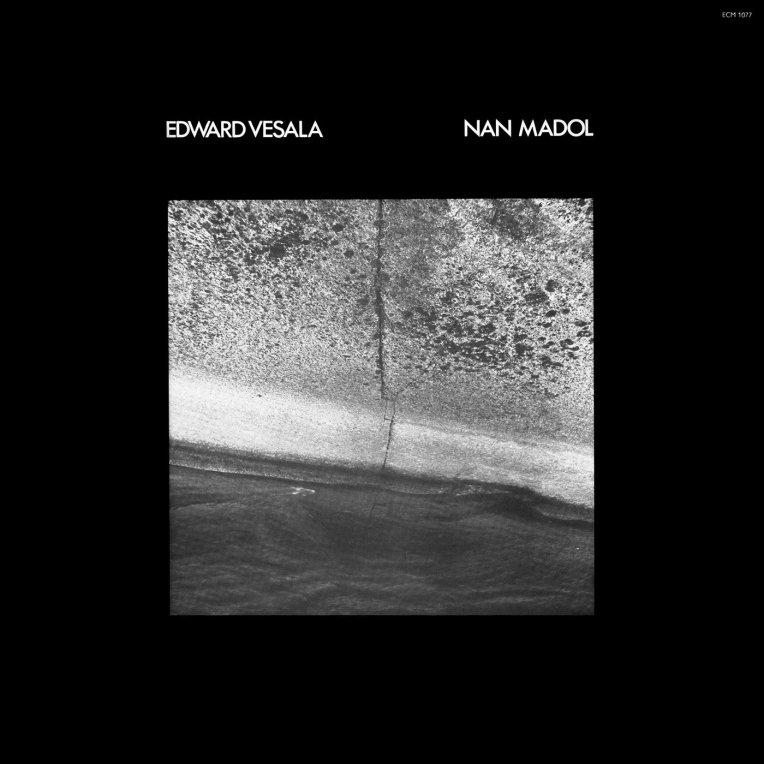
Edward Vesala: Nan Madol (ECM 1077)

ECM 1077

Edward Vesala
Nan Madol

Edward Vesala drums, percussion, harp, flutes
Juhani Aaltonen saxophones, bells, flutes, voice
Sakari Kukko flute
Seppo Paakkunainen flute, soprano saxophone
Pentti Lahti soprano saxophone, bass clarinet
Charlie Mariano alto saxophone, flute, nagaswaram
Elisabeth Leistola harp
Recorded April 25/26, 1974 at Alppi Studio, Helsinki
Engineer: Harry Bergman
An ECM Production

If jazz was ever meant to be a religion, its prayers might sound something like Nan Madol. The title means “spaces between,” and no description of this music could be more apt. The album is an eclectic mandala of drones, eruptions of ecstatic liberation, and snatches of melody from both near and far. Influences range from Japanese folk melodies to Alpine herding calls, and all of them strung by a powerful understatement of continuity.

We open our eyes to find ourselves in a field at night in which a nearby forest looms with untold life. Soprano sax verses mingle with the shawm-like nagaswaram, dripping with the luscious slowness of honey from a broken hive as abstract solos bounce over a corroded surface of ever-so-slightly detuned harps. We proceed from meditation to incantation, calling upon the sounds of spirits rather than the spirits of sound. Melodies drag, are picked up, only to drag again: the final paroxysms of a dying organism laid bare for our imaginations. Motifs flit in and out of earshot like radio transmissions struggling to hang on. The instruments weep as if the entire album were nothing but a cathartic ritual. On the surface, the musicians seem unaware of each other, all the while reveling in their secret synergy far beyond the threshold of audibility. This is music on its own plane and we must approach it as we are. There is no middle ground, no meeting point to be had.

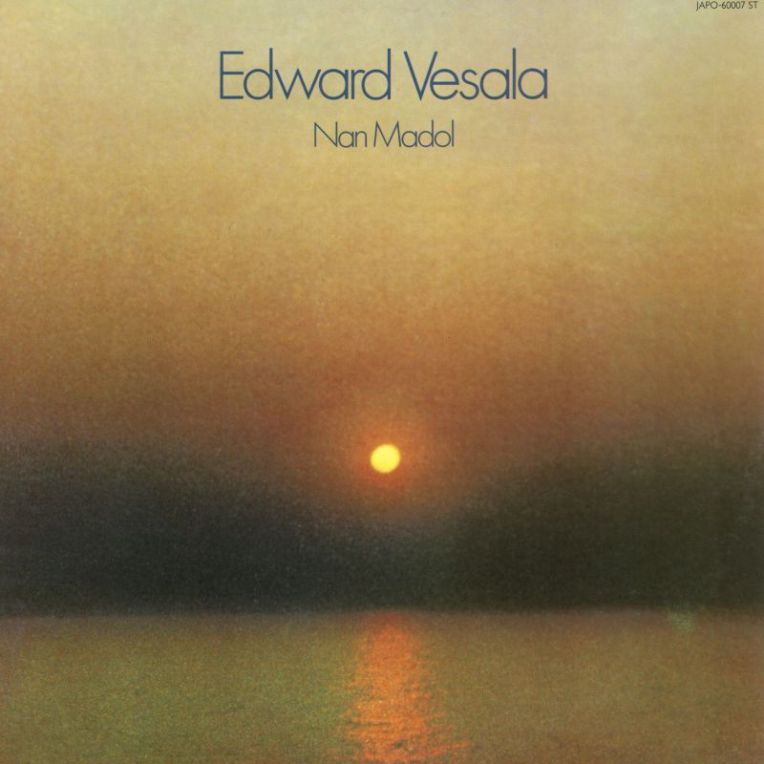
Nan Madol JAPO
Original JAPO cover

This may not be “fun” album to listen to, and certainly not an easy one to describe, but it is rewarding in more metaphysical ways. Far from a jazz album to tap one’s foot to, it is instead a free-form surrender to the possibilities of automatic music. Its mood is inward while its exposition is extroverted and full of exquisite contradictions. If nothing else, the stunning “Areous Vlor Ta” will leave you breathless and vulnerable to the grand Return that brings the listener full circle to where it all began.

<< Barre Phillips: Mountainscapes (ECM 1076)
>> Enrico Rava: The Plot (ECM 1078)

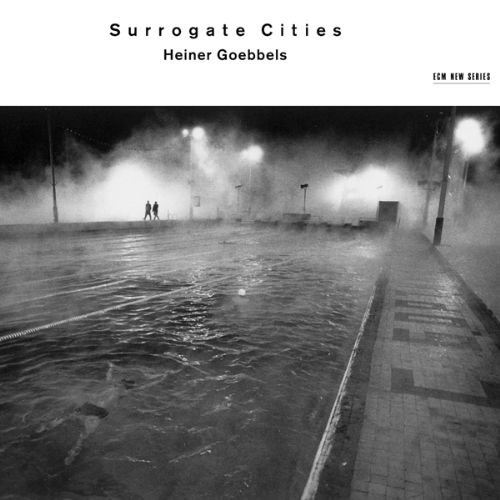
Heiner Goebbels: Surrogate Cities (ECM New Series 1688/89)


Heiner Goebbels
Surrogate Cities

Junge Deutsche Philharmonie
Peter Rundel conductor
Jocelyn B. Smith vocals
David Moss vocals
Recorded 1996, Bayerische Rundfunk, Munich / 1999, Frankfurt
Engineer: Peter Jütte
Produced by Heiner Goebbels & Manfred Eicher

As a longtime fan of David Moss, I needed only to learn of his involvement in Surrogate Cities before rushing out to buy the CD. Sadly, at the time I had no idea who Heiner Goebbels was. I couldn’t have asked for a more comprehensive introduction. The reader will forgive my penchant for abstract analogies when I say that Surrogate Cities is like pricking a piece of paper with a pin and shining a metropolitan nightscape through it so that one may connect those rays of light with brittle chalk. Practically speaking, the project is meant to be an ode to the city of Frankfurt in celebration of its 1200th year. As such, it is an amalgam of atmospheres, moods, and sensual provocations. This project unfolds like a massive suite with instruments drawn from architecture and flesh alike. Each section reads like a novella in the grander scheme of its binding.

Suite for Sampler and Orchestra
Preluded by snippets of cantorial singing, computer-controlled voices seek dominance over the imperialistic power of the orchestra in a kaleidoscopic and utterly focused vision of the urban sprawl. Rather than penetrating the city, Goebbels turns it inside out for our inspection. The samples are not so much quotations as they are memories shaken loose from long-neglected nooks and crannies. The digital flick of “Menuett/L’ingénieur” is haunting in its subtlety, appropriated like so much data flowing through the airwaves. The conclusion, “Air/Compression,” is a chamber piece for the overlooked sounds of our post-industrial comfort. Admirers of John Zorn’s Kristallnacht will find themselves on familiar ground here, as the archival instinct is similarly apparent.

The Horatian – Three Songs
Based on words by Heiner Müller, this song cycle relates a conflict between Rome and neighboring Alba. A lot is cast to determine who will fight as representative of each city. A Horatian is chosen for Rome, a Curiation for Alba. During the course of the ensuing battle, the Horatian strikes down the Curiation and does not spare his life. His sister, who is betrothed to the Curiation, weeps upon his return. He rewards her grief by slaying her. Thus is the victor’s valiant heart tainted with murder. According to Müller, Goebbels “proposes a new form of reading, a different, no longer touristic approach to the landscape of a text.” In this sense, The Horatian is far from the bombastic cantata it could have been. Rather, it heaves with the weight of its own moral conundrum. Joselyn B. Smith is superb as the voice of bipartisanship, weaving in and out of its allegiances with the acuity of a practiced raconteuse. She emotes with a confident Broadway twang that is gorgeously appealing against Goebbels’s orchestral backdrop.

D & C sounds like someone knocking at the outside of a building with no entrance; a book one has been dying to read, but which opens to reveal rain-soaked pages. It is a film noir standing on its head, loose change and candy wrappers falling out of its pockets. The music circles until it loses hope and collapses onto the wet asphalt.

Surrogate, with words by Hugo Hamilton, is the moment I was waiting for during my first listen. Over a lush carpet of piano, Moss runs into the night along with the nameless character of Hamilton’s text. His indulgent enunciation of “surrogate” is priceless, prelude to a tranquil, breathy fade.

In the Country of Last Things
The words here are by Paul Auster. Bleak and morose, they paint a fatalistic picture of urban living. Moss provides the narration here as Smith wails plaintively in the background: “A house is there one day, and the next day it is gone. A street you walked down yesterday is no longer there today…” The city has become the ephemeral soldier, running AWOL from the army of its own becoming. All convictions remain unrequited, leaving the barest puffs of cigarette smoke as the only indications that they ever breathed.

Smith and Moss are the clear winners here. Not to be outdone, however, is the superb orchestra. The presentation is sharp, the sound so crisp you want to teethe on it, and the arrangements fantastically varied. Probably not the best album to play in your greenhouse, but for our psychological biota it does the trick.

<< Veljo Tormis: Litany To Thunder (ECM 1687 NS)
>> Gudmundson/Möller/Willemark: Frifot (ECM 1690
)

Collin Walcott: Grazing Dreams (ECM 1096)

ECM 1096

Collin Walcott
Grazing Dreams

Collin Walcott sitar, tabla
John Abercrombie electric and acoustic guitars, electric mandolin
Don Cherry trumpet, flute, doussn’gouni
Palle Danielsson bass
Dom Um Romão berimbau, chica, tambourine, percussion
Recorded February 1977 at Talent Studio, Oslo
Engineer: Jan Erik Kongshaug
Produced by Manfred Eicher

A plaintive, leisurely journey from Collin Walcott, North American pioneer in the art of the jazz sitar and ECM visionary whose life ended all too soon at the age 39. To anyone put off by this summary, I cannot stress enough the soulfulness of his playing. Walcott, who studied with the inimitable Ravi Shankar, does not treat his instrument as a mere substitute. Rather, he awakens the sitar to a whole new method of understanding, constructing a viable world around it rather than simply tossing it into the mix as a gimmick or afterthought.

Like the previously reviewed Survivors’ Suite from Keith Jarrett, Grazing Dreams is structured as long-form whole in which individual tracks blend into the overarching power that binds them. “Song Of The Morrow” starts things off right with flirtatious sitar riffs appearing and disappearing against a reverberant wash of guitar and trumpet while subtle and varied percussion sections sneak past in the background. “Jewel Ornament” is a personal favorite here, unfolding like a child’s raga. The hold and release of Cherry’s flute and Abercrombie’s insect-like guitar mesh beautifully with Walcott’s tabla stylings. By the time we get to the title track, which plays out like the folk tune of some undefined diaspora, we begin feel the weight of travel on our shoulders. And so, the final “Moon Lake” stretches out like a diffuse reflection across its titular surface, providing rest and replenishment beneath the sheltering sky of our nocturnal wanderings.

The engineering of this album is ahead of its time. Considering the way each track evolves, an attuned sensibility was clearly required to bring out the music’s full breadth. Case in point: the way the buzzing solitude that opens “Gold Sun” gradually develops into a honeyed elaboration of sitar and bass is nothing short of astonishing. Each tune is spun from the same cloth, dyed in real time with the languid syncopation of improvisers who feel what they hear. Gentility through strength is the backbone of Grazing Dreams, a poignant and timeless statement spun from the ether of dreams.

<< Ralph Towner’s Solstice: Sound And Shadows (ECM 1095)
>> Pat Metheny: Watercolors (ECM 1097)

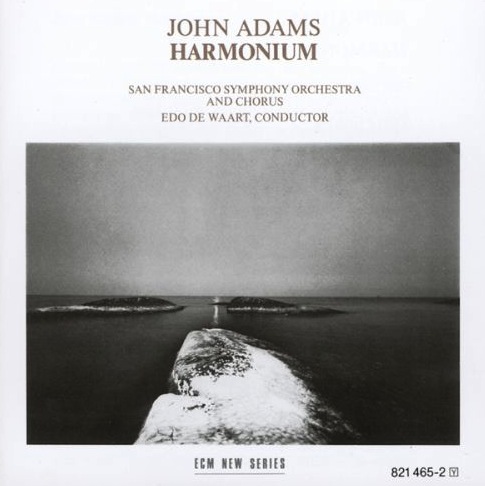
John Adams: Harmonium (ECM New Series 1277)

John Adams
Harmonium

San Francisco Symphony Orchestra and Chorus
Edo de Waart conductor
Vance George chorus director
Recorded January 1984, Davies Symphony Hall, San Francisco
Engineer: John Newton
An ECM Production

Music emerges from a dark tunnel, a smooth and liquid train with a large chorus as passengers. The accelerated evolution of Harmonium is brought forth in what Adams calls a “preverbal creation scene,” an inescapable feeling of solitary light tinted with the weight of retrospection as the voices intercede. Harmonium seems to revel in self-awareness, building as it does through a series of dynamic swings from the threshold of audibility to ringing pronouncements of verse. It is a convoluted world where density and transparency coexist in equal measure.

At times this piece sounds like Adams’s popular Shaker Loops with words, at others like a Philip Glass tribute with characteristic pulses of flute and strings, at still others like a ritual of its own kind. It is a pastiche of poetry (John Donne and Emily Dickinson provide the texts), a bridge of intentions, a house with only two windows.

The recording quality here may polarize listeners somewhat. While on the one hand it captures the overall mood of the piece in a rather heterogeneous mix, on the other it loses detail in the quieter moments. I would imagine, however, that engineering choices in this case were dictated by Adams’s vision for the piece as a whole. It is meant to be a single “fabric of sound,” thereby necessitating a more distanced recording. It is like a lake: deceptively uniform from a distance, but promising new life and environments if only we can plunge into its depths. Yet somehow we are unable to take that plunge. The recording engineer, like the listener, is an observer here rather than an intruder. We do not approach this music; it approaches us, and it can only come so far before receding into its womb.

<< Keith Jarrett: Trio Changes (ECM 1276)
>> Pat Metheny Group: First Circle (ECM 1278)