Amina Alaoui: Arco Iris (ECM 2180)

Amina Alaoui
Arco Iris

Amina Alaoui vocals, daf
Saïfallah Ben Abderrazak violin
Sofiane Negra oud
José Luis Montón flamenco guitar
Eduardo Miranda mandolin
Idriss Agnel percussion
Recorded April 2010, Auditorio Radiotelevisione svizzera, Lugano
Engineer: Stefano Amerio
Produced by Manfred Eicher

Voices, loved and idealized, of those who have died, or of those lost for us like the dead. Sometimes they speak to us in dreams; sometimes deep in thought the mind hears them. And with their sound for a moment return sounds from our life’s first poetry—like music at night, distant, fading away.
–Constantin P. Cavafy, Voices

Does the incantation call or is it called? The word comes from the Latin incantationem, the “art of enchanting.” And what is enchantment but a merging of spell caster and object, of flesh and energy. And so, while the incantation masquerades as an offering to a sky we can never touch, it is a body composed of many. It shrugs off the wings sewn into its back, catching thermals of word alone. Moroccan-born Amina Alaoui understands, profoundly, that the incantation is not something one can hold or even shape but a web of moving parts on which her voice is a dewdrop poised to fall. We are accompanied, as the violin that joins her, by a butterfly of trepidation whose lilting paths of flight carve us like soapstone. An oud’s inky presence sprouts roots and calligraphy, wishing upon stars of portent. Alaoui holds the shore, touching the torches of her diction to ancestral memory, each a wad of flash paper in a trickster’s pocket. Plectrums open and close—dragonfly wings balancing on vibrating tightropes. Though we may dance to the taps of these hollow-bodied fantasies, hitting reality at 90-degree angles, we know that the variations known to open eyes are infinite. She assures us of this, appealing to the moon’s pale fire and licking our feathers clean as we grow lost and hungry for attention. We are the dream of a serpent’s unspoken prayer, waking just in time to see mountains cut the firmament with their life volcanic. Or is it the instruments that fill in those spaces, each a dervish to its own heartbeat? Bows and fingers, shifting winds and sands—all leave their fingerprints on our skin. This is how Arco Iris feels.

An album comprised of one song, drawn from fado, flamenco, and Al Andalusi currents, in addition to Alaoui’s own. We see her world for what it is, bearing as it does the mark of lived experience in a “common crucible of these styles.” One might say the Iberian Peninsula lingers in the marrow, but as she notes in the accompanying booklet, Alaoui is less interested in nostalgia than in dialogue, in how “poetic geography” communicates through openness of expression. This means not only a blurring of spatial, but also temporal borders. In so disassembling the origins of this music, she peers beyond idioms and straight into the images that sustain them. They are her shelter, her way of being in the world. This is what Arco Iris is.

(See this review as it originally appeared in RootsWorld Magazine. To hear more samples, click here.)

Amina Alaoui review in RootsWorld

The folks over at RootsWorld online magazine have just published a review by yours truly of Amina Alaoui’s fabulous new ECM release, Arco Iris. Truly one of the finest albums from the label in years. Don’t pass this one up.

For the review, click here. And while you’re there, you can check out my older review of Kuára among RootsWorld’s enviable assortment of world musics.

Jan Garbarek: Visible World (ECM 1585)

Jan Garbarek
Visible World

Jan Garbarek soprano & tenor saxophone, keyboards, percussion
Rainer Brüninghaus piano, synthesizer
Eberhard Weber bass
Marilyn Mazur percussion, drums
Manu Katché drums
Trilok Gurtu tabla
Mari Boine vocals
Recorded June 1995 at Rainbow Studio, Oslo
Engineer: Jan Erik Kongshaug
Produced by Manfred Eicher

As one who started out with ECM’s New Series and only years later began branching out into ECM proper, how can I ever forget my first parent label experience: Visible World. Having heard Jan Garbarek only on Officium, I was curious to see what the saxophonist had to offer and was lucky enough to spot this disc in a used CD bin. The cover photograph pulled me in…yet how much more so when I pressed PLAY and let the waterwheel flow of “Red Wind” wash over me. Here was an artist, I now knew, who felt the deserts in the rains and vice versa, one who turned every lilting ornament into a ritual gesture. From the quiet strength of his themes and non-invasive synthesizer touches to the feathered synergy of his band mates, songs like “The Creek” gifted experiences from another life. And songs is exactly what these are, for in their precious adlibbing form crystals of hope, catching the drum-shocked catharsis of “The Survivor” on bassist Eberhard Weber’s thrumming comet tails like sunbeams in a prism. While Garbarek’s tribalism may ring a touch ingenuous to some folks, the maps of his travels come cased in loving care, so that no creases ever turn into tears. Take, for instance, the vivid skin Garbarek stretches over the skeleton of “The Healing Smoke.” By turns robust and willowy, it never backs down from its convictions, lays them bare for our scrutiny, if not also for the blindness of our souls. Pianist Rainer Brüninghaus makes a welcome return to the Garbarek fold, bringing his trademark touch to journeys over three “Desolate Mountains” and the moving portrait of one “Giulietta,” even as percussionists Marilyn Mazur and Manu Katché lay runes along the way. The cinematic bliss of the two-part title track, one scuro to the other’s chiaro, reminds us that much of the music featured on Visible World was written for video or film. Other moving pictures include a gorgeous, I daresay funky, rendition of “Pygmy Lullaby” (which I, like many I’m sure, first encountered through Deep Forest’s classic unearthing) and “The Arrow,” an evocative landscape of melodic steles and natural wonder. Yet all of this is just the smoke to the fire of “Evening Land.” Said saga of sound and sentiment blows like the exhalations of feature vocalist Mari Boine, who pulls up the calls leading up to this point on threads spun from Garbarek’s crescent-moon commentary, culminating in a seesawing of chords around which tumble the children of tomorrow.

This is the quintessential Garbarek album, the perfect synthesis of everything he and producer Manfred Eicher ever set out to achieve together from the start. Being the sculptors that they are, both artists saw the finished form in the slab, leaving us with a masterpiece we would never have known without their intervention.

<< Pierre Favre: Window Steps (ECM 1584)
>> Egberto Gismonti: Meeting Point (ECM 1586)

Anouar Brahem: Khomsa (ECM 1561)

Anouar Brahem
Khomsa

Anouar Brahem oud
Richard Galliano accordion
François Couturier piano, synthesizer
Jean-Marc Larché soprano saxophone
Béchir Selmi violin
Palle Danielsson double-bass
Jon Christensen drums
Recorded September 1994 at Rainbow Studio, Oslo
Engineer: Jan Erik Kongshaug
Produced by Manfred Eicher

Anouar Brahem’s third leader date for ECM explores the oud player’s incidental music for Tunisian film and theatre as interpreted by a shifting nexus of musicians, new and old alike. His compositional side takes precedence this time around, for it is accordionist Richard Galliano who lights the foreground with “Comme un depart” and hardly recedes until “Des rayons et des ombres,” the latter a superbly jazzy romp with Palle Danielsson and Jon Christensen. Bassist and drummer, respectively, add buoyancy to “E la nave va” and “Aïn ghazel,” culminating in the shadow of Jean-Marc Larché’s soprano for the title track. Galliano continues to somersault through the airspace of “Souffle un vent de sable.” Only here does the oud awaken, as if from long hibernation, its lips dry and puckered for the quench of a distant rain. Brahem deepens the sincerity of his instrument in “L’infini jour” with a twang that aches from the power of re-creation. He and Galliano flirt with the same watery surface in “Sur l’infini bleu,” the first of a handful of duets that also includes the animated “Claquent les voiles” (Brahem/Danielsson). “Vague” and its “Nouvelle” counterpart blossom with a piano that recalls the opening section of Philip Glass’s Glassworks, carrying over into the ensemble-oriented folktale of “Seule.” Larché questions the night in “Un sentier d’alliance,” where he is answered by the sparkling reflections of François Couturier’s pianism, only to be picked up by violin in “Comme une absence” before sliding into blissful self-awareness.

Khomsa is an inspired meeting, each musician highlighting a different curl of Brahem’s calligraphic art. This may not be his most consistent effort, but I discourage you from passing it up.

<< Nils Petter Molvær: Khmer (ECM 1560)
>> Gateway: Homecoming (ECM 1562)

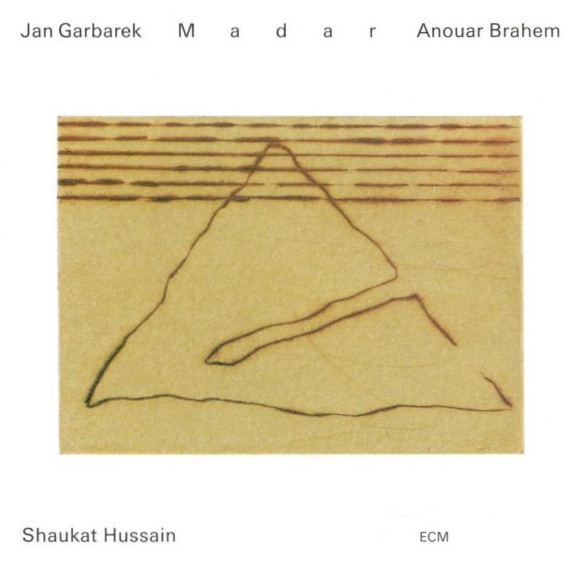
Garbarek/Brahem/Hussain: Madar (ECM 1515)

Madar

Jan Garbarek tenor and soprano saxophones
Anouar Brahem oud
Ustad Shaukat Hussain tabla
Recorded August 1992 at Rainbow Studio, Oslo
Engineer: Jan Erik Kongshaug
Produced by Manfred Eicher

Following in the footsteps of Ragas and Sagas, which found Jan Garbarek in the seemingly unlikely company of Ustad Fateh Ali Khan to uplifting effect, the Norwegian saxophonist continued to expand his horizons with Tunisian oud virtuoso Anouar Brahem and tablaist Ustad Shaukat Hussain on Madar. The three bond naturally in the lengthy “Sull lull,” a nearly 17-minute prayer of keen and sensible interaction for which Hussain brings constant airflow and foils Garbarek’s chameleonic talents superbly. It is one of two tracks based on folk melodies of Garbarek’s native land. The other is the saxophone/oud duet “Joron.” Madar serves in this vein as an internal conversation between the two instruments, their sounds speaking to one another like rocks from a river’s touch. Together they become a pair of hands etching stories into a stretch of hide, twisting incantations until they bleed light (“Sebika”) and dark (“Ramy”). As they continue to circle overhead, surveying a landscape of withering sin, they bring out something unknown in one another.

Despite the loveliness of these interactions, the album works best in solitary. Brahem’s contemplative solo, “Bahia,” treks over twilit mountains with aching footsteps, carrying us as if by palanquin into a vale of lost intentions. The wind of his percussiveness shakes the boughs of leafless trees and sends their dead seeds clicking to the ground like sand against a window. And in the rhythmic cast of “Jaw,” Hussain emotes lifetimes in a single beat of his tabla, thus offering some intensely lucid moments. He returns to the fold in “Qaws,” giving voice to those waiting eyes at last with solid excitement. An odd piano “Epilogue” (sounding like a chord outline for a studio track left behind) leads us out.

A word to the wise: Garbarek reaches some of his most piquant levels ever here, so intense that you may find yourself needing to lower the volume at peak moments. This may antagonize some, but in the end couldn’t we all do with a little awakening?

<< Bach: The French Suites (ECM 1513/14 NS)
>> Bobo Stenson Trio: Reflections (ECM 1516)

Stephan Micus: Athos (ECM 1551)

Stephan Micus
Athos: A Journey To The Holy Mountain

Stephan Micus Bavarian zither, sattar, shakuhachi, suling, ney, flowerpots, voice
Recorded November 1993–February 1994 at MCM Studios

If true meditation is not a centering but a shedding of the self into a plane where the ego no longer speaks under the illusion of a proper name, then Stephan Micus has walked some of the most meditative paths on disc. Inspired by a visit to the holy Greek mountain of Athos, his album of the same name bears traces of just such a traveler, one whose artistry sees medium and message as one. Those looking for anything close to the Byzantine chant that surely nourished his ears during this pilgrimage may feel disappointed. Then again, the Micus experience has never been about total re-creation, but rather about the ways in which the lens of his soul refracts all it comes in contact with during its itinerancy.

Athos takes a diurnal structure, with days marked by flutes of varying origins and nights woven in 22-part choruses, all sung by a multi-tracked Micus. The latter serve as touchstones in the fullness of his narrative, which takes its histrionic steps in voices mineral, unaffected, spun from the wood, clay, and strings of another time and place. In these drones is where the true indeterminacy of life takes shape, shifting from circle to ellipse and back again like a full moon stared at for too long. “The First Day,” a shakuhachi solo, rests on a sibilant edge and awakens like an animal from winter slumber, even as it cranes its neck, heron-like, back toward memory, now hazed by the passage of the seasons. “The Second Day” hangs a suling (Indonesian bamboo flute) above a garden of flowerpots. And in “The Third Day” Micus offers a ney solo, wavering like a reflection across molten rock and shaped by the lips of a divine glassblower who fashions from it a teardrop in the cosmos, forever crystalline and unshattered. Such music turns the sun inside out and shows us that its heart is nothing but shadow, for otherwise it would never know the generative power of fire.

This cosmic passage is bookended by a prologue and epilogue. “On The Way” pairs cascades of Bavarian zither with the tinny laments of sattar (long-necked bowed instrument of the Uyghur people). In its depths we weep at the fallacy of what we have created, but know that within the distorted memories of those tears lies something far more meaningful: constant change. This and more we hear in these moments, in the total dedication that engenders them. “On The Way Back” pulls those evening voices from the clothing of their afterlife, vibrating like a reed in the core of something devoid of song.

Athos is the diary of a sacred space whose pages are born in the siren that calls everyone into the stillness of eternity. It tugs your heart until it merges with Micus’s own, so attuned is his playing to the spirit of all that moves us to listen. He reaches through the veil of distance holding a broken watch, asking us to breathe time back into its silent circle.

<< hr-Jazzensemble: Atmospheric Conditions Permitting (ECM 1549/50)
>> Heiner Goebbels: Ou bien le débarquement désastreux (ECM 1552)

Stephan Micus: To The Evening Child (ECM 1486)

Stephan Micus
To The Evening Child

Stephan Micus steel drums, voice, dilruba, suling, kortholt, ney, sinding
Recorded January and Feburary 1992 at MCM Studios
Digital mastering: Tonstudio Mahne, Dießen

Stephan Micus’s fifth album for ECM is a lullaby. I know nothing of its origins, but I would be surprised if he hadn’t just become a father before recording it, so freshly paternal are its meditations. This time, Micus turns the kaleidoscope of his endless talent to reveal steel drums as the sound color of the moment. These provide a resonant, gamelan-like undercurrent throughout and become more biologically attuned as they sing beneath his mallets. Yet it is his actual voice that awakens the heart in “Nomad Song,” scooping earth in such a way that all life falls through its fingers unharmed, leaving only a heap of unconditional love. The newness of creation abounds in “Yuko’s Eyes,” in which Micus sings now through a bowed dilruba, turning infancy inside out to reveal a future of hope and dreams fulfilled. “Young Moon” pairs that constant steel drum with suling (an Indonesian bamboo flute) and kortholt (a capped reed instrument popular during the Renaissance) for a softly glittering wave of light, given corporeal shape through open-throated calls. The title track welcomes ney, through it gilding the album’s aquatic themes with moonlight. It grows a feather for every breath that falls, as if reaching out to any and all children who slumber in fear and security alike. From these Micus spins a wealth of comfort, trembling to the tune of his heartbeat. There is perpetuity in this dream, from which one is born and to which one returns when circadian rhythms have become a thread of silence. “Morgenstern” stretches a sky bridge from cloud to cloud with steel-drummed steps, while “Equinox” lives in penumbral shadow, crowning a procession of closed-mouthed reverence. Each pair of hands offers a flower to “Desert Poem.” Eyes shielded by sleep, Micus dips his toes in the Milky Way’s waters and dries himself against a tree that grows alone, save for the fallen seed who awaits for the light of dawn to bless it with the kiss of tomorrow.

This music sounds in those hushed spaces where the universe inhales, the sound that keeps all celestial bodies spinning. Like the language in which Micus sings, its words convey meaning to a part of us deep and out of grasp. But for the duration of an album, at least, we can feel it as presently as the rain on our faces.

<< Michael Mantler: Folly Seeing All This (ECM 1485)
>> Paul Giger: Schattenwelt (ECM 1487 NS)

Anouar Brahem: Conte de l’incroyable amour (ECM 1457)


Anouar Brahem
Conte de l’incroyable amour

Anouar Brahem oud
Barbaros Erköse clarinet
Kudsi Erguner ney
Lassad Hosni bendir, darbouka
Recorded October 1991 at Rainbow Studio, Oslo
Engineer: Jan Erik Kongshaug
Produced by Manfred Eicher

After a memorable ECM debut with Barzakh, Anouar Brahem recorded this even more memorable sophomore effort one year later. Carrying over percussionist Lassad Hosni, Brahem welcomes Turkish musicians Kudsi Erguner on ney and Barbaros Erköse on clarinet. Erköse, a gypsy music specialist, adds rich colors to an already dense palette, weaving tethers that pull us into tender worlds. His duets with Erguner (“Etincelles” and “Peshrev Hidjaz Homayoun”) stand out as some of the album’s most flowing. The title track brings the patter of clay drums, weaving a gorgeous ney into our vision. (The melodies and rhythms here put this listener immediately in mind of the song “I Love You” from Omar Faruk Tekbilek’s album One Truth.) Captivating. Erguner shines again in “Diversion.” Slaloming through every drummed pillar with the conviction of a bird in search of prey and yet with the delicacy of an angel avoiding such violence, he brings a sense of history to every lilting gesture. “Nayzak” revives the clarinet amid oud and drums for a stunning taste of mountains and the plains. The album’s meat, though, comes in Brahem’s unaccompanied storytelling. From the dawn chorus of “L’oiseau de bois” and invigorating virtuosity of “Battements,” through the tender air “Le chien sur les genoux de la devineresse,” and on to “Epilogue,” there is unimaginable depth of yearning in every twang and strum.

This album is all about the composition, stripped to the barest essentials of melodic craft and burrowing straight into the marrow of our past lives.

<< Eleni Karaindrou: The Suspended Step Of The Stork (ECM 1456)
>> Louis Sclavis Quintet: Rouge (ECM 1458)

Trevor Watts/Moiré Music Drum Orchestra: A Wider Embrace (ECM 1449)

Trevor Watts
Moiré Music Drum Orchestra
A Wider Embrace

Trevor Watts alto and soprano saxophones
Nana Tsiboe african drums, congas, gonje, djembe, lead twanga, wea flute, vocals
Nee-Daku Patato congas, african drums, berimbau, bells, cabasa, vocals
Jojo Yates mbira, twanga, cowbells, african drums, bells, cabasa, wea flute, vocals
Nana Appiah african drums, lead wea flute, shakers, cabasa, cowbells, vocals
Paapa J. Mensah kit drums, shakers, wea flute, vocals
Colin McKenzie bass guitar
Recorded April 1993 at Angel Studios, London
Engineer: Gary Thomas
Produced by Steve Lake

Blending Ghanaian folk music with groove and jazz elements, saxophonist Trevor Watts and bassist Colin McKenzie join a group of multitalented drummers for one of ECM’s smoothest crossovers. My ignorance of all the musicians involved allowed me to take its sounds as they came during my first listen. The energy that surges from the first drum hit of “Egugu” frees a chorus of voices calling to the sky as every drum leaves a footprint upon the plains. Watts treats these visions not as mere backdrop but as an environment into which he must totally integrate himself. The medley that follows is an album in and of itself, starting with the spirited “Ahoom Mbram” and ending with the drums-only “Tetegramatan.” Watts adds a nice rasp to his soprano in “Opening Gambit” (and don’t miss the shawm-like circular strains of “Brekete Takai”), while “Otublohu” brings on the fun(k) and then some with some heady alto work over a firm grounding of bass and get-out-of-your-seat-and-dance rhythms. After the pleasant excursions of “Bomsu” and the a cappella “Hunters’ Song: Ibrumankuman,” the tinkling percussion of “The Rocky Road To Dublin” dives into a swanky trio with an ecstatic finish. The jazziest moods await in “Southern Memories.” Throwing his smoky alto into the night, Watts engages a funky bass line and powerful vocals, only to recede for the congregation of flutes and spirits in “We Are,” which carries us out on invisible wings.

A fantastic coming together, superbly recorded. This is the art of song personified.

<< Cherry/Åberg/Stenson: Dona Nostra (ECM 1448)
>> Keith Jarrett: Bridge Of Light (ECM 1450 NS)