

My latest review for All About Jazz (available here) is of a real left-field “jazz” album from comedian Jon Benjamin. For more on the project, see the video below. Check it out and let me know your thoughts. It raises a lot of questions…
St Germain review for RootsWorld
My latest review for RootsWorld online magazine is of St Germain’s self-titled electronic-world-mash-up, and his first album in 15 years. Click the cover to discover!

Errol Rackipov Group: pictures from a train window

With pictures from a train window, Bulgarian-born vibraphonist and composer Errol Rackipov debuts his eponymous group with guitarist Hristo Vitchev, reedman Lubomir Gospodinov, pianist Martin Bejerano, bassist Josh Allen, and drummer Rodolfo Zuniga. Listening to the groove laid down by the bandleader on “Mad Djore,” it won’t come as any surprise that the mallet man studied under greats Gary Burton and Ed Saindon. But there’s also an underlying sensibility that is uniquely his own, and which he expresses in his ability to keep his musicians in focus.
The ever-prolific Vitchev trades his normally outgoing smoothness for the back road, architecting his virtuosity distinctly in “Folk Dance” but for the most part content in providing tender underpinnings. Gospodinov carries the band into nostalgic territory on “Far Away From Here, A Long Time Ago,” where his sopranism reveals the art of a genuinely melodic improviser. Then there’s Allen, whose bassing draws triple-metered spirals in “Dill Man,” also a fine vehicle for Bejerano’s pianism. As for Zuniga, he is the heartbeat of heartbeats, anchoring the set from start to finish with chameleonic ability.
Yet despite, if not also because of, these contributions, pictures is Rackipov’s baby through and through. He is a consummate player who shows not only the skin but the internal organs, and whose geometric styling leaves few facets un-rendered. Be it the Eastern European folksiness of “Jumble” and “The Other (Wrong) Way,” the sparkling dialoguing with Vitchev in “Wild River,” or laid-back beauties of the title track, he spins the wheel with assurance and tenderness. As on the final “Once A Mother Had A Child” by Dimitar Ianev, the only non-original of the album, his attention to structure leaves an aftertaste that is clean, sonorous, and itinerant, making for a lovely addition to any vibraphone enthusiast’s shelf.
Elliott Sharp review for Sequenza 21
I’ve just posted a review of Elliott Sharp’s fantastic The Boreal for Sequenza 21. Sharp is a towering figure in the New York underground and a formidable composer. This is one of his finest releases to date, and includes liner notes by cellist Frances-Marie Uitti. Click the cover to discover!

An interview with engineer Stefano Amerio by Stefano Bertoncello
Those who pay attention to album credits will notice that in recent years ECM has been employing the services of genius engineer Stefano Amerio. One of my dedicated readers, Stefano Bertoncello, visited Amerio in his ArteSuono studio near Udine, Italy for a lively interview and portrait of the artist in his element. Click the photo below to read on…

Mamak Khadem review for RootsWorld
My latest review for RootsWorld online magazine is of Iranian singer Mamak Khadem’s epic album, The Road, which should appeal to fans of Savina Yannatou. Click the cover to discover!

Live Report: Keith Jarrett at Carnegie Hall
On Tuesday, 9 February 2016, Keith Jarrett returned to Carnegie Hall for a solo performance of spontaneously improvised music. My review of the concert is now available at All About Jazz here.
Tigran Hamasyan: Luys i Luso (ECM 2447)
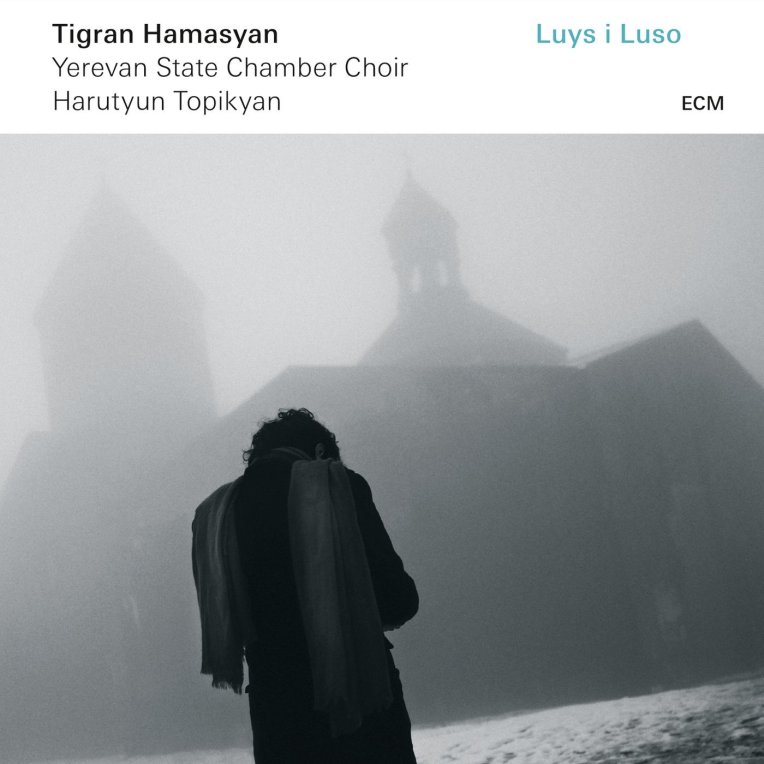
Tigran Hamasyan
Luys i Luso
Tigran Hamasyan piano, prepared piano
Yerevan State Chamber Choir
Harutyun Topikyan conductor
Recorded October 2014 at Argo Recording Studio, Yerevan
Engineer: Markus Heiland
Assistant engineer: Armen Paremuzyan
Mixed March 2015 at RSI Studio Lugano by Markus Heiland, Manfred Eicher, and Tigran Hamasyan
Produced by Manfred Eicher
U.S. release date: October 2, 2015
Luys i Luso realizes the dream of Tigran Hamasyan to build an entire album around the sacred music of Armenia. Now based in Los Angeles, the prodigious jazz pianist has held on to the melodies of his homeland with solemnity and patience for this project. The antiquity of much of the repertoire—hymns, sharakans (chants), and cantos, some of which date back to the fifth century—leaves room for improvisation, which evidence suggests has been a part of its living tradition for centuries. Hamasyan takes to this freedom like a wing to wind, using his polyphonic arrangements of monophonic melodies as runways for spontaneous flights. He has intentionally left the piano parts unwritten, so that by following only skeletal structures he is free to move about the score.
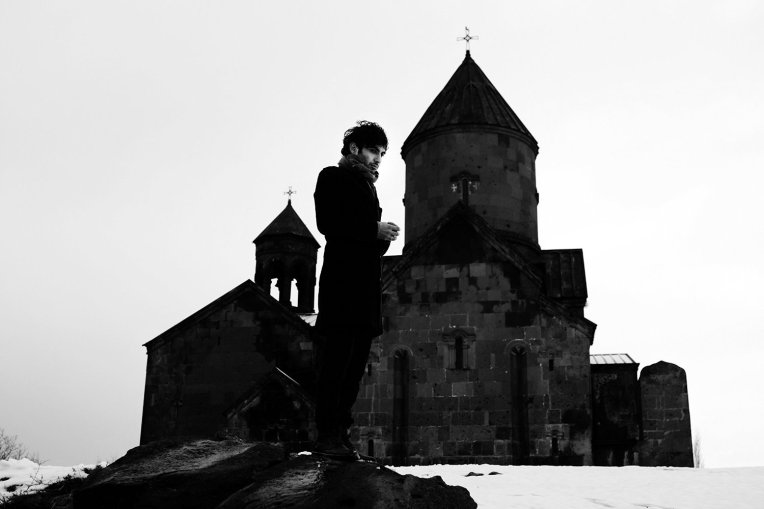
(Photo credit: Vahan Stepanyan)
The album’s title (Light from Light) is primarily descriptive, revealing the process of pulling out an interpretive glow from contemporary compositions, and from the older ones embers of bygone devotions. It also signals themes of variation in a program built around multiple incarnations of the core melodies. The preludinal “Ov Zarmanali” (Oh this Amazing and Great Mystery) by 12th-century catholicos and composer Grigor G. Pahlavuni, for example, illuminates the listener’s ears first through a solo piano treatment, like snow falling from the branches of a godly tree, and later in the album in a veritable river of voices. The Yerevan State Chamber Choir’s balance of raw technique and rhythmic precision indicates a vulnerability diminished by numbers. Hamasyan’s pianism takes on a regular role here, sounding its arpeggios with veracity. The modal changes speak to something deeper than beauty, to the heart within it darkened by neglect. Midway through the singers fade and leave the piano to move jazzily through their afterimages, only to return like objects of worship polished smooth over centuries of devotion. “Sirt im Sasani” (My Heart is Trembling!), a canticle by 13th-century canonical writer Mkhitar Ayrivanetsi (c. 1230-1297) also reveals its mercies through two iterations, the second of which is a piano variation of Trinitarian dimension, while the first professes faith through the distant mechanisms of exile. Bass soloist Seiran Avagyan renders a flower of textual identity shedding petals in favor of bodiless light.
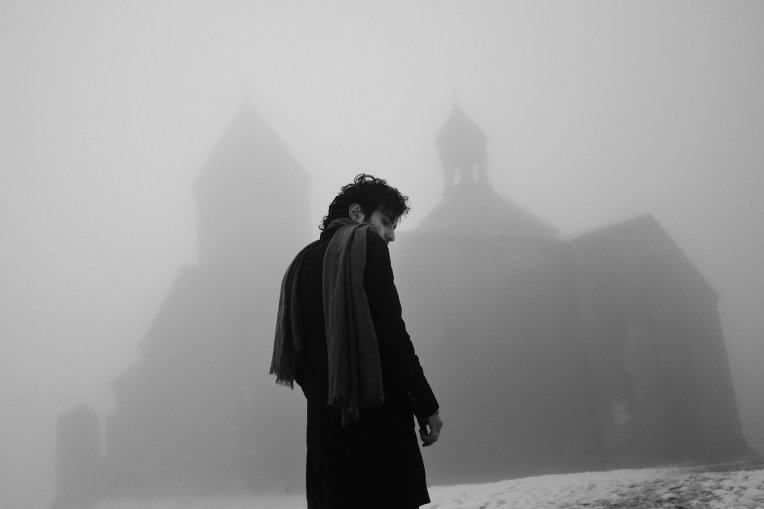
(Photo credit: Vahan Stepanyan)
No such project would be complete without Komitas (1869-1935), because of whose efforts much of Armenia’s sacred music has been preserved. His “Hayrapetakan Maghterg” (Patriarchal Ode), a hymnal request to be heard and absolved, takes three forms. In two Hamasyan-only versions, the pianist attends to the words between notes. He is keenly aware of these spaces and gathers strength through their collective presence. Like the pages of a thumb-worn Bible, its gilding has faded through absorption, finding in its choral life a treasure of grace and, in soprano soloist Jenni Nazaryan, a dove clutching sprigs of gratitude. From Komitas’s Armenian Holy Mass we encounter two sections, “Surb Astvats” (Holy God) and “Orhnyal e Astvats” (Blessed is God), each based on melodies from the seventh century. Where the former is driven by forward-thinking improvisation, the latter looks backward by sampling tenor Armenak Shahmuradyan. This 1912 archival recording, made in Paris in the presence of Komitas, defines the palette from which the choir draws its colors over a century later.
Medieval theologian and hymnologist Mesrop Mashtots (c. 362-440) is represented in two chants and a canticle for Fasting Days. The first of these, “Ankanim araji Qo” (I Kneel Before You), is where the choir makes its album entrance—or should I say “in-trance,” for such is its state of being. Therein, singers descend to the bottoms of their linguistic wells, making dervish circles until the shadows are cleansed. Each is a powerful statement of redemption, of the will to drown in transgression so that one might be reborn into sobriety.
For the singly rendered, Hamasyan offers two cantos of the Resurrection, both chanted during Divine Liturgy. “Nor Tsaghik” (New Flower) by Nerses Shnorhali (c. 1102-1173) strikes difference through its use of prepared piano, at which Hamasyan uncovers hidden voices behind the voices, while “Havoun Havoun” (The Bird, the Bird was Awake) by Grigor Narekatsi (c. 951-1003) pairs soprano and piano in the name of faith. Nazaryan’s lone singing barely grazes the belly of the nearest cloud until the nourishment of Heaven comes raining forth, leaving us to drink in what we can.
Those who would write off this recording on the sole basis of its description—Do we really, they might say, need another jazz musician improvising over a vocal ensemble?—may be pleasantly surprised at the level of integration achieved on Luys i Luso. Like Misha Alperin, Hamasyan recognizes the dedication of knowledge required to mesh with equally disciplined singers. Whether broken or healed, each of his selections embodies the fragmentary nature of things as a path to wholeness. The sheer love pouring from that wholeness is proof of concept.
An unexpected masterpiece, and one of ECM’s most astonishing in years.
(To hear samples of Luys i Luso, please click here. Further information about the project is available here.)
Sounding Andrew Wyeth
In a review I wrote last year of Aaron Parks’s Arborescence, I made a comparison to an Andrew Wyeth painting entitled Chambered Nautilus. Having spent my teens in the state of Connecticut, where this painting is housed at the Wadsworth Atheneum, I stood before this painting on many occasions but had rarely known a sonic equivalent until encountering some of the more recent ECM releases. In the interest of expanding the aesthetic connections of the music I review on these pages, I wanted to share some information about Artsy, an online source set up with the goal of making the world’s art free to view for all. In particular, the folks at Artsy have set up a fine Wyeth page, accessible by clicking the chamber below.

 Between Sound and Space: ECM Records and Beyond