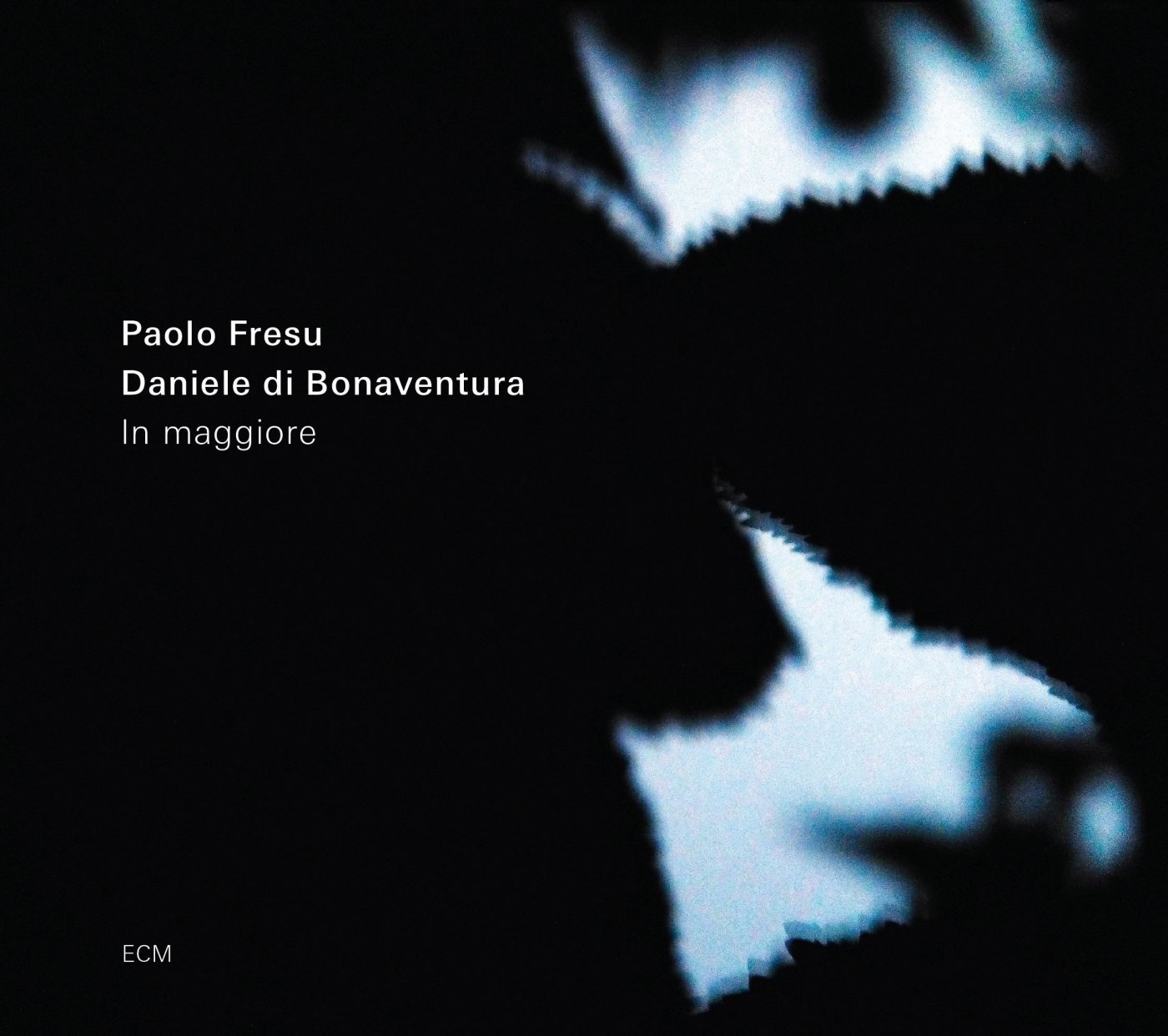
Paolo Fresu/Daniele di Bonaventura: In maggiore (ECM 2412)

In maggiore

In maggiore

Paolo Fresu trumpet, flugelhorn
Daniele di Bonaventura bandoneón
Recorded May 2014, Auditorio Stelio Molo RSI, Lugano
Engineer: Stefano Amerio
Produced by Manfred Eicher
Release date: 20 March 2015 (Europe only)

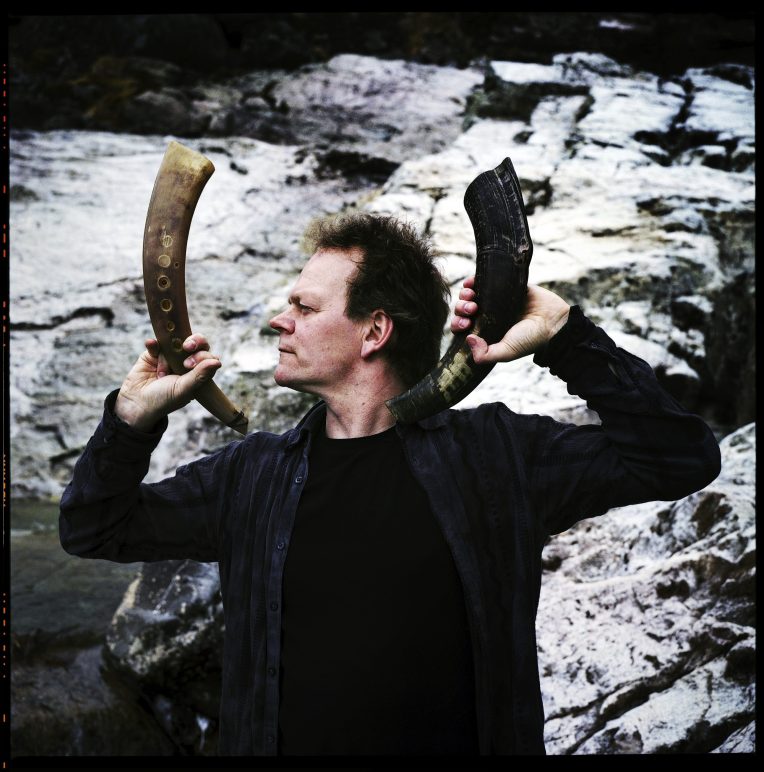
Trumpeter Paolo Fresu hails from the island of Sardinia, bandoneonist Daniele di Bonaventura from the coastal town of Fermo on the Italian mainland. Water and land may separate their origins, but together they make music so unified that a single landscape is enough to define them in this context. Their first ECM appearance on Mistico Mediterraneo placed their collaboration at the center of a project fusing improvisation with Corsican chant. With nothing but air between them here, they create a chant all their own, a language that breathes in and sings out.

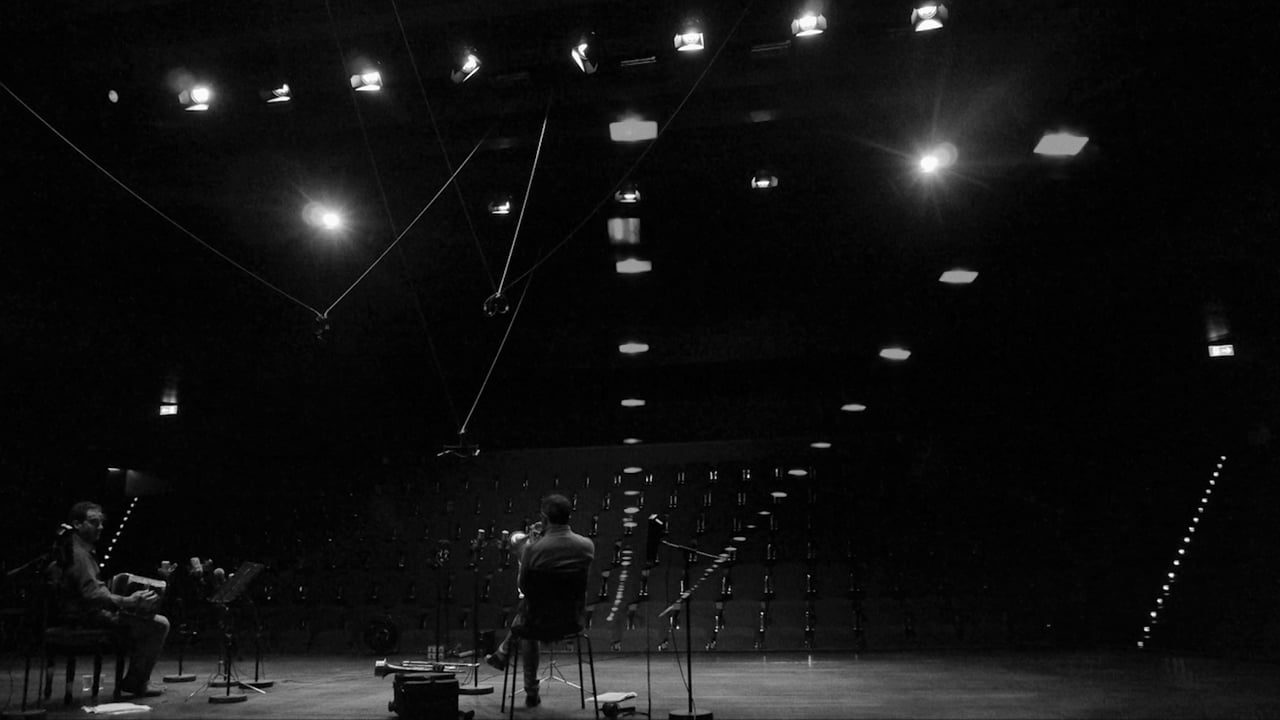
“Da Capo Cadenza” is the first of three tunes by di Bonaventura. Fresu’s lucid colorations cross every tee of the composer’s bellowed writing. The feeling of cinema is so strong here, it’s no wonder that the recording session should be the subject of Italian filmmaker Fabrizio Ferraro’s documentary Wenn aus dem Himmel, which turns the creation of this music into a meditation on spatial crossings.

Wenn aus dem Himmel still

This set opener is also a fine example of flugelhorn virtuosity, not in terms of technical flourish (a given) but of emotional integrity. His way with a horn lends itself to poetry, but versifies with a style that shades any description of it. To experience its atmospheric range, listeners need only immerse themselves in the duo’s take on Brazilian composer Chico Buarque’s “O que será,” last heard on an ECM album of the same name by Stefano Bollani and Hamilton de Holanda. The version here follows a progression that characterizes many on this album, building from caution to confidence as it gathers momentum into the Chilean resistance song ”El pueblo unido jamàs serà vencido” of Sergio Ortega. Despite, if not because of, the delicacy with which Fresu and di Bonaventura breeze through these changes, a raw, underlying power begins to emerge.

Fresu deepens the flugelhorn in three tunes from his own pen, including “Calmo” and the title track, both lyrical highlights. The latter tune closes out a disc that, despite its general quietude, stays on in the memory as a blast of renewable energy. As Fresu’s final note trails into non-existence, it carries into tomorrow the certainty of another sunrise. Other highlights from this darker instrument can be found in the freely improvised “Sketches” and delightful, if somber, take on “Quando me’n vò” from Puccini’s La Bohème. It is music that has lived many lives before, and lives again, as it will ever onward.

Close to center is di Bonaventura’s “Kyrie Eleison,” a wordless solo moves with the quiet strength of a hymn. Beyond it are tracks that employ muted trumpet, which at Fresu’s fingertips invokes early Miles Davis, even as it oozes a distinct charisma. Along with his own “Ton Kozh” and di Bonaventura’s “La mia terra,” Uruguayan singer-songwriter Jaime Roos’s “Se va la murga” stands as an album touch-point. The latter is lovingly arranged and awakens percussive details from within the instruments. By it is revealed an inner pulse that binds their art within the acoustics of the Lugano recording studio in which they find themselves transfixed for this enchanting hour. Di Bonaventura carries enough weight in his bellows to support the grandest sweeps from Fresu and, by the same token, enough airiness to guide his lightest feathers, unbroken, to shore.

More playful elaborations make the four minutes of Neapolitan composer Ernesto de Curtis’s “Non ti scordar di me” (Do not forget me) pass by with the wistfulness of youth itself, thereby enhancing the nostalgic hope of the title. But nowhere does the muted trumpet speak so forthrightly as in “Te recuerdo Amanda.” This aching melody by Chilean songwriter Victor Jara flows through brass like time itself, bypassing layers of history to let its voice be known. And, really, that’s the essence of this music. It is so personal that it becomes relatable on a purely human scale, shed of politics and origins until only the musicians and audiences remain, bound by mutual recognition that life is infinitely more important than its hindrances.

(To hear samples of In maggiore, please click here.)

Suite for Sampler – Selected Signs, II (ECM 1750)

Selected Signs II

Suite for Sampler – Selected Signs, II

This second ECM anthology was released in the spring of 2000, three years after the first, and shows the broadening of the label’s ocean in that short yet productive span. This album’s predecessor sustained itself on breath, featuring as it did a generous helping of Tomasz Stanko, and here too we encounter the clarinet of Gianluigi Trovesi and accordion of Gianni Coscia in the title track from from In cerca di cibo, which opens new contexts still. The tune was originally composed by Fiorenzo Carpi for a 1971 TV mini-series about Pinocchio, and perhaps one can read the stirrings of life in dormant wood passing over Trovesi’s reed. A leafy introduction from pianist Bobo Stenson then draws us into the forested “Polska of Despair (I),” off his trio album Serenity. As bassist Anders Jormin and drummer Jon Christensen fall into frame, the evolution of ECM’s sound practice discloses a yearning for space in jazz structures. The distance applied to Christensen’s drums is especially evident against the foregrounded cymbals and makes for effective contrast within a single instrument.

“Vilderness 2” significantly changes up the palette with Nils Petter Molvær’s electronics-heavy assembly, flowing into a blinding sun with every mechanism shining. The enhancements of guitarist Eivind Aarset add crosswind to the flight, while drum ‘n’ bass thermals puff their sporadic dragons into being. This one is off Molvær’s second ECM leader date, Solid Ether, the title of which produces as much as it describes.

Greek pianist Vassilis Tsabropoulos, a classically trained musician turned jazz architect, made an intensely melodic splash with Achirana, on which he debuted a trio with bassist Arild Andersen and drummer John Marshall. The smoothness of his improvising on the selected sign “Mystic,” which demonstrates the ECM ethos of melody having a life of its own, turns the program in yet another direction. And just when we are about to slip along an atmospheric slope into misty uncertainty, Trovesi and Coscia bring us back to where we started, extolling the virtues of “Django,” by jazz pianist John Lewis. It’s a subdued romp, but one of assertive whimsy.

Epigraphs was the second duo album from pianist Ketil Bjørnstad and cellist David Darling, and from it we encounter a fresh pairing of tracks. The aching “Upland” carries the flow of this compilation even deeper into the rock, while “Song for TKJD” drifts along the currents of Darling’s electric cello and Bjørnstad’s poetic commentary. Lest we get too attached to reverie, the first two movements of Heiner Goebbels’s Suite for Sampler and Orchestra (from the album Surrogate Cities) fragments all expectation with an electro-acoustic blend of cantorial sampling and string swells that recalls John Zorn’s Kristallnacht, ending this album with a reminder that beauty sometimes comes at the price of senseless destruction, and vice versa.

<< Claudio Puntin/Gerður Gunnarsdóttir: Ýlir (ECM 1749)
>> John Taylor Trio: Rosslyn (
ECM 1751)

Keller Quartett: Cantante e tranquillo (ECM New Series 2324)

Cantante e tranquillo

Keller Quartett
Cantante e tranquillo

Keller Quartett
András Keller violin
János Pilz/Zsófia Környei violin
Zoltán Gál viola
Ottó Kertész/Judit Szabó violoncello
Alexei Lubimov piano
Recorded 1995-2012
Casino Zögernitz, Vienna
Stadttheater Eichstätt
Radiostudio DRS, Zürich
Engineer: Peter Laenger
Mastered by Christoph Stickel at MSM Studios, München
Produced by Manfred Eicher
U.S. release date: 2 June 2015

Cantante e tranquillo grew out of a conversation between producer Manfred Eicher and violinist András Keller, who envisioned an album of slower sections divorced from longer works. In true ECM fashion, this idea developed into a project all its own, framing previous recordings of Knaifel, Schnittke, Ligeti, and Bach by the renowned Keller Quartett with newly recorded selections from Beethoven’s opuses 130 and 135, and between them shorter pieces by Kurtág. The result is not a compilation but a sculpted entity with shape and sentience.

The concept alone is haunting enough; more so in execution, as ghostly appearances begin to sing once the third movement of Ludwig van Beethoven’s F-major quartet (from which the album gets its name) whispers into life. This rustling of the heart, slowed to feverish pathos and drawn as a brush across absorbent paper, embodies a yearning that, over the course of its awakening, resolves into a style of slumber in which the depth of life is surpassed only by that of death. Unlike the Adagio from the quartet in B-flat major, in inhales rather than exhales, holding all it can before expiring.

György Kurtág is known for his ability to pack surprising amounts of information into minute forms, but the Kellers give us examples of pieces that, despite their characteristic brevity, are spacious and expansive. At times parabolic (cf. the Officium breve in memoriam Andreæ Szervánszky), at others misty (Flowers We Are – for Miyako), and at still others pulsing like a geographic lay line (Aus der Ferne V), his music has no need to seek anything because it is starting point and destination all in one. The final movement of György Ligeti’s String Quartet No. 2, by contrast, sprouts in leaf-like structures that tremble to the rhythms of nervous winds. Unlike Narcissus, its reflection is being constantly disturbed, so that the illusion of a second self never clarifies. By yet further contrast, the stillness implied by “An Autumn Evening” (from Alexander Knaifel’s In Air Clear and Unseen), along with the Moderato pastorale of Alfred Schnittke’s Piano Quintet, breathes with lucidity. The latter’s pianism filters an unrequited dance which, like something out of a Tolstoy novel, twists until it bleeds music.

Anchoring all of this are two selections from one of the Keller Quartett’s finest recordings: Die Kunst der Fuge. Johann Sebastian Bach’s final masterwork is alluded to twice in the program, cycling between gradients of lost and found before ultimately falling in love with exile. A variation of Beethoven’s “Cantante” closes the circle with urgent, pregnant emotion, outlining a keyhole that only shadow can unlock to access the light beyond it.

Listening to this album is like watching the moon rise: if you focus on it long enough, you begin to detect its movement through the sky as if it had a mind of its own. Haunting, yes, but then again this music has no ghost to give up. It has one only to acquire.

(To hear samples of Cantante e tranquillo, click here.)

Praxis: Sound Virus

Sound Virus

Sound Virus combines selections from the second (Sacrifist) and third (Metatron) studio albums of Praxis, featuring bassist Bill Laswell, guitarist Buckethead, and drummer Brain, along with inimitable contributions by John Zorn on alto saxophone and vocals by Yamatsuka Eye and Mick Harris. Both albums were released in 1994, during a particularly fruitful era for everyone involved, on the seminal yet ephemeral Subharmonic label. While such a description might lead one to treat the present compilation is merely that, it is in fact a reconstructed vehicle running on fresh cylinders. Not that fans won’t recognize enduring riffs from this eruptive supergroup; only that new fault lines will appear by the tectonic re-reckonings of producers and listeners alike. Tracks once separated by others find themselves melded in new biomechanical assemblages, while standalones emerge, nostalgia intact, in remastered clothing.

Three selections from Sacrifist indicate their mother context as arguably the edgier of the two albums, not least of all through the influences of Zorn, Harris, and Eye. Their juxtapositions not only of genres, such as they are, but also of atmospheres might seem audacious were it not for the inner logic of their grafting. Their placement is paramount. “Suspension” opens the skin, proceeds through several subcutaneous layers before nicking “Stronghold,” then lodges itself at last in the muscle of “Nine.” The latter track, originally billed as “Nine Secrets,” no longer has anything to hide, for it has stood the test of time. A masterpiece of the Praxis canon, it ends Sound Virus on a high note, flipping itself like a coin between industrial hell-scape (replete with Zorn’s spastic reed and Harris’s screaming) and tropical heaven (in which a squealing Eye swings whimsically from vine to vine). Here, as throughout, one encounters proof of the Praxis formula, solvable less through calculations of virtuosity than an unalterable dedication to every climate change. In the first Sacrifist throwback, for instance, initiatory transmissions of some other universe send out barest pulses via wormhole, indicating nothing of the onslaught about to ensue. The effect is not one of contrast or startlement, but rather of productive rupture that flags these audio signals as more than postmodern—they are posthuman.

Sacrifist

At its most aggressive, Praxis plies a melodic arc, finding truth in the pain of things through self-awareness. And because Metatron deals with the Laswell/Buckethead/Brain nexus alone, its commitment to a center line is even clearer. Noticeable is the foregrounding of Buckethead’s guitar, an instrument of such versatility that it’s like listening to history in the making. Those familiar with his prolific solo work will recognize seeds of later albums such as Colma (“Low Time Machine”) and are sure to appreciate the anthemism of “Inferno.” There’s even a guitar-only collage, “Triad,” of which chameleonic shifts through metal, backwoods blues, and psychedelic freak-out distill themselves from the harder liquor of “Warcraft.” Again, what seems to be a thrash-oriented aesthetic cages a heart sustained by absolute kinship. One can hear the trio working toward something so unpretentious, it can’t help but blast satellites away with its catharses.

Metatron

Laswell, for his part, pushes the cerebral groove quotient into the stratosphere, bringing in that exacting way he does a level of control to every head-nod drift. The elasticity of his playing in “Skull Crack/Cathedral” recalls the muddy jams of Primus, of which Brain was of course a key member in the latter half of the 1990s. The relationship between bassist and drummer is a tactile one throughout most of these tunes, and triangulates most memorably with Buckethead in “Turbine.” Cohesion abounds in all inward directions and renders this album’s title a most appropriate one. Like that strangely pleasant ache after a blood draw, you emerge knowing that, although something has been taken from you, a surge of survival has rushed in to take its place.

Hans Abrahamsen: Schnee

Schnee

All Heaven and Earth
Flowered white obliterate…
Snow…unceasing snow
–Kajiwara Hashin (1864-?)

Written between 2006 and 2008 as five two-part canons and three intermezzi, Schnee grew out of Danish composer Hans Abrahamsen’s engagement with Bach. Commissioned by the ensemble recherche, who performs it for this Winter & Winter Music Edition (and what more appropriate label?), this vast, feathery piece withstands its composer’s own comparison to the structures of an Escher print. Such ambiguity of foreground and background, at once both and neither, makes it an all-encompassing experience. Like the recording itself, it reaches for us even as it occupies a world of its own making.

Despite the sparseness of Abrahamsen’s scoring, to say little of his nominal allegiance to the so-called “New Simplicity” movement, it would be deceptive to call him a minimalist. If anything, he is a maximalist, maximizing as he does the depth of effects possible through bare means. Unlike the music of, say, Alexander Knaifel, you won’t find yourself drifting through, but rather pervaded by, incarnate atmosphere.

Describing the music itself is as futile as describing the snow it is meant to evoke. First and foremost, it creates a tactile climate, not least of all through the placement of its instrumental forces. Two trios—one of strings, the other of woodwinds—occupy stages right and left, respectively, with a piano behind each and percussion tables at their center. It’s an arrangement that recalls the meticulousness of Karlheinz Stockhausen, only here it is meant to transform space, but become space. In this sense it is not some metaphorical re-creation of wintry landscape, but snow of a fashion all its own, replete with self-generated season.

Despite their placement, the pianos occupy a harmonic center, while the strings and cor anglais have been detuned to nearly imperceptible intervals of alterity. The caution with which bowed instruments are for the most part played yields indeterminate overtones with lives all their own, thus providing organic contrast to the regularity of their patterns on paper. The pianos move more waywardly, grabbing hold of congruities at the ends of phrases with hands of flame.

Abrahamsen’s snow isn’t always white. Sometimes it takes on the colors of sunset and other times a paler hue. Neither are his snowflakes always frail descenders, subject instead to a variety of physical actions. Whether being scraped off the bottom of a boot or alighting upon a metal roof, together they lay a path into a place where dreams reside. All of this dispersion and coagulation, a persistent binary of unblemished skin and ashen muscle, builds to premonitory levels of dynamism in an environment that you do not touch but which touches you—a cognizant sprawl in which every cell knows its place.

The writing for flute is particularly affecting, becoming more diffusive as its role intensifies. With each successive canon, layers of reflection build to peak levels of mystery, erupting with a blush of sun through the fragmented lungs of the fourth canon. The shortest intermezzo then leads to the shortest pair of canons. Fragile and sparse, each the mirror image of the other, they allow an eternity to step through on finite legs.

Quicksilver: Fantasticus

MFA43883_Digipak_slitpocket.eps

Those among my regular readers who admire the work of Stephen Stubbs, John Holloway, and Rolf Lislevand as documented on ECM’s New Series will want to cast their ears on this assortment of Baroque gems from the independent Acis label. Plying their gifts are violinists Robert Mealy and Julie Andrijeski, trombonist Greg Ingles, dulcianist Dominic Teresi, viola da gambist David Morris, keyboardist Avi Stein (on harpsichord and organ), and Charles Weaver on theorbo and guitar. Known collectively as Quicksilver, they bring a formidable admixture of panache and musicological erudition to everything they touch, engaging the discerning listener with the alacrity of their programming.

Although billed as “Extravagant and Virtuosic Music of the German Seventeenth Century,” the present program approaches these monolithic adjectives in ways more nuanced than one might expect. The album’s title refers to the “Stylus Fantasticus,” which in the experimental tradition of the Italians (think Farina, Fontana, Castello, etc.) brought a cellular, wayward brand of composing into vogue. In this instance, however, “extravagance” connotes not grandiosity but inward qualities at play. The music offered here is focused and stays true to where it wants to go. As for virtuosity, it is less a matter of technical flourish than of balancing and controlling emotion, of keeping even the most challenging motif always within frame.

Although pieces by better known composers are sure highlights—the g-minor Prelude and G-major Sonata by Dieterich Buxtehude (1637-1707) for their urgent, sparkling counterpoint and the Polnische Scakpfeiffen of Johann Schmeltzer (c.1623-1680) for its vibrant upsweep—the generous helping of sonatas by Matthias Weckmann (1616-1674) and Antonio Bertali (1605-1669) is by no means anything to balk at. The former’s acrobatically inflected Sonata no.9 à 4 delineates complementary qualities in each instrument, while each of the latter’s three chosen selections, and especially the Sonata à 3 in d minor, blends courtly and bucolic sentiments with nary a seam within earshot. Bertali’s Sonata no.10 is another lively delight, which, in being hollow-boned, is best suited for its edgier chromatism.

Other pieces showcase the musicians as much as their composers of interest. A sonata by Johann Kaspar Kerll (1627-1693) emphasizes the conversational relationship between the violins, another by Andreas Oswald (1634-1665) the dulcian’s melodic potential and keen interactions with trombone, and an anonymous Ciaconna the shadings of Quicksilver’s basso continuo. This leaves only the Canzona in C major, no.21 of Johannes Vierdanck (1605-1646), which gathers wood and strings in concert with Biber-like exuberance, shuffling atmospheres like a deck of cards dealt into a royal flush with every hand.

The Unruly Mystic: Saint Hildegard of Bingen

In her lucid biography of Hildegard of Bingen (1098-1179), author Fiona Maddocks calls the 12th-century German abbess not a, but the woman of her age. Assertion of the definite article would seem to mirror transformations undergone by so many of Hildegard’s followers, who in becoming aware of the sheer breadth of her insights have found themselves crawling out of indefinite shows and into affirmative light. Such was the case with filmmaker Michael Conti, whose own existential crisis brought him into communion with Saint Hildegard’s calling, visions, and prescriptions. One of those prescriptions was music, the art by which so many first came to speak her name when a slew of recordings flooded the early music market in the mid-1990s. Yet her ear for sonic devotions was but one of many gifts, for not only did she immerse herself in divine liturgies and holy works, but also learned to read and paint, skills passed on to her by an anchoress at her abbey.

And what, you might ask, led a 21st-century American to the accomplishments of a 12th-century prophetess? Conti explains:

“My initial transformation occurred in 1983, when I first caught a whiff of the creative potential found in Barcelona at that time. Being there gave me confidence to pursue a life of creativity when I went to Hollywood after graduation. Little did I know that Hollywood would be kryptonite to my desire to be truly creative in my own way. When I encountered Saint Hildegard’s spirit during a retreat to Germany in 2013, I rediscovered that deep, sweet connection again and had an awakening to her as my Patron Saint of Creativity.”

Conti’s connection between, if not equation of, mysticism and creativity is a leitmotif throughout his documentary, The Unruly Mystic. Fueled by his overseas revival and addressing the lack of Hildegard depictions in film, The Unruly Mystic puts forward the notion that mysticism is one true path to awakening of religion and culture. It’s an idea that will be familiar to any Jungian, but also one echoed by the film’s many passionate figures, each of whom brings an idiosyncratic perspective to the Hildegard ethos. Actor and singer Linn Maxwell, who has created a one-woman show of Hildegard’s musical life, calls her the “saint of creativity” and stresses the demanding nature of her songs. Also featured is Dietburg Spohr, whose bold interpretation of Hildegard’s morality play, the Ordo Virtutum was released in 2013 on ECM Records. She stresses the fact that Hildegard’s music was largely ignored, and that we simply don’t know how or where it was performed. What we can surmise is that, as something heard and transcribed through the spirit, music was her worship. This, Spohr reminds us, is what gives value as a composer, beyond whose commercial image we must look beyond in order to see innovation and longevity of purpose.

That we still have Hildegard’s music with us at all is a miracle in and of itself, and something of a recent wonder, more known as she has been for her many books, written by way of dictation to a monk (its own form of musical transmission). Among their ranging topics, and most famously of all, she left record of her divine visions. If the music was an expression of what she heard, then the writing was an expression of what was shown to her. Whether for fear of not being believed, or simply due to the intimacy of these revelations, Hildegard chose to keep them to herself for years, openly sharing them only in her prime.

“To be a superstar in the Middle Ages meant to excel in holiness,” says Dr. Beverly Rienzle of the Harvard Divinity School, also interviewed by Conti, and a superstar Hildegard certainly was. In addition to her creative pursuits, she founded two monasteries and even had a healing ministry. Her interest in medicine was erudite and held authority by its connections to the energies of elements, animals, and nature at large. Although current medical science would likely dismiss many of Hildegard’s claims, their innovation and timely importance are undeniable. The creation of goodness—for her a God-given responsibility—was ongoing, and fed into a personal mission of hope. Dr. Wighard Strehlow, interviewed at great length, speaks highly of the health benefits predicted in her work, which through his efforts eight centuries later have entered a phase of rediscovery. Hildegard was one of the first true (western) practitioners of holistic healing on record and was an advocate for “greening” the world long before it was ecologically fashionable to be one.

It’s important to realize that, contrary to popular use, the word “mystic” isn’t used here to connote the esoteric supernaturalia of an impenetrable soul. In Conti’s words:

“I use the word to emphasize we are all open to the possibility of awakening. It is not something owned by a few but should be democratic in nature. We tend to ‘pedestalize’ our ‘actor’ heroes in movies, sports, and arts. This limits ourselves through comparison. If we accept that being a ‘mystic’ is available to everyone, I think we have a greater potential for good.”

The film makes it a point to stress that mystics are the keepers of humanity at its best and most authentic, and that Hildegard’s vision can empower us by dissociating us from our egos. Regarding Hildegard, Conti would like audiences to come away with whatever moves them about her legacy. Whether through creative potential or potential creation, Hildegard has gifted us with more than enough tools to build virtues from scratch. In the end, it’s about understanding our beginnings.

To learn more about The Unruly Mystic, please visit the official website here.

Arvo Pärt: Musica Selecta (ECM New Series 2454/55)

2454|55 X

Arvo Pärt
Musica Selecta
A Sequence by Manfred Eicher

Recorded 1983-2011
Mastered May 2015 from the original recordings by Peter Laenger and Manfred Eicher
Produced by Manfred Eicher
U.S. release date: 11 September 2015

Here is a commemoration not only of the professional and personal collaboration of Estonian composer Arvo Pärt and German record producer Manfred Eicher, but also of the creative spirits that guide them both toward shared spatial goals. Beyond that, it is a looking glass of sonic history in which is reflected two souls who’ve welcomed countless listeners on a journey of light. Issued in time for Pärt’s 80th birthday, Musica Selecta divides that light into its spectral gradations, sounding every band in a sequence of hand-selected pieces from his ECM New Series tenure thus far.

In his liner note for the two-disc album, Eicher refers to Pärt’s compositions as “solitary sound-sculptures.” An apt description if ever there was one. Solitary, because they come from the relationship of one man to the divine, but also sculpted because they take in countless aspects of creation into their corporea. What emerges from Eicher’s idiosyncratic sequencing of events here is therefore less the portrait of an artist than a horoscope, as planetary alignments contradict, refract, and inspire one another into a harmony of greater spheres.

Pärt and Eicher

Remarkable about the program is not only the way in which it compresses a 30-year history into two hours, but also the gentle reminders and forgotten facets—if not new discoveries—of the composer’s oeuvre it contains. Of the latter, the Hilliard Ensemble’s previously unreleased performance of Most Holy Mother of God is an astonishing example and proof that, more than meaning, it is the very architecture of words which determines their sacredness. Like a modest, timeworn church, these melodic structures stand before us marked by the passage of time. Astonishing, too, are those textures more familiar to us, such as the chant-like Ode VI from the Kanon pokajanen, one of Pärt’s profoundest medi(t)ations of flesh and sacrament. Architectural awareness is again central to understanding the integrity of this music, miring itself as it does in the rafters and other neglected places where godly light is most needed. It also introduces into the album’s narrative flow the Estonian Philharmonic Chamber Choir, whose voices, under the direction of Tõnu Kaljuste, have occupied the central axis of Pärt’s ECM zodiac from almost the beginning. Their harmonies uncover, like a skilled woodcarver’s tools, moments of transcendence as wounding as they are luminescent. Pärt recognizes the scar in every beauty.

This is what we really mean by the phrase “reading between the lines.” Not the extraction of the visible from the invisible, but the knowledge that everything is inherently invisible, except by the illumination of regard. And so, if either of these pieces feels like dreaming, it is only because singing can sometimes be more surreal than anything taking place behind closed eyes. Solitary voices fluctuate like reflections on water, because neither can exist without the other. We might do well to understand Pärt’s compositions in likeminded fashion—that is, to recognize that no simple motif would have grown without the ancestors before it. All the more appropriate, then, that this conspectus should begin with Es sang vor langen Jahren (“From long ago thus singing”) from Arbos. An album that seems to have fallen off the critical radar, but one that is nevertheless a Musica Selecta of its own. It showcases his ability to negotiate a range of atmospheres—from the intimacy of chamber settings (such as this one for alto, violin, and viola) to the inward-looking sweep of his Stabat Mater, which at 24 minutes is the vastest work included here. Its dramas are theatrical in the same way the heart is theatrical.

This collection’s remaining choral pieces are more entangled with non-living, yet somehow sentient, instruments. The Alleluia-Tropus and Beatus Petronius from Adam’s Lament represent organic conversations—one playful, the other somber—between voices and strings. The latter’s addition of winds renders stems for every leaf. Between them is Trisagion (from Litany), performed here by the Lithuanian Chamber Orchestra as if it were so fragile that even playing it might break it. In this universe, the value of silence, such as it is, feels especially alive. Wallfahrtslied / Pilgrims’ Song (Orient & Occident) is scored for men’s choir and string orchestra and moves more celestially in a combinatory realm of mysticism and gravity. It is an expression of the itinerancy of faith and the challenges it faces when crossing borders. Sometimes, however, the borders cross us, as in the two selections from In Principio. Mein Weg, scored for 14 strings and percussion, builds a descending framework to move upward, while antiphonal Da Pacem Domine is a righteous summation, a tipping point into the as-yet-unknown future of his flourishing.

Silouans Song brings us to one of Pärt’s most pivotal and defining releases: Te Deum, which in addition to the stirring title work (not featured here) yields the mighty Magnificat. These works—Silhouans Song for strings and the Magnificat for choir—feel their way along their respective paths, finding that the truest epiphany comes not from moments of grace (however one chooses to frame them) but in their aftermath, during which one trembles from the shock of revelation while putting together the pieces of a shattered soul. As strings cry out, so do voices draw their bows, each the inner to the other’s outer.

In the company of such vocal apparatuses, the mechanism of the piano, in all its earthy resonance, comes to us as if out of time. In his rendering of Für Alina (Alina), Alexander Malter removes enough of his touch that the windows of access he finds in the score glow with a light born of need to see itself seen.

In highlighting the spaces in which Eicher and Pärt have forged their friendship, one necessarily emphasizes the care with which they have chosen musicians to transport listeners outside themselves. And who better than pianist Keith Jarrett and violinist Gidon Kremer to play a duo version of Fratres. It is the most significant work of this collection, being the world’s introduction to Pärt via the seminal Tabula rasa. The album was the first of ECM’s New Series imprint, which since 1984 has sailed a discriminating vessel at the fore of contemporary music. Jarrett and Kremer bring a level of sensitivity rarely heard in subsequent versions of this often-recorded piece, a spirit of newness and adventure that can only have come from their unprecedented reckoning with what was then a relatively obscure voice leaping like the violin from behind the iron curtain of Soviet oppression. The Cantus in Memory of Benjamin Britten is another quintessential selection from Tabula rasa, a vibrant threnody that throbs with passion and memory.

From what is arguably Pärt’s finest release, Miserere, comes Festina Lente. Scored for orchestra and harp, it pairs beautifully with the Cantus, if only for its gradual development and lilting form. It also bears dedication, this time to Eicher himself. The tripartite Lamentate, from the album of the same name, is also included. Pianist Alexei Lubimov and the Stuttgart Radio Symphony Orchestra, at the baton of Andrey Boreyko, strike a most appropriate balance of lucidity and distortion in this fragile tone poem.

Musica Selecta does more than tell a story. It pulls the beginning and ending of that story together to form a circle, which stands before us like a portal, replacing the suffocation of expectations with an eminently breathable oxygen. Pärt, as only he can, spins our comprehension of it all from elements unseen yet—praise creation—audible. So audible, in fact, that this music might just hear more of us than we ever will of it.


Live Report: Made in Chicago at Cornell

Made in Chicago

Made in Chicago
Live at Bailey Hall, Cornell University
October 4, 2015
8:00pm

In 2013, a year after being named a National Endowment for the Arts Jazz Master, drummer Jack DeJohnette was asked to perform at the Chicago Jazz Festival. Given a free choice of bandmates, he convened reedmen Henry Threadgill and Roscoe Mitchell, pianist Muhal Richard Abrams and bassist Larry Gray on far more than a whim. Their connection runs back to the early 1960s, when DeJohnette was making a name in his hometown of Chicago. Abrams and company would go on to found the Association for the Advancement of Creative Musicians, or AACM, from whose ranks would arise the legendary Art Ensemble of Chicago. By that time, DeJohnette’s career was already taking off in New York City. Still, he never forgot those formative spaces, where Chicago cats would play together for hours on end in the city’s legendary “loft” concerts, performed in musicians’ homes. As frequent host Mitchell recalls elsewhere, “Every time I get together with musicians from the AACM it’s like we are just picking up from wherever we left off.” And so, despite having never recorded before as a quintet, an organic unity abounded when the historicity of the 2013 gathering was captured as Made in Chicago, released this past January on the influential ECM Records label.

If the album can be said to be a feather in the cap of DeJohnette’s already vast output, then by now that same cap could surely unfurl wings and soar of its own accord. His discography reads like a Who’s Who of modern jazz, ranging from untouchables like Miles Davis and Ornette Coleman to the brightest stars, among them bassist Esperanza Spalding and trumpeter Ambrose Akinmusire, of the here and now. Although his integrated style is recognizable across a spectrum of genres and cross-cultural collaborations, his open-door policy with ECM has yielded some of the finest projects of his career. Whether in the Gateway Trio with bassist Dave Holland and guitarist John Abercrombie or the pet project known as Special Edition (which included pioneers Baikida Carroll, Chico Freeman, and Rufus Reid), to say little of the enduring Standards Trio with bassist Gary Peacock and pianist Keith Jarrett, DeJohnette has consistently brought an exhale of soul to every inhale of heart that imbues whatever musical organism he touches. All this and more was in clear evidence on Sunday night as Made in Chicago kicked off this year’s Cornell Concert Series on the Bailey Hall stage.

Before a single gesture of the band went live, I had the rare privilege of interviewing Mr. DeJohnette in an open Q&A session the previous afternoon. I asked him about his association with AACM musicians and how it shaped his musical identity. “Back then, we were cultivating an original approach to improvisation,” he told me in his thoughtful yet humble manner. “AACM’s motto was to establish the serious intentions of everyone that came out of its ranks. Jazz wasn’t simply improvisation, but a continuation of improvisation, creation through a process by which everyone and everything in the multiverse is hardwired to do. That concept fuels me and this combination of players that I got together. To play spontaneously is a challenge. You are exposed. The ability to compose on the spot, to create motifs and rhythms and communicate those not only to the other musicians but to the audience … It’s more like soundscapes, painting in sound.”

I asked DeJohnette whether he felt that hanging out with the AACM crowd allowed him to explore spontaneity in ways he hadn’t before. “Definitely,” he agreed. “Chicago prepared me for New York. It was my school. You practiced at home, but you played and developed your consistency to create and improvise fluidly on the instrument by performing. I don’t like the term ‘free jazz,’ because it’s not really free. The real freedom is in the choices we make. That’s why I always prefer to think of it as spontaneous composition.”

Indeed, we do well to remember that DeJohnette is a composer at heart, crafting — whether off the cuff or with more forethought — melodic and intervallic structures with the ease of a lifelong painter at the canvas. The analogy is not ill-chosen, for it is one that DeJohnette shares in reference to his own craft. “I’m not just a drummer,” he said of the capacity in which fans are more likely to understand him. “I’m a colorist who paints and participates in the music both harmonically and rhythmically.” He likewise cites the piano as a central component of his sonic upbringing. It was his primary instrument and one to which the drums were a later addition.  “I used to spend three to four hours a day on each instrument, because I wanted to bring the drums up to the level of my piano playing. The piano helped how I heard the ensemble, tuned the drums and how I approached the cymbals. If you listen to cymbals closely, they have a gong-like resonance, a higher frequency. Both piano and drums, of course, belong to the percussion family, so for me the two instruments have always overlapped one another.” This idea of overlapping is immortal in DeJohnette’s musical worldview, by which the growth of his art comes across with that much deeper inherency.

Where in the latter vein DeJohnette brought the wisdom of history, Abrams brought the wisdom of process when, following the Q&A, he led a master class for the Cornell University Jazz Band. Since co-founding the AACM, Abrams has had a formidable career of his own not only as a musician but also as a bona fide composer, his String Quartet No. 2, for one, having been premiered in 1985 by the Kronos Quartet at Carnegie Hall. It was from beneath the shadow of this hat that Abrams addressed the young musicians with poignant, if dense, nuggets of advice. “I’m interested in what you don’t know about yourselves,” he told them. “Allow your imagination to go inside.” Simple words on paper, to be sure, but difficult to embody in practice. In his sagacious, patient manner, Abrams worked through moments of confusion and revelation with equal attention, encouraging students to “give it presence” here or “create however you want to play it” there whenever hesitations manifested themselves. All of this was meant to bring across a central point: Evolving jazz artists feed not on the carrion of others, hunt not for things that have been found. Rather, they dig within and give us something we can carry on into the future.

Nowhere was this so aptly demonstrated as in the performance proper, in which the straight line paved by DeJohnette and Abrams yielded a downright ritualistic pentagon when Made in Chicago gave presence to 90 minutes of uninterrupted experience. No titles were given to the concert’s four long tunes, and perhaps any announcement thereof would have imposed on their continuity. The first piece, which felt more through-composed than improvised, opened where most jazz performances wouldn’t: with a cello solo. Gray’s bow was mellifluous yet robust, trailing a mournful shadow by its gait. Like so much of what followed, it catalyzed a play of frequencies, at once ancient and of the moment. One by one, the rest of the band followed suit. As Mitchell’s full-throated alto, DeJohnette’s selective contacts, Abrams’s starlit keys, and Threadgill’s incanting flute took shape, one could almost feel the molecules transforming in the room. It was, I would wager, a challenging introduction to those who were expecting to tap their feet to something recognizable. But as Abrams surely would have reminded us, it was all about sharing a search for the unknown.

How lucid this philosophy blossomed as the pianist himself introduced the second tune, rippling into Mitchell, whose alto proved a force to be reckoned with. His penchant for circular breathing and complex finger work led to some of the concert’s most arresting developments, contrasting beautifully with Threadgill’s halting pointillism. It was as if both were navigating a rift between dimensions, only one was trying to escape while the other was content to remain where he was. Gray and DeJohnette meanwhile played not so much off as through each other, shifting their densities to allow for Abrams’s extensions. Like a player piano gone haywire, his keys seemed to move of their own accord. From there the band whittled its way down to DeJohnette alone, crisply defining every hue with painterly intelligence, as he did also in the next tune, which found him exploring the possibilities of a full-contact drum synthesizer in a veritable rain forest of utterances, and in the final piece, recognizable as Mitchell’s “Chant” from the quintet’s recent album. Here Mitchell dominated on the shriller sopranino saxophone, keeping step with Abrams’s mounting speed. If anywhere, here was the potential of simplicity to the fullest, a difference through sameness that blew the candle flame of inspiration enough to keep it wildly dancing but unextinguished.

For its encore, the quintet proceeded whimsically, Mitchell (switching between three saxophones) and Threadgill (on alto) playing with expectations over the solid groove laid down by DeJohnette, who demonstrated himself, like the band as a whole, for all a peaceful commander. As the musicians turned on their last dime, strangely evoking a feeling of travel by way of suspension, I couldn’t help but be reminded of what DeJohnette had said the day before: “I just follow where jazz wants me to go, and where jazz wants to go depends on what humanity does with the challenges we face as a species. We have to adapt to our environment, and I think that music and art speak to that. I don’t know if you’re going to have any more John Coltranes and Miles Davises, but there will always be people addressing the times we live in through their music. The actual event of getting together and playing music together is vital. The people who come to listen are instruments, too.” Which is not to say that we as an audience were being played, but invited to join our notes of appreciation to theirs of generation.

Among the handful of albums in the DeJohnette catalog to which I find myself returning with especial frequency is his 1997 ECM effort Oneness. In addition to its moving progressions, this understated leader date boasts one of his most emblematic titles. Oneness is no mere throwaway concept, but a core tenet of this essentially ad hoc collective. It is an overarching expression for what DeJohnette and his peers can do, a testament to their quasi-spiritual quest for unity. As Abrams mentioned in his master class, musicians don’t need to be anywhere else than where they want to be, and neither did the fortunate listeners, as we sought purchase in the increasing density of their comet’s tail. They followed wherever the sounds wanted them to go and, despite the distant past implied in their advancing years, had nothing but the future in their hands.

(See this article as it originally appeared in The Cornell Daily Sun here.)