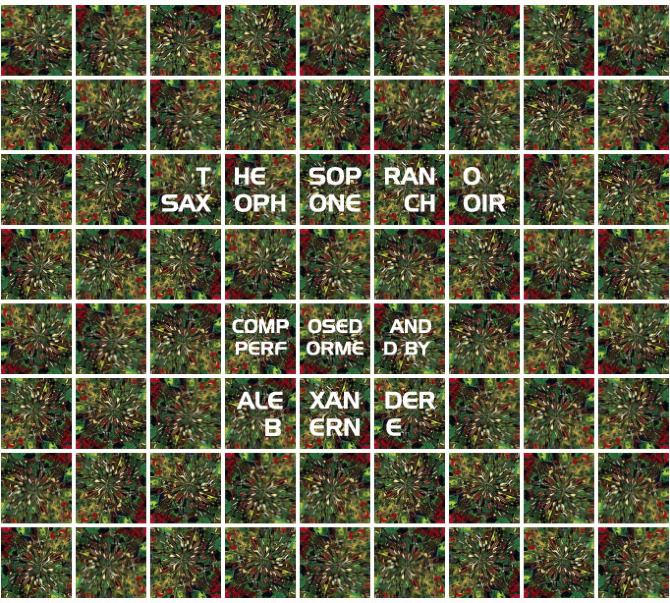
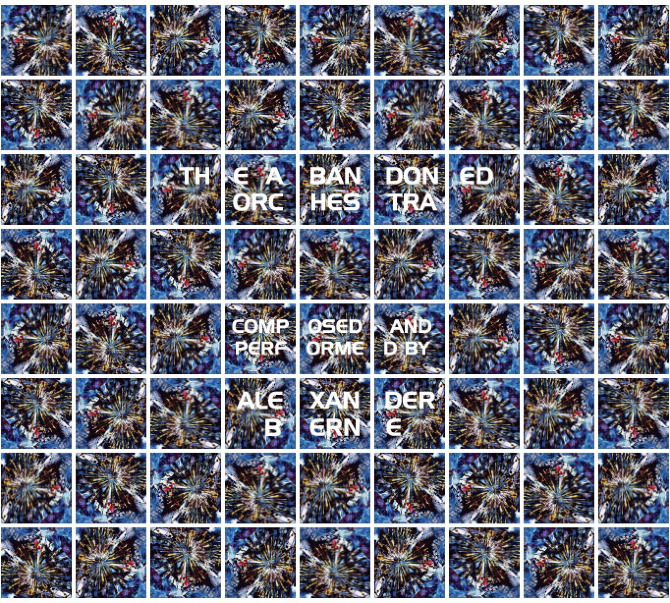
Alexander Berne is a world unto himself. Although this double album nominally features him and “The Abandoned Orchestra,” the latter is no more—and no less—than an expansion of self through the art of multi-tracking. Emoting through a variety of wind instruments, piano, percussion, and electronic treatments, he crafts brooding soundscapes for the discerning ambient listener. But don’t let the word “ambient” fool you. This is music that burrows with its own bronze sheen into the darkest corners of the soul and by that light inscribes reams of verses from makeshift biological desks.
Flickers of Mime is in eleven parts and is one of Berne’s most focused atmospheres yet. There is a magical consistency at work in the near-continual drone of Flickers I through IV, bleeding through psychological lattice with the persistence of solitude. Flicker V, however, transgresses a different skin altogether with its persistent, swirling luminescence. And yet, it doesn’t mark a turning point so much as a turning, period—a metamorphosis, if you will, of the self into an alternate signature. Overtly classical inflections speak not of earthly art but of an intergalactic pigment, whereby the unknown becomes the only frame of reference. By Flicker VIII we are caught in the machinery of linearly bound time. The electro-acoustic blend of crunchy break beats and organic breath forge enough heat in their center to turn dark matter into diamond. The flock of piano and reeds that is Flicker X gives glimpse into every occlusion, while the unconsummated matrix of the final Flicker gives rise to sinking.
Death of Memes is in nine parts. Its title comes from poet Michael Bonine’s sonnet sequence “August 12th, 1996.” There is indeed a feeling of raw poetry in the more industrial textures at play. From an introduction I can only describe as “comatose grunge,” it compresses anarchy into a single drop of ink and unfurls its dragon’s tail in a glass of water. This far more contemplative collection of impressions feeds on nutrients of the forgotten, the left-behind, the ruinous. Like the early tape loops of William Basinski, it embraces the aesthetic of decay as the only path toward completion. The sounds here are less locatable, more of a piece with outer spaces than with inner logics. In Meme VI the architecture begins to vibrate so intensely that it bends to the limits of its structural integrity. The droning textures are filled with promise, leaving the piano to resurface in Meme VIII like a floating dream, so that only in the final hour can angels touch their own ears.
This is asylum in sound. Welcome to your hermitage.
Although the word “enigma” refers to hidden meanings and messages, the music of composer-instrumentalist Alexander Berne discloses itself in starkness, not darkness. Nowhere so clearly as in this triptych of albums released in 2010 on the progressive Innova Recordings. Closest in spirit to the multi-tracked worlds of Stephan Micus, Berne’s universe expands well beyond the binary of flesh and spirit into geometries of neither.
The Soprano Saxophone Choir opens this 158-minute path by slowly melting away any obscuring hinges of expectation until the door falls away, leaving the listener between the infinity of two opposing mirrors. The ensuing soundscape unfolds a variety of topographical textures, each suited to its theme like light to color. The initiatory “Shores,” for example, paints miles of coastline with a minimal palette, evoking waters and coastlines with a fisherman’s intuition. It doesn’t so much tell as comport its story, as a dancer would favor gesture over pen. Yet it is not only bodies but environments themselves which move with mammalian self-awareness, moving stealthily through the sun and groundswell of “Gardens” and picking the “Hyacinth” that grows in its soil. What follows is a spectrum of nodes, moving from the isolationist jewel that is “Eschaton,” through the science fiction scope of “Reaches” and the ritual motifs of “Uhm,” and linking to the cellular origins of “Magic,” where modal poetry glows like desert canopy.
The Saduk takes its title from an instrument of Berne’s own invention. Something of a cross between a saxophone and a duduk but of a sphere all its own, it unfolds the very map charted on the first disc and adds names to its rivers, mountains, and geographical regions. The “Aubade” is a morning love song by name, a migration of geese and cranes reflected in sunlit waters that sets a viscerally focused tone, by which the tenderness of Berne’s performance sheds skin to reveal a syncopation free of clots in “Wanderer,” whereby the itinerant body reveals the lessons of its calluses and sunburns as if they were scripture. In contrast to this arid passage, “Clepsydra” (Greek for “water clock”) pours its liquid song from one vessel to another and back again in a droning piece that absorbs brief rhythmic elements to count the seconds. Filling the chasm framed by the eternal golden braid of “Sirens” (wherein one can hear the inner beauties of the saduk in all their glory) is Christo Nicholoudis, who provides vocals on two tracks: “Tridoula” and “Supernal.” His presence subtracts a feeling of architecture and substitutes cavernous breathing in its place. A stirring at the biological level.
The Abandoned Orchestra is Berne’s self-styled refraction, an expression of self that finds union in multiplicity. “Plumescent” is the first of seven steps into this more colorful anatomy. Pulses provide requisite traction, but feel almost accidental in their flips of grace. “Lustening” dips into Muslimgauze territory with its distorted break beat and fading reed lines, while “Kenosis” (another Greek word, this referring to the processes by which one empties the self to receive divine will) diffuses a mind interrupted by its own vocal desires. “Najash” refers to the snake in the Garden of Eden, enchanting with charmer’s croon but disappearing into the self-replicating spiral of “Arise” before being blasted into strands of infinity by the soprano saxophone in “Auriga.” Named for the constellation better known as the Charioteer, the latter does indeed pull its charge from one night to the next, unrelenting in its quest for fire.
Standing out like facial features along the way are three “Chronicles,” each a summary of what came before that treats every lilting line with the care of a mother bird warming her eggs. Averaging at 16.5 minutes each, they constitute a nomadic horizon at various stages of recession, and leave us wondering just how long it will take for our shadows to stretch until we step on our own heads.
Nicolas Masson tenor and soprano saxophones, clarinet Roberto Pianca guitar Emanuele Maniscalco drums, piano
Recorded August 2014, Auditorio Stelio Molo RSI, Lugano
Engineer: Lara Persia
Executive producer RSI: Paolo Keller
Produced by Manfred Eicher
U.S. release date: 2 June 2015
One might characterize multi-reedist Nicolas Masson, guitarist Roberto Pianca, and drummer Emanuele Maniscalco—a.k.a. Third Reel—as having carved a niche for themselves. Truer to say they’ve painted a context around that niche, which has taken shape from sheer formlessness into a tributary, emptying into a sea of shadows. Shadows, because the trio’s gestures seem to grow only darker with time, denying the convenience of light in favor of what can be felt in its absence.
If Third Reel’s self-titled ECM debut was the sun, then Many More Days is its corona, a dream to the former’s waking and a push toward those regions of the psyche wherein eddy fresh rhythmic motives. Days thus feels distinctly microscopic compared to its predecessor, even as it seems to travel farther. “For the first album we deliberately chose to almost never play a strict tempo,” Masson tells between sound and space, “we wanted to explore different ways to play in a very organic, non-linear way. For the second album, we wanted to keep the idea of short pieces, the same basic approach to interacting together, the same flow but with a more defined contour.” Along with the album’s temporal coming of age is the internal addition of Maniscalco’s pianism, which, Masson notes, hints at a chamber music aesthetic that sheds a few layers of jazz toward an art form less interested in genre than in generation.
Maniscalco yields a sizable share of the album’s compositions, ranging from the strangely comforting aneurysms of “Afterwards” to the burnished sounds of “Two-Part Chorale.” Such titles indicate a reflexive naming process. And yet, wherever they might fall into their respective slots, one knows the sacredness of their urgency, which apportions equal value to density and dissolution. Relationships between clarinet and piano or tenor saxophone and drums treat the album’s nervous system as a map to be rewritten. Pianca’s spider-veined chords in “Fourth Reel” and surface tensions in “Gilberto Stimmung” enhance the anatomical aspect, receding but never gone, even in the quiet foray of “Strand.” Each note is an eye in search of a face.
Although the two albums are different, I tell Masson they share a common approach to performance, which feels “bacterial,” as if every composed theme were a culture in a petri dish allowed to germinate and grow until it becomes its own unexpected entity. Though he agrees with this analogy, he cautions against painting Third Reel with a single brush:
“Most of the written material has no preconceived scenario, can be used for different musical purposes, and can take various forms according to the needs of a set or simply the inspiration of the moment. We’re trying to maintain an instinctive approach to the interpretation of our compositions, which are conceived with this idea in mind from the beginning. We’re all writing music for the trio, so I’m only speaking for myself, but in fact many times the idea I had in mind when composing was quite different from the results. We’re trying to leave enough space in our compositions to allow for multiple interpretations and developments. It is true that some pieces have a life of their own—we bring a few dots on a piece music paper and we just let them grow as we play. However, we don’t restrict ourselves to a single concept. If a tune feels complete by just reading it from top to bottom, without improvisations or variations, it’s also fine.”
While such openness might lead to chaos and wildness in the hands of others, in theirs it blossoms in thoughtful radiation. Masson’s own compositions, in particular the emblematic “Simple,” are self-deciphering codes—in other words, pieces that ask nothing of us in return for their admissions except our willingness to hear them as they are. Masson’s writing frames an organic triptych lodged in the album’s center. His “White” was inspired by Masabumi Kikuchi’s Sunrise, to which one may liken a kindred contemplation, while the title track follows clearer peaks and valleys. The same combination of drums, guitar, and saxophone graces Pianca’s “Happy People,” which nestles itself between them in a mosaic of endearing immediacy. Masson observes in retrospect how these three pieces “mark a turning point in the album’s dramaturgy, from the more intimate, chamber music-like pieces to the more expressive, lyrical pieces,” and the attentive listener is sure to feel this shift in visceral spades.
Between the parabolic “Hill” and the galactic compressions of “Fast Forward,” Masson’s pieces underscore Third Reel’s commitment to let the music go on only as long as it wants to. Each track, no matter how short, precludes the need for elaboration or reduction. I asked Masson whether any given performance of a particular piece influences its duration in real time, or where the band has a sense about how long a piece should go beforehand, to which he responded:
“The performance and the moment has a direct influence on a given piece’s duration, whether it is 2 or 20 minutes long. When we play live, we often connect compositions with open improvisations and therefore what is written becomes part of a bigger piece, like musical crossings to change direction and explore new territories. In the studio, however, we approached the material more with the idea of playing miniatures, each one of them being like a microcosm belonging to a bigger system or characters in a story. The studio in which we recorded both albums also played a good part in the outcome. We recorded at Swiss Radio’s Auditorio Stelio Molo in Lugano, Switzerland. The studio is actually a large wooden concert room designed primarily for classical music. It has beautiful acoustic qualities, with lots of reverb. This room is very inspiring, and the sound so detailed there, that it made us extremely cautious of the slightest changes in dynamics and sound textures. It definitely helped us being focused on the balance of each song. We tried to play only what we felt was necessary.”
Video from the CD release concert at Scnaffhauser Jazz Festival:
In the context of the Lugano studio, we can thank and acknowledge engineer Lara Persia, who may or may not be the subject of “Lara’s Song.” Either way, this piece, written by Pianca, does have something of the technician’s presence about it, the lone silhouette at the mixing board, her hands moving about the knobs and buttons to bring out the moment of the moment. It is therefore, and above all, a song of trust, an opening of newborn eyes, a quiet resignation into being in the world and its many purposes of living.
Behind it all, of course, is producer Manfred Eicher, whose tireless commitment to new music is expressly realized in this project. Indeed, Masson credits Eicher and ECM for playing no small role in the band’s evolution. “Working with Manfred Eicher as a producer is a unique experience,” he says, echoing many others in the sentiment, “and I think he helped us reveal a part of our musical personality and take it to the next level. However, playing live is still another story than making a studio recording, we stretch out more in concert, we’re taking more risks. We’re still experimenting but our musical identity got stronger and I personally feel more confident in what I have to offer.” That said, there is plenty of confidence in the dramaturgy of Days, proceeding as it does with such unhurried graciousness. With it, Masson and his bandmates have assured their place in the label’s history, from which key records by Paul Motian, Dewey Redman, Don Cherry, Keith Jarrett, Bill Frisell, Joe Lovano, and many others have fed into Third Reel’s dedication to liberty and abiding integrity of sound.
(To hear samples of Many More Days in its studio form, click here.)
Andy Sheppard tenor and soprano saxophones Eivind Aarset guitar Michel Benita double bass Sebastian Rochford drums
Recorded August 2014, Auditorio Stelio Molo RSI, Lugano
Engineer: Stefano Amerio Produced by Manfred Eicher
U.S. release date: 2 June 2015
Surrounded by Sea marks the fifth ECM appearance by English saxophonist Andy Sheppard. To the configuration of bassist Michel Benita and drummer Sebastian Rochford (with whom he previously recorded as Trio Libero) he now welcomes the ambient touch of guitarist Eivind Aarset. The latter, perhaps more than any other, evokes the encompassing waters of the album’s title, and draws on the relationship formed on Sheppard’s ECM debut, Movements in Colour.
Emphasis sides with Sheppard’s compositions, which have the first and final word on Surrounded by Sea. “Tipping Point,” co-written with Benita, opens the set on a distant shore. Given its delicate bass ostinato and cavernous sustains (courtesy of Aarset), one could be forgiven in mistaking it for Arild Andersen’s Hyperborean. But tenor and drums paint a clearly different picture, Sheppard working his blemish-less magic into the fade-in. Intensely melodic yet never overwhelming, he balances mild and sharp like a chef aiming to please as many diners as possible without losing his originality. Already we can tell this will be a fruitful leap inward for the saxophonist, as well as a memorable masterstroke of overall production, writing, and performance that never wavers on its way toward the closing “Looking For Ornette,” which shines all the more poignantly in the wake of its namesake’s recent death. Sheppard cites Coleman as a towering influence, but one may also detect a little of Lee Konitz (cf. Angel Song) in the playing.
Between these two signposts, Sheppard’s new quartet charts the melodic valleys between his mountainous originals. Both “Origin Of Species” and “Medication” spotlight Benita’s versatile stylistics, ranging from starkly original contemplations to Eberhard Weber-like infrastructures. Each theme is stretched like taffy into an intensely flavored ocean for Sheppard’s vessels, which find their grooves in the motions of the waves. Two further tunes—“The Impossibility Of Silence” and “I See Your Eyes Before Me”—are by comparison more bodily than environmental, steeping in the viscosity of Aarset’s magic and drawing nourishment from Rochford’s carefully knotted roots.
Bassist and drummer each contribute their own tunes, which between the David Lynchean swagger of Benita’s “A Letter” and the psychedelic charge of Rochford’s “They Aren’t Perfect And Neither Am I” forge a wide spectrum of emotional courage. It’s as if every mood were a skin the band as a whole could put on and take off at will, just as the sky dons and discards shades from dusk to dawn. In that same spirit of variation, the quartet pays homage to the unexpected in an atmospheric rendition of Elvis Costello’s “I Want To Vanish,” in which Sheppard’s soprano, as windswept as the grasslands, settles into the comforts of brushed drums and more selective bassing. As in the traditional Gaelic “Aoidh, Na Dean Cadal Idir” (Aoidh, Don’t Sleep At All), scattered in three parts throughout the album, Sheppard and his companions make every note count. But like Pi, we need only know the first few numbers after the decimal to recognize their infinite potential.
(To hear samples of Surrounded by Sea, click here.)
I have now reviewed every release in the JAPO catalogue. Shout outs to Craig LeHoullier, Steve Lake, and Bernd Webler for helping make my JAPO listening complete!
Any of you regular readers out there might have noticed that I recently reviewed the two latest XtraWATT albums. These stand as my backward entry into ECM’s other sub-labels. I do, of course, plan to also explore WATT and CARMO in full on this site, although such reviews may be sporadic, mixed in as they will be with the most up-to-date ECMs, along with albums from farther afield.
Below is a list of all JAPO releases, hyperlinked to my reviews for your convenience.
JAPO 60001Mal WaldronThe Call (Feb 1971) JAPO 60002Abdullah IbrahimAfrican Piano (Oct 1969) JAPO 60003Barre PhillipsFor All It Is (Mar 1971) JAPO 60004Herbert JoosThe Philosophy of the Fluegelhorn (Jul 1973) JAPO 60005Dollar BrandAncient Africa (Jun 1972) JAPO 60006Bobby NaughtonUnderstanding (Oct 1971) JAPO 60007Edward VesalaNan Madol (Apr 1974) JAPO 60008Jiří Stivín & Rudolf DašekSystem Tandem (May 1974) JAPO 60009Children At Plays/t (1973) JAPO 60010Enrico Rava“Quotation Marks” (Dec 1973, Apr 1974) JAPO 60011Magogs/t (Nov 1974) JAPO 60012OMKirikuki (Oct 1975) JAPO 60013Manfred Schoof QuintetScales (Aug 1976) JAPO 60014Larry Karush/Glen MooreMay 24, 1976 (May 1976) JAPO 60015Herbert JoosDaybreak (Oct 1976) JAPO 60016OMRautionaha (Dec 1976) JAPO 60017Stephan MicusImplosions (Mar 1977) JAPO 60018Ken Hyder’s TaliskerLand Of Stone (Apr 1977) JAPO 60019Manfred Schoof QuintetLight Lines (Dec 1977) JAPO 60020Rena RamaLandscapes (Jun 1977) JAPO 60021Globe Unity OrchestraImprovisations (Sep 1977) JAPO 60022OMOM with Dom Um Romao (Aug 1977) JAPO 60023Lennart ÅbergPartial Solar Eclipse (Sep 1977) JAPO 60024Contact TrioNew Marks (Jan 1978) JAPO 60025George GruntzPercussion Profiles (Sep 1977) JAPO 60026Stephan MicusTill The End Of Time (Jun 1978) JAPO 60027Globe UnityCompositions (Jan 1979) JAPO 60028Barry GuyEndgame (Apr 1979) JAPO 60029TOKParadox (Jun 1979) JAPO 60030Manfred Schoof QuintetHorizons (Nov 1979) JAPO 60031AMMIIIIt Had Been an Ordinary Enough Day… (Dec 1979) JAPO 60032OMCerberus (Jan 1980) JAPO 60033Elton Dean QuintetBoundaries (Feb 1980) JAPO 60034Peter WarrenSolidarity JAPO 60035Tom van der Geld/Children At PlayOut Patients (Jul 1980) JAPO 60036Contact TrioMusik (Oct 1980) JAPO 60037Es herrscht Uhu im Lands/t (Dec 1980) JAPO 60038Stephan MicusWings Over Water (Jan 1981) JAPO 60039The Globe Unity OrchestraIntergalactic Blow (Jun 1982) JAPO 60040Stephan MicusListen to the Rain (Jun 1980, Jul 1983) JAPO 60041Stephan MicusEast Of The Night (Jan 1985)
Barry Guy bass Howard Riley piano John Stevens drums, cornet Trevor Watts alto and soprano saxophones
Recorded April 1979 at Tonstudio Bauer, Ludwigsburg
Engineer: Martin Wieland
Produced by Steve Lake and Manfred Eicher
Bassist Barry Guy has always lurked in some of ECM’s most unexpected corners, and on this JAPO release from 1979 he joins pianist Howard Riley, drummer John Stevens, and saxophonist Trevor Watts for five freely improvised tracks of understated pandemonium. The titles of said tracks confuse more than they clarify, because the music speaks so well for itself. “The Y?” is a bubbling broth that gradually thickens into stew. Each musician seems to play in his own space, feeling out the dynamics of the scene before populating it with movements. Watts’s altoism is the boldest color of this spectrum, diving through his bandmates’ hoops with the ease of a dolphin. This leaves Guy to navigate Riley’s punctuations with strange tenderness, and Stevens to fill the void with his brilliant sputtering.
The sub-terrain to the former’s mountains, “Remember To Remember” opens low and dark in Guy’s strings. Watts carves a stark alphabet into Riley’s chaotic palimpsest, leaving Stevens to flounder on shore. There is a dynamic of searching here that, if not apparent already, should by now hit the listener like a eureka moment, as the group’s modus operandi becomes clear as day: this is not free improvisation but improvised freedom. With this realization as our compass, we leap over every pin and needle into “Du Doo.” Guy again provides the anchor, which is meant to maintain as much as obliterate stasis. His heart is in the details. Stevens brushes the frame until it turns to dust, while Watts wanders joyfully in these ashen ruins as if they were newly built. The detailed finish shows just how sensitive this quartet can be.
“Maze,” in spite of its title, is the most linear track on the album. Its surface-level overlap only thinly veils a continuity that sustains a full 13 minutes’ worth of depth-soundings. At the core of it all is the relationship between Guy and Watts, who, like photographers taking pictures of the same scene but from different angles, share complementary foci. On the other side of the coin is the final track, “In Relationship To The Circumstance…” Its gestural fabric is rendered opaque by the illusion of space between instruments. The sparseness is dark matter made audible. Watts plays the roll of bait and the others fish hooked to its line, flailing for one last song.
Like Barre Phillips, Guy is a bassist who avoids pigeonholes like the plague, but with an art that is ultimately healing. This is one of his many effective prescriptions.
Enrico Rava trumpet Kenny Wheeler trumpet, flugelhorn Manfred Schoof trumpet, flugelhorn Albert Mangelsdorff trombone Günther Christmann trombone Paul Rutherford trombone, euphonium Steve Lacy soprano saxophone (piano interior on “Worms”) Evan Parker tenor and soprano saxophones Gerd Dudek tenor and soprano saxophones, flute Michel Pilz bass clarinet Alexander von Schlippenbach piano Bob Stewart tuba Buschi Niebergall bass Paul Lovens drums, percussion, etc.
Recorded January 1979 at Tonstudio Bauer, Ludwigsburg
Engineer: Martin Wieland
Produced by Globe Unity with Thomas Stöwsand and Steve Lake in cooperation with the WDR, Cologne
Globe Unity’s Compositions makes a natural partner to Improvisations, also released on JAPO. This is the last of the collective’s three albums for ECM’s sister label, and ends a sporadic tenure with colorful tapestries of internally composed pieces. What makes this album such an archival treasure its early glimpse into the compositional careers of trumpeters Kenny Wheeler, Enrico Rava, and Manfred Schoof.
“Nodagoo” is quintessentially Wheelerian, opening with a solemn tuba before erupting into a late-night free jazz masterstroke spearheaded by Evan Parker on tenor. All the classic elements are there: an almost literary feel for structure, with room to grow, and a penchant for contrasts. Rava’s “Flat Feet” blends just the sort of playfulness and heavy traction one might expect from his younger self. One can’t help but read a symphony of smiles into its jaunty contours. It is, as might be expected, a delightful tangle of trumpets, but legendary trombonist Albert Mangelsdorff gives us plenty of meat to chew on as well. Rava is a burst of flame and a joy to experience on such historical terms. The trumpet squeals of Schoof’s “Reflections” begin the album’s most cinematic track, which follows an unusual narrative arc through Parker’s circular sopranism and Alexander von Schlippenbach’s sensitive monologue on piano, while the brass and winds suspend their motives high above sea level.
Von Schlippenbach himself offers two pieces. “Boa” has a more nostalgic, big band sound, kept confidently in check by drummer Paul Lovens at every turn. Superb solos on soprano saxophone (courtesy of the inimitable Steve Lacy) and bass clarinet (Michel Pilz) make this slice of anatomical fortitude glow like a lightning bug. “The Forge,” which ends the album, is a propulsive blast of gold that boasts some of the most concentrated playing on the record. Trombonist Günther Christmann’s offering is “Trom-bone-it,” a jovial piece that grows from outtake to full-force jungle. Such elevations are Globe Unity’s forte and reveal an astonishing ability to keep every expression clear in the face of chaos. Like the Art Ensemble of Chicago at its loudest, this one takes fun seriously. Lacy counters with “Worms,” which bears suitable dedication to Ezra Pound, whose gnarled poetics can be heard in musical parallels throughout the 10-minute piece. Its massive chains of dissonance give relatively little room for solo space, opting instead for a grander, organic ecosystem.
While not as exciting as its freely improvised predecessors, Compositions nonetheless affords more than enough space for the unexpected and is a worthy stopover on your JAPO collecting adventures.
Takashi Kako piano Kent Carter bass Oliver Johnson drums
Recorded June 1979 at Tonstudio Bauer, Ludwigsburg
Engineer: Martin Wieland
Produced by Steve Lake
That Japanese pianist Takashi Kako has spent much of his career as an accomplished classical pianist should come as no surprise to anyone who listens to this album, which documents a time in his life when he was heavily involved in the French free jazz movement at its zenith. It was during this period that, in 1979, he formed TOK, an acronym of its members, of whom drummer Oliver Johnson and bassist Kent Carter completed the trio. All of its pieces are by Kako, save for the last, the fantastic “Wobbly Walk Parade,” by Carter. This carnival dream expands the trio’s standard palette, adding cello to its composer’s toolkit; celesta to Kako’s; toy piano, tambourine, and vocals to Johnson’s; and featuring an unexpected appearance by producer Steve Lake on harpsichord (!). Leading up to this whimsical flourish is a program of striking originality, which is all the more intensified by Kako’s undeniable acuity at the keyboard. Certainly his time in Paris has worn off here, as riffs resembling those of the great 20th-century French composers—including his teacher, Olivier Messiaen—are recognizable throughout.
The OK to Kako’s T are finely supportive, responding to every dip and spiral of the pianist’s flights over delectable comping. Each listens to the other before deciding on a single note. Whether riding the groove of “Dodéc” or painting with shadow in “A Lua De Portugal,” the trio shares equal duties in the evocation department. Between Carter’s elasticity, Johnson’s adaptive timekeeping, and and Kako’s denser ligaments, the resulting music hides in a crawl space somewhere between classical and jazz.
But Paradox throws its brightest spotlight on Kako, whose piano piece “Night Music” shows the beginnings of what has since grown into a lauded career as solo performer. Another return to roots is “Sekitei” (the title means “rock garden” in Japanese), which is the album’s masterwork. This painterly piece takes chamber jazz to a high level of abstraction that is almost linguistic, diagnostic. Every new element in its unfolding becomes integral to the whole and, although in seeming contrast to the title, rather accurately captures the blossoming order of chaos in this often-misunderstood art form.
Peter Warren bass, cello John Purcell saxophones John Scofield guitar Jack DeJohnette drums Ray Anderson trombone
Recorded May 1981 at Grog Kill Studio, New York
Engineer: Tom Mark
Produced by Jack DeJohnette
Bassist Peter Warren quite simply put out one of the finest albums in the JAPO catalogue: the long out-of-print Solidarity. Warren is one of a cadre of American jazz musicians who made a career for themselves in Europe, where his idiosyncratic approach was enriched and encouraged by the likes of Edward Vesala, Rolf Kühn, and Albert Mangelsdorff. In 1974, he returned to New York City, where he joined forces with Jack DeJohnette’s Special Edition, appearing on the classic ECM sessions Special Edition and Tin Can Alley. It was in that context where he also met reedman John Purcell, who along with the drummer was carried over into this phenomenal one-off band, rounded out by guitarist John Scofield and, for the set’s first half, trombonist Ray Anderson.
Anderson dominates the starter, “Riff-Raff,” which emphasizes his fiery tone against a groovy backdrop. His energy proves infectious, taking root in Warren and DeJohnette’s spirited contributions to the playing field. Scofield responds with a well-constructed solo of his own, minimal by comparison but no less robust for its underbite, while Purcell’s alto croons and cries. The overall effect here, as in the title track that follows, is one of meticulous abandon, whereby the latter tune’s circular bass intro betrays nothing of the tension about to unfurl.
The album’s remainder subtracts the trombone, shifting register into a darker quartet. Purcell’s soprano fogs the window of “Mlle. Jolie,” making for an attractive ballad further deepened by DeJohnette’s rarely-heard-but-always-artful pianism. Warren focuses on the infrared portion of his emotional spectrum, while Scofield dances on air. “Lisa’s Tilt” finds Purcell darker still on alto in a track that swings more than any other on the album. DeJohnette is noticeably foregrounded, holding every seam together, even as the band finishes in a swanky free for all. As a postscript, Warren offers “I Remember Stu,” on which he plays bass and cello in a piece written in memory of Stu Martin, whom he thanks in his acknowledgments “for his love and musical inspiration.”
Solidarity is characterized, among other aspects, by its ebb and flow, which at one moment may cast a spell and the next push through it like water through a broken dam. And with DeJohnette producing, the listener is left with an elusive but unquestionable winner.