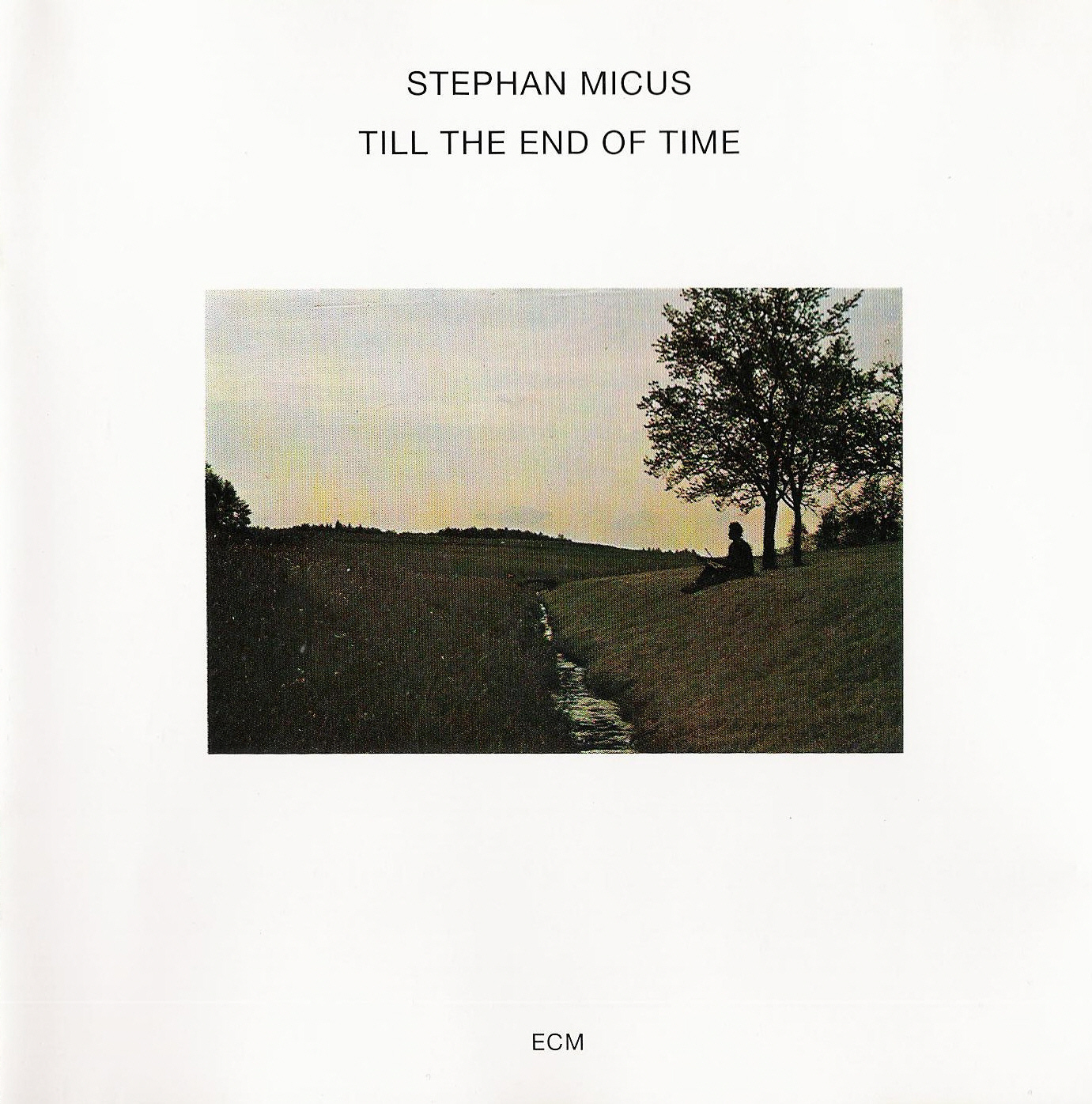
Stephan Micus: Till The End Of Time (JAPO 60026)

Till The End Of Time

Stephan Micus
Till The End Of Time

Stephan Micus table harp, kortholt, zither, guitar, vocal
Recorded June 1978 at Tonstudio Bauer, Ludwigsburg
Engineer: Martin Wieland
Produced by Manfred Eicher

Before migrating across the ECM continent, Stephan Micus outfitted some of his most formative expeditions in the territories of the JAPO sub-label. On these albums one hears Micus at his most elemental, turning every gesture into inter-spatial awareness. The album’s duration of 36 minutes only serves to deepen its intimacy as a space in which the listener might catch a cushion of meditation in a world of splinters.

Micus’s practice has always been to render the stem before the flower, and in the album’s title track a table harp provides that very illustrative function. Its dulcimer-like heart beats a rhythm at once ancient and fresh, curling as the scriptural page, its edges darkened from constant contact with the hands. Those same hands cradle a method of speech so musical that its melody is discernible only in the freedom of solitude. This is perhaps why Micus tends to work alone: so that he might open every angle honestly and uniquely, until the geometry of his life grows big enough to Venn-diagram into the listener’s own. Bowed zither expands the roots and gives way to a kortholt, a crumhorn-like reed from the Renaissance that pulls hidden colors from the sunlight. A classical guitar, which all but disappears from Micus’s later work, defines ethereal flesh through a worldly skeleton. Like the music itself, it is gut and wood and movement, drawing a string through immediate intellect to that of another time.

“For Wis And Ramin” is even more direct in its expressiveness, triangulating guitar and zither with Micus’s imagined singing. Imagined, because no words would do justice to the palette from which he draws, one that harbors not the barest pigment of politics. After the opening classical guitar solo connects its geometric touch-points, only a throated language can bring to the light that which is born in the dark. Micus is thus a troubadour who seeks love not only on earth but also from heaven, so that when the zither walks in the voice’s path, we must also feel the soles of our feet pressing their outlines into planes of stardust, refuges of forgotten pollen.

on a rainy night a traveler: Stephan Micus’s ongoing raga

The music of Stephan Micus is a soundtrack to life. It holds the sky in its crown, the earth in its belly, a molecule of ocean on its tongue. And while each of his albums may be the first step of a longer journey, the two early releases reviewed here just might be the best places to start for those who have never encountered him in their travels.

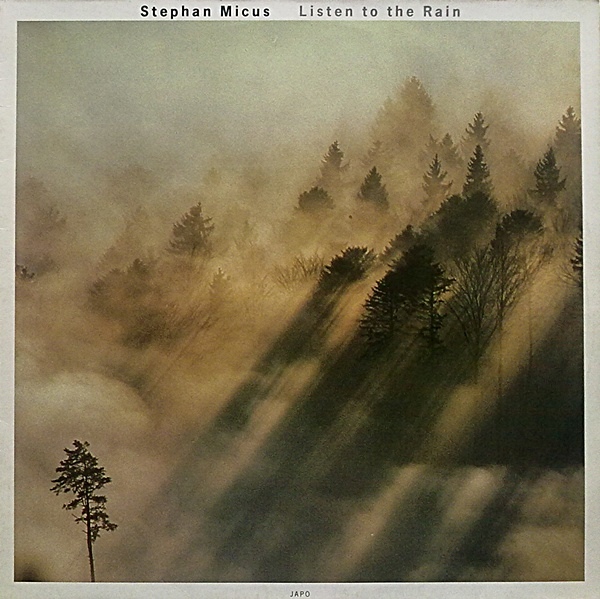
Listen to the Rain

Listen to the Rain (JAPO 60040)

Stephan Micus dilrubas, Spanish guitar, steel string guitar, suling, shakuhachi, tamboura
“For Abai and Togshan” recorded July 1983 at Tonstudio Bauer, Ludwigsburg
Engineer: Martin Wieland
“Dancing with the Morning,” “Listen to the Rain,” “White Paint on Silver Wood” recorded June 1980 at Sound Studio N. Kiln
Engineer: Günther Kasper

If Micus’s saga were an ongoing raga, then 1983’s Listen to the Rain would be one of its most inward-looking prayers. All four meditations that make up the album, while externally distinct, are internally connected through Micus’s use of guitar. The Spanish variety plays a particularly active role throughout, with the sole exception of “Dancing with the Morning,” for which he pairs the ubiquitous steel-stringed with the suling, a bamboo flute often heard in gamelan ensembles of southeast Asia. Knowledgeable listeners will recognize both the rarity of the backpacker’s trusty companion in the Micus canon and its elemental necessity in this setting. The ascetic sheen of its metal strings paints a world of shine to which a human presence adds less manufactured colors. The suling’s unclipped wings, by extension, are exhaled into the sky above, circling and darting through the surrounding melodies until they take shape under cover of their own imagination.

The title track is a duet for Spanish guitar and tamboura. True to his extensively creative spirit, Micus plays the latter like a zither, over which the former’s gut strings produce an ascendant pathway into “White Paint on Silver Wood,” which trades the tamboura for shakuhachi. The Japanese bamboo flute begins with a solo that teeters on the edge of breathlessness and follows through on its wandering spirit. Flamenco-esque touches evoke movement not only of dancer’s feet but also of artist’s brush.

Yet it is “For Abai and Togshan,” which takes up Side A of the original vinyl, in which the farthest reach of this interior song takes physical form. Three dilrubas (bowed lap instruments from northern India) open in drone, wavering like bodies once lost in time but only now finding each other, piece by sunlit piece. Three soon give way to five, joined by four Spanish guitars, whose harmonic infusions fade in rose tones of complexion. The atmosphere is as much introspective as it is joyous, and finds in the solitary center a peace immune to corruption of shadow. The dilruba’s sympathetic overtones begin as if leaving, dropping cartographic messages as breadcrumbs into sundown.

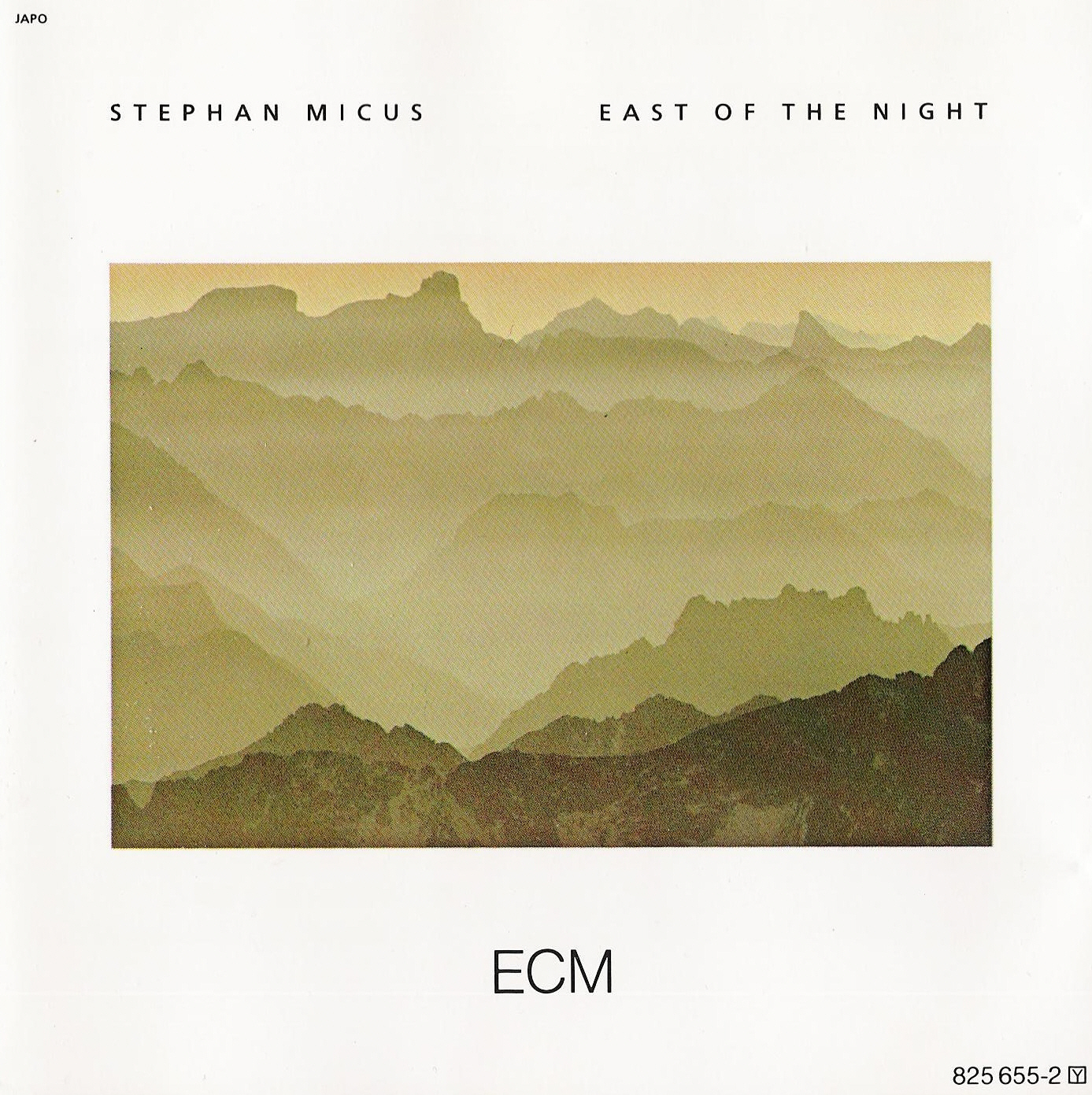
East Of The Night

East Of The Night (JAPO 60041)

Stephan Micus 10- and 14-string guitars, shakuhachi
Digital recording, January 1985 at Tonstudio Bauer, Ludwigsburg
Engineer: Martin Wieland

East Of The Night, released in 1985, is one of Micus’s most melodic albums. Its two long tracks epitomize, ever so humbly, the dictum of less is more. The title piece, a conversation for 10-string guitar (an instrument of his own design) and shakuhachi, feels like a dialogue between master and disciple. Micus’s guitar combines the reediness of a lute with the subtle ferocity of a koto, making it a natural partner to the shakuhachi’s dawning breath. Each pluck of a string works the upholstery of the sky until a surface of untreated wood is revealed behind it. Details of handiwork once obscured by finery and ornament now become naked art. With the softness of a windblown curtain, the plectrum moves from foreground to background before the shakuhachi takes on a Milky Way texture in a suite of thrumming stardust. The flute fragments, multiplies, and ends the set’s first half on a congregational sigh.

“For Nobuko” is dedicated to Micus’s wife, recipient of this powerfully intimate solo for another custom instrument: the 14-string guitar. Its flowerbed extends far beyond the window box and trails vines from one domicile to another, stretching across vast plains of tundra toward immaculate love. It encompasses the dedication of one human being, whose balance is achievable only by offering himself up to another’s fundament, into which the listener’s own messages might also be divined.

Like two vapor trails, Listen to the Rain and East Of The Night mark their respective paths of motion by holding relatively still against the blue. One is the parallel of the other, never intersecting except by the illusion of perspective. Together, they are further significant for easing the JAPO sub-label’s 14-year flight in for a landing, thus ending one fantastic voyage by barely beginning another.

Cyminology: Phoenix (ECM 2397)

Phoenix

Cyminology
Phoenix

Cymin Samawatie vocals
Benedikt Jahnel piano
Ralf Schwarz double bass
Ketan Bhatti drums, percussion
Martin Stegner viola
Recorded March 2014 at Rainbow Studio, Oslo
Engineer: Jan Erik Kongshaug
Produced by Manfred Eicher
Release date: 20 February 2015 (Europe only)

My melodies are reaching your heart, how come?
My words are easing your pain, how come?
Everything that I do, I don’t do it myself, how come?
I live for the ones, who love me
Why not for myself?

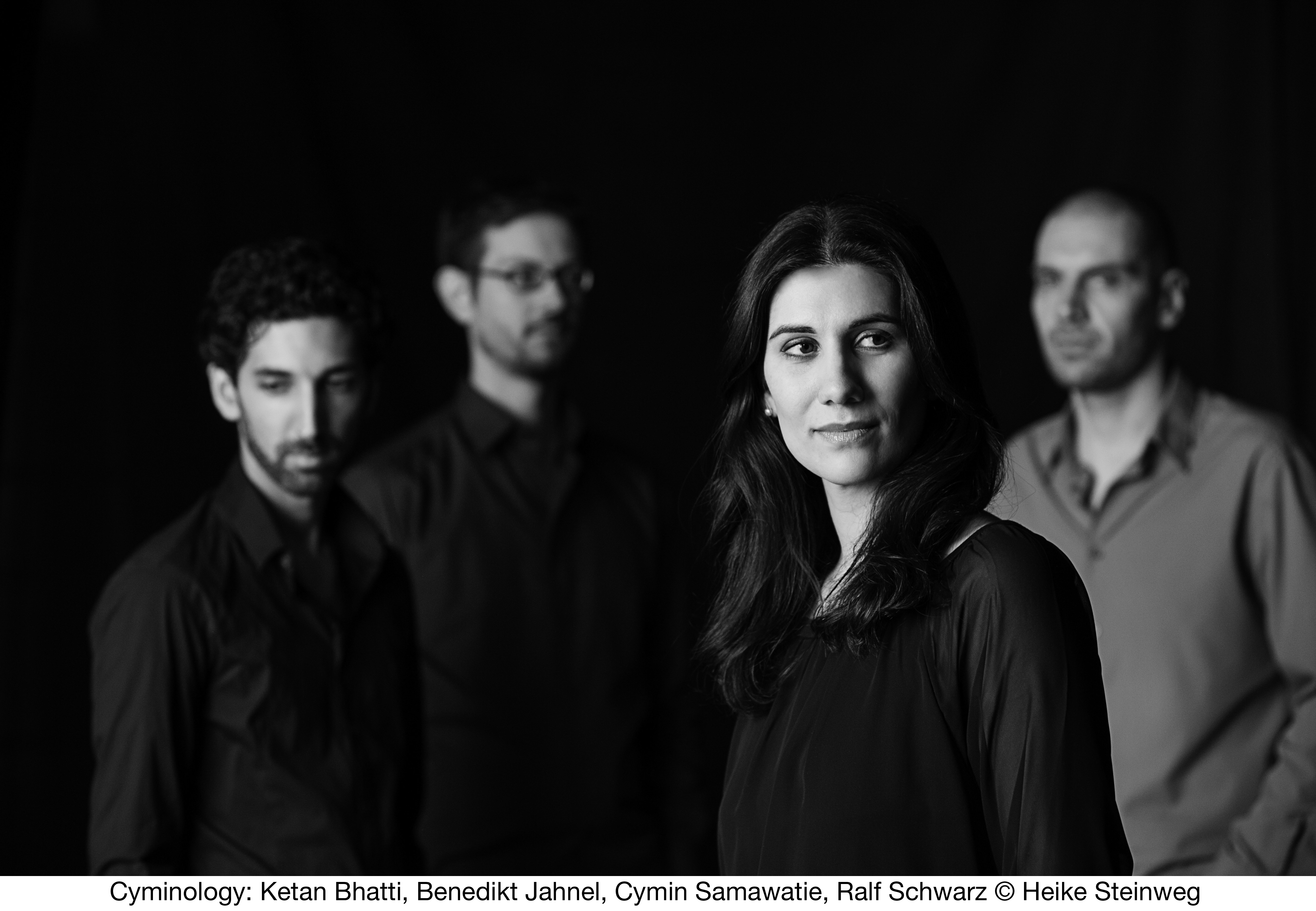
Cymin Samawatie, whose band Cyminology has swum twice in ECM waters (cf. 2009’s As Ney and 2011’s Saburi), is a crosser of barriers at once ethnic, linguistic, and musical. Such a characterization risks painting the German-Iranian singer as an enigma, when in fact she gives voice to her gifts through love of sentiment, empathy for politics, and humility of creation in a way so grounded, it feels as if she is singing as much for you alone as for the world. Samawatie’s backing trio of pianist Benedikt Jahnel, bassist Ralf Schwarz, and drummer Ketan Bhatti now welcomes violist Martin Stegner, whose presence is as defining as it is dressed in shadow. The voices of his bow constitute nominal additions, but their presence removes a few more layers of perception to reveal the naked truth of every note they touch.

Cyminology

The appropriately titled Phoenix revisits Iranian poet Forough Farrokhzaad (1935-1967), from whose own premature ashes emerged the winged verses explored therein. Farrokhzaad paints a veritable world around her body, which in “Aaftaab” and “Gozaraan” binds the narrator hand and food with ribbons of love’s many unspoken hues. The latter song’s improvisatory colors slip into a black hole as quickly as they emerge from one, feeling through the dark as if by every word, a fingertip. This is much in contrast with the former song, which unfolds, fractal-like, inlaying repeated patterns and meshing viola and voice interchangeably. Likewise, Farrokhzaad’s shapes tend toward a yin and yang relationship, whereby every pool of light contains one fish of dark, and vice versa. Like the stars she collects in “Harire Buse,” which accompanies Samawatie by bass alone, they shine only because of the unknowable pitch in which they swim.

Yet nowhere does Farrokhzaad—and Samawatie, by extension—speak so inwardly as in the closing “Baraaye To.” Here drums and bass shed their rigid constructions to better comprehend Cymin’s realisms as she sings:

I am writing this poem for you
In the sunset, in the thirsty summer
On a half gone, fatal way
In the old grave of my endless pain

Let my eyes overflow again
with dewdrops

The day will come when your yearning sight
Will fall on this painful tune
Searching within my words
You will say: “This was my mother”

Throughout this incremental, emotional implosion, the band’s melodic blush yields more than the sum of its parts and proves that life can be written only on the palimpsest of memory.

The distinction of Cyminology as a vocally-centered group is that its instrumentalists also emit a poetry of their own, every bit as verbal as their bandleader’s. This is nowhere truer than throughout Samawatie’s own songs, wherein members of the rhythm section, into which the piano grows to be an interlocking part, punctuate each other’s sentences until they are spherical—global, if you will. Her texts may be far more concise, but their impact is anything but. In the pulsing infrastructure of “Che Gune Ast,” she activates a fierce individuality. From the pulsing pianism, which gives a sun for drums to compass their solar system, to the viola’s innocence, which feels almost blood-related to the breath-drawn bass, Samawatie’s singing tracks every change of mood as if it were a diary in real time. “Talaash Makon” is another duet, this time pairing her with Jahnel, whose defining pianism sets up one patch of earth per footstep. The band saves its deepest poetry for “Baraaye Ranj,” which, although effectively wordless, nevertheless alters its own DNA as if by language alone.

From Nimā Yushij (1896-1960), so-called father of Persian poetry, comes the album’s title poem. Over the course of its two parts, Samawatie embodies the fabled bird’s tragic cycle, which in this context becomes an exercise in self-reflection. The viola reveals itself as a descriptive force, soaring with arpeggios before landing on the mountain from which Yushij unspools its sorrowful cry. In Part II, the instrumentalists are Erdnase-shuffled into Samawatie’s muscular legato, by which new details emerge from every listen.

A canonical Sufi poem by Hāfez (c. 1325-1390) completes the mosaic. The mournful “Dishab” is the album in miniature, blending clearly defined voices into an even more clearly defined whole, while holding on to one elemental mantra: there can be no water without land. And indeed, as a whole these melodies reach out their talons and pull until sky and earth become one horizon, opening an internal eye that interlocks with the external knowing of being gazed upon. By this dynamic, the listener turns into participant and allows the music to be reborn through the act of knowing it.

(To hear samples of Phoenix, you may watch the EPK above or click here.)

One in a million

As of this afternoon, between sound and space has reached one million hits. As always, I thank you all for reading. Keep an eye out for some new reviews this week, at long last!

1million_bday_large2

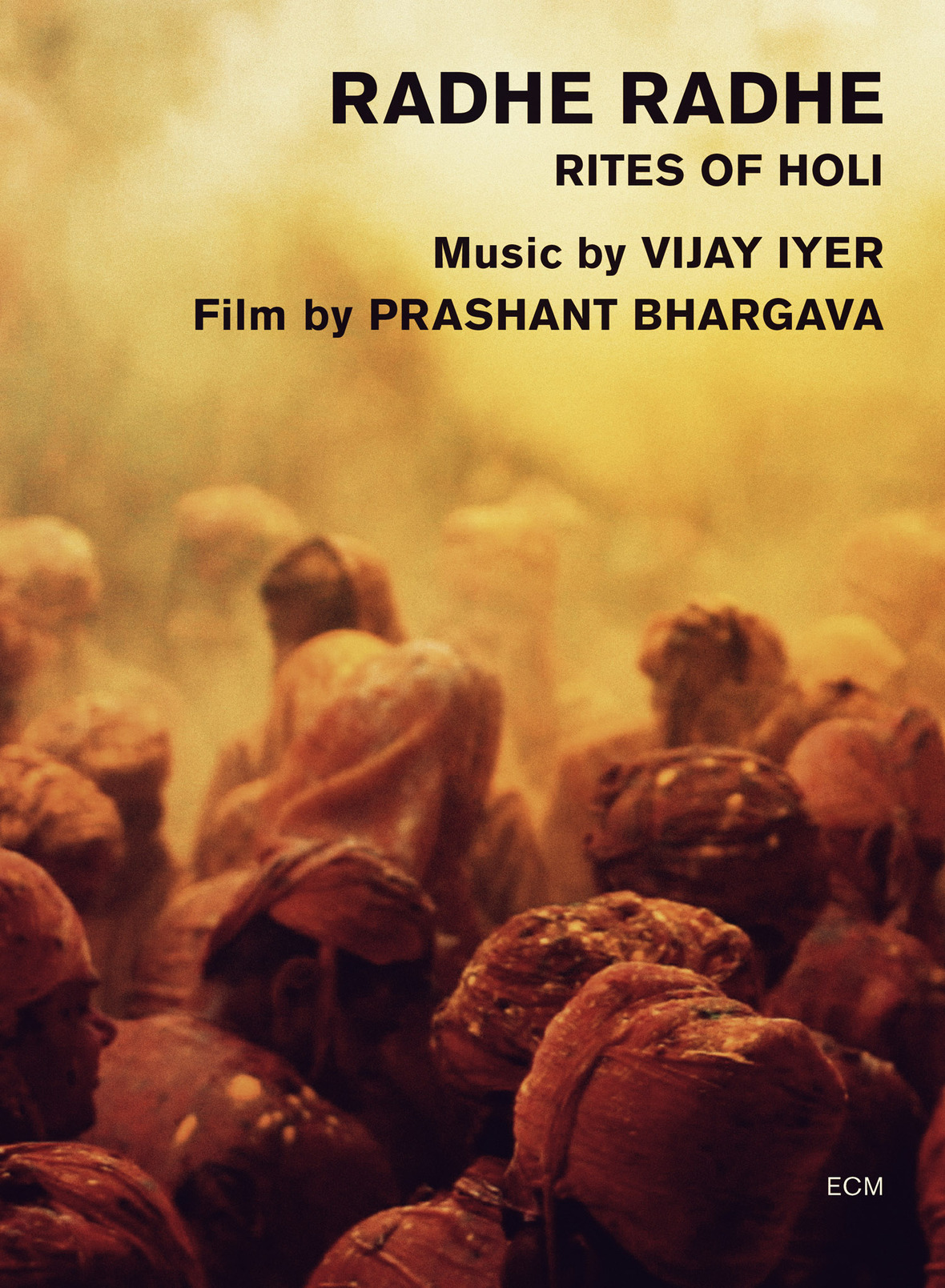
Prashant Bhargava & Vijay Iyer: Radhe Radhe – Rites of Holi (ECM 5507)

Radhe Radhe

Radhe Radhe: Rites of Holi

Vijay Iyer composer
Prashant Bhargava film director, editor
Anna George actor
Craig Marsden director of photography
International Contemporary Ensemble
Eric LambLaura Jordan Cocks: flute, alto flute, piccolo
Joshua Rubin: clarinet, bass clarinet
Rebekah Heller: basoon, contrabasoon
Gareth FlowersAmir Elsaffar: trumpet
Jennifer Curtis: violin
Kyle Armbrust: viola
Kivie Cahn-Lipman: cello
Cory Smythe: piano
Ross Karre: percussion
Tyshawn Sorey: percussion, drum set
Adam Sliwinski: conductor
Vijay Iyer: piano, electronics
Soundtrack produced by Vijay Iyer and Manfred Eicher.
Recorded live at Memorial Hall, UNC Chapel Hill, March 26, 2013
Engineer: Frank Martin/Media Production Associates
Live concert sound engineer: Levy Lorenzo
Additional recording at The Bunker Studio, April 20, 2014
Engineer: John Davis
Mixed at Avatar Studios, NYC by James Farber, Vijay Iyer, and Manfred Eicher
Assistant: Aki Nishimura
Additional engineering, editing, and consultation: Liberty Ellman

Bird

Ron Fricke’s 1992 classic Baraka endures as one of the most consummate examples of non-narrative cinema. Its montage of images from around the world was even more eclectic than the soundtrack that went along with it. But despite the many ceremonies, creative arts, and labors that Fricke documented—including death pyres and ritual baths in the river Ganges—he never captured the Hindu religious festival known as Holi. Had he done so, it might have looked something like Radhe Radhe.

Opening Shot

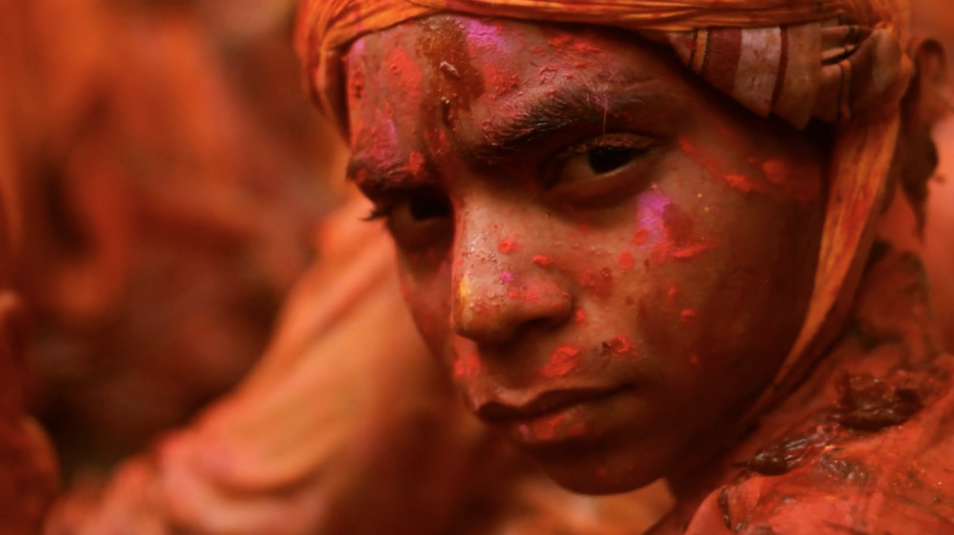
Filmmaker Prashant Bhargava’s ode to this so-called “festival of colors” traces the eight-day celebration back to Mathura, mythic birthplace of the supreme deity Krishna and his lover (in the strongest sense) Radha. Hence the film’s title, a term of praise and greeting often exchanged in the streets of Mathura, where she is believed to be a gateway to true understanding of Krishna. Her power is a central theme, an explosion of devotion far more vivid than the human-made pigment sold on the streets in the weeks leading up to this cathartic event.

Given the film’s subtitle, “Rites of Holi,” and the fact that Holi is practiced in the spring may put one in mind of Igor Stravinsky. This is no coincidence. Although not a direct homage to Stravinsky, Radhe Radhe was the result of a commission for the 100th anniversary of the Russian composer’s Rite of Spring, and one of a dozen projects freshly created in its honor. It is still a ballet of sorts, not least of all for the dialogic contributions of Indian-American pianist Vijay Iyer. In a manner of speaking, he and Bhargava met halfway—the director boiling down over 30 hours of footage into a 35-minute film and the composer expanding molecular impressions into a fully integrated score—so that the finished product was a narrative duly rendered. Iyer’s task was to match Bhargava’s rhythms, taking the listener through what he calls a “series of energies.”

Crowd 3

Bhargava first gained international attention with his debut feature Patang (The Kite) in 2011. That his roots grabbed their soil in hip-hop and graffiti art should come as no surprise, for his gifts of rhythm, poetry, and color were likeminded in their urban respect. But with Radhe Radhe he went further underground, mining deeper traditions of those same creative registers. The film is, then, as much a musical as it is a visual tour de force, building like a raga to near-ecstatic heights. Indeed, before a single image graces our retinas, Iyer’s pianism sets the stage over a dark title screen. Slight dissonances therein betray something of the chaos about to unfold, but obscure enough of it so that we might experience it anew, even in multiple viewings. Along with the young musicians of the International Contemporary Ensemble, Iyer creates a mood that is beautifully unsettling, and all the more organic for it.

Face 1

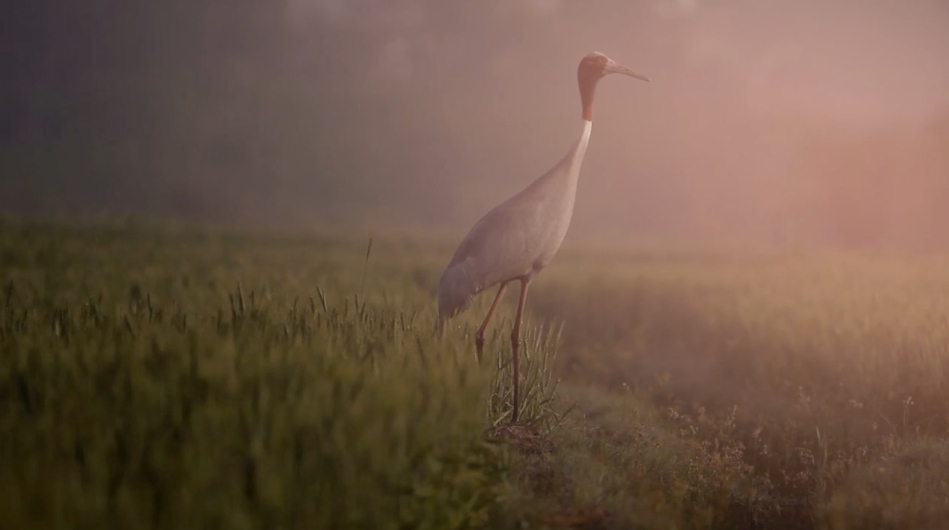
The film’s first part, “Adoration,” builds its intimacies one stratum at a time. The stage is set in a misty landscape. We see only details: boatmen preparing for the days’ revelry, a bare back, a glimpse of braided hair. The streets then come to life as food vendors ready their meals and women wash their garments in the river. The soundtrack is restless, anticipatory. A cargo train passes by, as if to underscore the film’s narrative drive. More fragments: a face half-reflected in a mirror, candles burning on an altar, a gossamer veil. As crowds thicken and the dance begins, Iyer’s pianism brightens. Even the birds in the field seem to join in. Flute and brass contrast one another with purpose. Their notes flower and wither, changing focus like the lens that guides them. Strings and percussion add color streamers of their own as the iconic powder hits the air.

Crowd 2

Part 2, “Transcendence,” puts further emphasis on Bhargava’s footage of an imaginary Radha played by actress Anna George. He spins from these scenes, shot in the US and woven throughout the film, a primal and sexual interplay that signals the true emergence of spring. It’s a bold move, as the director himself is first to admit in the DVD’s “Making Of” segment, but he wanted to bring that “everyday magic, that intimacy that we share as people to the narratives of the gods.” He believes that the push and pull of Radha and Krishna exists in all of us, as it does also in the increasingly inseparable relationship between sounds and scenarios. A trumpet, for example, works its melodic overlay during a long shot of Radha’s face, implying an environment far vaster than the immediate contrivance of the studio.

Radha 2

As the cinematography becomes more contemplative, the music subdues itself in solidarity. In the same way that Bhargava seems to have eyes in many places at once and flits between them by changing cognitive channels, so too does Iyer’s complementary switching take every movement into account. A sensual flowering of street noise enters the mix, as if bleeding of its own volition, leaving us wanting to shed our inhibitions and dive into that sea of color.

Dancing 2

In May of 2015, Bhargava died at the age of 42 from cardiac arrest after a history of heart disease. But the tragedy of this death is so graciously balanced by the exuberance of his small yet vivid oeuvre that one can focus on the latter in a state of pure invigoration. In this respect, we do well to read Radhe Radhe in the spirit for which it was made. In a world where the rites of Holi have spread to unlikely corners (I witness its rainbowed aftereffects on my American university campus every year), it’s nice to know that one artist’s vision can bring us anytime to the source with just the press of a PLAY button.

Field

(See this article as it originally appeared in RootsWorld online magazine here.)

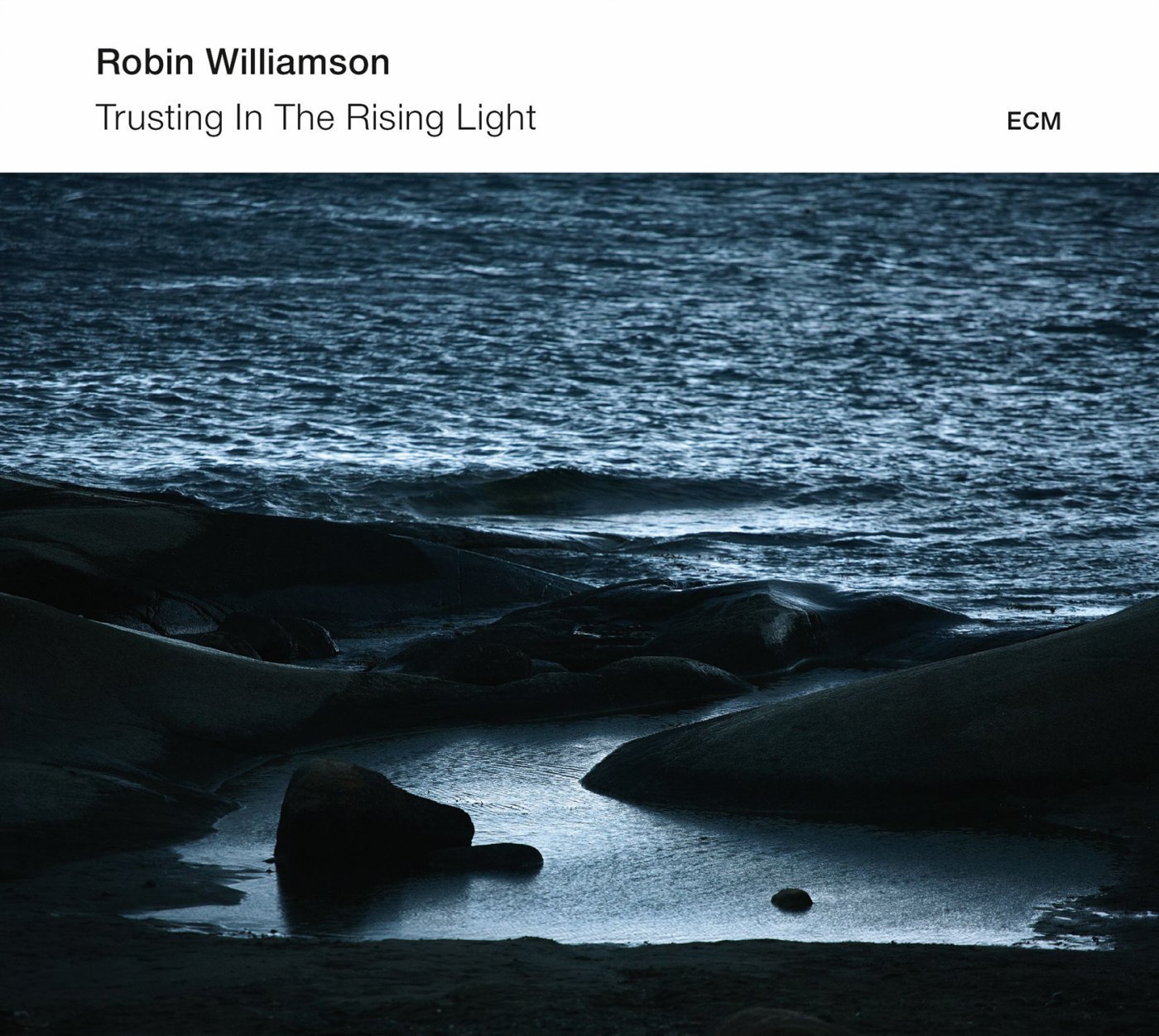
Robin Williamson: Trusting In The Rising Light (ECM 2393)

Trusting In The Rising Light

Robin Williamson
Trusting In The Rising Light

Robin Williamson vocals, Celtic harp, guitar, hardanger fiddle, whistles
Mat Maneri viola
Ches Smith vibraphone, drums, gongs, percussion
Recorded January 2014, Rockfield Studios, Monmouth
Engineer: Steve Lowe
Assistant engineer: Tim Lewis
Mastering: Christoph Stickel and Steve Lake
Produced by Steve Lake

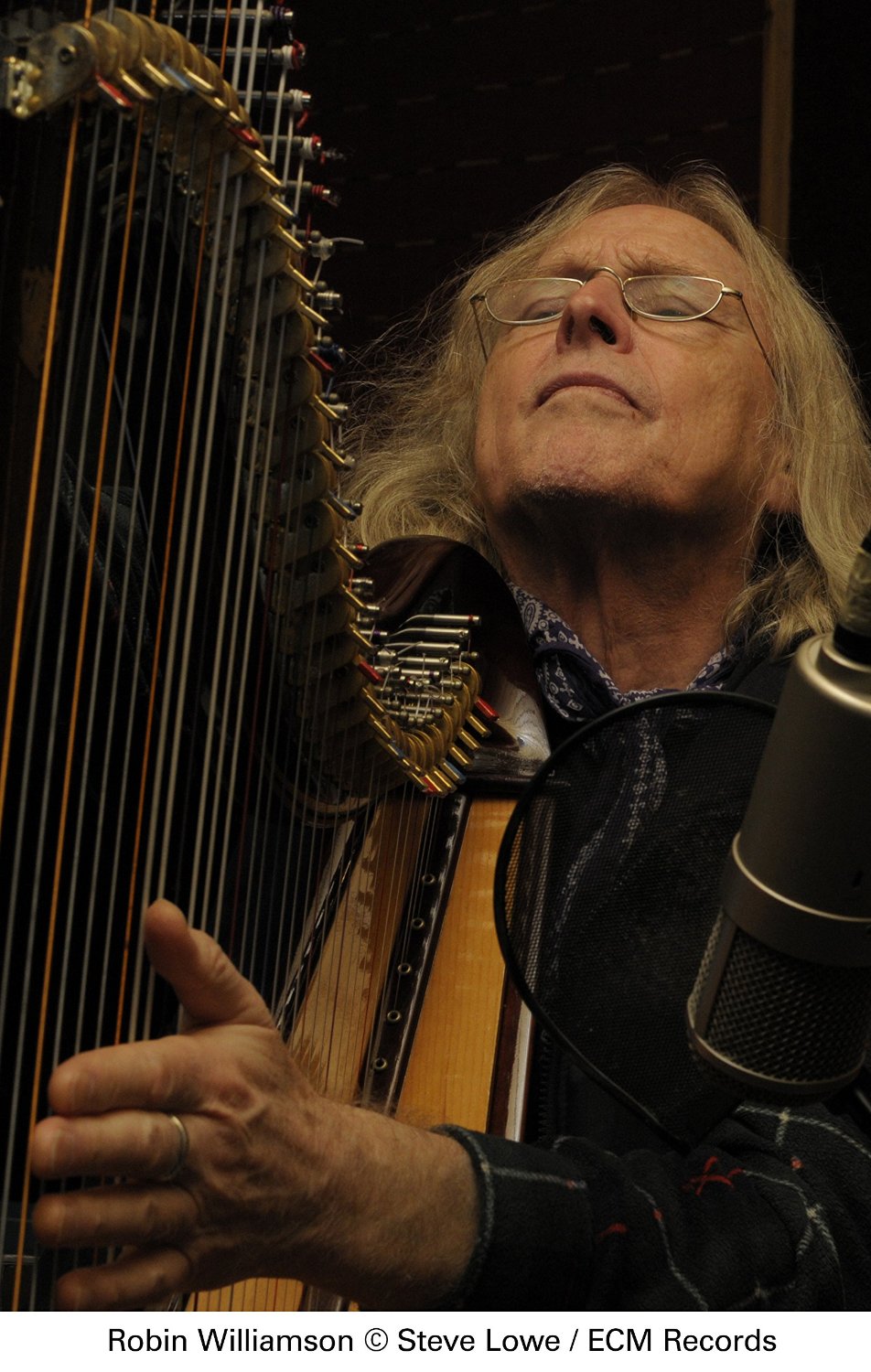
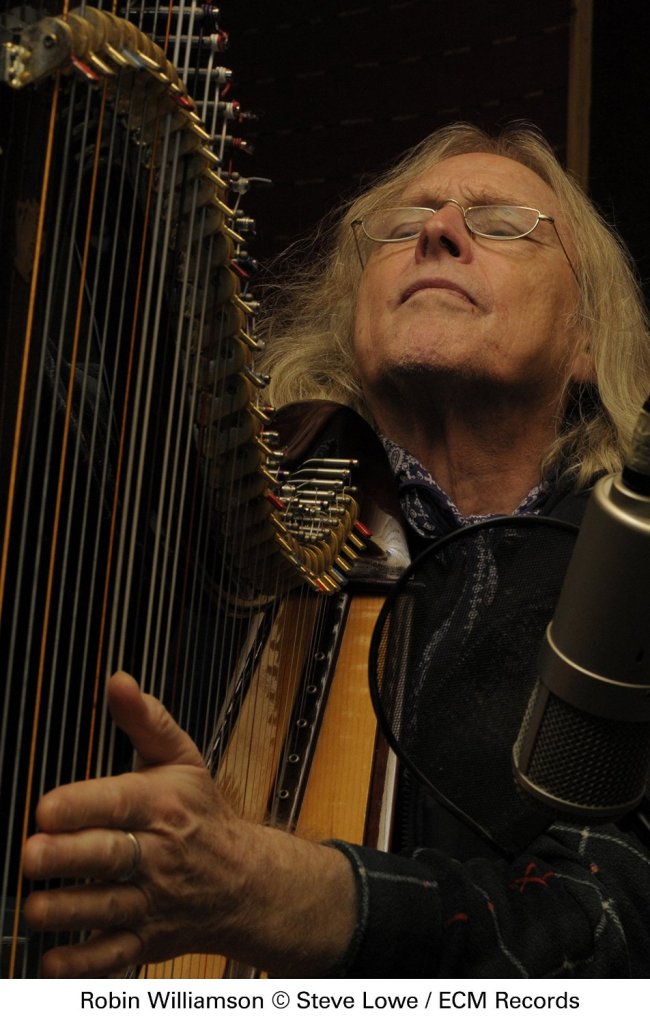
Robin Williamson, perhaps the last true bard on earth, returns with Trusting In The Rising Light. Following a string of intimate programs setting the words of famous poets to music (among them Dylan Thomas, Walt Whitman, and William Blake), he now dips a quill into his own inkwell and scrawls a masterful new ream of originals. Ten years separate this recording from its predecessor on ECM, The Iron Stone, but the wait has been well worth it, not least of all for the contributions of his fellow session musicians. From that last album he retains violist Mat Maneri and to this nexus adds drummer-percussionist Ches Smith. The result is an attuned, free jazz-folk session that feels at once long overdue and just right for its time.
RW

I caught up via e-mail with the album’s producer, Steve Lake, who described how the project came together:

“I’d been in touch with Robin over the years, and hadn’t realized that so much time had elapsed since The Iron Stone—the clichés about time moving faster as we age are true. In autumn 2013 he said he was in a period of writing lots of songs and read me the lyrics to ‘Trusting In The Rising Light’ and ‘Swan’ over the phone. It seemed like the moment for a new album. Robin said he wanted to work with Mat Maneri again, which of course was fine with me. I talked with [ECM head] Manfred Eicher about a possible vibraphone player for the session and Ches Smith’s name came up. It struck me as a good idea since I knew that Ches had formed a new trio with Mat and Craig Taborn. So inside the Williamson line-up there were two proven associations, Robin/Mat and Ches/Mat. With this as a basis we could confidently get to work.”

Where some voices crack and smolder with age, Williamson’s is like a fine sword: it only gets stronger the more it’s folded in its malleable state. And while he has always engaged larger questions of conviction, politics, love, and sense of place, on Trusting he seems far more content to dwell on the little things: spending time with a loved one, the fundamental pleasures of observation, and, as the album’s title implies, faith in life’s givens and regularities. As a romantic, he is lyrical yet realistic. He seems well aware that the limits of his control extend not much farther beyond his own body and the words and music it produces.

Nowhere is this clearer than in the title song, which turns on a movie with no opening credits. Here is one who stands at harbor, watching the rise and fall of the waves and knowing that some things are better left to their own rhythm:

In every man-hewn stone
The anchored voices murmur
Long long
What they have always to say
As to what of our life
When whence and whither
We born of woman
Born of the Great Mystery

Being a relatively new yet enthusiastic fan, I asked Lake to place the album in the larger context of Williamson’s decades-long career. “It’s a high point,” he answered, “but if I look at Robin’s discography there are a lot of high points, including albums on his own Pig’s Whisker label which too few people have heard (if you can find them I recommend Ring Dance, At The Pure Fountain, and Dream Journals). Robin’s been a working musician for almost sixty years but has never been exactly career-minded. His musical and literary interests carry him forward and as a result he has had, I would guess, a richer and more interesting life than many who have made the career a priority. Trusting in the way of the waves, as he says in the title track…”

Accompanying these sentiments—in truth, embodying them—is Williamson’s trusty harp. Despite being prone to putting on magical airs, at his fingertips it is not an instrument of spells and incantations. Over the years it has become burnished like a well-worn table at which countless meals have taken place. And there, among the dishes and scratched spoons are those same rhythms of life, having left their hieroglyphics behind for deciphering. As he blossoms in a wave of strings, crashing on the shores of a dawn not so far away, he provides confirmation that in the good work one can be grateful for the opportunity to engage with land and sea, to know that it will all be waiting on the other side of slumber.

Whether through the droning raga of “Our Evening Walk,” in which love begets love, or the heartfelt wonder of “Alive Today,” in which Williamson takes comfort in something as insignificant as the flap of a bird’s wings, such assurances thread every song that follows with the knowledge that all those things we rely on will be there for us, in light or darkness. Sometimes, as in “Falling Snow,” his romance is with the universe at large, pulling together time and space like a massive proof of emotional and spiritual relativity. At others, it is undeniably close to home, calling his wife Bina by name as he does in the sensuously realized “Your Kisses.” For the most part, however, Williamson looks either down at “These Hands Of Mine” or back along the “Roads” that led him to where he stands. The former tune features a jaunty guitar while the latter’s commentating viola weaves in and out of the loom. In both, the feeling of departure is constant, arrival questionable. And in “The Cards,” a song loosely based on a traditional Irish air “The Coolin” but otherwise ad-libbed in the studio, he offers a cautionary tale against prediction, trusting in reality instead of relying on dreams or elusive signs. Accompanied only by guitar, elastic and supportive of any and all possibilities, he contemplates this dance in what he calls the “soul of souls.” It’s as if he were at a bar alone, the last dart thrown along with last call, but it’s the kind of draft of which every sip tastes as good as the first.

Sitting with this album is like traveling somewhere for a while, much as the musicians did just to bring it all together. Lake sets up the scene:

“Rockfield is a residential studio deep in the Welsh countryside with a long history of recording especially rock music. When we arrived, Mott The Hoople were just finishing a mixing session. We spoke briefly with them. It was slightly odd, almost time-warp inducing, to be in the same room with Mott and Mat Maneri, but strange juxtapositions belong to the journey. I liked living at the studio and had some interesting talks with its owner Kingsley Ward about his early life as a session musician working for Joe Meek in London. There’s a lot of idiosyncratic recording knowledge concentrated at Rockfield. For the session with Robin the mood was positive, friendly and committed. Robin had some songs mapped out on which Mat and Ches were given directives and specific things to play, mostly with some improvisational freedom. And there were some pieces that were wide open to improvising, particularly ‘Just West Of Monmouth,’ ‘Night Comes Quick In LA,’ ‘Swan’ and ‘Islands Of The Inner Firth.’”

The latter songs rest somewhere between speech and singing and flower in freely improvised settings. “Youth burns brighter than neon,” he sings in “Night Comes Quick In LA,” a cynical, bird’s-eye view of superficiality gone rotten in the valley. The beat poetry aesthetic only adds to the acuteness of his poet’s eye. In “Just West Of Monmouth,” Williamson nestles himself in a gravelly accompaniment of percussion, whistles, and bows, unspooling his tale of creation in the rustle of underbrush and thirsty plains. Next is a sojourn into “The Islands Of The Inner Firth,” where awaits the mirror into which we must all someday look:

Now in the October of my life
I trace
Beloved and well remembered shore
Your stony verge
You cold and turbulent Scots water
In memory I trace
My kindly haunted past

So begins a summation of a creation and a new beginning of memory strung like a bead on a necklace that is forever growing to fit the thickening neck of experience. And before him is the pond where swims the eternal “Swan,” who joins her “world self / Where air and water meet.” Let us hope that Williamson’s swan has a long time yet before it sings.

(See this article as it originally appeared in RootsWorld online magazine, where you can also hear sample clips. To hear more of Trusting In The Rising Light, click here.)

Live Report: Avi Rothbard Trio at Smalls Jazz Club

Avi Rothbard Trio
with Jay Leonhart (bass/vocals) and Tomoko Ohno Farnham (piano)
Smalls Jazz Club
22 June 2015
7:30pm

Israeli-born guitarist and composer Avi Rothbard has earned his stripes in the relentless music scene of New York, where he has lived since 1999 and where his talents have found their way into a range of projects. With such a full palette already on his own, only those musicians with the right sensibility will do for bandmates, and a trio performance with bassist Jay Leonhart and pianist Tomoko Ohno Farnham at Smalls in June of 2015 was just what the doctor ordered in this regard.

Over the course of two richly varied sets, Rothbard and friends managed to balance their idiosyncratic strong points within a smooth group unity. Each musician brought a distinct signature to the stage without ever clashing for dominance. Farnham’s compacted, cellular approach to soloing, for instance, tapped the flavors of old-timey jazz to everything she touched. Whether comping beneath Rothbard’s leading tone in Randy Weston’s “High Fly” or bringing nostalgia and joy to the music of Wes Montgomery and Kenny Baron, she maintained a free, conversational tone. She further showed her inventiveness in Herbie Hancock’s “Dolphy Dance,” for which, in tandem with Rothbard’s sensitive touch, she spun fresh colors from the older threads.

Rothbard, for his part, stretched each tune until it fit like a favorite shirt. As composer, he spearheaded some of the most impressive turns of the night. Three originals—“Eye Talk,” “Twin Song,” and “Minor Impact”—acted as vibrant springboards for the band’s communicative potential, each more appealing than the next. With moods ranging from lyrical to blinding, they had an overall ductile quality that adapted itself to the themes at hand. As technician, Rothbard bared his chops on the theme from I Love Lucy, an unexpected highlight made all the more brilliant for its arrangement and virtuosic energies.

Overall, the drum-less roster allowed the band members to revel in open improvisational spaces. Leonhart was particularly on point in this regard, his playing so percussive that the sticks and skins were hardly missed. A fixture in the New York jazz club scene, Leonhart sang not only through his instrument but also along with it, offering two originals of his own—a self-deprecating blues called “Joy” (another fine vehicle for Farnham) and a humorous ditty about sitting next to Leonard Bernstein on a plane—and a lighthearted take on “Cool,” from Bernstein’s West Side Story.

With so much to appreciate in terms of execution and variety, the Avi Rothbard Trio delivered exactly as advertised, plus a few surprises thrown in for good measure, for a thoroughly enjoyable summertime gig that was the very essence of cool.

Klaus Gesing review for All About Jazz

My latest review for All About Jazz is of multi-reedist and composer Klaus Gesing’s solo album reaLTime. Gesing will be known to ECM listeners for his collaborations with Norma Winstone and Anouar Brahem, but his solo work should have strongest appeal to fans of John Surman. Click the cover to discover!

reaLTime