Stephan Micus: Panagia (ECM 2308)

2308 X

Stephan Micus
Panagia

Stephan Micus Bavarian zither, dilruba, chitrali sitar, sattar, 14-string guitar, nay, voice
Recorded 2009-2012 at MCM Studios
An ECM Production

Panagia may be heard as the divine counterpart to Stephan Micus’s earthly album Athos of two decades before, and revisits the Greek peninsula that inspired its predecessor. As with all Micus projects, the focus here is crystalline and spiritual in a way that shuns any specific label or dogma. That being said, one can surely feel the personal histories that go into the many instruments with which he births his universal sounds, their ties to places rendered frozen by time. Micus’s magic—his rite, if you will—is to blend those variant histories into a singularity that few world travelers have ever translated so nakedly into the language of music.
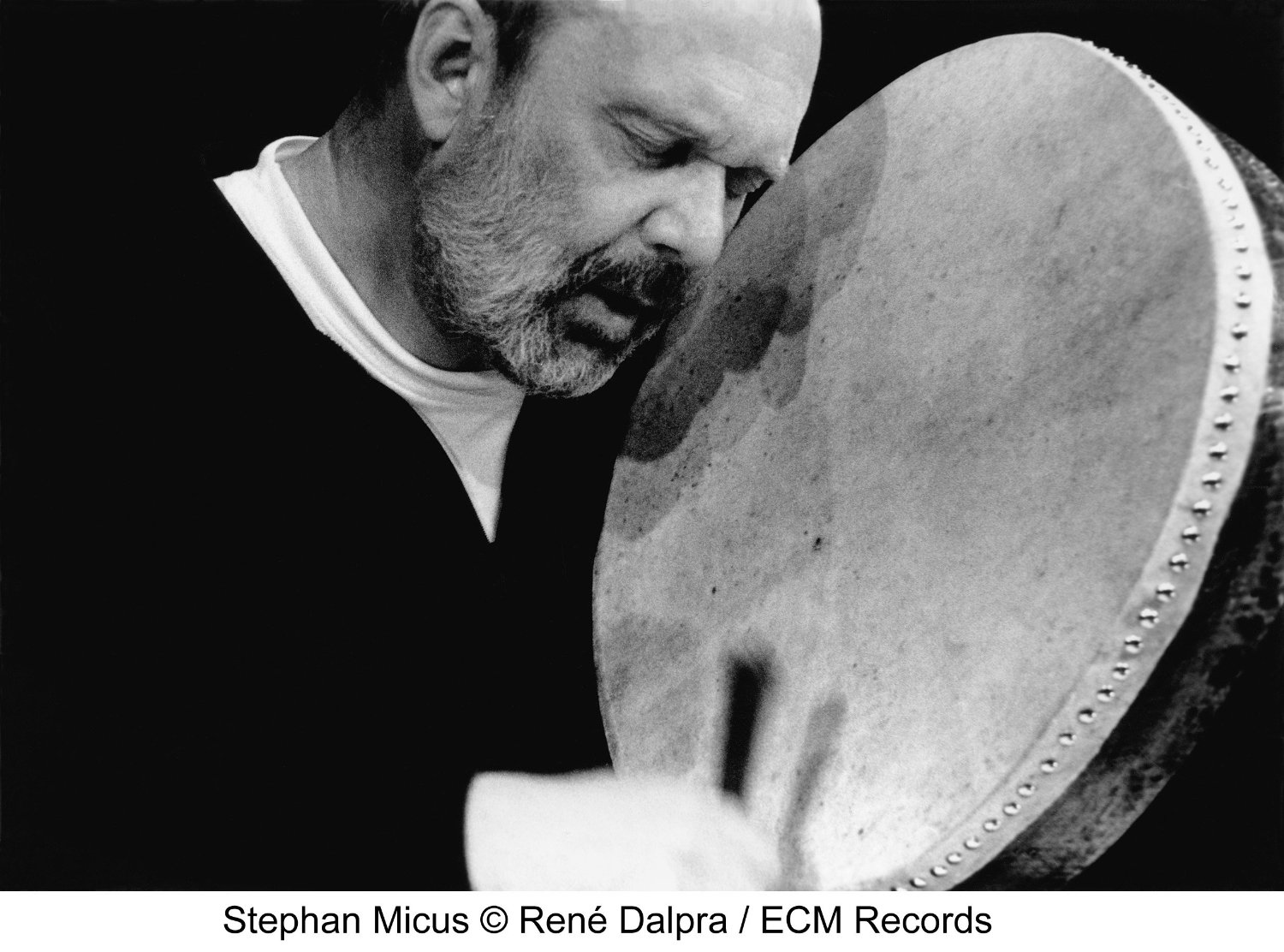
Micus 1

Micus demonstrates this personal ethos in a brief album statement: “Throughout the world people have put their trust in a female goddess. In Greece she is called Panagia,” thus invoking an all-encompassing goddess even as he locates her within a particular faith. According to Evy Johanne Håland in her book Rituals of Death and Dying in Modern and Ancient Greece, Greek orthodoxy calls her Ē Prōtē (The First) and places her at the pinnacle of sainthood. Hence the seventh-century Byzantine prayers to Panagia of which Micus sings his verses, and in which Panagia is called, among other things, “Virgin Mary,” “blissful swallow,” “radiant cloud,” and, in Christ-like fashion, “the joy of the distressed, the guide of the blind and the refuge of orphans.” Where normally Micus falls into the histrionics of his own phonetic language, here a certain thematic vividness of worship lends his singing fresh anchorage.

Through its 11-part traversal, the album shuffles vocal tracks into instrumentals. The former are songs of praise, as indicated by their liturgical titles, while the latter are analogic poems in and of themselves. “I Praise You, Unfading Rose” and “I Praise You, Cloud of Light” open and close the circle with Micus accompanying himself on the Bavarian zither. The zither’s sparkle, in combination with the words, draws flesh from vibrational frequencies. It is as if the world were cradled in a giant hammock and swung from soul to soul like a pendulum of fate, leaving the solitary voice to twist like knots of meditation where tether meets tree. “I Praise You, Shelter of the World” is also bifurcated, only now we encounter 10 voices accompanied by Chinese gongs in a tangle of vapor and vine. In “I Praise You, Sweet-Smelling Cypress,” Micus adds to that number of voices his custom-built 14-string guitar, 8 dilruba (a bowed Indian instrument similar to the sarangi and prominently featured in Desert Poems), 3 sattar (Uyghur violin), and 5 Egyptian nay flutes for a thoroughly spectral palette. Two further tracks—“I Praise You, Lady of Passion” and “I Praise You, Sacred Mother”—feature 22 voices and 20 voices, respectively. Both are deeply hymnal.
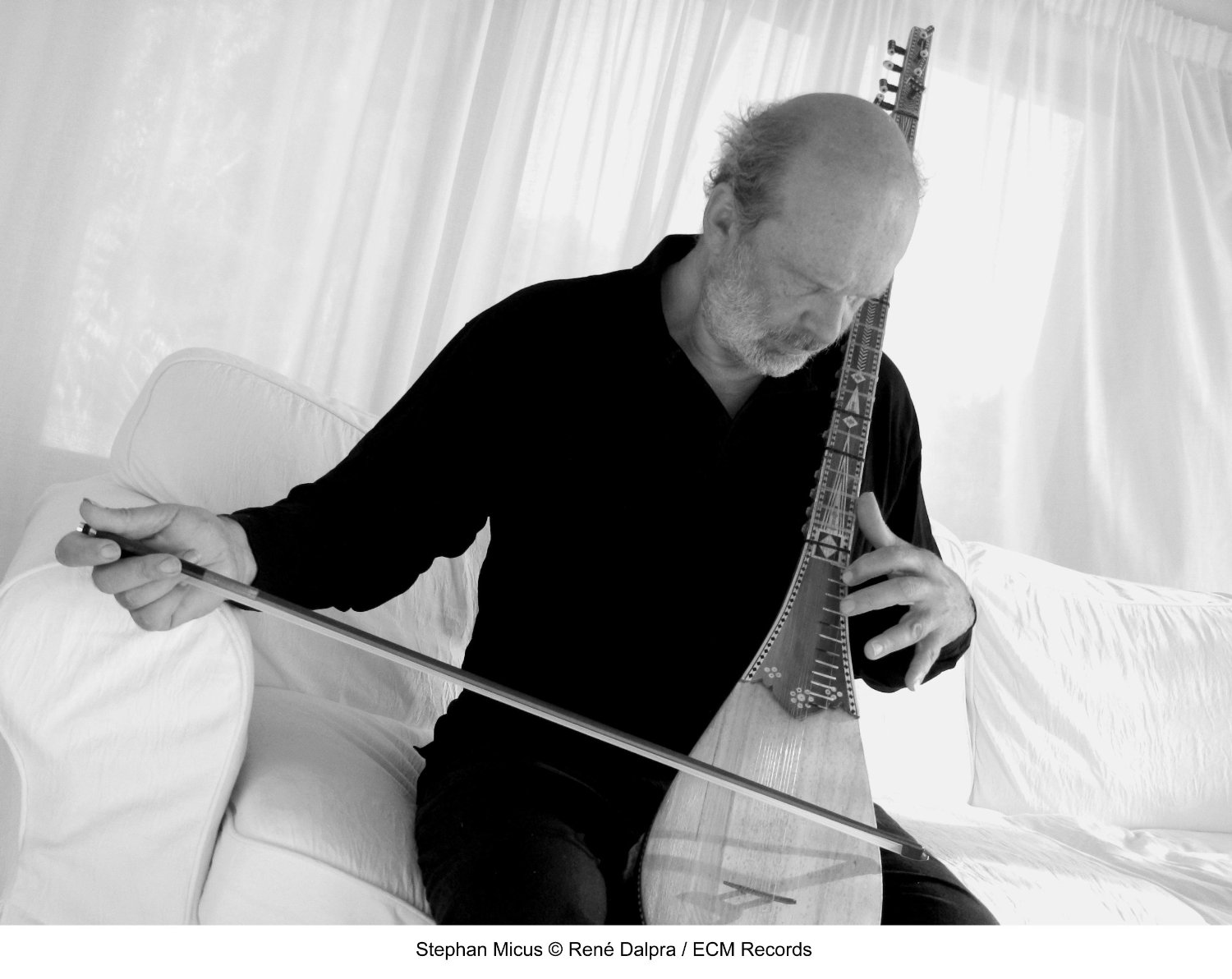
Micus 2

The rebec-like sonority of 3 sattar in “You are like Fragrant Incense” (3 sattar) adds new timbres to Micus’s sound-world. With only their wordlessness to reckon with, the listener can feel their shape in a performance that travels like a pheromone: just below the radar of perception yet overflowing with connectivity. Whether doubled and joined by 2 Chitrali sitar in “You are Full of Grace” or with one sitar and 6 dilruba in “You are the Life-Giving Rain,” their topographical consistency attends to every leaf and branch and reveals the love necessary for self-enclosure. In a different stroke, both “You are the Treasure of Life” and “You are a Shining Spring” engage the same instrumentation of Tibetan chimes, Burmese temple bells, Zanskari horsebells, and 2 dilruba. The contrast between bell dust and dilruba soil mirrors that between sleeping and waking.

If pressed for a comparison, I would say that Panagia resembles Japanese classical gagaku in its arrangement and color, even if it is devoid of gagaku’s exclusivity. Rather, it makes of this big blue ball a royal court where we live not as servants but as purveyors of destiny. Its play of light on reflective surfaces makes it one of the best-recorded albums in the Micus catalogue. It is the meta-statement of a meta-statement, an expression of Gaia through cycles of human thought.

(To hear samples of Panagia, click here.)

Back, and here to stay

For those of you wondering where I’ve gone, and especially those who so kindly inquired, I just want to assure you that I’ve officially returned to my labors of reviewing love. As longtime readers will know, by day I’m pursuing a Ph.D. in Japanese Literature at Cornell University, and in that guise I’ve spent the better part of two months working on a rigorous and possibly career-defining fellowship application to conduct dissertational research in Japan. Now that said application is finished and has been submitted, I can return both to my academic and musical ramblings with renewed vigor. Onward I go.

Jordi Savall: A Melancholy Rose

Jordi Savall
(Photo credit: Molina Visuals)

On 24 January 2003, I witnessed a vibrant soul at play on Vienna’s Konzerthaus stage. Leading La Capella Reial de Catalunya and Le Concert des Nations in a program of madrigals and sinfonias by Claudio Monteverdi, Johann Hermann Schein and Samuel Scheidt, Jordi Savall’s performance was everything the music was: thrilling, captivating and, above all, inviting. On April 15, hunched over his bass viol (the fretted, cello-like instrument of which he is a legendary virtuoso) and accompanied by soloists from Le Concert des Nations, I saw a changed man—a man playing for himself, as if into a mirror.

It was more than a little surprising that, from a musician who boasts nearly 200 recordings, we should encounter such a pedantic program. Composers Jean de Sainte-Colombe and protégé Marin Marais were surely familiar to anyone who has at least glanced at Savall’s 40-year career, which broke international waters when he provided the soundtrack for the 1991 film Tous les Matins du Monde, a dramatization of Marais’s relationship with his reclusive teacher. By far, the musical offerings from those masters of the instrument were highlights of the evening’s performance. Sainte-Colombe’s brooding Tombeau les Regrets was a rare chance to hear Savall in duet. The sound of two bass viols alone was nothing short of transportive. Even the leading violin of Marais’s Sonnerie de Ste-Geneviève du Mont-de-Paris, an inventive piece meant to evoke the din of church bells, could do nothing to undermine their resonance.

The same could not be said for the rest of the program, which distilled unremarkable background music from some of the biggest names in the 17th-century French Baroque. Anonymous selections from the era of Louis XIII set the tone for the program’s theme, which sought to articulate the splendor of the French Bourbon court. And yet, what began as a royal affair settled into what felt like a glorified rehearsal. This was not only because of the awkward staging (the musicians were, for instance, left floundering without assistance when a music stand broke), but also because court music was for the most part incidental and not designed to be heard out of context. And so, whatever stateliness might have infused its origins, this music came across not as regal but as dolorous. This rendered the listening experience both intriguing and depressing. While on the one hand we could feel ourselves traveling back in time, on the other it reminded us of the transience of power and arbitrariness of kingly life. It was like hearing history crumble before our very ears, leaving only a handful of extant sonic monuments to an unrecoverable age. Even the jewelry of violin and flute seemed to harbor shadows of doubt. It was a strange thing: this music would not have existed without the power structures that engendered it, but its occasional beauties spoke of realms far beyond any artifice of courtly refinement.

From a curatorial perspective, missed opportunities abounded. For one, there was no chance to hear the unaccompanied solo viol, and two duo miniatures by Antoine Forqueray and his son Jean-Baptiste were etudinal at best, further diluted by a superfluous keyboard backbone. Despite father Forqueray being once called by Savall “a knight who is always on the verge of working his horse to death, but who knows his horse too well to go quite that far,” there was little proof of concept. For another, to be in the presence of renowned harpsichordist Pierre Hantaï, only to find him relegated to a continuo (i.e., supporting) role was curious, even if we did hear some of his brilliance come through in three selections from Jean-Philippe Rameau’s 1741 Pièces de Clavecin en Concerts. Yet with so much rich keyboard literature to choose from among the likes of Rameau and François Couperin, I couldn’t help but scratch my head over the latter’s Les Concerts Royaux, of which the three sections played were like the courtiers they were meant to entertain: passive and overdressed. (Far more active, though no less dressed, was the suite from Jean-Baptiste Lully’s 1670 Le Bourgeois Gentilhomme, after which the musicians were, for once, visibly satisfied.) Why not choose from something more suitable for a live setting, such as Couperin’s 1728 collection of suites for viol? Likewise, the inclusion of Jean-Marie Leclair’s Sonata in D Major, Op. 2, No. 8 was apocryphal at best, especially when one considers the lack of any credible evidence suggesting that Leclair even played at the court of Louis XIV. Why not instead bring another violinist and play the far more mature fascinations of his Opus 5?

In light of the fact that Savall has become increasingly known as an artist of difference, weaving together wide-ranging faiths, histories and spiritual threads through the loom of his musical vision, perhaps there was too much similarity. In the end, the playing, while effortless, was self-contained and the virtuosity incidental. And while one may never fully see into the heart of another, it was impossible to watch Savall and not mourn for him. Since facing immeasurable personal tragedy in 2011, we may only speculate about the depth of his loss and stand in awe at his creative resolve. Having recently lost someone close to me, I am admittedly primed to give such a reading, but I couldn’t help but feel the melancholy rose of his heart wilting just a little under the spotlight. It made me want to hear him play alone, if only to let that heart sing without obstacle, so that it might throw open a window into its own unrecoverable past. With this realization—or projection, if you will—in tow, I left the concert hall berating myself for the above criticisms and share them here only in the interest of full disclosure. It was a sobering reminder that there is far more to gain in this world than there is to lose. And at any rate, the world has gained so much from Savall already that one mere lackluster performance will leave no dent in his legacy.

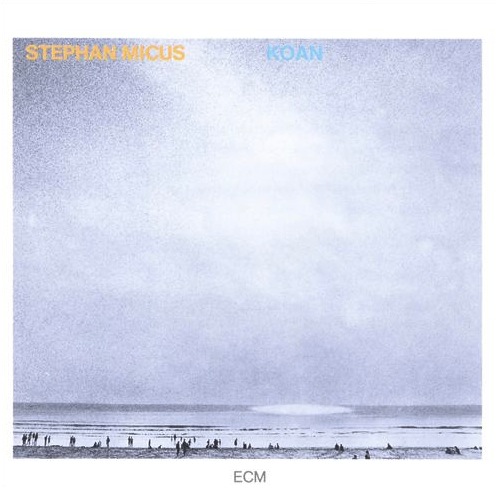
Stephan Micus: Koan (ECM 2305 804 SP)

Koan

Stephan Micus
Koan

Stephan Micus shakuhachi, zither, gender, sarangi, rabab, bodhran, angklung, kyeezee, Burmese bells, guitar, voice
Recorded 1977 in Cologne
An ECM Production

Wayfaring multi-instrumentalist Stephan Micus began his ECM journey with this five-part album of characteristic rituals, now digitally restored for posterity. The Zen Buddhist kōan, often misunderstood as a riddle without answer, is more rightly experienced as a path to openness, and it is this path that Micus has walked since he first committed his sounds to disc. In denying an effect for every cause, the kōan opens both the questioner and the questioned to the possibility of possibility—which is to say, beyond the duality of things. Like the music contained on this eponymous recording, it is not meant to be solved but discovered for what it is. Micus’s music is thus an ongoing kōan, for despite the fascination of his array and technical adjustments thereto, an awareness of infinity prevails.

If we discover anything from the shakuhachi solo that is Part I, it’s that Micus’s unaccompanied sojourns are as multitudinous as his multi-tracked assemblages are singular. For while that hollowed stalk of bamboo, itself a voice without breath, finds accompaniment in the form of zither, gender (Balinese xylophone), and guitar in Parts II and V, in those group settings it feels more like the reflection than the reflected. Each instrument embodies one element in an organic picture, leaving the unsung song to trace its slow-motion arc across the sky, a comet on its way toward slumber. In the final wave, the zither offers itself percussively: the string as skin. Micus’s breath, simple and serene, meanwhile blots the torch of every star until the darkness becomes an expression of light.

Parts IIIa and IIIb feature the rabab—an Afghan lute, which sounds like a resonant shamisen and has both rhythmic and melodic functions—and the deeper sarangi. A translucent shakuhachi marks the first half, but gives way to a Mongolian-influenced sound, scraped like barnacles from the earth’s crust. This leaves only Part IV, in which Micus sings over a congregation of Burmese bells.

In this sound-world, instruments never compete. Nothing “solos,” per se, but coheres by means of an undying spirit, to which only the master musician may attend through a lifetime of rare creation. As one of Micus’s most meditative sustains, Koan enables a microscopically visceral experience that is forever new because it is the very picture of regeneration.

John Surman: Saltash Bells (ECM 2266)

Saltash Bells

John Surman
Saltash Bells

John Surman soprano, tenor and baritone saxophones, alto, bass and contrabass clarinets, harmonica, synthesizer
Recorded June 2009 and March 2011 at Rainbow Studios, Oslo
Engineer: Jan Erik Kongshaug
Produced by John Surman and Manfred Eicher

Saltash Bells expands multi-reedist John Surman’s ECM cartographies in directions that are at once new and familiar. The album marks a return to the solo projects that so distinguished his contributions to recorded art in the 80s and 90s. Originally conceived as the soundtrack for a documentary on the English West Country that fell through the cracks, the music evolved from memories of Surman’s childhood in Devon, of which the local environs are cued by track titles throughout.

JS

Despite the fact that Surman’s solo efforts are known for incorporating—seamlessly, I might add—the technological adornments of synthesizers and digital delays, there’s always a taste of soil about them. Take, for instance, “Whistman’s Wood,” which opens the program with a program of its own in the form of pulsing, electronic signals beamed across a vista tilled by bass clarinet. An ancient spirit works the land, lifting arpeggios from their graves and animating them in such a way that respects their ability to sing. All this before Surman’s baritone proclaims its inner heart and unfolds it as a map for the journey to follow. Guided by a comet’s tail of soprano, he proceeds into the lonesome yet unbreakable bass clarinet of “Glass Flower.”

On the low reeds Surman is unmatched. His bass clarinet hovers as a sagacious presence over the oceanic currents of “On Staddon Heights” until a soprano joins in the swim, caressing every bubble to ensure it doesn’t break on the way to the surface. The same pairing ends the album with “Sailing Westwards,” further augmented by an exclusive appearance of harmonica. Aquatic textures also pervade the title track, which immediately follows “Ælfwin,” a robust yet lacey baritone solo. Between this and “Dark Reflections” (an unaccompanied piece for soprano), one can chart a defining contradiction of Surman’s playing: the higher the reed, the darker the sound, and vice versa. And in the solos especially, listeners can encounter the naked, self-directed nature of his writing.

The small congresses of “Triadichorum” and “The Crooked Inn” nevertheless pack visceral effect, rounding out one of Surman’s finest to date with the assurance that he still has decades more to say.

(To hear samples of Saltash Bells, click here.)

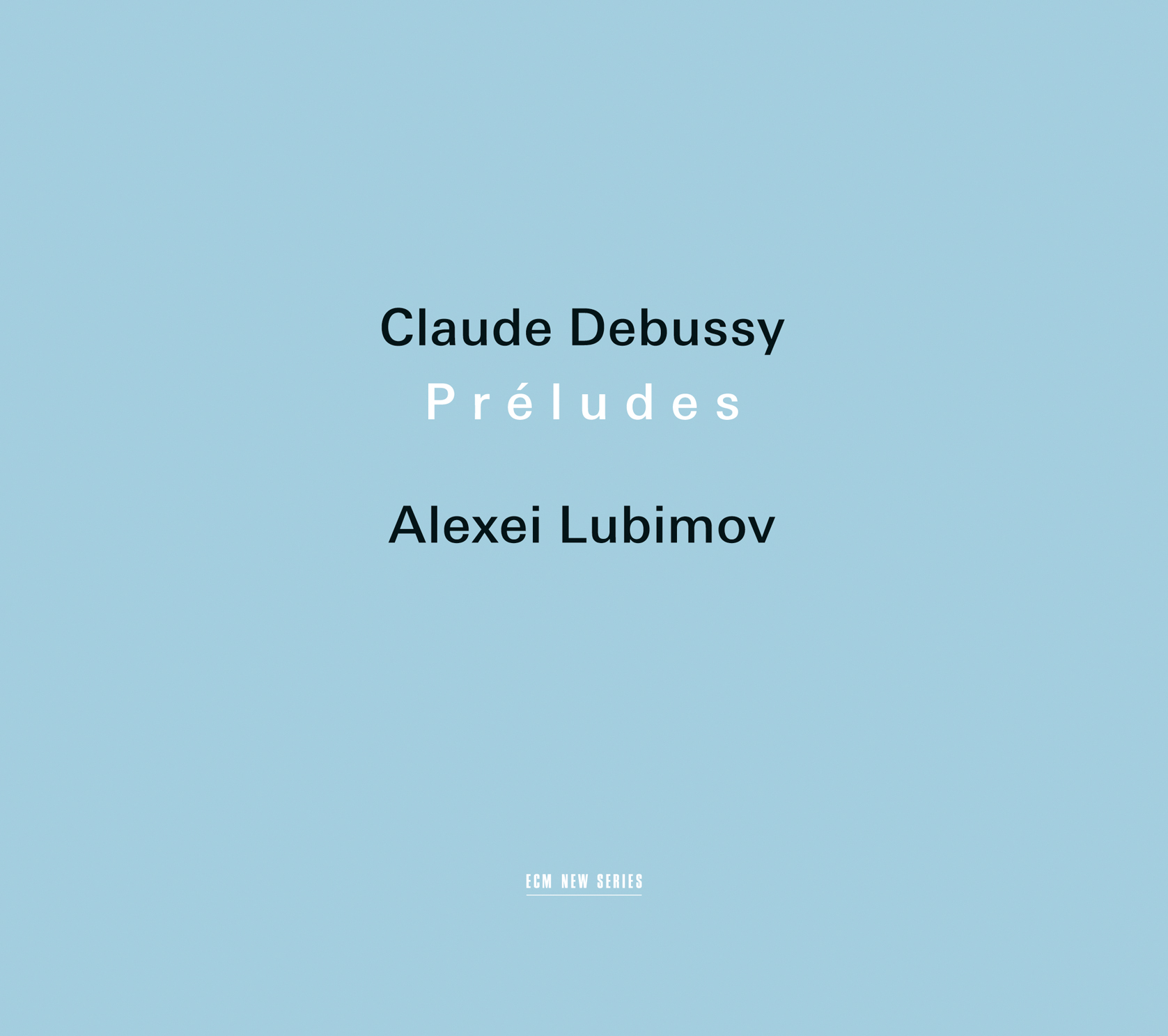
Claude Debussy: Préludes (ECM New Series 2241/42)

Préludes

Claude Debussy
Préludes

Alexei Lubimov piano
Alexei Zuev piano
Recorded April 2011, Sint-Pieterskerk, Leut, Belgium
Engineer: Peter Laenger
Production coordination: Guido Gorna
Executive producer: Manfred Eicher
An ECM Production

My shadow glides in silence
over the watercourse
[…]
A glow arises in my breast,
the one mirrored in the water.
–Federico García Lorca, “Debussy”

Though unconventional in form, the two books of piano music known as Claude Debussy’s Préludes have withstood the test of time by means of their structural integrity and ordering—or, in the latter case, their lack thereof. For while their collective title conjures the well-tempered catalogs of composers as divergent as Bach, Chopin, and Shostakovich, in practice they bear little resemblance to those 24-part pantheons of keyboard literature. Whether by the descriptive titles famously appended to the ends individual pieces or by the fact that Debussy never intended for them to be played as a unified set, one can see that the Préludes were built as agents of a creative mind for whom fragments were worlds unto themselves. On the latter note, it’s easy to see why Debussy’s sound has so often been misconstrued as “impressionistic,” when in fact it was more closely aligned to the assured stroke of a pen than to the fleeting contact of a paintbrush. With such knowledge held firmly in mind, Russian pianist Alexei Lubimov roulettes the sonority of these emotionally charged miniatures by recording Book I on a 1925 Bechstein and Book II on a 1913 Steinway—the logic being that such instruments might better express Debussy’s own envisioning of how they should be played. This decision brings about surprising color shifts and, somehow, a keener feel for the rhythms therein.

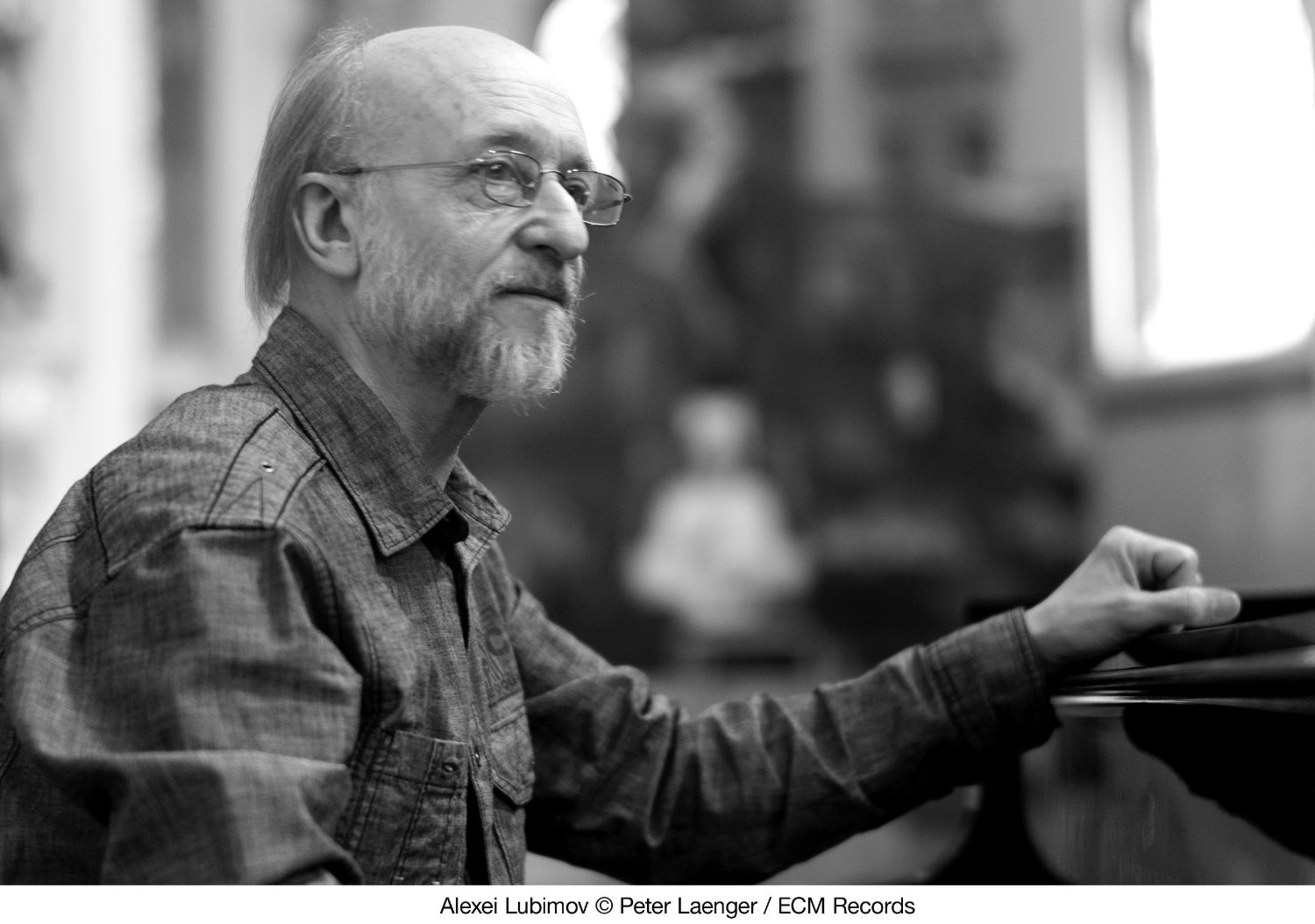
Lubimov

Book I, composed between 1909 and 1910, opens and closes with touches of cabaret, balancing the sweep of Debussy’s pastoral vision with “pingbacks” of striking modernism. Between them is nothing so dramatic as to bog down the listener’s response, so that even the most provocative spirals—viz: “Le vent dans la plaine,” “Ce qu’a vu le vent d’ouest,” and the flamenco-inspired “La sérénade interrompue”—seem but compressions of the more typified mysteries of “Les sons et les parfums tournent dans l’air du soir” and the echoing passage of “Des pas sur la neige.” Even the sportive “Les collines d’Anacapri,” while exuberant enough, only reinforces the reflective heart of this music. Nowhere do these two ends of the spectrum mesh so democratically than in the “La cathédrale engloutie,” which drips from Lubimov’s fingers like the anointing perfume from Mary Magdalene’s alabaster jar. Cutting across their timeworn densities, Lubimov lets those block chords sing with ecumenical clarity and hits that fated low note with perfect pressure.

Through this “inside-out” approach, Lubimov nurtures a sustainable ecosystem from Debussy’s already-organic notecraft, thus clarifying the bas-relief of Book II. Composed between 1911 and 1912, its elemental pathways range from watery swirls (“Brouillards,” “Ondine,” and “Canope”) and flowering dances (“La puerta del vino” and “Feux d’artifice”) to downright Bartókian diversion (“General Lavine – excentric”) and sweeping intimacies (“Les fées sont d’exquises danseuses” and “Bruyères”). A note-worthily deep point coheres around “La terrasse des audiences du clair de lune,” the exposition of which calls forth the composer’s opera Pelléas et Mélisande as if it were a lucid dream.

In addition to the Préludes, Lubimov’s student Alexei Zuev joins his teacher to traverse piano versions of two of Debussy’s most beloved orchestral works. Maurice Ravel’s transcription of the Trois Nocturnes cuts a tree of plaintive ornaments, swaying to increasingly fervent winds toward the final “Sirènes,” wherein seeps 11 minutes of nutrients for roots stretching far into the interpretive histories of those on either side of the score, the undercurrent of which teems with an oceanic abundance of life. To finish, the duo benchmarks Debussy’s own transcription of Prélude à l’après-midi d’un faune with a performance of such scope and vision that one need no effort trying to imagine the landscape burgeoning beneath its 20 fingers.

Kurtág/Ligeti: Music for Viola (ECM New Series 2240)

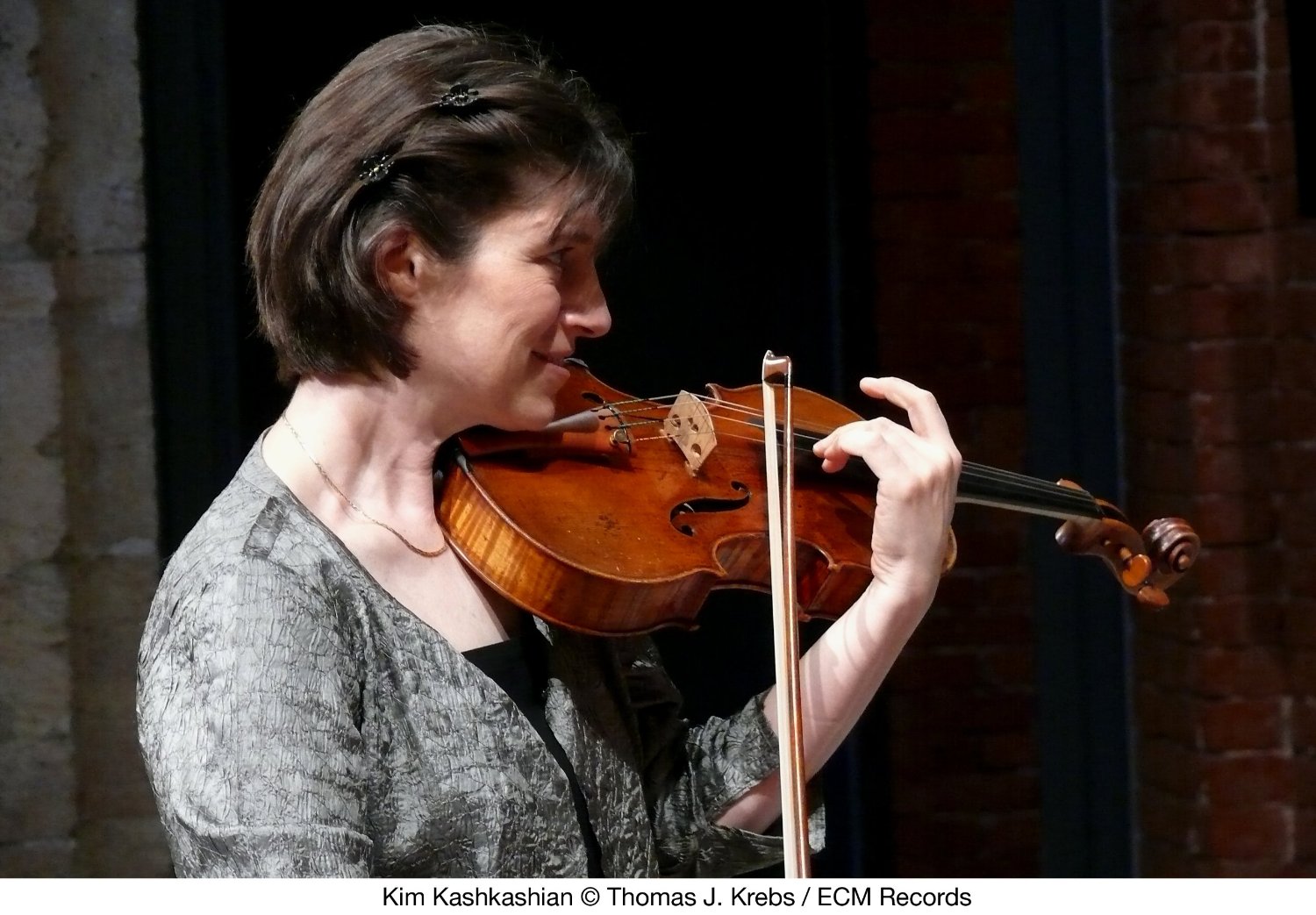
Kashkashian KL

Kurtág/Ligeti
Music for Viola

Kim Kashkashian viola
Recorded May 2011 at Propstei St. Gerold
Engineer: Peter Laenger
Produced by Manfred Eicher

Two Györgys, Kurtág and Ligeti, are subjects of violist Kim Kashkashian’s adventurous solo program—“adventurous” because the music steps bravely out into the open, absorbing the elements as they come: wind, water, earth, fire, and air, but also mineral, animal, and vegetable. The end result begins an experience which, if handled with time and care, is sure to grow with the listener in ways only the most intimate albums can.

Kashkashian

Kurtág’s Signs, Games and Messages is an ongoing project begun in 1989. Instigated by the composer’s usual insistence on note integrity, these pieces divide like cells in a colony toward a body that will likely never walk upright. It is, rather, content to slither and percolate into mental corners both dark and delightful. Though characterized as a master miniaturist, Kurtág is more the scientist whose microscopy reveals terrains not audible to the naked ear without intervention of ink and staves. Bound to an honest, exploratory spirit, Kurtág charms in the purest sense of the word, combining thought and action through a system of articulation that is only magnified by Kashkashian’s dynamic readings thereof.

An introductory “In Nomine” widens the scope of possibilities from the earliest stirrings. It slides and swivels like a Rubik’s cube without a solution but which finds language hidden in every manipulation. The pieces that follow don’t so much have beginnings and endings as they do openings and closings. This gives them a three-dimensionality, forged at the intersection of an inner space the musician might enter, an outer space from which she might shut herself away, and a sense of time that meshes the two. Details emerge in literary fashion—which is to say, by the scrawl of a writer’s instrument. The most frenetic passages swirl behind closed eyes, manifesting in their destined form before emerging on the open page. The notion of the solo performer as one who interacts as much with herself as with the music finds itself multiply confirmed by a tactility that only Kashkashian can bring to her instrument. Even at points of least resistance, she remains aware of the skin at hand, scars and all.

That Kurtág and Ligeti were lifelong friends may not be so obvious based on their compositional output alone, but through this recording one may locate an affinity that goes beyond the mere juxtaposition of their works. For while Ligeti’s masterful Sonata for viola solo (1991-1994) would seem a more constructed organism, its veins guide a likeminded bloodstream between inhale and exhale. The opening “Hora lungă,” modeled after a traditional lament, is played exclusively on the viola’s C string. Kashkashian deftly handles the timbral subtleties required to bring it to life. She bends notes at the cusp of their chromatic defaults, warping them like the convex surface tension of a fully filled glass. After the candle’s flicker that is “Loop,” the ashen “Facsar” revisits the psychological vessel in which the sonata began, only now with the addition of double stop harmonies and thus a feeling of ceremonial craftsmanship. The fourth movement, marked “Prestissimo con sordino,” is an energetic afterimage, but also preludes the fifth movement, a “Lamento” that works muscles of mystery in the finish before the final “Chaconne chromatique” parts the darkness to reveal a lantern’s glow. Though tense and sinuous, it feeds its own melancholy by taking a step forward to contain the shadows.

This album’s earning of a Grammy Award for Best Classical Instrumental Solo is proof enough of the wonders of its performance, program, and production. But neither award nor accolade can express Kashkashian’s embodied art better than the recording itself. It’s a truth that comes out only in the listening, so that even these words, as I write them, turn to smoke in the firelight of experiencing it for yourself.

(To hear samples of Music for Viola, click here.)

The Gurdjieff Folk Instruments Ensemble: Music of Georges I. Gurdjieff (ECM 2236)

GFIE

The Gurdjieff Folk Instruments Ensemble
Music of Georges I. Gurdjieff

Emmanuel Hovhannisyan duduk
Avag Margaryan blul
Armen Ayvazyan kamancha
Aram Nikoghosyan oud
Levon Torosyan oud
Meri Vardanyan kanon
Vladimir Papikyan santur
Davit Avagyan tar
Mesrop Khalatyan dap, dhol
Armen Yeganyan saz
Reza Nesimi tombak
Harutyun Chkolyan duduk
Tigran Karapetyan duduk
Artur Atoyan dam duduk
Levon Eskenian director
Recorded November and December 2008 at Teryan Studio, Public Radio of Armenia, Yerevan
Recording producer: Levon Eskenian
Engineers: Armen Yeganyan and Khatchig Khatchadourian
Mastered by ECM at MSM Studio, Munich
Album produced by Manfred Eicher

The music of esoteric spiritual teacher G. I. Gurdjieff has been a lucid, if sporadic, touchstone of ECM set lists since Sacred Hymns, released in 1980. Keith Jarrett’s solo album was an appropriate place to begin such an association, as Gurdjieff’s inner melodies were made available to the outer world through the piano transcriptions of his student, Russian composer Thomas de Hartmann. Music was an integral part of Gurdjieff’s teachings, and much of his oeuvre of over 300 pieces came from a place unknown. The energy of his melodies molded the skeleton of its own sacred geometry, and to have an entire ensemble of musicians dedicating their musical lives to casting its patterns across the oceans is a gift, pure and simple.

On a mission of his own to nuance this romantic vision is Levon Eskenian, whose program draws from Gurdjieff’s experiences in lands where the instruments of this ensemble would have been heard in context, singing of the earth even while soaring above it. Eskenian and his talented musicians thus shine Gurdjieff’s light through the prism of the traditions he would have encountered as an itinerant (anti-)ascetic. There is an unmitigated sensibility at work in their extraction of the Armenian, Greek, Arabic, Kurdish, Assyrian, and Caucasian sources Eskenian heard echoing in Gurdjieff’s music. At last, we can experience them in interlocking contrast.

Four pieces link to cellist Anja Lechner and pianist Vassilis Tsabropoulos’s Chants, Hymns and Dances, the 2004 album which took Gurdjieff as starting point for improvisational pathways. Excepting the brightly inflected “Bayaty,” the present versions put the Armenian double-reed duduk at the center of the picture. The “Chant from a Holy Book” places three duduk alongside a single oud. Structured as a tagh, or Armenian sacred song, its cantabile enchantment opens the program at dusk. In comparison to the previously recorded reading, this one suspends itself, rendering the oud a current of wind beneath feathers. “Duduki” adds to this instrumental configuration the dap, or Persian frame drum. With such flexible tension in tow, the melody coheres by way of a mournful finality, even as it extends back toward infancy. Four duduk and one dap form the evocative palette of “Assyrian Women Mourners,” which is as cleansing as it is heart-wrenching.

Some tunes ply the trade of ancient dances. Two selections from Gurdjieff’s Asian Songs and Rhythms explore the ensemble’s percussive capabilities to the fullest. Combining Armenian motifs and spontaneous creation, they allow insight into the meta-level of it all: We can hear Eskenian hearing Gurdjieff hearing something in the world. Others, like the “Caucasian Dance,” draw from a rainbowed palette, relaying ecstatic flights and contemplative landings. Elsewhere, as in the “Sayyid Chant and Dance No. 10,” amalgamations of Greek, Sephardic, and Andalusian influences abound. In these compressions, the receiving body becomes a sheet of paper folded until its resistance as a single molecule can no longer be doubled.

The most transformative moments are reserved for the Kurdish tunes: a “Shepherd Melody,” played on instruments used by shepherds, and the “Atarnakh, Kurd Song,” which traverses continents in single bounds yet with a quiet dignity that feels as effortless as a cloud. At the heart of all this stands a “Prayer” played solo on the kanon zither. By its sounding a nameless portal opens, through which the hesitation of spiritual experience flees into the darkest corners of the mind.

In the album’s booklet, composer Tigran Mansurian describes a silence at the core of this music. Indeed, it moves to what Gurdjieff called the “swing of thought,” that unquantifiable rhythm by which flesh and spirit dance their eternal dance. These sounds are shadows of those movements, and in them is the key to a door, behind which glows the solace of another key.

(To hear samples of Music of Georges I. Gurdjieff, click here.)