Sinikka Langeland: Starflowers (ECM 1996)

Starflowers

Sinikka Langeland
Starflowers

Sinikka Langeland vocal, kantele
Arve Henriksen trumpet
Trygve Seim tenor and soprano saxophones
Anders Jormin double-bass
Markku Ounaskari percussion
Recorded May 2006 at Rainbow Studio, Oslo
Engineer: Jan Erik Kongshaug
Produced by Manfred Eicher

It is one of those nights
when loneliness stands with its back turned to everything
and its face frozen fast in the western sky.

“Starflowers” is both an apt name for Sinikka Langeland’s ECM debut and for the cast assembled beneath its canopy. The Norwegian vocalist and kantele (Finnish table harp) player welcomes trumpeter Arve Henriksen, saxophonist Trygve Seim, bassist Anders Jormin, and percussionist Markku Ounaskari for her original settings of verses by lumberjack-poet Hans Børli (1918-1989). Although classically trained, Langeland has nurtured a longstanding interest in folk music. This disc takes that interest into crucible, concentrating it into a melodic cosmology all her own. That Jan Garbarek was an early influence should come as no surprise, for the same mystical undercurrents that inform his own music are undeniably present in hers (refer especially to Mari Boine’s appearances with the saxophonist’s eponymous Group).

Sinikka
(Photo by Dag Alveng)

That said, Langeland is possessed of a voice and touch like no other. The latter, as fed through her five-octave concert kantele (different from the one pictured above) is striking enough to preclude the need for voice. Like the Japanese shō or Constantinople lyra, it’s one of those instruments that seems handed down from on high, left to sing of a homeland to which it can never return. It spins an earthy web as well, shimmering with the pliancy of water but the strength of trees. So preaches the album’s first song, “Høstnatt på Fjellskogen” (Autumn Night in the Mountain Woods), in which Langeland paints entire scenes with a caress of the strings, warping their sound to suit a dreamlike cast. It’s as if the words pull at her, and we hear their pull in every pitch-bent note. The forest is palpable.

Although Børli may rightly be considered a naturalist poet, he was not entirely unaware of the workaday world:

The earth seems to climb and climb,
Lifting into the sky.
Then suddenly there’s calm.
As when the elevator halts
Somewhere on the higher floors and
you take instinctively a backward step
to keep your balance.

Such analogizing only serves his commitment to the outdoors, where his imagery finds common home. Whether chipped away in “Saltstein” (Rock Salt) or emerging from the brushed snare and ghostly bassing of “Sus i myrull” (Whispers in the Cotton Grass) in Meredith Monk-like song-speech, a feeling of rootedness reigns. And in “Langt innpå skoga” (Deep in the Woods), a scrim of frost clings to Langeland’s raw voice, reflecting jazzier denouements from Seim and Ounaskari that speak of urban climes far in the distance.

“Stjernestund” (A Moment of Stars) and “Treet som vekser opp-ned” (The Tree That Grows Upside Down) take on a decidedly mystical air. Cosmic percussion in the one gives life through primal contact, while the other indulges in the power of progression. Both grow in tangled vines, fanciful yet sure as sun and sky. The scintillating quality never weakens. Like the titular instrument of “Den lille fløyten” (The Little Flute), its potential waits for the right person to come along and share it. Even stronger album highlights include “Det er ei slik natt” (It Is One of Those Nights), which features Langeland’s lone voice against the aurora borealis of Jormin’s harmonics, and “Elghjertet” (The Moose Heart), which tells of the same thrown steaming into the snow after a hunt. The heart is covered before the cutting of the carcass is done, left forgotten, cooling to crimson ice.

The album’s three instrumentals are sacred in their own light. “Sølv” (Silver) and “Støv” (Dust) explore likeminded ostinatos, glistening and true. The jazzier “Vindtreet” finds Langeland contributing wordless vocals as the band ventures into its freest territories settling into the quiet sheen and shimmer of strings. All roads, then, lead to “Har du lyttet til elvene om natta?” (Have You Listened to the Rivers in the Night?), where Seim’s soprano and Jormin’s bass embrace a rift of kantele in the rock. The river between them is at once artery and vein. The music builds with urgency, but looses every fish caught back into current. In the wake of their sudden departure, a heat distortion breathes like a church organ fading into sleep.

If you listen long to the rivers in the night,
listen long,
it is at last as if your soul
is mysteriously remembering its future.

François Couturier: Nostalghia – Song for Tarkovsky (ECM 1979)

Nostalghia

François Couturier
Nostalghia – Song for Tarkovsky

François Couturier piano
Anja Lechner violoncello
Jean-Marc Larché soprano saxophone
Jean-Louis Matinier accordion
Recorded December 2005, Auditorium Radio Svizzera, Lugano
Engineer: Markus Heiland
Produced by Manfred Eicher

“What kind of world is this if a madman tells you you must be ashamed of yourselves? Music now!”

So espouses Erland Josephson as Domenico in Andrei Tarkovsky’s 1983 masterpiece Nostalghia, of which this album by pianist François Couturier takes the name. Domenico is, in many ways, himself a musical figure. As the very madman he admonishes, one who shackled his family in their own home for seven years as protection against an imperfect world, he is constantly refolding his own psyche in a leitmotif of fixation, building reality from blocks of fanciful impulses, each more poetic than the last. Yet as Tarkovsky himself once averred, art exists only because the world is imperfect. Music thrives on insanity.

That said, the even keel of Nostalghia presents the listener with such an expressive compass that even the most elemental sound becomes a northward tug. Anyone who has followed Couturier’s ECM travels will know that he is a musician of many directions. From the taut classical forays of Poros to the border-crossing trio recordings with Anouar Brahem (see Le pas du chat noir and Le voyage de sahar), he is anything but predictable. Counting cellist Anja Lechner, accordionist Jean-Louis Matinier, and saxophonist Jean-Marc Larché among the present company, he darkens Tarkovsky’s blueprints with the press of every key until they are ashen with wayfaring.

The album’s outer circle is inscribed by way of “Erbarme Dich” from Bach’s St Matthew Passion, which seeds the opening and closing tracks by way of profound lament. In the absence of words, “Le Sacrifice” (Bach’s aria appears in the Tarkovsky film of the same name) holds on to the text of the moment. In the absence of the cross, one feels the intersection of piano and accordion as a sacrifice in and of itself. The feeling of decay is palpable—surely, if imperceptibly, approaching disappearance—as was Tarkovsky’s play of color and shadow. The concluding “L’éternel retour” unravels by way of piano alone. Like a lost entry from Vassilis Tsabropoulos’s The Promise, its hand closes the lid of a box that houses creative spirit. That the song bears dedication to Erland Josephson indicates Couturier’s attention to detail in paying tribute not only to the artist of interest, but also his brilliant actors and collaborators.

“Crépusculaire,” for instance, honors Sven Nykvist, Ingmar Bergman’s right-hand cinematographer (who also filmed The Sacrifice) and moves accordingly by the touch of Lechner’s picturesque bowing. Her feel for notecraft and harmony is matched only by her attention to atmosphere. Couturier blends pigments with charcoal-stained fingers, each a pontiff reduced to a smudge across gray sky as the accordion finds its peace in the waters below. The combination aches with dew, trembling on grass stems when the three instruments at last share the same breath in focus.

“Nostalghia” is for screenwriter Tonino Guerra, with whom Tarkovsky co-wrote the screenplay for that very film. It opens us to the affectations of the full quartet and takes its inspiration from Schnittke’s Sonata No. 1 for violoncello and piano. This gentle music is a wish turned into stone and laid in stagnant water. The most obvious dedication, “Andreï,” also incorporates the Schnittke. A steady pulse in the left hand frees the right to orbit the keyboard, while the accordion fits like wind to wing over barren plains of consciousness.

“Stalker” gives proper attention to Eduard Artemyev, who wrote the soundtracks for that film and Solaris, and meshes bucolic and hypermodern impulses in kind. Its impactful pianism gives up many relics, each more sacred than the last. Anatoly Solonitsyn, lead actor of Andrei Rublev, is the final dedicatee. With its allusions to the “Amen” from Pergolesi’s Stabat Mater, “Toliu” multiplies shades of night.

Although Couturier consciously avoided the evocation of specific Tarkovsky scenery (this is more than a concept album), the feeling of pathos is so visual that one might as well be watching a film by the great director. The pianism shines like the water so prevalent in Tarkovsky’s cinema, if not swimming among many artifacts strewn below the surface. And in any sense, Couturier is very much the director of all that one hears throughout the program, as borne out most directly in the freely improvised “Solaris I” and “Solaris II.” In these the soprano saxophone turns the sun into a pilot light, and the world its oven, even as the rest of the ensemble hangs icicles from the eaves. Still, the overall effect is more literary than filmic, picking up words and turning them into actions that grow with listening.

“Ivan” references Ivan’s Childhood, Tarkovsky’s first feature. Its declamatory beginning spawns an almost theatrical feeling in distorted fairytale gestures before the quartet rejoins to finish off strong. In the wake of such confluence, Couturier’s solo “Miroir” wipes the slate clean, leaving superbly engineered ambience as the only evidence of an inner world to be discovered. Each step taken on this Escherian staircase walks a path of light.

Perfection may be an impossible ideal, but this album almost touches it. It’s a sheet of paper curling into its own insecurity for want of inscription. Don’t let it slip through your fingers, no matter what kind of quill you wield.

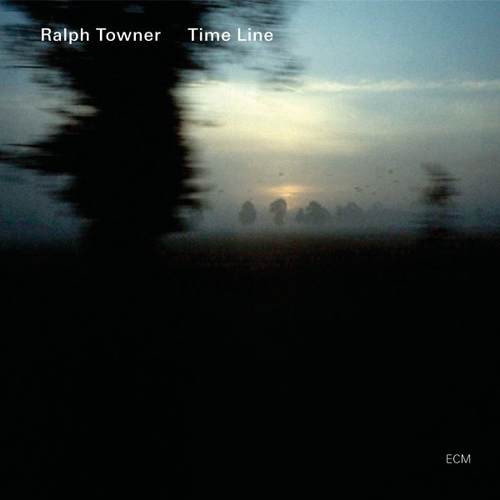
Ralph Towner: Time Line (ECM 1968)

Time Line

Ralph Towner
Time Line

Ralph Towner guitar
Recorded September 2005 at Propstei St. Gerold, Austria
Engineer: Markus Heiland
Produced by Manfred Eicher

Ralph Towner has left many indelible fingerprints along his trail of solo guitar albums, yet none so transcendent as by the acoustics of St. Gerold. The Austrian monastery has long served as recording venue of choice for the Hilliard Ensemble and other ECM New Series acts. The magnification engendered by its architecture serves only to bring out the expanse of Towner’s jazzier vocabulary, which somehow comes across all the more intimately. Exhibit A: “The Pendant.” Its lilting chromatism patterns itself like breathing, dripping just as involuntarily from Towner’s hands. Its reflective classical guitar evokes a veritable photo album of places and faces. Towner traces the flurry of sunlit arpeggios that make up his “Oleander Etude,” for instance, back to memories of Sicily, where oleanders grow in plenitude by the roadside, recreated here by the piece’s traveling speed. Other Sicily-inspired pieces are “Anniversary Song” (written for his wife, actress Mariella Lo Sardo), “Turning Of The Leaves” (written in collaboration with singer Maria Pia De Vito), and “The Lizards Of Eraclea,” which despite its evocative title has little at all to do with lizards. In contrast, “Always By Your Side” takes direct inspiration from Shakespeare’s The Tempest, for a production of which Towner once wrote it as incidental music—although, as he recalls, it feels more like Broadway than Elizabethan theatre. Like so much of the disc, it takes on its own life, dripping sweetness into the ear even as the heart proclaims it within. Whatever the original associations might have been, the truth of these pieces begins here.

Whereas Towner often allows for improvisation, “The Hollows” is through-composed. Its warped harmonies cohere by a strange geometry, which by the end reveals itself to be balanced and assured. “Five Glimpses,” on the other hand, is a collection of entirely improvised vignettes that arose during the recording process. Each is a window into Towner’s mind at work and switches from diaristic meditation to tense poetry at the drop of a pin. The final glimpse is all of 25 seconds of finger tapping, as magical as it is fleeting. Somewhere between the two is “If.” Towner interprets it as a self-contained call and response, whereby the language of the piece emerges through melodic parthenogenesis. Indeed, its shape is almost helical, a strand of DNA floating through its own dream on a cloud. Even as one of the busier pieces of the set, it wants not for breathing room.

“Come Rain Or Come Shine” is one of two standards on the album once favored by Bill Evans, an early influence on Towner. This one, by Harold Arlen (most famous for “Over the Rainbow”), is another nimble turn from Towner, who carves through it a maze with many solutions. The other standard is George Gershwin’s “My Man’s Gone Now,” which, like Towner’s chromatic “Freeze Frame” that precedes it, is played on the 12-string guitar. Both pieces employ a nonstandard tuning that inks the waters. From the Gershwin especially, it teases out a shade of blue hitherto absent.

With his usual solitary, tactile quality, Towner has created a real artifact in sound. Meticulously designed and played, its arching motifs and rhythms come across with photographic assurance, so that one may return to them time and again, knowing they will never change.

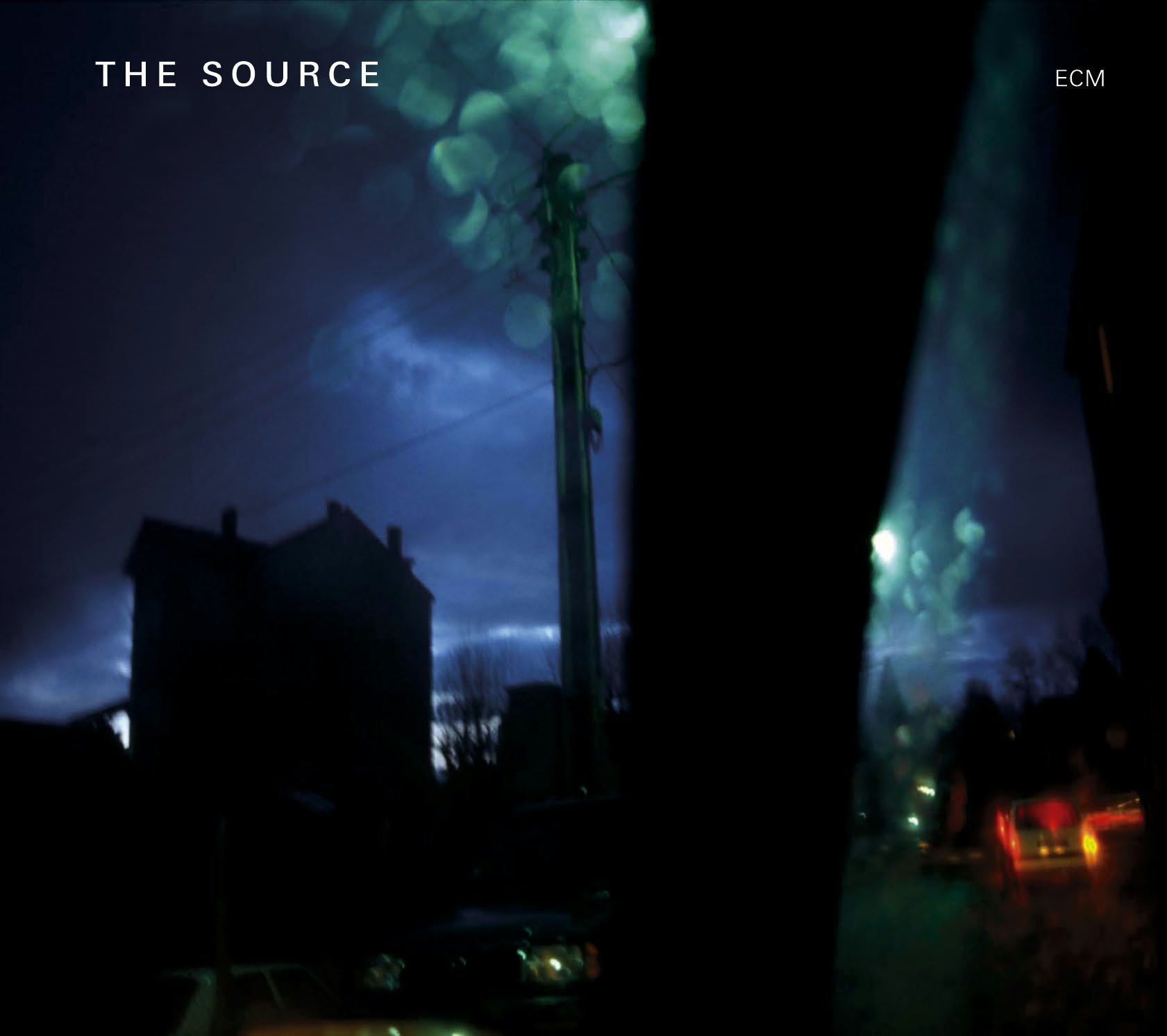
The Source: s/t (ECM 1966)

The Source

The Source

Trygve Seim tenor and soprano saxophones
Øyvind Brække trombone
Mats Eilertsen double-bass
Per Oddvar Johansen drums
Recorded July 2005 at Rainbow Studio, Oslo
Engineer: Jan Erik Kongshaug
Produced by Manfred Eicher

Trygve Seim offers a second helping of his eponymous group. True to form, the egalitarian collective redefines parameters, shedding the string quartet from 2002’s The Source and Different Cikadas and focusing instead on the Norwegian saxophonist’s core quartet with trombonist Øyvind Brække, bassist Mats Eilertsen, and drummer Per Oddvar Johansen.

The lion’s share of the writing comes from Brække, who embraces extremes of mood and register. Approaching the set list from the outside in, one encounters the slow burn of midnight oil in “Caballero” (the title, of course, a reference to Don Quixote) and, one layer in, “Water Glass Rhapsody.” Both tracks go down like cold coffee, Eilertsen either flying high or growling, tiger-like, in the depths of abstraction as the horns ready their wings. Deeper mining reveals more upbeat ends of the spectrum, as in the Johansen-centered “Alle Blå De Er.” The drummer, too, shows range in his “Tamboura Rasa.” Through misty cymbals, singing bass, and the crackling kindling of horns, this highly descriptive track paints itself one stroke at a time. Although Seim contributes a single tune (the kinetically astute “Un Fingo Andalou,” a play on Buñuel and Dalí’s 1929 masterpiece Un Chien Andalou), he often carries the full weight of the band in his bell, particularly in Brække’s “Prelude To A Boy.”

The Source furthermore pays tribute to the label it calls home. ECM’s output has been of lasting influence among the band members, and it shows. “Libanera” gives props to its composer, drummer Edward Vesala, in whose last group Seim played. To that fortunate collaboration he gives soulful deference, digging some of his strongest trenches yet. The rhythm section is aptly attuned to his stubborn prosody all the while. The trombonist’s other themes cross even more hatches. “Life So Far” means to evoke Keith Jarrett’s Belonging lineup and comes as a welcome surprise after the quicksand of the album’s first half (it’s also where Seim takes a match to his tenor and reveals the fire behind the smoke). The funkier “Mail Me Or Leave Me” might easily be mistaken for a Dave Holland joint, while the concluding “A Surrender Triptych” is an homage to the golden age of Triptykon. The band even references itself with the Johansen-penned “Mmball,” reprised from its appearance on Cikadas. The resolution of Seim and Brække’s slight dissonances into smooth becomings, in combination with the rhythm section’s lyrical sway, makes for some quintessential soundings.

This is music in primary colors that looks to light and shadow for variation, and crafts along the way a warm welcome for any who might chance to sit down for a spell and listen.

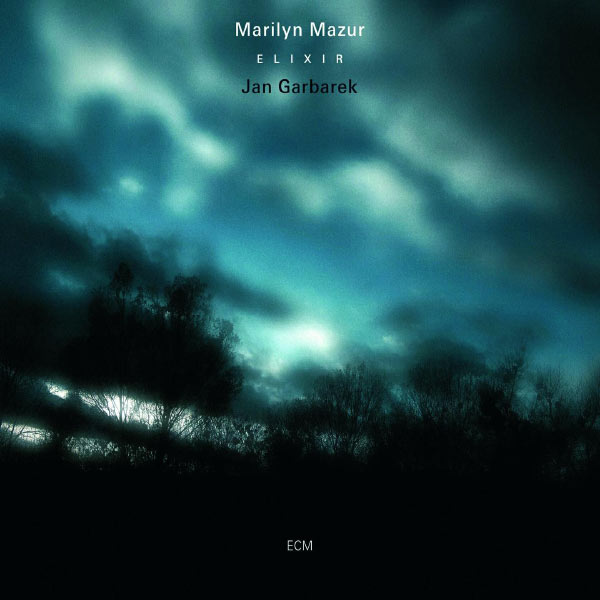
Marilyn Mazur/Jan Garbarek: Elixir (ECM 1962)

Elixir

Elixir

Marilyn Mazur marimba, bowed vibraphone and waterphone, hang, bells, gongs, cymbals, magic drum, log drum, sheep bells, Indian cowbells, udu drum, various drums and metal utensils
Jan Garbarek tenor and soprano saxophones, flute
Recorded June 2005 at Sun Studio, Copenhagen
Engineer: Bjarne Hansen
Produced by Manfred Eicher

As resident percussionist of the Jan Garbarek Group for 14 years, Marilyn Mazur enlivened every path set before her with dynamism and panache. On Elixir, she delineates her own compass and invites Garbarek on a journey of organic play, thus yielding a composite sketchbook of improvised solos, duos, and multitracked collages.

Each of the album’s 21 tracks is an iceberg’s tip. Only the penultimate “Winter Wish” exceeds four minutes, and with it the waterline. This and other such evocative titles as “The Siren In The Well,” “Mountain Breath” (which sounds like an eagle dreaming of a whale), and “Bell-Painting” afford imaginings for the wayward listener fortunate to wander into these territories. The latter title is especially appropriate, for Mazur is very much a painter whose palette is her instrument. From a kit that spans the globe, she chooses only the most appropriate pigment for each image. Be it the splash of a Chinese gong (cf. “Creature Walk” and “Talking Wind”), the pulse of hand on taut skin (“Mother Drum”), or the resonant metals of “Pathway,” she reverse engineers gold into its base components and treats each as if it were just as precious. Her solos speak to the heart because they speak to the earth: the two are one in the same.

Her duets with Garbarek both open (“Clear”) and close (“Clear Recycle”) the program. The Norwegian saxophonist’s rasp brings out the light of Mazur’s subterranean designs and with it illuminates their innermost dances. Colors reveal themselves accordingly in the sheer variety of instruments. Whether by hang drum or waterphone, cymbals or flute, their groove magnifies the great within: foot to earth as soul to sky. Through them run the ley lines of the plains, singing and free. Like the track from which the album gets its name, they feed an incantation of which verses come and go like clouds, if only to remind us that the sky above never goes away, for that is where we will go when our bodies bend over in silence.

Miroslav Vitous Group w/Michel Portal: Remembering Weather Report (ECM 2073)

Remembering Weather Report

Miroslav Vitous Group
Remembering Weather Report

Miroslav Vitous double-bass
Franco Ambrosetti trumpet
Gary Campbell tenor saxophone
Gerald Cleaver drums
Michel Portal bass clarinet
Recorded fall 2006 and spring 2007 at Universal Syncopation Studios
Recording producer and engineer: Miroslav Vitous
Assistant engineer: Andrea Luciano
Executive producer: Manfred Eicher

After the challenging yet ultimately rewarding experimentalism of Universal Syncopations II, Remembering Weather Report comes as a breath of fresh air for bassist Miroslav Vitous, who preens previously undetected feathers in this warped look back. Indeed, similarities to the titular fusion band with which Vitous once played (and which he co-founded with Wayne Shorter and Joe Zawinul) are glancing at best. Here that original band’s fiercely democratic approach takes on new hues as individual instruments click through the front line like a roulette of alter egos in the form of Americans Gerald Cleaver on drums and Gary Campbell on tenor, and Swiss trumpeter Franco Ambrosetti.

In addition, French clarinetist and new music advocate Michel Porter joins the quartet on half of the album’s six hefty tunes. His involvement unleashes the firmest successes thereof, as in an aching set of variations on Ornette Coleman’s “Lonely Woman” (the only track not from the bandleader’s pen) and “Surfing With Michel,” a spirited duet between Vitous and Porter that is the missing capstone to the core quartet’s great pyramid. Another set of variations on Wayne Shorter material finds the bassist shuffling between arco and pizzicato modes, all the while navigating a flurry of drums with a papercutter’s feel for negative space. A surreal and frenetic sense of control reigns, skipping with assurance.

The tripartite “Semina” is Vitous at his most honest, although this time Cleaver divulges heart and soul, inciting as he does calligraphic brilliance from Campbell and, in the concluding “Blues Report,” a swift kick to the stratosphere, where soars the album’s pièce de résistance, “When Dvořák Meets Miles.” Fine arco playing connects blats of muted trumpet, and all with a percussive finish that lingers sweetly on the palate. As ever, the interactions are subtle yet naked, each element brimming with snap, crackle, and pop.

Remembering Weather Report is not for the jazz tourist. Its highly evolved messages comprise a raw manifesto on what it means to be progressive in a regressive climate. Motifs run the gamut from static to ballistic, but quickly dissolve in favor of broader improvisational paths, each a vein to some distant thematic artery. The album is further notable for being recorded in Vitous’s own Italian studio. His direct involvement in not only the elicitation but also the rendering of these sounds lends remarkable immediacy to the space in which they unfold.

Tom van der Geld/Children At Play: Out Patients (JAPO 60035)

Out Patients

Tom van der Geld
Children At Play
Out Patients

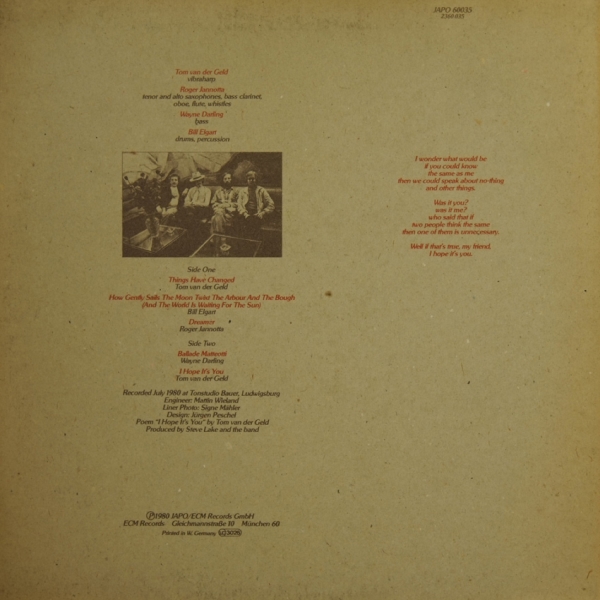
Tom van der Geld vibraharp
Roger Jannotta tenor and alto saxophones, bass clarinet, oboe, flute, whistles
Wayne Darling bass
Bill Elgart drums, percussion
Recorded July 1980 at Tonstudio Bauer, Ludwigsburg
Engineer: Martin Wieland
Produced by Steve Lake and the band

Was it you?
was it me?
who said that if
two people think the same
then one of them is unnecessary.

Well if that’s true, my friend,
I hope it’s you.

–Tom van der Geld

Vibraphonist-composer Tom van der Geld’s ECM initiation came by way of the JAPO sister label when, in 1976, the self-titled Children At Play introduced listeners to an album of uncompromising originality. Recorded in 1973, the same year of van der Geld’s permanent relocation to Germany (where the band’s reedman, Roger Jannotta, and drummer, Bill Elgart, would also find new homes), it’s a formative release not only for being Children At Play’s first, but also for sharing its uniquely sunlit sound with the world at large. Tropical and sweet, the album is a sparkling endeavor that favors the lived reality of jazz over its descriptive pitfalls. Patience (1978) was van der Geld’s first dip into ECM proper and stands out for its bright geography. This time, however, the tectonic plates shift more abstractly below with the heat of friction. The freedom of this sophomore effort offers plenty of room for the listener to find a story. On its heels came Path (1979), the phenomenal trio album with Jannotta and guitarist Bill Connors. Hewn in pastels rather than oils, it’s a decidedly softer and sometimes-haunting affair.

TvdG
(Photo by Peter Nimsky)

This brings us to 1980’s Out Patients, in which van der Geld closed the JAPO circle alongside the ever-versatile Jannotta (on tenor and alto saxophones, bass clarinet, oboe, flute, and whistles), bassist Wayne Darling, and Elgart on drums and percussion. Two of the vibraphonist’s compositions bookend the album, contrasting the free unity of “Things Have Changed” with the expressive rubato of “I Hope It’s You.” The first coheres into a loose brand of unity, the bass clarinet a noteworthy foil to van der Geld, who takes an early solo down a slippery slope yet maintains tactful balance within the rhythm section’s mosaic. The concluding tune finds Jannotta (on tenor) leading with truth. The reedman further contributes “Dreamer” for the listener’s fortunate consideration. It travels and unravels somewhere between starlight and sunrise, revealing a melodic core in Jannotta’s flute and Darling’s resonant bassing. The latter’s “Ballade Matteotti” awakens like a dawn chorus. Van der Geld describes so much of the image that, were his bandmates not so attuned, they might feel superfluous. Their ease of diction contributes to the group’s strength. Consequently, the music flips from intense to reflective at the turn of a phrase. Jannotta’s extended delivery in the second half is tour de force in the truest sense, for in it force prevails.

Yet nothing in the program surpasses Elgart’s “How Gently Sails The Moon Twixt The Arbour And The Bough (And The World Is Waiting For The Sun,” a tune as epic as its title, and one that adds some groove to the band’s loose equation. Smooth yet crisp, and brimming with a chamber jazz aesthetic, it explores a wide dynamic range, with a memorable midsection in which delicate utterances ripple through the quartet. Jannotta (now on alto) lends mystical qualities to the scene, finding scratchy-throated catharsis in the unfolding. Interpretive diffusions all around show a group becoming more unified the wilder it gets: proof that, at least in musical terms, letting go will sometimes be the key to being found.

Although Children At Play disbanded in 1981, its spirit lives on in these highly collectible recordings, as also through its leader’s commitment to jazz education. In the interest of making his mission known, below is an e-mail Q&A I conducted with van der Geld, who kindly shared his memories and thoughts. And for an exhaustive assessment of van der Geld’s career, plus a more extensive interview, check out Formosa Coweater’s fabulous article here.

Can you tell me about your musical background and about how you came to be a jazz musician?

Well, I come from a third-generation family of musicians, so I guess there is something hereditary here. I grew up in an environment where jazz was always being played or listened to. My parents had a “dance band” which played on weekends at officer’s clubs and private clubs. I played trumpet in that band for several years. Having been the world’s second worse trumpet player (!), I decided at age 21 to start playing the vibes. There was never really much of a choice regarding becoming a jazz musician. At one point, I did earn an engineering degree—mainly at the request of my father. Following that, I was devoted to music.

You seem to have followed in the footsteps of many American-born musicians who have found a musical home in Europe. Can you tell me what differentiates European approaches to jazz performance and pedagogy from their counterparts elsewhere?

The Europeans have, over the decades, developed a very special jazz signature. Significant input has come from English players like Kenny Wheeler and John Taylor. But throughout Europe there have been great players who have taken American music and blended it with their own particular cultural and musical expression. Names that come into mind would include Thomas Stanko, Jan Garbarek, Dave Holland and many more.

In the early seventies, there were very few schools in Europe with an adequate jazz curriculum. This is no longer the case. There are excellent jazz departments in many European universities.

Who did you count among your deepest musical influences when you began your professional career? Has that list changed since then?

As far as the vibes are concerned, my first influences were Lionel Hampton (the first LP I ever bought) and Milt Jackson (the first jazz concert I ever went to). When Gary Burton came to Albuquerque with his famous first quartet in 1969, I was completely blown away. Later I became one of his students at Berklee. Other important musical influences included Marion Brown, Ornette Coleman, Paul Bley, the Art Ensemble of Chicago, ESP, Archie Shepp, Eric Dolphy and Albert Ayler.

What role does teaching play in your musical life? What have you learned from your students?

I was fortunate to be able to teach and, in fact, to quite enjoy teaching. Teaching was also often the mainstay regarding things like paying the rent. And I have indeed learned very much from my students. The most important lesson: be open to questions and remain curious.

Each of the four albums you recorded for ECM/JAPO is distinct from the rest. How would you characterize their moods and styles? Is there an overarching theme that connects them all?

Those recordings are individually the result of circumstance and coincidence. There is no overarching theme connecting them. It was very rewarding to play with those great players/composers.

How has the experience of performing enhanced your understanding of jazz as an art form? Do you see jazz as an art form to begin with, or is it something else?

I don’t know: I never use the word “artist” when describing myself, and have never consciously considered these questions.

Who are you listening to these days?

Mostly piano players, with Bill Evans, John Taylor, Ahmad Jamal, Bud Powell and Art Tatum being on top of the list. I also listen often to “classical” music.

Your Ear Training textbook has enjoyed international success as a teaching tool. How did you come to write it? What did it mean for you to have Dave Liebman write its Foreword?

I had applied for a professorship at the Musikhochschule Köln (a school of music at the university level in Cologne). This must have been sometime during early 1994. Well, I didn’t get the professorship. They were, however, at that time looking for someone to teach the jazz ear-training courses. Since I had already been teaching ear-training at Berklee, they asked me to join the faculty. After a few semesters, I had produced a large amount of my own teaching materials. My subsequent method books are based on these materials.

I was extremely happy that Dave agreed to write the Foreword for these books: he is a player and teacher of great integrity for whom I have always had the greatest respect.

What is your best advice for aspiring jazz musicians?

Learn the science of our music (harmony) and develop your instrumental technique.

But NEVER forget: jazz improvisation begins and ends with your ears.

If you can’t hear it, don’t play it!

Out (Back) Patients
(Out Patients back cover)

Quercus review in RootsWorld

Another new review for RootsWorld online magazine. This one details the self-titled ECM debut of Quercus, a trio consisting of folksinger June Tabor, pianist Huw Warren, and saxophonist Iain Ballamy. Click the cover to read the article and hear a sample track.

2276 X