Jon Balke/Amina Alaoui: SIWAN (ECM 2042)

Siwan

SIWAN

Amina Alaoui vocal
Jon Hassell trumpet, electronics
Kheir Eddine M’Kachiche violin
Jon Balke keyboards, conductor
Helge Andreas Norbakken percussion
Pedram Khavar Zamini zarb
Barokksolistene
Bjarte Eike leader
Recorded September 2007 and March 2008 at Rainbow Studio, Oslo
Engineers: Jan Erik Kongshaug and Peer Espen Ursfjord
Mixed September 2008 by Manfred Eicher, Jon Balke, Amina Alaoui, and Jan Erik Kongshaug
Produced by Manfred Eicher and Jon Balke

“Siwan” connotes equilibrium. This album of the same name achieves equilibrium through many meetings and intersections: of Norwegian pianist Jon Balke and Moroccan singer Amina Alaoui (in her first ECM appearance), of Baroque and Andalusian musical idioms, of Sufi poetry and Christian mysticism, of dark ages and burning inquisitions. For this studio recording of resolutely live music, Balke doubles as keyboardist and conductor for a veritably intergalactic ensemble that includes Algerian violinist Kheir Eddine M’Kachiche, American trumpeter Jon Hassell, and Norwegian violinist Bjarte Eike’s period group Barokksolistene.

Like Alaoui’s seminal Arco Iris, this project is not a fusion of traditions. It is, rather, a deepening of common ground between them. A work of stunning originality, blending geographies into a single airborne continent, its ecosystem runs on ether. Like the solo violin buoyed by strings in the program’s introductory “Tuchia,” the whole flexes and ornaments itself organically. In that violin is a heartbreaking softness that conforms itself to all manner of densities in what follows. After such a fecund inauguration, it is no wonder that the first proper song, “O Andalusin,” should extol the natural wonders of Al-Andalus. Elegiacally described by poet Ibrahim Ibn Khafaja (1058-1139) as “the Eden of the chosen,” the paradisiacal wonders of its landscape shine forth. Harpsichord claws burrow into ocean floor even as Alaoui unfurls sails, hang-gliders, and other disembodied wings to catch every possible current. From burrowing to dislocation, traveler Abu Abdallah Al-Homai’di (1029-1095) yearns for that “faraway homeland” in his poem “Jadwa.” A filigree of percussion and lute illuminates the night as would gold leaf a sacred manuscript, audible tethers each between body and home. Alaoui’s voice wanders but holds its resolve so tightly to bosom that it slips into the ribcage, where it swings on a perch of belonging. She is positively flute-like in wordless moments, touching off M’Kachiche’s elliptical storytelling against a tense ostinato.

The words of Al-Mu’tamid Ibn Abbad (1040-1095), poet-king of Seville, strangely echo the deposition that would incarcerate him for the last five years of his life. “Ya Safwati” is a romantic verse, a profession of utter surrender to that universal captor known as love. This song fronts Jon Hassell’s signature vocality and falls like a curtain to reveal a bevy of percussion carrying Alaoui like a Sherpa across mountains of history. “Itimad” names the wife of Al-Mu’tamid Ibn Abbad, to whom he slipped this poem through the bars of the neighboring cell. “I am untamable yet you dominate me,” he professes, again echoing the power of emotion to conquer in soul what can never be conquered in flesh. Alaoui moves like a bow and finds herself accompanied by that very object, animated and free, across a burial ground of song. Troubador Martín Codax (13/14th century) is similarly lovestruck in his “Ondas do mar de Vigo,” only here the poet embodies a proto-female who laments the consignment of her loved ones to the Sea of Vigo, whose waves took many in the crusades.

Lope de Vega (1562-1635), a star poet of the Spanish golden age, delights with the phonetic play of “A la dina dana.” Here Alaoui parts the clouds by way of golden, celebratory light, setting up the instrumental contrasts of “Zahori” (featuring lyrical recorder playing in place of text), flowing with all the threat of a poisonous serpent, minus the fangs. The lute’s cross-cultural pedigree comes through most readily and beckons the singing of “Ashiyin Raïqin.” Penned by Abu Abdallah Ibn Ghalib Al-Rusafi (d. 1177), who in her liner notes Alaoui describes as a hedonistic writer, this painterly song indeed strips pleasure of its sin. “How lucky we are to find this spot for our sojourn / with doves cooing for our greater delight”: a sentiment within a sentiment, planted in a garden of mirrors.

Persian-born Sufi mystic Husayn Mansur Al-Hallaj (857-922), who suffered martyrdom on the cross for his profession of godliness and who was a beacon of inspiration for Rumi, outlines the manifold path to what Alaoui calls “a ceaseless transformation through vital alternation.” It is a state of fluctuating being in which the contemplation of silence, if not the silence of contemplation, gives way to discovery. A “stripping bare,” as the poet phrases it, an instinct without a door.

“Thulâthiyat” features Alaoui in narrative mode. She lays her speech on the sands like dry bones of an augury for the here and now. Caring neither for past nor for future, she drinks them for the illusions they are and expels them along with the sweat of the midday heat. Sunlit, too, is the verse-chain “Toda ciencia trascendiendo” (Rising beyond all science) of San Juan de la Cruz (1542-1591). This concluding piece is, in Alaoui’s estimation, one of the finest examples of Christian mysticism. Even without knowledge of text and translation, the present arrangement would have us know its secrets. Here there is a door, forged not of wood-flesh but of heart-mind, an analysis of slumber illuminated from within that records its footsteps for posterity before they are buried by wind and dust.

Alaoui’s melodic settings of these lyrics are so intuitive, it’s as if the notes preceded the words. In combination with the astonishing forces gathered around her, every turning of the tongue unspools a thread into the soul.

One of ECM’s finest releases. Ever.

(To hear samples of Siwan, click here.)

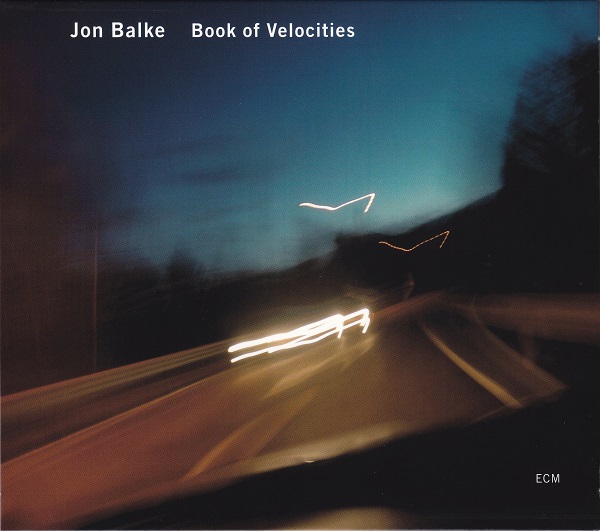
Jon Balke: Book of Velocities (ECM 2010)

Book of Velocities

Jon Balke
Book of Velocities

Jon Balke piano
Recorded September 2006 at Radio Studio DRS, Zürich
Engineer: Markus Heiland
Produced by Manfred Eicher

“We believe that mere movement is life, and that the more velocity it has, the more it expresses vitality.”
–Rabindranath Tagore

Tagore’s statement harbors an implicit question: Does vitality necessarily correlate with velocity? Wittingly or not, Jon Balke would seem to have an answer in this unique album. After a series of memorable appearances on ECM as sideman and group leader (notably, in the latter vein, with his Magnetic North Orchestra), we at last find the Norwegian pianist unaccompanied. The title alone is enough to place the music in a modern tradition of fragmentary collections: Bartók’s Mikrokosmos and Kurtág’s Játékok come most immediately to mind. Yet listening to what Balke has done with both form and instrument, one quickly realizes the profundity of his crafting.

Divided into four Chapters and an Epilogue, Book of Velocities extricates the finer implications of its elements—improvised and composed alike—via thorough examination of the piano itself. By way of introduction, “Giada” flutters between plucked piano strings and dotted punctuations at the keyboard proper. The descriptive cast of “Scintilla” that follows sets the stage for a procession of dreamlike actors, each a cipher for something elemental and transfigured. Other examples in this regard include “Single Line” and “Double Line,” “Gum Bounce,” and the nail-scratched mysteries of “Finger Bass,” the latter droning in Gurdjieff-like meditation.

Many pieces, like the penultimate “Sonance,” exert an organic influence of exhale and inhale, of speech and pause. Indeed, the deepest moments are those least audible, as in the non-invasive contact of “Resilience,” in which one finds the piano’s fantasy life made real. The bodily nature of the music thus shines at carefully selected moments of expression. Whether in the substrate of its own becoming or in the opacity of its outer skin, Balke’s language refashions grammar through every contour. In this respect, the poignant “Drape Hanger” is among the more precious turns of phrase and foreshadows the photorealism of “Scrim Stand,” undulating in real time.

The mirrors of this disc are more than reflective; they are embodied, a dance between beauty and blues. Slowly and surely, Balke turns paths of teardrops into channels of blood flow. This is his art distilled in a crucible of origins until pure feeling remains. It transcends the need for means and returns to the sky whence it came.

Nik Bärtsch’s Ronin: Holon (ECM 2049)

Holon

Nik Bärtsch’s Ronin
Holon

Nik Bärtsch piano
Sha bass clarinets, alto saxophone
Björn Meyer bass
Kaspar Rast drums
Andi Pupato percussion
Recorded July 2007, Studios La Buissonne, Pernes-les-Fontaines
Engineer: Gérard de Haro
Produced by Manfred Eicher

“A band should mature into an integral organism—then it is alive, like an animal, a biotope, an urban space.”
–Nik Bärtsch

With the release of its ECM debut, Stoa, Nik Bärtsch’s Ronin hit the air flying with its meticulous brand of Zen-funk. Two years and eons of experience later, we have Holon, the title of which reveals the band’s underlying ethos: that which is simultaneously part and whole. The beats of this sophomore studio effort are no less regular than those of their predecessor, but now there is something more unitary and, as Bärtsch himself observes above, downright biological going on. Such wording is no mere metaphor, but a lived reality helped along by the decidedly acoustic mix (only Björn Meyer’s bass is plugged), as well as by the fearless integration the group has honed over countless hours of playing as one.

“Modul 42” is where Ronin’s openness comes most explicitly into play. It is an aural body built around contrasting elements. Sparkle and shadow, peace and unrest, freshness and decay—all of these intermingle in recurring dreams, inflected slightly differently with each repetition. Here and elsewhere on the album, Bärtsch’s contact inside the piano reveals a percussive, resonant core less obvious in previous recordings: a staple of his performance style since.

“Modul 41_17” is the first of two transfusions, this one offsetting the same earlier Modul 17 that was dovetailed with 38 on Stoa. Set atop a spinning plate of two notes, Meyer’s contemplative spirals join with others in the fray, cohering into a veritable golem of groove. One can almost feel the platelets conjoining in renewed life as the elements shift and sway to the pulse of some physiological alterity, which marks by its upward chromatic swings the flexion of something divinely ordered. Bärtsch’s dampened finger tapping looses sonic sponges, which soak up all the surrounding water until nothing is left. The second pairing, “Modul 39_8,” is among Bärtsch’s most enchanting. A delicate chemical infusion, it strikes the ether as if it were a matchbook.

“Modul 46” is a blush of autumnal nostalgia that proceeds by delicate propulsions. From the enchanting pianism to the underlay of rhythmatists Kaspar Rast and Andi Pupato, Meyer’s rounded spine and reedist Sha’s tender pocket, this especially jazzy module builds to a luminescent peak.

Rhythmic stacking continues to be a leitmotif of Bärtsch’s vocabulary, and the corridors of “Modul 45” are noteworthy in this regard. Anchored by a rubbery bass and smoothed by interplay between piano and saxophone, it slows into utter transcendence, balancing the piano’s reflective highs with Meyer’s twangs of reconciliation before opening into a stretch of desert music. Sha’s yodeling saxophone cleaves the night with rifts of ebony, while Bärtsch’s solo epilogue reveals nakedness beneath an outer skin.

“Modul 44” tells the story of the former’s slumber, not a dream but a sleepwalk through vestiges of time and space. This is a skeletal creation, a constellation that maps an intergalactic railroad ridden by remnants of ethers whose tickets have yet to be punched.

Call the music of Ronin whatever you will. I call it a jamming of dark matter that abides by its own string theory, and which through self-absorption finds an alternate identity waiting in the wings. One flap, and its echo is felt galaxies away.

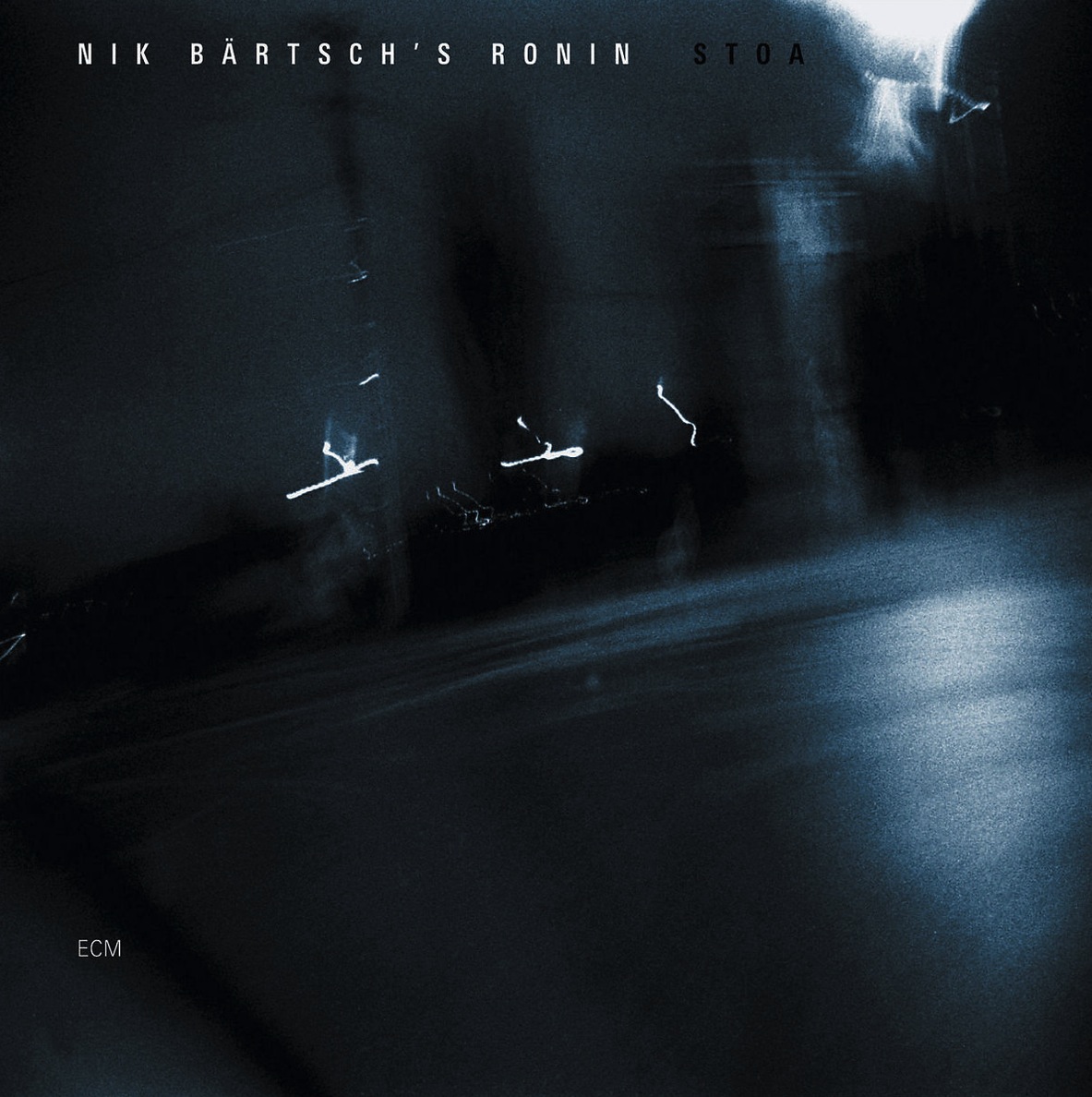
Nik Bärtsch’s Ronin: Stoa (ECM 1939)

Stoa

Nik Bärtsch’s Ronin
Stoa

Nik Bärtsch piano
Sha contrabass and bass clarinets
Björn Meyer bass
Kaspar Rast drums
Andi Pupato percussion
Recorded May 2005, Studios La Buissonne, Pernes-les-Fontaines
Engineer: Gérard de Haro
Produced by Manfred Eicher

“The rule of Japanese martial arts is: think with your body.”
–Nik Bärtsch

With Stoa, Nik Bärtsch’s Ronin dropped into the pond of ECM—indeed, of the world—with profoundly concentric ripples. Listeners can be thankful the effects of those ripples have yet to dissipate, and can only hope decades’ worth more from this nonpareil collective awaits. Pianist Bärtsch drafted the architecture of Stoa while in Japan, the enigmatic and fiercely vivid culture of which had long been the philosophical foundation of his work, yet which remained distant to him until fortune brought him there during the rainy season of 2003.

The formula of Ronin is rooted in the “module,” a molecular prism of being through which Bärtsch’s headstrong quintet splashes light. “Modul 36” thus opens the program with the intermittent glow of a harmonic piano hit, tolling the hour with fallacies of salutation. The only things tangible in these inaugural stirrings are those lone hands at the keyboard. Divorced from body, they step even as they hold themselves against the chill. Wrists plant themselves in the first patches of soil they come to, glowing like eyes in the black ice. Their fingers stretch into branches, from which scatter the blossoms of Ronin’s melodic art proper.

More than any Ronin album since, Stoa measures its respiration in clear-cut rhythmic overlay—this courtesy of drummer Kaspar Rast and percussionist Andi Pupato—with phenomenally engaging results. The stealthy bass of Björn Meyer in “Modul 33” sets off the deepest chain reaction in this regard, followed in kind by the piano’s upper register, Rast’s careful flurry, and the popping bass clarinet of reedist Sha. Overlapping circles, squares, and triangles—each the essence of a different spiritual idea—dance in lockstep toward densities in the latter half. A solid bass line muscles through the smog with finesse. Even subtler syncopations abound in “Modul 32.” Phasing heart rates with magical depressions, it braids the air of the studio with timelessness. From planetary to nebular, its hip-rocking moves evoke the gait of a tireless nomad who has found that middle ground by which to renounce any claims to territory.

“Modul 35” is classically urban Ronin, a world of revolving doors and robotic drones, whose mouths open and close to the tune of cash registers and credit swipes. Yet hovering around these bar-coded souls is a guardian angel of repose, one that counts not tender but connections on its fingers and who speaks through Bärtsch’s own fingers in pylons of light. Microtonal lifts from Meyer add spongy evanescence. Similar contrasts abound in the finishing “Modul 38_17,” another mechanistic fantasy that cuts a line through landscape like a bullet train—which is to stay, smoothly and with barest indications of its actual speed. Winds follow, rolling like the hills in denser chord voicings here. A gorgeously minimal flavor laces the proceedings with tension, urgency growing like a beard on the face of change. Before long that sense of speed catches up with us and tousles our hair, keeping sleep at bay with the sheer energy of self-realization and pulsing through to silence, as resolute as it is fragile.

What we have, then, is not a journey, per se. Instead, a flame rejuvenating itself with every flicker. It travels down the match, edging ever closer to bare fingertips until a gasp of pain and shaking hand offer its ashen frame to the water. But its smoke trails upward yet, the final tether between flesh and firmament.

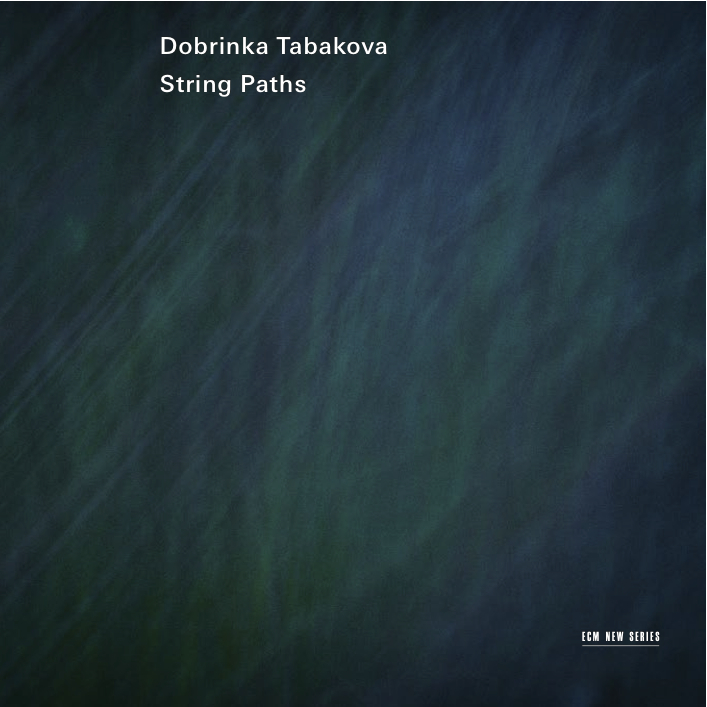
Dobrinka Tabakova: String Paths (ECM New Series 2239)

String Paths

Dobrinka Tabakova
String Paths

Kristina Blaumane violoncello
Maxim Rysanov viola, conductor
Janine Jansen violin
Roman Mints violin
Julia-Maria Kretz violin
Amihai Grosz viola
Torleif Thedéen violoncello
Boris Andrianov violoncello
Raimondas Sviackevičius accordion
Vaiva Eidukaitytė-Storastienė harpsichord
Stacey Watton double bass
Donatas Bagurskas double bass
Lithuanian Chamber Orchestra
Recorded March/April 2011 at National Philharmonic Hall, Vilnius by Laura Jurgelionyté and Valdemaras Kiršys, Studija Aurea in Vilnius
Such different paths recorded June 2011 at Jesus-Christus-Kirche Dahlem, Berlin by Markus Heiland
Mixed and mastered at Rainbow Studio in Oslo by Jan Erik Kongshaug, Manfred Eicher and Dobrinka Tabakova
Produced by Manfred Eicher

When art promises to be revelatory, it may become something to fear. Such is the case of String Paths, the first conspectus of music by Dobrinka Tabakova. Fear, in this sense, is close to awe, for before hearing a single note one knows its details will seep into places to which few others have traveled. Fear, because the trust and intimacy required of such an act is what the composer’s life is all about: she fills staves with glyphs so that anyone with an open heart might encounter their fleeting interpretations and become part of their accretion. Indeed, many factors go into the creation of a single instrumental line, incalculably magnified by its interaction with others. Fear, then, is closer still to love.

Born in 1980, Tabakova moved at age 11 from her Bulgarian hometown of Plovdiv to London, where she went on to study at the Guildhall School of Music and Drama. Her career began in earnest after winning an international competition at 14, since which time she has developed a voice that is refreshingly full and melodious. Such a biographical sketch, despite its prodigious overtones, does little to set Tabakova apart from her contemporaries. Recognition is one thing; experience is another. The coloring of imagination sustained in this timely album’s program, the whole of its corporeal sensibilities, can only come across when its water fills a listener’s cup.

Ukrainian violist-conductor Maxim Rysanov, notable proponent of Kancheli and other composers of our time, has become one of Tabakova’s strongest advocates. It was, in fact, his performance of the Suite in Old Style (written 2006 for solo viola, harpsichord and strings) at the prestigious Lockenhaus Festival that first caught ECM producer Manfred Eicher’s ear and led him to propose the present disc. As the album’s seed, it shelters refugees of the surrounding works. In amending a practice established by such visionaries as Górecki, Schnittke, Eller, and others who have mined elder idioms as a means of looking forward, Tabakova might be placed squarely in an ongoing tradition. She, however, prefers to trace the piece’s genealogy back to Rameau by way of Respighi. Given its descriptive edge, we might link it further to the great Baroque mimeticists—Farina, Biber, Muffat, Schmelzer, and Vivaldi—who were less interested in imitating each other (although some intertextuality was to be expected) than they were in describing nature and circumstance. In this respect, Tabakova’s triptych interfaces a variety of signatures, from which her own stands boldest.

The first movement is a triptych unto itself. Beginning with a Prelude marked “Fanfare from the balconies,” proceeding to “Back from hunting,” and on to “Through mirrored corridors,” already one can note Tabakova’s special affinity for space and place. A rich and delightful piece of prosody, its syncopations feel like ballet, a joyous dance of fit bodies. The viola leaps while the harpsichord adds tactile diacritics to Rysanov’s slippery alphabet. The transcendent centerpiece, entitled “The rose garden by moonlight,” is a shiver down the spine in slow motion, a season at once born and dying. The harpsichord elicits brief exaltations, pushing its wordless song into snowdrift, even as intimations of spring exchange glances with those of autumn. The quasi-Italian filigree of “Riddle of the barrel-organ player” and the Postlude (“Hunting and Finale”) fosters a nostalgic air of antique tracings, bearing yin and yang with plenty of drama to spare.

Insight (2002) for string trio opens the program with exactly that. Played by its dedicatees (Rysanov, Russian violinist Roman Mints, and Latvian-born Kristina Blaumane, principal cellist of the London Philharmonic), it unfolds in dense streams. For Tabakova the trio breathes as one, as might the moving parts of some singing, bellowed engine. The trio thus becomes something else entirely (a phenomenon achieved via the same configuration perhaps only by Górecki in his Genesis I). Moments of shining vibrato add pulse and skin. Glissandi also play an important role in establishing a smooth, coherent fable. The violin’s harmonics are glassine, somehow vulnerable. Indications of dances hold hands with jagged flames. Hints of a free spirit shine through the cracks. A decorated return to the theme looses a bird from an open palm, watching it fly until its song grows too faint to hear.

The 2008 Concerto for Cello and Strings, written for and featuring Blaumane as soloist, moves in three phases, the names of which recall the designations of John Adams. The music, too, may remind one of the American humanist, singing as it does with a likeminded breadth of inflection. The first movement (“Turbulent, tense”) unfolds in pulsing energy. Like a spirit coursing through the sky, it searches the heavens, lantern in hand, for earthly connection. The spirit casts a longing gaze across the oceans, leaping from continent to continent, harming not a single blade of grass by her step. The cello thus takes up the opening theme like a haul from the deep, letting all creatures slip through its fingers to hold the one treasure it seeks by their tips. In that box: a beating heart, one that seeks its own undoing by virtue of its discovery. It is a story revived in countless historical tragedies. The orchestra flowers around the soloist, carrying equilibrium as might a parent cradle a sickly child, laying her down on the altar where the opening motif may reach. The slow movement, marked “Longing,” thus revives that body, spinning from the treasure’s contents a trail she might follow back toward breath. With her resurrection come also the fears that killed her: the conflicts of a warring state, the ideals of a corrupt ruler, the confusion of a hopeless citizenry. The kingdom no longer smiles beneath the sun but weeps by moonlight. Chromatic lilts keep those tears in check, holding them true to form: as vast internal calligraphies whose tails find purchase only on composition paper. Echoes appear and remain. Blaumane’s rich, singing tone conveys all of this and more, never letting go of its full-bodied emotion. The softness of the final stretch turns charcoal into pastel, cloud into dusk, star into supernova. It is therefore tempting to read resolution into the final movement (“Radiant”). From its icy opening harmonics, it seems to beg for the cello’s appearance, which in spite of its jaggedness never bleeds into forceful suggestion. For whenever it verges on puncture, it reconnects to the surrounding orchestral flow, from which it was born and to which it always returns for recharge. Its blasting high sends a message: I am fallen that I might rise again.

Frozen River Flows (2005) is scored for violin, accordion and double bass. Intended to evoke water beneath ice, it expresses two states of the same substance yet so much more. It encompasses the snowy banks, the laden trees, the footprints left beneath them. It imparts glimpses of those who wandered through here not long ago, whose warmth still lingers like a puff of exhaled breath. The violin takes on a vocal lilt, the accordion a windy rasp, the double bass a gestural vocabulary—all of which ends as if beginning.

Such different paths (2008) for string septet ends the program. Dedicated to Dutch violinist Janine Jansen, it ushers in a full, chromatic sound. There is a feeling of constant movement here that is duly organic: in one sense as flow, in another as melodic variety. There is, again, a rocking quality, as if the music always rests on some sort of fulcrum. A quiet passage that deals with the barbs lifted to our eyes. It ends in transcendent wash, a bleed of dye in cloth.

The performances on this finely produced disc are as gorgeous as they come, even more so under the purview of such attentive engineering. This is not music we simply listen to, but music that also listens to us.

It is in precisely this spirit of mutual listening that I participated in an e-mail interview with Ms. Tabakova, who kindly answered the following questions from this enamored soul…

Dobrinka Tabakova

Tyran Grillo: In the String Paths CD booklet, your mention of a powerful first encounter with Keith Jarrett’s Köln Concert makes me recall my own. I felt as if that music had always existed beyond time, but that somehow Jarrett’s performance gave us the means to hear it at mortal speed. Because improvisation is, of course, vital to the compositional act, do you feel this way about your own music (i.e., that you funnel it from the ether), or do you see it emerging entirely from within, by your own design?

Dobrinka Tabakova: Longfellow said that “music is the universal language of mankind,” and I think this is what happens when you “meet” a work of music for the first time and it speaks in a way that you understand and/or it resonates with you. The time-old abstract dilemma of where music comes from, in this case, could be discussed under the larger topic of “how do we communicate.” Of course there is inspiration, and I hope the process of how that sparks the beginning of a new work will remain the wonderful mystery that it is. But that spark gets refracted through the artist’s own prism, made up of the experiences around, exposure to different musics, aesthetic preference… With composition we have the added layer of not working in real time and being able to work at the form and structure of a piece of music far longer than it will take to listen to it. Mendeleev imagined the periodic table in a dream, and the same is sometimes said of compositions, but that dream can only be the beginning, I think. It is a responsibility to capture it in the best possible way, and make it speak.

TG: As a listener who has been moved by your music, I see it as a gift. What has your music given you?

DT: The ability to express something through music has been the main focus of my life, and to have connected with someone is a privilege. That feeling is beyond words.

TG: I’ve always felt that music and literature are much alike: both are “written,” both “tell stories,” one has “movements” instead of “chapters,” etc. How do you envisage the relationship between the two?

DT: I am engrossed by literature, well-told stories, captivating multi-layered characters and, like you say, there are similarities with music in terms of form. But, at least for me, words and music occupy two very different worlds, and I am distracted to think too “literally” when composing. I don’t mean writing music to words—there is a relationship there, and this is when words become music.

TG: There is a seesawing quality to the opening and closing pieces of the program (Insight and Such different paths), as if they rest atop an unvoiced fulcrum and spin a melodic and chromatic equilibrium throughout. How do you visualize the structural nature of those two compositions?

DT: I am glad that you felt it this way and asked about this, because the structure of the album was an important part of the concept of the whole project. Although each of the pieces has its own structure, the feeling of an overarching symmetry to the structure of the album was important. The opening to Insight is almost deliberately aiming to make your ear search. The gradual development of the sounds from there, I feel, leads quite naturally and logically to the effect of the closing of Such different paths: having walked aurally through the album, reaching a kind of settled, calm sonic space.

TG: It’s easy to see your Suite in Old Style as continuing a trend among composers such as Górecki, Schnittke, Eller, and others who have leaned toward the past as a means of looking forward. Yet I wonder if what you have done in this marvelous piece is not more like the great Baroque mimetic composers—Farina, Biber, Muffat, Schmelzer, and Vivaldi—who seemed more interested in describing nature and action than in imitating each other.

DT: I think ultimately, I didn’t wish to try and sound like a composer from a certain time. The Suite is a bow to the music which inspired me and that I grew up hearing. Trying to capture that inspiration and present it through modern eyes/ears was at the heart of the concept of this work.

TG: Speaking of the same piece, your subsection titles have a very dramaturgical sheen to them.

DT: Yes, it helped me imagine being in this other time and also to emphasize the daily distance between then and now, but fundamentally hoping that the music would bridge the time gap.

TG: Insight is an appropriate way to open the program of String Paths. I particularly enjoy its horizontal energies, its balance of density and openness. Compared to the pieces that follow, it feels like a stream of consciousness that has undergone relatively little revision. Can you talk about its inception and unfolding throughout the process of composing it?

DT: I am glad you had that reaction—that it sounds like a stream of consciousness. I think at the start of most pieces, I have a general shape which I would like to achieve with a composition, so I am happy if it is perceived as a flowing unfolding. There are always edits and re-thinks, but I try to stick to the original shape. Also, having challenging parts for each voice makes the work dramatic which propels the motion of the piece.

TG: I am so fond of the little chromatic descending motifs in the second movement of your Concerto for Cello and Strings. They catch my attention every time like the teeth of a zipper locking together. How did this detail come to be in the piece?

DT:  The almost glissando motif came together with the melody—the two have always been inseparable. As I was imagining this to be the “human” section of the concerto (see my next answer), there is a desire to be particularly expressive and almost transform the cello to a singer.

TG: In relation to my earlier question regarding literature, I find the concerto to be especially vivid in its storytelling. What kinds of images does it bring to your mind?

DT: The overall shape of the concerto is an upward one—an ascent. As a student, my main thesis was about Music and Science, and while researching that I discovered the writing of Boethius, a 4th-century Roman philosopher who categorized music in three levels: musica instrumentalis, musica humana, and musica mundana. The first movement can be seen as an expression of musica instrumentalis—the “taming” of the instrument, challenging and stretching the performer and the instrument. Musica humana—believed to be the music of the soul, and everything that affects us as humans—is expressed in the second movement, while musica mundane—also known as music of the spheres—is our impression and hope for what may lie beyond our planet, which finds an expression in the final movement. I didn’t have a particular story in mind, more a shape, perhaps.

TG: Frozen River Flows, more than by virtue of its title, is a remarkably organic piece. The combination of instruments is intriguing. Did your decisions in this regard arise out of wanting to write for particular musicians or was there something about their admixture that spoke to you?

DT: Frozen River Flows was originally written for two conservatoire colleagues of mine, who formed an oboe-and-percussion duo called newnoise. Soon after I completed it, Roman Mints, who I also studied with at Guildhall, asked me if I could contribute a piece to a concert he was programming with violin, accordion, and double bass. This is how the unusual instrumentation came about.

TG: Such different paths is a piece of many layers. Where do you situate yourself among them?

DT: Perhaps, being the composer, I might situate myself at the foundation. But, in all seriousness, it is true, the septet is very layered and polyphonic/contrapuntal. This for me is the great pleasure in writing chamber music: one can have all these lines and give equal weight to each. The inter-relationships between parts can be very complex. Setting myself to this challenge—to have complexity within a clear structure and sound—was one of the first steps in the compositional process.

TG: Such different paths feels like an emblematic piece. What personal importance does it hold for you?

DT: I feel that way about all the pieces on the CD, to be honest. In each there are elements which build from previous ideas or thoughts, and since both the Cello Concerto and Such different paths are the latest compositions on the disk, I guess I’ve had more time to accumulate further thoughts when writing.

TG: Much of your music seems cyclical. Is this conscious?

DT: It really depends on the piece, I wouldn’t say that, for example, Such different paths is cyclical. But sometimes there is a satisfaction in hearing material in two contexts—without having a reference and after a certain development.

TG: Manfred Eicher has been a blessing to so many composers since beginning his New Series in the mid-80s. What does it mean for you to have worked with him and to see your music represented by an influential and prestigious venue?

DT: Manfred Eicher is inspirational, and it has been an unparalleled privilege to work with him and his team! It’s more than a dream to be part of such a catalogue of creativity. As a composer, it is a really great feeling to be able to feel that your music is understood and that those responsible for its delivery on record are concerned, above all, with the integrity and true nature of the music.

TG: On a related note, can you describe your involvement in the recording/mixing process and any insights Mr. Eicher imparted along the way?

DT: Well, my ability to navigate around a mixing desk would perhaps equal my ability to ice-skate, so I couldn’t have a detailed and technical conversation, as much as I may have liked. The process was very natural and dependent on what we were hearing, and at least my main point of reference was the feeling of being in the hall and experiencing the music as if it were played live.

TG: What currently excites you about being a composer? What currently excites you as a listener?

DT: I have a ton of research to get through for some upcoming projects, including one for the Shakespeare anniversary in 2016, and this is providing me with a well of inspiration and excitement. Being a Londoner excites me as a listener—with access to so many fantastic concerts and events as well as sounds.

TG: Generally speaking, how do you compose? Do you have a preferred space, environment, or atmosphere in which to do so?

DT: As long as I can have some quiet, a piano, and my notepad, I’m happy.

(See this article as it originally appeared in Sequenza 21. To hear samples of String Paths, please click here.)

of shrieking and sleeping: powerdove live

powerdove live

powerdove
live at Cornell Cinema
December 5, 2013
7:30pm

Turn on the radio in Small Town, Nowhere, and you might just feel the sounds of powerdove emanating from your speakers, if not from your own skin. The brainchild of composer and multi-instrumentalist Annie Lewandowski, powerdove skirts the edges of distant counties even as it erases them in favor of a landscape populated by songs in place of people. Guitarist John Dieterich and Thomas Bonvalet (who forges a distinct percussive palette with various technological and organic accoutrements, including his own body) complete the cybernetic triangle by which the music navigates, corroded yet still trustworthily affecting.

To hear the group’s latest album, do you burn?, in the ugly comfort of your own home is to open a dusty diary of impressions that remain nevertheless crystalline. To hear those songs in the beautiful discomfort of a live setting is to take those pages, leaf by leaf, and fashion from them a bed of kindling. Such was the warmth felt as Annie and company brought their characteristic brand of washboard balladry to Cornell Cinema’s stage on a crisp December night.

Although short in duration, each song was a story brought to chest-piercing fruition by some enviable synergy. Miniatures, yes, but in the way of a white dwarf star. Annie’s presence—willowed in body yet avalanched in mind—was the eye of the supernova; John’s insightful picking wielded gaseous filaments, like the webs that hold every corner of a house together in semblance of memory; leaving Thomas to connect the evening’s constellatory dots. The latter’s apparatuses—which included contact mics, harmonica innards, mouth organ, and even a light-activated banjo—were only nominally technologic. Whether the distorted desk bell at his foot (not a bid for help but a signal to the helpless) or the two metronomes phasing in “Easter Story” (off 2011’s be mine), his periphery sang apart, for it was clear that powerdove was plugged into more than just amps. These were songs written by means of and through a body steepled by childhood, broken like bread along fault lines of the here and now.

Like Annie herself, who started offstage and coalesced into sight only when the second song (“California”) commenced, the music was docked in immediate reality but tangled itself in seafaring dreams. Her enunciation was as convex as the words were concave, all touched to flame by the spell of her accordion. From a blur of cacti and rustling sleeping bags, she emerged with bits of wisdom, unadorned. These took on the color of something bloody in her bellows—nothing macabre but fleshy, pliant. There was also in the words a naturalist slant. A hollowed-out willow could become the dance floor of an entire fungal congregation. With moss for a canopy and pulp for refreshment, the party mingled until no single appendage was discernible from the next.

The performance ended with three videos (these for “Under Awnings,” “Do You Burn?” and “Wandering Jew”), each of which plunged into a crumbling imaginary with vivid eye-breaks and uneven seams: the American dream sinking into its own cavity until only a single tooth remained. And so, filing back out into the chill, spurred by a click track of the soul, we the concertgoers knew the story would continue on only in the mouth’s void.

Martin Speake: Change of Heart (ECM 1831)

Change of Heart

Martin Speake
Change of Heart

Martin Speake alto saxophone
Bobo Stenson piano
Mick Hutton bass
Paul Motian drums
Recorded April 2002 at Rainbow Studio, Oslo
Engineer: Jan Erik Kongshaug
Produced by Manfred Eicher

Saxophonist Martin Speake makes his first—and so far only—ECM appearance in a dream quartet rounded out by pianist Bobo Stenson, bassist Mick Hutton (who debuted for the label with another English reedman, Ken Stubbs, on Eréndira), and drummer Paul Motian. The group’s account of eight Speake originals is as poetic as his titles.

Being made aware of the river that is “The Healing Power of Intimacy” as if we’d already had a toe in its waters is a startling way to introduce us to the session’s flow. Speake’s free-blowing ways fill the covers of Lee Konitz’s signature sweetness with pages all his own, on each of which is written a day in the life of a melodic sage. In the latter sense, we might also reference Charles Lloyd, whose tender drive seems to lurk in the altoist’s dream-weaving. Stenson offers some of his loveliest improvisatory reparations ever committed to disc as sideman. In this regard, the title track shuffles its feet by candlelight, in the soft illumination of which Speake puts pen to paper and lets the muses sing.

Hutton and Motian play catch and release throughout the set, gelling rather swingingly on “Barefaced Thieves” and spreading their fingers wider on “Venn,” into which Stenson and Speake interlace their own. The latter cut contains top-flight thematizing and shows the band at its most aligned. Speake’s golden hour comes in “Buried Somewhere.” This balladic tour de force casts its spell without thinking, lures the muses closer and grazes their palms with methodical freedom.

The rhythm section’s tailwind is that of a comet: vivid yet distant enough to seem frozen in time. And on the question of time, “In the Moment” has much to say. Its sweep is generous, allowing each member’s breath to circulate in the warmth of elegy. Here the flame flickers, never losing hold of its wick. Motian’s charcoal turns to pastel in “Three Hours” with no loss of blend. The steadiness of this tune gives it arms with which to hug, legs with which to move, and a mind with which to lower the cerebral to relatable levels. Listeners can appreciate the respect of this move, hard to come by in a sometimes far too intellectual business. All of which might help to explain why the album ends “In Code”—not for want of secrecy but for honesty of message. Encryptions take place at the very moment of creation. And even as Speake’s alto careens across the night, we can be sure that its soul will stay behind, awaiting further instructions.

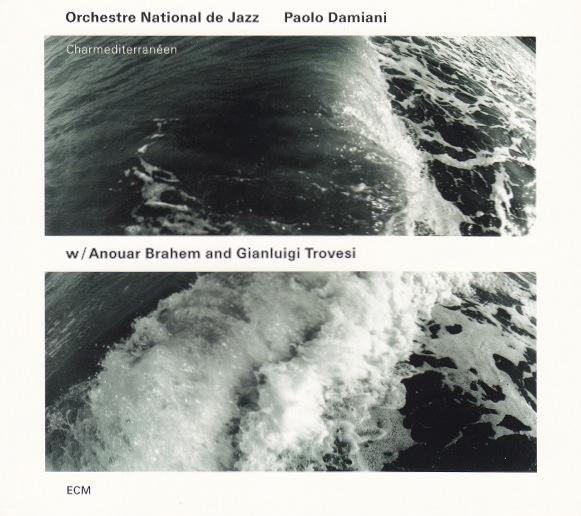
Orchestre National de Jazz: Charmediterranéen (ECM 1828)

Charmediterranéen

Orchestre National de Jazz
Charmediterranéen

Paolo Damiani cello
Anouar Brahem oud
Gianluigi Trovesi piccolo clarinet, alto saxophone
François Jeanneau soprano sax, flute
Thomas de Pourquery soprano, alto and tenor saxophones
Jean-Marc Larché soprano, alto and baritone saxophones
Médéric Collignon pocket trumpet, fluegelhorn, voice
Alain Vankenhove trumpet, fluegelhorn
Gianluca Petrella trombone
Didier Havet sousaphone
Régis Huby violin
Olivier Benoit guitar
Paul Rogers double-bass
Christophe Marguet drums
Recorded October 15 & 16, 2001 live in concerts at Scene Nationale de Montbéliard, Palot/L’Allan
Mixed at Studios La Buissonne, Pernes-les-Fontaines
Engineer: Gérard de Haro
Assisstant: Gilles Olivesi
Produced by l’Association pour le Jazz en Orchestre National

The seeds for the Orchestre National de Jazz were planted in 1982, when France’s Ministry of Culture set out to promote non-classical forms of music in general, and jazz in particular. The ONJ was at the forefront of this movement and, since its establishment in 1985, has cut across musical divides with utmost professionalism and slick telepathy. In the spirit of developing and exploring fresh repertoire, the ONJ takes on a new director every few years. This album comes from a period under the artistic vision of cellist and double-bassist Paolo Damiani, who spearheaded the ensemble between 2000 and 2002. Although Damiani had previously appeared on ECM as part of the Italian Instabile Orchestra (see Skies Of Europe), his presence here gains frontline recognition. Guesting with him are Tunisian oudist and Anouar Brahem and Italian reed maestro Gianluigi Trovesi.

The album begins with a suite composed around the myth of Orpheus. Told in four chapters, plus a prologue and epilogue, they key to this revisionist narrative lies in its array of psychological insights. The journey into the underworld, for example, feels as if it begins the moment the music exhales with its playful mélange of modern classical touches and eclectic flourishes. Yet rather than a torturous slog through fire and brimstone, we get a swinging gait through the pits of human despair toward the reflected light of Eurydice’s mirror. As much Godard as it is Cocteau, the resolve of this mise-en-scène blisters across a free jazz landscape. Electronic enhancements to the horns render ghostly faces that swirl in and out of focus. Such infusions align this album more closely to Evan Parker’s Electro-Acoustic Ensemble than to more conventional outfits. This isn’t your grandmother’s big band.

One suite follows another in the form of “Estramadure.” This three-parter is attuned to overtly compositional impulses, overlaying jagged themes onto smooth backings of winds and brass. Rhythms are tight but spongy, absorbing all that comes their way. Damiani glows in a superb solo turn, making way for a rainy montage cut to ribbons by the sharp relief of Trovesi’s altoism.

Those expecting to hear more of Brahem and Trovesi will either be disappointed or pleasantly surprised. Still, enthusiasts can bask in the warm light of “Montbéliard Trio,” in which the heroes of the hour spend twenty luxurious minutes in various stages of audibility eliciting gorgeous, elliptical themes toward rapture. Brahem also gilds the title track—which translates to “Mediterranean spell”—with appropriately dream-like patterns. Equally deserving of attention are the contributions of violinist Régis Huby, whose restless technical precision recalls that of Mark Feldman. Huby gives especial vibrancy to this 14 and a half-minute epic and elicits a memorable performance in the first of two iterations of “Argentiera.” The fluid stylings of electric guitarist Olivier Benoit also deserve special note.

All told, this is a consistently detailed and sometimes surprising effort that is sure to reward repeated listening.

Gianluigi Trovesi Ottetto: Fugace (ECM 1827)

Fugace

Gianluigi Trovesi Ottetto
Fugace

Gianluigi Trovesi alto saxophone, piccolo, alto clarinets
Beppe Caruso trombone
Massimo Greco trumpet, electronics
Marco Remondini cello, electronics
Roberto Bonati double-bass
Marco Micheli double-bass, electric bass
Fulvio Maras percussion, electronics
Vittorio Marinoni drums
Recorded June 2002 at Next Officine Meccaniche Studios, Milan
Recording engineer: Marti Jane Robertson
Assistant engineer: Guido Andreani
Mixed at Rainbow Studio, Oslo
Engineer: Jan Erik Konshaug
Produced by Manfred Eicher

Gianluigi Trovesi is a maverick in ECM’s stable. His ear for melody and, above all, aesthetics makes him a perfect fit for the label and a standout among its crowded roster. The Italian multi-reedist and composer has, it seems, always had his fingers in many pies, yet consistent to his flavor has been the acidity of celluloid. Indeed, Trovei’s penchant for cinematic atmospheres is a running theme throughout his work on all scales, but nowhere more so than on Fugace. The album’s tasteful admixture of noir, new wave, and expressionist “imagery” enables a deep journey to take place for the open-minded listener. Black-and-white figures shake hands with old-time jazzmen and sultry Technicolor beauties alike—all of them bound to a code of traditional and popular European elements. The latter serve to clear all distractions and highlight the diasporic nature of each genre sampled therein. These elements and more come together in what essentially amounts to a fantasy soundtrack, for it needs no film in order to find focus. Rather, moving pictures would be a hindrance to this music, already so robust in its evocativeness that a screen would be just that: something in the way.

The psychedelic electronic refrain of opener “As strange as a ballad” smacks of a dream sequence, Trovesi’s clarinet the psychoanalyst with an ulterior motive hovering at its periphery. Between this and the follow-up, “Sogno d’Orfeo,” there is already much to admire. The latter’s swanky air opens wispily before floating along the avenues of times past in vintage clothing, clutching worn-out hopes all the while. Sampled harpsichord runs add clink and spatter to this astute rollick, as also to the four “Siparietti,” or entr’actes, that pepper the album’s second act. Each turns a similar motif into a corkscrew of Baroque energy just waiting for the right moment to spawn. The title track performs the same trick, replacing one impact with another.

The “African Triptych” is an indisputable highlight of the program, moving across swaths of landscape in smooth and easygoing melodies. The musicianship is at once careful and carefree, the composing likewise. The second section, “Scarlet Dunes,” unveils a refreshing turn from alto, plying that middle range with all the depth of a sailor dropping anchor. Trovesi manages to scrape the horizon with his fingernails and reveal the gessoed backing. His screeching works wonders here and hereafter, and enhances the band’s subconscious qualities.

Of said band, one can hardly say enough. With Trovesi in the lead, it includes two bassists, two percussionists, a cellist, trombonist, and trumpeter. Its recipes expand upon the minimal ingredients of Trovesi’s chamber projects, and the decade of experience that comes to the table here is detectable in every course. The incorporation of electronics is an ingenious touch, resulting in a hybrid that is as much nu jazz (cf. the dancing breakbeats of “Clumsy dancing of the fat bird”) as Vivaldi; at times haunting (“Canto di lavoro”) and at others parodic. “Blues and West” fits squarely in the vein of parody. Fronting gritty electric guitar work over a smooth bass line and hip blowing from the horns, it gives off whimsical pheromones to be sure. Trovesi’s nod to W. C. Handy, “Ramble,” is another fascinating mélange of eras and styles, shifting John Zorn-like from Dixieland to free jazz in the blink of an eye. The rhythms are totally on point and keep us locked into every chameleonic change. Further along, the whitewash of “Il Domatore” dovetails the beauteous desolation of a William Basinski loop with the hard post-bop of a Dave Holland joint. Its arc goes into hiding until it touches ground in “Totò nei Caraibi,” which pulls the mournful final credits like a curtain in reverse.

Of all possible genres to have been referenced here, neo-realism remains unacknowledged, perhaps in fear of its own reflection. That its hard-won lessons might jump out and startle us at any time is part of the appeal of Fugace, which quells those urges with tightly wound lyricism and colorful appeal. Another masterstroke from Trovesi and his circle.