John Surman Quartet: Stranger Than Fiction (ECM 1534)

John Surman Quartet
Stranger Than Fiction

John Surman soprano and baritone saxophones, alto and bass clarinets
John Taylor piano
Chris Laurence double-bass
John Marshall drums
Recorded December 1993 at Rainbow Studio, Oslo
Engineer: Jan Erik Kongshaug
Produced by Manfred Eicher

Reedist John Surman has laid much of his ECM path with the polished stones of his solo work. Whatever the setting, he is one who listens to his surroundings, be they atmospheric or human. In the latter vein comes “Canticle With Response,” which opens this wintry quartet date with pianist John Taylor, bassist Chris Laurence, and drummer John Marshall. Its sparse, porous mood is a leitmotif on Stranger Than Fiction. Yet rather than something to which the musicians return, it is something that returns to them, a ghost that finds movement where there is stillness. Like a sage’s hair in twilight, the group’s sound is gray yet aglow, worn to the bone by reflection in “A Distant Spring.” Surman sets his soprano to flight in the watercolors of “Tess,” for which Taylor splashes stories, each a step in river water. Those gray strands continue to bend and stretch, winding around the memorable theme of “Promising Horizons.” This haunting afterimage of Beethoven’s Ode to Joy bows to distillations of baritone and bass.

In this forest, dark with age, one can only travel “Across The Bridge,” guided by Surman’s prowess on the bass clarinet. His improvisations on said unwieldy instrument glisten despite the shadows of which they are composed. “Moonshine Dancer” welcomes us to a nocturnal circus, where performer and spectator number two in the night, their hands and laughter for each other alone, while “Running Sands” flows, like its namesake, at the touch of wind and water. A pliant solo from Laurence lifts us into the clouds, each topped like a sundae with delicious baritone caramel. Everything above funnels into the final “Triptych.” Like a fiber optic cable, it flows through the earth, hidden and dormant until the flick of a creative switch sets its veins thrumming with information—only here, you need nothing more than your ears to cup the light into oblivion.

<< Gavin Bryars: Vita Nova (ECM 1533 NS)
>> Giya Kancheli: Exil (ECM 1535 NS)

Jarrett/Peacock/Motian: At The Deer Head Inn (ECM 1531)

Keith Jarrett
Gary Peacock
Paul Motian
At The Deer Head Inn

Keith Jarrett piano
Gary Peacock bass
Paul Motian drums
Recorded September 16, 1992 at the Deer Head Inn
Engineer: Kent Heckman
Produced by Bill Goodwin

By the fall of 1992, Keith Jarrett had already spent 30 years as a notable jazz performer. What better way to celebrate than to return to this record’s eponymous venue in his birthplace of Allentown, Pennsylvania for a once-in-a-lifetime gig? Switching out his usual go-to, Jack DeJohnette, for Paul Motian (no stranger to Jarrett, with whom he’d worked in the 70s), the trio works wonders with the new colors the latter provides. Peacock and Jarrett are both verbose players who manage never to step on each other’s toes. With Motian backing them, they take longer pauses for reflection, listening to the wind as it blows through their leaves. His presence and panache are as palpable as the prevalence of alliterations in this sentence, bringing an irresistible brushed beat to the squint-eyed groove of Jaki Byard’s “Chandra.” That hook keeps us sharp to improvisatory angle and inspires some youthful banter from Peacock, who feeds off those drums like Christmas. Motian excels further in the balance of fire and ice that bubble throughout “You And The Night And The Music.” The band also dips into Miles Davis-era waters with glowing renditions of “Solar” and “Bye Bye Blackbird.” Atop quilted commentaries from the man at the kit, Jarrett’s unpacking of these timeless melodies is the cherry on the sundae. Sweet toppings also abound in the laid-back “Basin Street Blues,” in which, with closed eyes and an open heart, Peacock finds the perfect resolution for Jarrett’s uncontainable fire. All three musicians up the ante in “You Don’t Know What Love Is.” Jarrett negotiates its changes like breathing while Peacock and Motian speak in vocabularies just beyond the radar of feasibility. Before we know it, we’re caught up in a joyous surge and relaxation. By ending with “It’s Easy To Remember,” the trio saves its finest translucent china for last.

The value of ECM as a live archive is proven beyond the shadow of a doubt in this recording. This is where it’s at.

<< Händel: Suites for Keyboard (ECM 1530 NS)
>> Peter Erskine Trio: Time Being (ECM 1532)

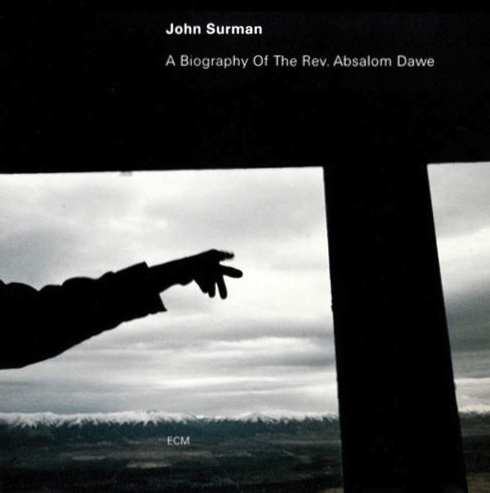
John Surman: A Biography Of The Rev. Absalom Dawe (ECM 1528)

John Surman
A Biography Of The Rev. Absalom Dawe

John Surman alto and bass clarinets, soprano and baritone saxophones, keyboards
Recorded October 1994 at Rainbow Studio, Oslo
Engineer: Jan Erik Kongshaug
Produced by Manfred Eicher

I would venture to say that anyone who has dug into the trove of ECM’s 1980s output has a soft spot for John Surman’s lone outings. The English reedman brings a signature sense of purpose to every musical line he touches, whether it’s by mouth through his favored baritone or by hand, laying down tasteful electronic contexts for looser improvisations. Now well into the 1990s, Surman outdid himself with A Biography Of The Rev. Absalom Dawe, treating listeners to his most deeply realized solo experience yet. Named for a cousin of Surman’s great-great grandmother, Biography employs the usual studio trickery for a sound that is wood-grained, born of earth and sky. “First Light” highlights another preferred tool in his kit—the bass clarinet—and grows from it feathers like no one else can. Following this dawn chorus for one, he plucks out yet another, drawing the needle of his soprano—honeyed but never saccharine—through the diaristic airs of “Countless Journeys.” Moods vary thereafter, cycling through the orthodox (“A Monastic Calling”), the pagan (“Druid’s Circle”), the questioning (“The Long Narrow Road”), and back into the unity of “Three Aspects,” which braids a trinity of sopranos, from which one breaks strays like a firefly to the far side of a darkening field. In addition to these evocative poems, “Wayfarer” and “The Far Corners” are among Surman’s best, the one somehow dancing bass clarinet on the head of a pin, the other paying homage to tone in a soprano solo for the ages. This leaves only “An Image,” refracting baritone lines through an echoing prism.

Surman brings out, especially through this album, a distinct sort of programmatic expression, which through its inflections evokes environments so internal they cannot be rendered, except through the gift of his interpretations.

<< Steve Tibbetts: The Fall Of Us All (ECM 1527)
>> Krakatau: Matinale (ECM 1529)

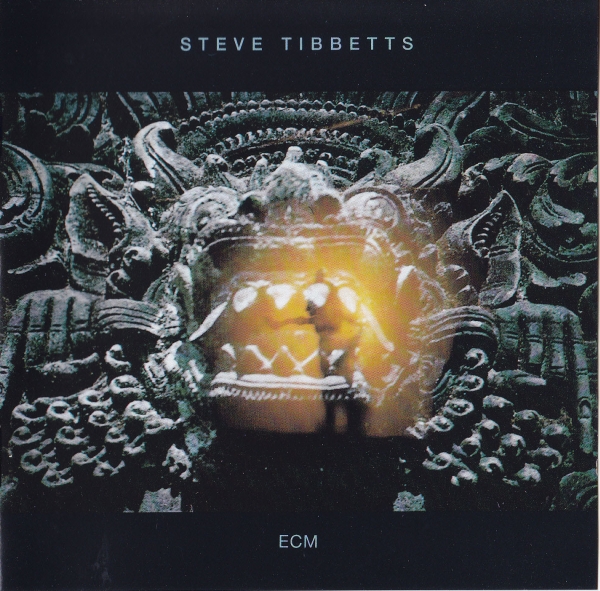
Steve Tibbetts: The Fall Of Us All (ECM 1527)

Steve Tibbetts
The Fall Of Us All

Steve Tibbetts guitars, percussion, discs
Marc Anderson congas, steel drum, percussion
Marcus Wise tabla
Jim Anton bass
Eric Anderson bass
Mike Olson synthesizer
Claudia Schmidt voice
Rhea Valentine voice
Recorded 1990-1993, St. Paul and Boudhanath
Engineer: Steve Tibbetts
Produced by Steve Tibbetts

The Fall Of Us All was my rite of passage into the Book of Tibbetts. The breadth of “Dzogchen Punks” never fails to bring me back to that first precious experience, buried in the solitude of my room under mounds of headphone-induced absorption. Those polyrhythmic drums snatch the hapless listener up in a fiery kiss of technique and experience, one that bears tender fruit in a ribboned middle passage before bleeding itself dry into renewed life. Even in the absence of those percussive footsteps, one always feels them hovering below the skin like a survival instinct. Every flip of the page reveals a new and enthralling illustration. From the steel-wound tassels of “Full Moon Dogs” to the vocal filigree of “Nyemma,” Tibbetts and his intuitive band members arch their backs like cheetahs across a savannah of fire, each the karmic acrobat of a different dream. Surrounded by such ecstatic unrest, we can only “Roam And Spy” until we board a “Hellbound Train” for an arachnid ride that screeches, wheels grinding, into a brimstone station with all the pop of a balloon at a pin’s tip. Cooler temperatures do give us some reprieve, reaching something close to enlightenment in “Drinking Lesson,” a 12-string solo that hangs itself to dry on the psychological fishhooks of “Burnt Offering.” From solemn reflection to full-on walkabout, these coals reignite in “Travel Alone,” becoming one with mindful synths and boundless articulation—a chakra that hits close to home every time.

An organic beat, arid movement, a spiny electric, and a gust of wind nipping at our heels: these are the essential ingredients of Fall. Immaculately engineered and produced by Tibbetts himself, its sound keeps a foot inside and outside this circle of flesh we call the body, sweeping aside mountains with every circular breath. His craftsmanship draws from, even as it defines, the music. We may be aware of individual granules, but in the end we can only cower in the grand ancestral shadow that awakens before us the moment we press PLAY.

Because this was for years my only Tibbetts album, it is the one I cannot do without. But don’t let that stop you from turning every knob he has set for your inner adventurer to discover.

<< Louis Sclavis/Dominique Pifarély: Acoustic Quartet (ECM 1526)
>> John Surman: A Biography Of The Rev. Absalom Dawe (ECM 1528)

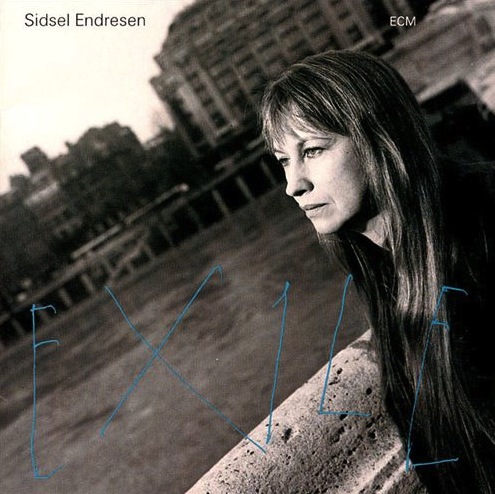
Sidsel Endresen: Exile (ECM 1524)

Sidsel Endresen
Exile

Sidsel Endresen voice
Django Bates piano, tenor horn
Nils Petter Molvær trumpet
Jon Christensen drums, percussion
Bugge Wesseltoft keyboards
David Darling cello
Recorded August 1993 at Rainbow Studio, Oslo
Engineer: Jan Erik Kongshaug
Produced by Manfred Eicher

After an astonishing ECM debut with So I Write, Norwegian jazz vocalist Sidsel Endresen returned to the label with this haunting companion. Like its predecessor, Exile takes an intimate peek into the nature of our burdens, nesting among the virtues of self-reflection. Having already come to know the raw beauty of Endresen’s voice, those familiar with the former album can take pleasure in strolling among the fine musicianship that accompanies her this time around. Of note is cellist David Darling, who makes healthy appearances at key moments during the album’s unfolding story. His interactions with Django Bates at the keys in “Quest” and duet with Endresen in “Theme II” are but two examples of his flowing presence. Bates himself throws pianistic sunlight onto water in such tracks as “Hunger” while overflowing with soul through his tenor horn in “Dust.” But let us not neglect Endresen, whose steady avenues in “Here The Moon” extend from the outset into a cloudy future. Even when singing wordlessly, she captures our hearts with images and trailing thoughts. The title track brings together all of these elements and more in a journey of roads, rivers, and rails; a shift from black and white to color; a tale of solitude, touched by kisses of hope. Yet the greatest seclusion thrives in “Waiting Train,” which dissolves away, awash in cymbals and thoughts of what could have been. We fend for ourselves in this frame, blind to any and all destinations. Hooking sadness onto your arm like an old friend, Endresen leads you from this place, leaving behind a tear-stained letter where you once stood.

<< Federico Mompou: Música Callada (ECM 1523 NS)
>> Jan Garbarek/The Hilliard Ensemble: Officium (ECM 1525 NS)

David Darling: Dark Wood (ECM 1519)

David Darling
Dark Wood

David Darling cello
Recorded July 1993 at Rainbow Studio, Oslo
Engineer: Jan Erik Kongshaug
Produced by Manfred Eicher

In the middle of the journey of our life
I came to myself in a dark wood
For the straight way was lost.
–Dante Alighieri

Cellist David Darling continues where he left off on Cello, furthering the rings and grains of “Darkwood,” a multitracked suite drawn in otherwise acoustic measures, of which the latter four parts appear here. While such name might evoke visions of shadow and deepest night, each part starts its titled sections with anything but. Darkwood IV opens its eyes to the “Dawn” while V passes through “Light,” which marks the “Beginning” VI and illuminates downward to “The Picture” in Darkwood VII. The latter is one of the most heart-tugging pieces Darling has ever recorded, weaving tender threads of thought whose philosophies are drawn from the wayside where others have left their faith. Stained tones cradle us in cloud and wind, leveling stepwise motions into molasses tide, proceeding ever deeper into a monochromatic ceiling, at the center of which a light drives away the spirits of insects whose flights are captured “In Motion.” In the starlit expanse of these dreams, we step on floes of ice, each an eye closed by lids of water as it sinks.

Such are the stories, rising from within rather than falling from without. Plunged into the heavy pizzicato of “Earth,” Darling sparks kindling by torchlight, casting bones into a hearth of sky. In its smoke we find the fantasy of a folksong trembling in wake of sunset. Primal cry in slow motion, harmonic ostinato and trembling alto line—these connect one spirit to another and arch their heads, slingshots at the ready. Only instead of a sudden unleashing we get the meditative crawl of fadeout. “Searching” is the cello equivalent of Paul Giger’s “Birth Of The Bull,” which pries open its mortality to find that in death there is life, and in “Medieval Dance” we feel hands touching and releasing, bodies whirling in smoky midnight, following harvest and offering. This leaves only “Returning,” and the eclipse of “New Morning,” where hints of infinity plough and turn like the soil from which they were born, lustful for nothing but absence.

Ultimately, such (di)visions become as arbitrary as the names ascribed to them, etched as they are in perpetual cosmic change. They skip across the chasm of time, closing their parched lips around morsels of memory along the way. Darling bows his cello as if with a comet’s tail and leaves us similarly alone beneath a stretch of sky, harps at Poseidon’s call, hoping for that next chance encounter between perception and transience.

<< Eberhard Weber: Pendulum (ECM 1518)
>> Demenga/Demenga: 12 Hommages A Paul Sacher (ECM 1520/21 NS)

Eberhard Weber: Pendulum (ECM 1518)

Eberhard Weber
Pendulum

Eberhard Weber bass
Recorded Spring 1993, München
Engineer: Jochen Scheffter
Produced by Eberhard Weber

Eberhard Weber, perhaps best known as bassist for the Jan Garbarek Group, in addition to his own string of classic ECM albums as leader throughout the 1970s and 80s, brings his 5-string electric upright into a more focused spotlight with Pendulum. This solo date from 1993 marks yet another evolutionary step in this unmistakable musician, whose wings discover fresh space in which to flap in “Bird Out Of Cage.” Through its menagerie of overdubs and loops, Weber navigates the pops and jagged peaks of spontaneous creation. Yet despite its skyward beginnings, Pendulum tells an earthbound story that turns in its own cycle of life. Maternal shores skirt paternal oceans in “Notes After An Evening,” while in “Delirium” Weber unfurls visceral diversions against a droning canvas. “Children’s Song No. 1” picks up the thread, swaying to the rhythm of a playground swing, and continues to spin it into “Street Scenes.” Playful harmonics carry over into the meditative “Silent For A While,” reaching out to the birds that brought us here. The title track hones a robust thematic edge, dancing its slow dance across a hundred dreams and lifetimes, leaving “Unfinished Self-Portrait” to drip equal parts whimsy and grandiosity into the comforting “Closing Scene,” tingling with the taste of destiny.

With unerring delicacy yet with a weightiness that oozes security, Weber treats his bass at times pianistically, at times chorally, and often as both at once on an album that offers an intimate look at his compositional sensitivity. One of his absolute triumphs in that quiescent, fluid way he has.

<< Jon Balke w/Magnetic North Orchestra: Further (ECM 1517)
>> David Darling: Dark Wood (ECM 1519)

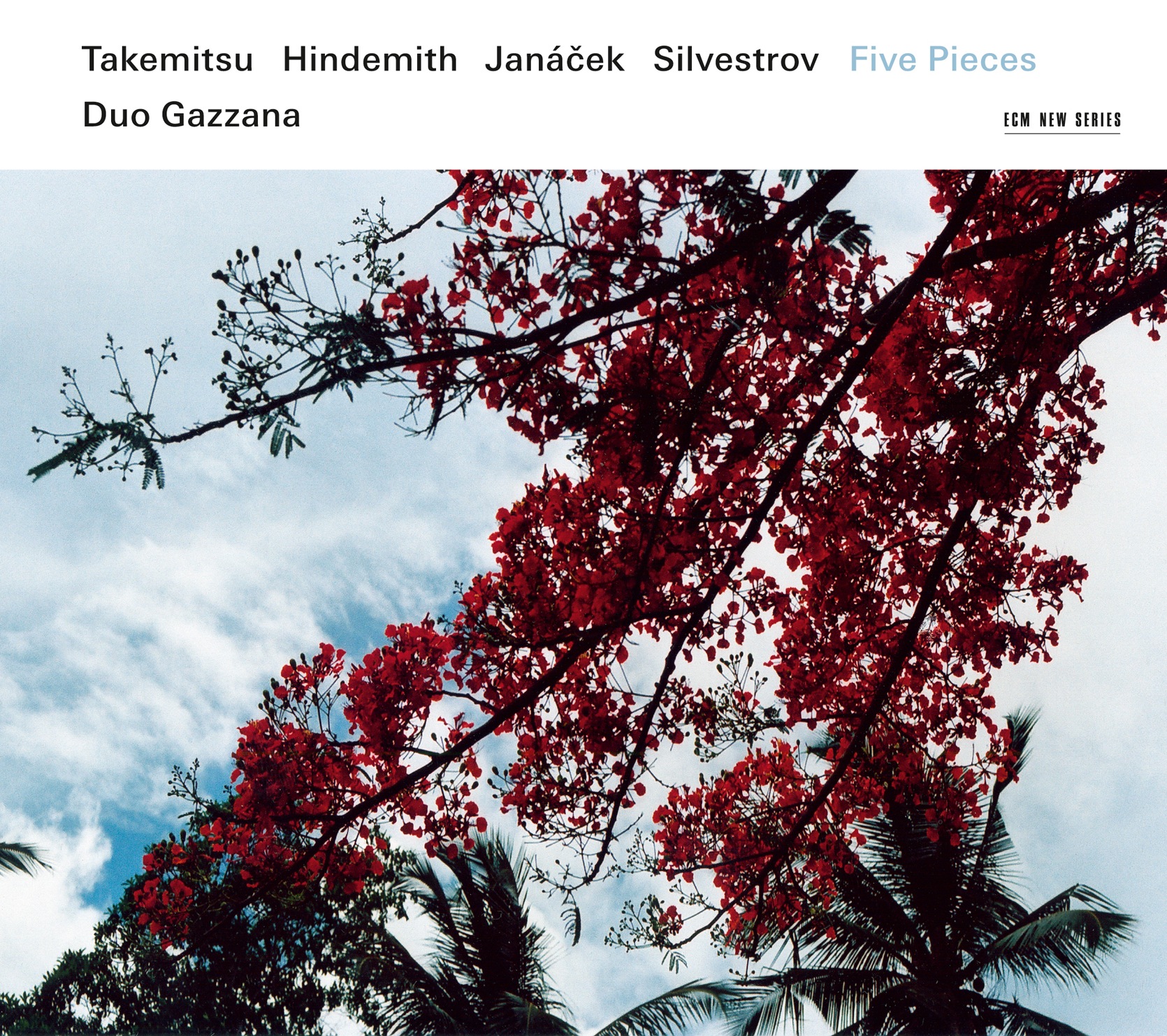
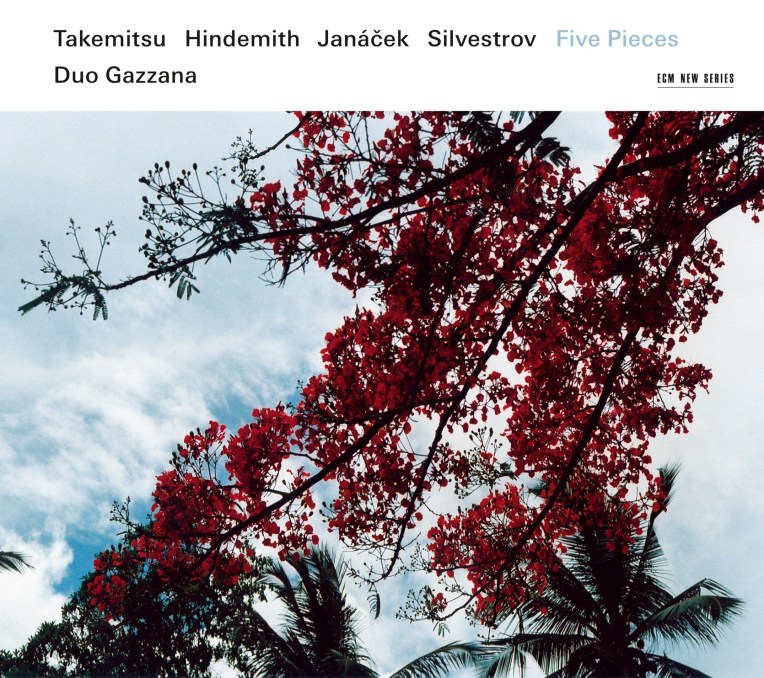
Duo Gazzana: Five Pieces (ECM New Series 2238)

Duo Gazzana
Five Pieces

Natascia Gazzana violin
Raffaella Gazzana piano
Recorded March 2011, Auditorio Radiotelevisione svizzera, Lugano
Engineer: Markus Heiland
Produced by Manfred Eicher

Beautiful teeth sung behind the trees
Finely shaped ears were between the clouds
Iridescent nails blended with water
Kicked off a pebble
All like footsteps
–Shuzo Takiguchi, trans. Noriko Ohtake

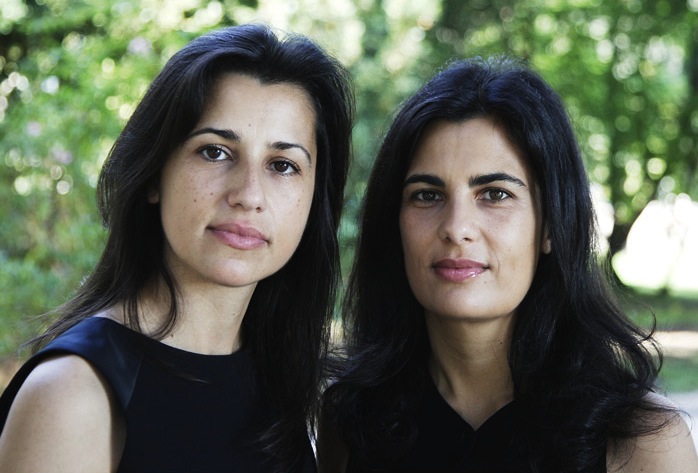
Natascia and Raffaella Gazzana are sisters in more ways than one. Having performed together since they began their classical educations, as Duo Gazzana they have been impressing audiences since the 1990s with the galactic swirl of their milk-and-coffee blend. It is perhaps no coincidence, then, that their sororal sound and abiding interest in modern music would lead them to ECM producer Manfred Eicher, who has seen fit to oversee their recording debut of a program that includes works by Tōru Takemitsu, Paul Hindemith, Leoš Janáček, and Valentin Silvestrov. I recently “sat down” (inasmuch as one can via e-mail) with the Gazzanas, who were gracious enough to expound at some length on the questions tickling this voracious listener’s brain.

The violin/piano repertoire is so vast. How did you begin to conceive of such a refreshing program? Were you looking at it in terms of obscurity versus knowability, or simply playing what you love?

Thanks for calling it “refreshing”! We liked the idea of proposing pieces not so often played, excluding perhaps the Janáček sonata. This became possible with the ECM label, which generally offers its listeners “unusual” music. We particularly enjoy playing all the pieces in this program, and each has its own reason for being on the CD. While Janáček and Hindemith were part of our usual repertoire, we encountered Takemitsu relatively late. We came to know Silvestrov’s music through the several ECM recordings that Manfred Eicher encouraged us to listen to. We were immediately captivated by his delicate and evocative writing.

Does the music in this program, as a whole, tell a story? If so, what you hear, see, or feel in it?

The four composers, so apparently far from one another in age and background, tell similar stories with different languages. We liked the idea of giving this program a direction by moving from central European expressionism (Hindemith), through Janáček’s tormented postwar sonata and the gentle approach of Silvestrov, and finally into the far eastern refinement of Takemitsu’s music, loaded with that French influence that takes us back to where we began. A travel through old and new stories, with plenty of different nuances!

Takemitsu’s Distance de fée (1951) is indeed all about nuance. Its Debussean magic lures us into twilight from Raffaella’s first chord. Natascia’s cotton-spun tone wafts across time and space like pollen in darkness—which is to say, unseen yet felt at the bridge of a nose, gracing the forehead with the promise of an unattainable daybreak. She waits, the wind seems to say, as if there were no alternative but to run with her into the future. Harmonics cry like birds in the boughs of our unrest and end where we began, a palindrome in the night.

With such evocative threads to unravel, I ask the Duo how they approach this young piece from a then relatively new composer, one navigating the moral topography of the postwar era with decidedly French tools. Are these geographical slights of hand, I wonder, important to keep in mind?

We have great affinity for Japanese literature and culture and were curious to learn as much as possible about their different aspects, in which ancient traditions are so well integrated with advanced technology. We approached Takemitsu just before a long tour we held in Japan a couple of years ago. It was the right occasion for us to play the new, refined music that we wanted to offer to such an audience. Distance de fée, inspired by a surrealistic poem of Shuzo Takiguchi, is an early piece in which, still searching for more personal and original writing, he was strongly influenced by French music, and Messiaen in particular. Takemitsu himself once described the process as “reciprocal action, musical art re-imported to Japan.” His fascination for impressionistic music came from the fact that harmonies of modal scales, so dear to French composers, had been at the base of traditional Japanese music for centuries. Both cultures were united by a keen sense of tone, for pictorial and naturalistic elements. Nevertheless, he only took inspiration from the great Frenchman’s modes to transpose and create a world properly Japanese. The philosophical concept of MA, so distant from our culture, in music can be translated as the “art of no sound” or “art of the vacuum,” by which is born an inseparable relation of continuity rather than opposition between music and silence. Silence surrounded by sound adds tension and gives unity. You can hear this right from the beginning of the composition: we are immediately transported into a suspended world rising from nowhere. There are no real melodic lines but fragmented motivic cells alternating with pauses on the violin. They are never truly developed but are reiterated literally or with little variations supported by the rich harmonies of the piano’s ever-changing chords. In a way they represent the world around us from which the composer extracts but a segment.

That one finds all of this and more in six-and-a-half minutes of music is a testament not only to the composer, but to the performers who sensitively tease out these subtleties in thought and gesture.

And while the shift to Hindemith’s Sonata in E may seem like a dramatic one, the expressivity of the writing and the playing bears itself out with likeminded attention to color. The first movement of this 1935 diptych is like lost children running off into the sunset, trailing shadows of superstition and leaving footprints like barely audible commas before the languid search of the second surges forth at an equine clip to find them.

If in Hindemith we find a quick and easy resolution, then in the Janáček Sonata of 1914 (rev. 1921) we find a composer who revels in the uncertainty and internal reflections leading up to it. The violin’s silvery threads foreshadow the quiet aftershocks in the final Adagio, along the way sharing a variety of interactions with piano. Sometimes they walk parallel paths while at others seem blissfully indifferent. The second movement takes us on a journey not unlike Takemitsu’s, the coil set to spring from Raffaella’s rainfall into the starkly contrasting Allegretto, for which Natascia shades those memorable punctuations with individuality and purpose.

It is tempting to quarantine Janáček from the surrounding company, but to my ears his sonata is a mixture, and then some, of everything else in the program. That you were able to draw out that kinship is wonderful. What is your take on Janáček?

We have always admired Janáček for his intensity in writing music rich with twists and turns. You could distinguish him from any other composer. Beside his moodiness he is always capable of drawing captivating melodic material, mostly marked by sadness and sorrow. That makes us think of him as a poet of his people, Czechoslovakia being so often bereft of freedom. We used to listen to his chamber music very often: his string quartets dense with impassioned lyricism and dynamics, his fairytale-like cello sonata, his deeply touching piano sonatas and miniatures. Before getting to know the sonata we play, we saw Kát’a Kabanová at the opera. It is the tragic story of a young woman and her attempts to escape from a stifling environment and marriage. Driven by remorse, she throws herself into a river. It was a nice discovery to recognize soon after many themes borrowed from that opera in the violin sonata. It became a source of liberation for our playing.

One of the most striking turns in the Janáček takes place in the concluding Adagio, during which the violin is asked to speak in echoes. Seeing as the sonata ends with this effect, what does it signify to you?

The final Adagio is perhaps the most tragic movement of the sonata. The piano plays a sad, gently nostalgic melody in octaves, rather resigned, in a kind of rough but quiet mood. The violin, with its nervous interventions, gives a restless strength to the music. We would rather speak of a real dialogue between the two instruments more than an echo effect. Indeed the violin points out the increasing anxiety that reaches its natural climax toward the end of the movement, where the piano plays tremolos con forza and the violin a very expressive ascending melody. A quieter atmosphere is finally restored with both instruments agonizing over the nervous violin fragments with which the sonata began.

Nervousness would seem farthest from the sound-world of Valentin Silvestrov, who in his Five Pieces (2004) builds a nest of long flexible motives. His music always seems to rise from nowhere, as if birthed from some infinite yearning, realized only through the fleshiness of instrument and human touch. And what demands, if any, might this quality place on the performers?

Silvestrov’s music is pervaded by a sense of nostalgia, pure tenderness, and touching simplicity. Almost paradoxically this simplicity is achieved by the interpreters with great efforts, because of the numerous and detailed indications in each bar of the score. Maintaining awareness of all these dynamics does nothing to stop the musical flow in its organic atmosphere. Everything has to sound like as if it were wrapped in distance, through the balance of the instruments; the shrewd use of long, half, and una corda pedaling throughout; continuous rubato, sudden accelerando and suspensions. Dynamics range from pianissimo to piano, with small peaks never going beyond mezzo-piano. The approach suggested by the composer is that of extreme delicacy toward the instruments. Indeed we tend to think of caressing our piano and violin. Maybe the best definition of this sublime Ukrainian composer is given by Wolfgang Sandner in the refined booklet of our CD, where you can read that Silvestrov was able to catch the flower at the edge of the path left by Schubert in his musical wanderings…

And in that opening Elegie we do, in fact, wander that same path. The flower is heartening, drawing us on a canvas without even seeming to touch it. Certain themes (e.g., the Serenade) seem to call not to us, but from us, and are all the more inescapable for it.

Natascia, I adore your pizzicato technique yet we hear so little of it. We get a taste in the Silvestrov Intermezzo, evocative and tiptoeing through shadow. What does it feel like to bring out this splash of color, so dramatic against the palette of which it is such a brief part?

I appreciate very much the possibility that Silvestrov allows interpreters of his music to develop many different techniques for both the right and the left hand. The Intermezzo pizzicato technique creates a completely new atmosphere. It gives the piece a separate and defined character in comparison with the previous Serenada and the following Barcarole. As we can see in the score, Silvestrov writes many musical indications and dynamic marks on each pizzicato to give a precise meaning to the piece. That’s a great opportunity for a musician to serve a musical idea with all the means at her disposal.

This sense of service, of offering something to the listener, flows through every movement, floating quietly through the Barcarole on bittersweet currents into the concluding Nocturne, a long and winding signature to this aural love letter.

There something arboreal and forested about all the sonic choices taken on this endearing record. We can hear it in Natascia ringed tone of her instrument and in the clarity of separation (especially in the lower register) that Raffaella elicits from hers. Each note rises like a silent trunk, even as it falls like the leaves from its boughs. There is also the sense of casting that Paul Griffiths so poetically articulates in his liner notes, of composers drawing lines between themselves and idealized, faraway places, and brought home again through individual expression.

To play this music with such color as you do, is it fair to say that you draw upon personal experiences and emotional understandings, as might stage actors, when performing?

Music is a means of communication. The life of a person is constantly changing. Every day we receive different stimuli according to what we see, what we listen to, who we meet…. Personal experiences and emotional understandings become meaningful through music. That is why it is so important for us to dedicate spare time to our interests that may not be so apparently related to music. We both hold university degrees: Raffaella in Italian Literature and Musicology, Natascia in Visual Arts. We study, respectively, Japanese and Russian language, because we are very fond of cultures so different from ours. We had the chance to grow up in a house full of Latin and Greek books because our parents taught both in high schools. We like reading, listening to music, and watching good cinema. Music gives us the great opportunity to travel, to see different countries and their ways of living, to learn and exchange opinions. Life and music are absolutely intertwined.

Can you tell us what it was like to record for ECM? How did Manfred Eicher approach you for this recording? What did he bring to the project? How did he encourage you? 

ECM is a legendary label, synonymous with high quality recording, attention to detail, elegance, refinement, and courage in programming. It was an honor and a privilege for us to make our recording debut for such a prestigious label. We had the chance to record in Lugano’s RSI Studio, one of the most reputed and acoustically perfect for classical music. Beside all these technical considerations, the most important thing was the professional relationship we established with producer Manfred Eicher. He told us from the beginning that the recording process starts long before the studio session. Indeed, we contemplated our CD program for almost a year before stepping into the studio. He encouraged our decision to play music from the twentieth and twenty-first centuries. Thanks to him, we discovered Silvestrov’s music, which has now become part of our concert repertoire. We felt very focused but completely at ease during the recording session. That is because Mr. Eicher, as a musician first and a producer second, understands the needs of artists and helps tremendously with his inspiration at just the right time, during such delicate moments.

Are you both ECM fans? If so, what artists, composers, or albums do you most admire and why?

Yes we are! We think ECM’s greatest merit is bringing the public “new” music of different geographical areas by contemporary composers that would probably never be heard so widely otherwise. There are many ECM New Series discs we listen to quite often, with great interpreters such as Gidon Kremer, András Schiff (whose account of Janáček,A Recollection,is one of our top favorites), and the Keller Quartett (Die Kunst der Fuge). We love Kim Kashkashian, whose playing is very near perfect in most of her recordings. We would single out, though, the double-CD set of Hindemith’s viola sonatas or the Brahms viola-and-piano masterpieces, to say nothing of her touching interpretations of the Shostakovich sonata, Schnittke’s concerto, and all of the Kancheli and Mansurian recordings. Silvestrov and Kancheli are the composers we appreciate most among many others for being so different and intimately touching. Jazz-wise we enjoy Keith Jarrett’s early solo records and Tord Gustavsen’s Nordic flavors.

To listen to samples, click here. To learn more about Duo Gazzana, click here.
Jon Balke w/Magnetic North Orchestra: Further (ECM 1517)

Jon Balke
Magnetic North Orchestra
Further

Jens Petter Antonsen lead trumpet
Per Jørgensen trumpet, vocals
Morten Halle alto saxophone
Tore Brunborg tenor and soprano saxophones
Gertrud Økland violin
Trond Villa viola
Jonas Franke-Blom cello
Jon Balke piano, keyboards
Anders Jormin bass
Marilyn Mazur percussion
Audun Kleive drums
Recorded June 1993 at Rainbow Studio, Oslo
Engineer: Jan Erik Kongshaug
Produced by Manfred Eicher

Although Norwegian pianist/composer Jon Balke has effectively been with ECM since almost the very beginning, having appeared—at the tender age of 19, no less—with Arild Andersen’s early quartet on Clouds In My Head (1975), it wasn’t until the early 1990s that he broke out on his own with such distinct albums as Nonsentration and this fine follow-up. Further is not only a title, but also a mantra that has dictated his career hence through the mouthpiece of his Magnetic North Orchestra, debuting here. The incantation in horn-speak that is “Departure” welcomes us into a signature sound familiar to Balke aficionados: intimate pockets of detail, pianistic swirls, and robust horns that follow wherever he leads (or is led). Yet despite the 10-piece ensemble behind him, which includes such trailblazers as percussionist Marilyn Mazur and trumpeter Per Jørgensen, Balke finds plenty of room to breathe in arrangements as sparse as they are fruitful. His arcing lines, kissed by the sunlight and molten gold of Tore Brunborg’s reeds, take comfort in their surroundings. “Horizontal Song,” for one, languishes, letting cares fall like maple seeds propellering to the ground—prelude to Balke’s low-flying improvisations. Seemingly born to guide, he flushes through lovely chromatic spreads (“Shaded Place”) and groovy touches (“Moving Carpet”) with an easy charm, painting a children’s book of mythical beasts and cautious heroes.

For my money, the Jørgensen/Brunborg/Mazur nexus is where it’s really at on this date. The trumpet’s spaciousness in “Eastern Forest” and tenor’s limber rolls in “Taraf” evoke seasonal changes and unforgettable memories. Jørgensen flexes his vocal cords in “Changing Song” amid Mazur’s alluring, humid atmospheres, leaving the pointillist wonders of “Wooden Voices” to return us to the brassy fold of “Arrival.”

Balke is an artist whose music hides as much as it reveals, and Further is one way to get closer.

<< Bobo Stenson Trio: Reflections (ECM 1516)
>> Eberhard Weber: Pendulum (ECM 1518)