John Abercrombie Trio: Speak Of The Devil (ECM 1511)

John Abercrombie Trio
Speak Of The Devil

John Abercrombie guitars
Dan Wall hammond B3 organ
Adam Nussbaum drums
Recorded July 1993 at Rainbow Studio, Oslo
Engineer: Jan Erik Kongshaug
Produced by Manfred Eicher

Following up on 1992’s While We’re Young, guitarist John Abercrombie and his trio with Hammondist Dan Wall and drummer Adam Nussbaum returned one year later with Speak Of The Devil. A much looser date than its predecessor, it showcases three talents shunning restriction for want of a freer flow. As before, Wall defines the soundscape, drawing a sturdy mesh with the charcoal of his still-glowing coals. Sounding like some long lost voice given life in the creature comforts of the studio, his solos arc like rainbows into improvisatory gold. The heat distortion of that organ in the two opening tracks sets the mood against distant considerations found in strings and skins. Abercrombie’s smooth tractions grow magical, reaching high licks in “Mahat” against soft yet propulsive drumming, and later in “BT-U,” for which his octane triples in grade as Wall hands the reigns to Nussbaum, who gets his moment to dance on the pyre. Despite these virtuosic flourishes, it’s the group’s tender side that reveals most face. Between the rugged jewel that is  “Chorale” and the glittering susurrations from Nussbaum in “Farewell,” we can almost feel the sunlight through the trees, carving shadows at our feet before Abercrombie waxes nostalgic in “Early To Bed” and lures us into the monochrome fantasy of “Dreamland.” Ironically, “Hell’s Gate” is the coolest track on the album, with a smoothness of execution that makes the journey more than worthwhile, capping off a dynamic sophomore effort.

<< Giya Kancheli: Abii ne Viderem (ECM 1510 NS)
>> William Byrd: Motets and Mass for four voices (ECM 1512 NS)

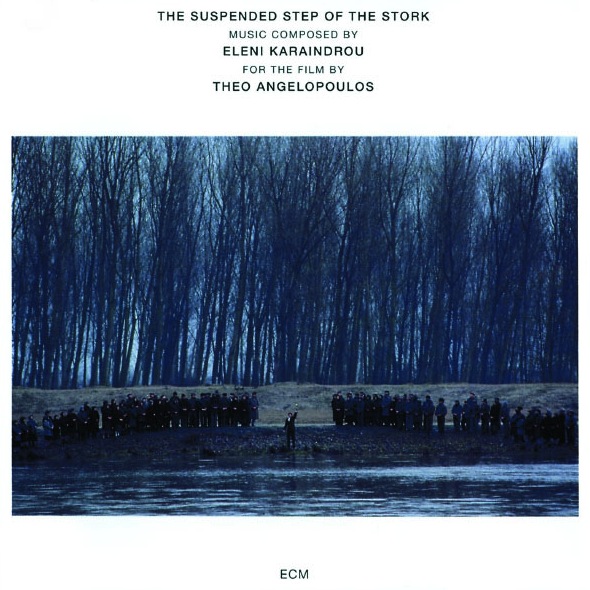
Eleni Karaindrou: The Suspended Step Of The Stork (ECM 1456)

Eleni Karaindrou
The Suspended Step Of The Stork

Vangelis Christopoulos oboe
Nikos Spinoulas French horn
Andreas Tsekouras accordion
Dimitris Vraskos violin
Christos Sfetsas cello
Ada Rouva harp
Lefteris Chalkiadakis director String orchestra
Recorded April and August 1991, Polysound and Sound, Athens
Engineer: Yannis Smyrneos
Produced by Manfred Eicher

“How does one leave?”

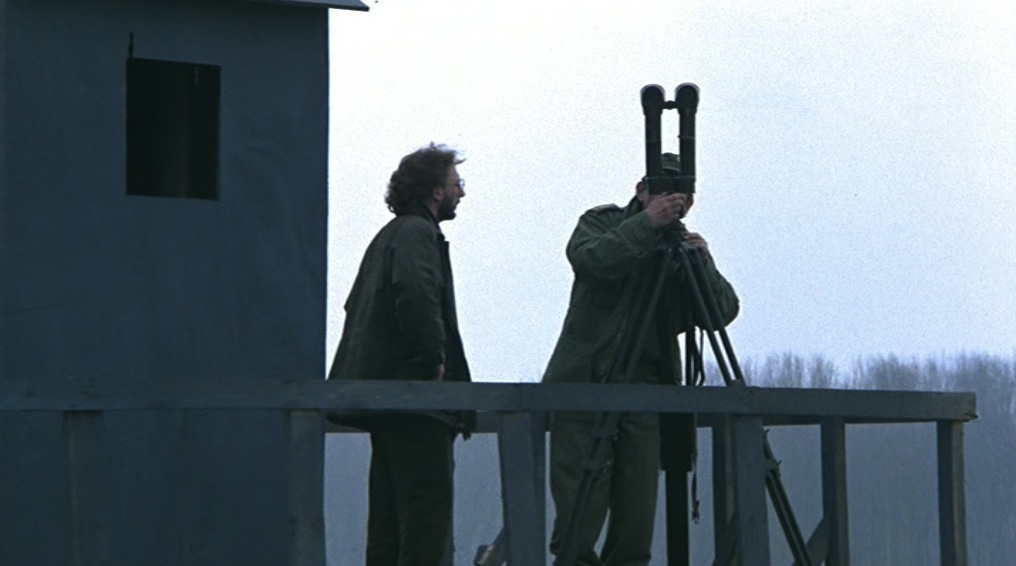
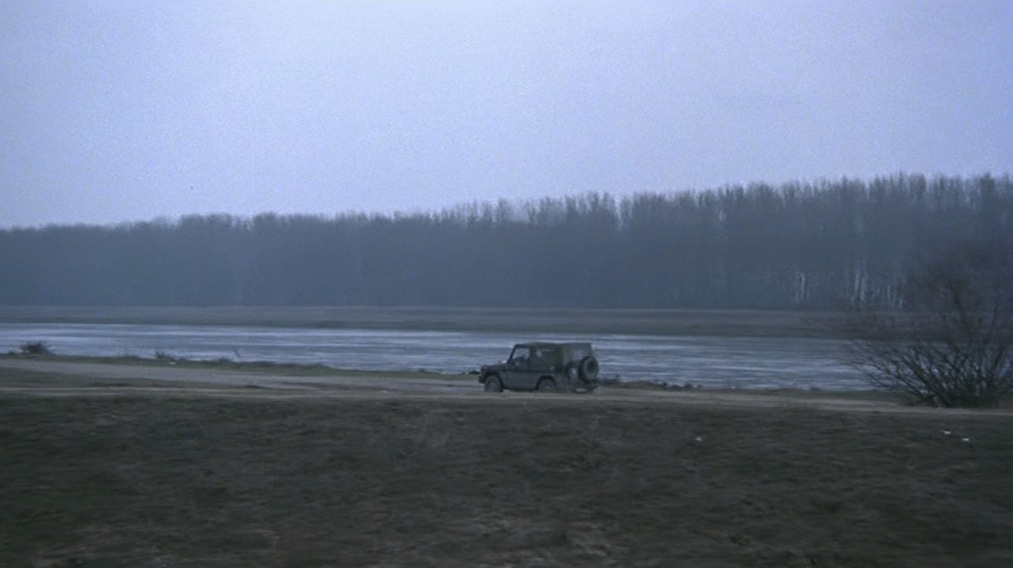
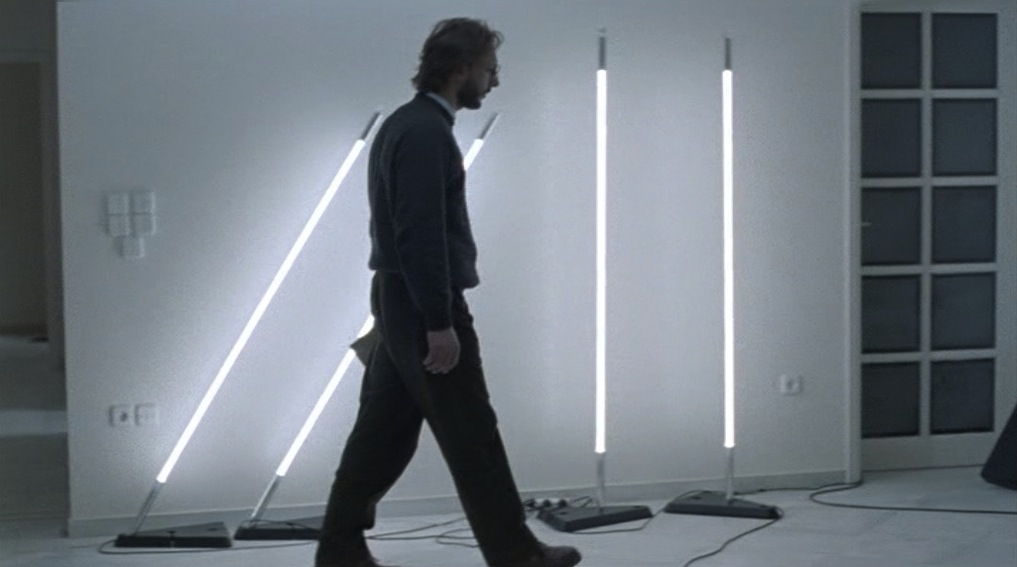
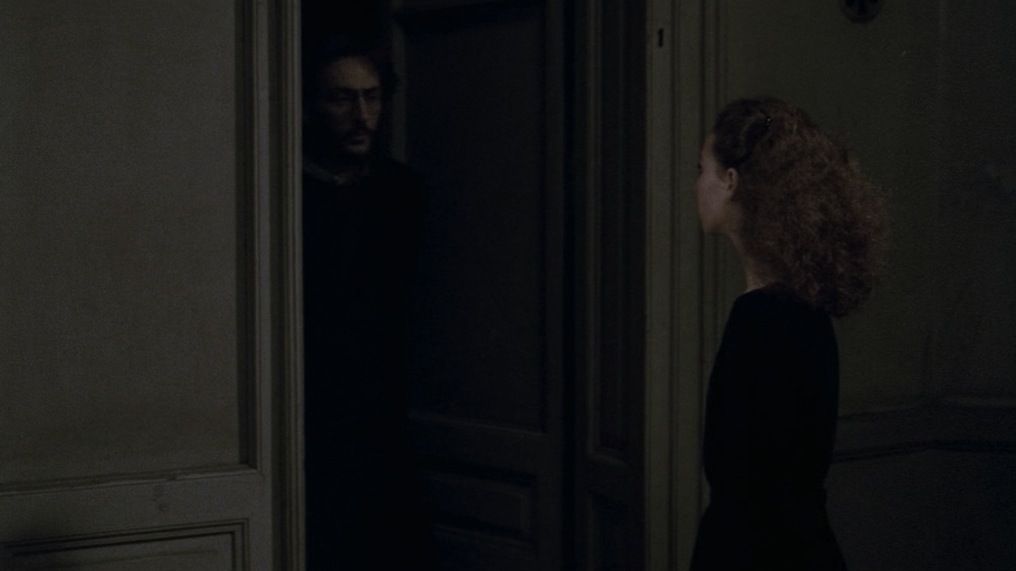
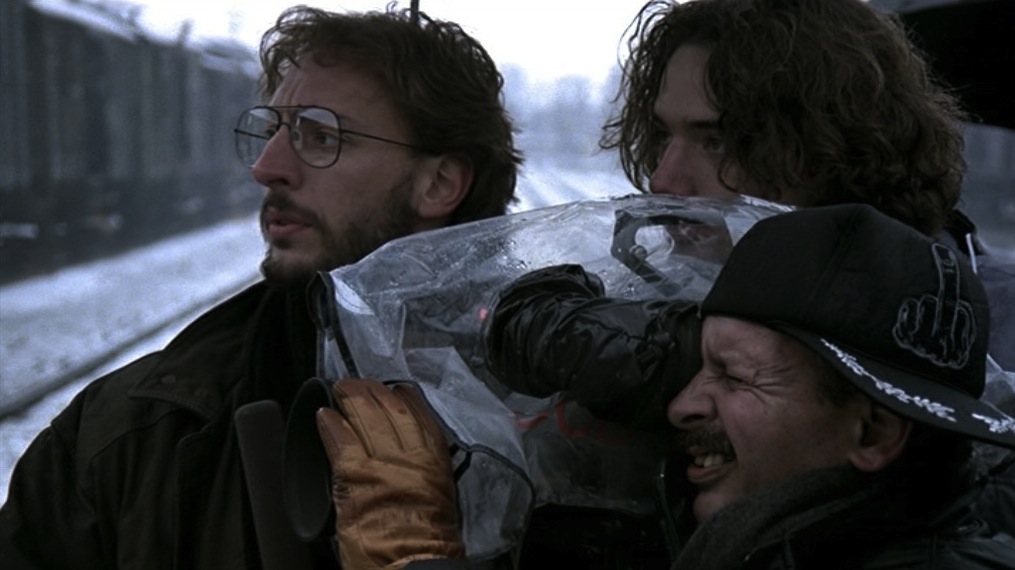
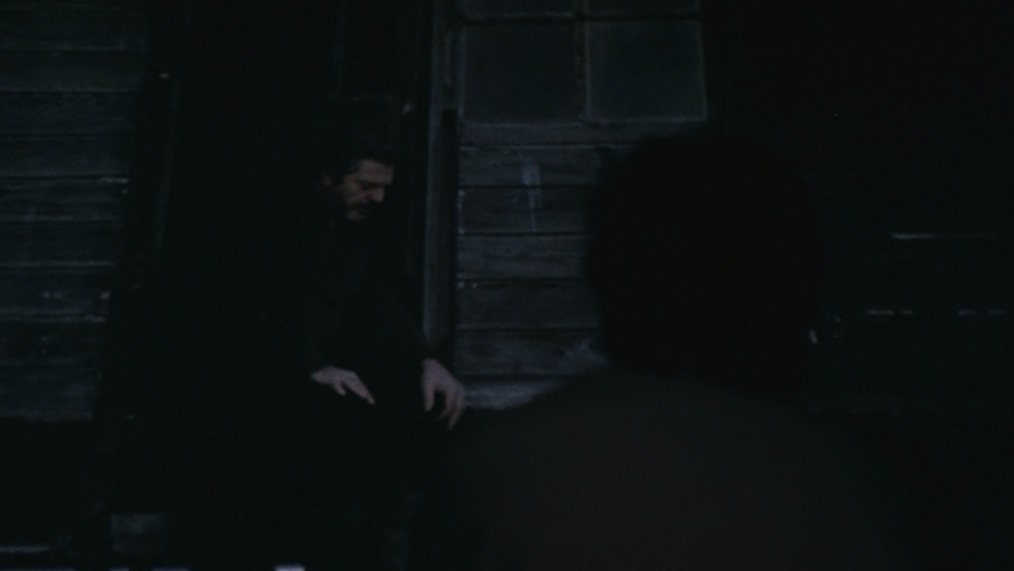
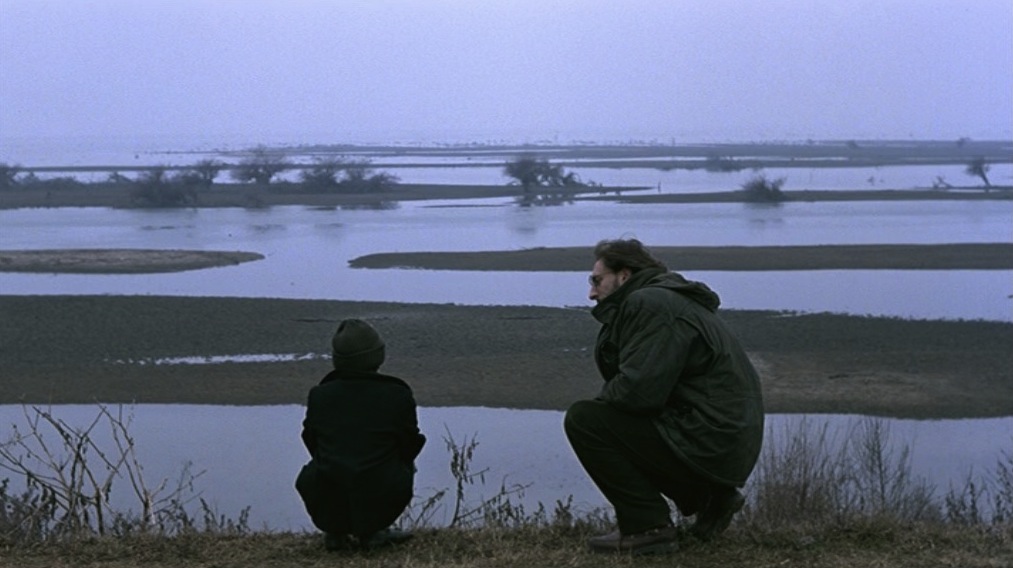
This question haunts The Suspended Step Of The Stork, Part I of Theo Angelopoulos’s “Borders” trilogy. A film of subcutaneous power, it finds beauty where there is suffering, stark yet foggy, as if through tearful recollection. Peeling layers to the emotional center of Stork is composer Eleni Karaindrou, whose soundtracks were never so much inserted into as bled from the late Greek director’s canvases. Hers is the audio equivalent of a tracking shot, scrolling through face, space, and race with barest touch. “Refugee’s Theme” shrouds the credits like an overture to lives whose variations are leaves on a tree of displacement.

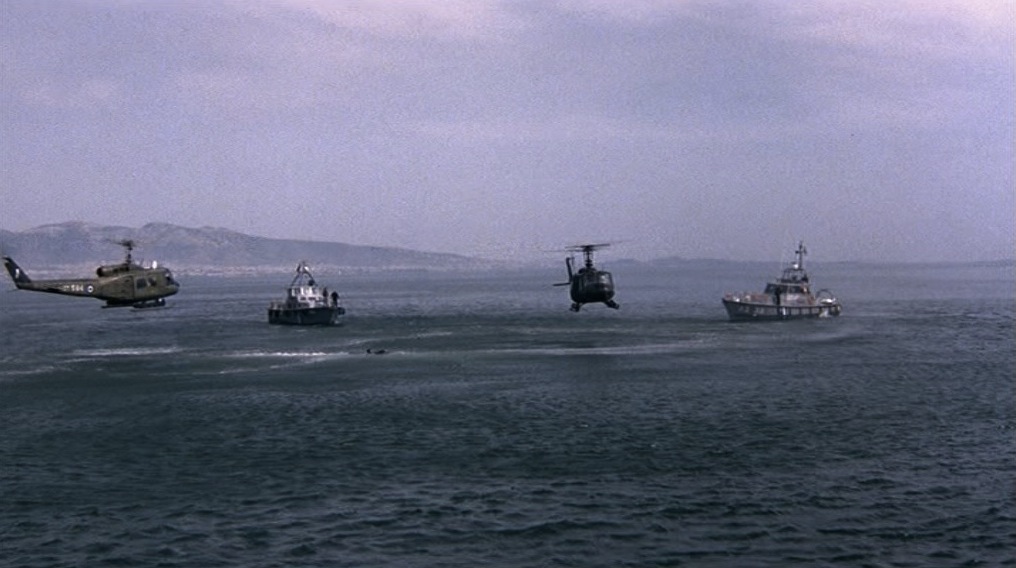
Of those lives we get only leitmotifs, each seeming far too short in the grander symphony of human suffering. Like the bodies floating in the opening shot, they bob at the whim of two rhythms: one natural, the other mechanical.

Helicopters and boats circle these transient martyrs, whose bodies huddle together still as they might have when still alive. Our protagonist, Alexandre (Gregory Patrikareas), a television reporter on his way from Athens to the Greek-Albanian border to do story, watches those same corpses—Asian stowaways refused political asylum by Greek authorities—and muses on the silence they represent amid all the commotion. The name of the ship from which those unfortunate souls would rather have leapt to certain death rings true: Oceanic Bird. Each has become exactly that, soaring far from the public eye on wings of salt spray and denial.

In a border town far from those waters, yet never from their ripples, a patrol Colonel (Ilias Logothetis) aids Alexandre in his search for information. Known by locals as the Waiting Room, said town plays host to refugees from Albania, Turkey, Kurdistan, among others. It is place with its own dimension, or so the Colonel asserts, a place where people lose themselves in the tide, forgetting that any such dimension is not inherent to the place, but forced upon it by politics and circumstance. It is, more to the point, a place of fear, where even the roar of the nearby river turns dreams into nightly prisons.

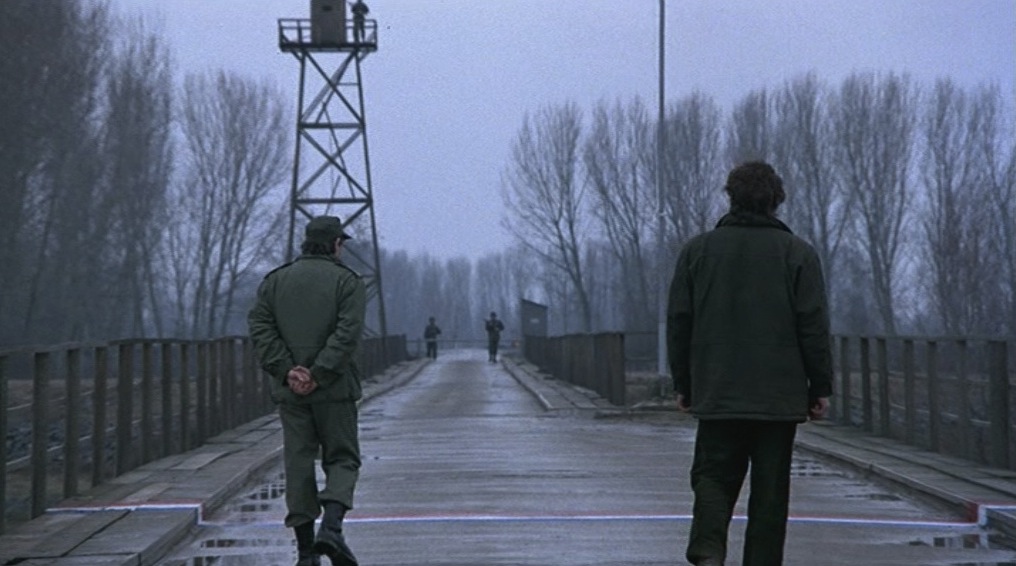
“Do you know what borders are?” the Colonel asks Alexandre in a key scene, as if the concept were in need of philosophical elaboration. This is the set piece he lives behind, the stage Alexandre so desperately, in his quiet way, hopes to transcend.

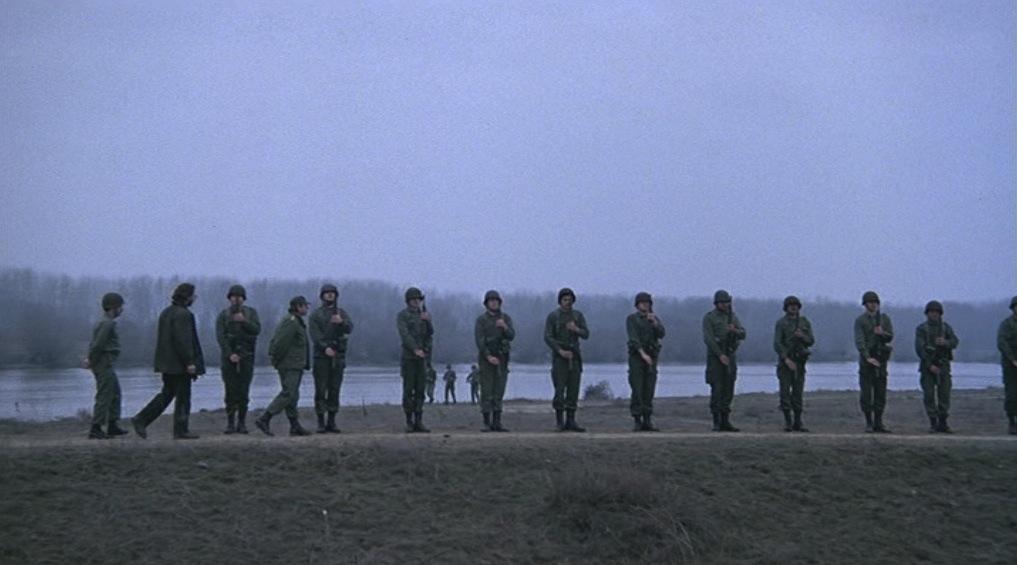
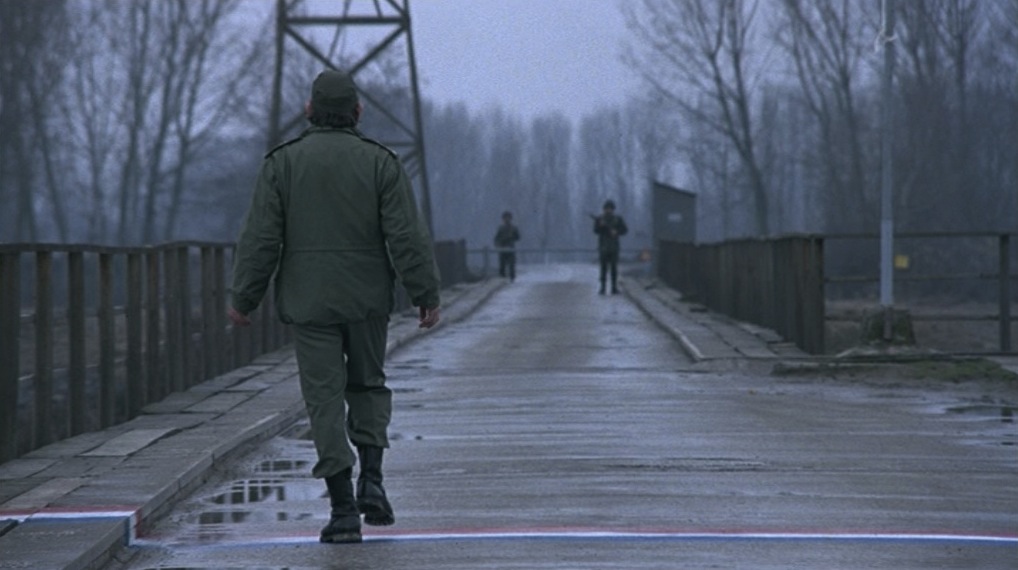
The Colonel lures the hapless reporter to that very line, threatening to cross it.


“If I take one more step, I’m ‘elsewhere’…or I die.”

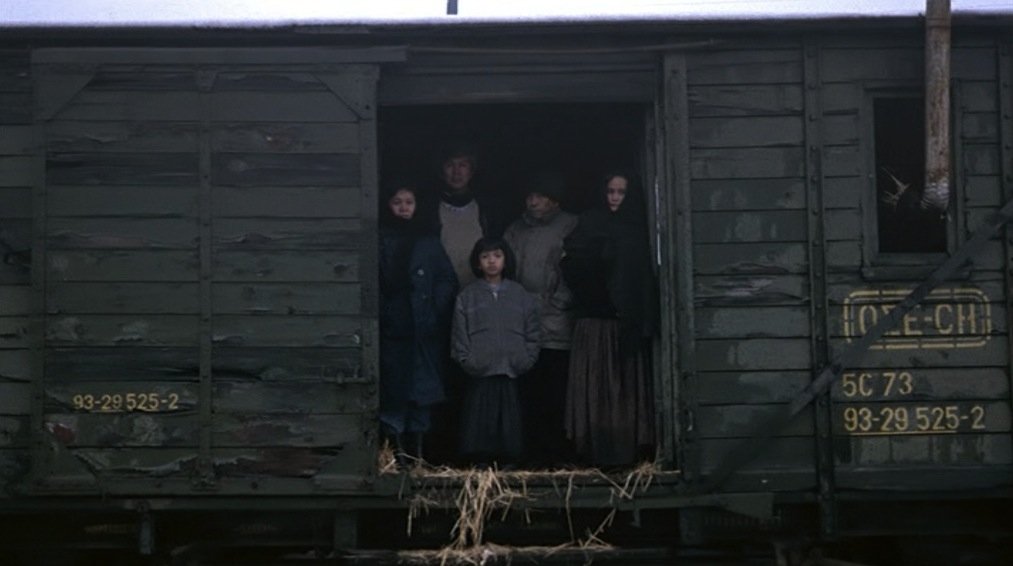
What seems on the surface a fruitful bonding moment, a shedding of rank that leaves two men at the brink of something profound and indelible, proves just as arbitrary as the border of their shared interest. Ever ahead of his audience, Angelopoulos offsets this shadow play with an audio montage of firsthand refugee accounts. Says one, recounting the fear of being seen during his night passage, “I could never imagine that I’d ever want the moon to die.” These words cut the Colonel’s sentiments like Brie, revealing the vulnerable innards of his arrogance. We are duly reminded that the “elsewhere” of which he feigns knowledge has, for them, taken on mythical meaning. It is the asymptote to their path of travel, seen in every expression as the camera pans along a train filled with survivors. Here, Karaindrou’s “Train-Car Neighbourhood” draws a thread through each life like a bead on a necklace of hardship.

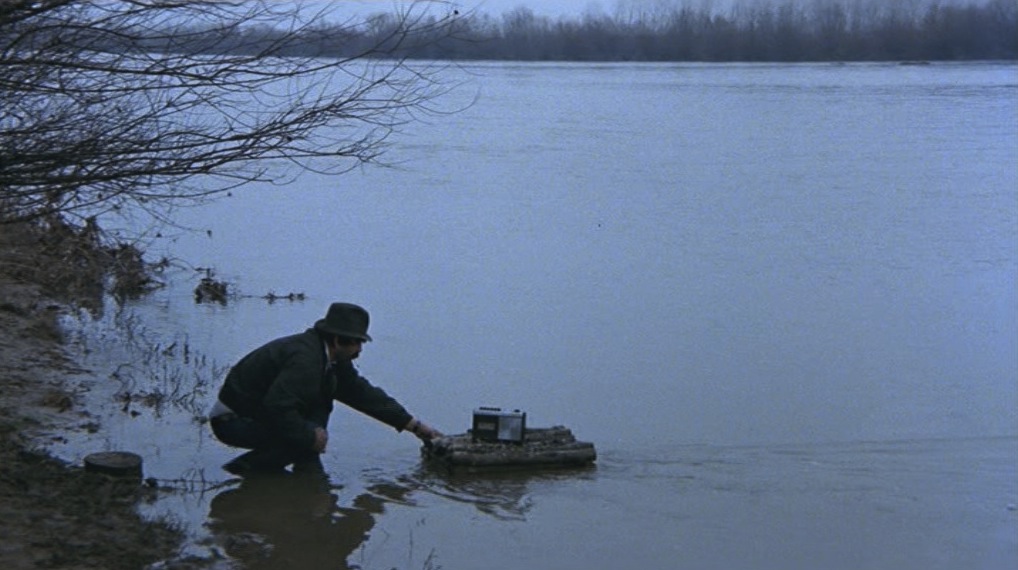
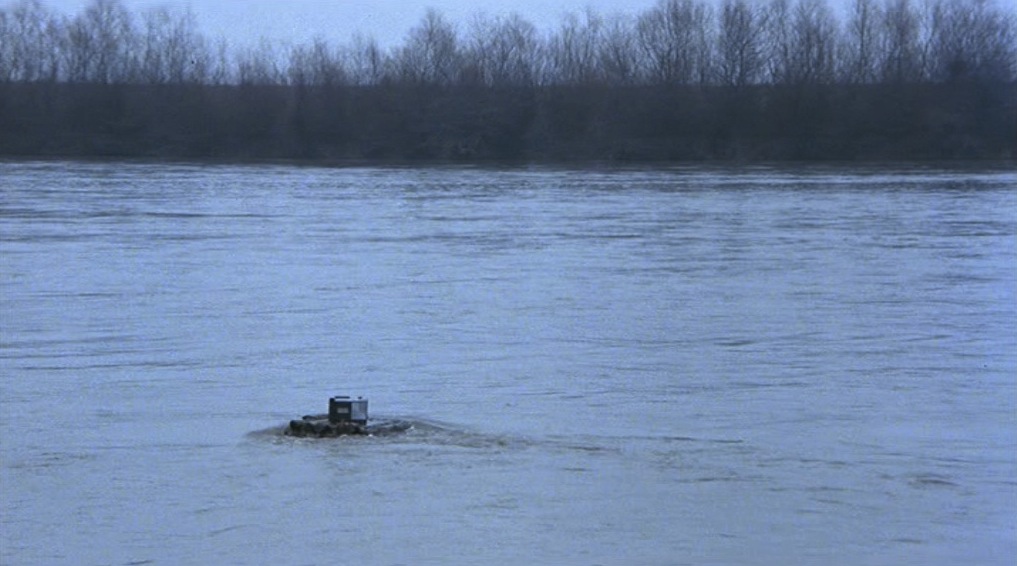
Yet perhaps no moment captures this separation of nomad and state power so heart-wrenchingly as when the Colonel berates a man for trading music across the river.

A cassette player spews popular lyrics of a better time on a small makeshift raft, which the man changes out before the player is pulled off screen.

Love is a full moon, croons Haris Alexiou from its weary speakers. It drives my body mad.

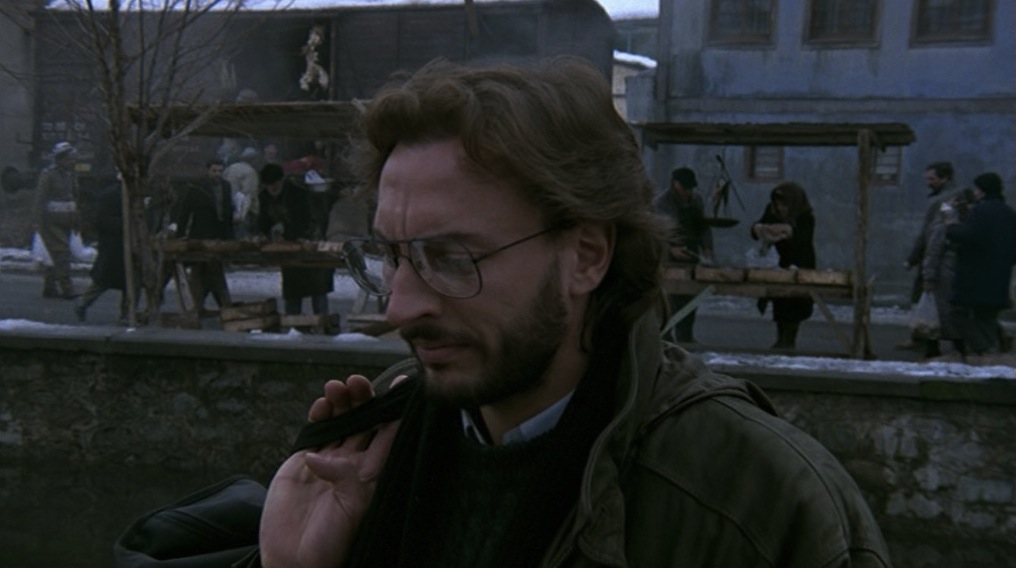
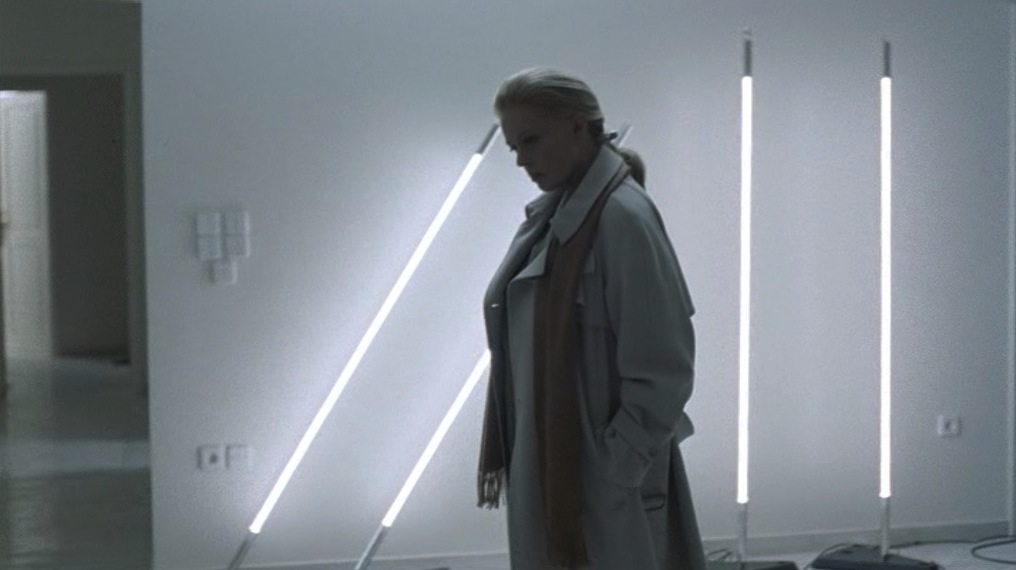
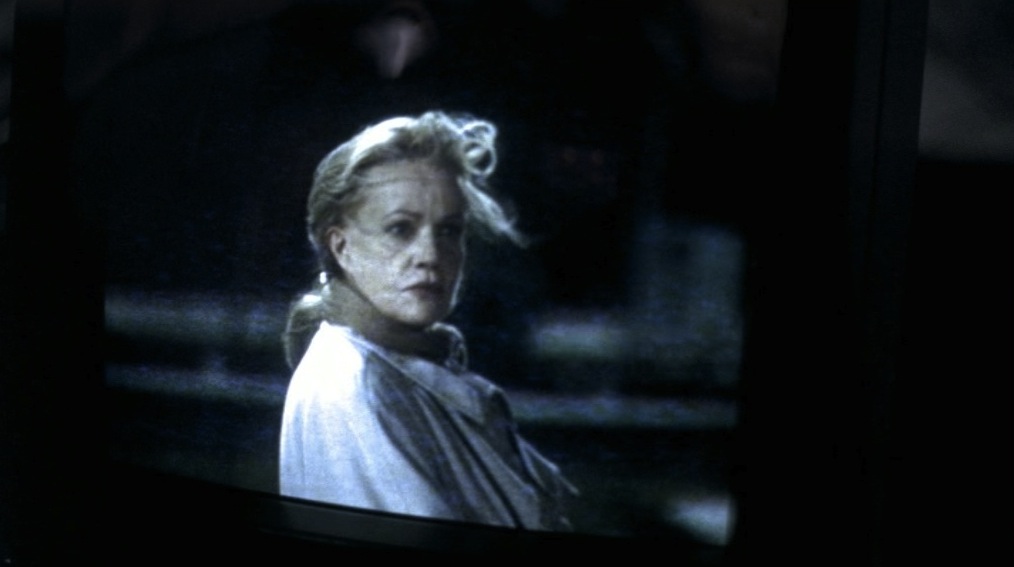
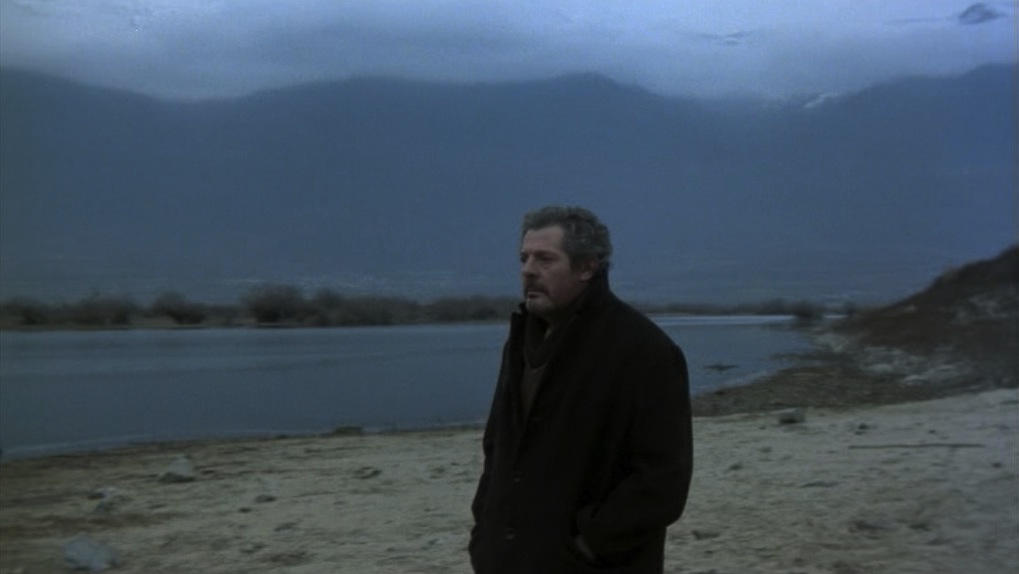
A rare close-up from Angelopoulos allies us with Alexandre, who believes he has spotted among the Waiting Room’s destitute a once-famous politician (Marcello Mastroianni). In Athens, he confronts the man’s ex-wife (Jeanne Moreau), who relates an abbreviated story of his mysterious 40-day disappearance—which indeed left him transformed upon his return—and subsequent vanishing act. She amends her brusqueness by coming to Alexandre’s home with a tape containing the last answering machine message her husband ever left, in which he admits, “I’m only a visitor.”

The woman tells Alexandre of a secret wound: “The thought that he wouldn’t share it with me was unbearable.” As the two move into the night, we realize that the cameras of reportage are now rolling, rendering her private confession into open testimony.

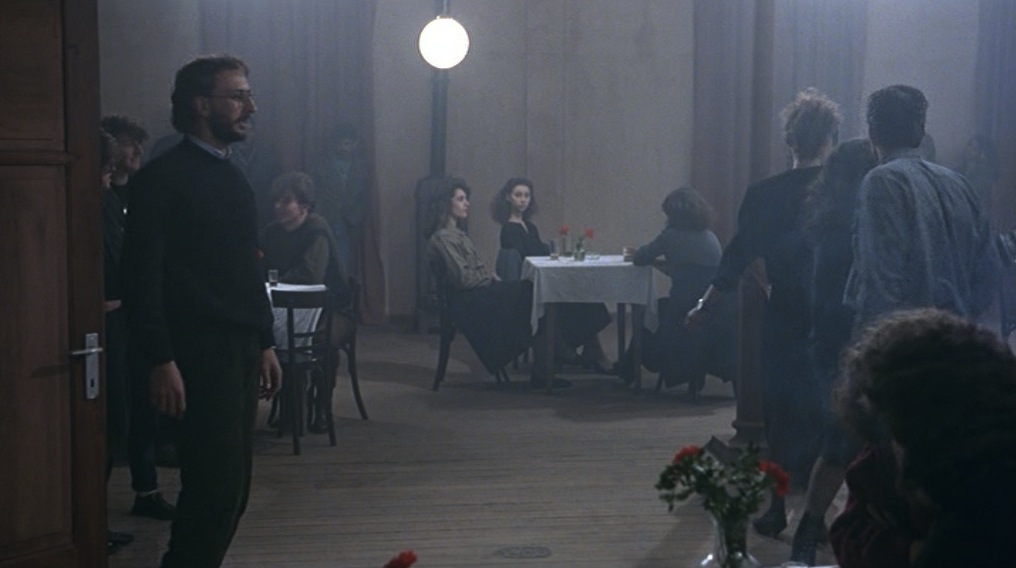
Alexandre searches the archives in the hopes of finding, somewhere in those tomb-like files of society’s forgotten, proof of the politician’s whereabouts. This chase leads him back to the border, and into the town’s only dance hall.

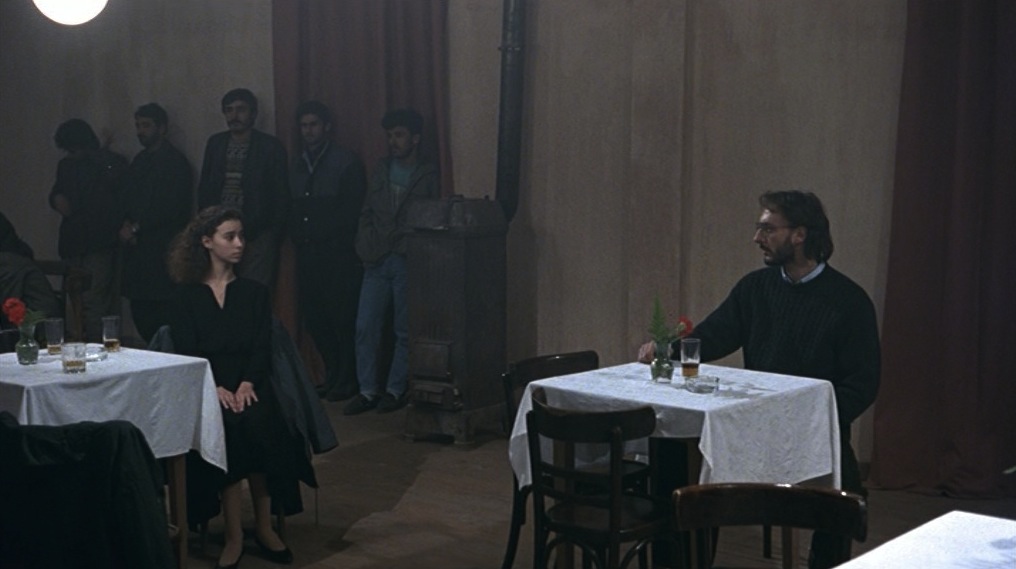
What begins as a chance to steep his thoughts in drink, however, soon funnels into a turned head, a stare from an enchanting girl (Dora Chrysikou), whose eyes now reverse the intense regard with which he has made his career back onto him.

Although he makes to leave, the girl approaches and follows him, silently, to his hotel room.

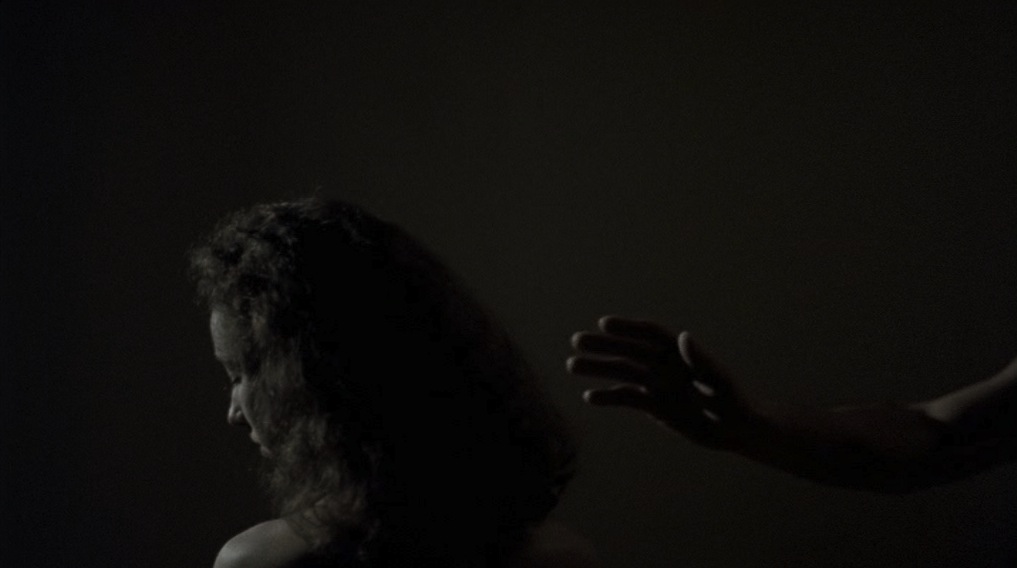
He recedes into shadow, able to touch her only as one might a rainbow.

This moment locks his resolve to get to the heart of this place, even as he (and the viewer) knows that such thinking is wishful at best. For although he does track down the politician (who we learn is the girl’s father), what he finds is the shell of a man who no longer is. Gone is the savvy figure of the spotlight. In its place is a storyteller who regales children with end time speculations.


“Forget me in the sea…”

Rather than leave this man to his own devices, Alexandre further reveals his own selfish interests when he arranges, and films, a reunion. The woman claims it is not him, retreating into the fantasy that her husband is long dead. The power of her statement resides in its duality: she is lying, but also not.

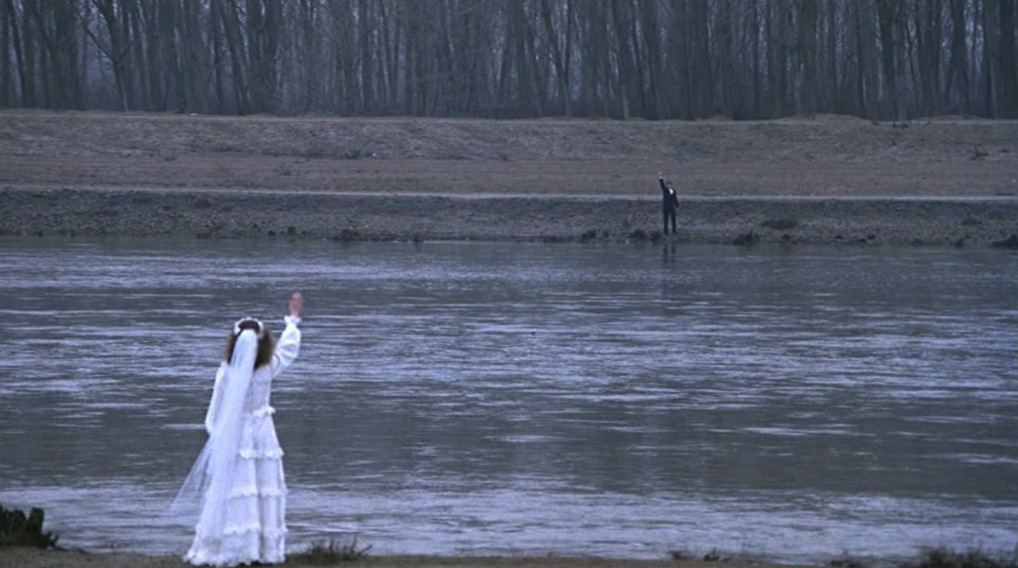
In the wake of this defeat, Alexandre suffers another when he discovers the girl of his refuge is to be married to a boy across the border. Only then does he admit to the Colonel, “The only thing I knew was to film other people without caring about their feelings.”

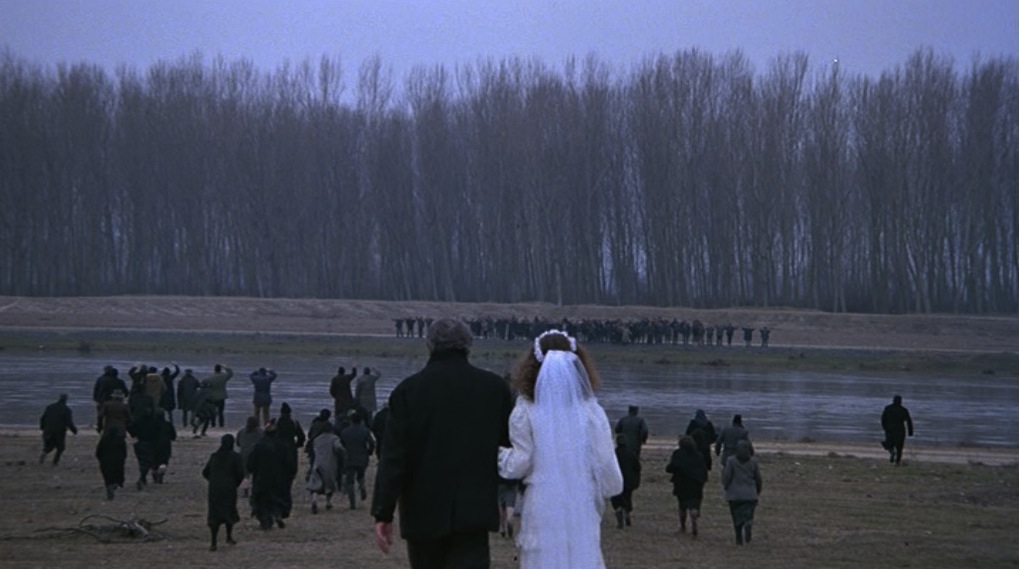
The ceremony must be conducted between patrols, even as that immutable river continues to roar and beckon between them.

Still, even after Alexandre’s epiphany, it falls under the watchful eye of his camera.


“We’re of the same race. I feel his hands holding me.”

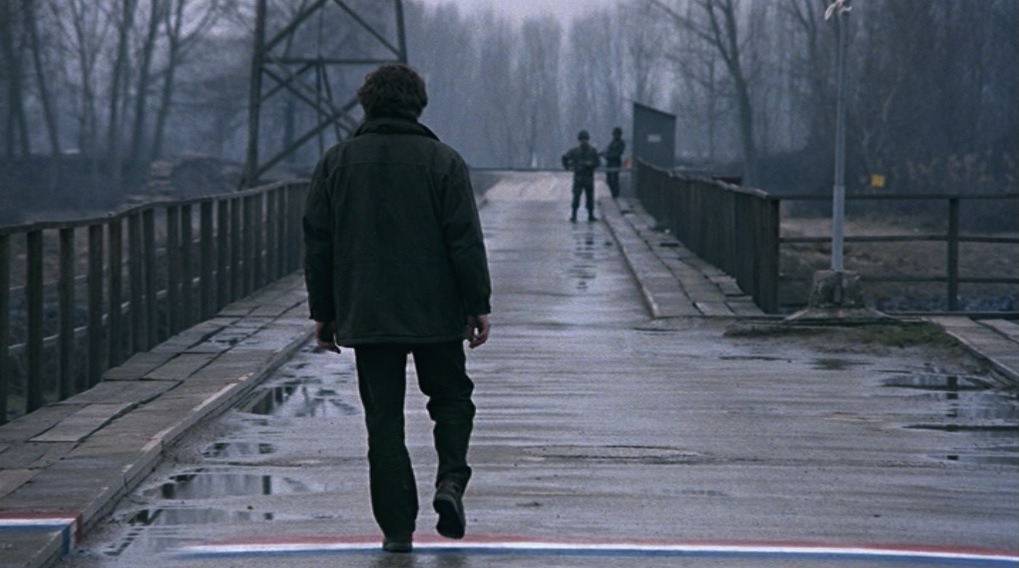
It is obvious to us now, if not before, that he can never be anything more than a tourist, a refugee who can never step out of his skin. Before leaving, he pauses at the border, holding up his foot like the Colonel, a crane in contemplation.

If the ceremony is the peak of the film’s narrative mountain, then these steps at the border are its sloping sides.

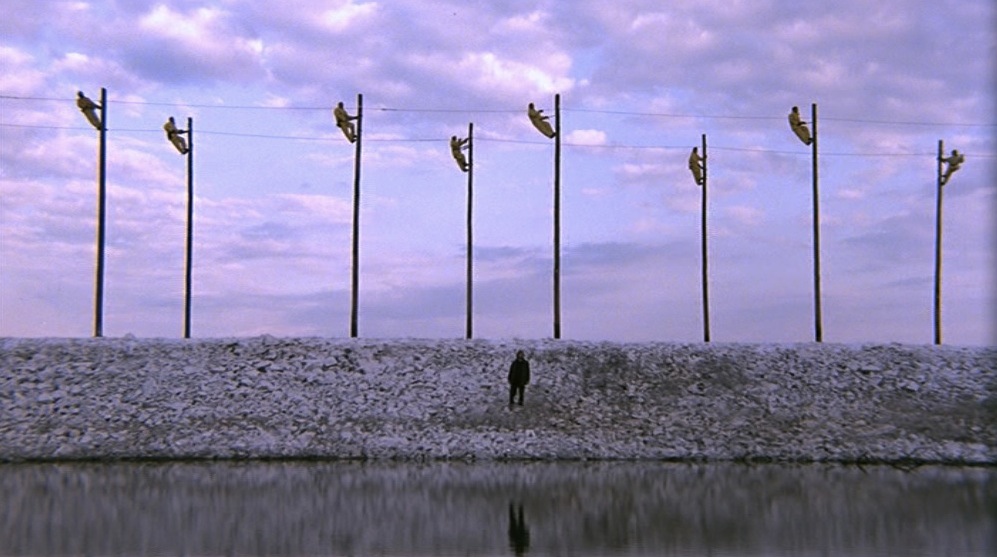
Heavy on Alexandre’s mind, we can be sure, is the news that the politician has again fled across the border, blending into the trees Angelopoulos paints so artfully in our vision throughout. And it is from those trees that the telephone poles that end the film are born, rising into the heavens, their wires able to connect nations in ways that no flesh, or even love, is capable.

Even with these powerful scenes pulsing through us, the sweeping carriage of Karaindrou’s soundtrack (the 36-minute running time of which betrays a ghostly presence) digs even deeper. An affect-rich creation, it solders the stained glass window that filters the film’s fettered light. From its heaving strings to forlorn winds, the music recedes into, as quickly as it awakens from, a wavering memory. One can almost feel in slow motion the searing cords of strife robbing necks of their breath, and minds of their faith, to the pathos of governmental indifference. And while moments of hope, such as the endearing accordion of “Waltz Of The Bride,” do appear, it is the slow pall of mist and water that Angelopoulos so favors that leave the boldest impressions in our ears.

The words the politician once spoke at a parliamentary session haunt us still: “There are times when one has to be silent in order to be able to hear the music behind the sound of the rain.”

How one leaves, then, has become an empty question. In the end, all that matters is how one sounds.

<< Hal Russell/NRG Ensemble: The Finnish/Swiss Tour (ECM 1455)
>> Anouar Brahem: Conte de L’incroyable Amour (ECM 1457)

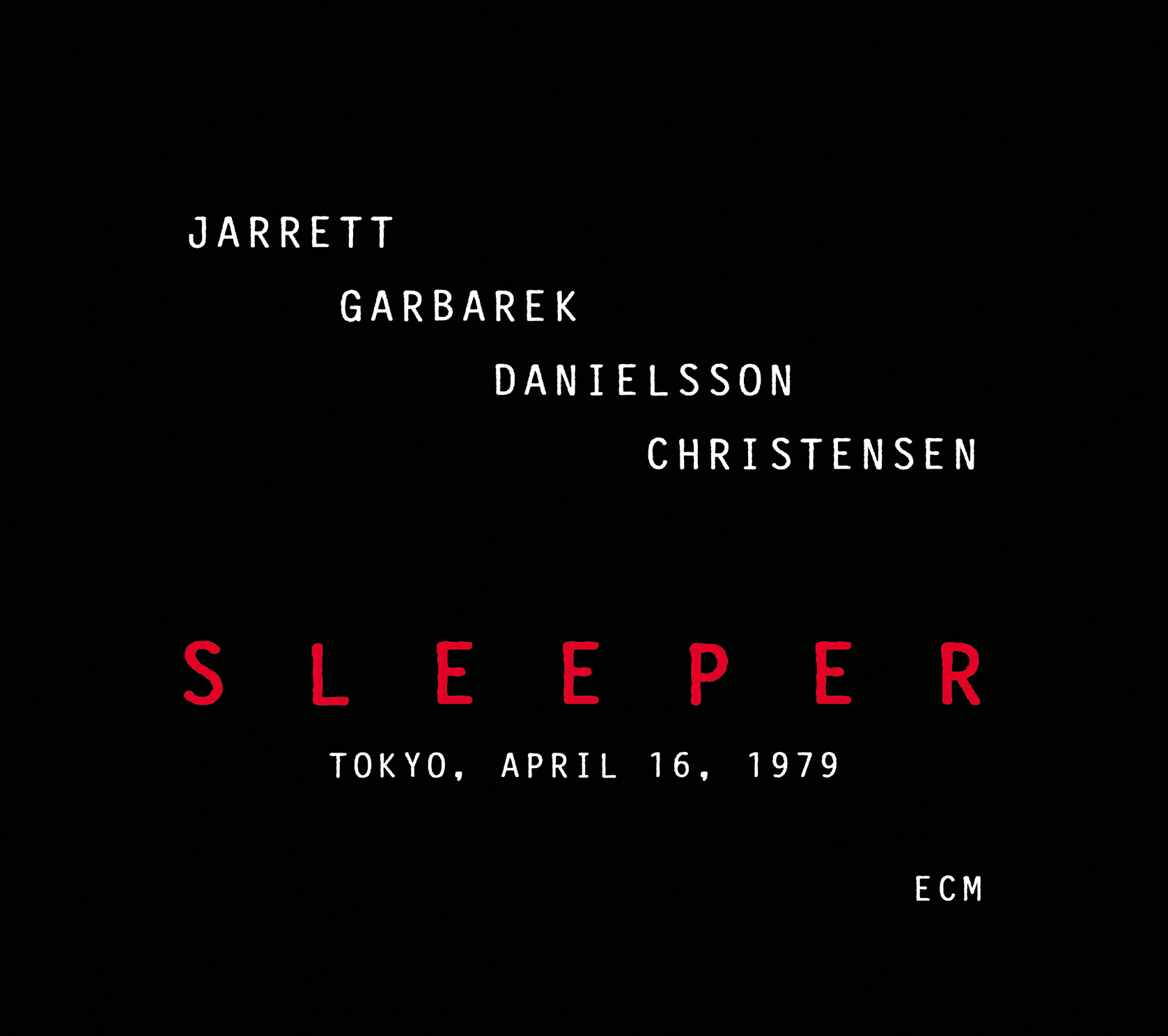
Keith Jarrett: Sleeper (ECM 2290/91)

Keith Jarrett
Sleeper

Keith Jarrett piano
Jan Garbarek tenor and soprano saxophones, flute, percussion
Palle Danielsson double-bass
Jon Christensen drums, percussion
Concert produced by AI Music (Toshinari Koinuma) in collaboration with Trio Records/ECM/Bose
Recorded live April 16, 1979 at Nakano Sun Plaza, Tokyo
Engineer: Jan Erik Kongshaug
Mixed 2012 at Rainbow Studio, Oslo by Jan Erik Kongshaug and Manfred Eicher
Produced by Manfred Eicher

Keith Jarrett’s European quartet—with Scandinavian cohorts Jan Garbarek of the reeds, Palle Danielsson of the strings, and Jon Christensen of the sticks—was the missing link to his trio endeavors with Gary Peacock and Jack DeJohnette, finding a happy medium between the latter’s standards-based approach and his marathon improvised performances alone at the keyboard. The quartet boasted not only fine technique and dovetailed sense of timing, but also the fruit of its leader’s compositional labors during a period of career-defining development. Representing the pinnacle of five sporadic years, Sleeper documents a 1979 Tokyo show from the same tour that brought us Personal Mountains. That very tune kicks off this set of amethyst originals, Jarrett and Garbarek comprising the perfect hand-tooled leather for D&C’s riffling pages. Their Niagara pulse splashes this April canvas with blistering watercolor, Garbarek close behind as he leads us by the ear into “Innocence.” For this he adopts a folkish quality against support so synchronous, it’s as if it were responding to something as elemental as wind. And Jarrett likewise, as he pours on the syrup of “So Tender.” This unexpected travelogue proceeds at an inviting clip and features resplendent emoting from Jarrett, who manages to brighten even Christensen’s characteristic glitter. Garbarek both shouts and whispers, riding a wave so robust that every lick feels thematic while also trembling at the threshold of Jarrett’s spontaneous pulchritude. So do we proceed, funneling romance into an “Oasis” that can only be filled by a lifetime of love for music. The nearly half-hour take given here is reason enough to celebrate this record. From the opening Spirits-like incantations, infused with wooden flute and gamelan-like percussion, to the uplifting procession with which they end, Garbarek and Jarrett draw shades of gut-wrenching intensity. Despite its length, this track walks an intimate, ritualistic space. Majestic without being magisterial, it touches us like the energy that sustains it and flavors the waters of its namesake with the promise of restoration. “Chant Of The Soil” locks early and doesn’t let go. Bass and drums work like dolphins to keep us from drowning, enlivening Garbarek’s soulful phrasing with conviction, while “Prism” (another highlight from Personal Mountains) finds itself resurrected here in flowing dialogue before the invigorating circle of “New Dance” gives fresh meaning to the encore.

If ever it were possible for a recording to be even more alive than the day it was laid down, this is it—such is the value of its release. In addition to the symbiotic rhythm section, Garbarek naysayers may find themselves knocked on their rears by the exuberant, life-affirming themes issuing from his bell, each fitting snugly in Jarrett’s pianistic relief. A classic before it ever hit the shelves, Sleeper may just be the ECM event of the year and is, as its title implies, a dream to hear at long last.

Listen to samples here.


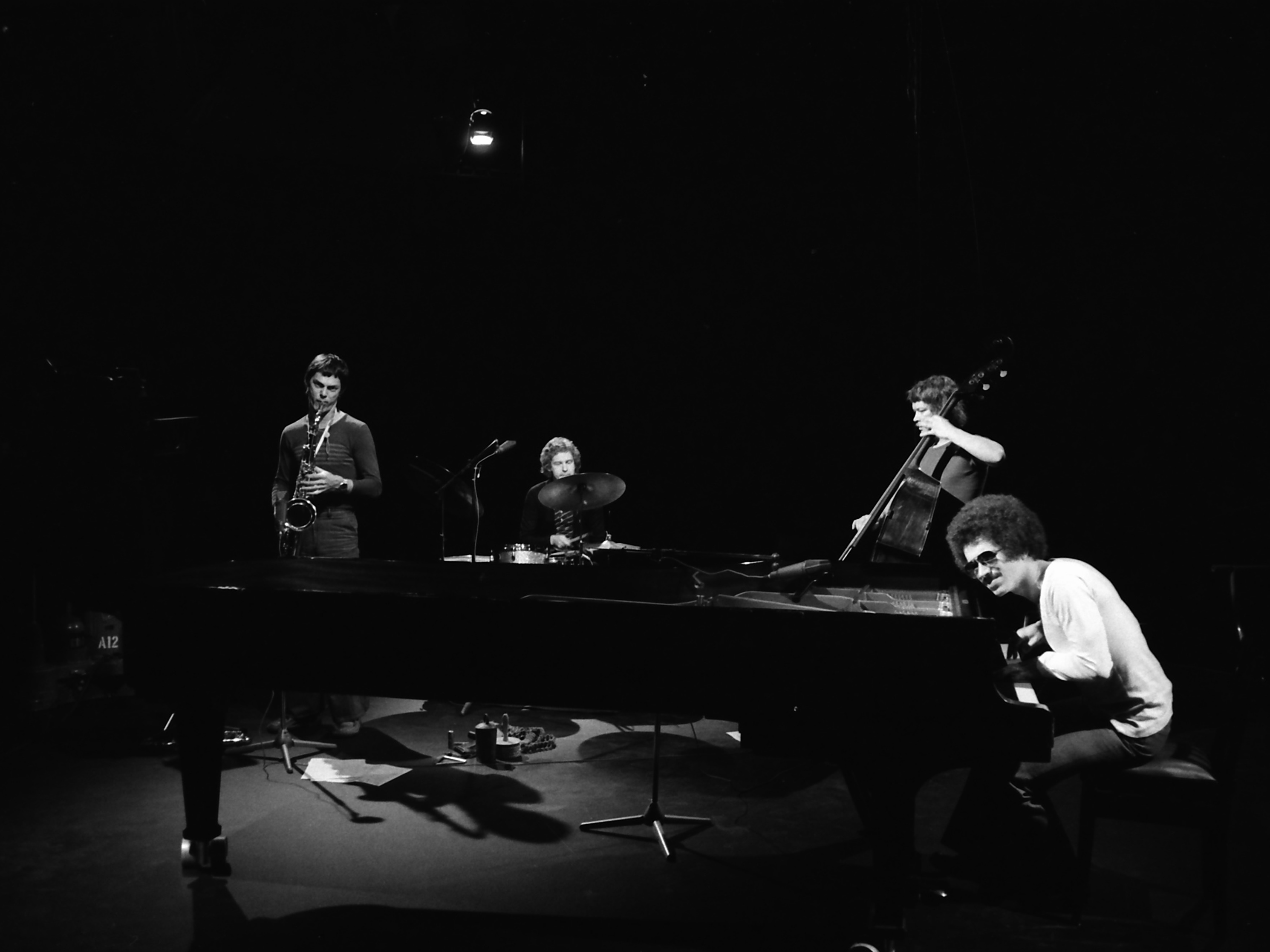
(Photo by Terje Mosnes)

“Before Your Very Eyes”: The Masters Quartet Live Report

August 4, 2012
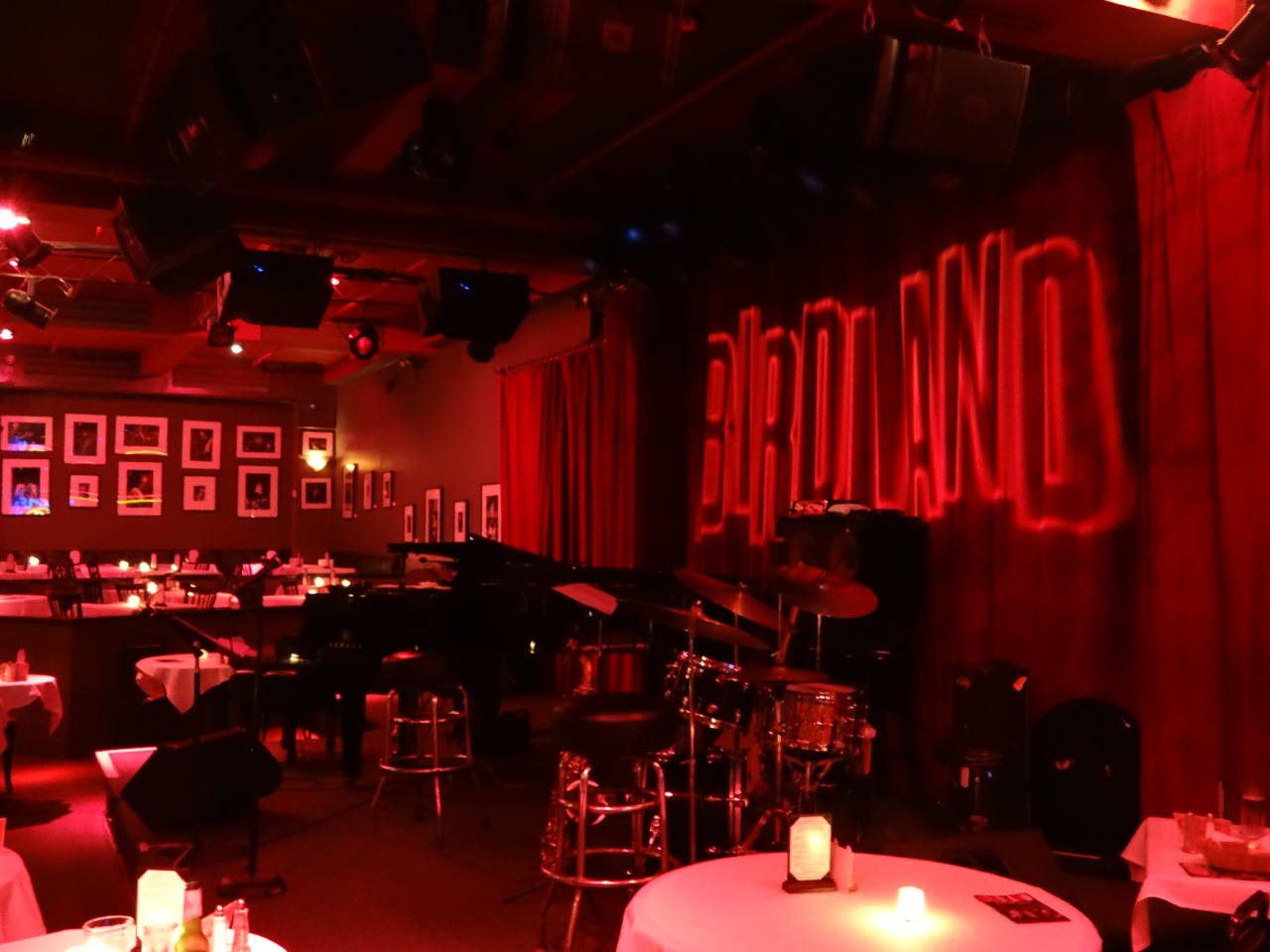
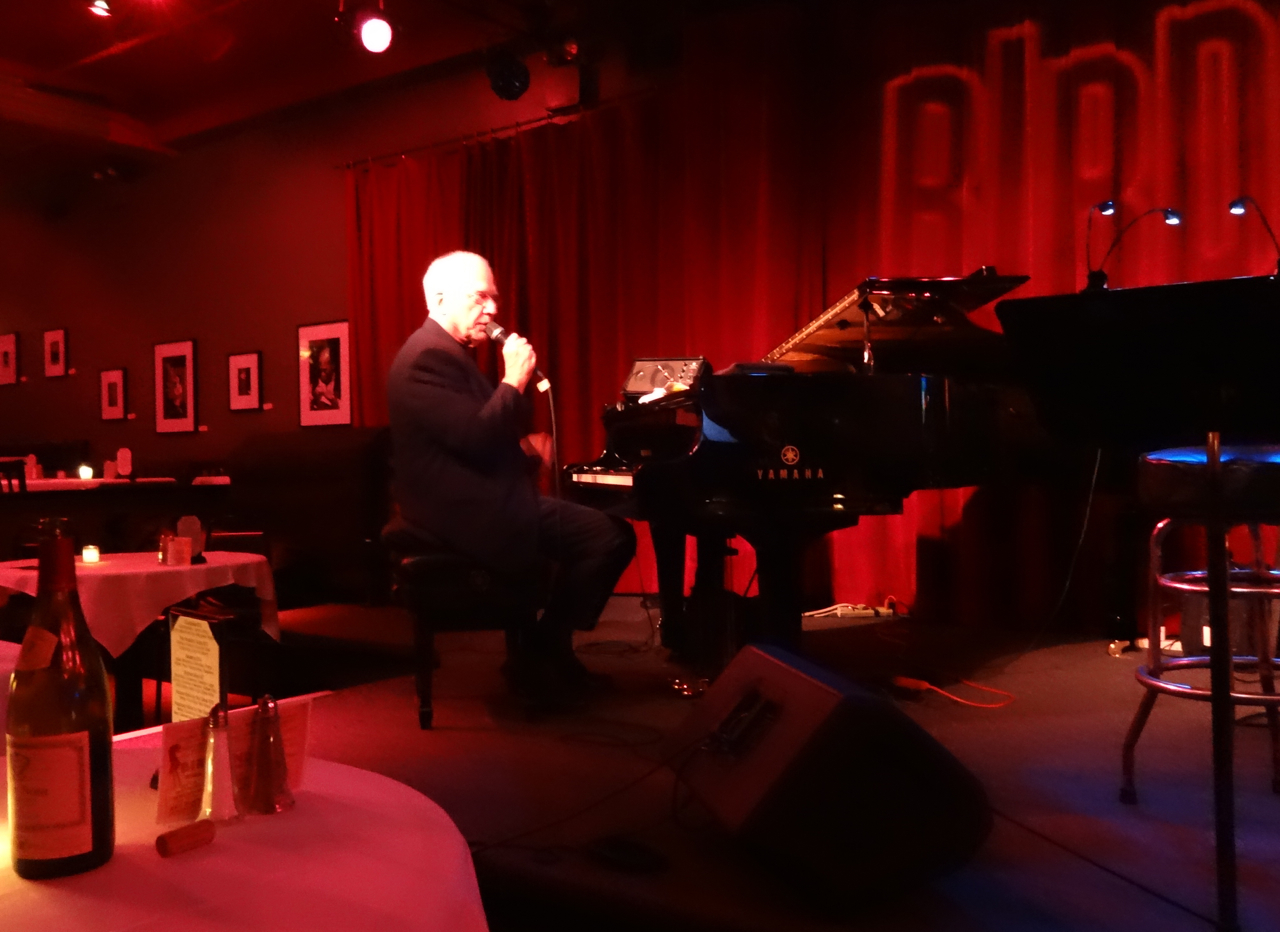
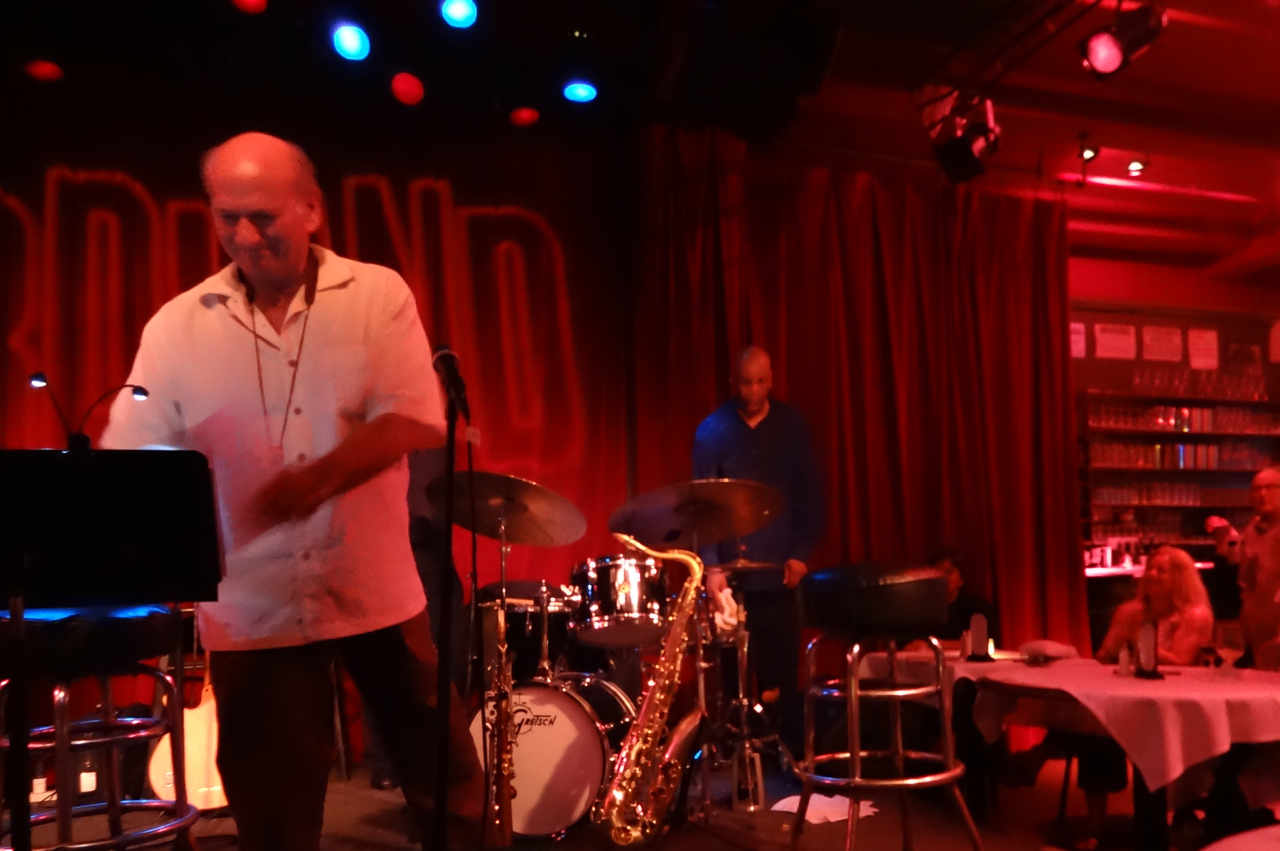
Birdland
8:30 & 11:00 pm

Steve Kuhn piano
Dave Liebman saxes
Steve Swallow bass
Billy Drummond drums

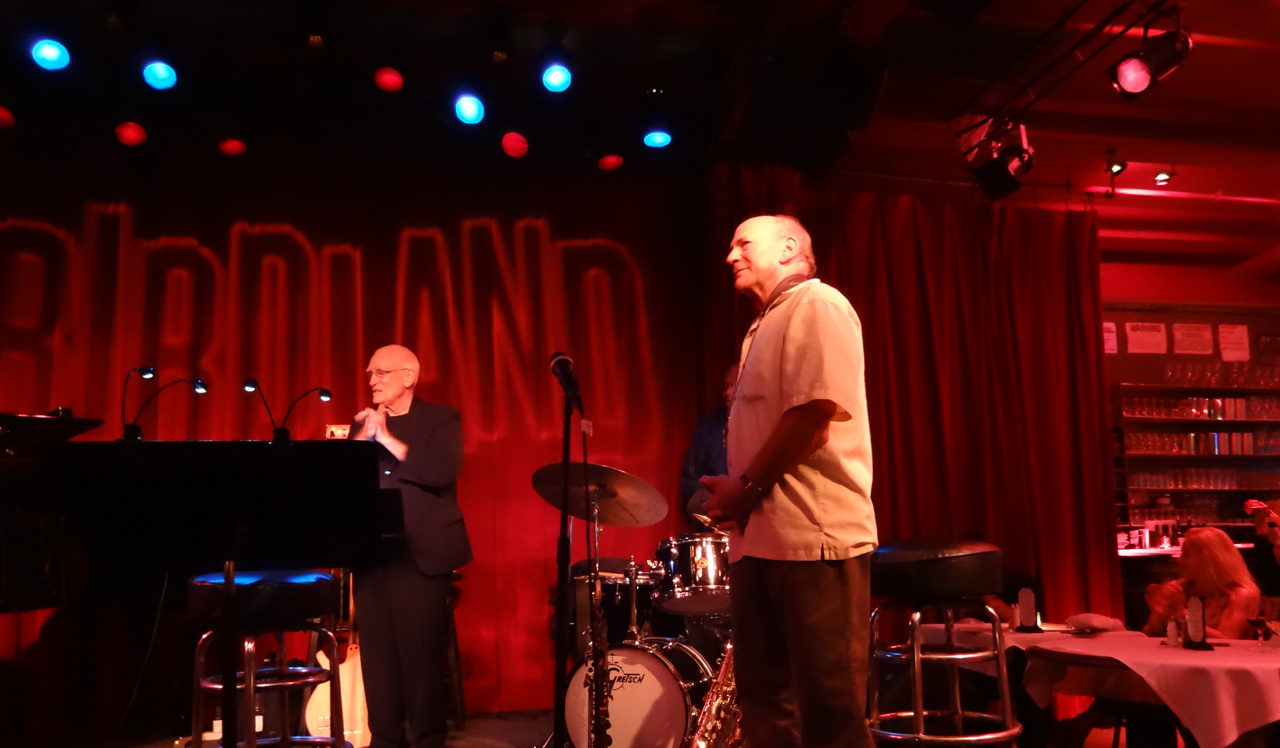
My first pilgrimage to New York’s hallowed Birdland brought me before the Masters Quartet. One year later I find myself coming full circle, once more in the presence of these phenomenal four.

Opening a pair of trio tunes (sans Liebman), Kuhn lulls a sold-out house with his intro to “There is No Greater Love,” from which arises a synergy between bass and drums that will come to rule the night. Those full and sparkling keys bring us to a gorgeous turn from Swallow, who casts a distinctly rounded shadow with a new custom instrument. His “Dark Glasses” marks the first of two nods to Wisteria, his new ECM joint with Kuhn and Joey Baron. Its slick ground line is the sunshine to Drummond’s butterfly wingbeats. The second Wisteria tune, “A Likely Story” (Kuhn) ends the set, for which Drummond wows with a proper solo, projecting sparks of life.

Along the way, Liebman lays down some tenor for an original, G.I.G. (i.e., George Ira Gershwin). With characteristic robustness he runs up and down the thematic ladder, pulling out a squeal or two along the way and pausing for effect against the tide. Kuhn throws in playful clusters Drummond’s way, joining Liebman in whipping the band to a cerebral, Masada-infused froth.

Swallow spins arid webs from the opening of Trane’s “Village Blues.” A solo from Kuhn, hip and loose, referees a heavy exchange between sticks and reed. Swallow follows up with “Remember,” for which soprano makes its first appearance of the night, complementing the bass’s winding legato. Liebman softens the mood with “Mommy’s Eyes,” projecting a childhood’s worth of memories and developing like a color photograph turned sepia from an oceanic voyage. Kuhn lifts these recollections beyond language, ensuring that only in music will we fold the void of loss into something shining and familiar.

The second set kicks off with “Eiderdown” (Swallow). This classic morsel is smoothness incarnate and provides ample segue into “Stella by Starlight.” Swallow’s lyricism here is a joy, feathered by a bone-vibrating quality, while Drummond skips stones across the watery surface of his Gretsch kit at the most tasteful moments. But the lantern is just getting lit, for Liebman has taken to the stage with plenty of midnight oil to spare. That soprano, silky yet striated with coal-bright sentiments, drips liquid gold in his “All the Things That…” Nothing, however, surpasses the nightcap: four unforgettable tunes of—say it with me—masterful proportion. A profoundly considered take on Wayne Shorter’s “Black Eyes” reveals catharsis from Liebman, who traces thicker shadows in the meditative rubato of “Master of the Obvious.”

A misplaced score yields the night’s greatest treasure when he reverts to tenor for an off-the-cuff “Blue Bossa.” He and the band do wonders with this, following up with the appropriately titled “Four” (Miles Davis), which runs a course of snakes and ladders through the jazz lover’s soul into Drummond’s fabulous closer.

Having just completed a European tour together, Swallow and Drummond make an intuitive team, while the ever-attentive Kuhn doesn’t so much make as allow the piano to sing. Yet it is Liebman whose storytelling goes deepest. His slipstream brilliance smoothes out every sonorous wrinkle to hotel sheet crispness, such that by the end it’s the vamp that feels avant-garde.

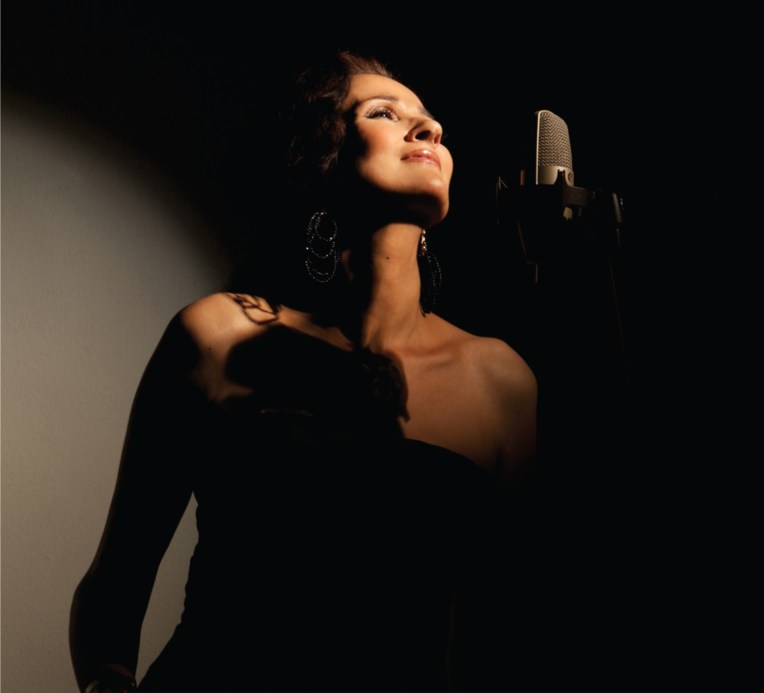
Pavanes from a Princess: Going Beyond the Blue with Tessa Souter


(This and Beyond The Blue cover photo by Joseph Boggess)

When Tessa sings
She dusts off her rings
Her baubles, bangles and beads
She takes to the stage
Irrespective of age
And emotes as if something she needs

All too often we throw jazz and classical music into opposite ends of a proverbial ring. In most circles the latter wins out, if only by the brute strength of its history. While time cannot be the sole criterion when evaluating the worth and self-sufficiency of any genre, it would seem to be primary in our hypothetical referee’s mind. Where does this referee come from? Do the black and white jail bars of his uniform manifest an equally divided worldview? Can anything in the audible universe really be so simple? We can thank the stars above that artists like Tessa Souter, whose voice blushes with an acceptance of life for what it may ever bring, are showing us just how limiting our quarantining of genres can be. For when those first strains of “The Lamp Is Low”—off her latest, Beyond The Blue—catch our cochlea unawares, we recognize the permeability between them, as if the most natural cross-fertilization in all of music. Set to Ravel’s Pavane For A Dead Princess, the song sashays into the night, flitting like the shadow of a hopeful sigh from behind a veil of melancholy. Only in that loneliness can we know the timeless truth of the singer as an artist in reverse, one who hands us the paints with which to render our appreciation visible.

Bridging this chasm of reflection from one end to the other is a personality that never falters in Beyond’s 12-song session, nine of which place Souter’s original lyrics alongside the tried and true. Each track takes a classical melody as its wings and cocoons at their center a body of stellar musicians: Steve Kuhn on piano, David Finck on bass, Billy Drummond on drums, Joe Locke on vibraphone, Gary Versace on accordion, and Joel Frahm on saxophones. With such a finely attuned thorax in the pilot’s chair, Souter’s luxuriance can catch those winds from long ago and flap them afresh like spring. Between the early light of “Prelude To The Sun” (a luscious reimagining of the second movement from Beethoven’s 7th) and the glistening bossa inflections of “Brand New Day” (based on Fauré’s op. 24 Elegy) Souter charts a journey of great emotional distances, all the while drawing a circle private enough to conceal in a teardrop.

What with Kuhn’s enchantment and Frahm’s mellifluous commentary, there’s plenty to love when that unmistakable voice (but never its spell) recedes. Potentially hackneyed motives can be nothing less than clay in such capable hands. “Chiaroscuro,” for one, pours Albinoni’s diluted Adagio into a mold of midnight and cracks open from it something bright and fair. Neither is the group afraid to call upon Debussy (“My Reverie”), Brahms (“Sunrise”), Schubert (“Noa’s Dream”), and even Rodrigo (“En Aranjuez Con Tu Amor,” throughout which Locke wavers like moonlit waters). And then there’s “Dance With Me,” which through the lens of Borodin’s Polovetsian Dances tells the story of a reluctant partner whose movements of the heart, while enough for the limbo of passion that scuffs the floors of a shared life, find themselves faltering endearingly in reality. That sense of closeness and twirl finds clearest life in Versace’s solo, a highlight among a string of fine contenders. Souter makes sure to include the delightful “Baubles, Bangles And Beads” (based on the second movement of Borodin’s String Quartet in D) in deference to past classical-jazz crossovers. Drummond and Finck make for an exquisite rhythm section here. The title track emerges from the dark, cold, and starless sky of Chopin’s e-minor Prelude (op. 28, no. 4) holding galactic light to its bosom and wishing upon itself as it streaks into a sleeping child’s heart. Souter adopts a sparse approach to these songs, bookending shelves of thoughtful improvisation with her gliding ways. Her sources imbue the results with something aged, so that even when we think we’ve never heard them before, their contours are undeniably familiar, the sentiments to which they conform and respond even more so.

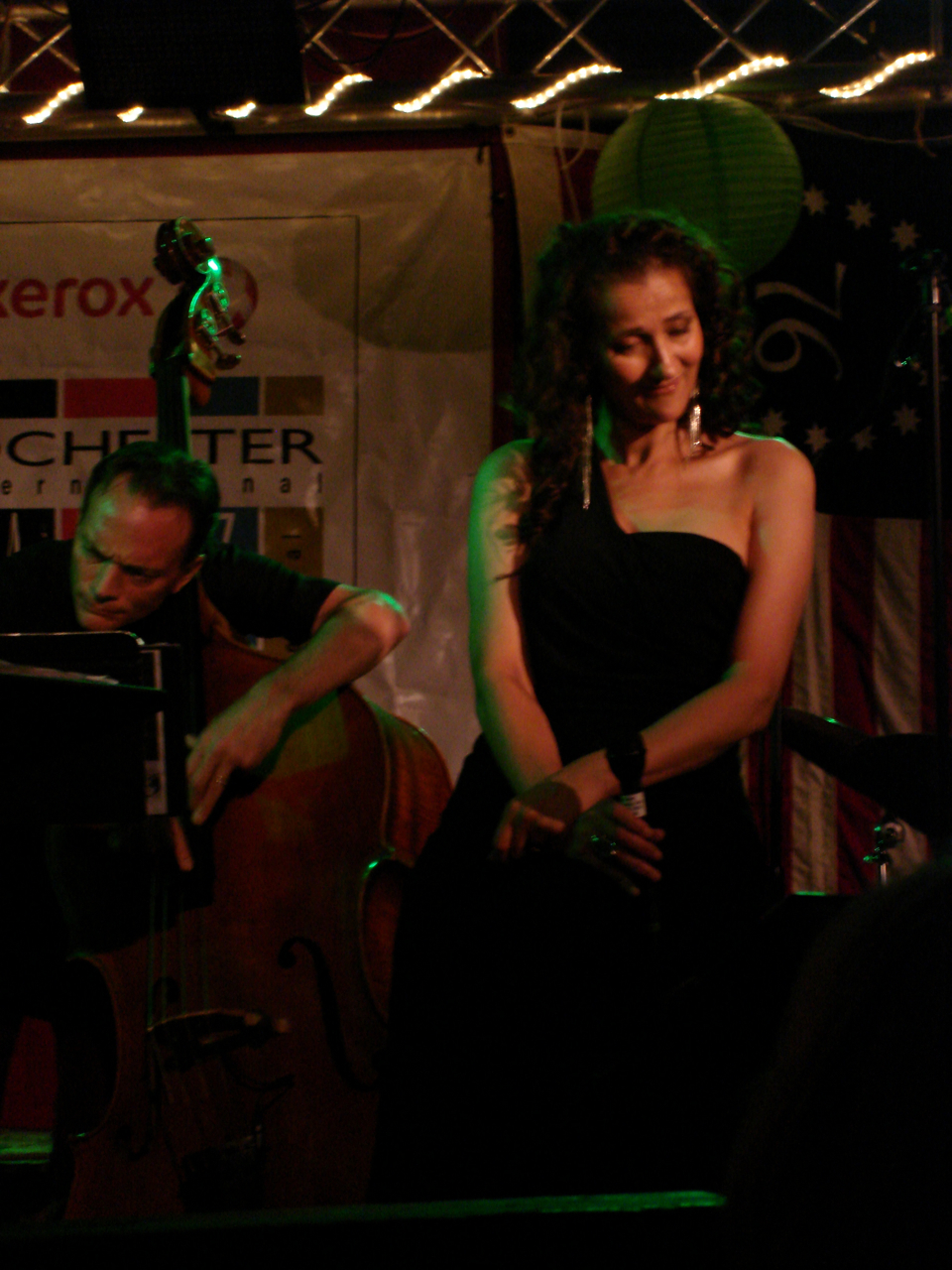
“Safe as milk” is how Souter, in a nod to Captain Beefheart, characterizes performing with her new bandmates for two live sets at this year’s Rochester Jazz Fest. Joined by guitarist Tom Guarna, bassist Sean Smith, and drummer Willard Dyson, Souter and company astonished those lucky enough to squeeze into the small venue from a line that trailed for blocks out the doors. They won us over from note one with the classic “Make This City Ours Tonight” (off Souter’s third album, Obsession), jumping right into the deep end as if the music couldn’t wait to sustain her.

Both sets featured a hefty selection of new tunes, “The Lamp Is Low” being a reigning favorite. In addition to the attractive rhythm support, it cinched the talents of Guarna, a musician’s musician whose skills had everyone in awe whenever he took a solo. In combination with Souter’s own brand of liquid mercury, the group’s full sound shaped the air, circulating like breath itself. This feeling of respiration pervaded the surf guitar vibe of “Prelude To The Sun” and further the smooth lines of “I’m Glad There Is You,” during which Souter pointed appreciatively to her bandmates as she sang the words “extraordinary people.” Guarna alone joined Souter in celebrating Burt Bacharach with a sweet rendition of “The Look Of Love,” the first of the evening’s dedications, which also included “Brand New Day,” written for Japan’s tsunami victims and featuring Guarna’s most stellar turn of the show.

Not to be overshadowed, Smith grabbed some spotlight in his heartfelt contributions to “Baubles, Bangles And Beads” and “Chiaroscuro,” while the ever-patient Dyson brought much to “Beyond The Blue,” “En Aranjuez Con Tu Amor,” and “You Don’t Have To Believe” with a caravan of sandy textures and shakers. Dyson also unleashed a memorable statement in “Alone Together.” Candy for the ears.

During an informal sit-down the morning after the Rochester sets, which came hot on the heels of a Blue Note Jazz Club album launch party and sold-out Russian tour, I asked Souter whether or not she has noticed a difference in audience reception across places and cultures. “The Russian people seemed to be very emotional,” she told me,

so afterwards you got a lot of people coming backstage in tears, because their emotions were so close you could practically see them through their skin. Perhaps it’s because they’ve had such a traumatic history that’s quite recent. I’d say for me—and I haven’t been to a huge amount of places—everywhere’s the same and different. Music seems to be very universal and audiences are very universal.

With this in mind, I couldn’t help but comment on the confidence she exudes on stage, seemingly internalized to the point of becoming second nature:

For me it’s all about being in the moment. When I walked into the room [in Rochester] I nearly burst into tears, because I could feel the expectant vibe. I was right on the edge. It’s overwhelming. I get subsumed, I don’t even exist. Confidence is important. It gets you past being self-conscious. For example, the first time I saw Billy Elliot I thought it was a nice movie. But then I watched it after I’d become a performer and it was an entirely new experience. There’s a moment when the boy is being interviewed for the ballet school. One of those posh guys says, “Why do you want to be a dancer?” and he says, “Because when I’m dancing I disappear,” and I thought, yes, that’s exactly what happens. So what you’re seeing is not just me, it’s us.

Does this affect how you sing the “sad” songs?

There’s always an element of sadness in a love song, even a happy love song, because one day it’s going to end, if only when death do us part. Somehow, you have that realization. I was thinking: Why do people always love the sad songs? Are they unhappy? But I realized because it’s sort of real, that even when you are happy there is a poignancy to how lucky we are.

Maybe it’s just part and parcel of the form, but it seems that in jazz people are constantly reconfiguring themselves in relation to others. One year you may be playing with a completely different band from the last.

One thing about jazz is that it’s just so free. Because each person brings a unique personality to the bandstand, it means that every time you play the same music with someone different, it’s a completely new experience. Like the band last night. It’s new for me. Tom had to remind me it was only our third gig together, but I’m blown away by what they all do.

Judging by audience reactions, she wasn’t the only one. This assured quartet set Rochester’s happening east end abuzz with adoration for a voice that needs no spoonful of sugar to make its medicine go down. As my wife and I left the venue I couldn’t help but smile, because, knowing that we’d be in attendance, Souter had been gracious enough to dedicate “Little Sunflower” to us and to the baby boy due to change our lives come the first week of September. And in the end, the creation of life is what her singing is all about.

Love doesn’t only live in dreams. It’s here.

Creating and Un-creating: A Conversation with Cayenna Ponchione

A rumble. Subterranean where there can be no ground. A calling from within where there can be no within. Is it a voice? A sleeping giant? The rolling pulse of marimbas. Something familiar, daunting all the same. Metal, touched to the skin of darkness, rolls like an ice cube down our backs. Suddenly, marimbas pronounce themselves ephemeral, morphing into glockenspiel and drums. A primordial froth, foaming at the mouth of something soon to be sacred. Finding itself as it goes along. Notes and staves invisible, but there. Like Braille across out space, they stand. A specific method of becoming, ever enveloped by a breath of destruction. Wrought, perhaps, in a filigree of swirling gasses and dark matter, in which there is only the emptiness of an embrace. Shape, size, and color—the peeling skin of sound. There is only inception, for nothing has ever ceased. The watery depths of a vibraphone give us our first taste of brine, finding in its habits an incalculable emotion. Each of these gestures is a cluster of numbers, elements, and intent, not so much divine as introductory. These deep build-ups reveal massive clouds of energy, imploding as much as exploding, as if searching for a primary spatiotemporal juncture in which to beat to the rhythm of all that animates it. A ghost in stardust. A child of orbit. Ring of fire. Singing tension. Birth.

This is what Cayenna Ponchione’s music feels like. As distinct as her name, it breathes. Born and raised in Fairbanks, Alaska, Ponchione pursues a life of conducting and composition imbued with fervent dedication to the orchestra as a site of creation. Having directed a number of ensembles in the Finger Lakes region of upstate New York, she has also amassed a growing body of sonic territories. Among them is, appropriately enough, The Creation, a work for percussion that won the 2003 Percussive Arts Society Composition Contest and garnered international recognition for her compositional accomplishments. As a marimbist herself, Ponchione is invested in the world of reverberation, and in shaping its amorphous possibilities into music one can admire and develop into life experience. For more, check out her site.

To hear The Creation, check out samples and buy the CD at Capstone Records.

Ponchione is currently at Oxford, where she hopes to complete a Ph.D. that will enable her to expand a personal mission of community music-making. Before she hopped across the pond, she was kind enough to take time out of her schedule and sit down for a conversation on her work and beyond.

Just hearing the title, The Creation, I cannot help but think biblically. I also think Haydn. Yet when I listen to the piece, the narrative possibilities of something out of nothing slip away in favor of a more immediate, visceral effect. Were there any images, texts, or pieces of music that you had in mind while bringing this piece to fruition, or did it emerge, as well it probably should, from a blank slate?

There was a piece of music that I heard—the Bloch Schelomo for cello and orchestra—by the Utah Symphony at Abravanel Hall. That would have been 1996. And when I heard that piece, I saw the creation of the earth unfold in dance. That visual stayed with me for a long time. When I went to write this piece, it wasn’t as musically inspired as it was—I don’t even want to say philosophically, because it’s kind of fantastical—just musing on the concept of matter, and the concept of matter as being quite transient, that without vibration, without motion, matter doesn’t exist. And so, I toyed with that, played with the notion of being able to hear that vibration just like you hear the vibrations of sound, and imagine what the creation of the world would have sounded like.

Building on the first question, clearly the title is a multivalent one, and for me seems to vocalize, if you will, the process of its own becoming. The compositional process is, of course, nothing if not creative. How do you see the medium and the message intertwining in The Creation?

For me, if I understand your question correctly, this was a very important aspect of the work. I wrote it based on a tone row, and I manipulated that tone row not simply abstractly but in ways that were personally connected to the subject matter—spiritually, intuitively choosing facets of the tone row, choosing different inversions and blocks for each of the four parts, which converge into the creation of the sphere, the explosion, water, and then from water the fire and the ice. In thinking about those through my personal experience, I used them in ways that reflected that.

One might say it takes boldness to compose such a piece, that to set oneself to the task of evoking the immensity of earthly existence into a formative, if not formal, piece of music. Yet after listening to it, it becomes clear to me that it’s not really about boldness at all, but rather about humility. Would you agree with this and how do you see yourself in relation to this music?

I think I wrote it at a time when there wasn’t much differentiation between myself and my surroundings, where I end and the rest of the world begins. It’s rather vague, so in that sense I didn’t feel that it was “bold,” though I probably should have. And in terms of humility I felt like it was more an extension of my own experience as opposed to a capturing or statement of an external topic. In hindsight, I never expected that people would pay enough attention to the title, despite being exactly what I wrote about. The whole title is a creation, a sonic manifestation. Had I known that a lot of people would be playing it all over the world and thinking about it in different ways…. The title is so culturally loaded and means some very specific things.

Can you talk about the structure of the piece and what part improvisational elements, if any, play in its performance?

Actually, there is a very small amount of improvisation involved. It’s set up in four parts, and each is linked and borrows from the others in one way or another. The only point at which there is improvisation is when the sound implodes on itself. The beginning is, if you can imagine, little particles of sound colliding with each other and building. When that all starts to swirl around and gives us a big implosion, the fallout is completely improvised and is meant to shatter and decay, and from that we get the earth.

In what respects did your choice of percussion over, say, winds or strings influence the genesis of the piece?
Unfortunately, it’s a very boring answer which is: as a percussionist, and at that time in my life, that is what I was capable of writing for, and those were the forces that were at my disposal. So it never actually occurred to me in any other form than percussion. In the end, the piece couldn’t have been written for any other instruments. There’s just nothing about it that’s transferrable. It has everything to do with the timbre and using the instruments in their idiomatic fashion.

If we wanted to be nitpicky, we might say that, with no one around to hear it, the creation of the universe would have been silent. Where does one even begin to imagine it sonically?

That’s fun! To be honest, where I imagined it sonically—and there is a very clear picture of this—was to hopefully do it one day with dance. To me, the universe before the Big Bang in the “storyboard” of this particular piece, was a silent space; a vaporous, undulating mass without any direction that, by happenstance, started to collide with itself. Why I ever mused on such things is beyond me (laughs), but at the time they were very important for me.

To me, the piece’s final, drum-laden passages don’t come off so much as upheaval as organization, for somewhere in the resounding chaos of any creative process there is a dedication to order and familiarity, which in turn nourishes the beauties of an indeterminate world. How do you see, hear, and/or feel their sudden cessation?

It’s actually interesting you ask that, because I hadn’t realized until you mentioned it that it’s very organized at the end. The section is called “Fire and Ice” and my intention was for it to be much more disruptive. I think part of the issue there is that the way I had written it requires a precision of execution which then leads it to sound pretty tight and, on the other hand, I think that inadvertently I wrote it that way because I do find that I am most comfortable in order and structure and that for me, intuitively, that encapsulated my need to finish the piece. But I’m not sure that I understood the last part of that question.

Well, for me, the drums at the end stop quite suddenly. They leave the listener in a state of suspension, and I wonder how you feel about the ending.

Oh, wow, I didn’t know it was sudden! I know it’s coming (laughs). It’s interesting. I think about this from time to time, listening to one’s own music. I don’t know that I hear my own music, because it’s already there, the image is there, and it’s hard to hear it objectively. There’s a marimba solo piece I wrote before this and play more frequently than any of my other pieces, and I recorded it about a year or so ago, and I went back to listen to the recording and thought, it’s just too fast. Why is it so fast? I’d slow it down and we’d record it, but it was still too fast. And I think part of it is because I already know it. It’s hard to hear it as I play it and then experience it basically for the first time. I just can’t do it. And I don’t think I’m alone in that. I remember hearing Copland play his own reduction of Appalachian Spring on the piano, and everything was much too fast. Not to compare myself to Copland, I don’t mean to, but I just mean the notion of the author—there’s just no element of surprise, and you’re just getting through it even though there’s a different experience that might be happening on either side.

Have you had much feedback in terms of how this piece has been received, whether right after a performance or in more prolonged discussions?

I never expected that anybody else would hear this, and I’ve gotten really great feedback. People find it to be, frankly, rather profound: it’s just a beautiful piece, they love this image, even technically just well balanced and enjoyable musically. One of the most touching things that happened is that when recording this piece at the University of South Florida, there was a young man who was in that percussion department who did not play in that piece, but who was there the entire time we recorded it. I think he was a freshman that year and so the upperclassmen played. But he absolutely fell in love with it. And he e-mailed me maybe nine months ago and said, “I’m putting together my graduate recital at the University of Boston in marimba performance and I want to program your piece because it has affected me so much as a musician and conceptually. He’s actually really interested in Carl Sagan and extraterrestrial concepts, so this was particularly interesting to him and very close to him as he developed as a musician, and there’s really no greater honor than to have someone say that. So it was quite special for me. I went out last March to Boston for his recital and it was very well done and clearly a very special moment for him. Probably one of the highlights in my life as a composer. It was really quite cool.

I also really love the piece. There is one moment close to the end that I find particularly effective, during which the drums rise up and stop and there’s a gap, only to re-congregate for a final passage. There is something resonating in that gap. I don’t know if it’s a tubular bell or—

It should be a chime, yes.

I adore that moment, and I’m wondering if you could talk about it a little bit and whatever intentionality lies behind it.

I have to say I don’t recall my specific thought for that, and I apologize because I’m sure there was something. I would guess more than anything that it had to do more with balance. Actually, when I write, being a percussionist, I don’t think melodically or harmonically in the same sense. I really think of flow and balance and structure, and if there’s a pitch contrast, again that has to do with where you’ve come from and where you’re going and what’s needed, so certainly if there wasn’t an extra-musical aspect to it, it’s just that there was a need for a breath before we went on with so much sound.

It occurs to me that Xenakis often used percussion to evoke cosmic forces, and I’m wondering if you feel there is anything particular to percussion in this regard.

Yeah, well it’s certainly less earthy than a wind instrument, which is connected to the breath, and even the contact that one has with a string instrument or a piano, and just the notion of a vibrating string in and of itself, whereas with percussion, the sound of clanging metal together, it’s almost industrial. The concept of percussion music came with the Industrial Revolution. Not to say that there weren’t percussion instruments earlier, and certainly in other cultures percussion has played a large role, but the concept of percussion the way we hear it now in Western art music is definitely all post-industrial, and so I think there is perhaps a connection there and a fascination with what’s beyond.

Can you talk more about the instruments involved?

It’s two five-octave marimbas, two sets of log drums, vibraphone, at least two or more break drums, lots of tam-tams, gongs, cymbals, a couple of bass drums, glockenspiel, crotales maybe, triangles, lots of toms. So during the section in the middle, the two solo marimbists go to play the two solo tom parts. It’s basically them with the two log drums and the backup at that point. The vibraphone plays a large role in Water, as do the cymbals in the gongs. Pretty straightforward. And in the beginning I’m using more of those metallic, spacey sounds with different sizes of triangles and glockenspiel. I’d love to be able to hear it with a different pair of ears, because I know how things tie together at the end from the different players, and it’s very intentional, and I don’t know if it sounds more continuous than it was meant to be. It is meant to be one gesture, but it’s supposed to be a gesture with a whole lot of different aspects from different players and different instruments.

You and I have talked in the past about your position as a conductor and how that may or may not change the ways in which music is perceived by the audience behind you. Could you describe the effect of your gender, as you see it being perceived, on audiences and how, if at all, these perceptions influence your work as a composer?

I think it doesn’t influence my work as a composer, only because even though I’ve thought of myself, as I’ve mentioned to you, only recently as a “female” conductor and that it hadn’t occurred to me. Being behind the screen of a composition, I don’t feel gendered and I don’t have a sense at all of how my gender might be perceived through the music that I write, and perhaps I should. You know, I was just looking through old pictures today. This moving process for me is insane. I was just in Alaska in August for a week, and I shipped the last five boxes of my childhood possessions to Ithaca, and they’ve been sitting in the living room, and before I can even pack I have to clear out the living room, so I just had to unpack these boxes I had packed thirteen years ago. It’s striking, but one of these photo albums I pulled out was from when I was in junior high and there’s a picture of me wrestling because I was on the wrestling team. And I was just thinking, yeah, I actually did that. And at the time, although some said to me, “You shouldn’t being doing that, you’re a girl,” I just thought they were old-fashioned and that I would be whatever I wanted, so of course I could do this. And it took me a long time to understand that people might see me differently. The more I’m aware, and I think the more I become a woman instead of a girl, I think that certainly changes, and dealing with a wider range of generations as an adult. So now when I engage with people in their 50s, 60s, 80s, they’re engaging with me as a woman, as an adult, as opposed to when I was a teenager or even in my early 20s, when they were engaging with me as a kid and I was engaging with them, again as this separate thing. And so I think in that way we conceptualized each other differently. But as for composition, I don’t feel any gender. And as for percussion, I also don’t feel any gender. I spent most of my life doing things that guys did. I mean, the percussion sections were all boys. They were all dumb boys and I was always section leader because somebody had to keep them in order (laughs)! And on the wrestling team I was already around guys. I had two older brothers and I wanted to do everything that they did. I had girls that were my friends, it wasn’t that. So, maybe I should think about this. I actually have another piece that I have to write for Tennessee Martin’s new music building, and I was thinking about this today as I was reflecting on this piece a little bit and trying to conceptualize what I want this to sound like, and now I have to think about what I have to sound like coming from a girl (laughs). What are they going to think at Tennessee Martin? I hope this answered your question.

Yes, well I think it was an ineffable one to begin with. On the one hand, it’s so arbitrary as to not even be worth asking. On the other, I often think about this issue in relation to myself as a countertenor and one who likes to “sing high.” When I create my choral music and people hear it, they invariably ask, “Is that you singing the high parts?” as if it’s not conceptually feasible that someone of my appearance or attitude would embark down that vocal path.

I made an embarrassing boo-boo the other day. I was speaking with a vocalist who was a woman, and I had asked if she would be willing to sing some Dichterliebe. And she says, “But I don’t sing Dichterliebe.” And I said, “Oh, is it the wrong voice?” And she says, “No, it’s a men’s role.” I knew that (laughs), but it never occurred to me there would be a reason why she wouldn’t sing the song, and I was actually really embarrassed. But when I reflect on it I realize it was just because you sing songs that are suitable for your gender. I sing Beatles songs all day long, you know? (Sings: “She loves you, yeah, yeah, yeah…”)


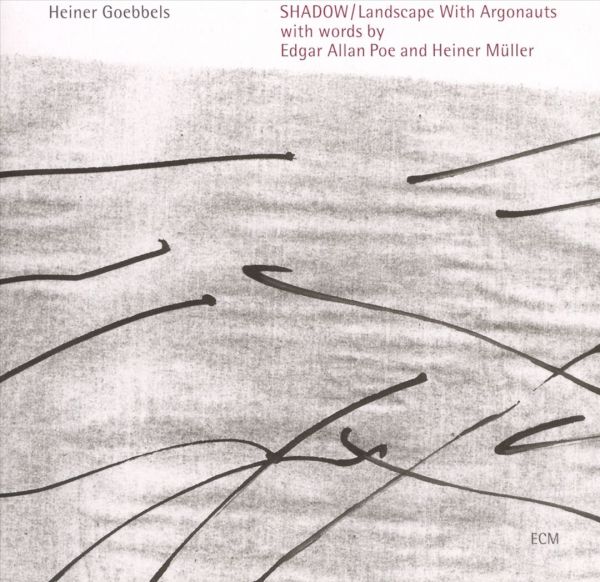
Heiner Goebbels: SHADOW/Landscape With Argonauts (ECM 1480)

Heiner Goebbels
SHADOW/Landscape With Argonauts
with words by Edgar Allan Poe and Heiner Müller

Sussan Deyhim vocals
René Lussier guitar
Charles Hayward drums, tipan, hand-percussion
Christos Govetas clarinet, chumbush, gardon
Heiner Goebbels keyboards, programming, accordion
Recorded September/October 1990 at Outpost Studio, Stoughton, Massachusetts
Engineer: G. B. Hicks
Produced by Heiner Goebbels

In the annals of the written word, there are chambers of suffering and chambers of joy, but in the mind of Edgar Allan Poe those chambers were one and the same. It is this twisted contradiction that Heiner Goebbels wrings out from the sodden towels of the human body’s myriad expectorations in SHADOW/Landscape With Argonauts. Following the same concept as its German radio play counterpart (only this time in English), for which random people on the street were asked to read a text aloud for later studio manipulation, this fully realized project draws even deeper connections between public and private spheres of communication. Because people’s hesitations and misunderstandings remain lucid in the final mix, we can relate immediately to the balance of confrontation and collaboration that ensues. From these initial unscripted stirrings arises the brilliance of Iranian singer and performance artist Sussan Deyhim, whose voice is a periodic touchstone in the work. “Ye who read” is the first of a handful of exquisite songs, glinting like a metal pushpin holding up the tapestry at large. A backgrounded organ trades plectrum musings with fluttering recitations of Poe, treading a Jon Hassell-like carpet of swampy electronics. Sirens of emergency echo in the distance, accompanied by laughter. Public transportation carries us away into the field of indecision that plagues these expressions and the honesty of their disavowal. As impossible as water that burns, it trickles along the throats of fever dreams into vessels shaped like literature. Firecrackers give up themselves in ecstatic pops, marking a year of terror against the celestial auguries of the urban sprawl, each a line on a star map drawn in subway routes. Machines disgorge loose change, grasped by sweaty fingers and thrown into the pockets of the itinerant. Deyhim, ever our internal guide, resolves from a klezmer shadow in “Over some flasks” into messages of many histories. In this environment, happiness is suffocation. And as the sky goes hunting in search of dawn, a distorted hotline breathes its empty promises into the wind. “A dead weight” stencils that rich contralto onto an ululating ocean of ill measure. Acrid squeals echo with the incisiveness of a razor. “No arrival no parking” levels a mocking energy, self-absorbed and self-reflected, spawning the delicate propulsions of “And lo” in a relay of echo and night. A radio dial arches its back toward a faraway jazz session, only to drown in the light of a caravan moon. Shrouded in the smoke of faraway dreams, a clarinet bubbles over into the as-yet-unwritten page.

Fascinating to contemplate are the ways in which Goebbels’s subjects read themselves into the text, as if the sounds of words dictated the constitutions of their bodies, the comportments of their quotidian selves blended into the wing-beats of farewell birds. I can no longer read myself, the music seems to say, so I will let others read in place of me. Anything spoken at the whim of the predetermined will always be at a distance removed.

The rest is poetry.

<< Jens-Peter Ostendorf: String Quartet (ECM 1479 NS)
>> Keith Jarrett: Vienna Concert (ECM 1481)

Wadada Leo Smith: Kulture Jazz (ECM 1507)

Wadada Leo Smith
Kulture Jazz

Wadada Leo Smith trumpet, fluegelhorn, koto, mbira, harmonica, bamboo notch flute, percussion, vocal
Recorded October 1992, Hardstudios, Winterthur
Engineer: Martin Wieland
Produced by Steve Lake

To characterize Wadada Leo Smith as a genuinely musical soul would be a gross understatement. Having shunned the spotlight that might so easily have blinded him, he continues to draw thread after thread between the world’s many shadows and the sustaining fire within (if you haven’t heard his 4-hour magnum opus, Ten Freedom Summers, you don’t know what you’re missing). We have Manfred Eicher to thank for first bringing Smith to ECM among the company of Dwight Andrews, Bobby Naughton, Charlie Haden, Lester Bowie, and Kenny Wheeler on 1979’s Divine Love, and further Steve Lake for bringing the label’s touch a second time to this subtly profound solo meditation on the energies that make the world turn. Wrapped in the strains of “Don’t You Remember,” which depicts with mbira and voice a traveler’s view of atrocity and victory, we find ourselves swept in less than four minutes through a tide of earthen histories and cotton-scented tribulations. To express such depth with such minimal means speaks not only to the talents of Smith as a musician, but also to the inherent power of the individual to affect change at the galactic level. We feel this power in the visceral bite of his trumpet solos. The muted “Song Of Humanity (Kanto Pri Homaro),” to choose but one, speaks the language of those same celestial energies, climbing down ladders of starlight into the pitted chambers of our hearts, where the strains of a koto in “Mississippi Delta Sunrise (for Bobbie)” and “Seven Rings Of Light In The Hola Trinity” intimately skirt the edge of a bandwagon’s trail, popping heritage like candy. “Fire-Sticks, Chrysanthemums And Moonlight (for Harumi)” is the album’s central ceremony (one, if the reader will allow a comparison, in the vein of Keith Jarrett’s Spirits). It haunts coves turned red by ancestral blood, into which Smith dips a fluted brush. He spreads his aural calligraphy in the fire of dawn and begins to fashion from it a love letter to those who have given him courage and life: through the celebratory braid of trumpeted strands in “Louis Armstrong Counter-Pointing,” the forested song of “The Healer’s Voyage On The Sacred River (for Ayl Kwel Armah),” and the porous dronescape that is “The Kemet Omega Reigns (for Billie Holiday),” we come to know the spirit of a friend, lover, and acolyte. And in the unitary transmissions of “Love Supreme (for John Coltrane)” and “Uprising (for Jessie and Yvonne)” Smith shields an essential and unwavering flame.

Kulture Jazz is a body of dedication with two extroversions for every intro. Unafraid to marvel at the rawness of creation, Smith plays as one might write in a diary or sketch on newsprint, sanding the figurines of his past into a rounded family of novel ideas. An album of such sparseness may not appeal to everyone, but with such indelible spiritual truth suffused into every moment, how can we keep ourselves from adding our adoration to its melodious font?

Truth, crushed to the earth, shall rise again.

<< Kim Kashkashian: Lachrymae (ECM 1506 NS)
>> György Kurtág: Hommage à R.Sch. (ECM 1508 NS)

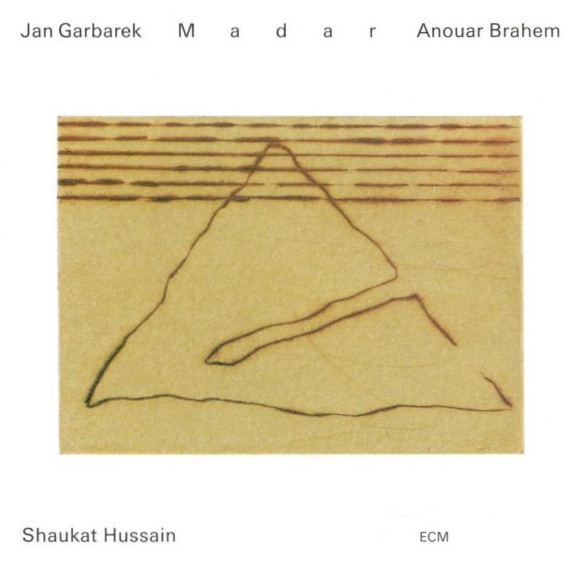
Garbarek/Brahem/Hussain: Madar (ECM 1515)

Madar

Jan Garbarek tenor and soprano saxophones
Anouar Brahem oud
Ustad Shaukat Hussain tabla
Recorded August 1992 at Rainbow Studio, Oslo
Engineer: Jan Erik Kongshaug
Produced by Manfred Eicher

Following in the footsteps of Ragas and Sagas, which found Jan Garbarek in the seemingly unlikely company of Ustad Fateh Ali Khan to uplifting effect, the Norwegian saxophonist continued to expand his horizons with Tunisian oud virtuoso Anouar Brahem and tablaist Ustad Shaukat Hussain on Madar. The three bond naturally in the lengthy “Sull lull,” a nearly 17-minute prayer of keen and sensible interaction for which Hussain brings constant airflow and foils Garbarek’s chameleonic talents superbly. It is one of two tracks based on folk melodies of Garbarek’s native land. The other is the saxophone/oud duet “Joron.” Madar serves in this vein as an internal conversation between the two instruments, their sounds speaking to one another like rocks from a river’s touch. Together they become a pair of hands etching stories into a stretch of hide, twisting incantations until they bleed light (“Sebika”) and dark (“Ramy”). As they continue to circle overhead, surveying a landscape of withering sin, they bring out something unknown in one another.

Despite the loveliness of these interactions, the album works best in solitary. Brahem’s contemplative solo, “Bahia,” treks over twilit mountains with aching footsteps, carrying us as if by palanquin into a vale of lost intentions. The wind of his percussiveness shakes the boughs of leafless trees and sends their dead seeds clicking to the ground like sand against a window. And in the rhythmic cast of “Jaw,” Hussain emotes lifetimes in a single beat of his tabla, thus offering some intensely lucid moments. He returns to the fold in “Qaws,” giving voice to those waiting eyes at last with solid excitement. An odd piano “Epilogue” (sounding like a chord outline for a studio track left behind) leads us out.
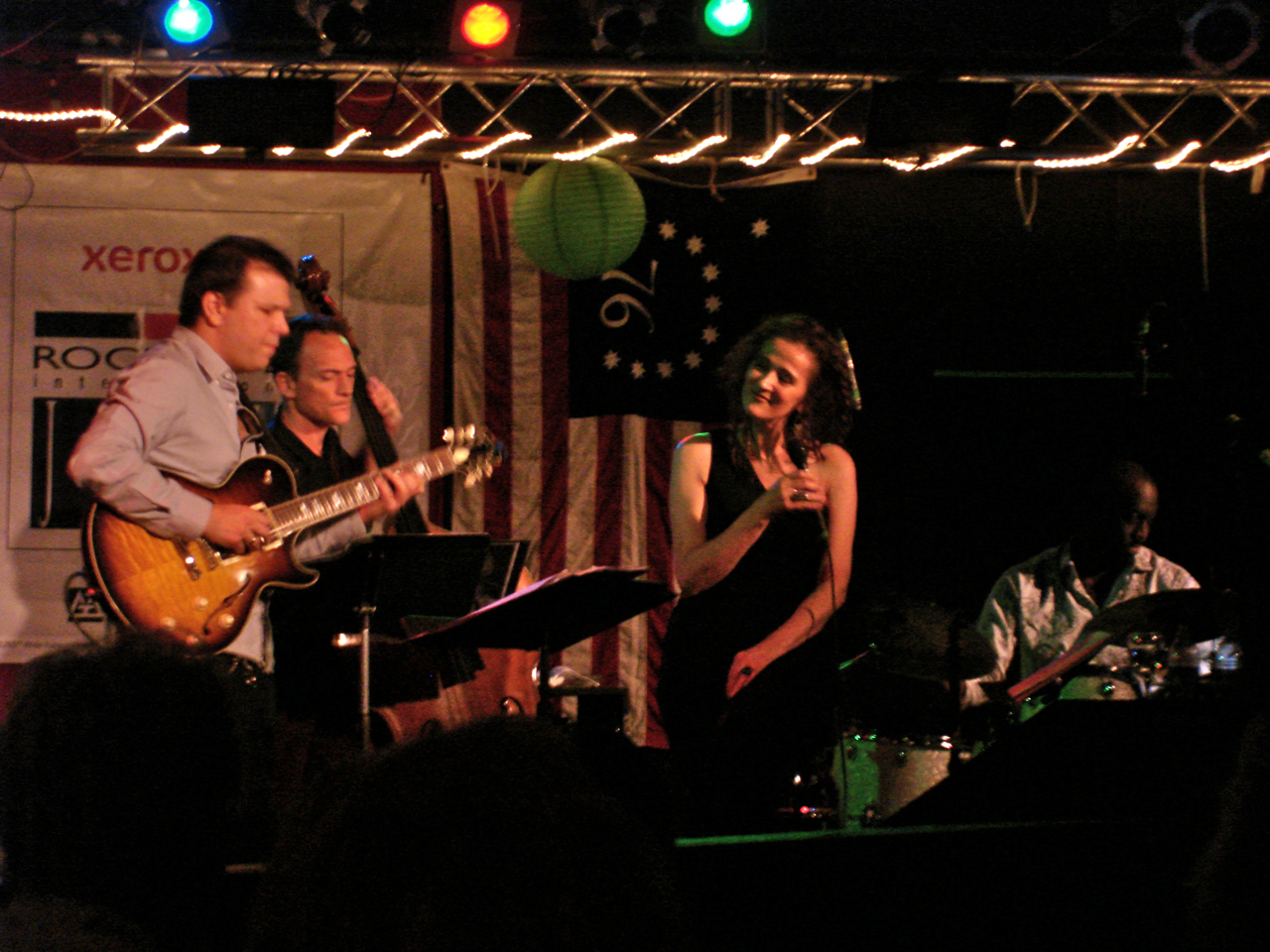
A word to the wise: Garbarek reaches some of his most piquant levels ever here, so intense that you may find yourself needing to lower the volume at peak moments. This may antagonize some, but in the end couldn’t we all do with a little awakening?

<< Bach: The French Suites (ECM 1513/14 NS)
>> Bobo Stenson Trio: Reflections (ECM 1516)