Alex Cline: The Lamp And The Star (ECM 1372)

Alex Cline
The Lamp And The Star

Aina Kemanis voice
Jeff Gauthier violin, viola, voice
Hank Roberts cello, voice
Wayne Peet piano, organ
Eric von Essen bass
Alex Cline percussion, voice
Nels Cline voice
Susan Rawcliffe didgeridoo
Recorded September 1987 at Mad Hatter Studio, Los Angeles
Engineer: Geoff Sykes
Produced by Nels Cline and Alex Cline

The Lamp And The Star was the first recording for American drummer Alex Cline as bandleader. At the core of this session is his Quartet Music group, which included twin brother and guitarist Nels, violinist Jeff Gauthier, and bassist Eric von Essen. Joining this already verdant nexus is vocalist Aina Kemanis (whose precise colors had already enhanced past ECM sessions with Barre Phillips and Adelhard Roidinger), pianist Wayne Peet, and cellist Hank Roberts (who added so much to Bill Frisell’s Lookout For Hope). The resulting offering is something just outside the purview of jazz and sits more comfortably under the rubric of chamber suite. This is clear from the prayerful chime that unfolds silence into “A Blue Robe In The Distance.” Like the bell worn around Mona’s neck in Lars von Trier’s The Kingdom, it floats along shores where life and death comingle. This gives way to subterranean soundings from percussion gilded by stalactites. These drip with age and recognize only the language of gravity. We hear the creaking of some vast gate opening out onto a war-torn land where tolls the emptiness of action gone still. A procession of cellos. Darkened veils obscure any intimation of earthly care even as their feet squish into the soil with every step. Their voices intone the litany of an ancient era. Kemanis matches their pace. Is she aware of the blue robe, we wonder. Is she the holder of that bell? She rains drizzle on the thirsty land. Peet’s pianism, meanwhile, curls one key only like a finger at the edge of rhythm. String and voice become inseparable. Do not be mistaken: this is not an exercise in morbidity, for there is something duly thriving and present about the configuration and its intermingling of sound, as if each instrument were its own language vying to be heard and translated across the open plains all share. Thus does Kemanis eschew words, choosing instead to spread her garments and catch the wind while delicate keys buoy her cause. She drinks in every invisible radio wave that inhabits her airspace, breathing out a single bow drawn across gut and wire. The last high note from Gauthier leaves us still, closing its eyes around the dream of “Eminence.” More percussion bubbles from the magma of which the strings are but a melodic fantasy, seeming to spread their delicate hands across a throated vista. The vibration of vocal folds is like an earthquake slowed into discernible pathos. Drums return, flirting with the water’s surface, if not dropping rocks through it, as strings and cymbals bring their delicacy to an organ’s slow-motion undertow. After a vocal line threads the needle of our attention into “Emerald Light,” it recedes for a foregrounding of piano and bass, heard through pellucid veils of strings. They catch the last rays of sunset in a cupped hand of water, sparkling with the memories of a space where love was once born. Bowed gongs touch the mountainous horizon with aurora light in “Altar Stone.” This opens into a tundra where drums hit the ground running with a chain of social conflicts and accords alike in tow and ending in that same private space where the borealis smiles across the sky: a Cheshire cat who needs no longer appear to be known. With the offering thus laid, “Accepting The Chalice” turns inward with piano and cello before the latter gives way to Kemanis, whose strains jump the cliffs amid ocean waves crashing below into hydrated ribbons of reflection.

One of ECM’s most beautiful enigmas.

<< Markus Stockhausen: Cosi Lontano … Quasi Dentro (ECM 1371)
>> Dave Holland Trio: Triplicate (ECM 1373)

Giya Kancheli: Diplipito (ECM New Series 1773)

Giya Kancheli
Diplipito

Derek Lee Ragin countertenor
Thomas Demenga cello
Dennis Russell Davies piano
Stuttgarter Kammerorchester
Dennis Russell Davies conductor
Recorded January 2001 at Mozart-Saal, Liederhalle, Stuttgart
Engineer: Peter Laenger
Produced by Manfred Eicher

“…I feel that, conceptually, I am still living in the age of the horse and carriage and the first motor cars.”
–Giya Kancheli

Giya Kancheli is a composer of contrasts. Hardly limited to the vast dynamic distances that have marked his work with increasing frequency, these contrasts also flourish in less discernible areas. We find them in mood, in timbre, and perhaps most vividly in the dance of sacred and secular that traces communicative patterns all over the music’s surface. The analogy is no accident, for dance would seem to be capital of the expansive territory etched herein.

The program’s title work, composed in 1997 and named after a drum of Kancheli’s native Georgia, is scored for violoncello, countertenor and orchestra. It begins where all of his works begin: inside. The piano is explored as a cavity in which echoes of Górecki’s Third Symphony comingle with every dancing scene of an Angelopoulos film, seen through a scrim of tears. The inclusion of guitar in the sound mix adds fractures to this glassine surface, while the cello births a countertenor voice from its winged enclosure (these roles reverse as the narrative develops). Though one might expect an ECM regular like David James for this recording, Kancheli has chosen instead a more vulnerable style in Derek Lee Ragin (who also gave the work’s premier). The match is perfect. Half-formed reinstatements of familiar motives shine through Ragin’s vocal branches, even as the strings weave a blanket of stillness over him from the piano’s block chords. At times Thomas Demenga’s song is hardly distinguishable from Ragin’s—not a question of resemblance but of presence. Small clusters of piano arpeggios roll down a hillside of tubular bells, tripping over their own voices. The titular hand drum makes a modest appearance toward the end, bringing with it the sound of villages and forgotten places. Hands brush across its skin in the final whisper, thus stretching to near invisibility one of Kancheli’s subtlest veils of sound. A masterpiece.

Dedicated both to Dennis Russell Davies (who conducts here from the bench) and to his wife (“with whom I have never danced”), Valse Boston for piano and strings (1996) opens with a strike from the keyboard. These outbursts crystallize like philosophies into their core questions. The orchestra breathes in and out through the instrument that enables its expressivity. Each measure is a microcosm held by the cosmos to the eye of a speechless god. Moments of pathos are few and far between, and all the more beautiful for the brevity of their passing. This wondrous music allows us to rethink the parameters of what we consider minimal. The single utterance never lingers yet its taste never dulls. Through this cumulative simplicity we find a monad of audible existence that has passed through us all. It is a silence, a heaviness that links memory to death, and in so doing illuminates the good deeds of our lives.

If we take the composer’s words above at face value, then we might cradle his music as one might a rare antique. There is history in its bruises, and these we can touch only with the intent to heal.

<< Juliane Banse/András Schiff: Songs of Debussy and Mozart (ECM 1772 NS)
>> Bach/Webern: Ricercar (ECM 1774 NS)

Keith Jarrett Trio: Still Live (ECM 1360/61)

Keith Jarrett Trio
Still Live

Keith Jarrett piano
Gary Peacock bass
Jack DeJohnette drums
Recorded live, July 13, 1986 at Philharmonic Hall, Munich
Engineer: Martin Wieland
Produced by Manfred Eicher

Mentioning the Keith Jarrett Trio and virtuosity in the same sentence is like breathing out after breathing in. That being said, none of said virtuosity would mean very much without the potent skeletons around which Jarrett, Gary Peacock, and Jack DeJohnette string their veins and flesh. This particular trio has always laid its performances at the altar of melody, the music’s A to Z, and the respect shows in every moment.

“My Funny Valentine” opens this 1986 date from Munich, where a crowd had the great fortune (let’s get this straight right away) of witnessing one of the finest trio sets in history. Jarrett’s unmistakable intro plows a field of harmonic possibility and hauls its crop through the dazzle of DeJohnette’s peripheral tracings. Jarrett sings with the ecstatic pain of his exposition, unfolding a chip carving of interlocking geometries. A change of angle from an unnamable light source imparts soloed secrets. Another brings us back into the fold of those solemn keys, each a window into another full instrument. In the sprightly rendition of “Autumn Leaves” that follows, Peacock regales like a bird loosed from its thematic cage, spurred ever onward by a crisp snare. DeJohnette and Jarrett share an interplay that most of us could hardly dream of, feeding off each other’s fire around the wick of that perpetual bass. In fact, the more I listen to this trio, the more I go starry-eyed over Peacock. I feel it especially in “When I Fall In Love.” Burnished to perfection by DeJohnette’s brushes, this ballad also finds Jarrett winding just the right amount of tension to make it sing. Which brings us to “The Song Is You.” Jarrett speaks more carefully here, pausing for reflection and putting intelligent expectorations into every new cluster, acting the lit match to DeJohnette’s fireworks. He cuts out amid a dissipation of applause, allowing the rhythm section to tip the scales in its favor, though Jarrett’s return does bring this pot to a raging boil. DeJohnette’s occasional snare hit here is one of the more magical touches of the show.

The second disc begins with a chromatically infused introduction into the smoothness of “Come Rain Or Come Shine.” Peacock takes an early lead, dancing on air into Jarrett’s highflying banks and turns. Things take another slow turn in the Gurdjieff-like “Late Lament.” After an elegiac intro, DeJohnette wipes away the dust of time with his brushes to expose a familiar tale in which Peacock’s soulful and maple-grained steps dance their way into our hearts. Jarrett outdoes himself in “You And The Night And The Music,” which kicks off a 19-minute medley that is an album in and of itself and proves that, for all their sensitivity, DeJohnette and Peacock can swing hard. Jarrett is content in playing string games in the ether for a while before sliding down to earth on a monochromatic rainbow into lush fields of twilight. DeJohnette pulls some microscopic trickery on cymbals as a monotone left hand keeps us in suspension before unfolding “Someday My Prince Will Come.” One of the most remarkable transitions on jazz record. Peacock wraps this sonic present with a florid bow, while Jarrett takes this tune to fresh heights of syncopation. Next, “Billie’s Bounce” achieves an eerie balance of airiness and forward drive and highlights the man with the sticks, popping as many kernels as he can over the open fire of his kit. Last but not least is “I Remember Clifford,” which like a master’s sketch conveys all that it needs to with the merest strokes, slow and sure.

Peacock and DeJohnette are instinctively attuned to every interstice of Jarrett’s architecture. Their unity has arguably never meshed so closely as it does here. It seems impossible that this trio could have ever hit a single wrong note, and one finds nothing but perfection at every turn throughout Still Live. It is, in fact, one of the most magical live recordings in ECM’s annals, both in terms of content and technicality. Jarrett and company know just how to let loose without ever breaking seams. It is this holding together that keeps us wanting more. The Keith Jarrett Trio exemplifies the pinnacle of the art by living the art of the pinnacle.

<< Rabih Abou-Khalil: Nafas (ECM 1359)
>> Bach: Das Wohltemperierte Klavier, Buch I – Jarrett (ECM 1362/63 NS)

Kim Kashkashian: Hayren (ECM New Series 1754)

Kim Kashkashian
Hayren

Kim Kashkashian viola
Robyn Schulkowsky percussion
Tigran Mansurian piano, voice
Recorded May 2000 at Teldec Studio, Berlin
Engineer: Peter Laenger
Produced by Manfred Eicher

The music of Armenian composer Tigran Mansurian made its first ECM appearance on Alexei Lubimov’s Der Bote. Yet it wasn’t until violist Kim Kashkashian reflected deeply on her own Armenian roots that his sound-world, along with that of the nation’s treasure Komitas (a.k.a. Soghomon Soghomonian, 1869-1935), came into its deserved own. The result is a fortuitous one, not least because of Kashkashian’s unwavering dedication to her instrument and its limitless possibilities. Hayren interlocks Mansurian’s earthen sensitivities with Komitas’s visionary roots for a blend that is at once supra-paradigmatic and forged on a shared oral connection between those who perform and the very earth on which they stand. The program’s title deliberately evokes the poetic style much revered in Armenia, and the implications could hardly be more appropriate, for while Mansurian is like a brittle page, Komitas’s typography is bold and crisp.

Although the album is made up mostly of chamber pieces such as Havik, in which the viola seems on the verge of losing its foothold, surprises await us Mansurian not only takes to the piano but also adds his actual voice into the rippling waters of his surroundings. The polished arrangements encase every raw lullaby in a lantern, such that the quietude of songs like Garun a feels like the shadow of the dying light of Krunk. His is not a voice to be praised for its technical prowess, but one to languish in for its unabashed descriptiveness. Mansurian seems to mimic Kashkashian’s gravelly emotions, if not the other way around. This is music that flirts with pitch as the wind might with a tree branch: no matter how much it bends, its essential form remains intact. One can say the same for Chinar es, which feels on the verge of utter collapse from the weight of its openness. And it is a fine musician indeed who can become even more vocal in her instrumental rendition of Krunk, which while timorous is by virtue of its lilt a caress on whatever part of the brain is activated when we read moving literature. After an alluring piano solo in Oror, sounding like a plaintive interlude in an Eleni Karaindrou soundtrack, Kashkashian and percussionist Robyn Schulkowsky untie every subtle knot to be found in Mansurian’s Duet for viola and percussion. What starts as a soulful postlude burrows into an 18-minute cavern of living darkness. The melodies are self-aware, dented by marimbas and gongs, and point like a compass needle to the truest north that is incantation.

Hayren is an album that will likely require repeated listening. As for myself, I can only say it has grown with me into a rich and multilayered carving. Not unlike life itself, it is narrated by a thousand cryptic asides for every direct proclamation, and through this disparity achieves a mature sort of unity that is nothing if not honest.

Kashkashian always brings a personal dimension to her playing and perhaps nowhere more so than here. The intimacy of her interpretations is only enhanced by those of Mansurian, who continues to open our ears to the possibility of what lies already locked behind those cochlear doors.

<< Trio Mediaeval: Words of the Angel (ECM 1753 NS)
>> Keller Quartett: Lento (
ECM 1755 NS)

Erkki-Sven Tüür: Exodus (ECM New Series 1830)


Erkki-Sven Tüür
Exodus

Isabelle van Keulen violin
City of Birmingham Symphony Orchestra
Paavo Järvi conductor
Recorded May 2002 at Symphony Hall, Birmingham
Engineers: Peter Laenger and Stephan Schellmann
Produced by Manfred Eicher

Exodus is the third ECM outing for Erkki-Sven Tüür and represents a particularly robust electron in the Estonian composer’s molecule of exploration. To be sure, his music (as Tüür himself is first to admit) is all about energy: its explosions and implosions, its heads and tails, its ruptures and healings. Yet in these three premiere recordings one finds also a consistency of purpose, whatever directions Tüür takes. Looking, for instance, at the 1998 Violin Concerto, we find that the relationship between soloist and orchestra has been transmogrified. No longer is the violin (played with due crispness by Isabelle van Keulen) a moderator, but now a transducer of biological information in a vast, multi-cellular organism. Both forces filter one another until their registers cross-pollinate, leaving the arpeggio as the only discernible genetic signature. The violin is at once dancer and stage, opening itself like a strainer through the first movement. Between the microscopic percussion and winds to the dialogic cellos, there is plenty to entice us. Tüür’s multi-tiered approach lends itself well to the concerto form, such that the soloist is not always the centerpiece of the work’s visual display, but is sometimes just as content to inhabit a corner of it, or even to jump off screen for a spell. Keulen, who brings a personal affinity for the piece to bear upon her performance, clearly revels in this freedom as she frolics through countless clima(c)tic possibilities. The second movement undermines the formulaic fast-slow-fast structure with a layer of interrogation. Protracted reveries share the air with ephemeral platitudes, each a jagged accent strung toward the final highs. All of which brings us to the decidedly brief third movement, which pits marimba and double basses in a condensed debate. This escalatory format, a notable forte of Tüür, then clusters around flute and glockenspiel dramas more reminiscent of his earlier architectonic pieces, drawing a tail of vibration to end.

After this juggernaut of a concerto, the two orchestral pieces that follow seem to fit more opaque slabs of color into this emerging stained glass window. The wind-heavy Aditus (2000, rev. 2002)— written in memory of an early mentor, Lep Sumero—is also rich with brass expulsions and percussion. It conjures a a pile of sonic coinage at once sullied and newly minted and leads almost seamlessly into the 1999 title composition—this dedicated to its conductor, Paavo Järvi. Those same convulsive flutes coupled with glockenspiel haunt every nook of the music’s ecstatic unwinding. Vast orchestral forces subside into a more liquid sound, trampling through the fallen branches of introspection. Flutes flutter into the distance like flock of birds while strings lay down an icy drone: the tundra of self-awareness, melting in the sunlight of a tinkling bell.

If we take exodus to mean a forceful expulsion from one’s roots, then we might see the music of Tüür as being engaged in a likeminded project. It thrives on the asymmetries of displacement and the new symmetries forged in its place. Listening to Tüür’s music is its own experience, one in which we encounter a book to which language seems but a shadow, for the moment we try to capture it in words it has already been forced into a grammar as arbitrary as my own.

Bach/Webern: Ricercar (ECM New Series 1774)

Johann Sebastian Bach
Anton Webern
Ricercar

The Hilliard Ensemble
Monika Mauch
soprano
David James countertenor
Rogers Covey-Crump tenor
Gordon Jones baritone
Münchener Kammerorchester
Christoph Poppen
Recorded January 2001, Himmelfahrtskirche, Sendling, München
Engineer: Andreas Neubronner
Produced by Manfred Eicher

With Ricercar Christoph Poppen continues where he left off on Morimur. While the goal of the latter project was to reveal what was hidden, here it is to direct our ears to what is already there. To achieve this Poppen bridges the J. S. Bach divide now to Anton Webern, highlighting an early Bach cantata—“Christ lag in Todesbanden” (Christ lay in the bonds of death)—as a genetic link to Webern’s op. 5 and the String Quartet of 1905, and ultimately to Webern’s own rendering of the six-part ricercar from Das musikalische Opfer (The Musical Offering). Herbert Glossner, in his liner notes, analogizes the relationship between the cantata and the ricercar in architectural terms, with the former standing at the center and the latter providing the cornerstones. The structural comparisons are far from arbitrary. They provide key insight into the potential for both composers to interlock in fresh and enlivening (more on this below) ways.

The bookending ricercar does, in fact, support the program like the columns of some aged temple, letting the language therein build from the afterlife of a single oboe line. This weave seems to pull the orchestra from a profound slumber, also drawing from within it deeper threads that unfold rather than obscure their source. This is no mere interpretation, but a bodily dip into Baroque waters. The same can be said of Poppen’s project on the whole: Ricercar is neither trying to modernize Bach nor even to accentuate the timelessness of his music, but rather taking an informed look into the prism of its inception. Paired with the conductor’s variegated arrangement of the 1905 quartet, it pours like the sun through an open curtain. On this side of the spectrum the music has a similarly fugal structure and sits comfortably in its shell, yet also bleeds into the cup of Bach’s fourth cantata. The soaring organ and heavy foliage of strings and voices in the opening movement accentuate the kaleidoscopic effects of all that have fed into it thus far. The assembled forces accelerate into a beautifully syncopated passage that almost rings of Steve Reich’s Tehillim in the allelujas. The cantata’s only duet, here between soprano Monika Mauch and countertenor David James, is a crystal of fine diction (especially in the words, “Das macht…”), as are the respective tenor and baritone solos from Rogers Covey-Crump and Gordon Jones. The performances are carefully striated and blossom in the glory of their full inclusion (whereas in Morimur only selections were decidedly offered out of their immediate contexts).

All of this gives us a profound feel for the concept and for the awakening stirrings of Webern’s Five Movements for String Quartet, performed here in the composer’s own expanded version. Not unlike the preceding cantata, it awakens in plush contours into a duet of sorts before regaling us with tutti and solo passages in turn. This constant negotiation between speaker and spoken heightens the music’s physicality and thus its mortal vitality, so that in its throes we think not of death but rather of the life-giving soil in a landscape now heavily traveled. For while it is tempting, of course, to read these works as if they were written on the brittle paper of death, one cannot help but feel the affirmation of survival thrumming through their veins. Each is a universe in fragments waiting to be painted, and the exigencies of our fragile existence its subjects.

<< Giya Kancheli: Diplipito (ECM 1773 NS)
>> Sofia Gubaidulina: Seven Words / Ten Preludes / De profundis (
ECM 1775 NS)

Stephan Micus: Twilight Fields (ECM 1358)


Stephan Micus
Twilight Fields

Stephan Micus flowerpots, hammered dulcimer, Bavarian zither, shakuhachi, nay
Recorded November 1987 at Tonstudio Bauer, Ludwigsburg
Engineer: Martin Wieland

Instrumentation is ever at the heart of the Stephan Micus experience. Never a gimmick, it imparts to listeners a sense of organic care that is palpable in every gesture. Of those gestures we get a plethora in Twilight Fields, his second album for ECM proper. In this close-eyed experience, the crowning elements come from a set of tuned flowerpots which, when struck with hand or mallet, produce a xylophonic texture that borders on gamelan. Part 1 spreads its vision like a walk through rice fields, lush and crepuscular. Hammered dulcimers dance above your head like a thousand memories, through which the rasp of a shakuhachi carries a pregnant song. Myriad footsteps walk alongside as you traipse through the otherwise unpopulated expanse of a nubile life, one to which you have strung all manner of concerns and loves and which now unites in a cord of simple possibility. The thrumming energy of that shakuhachi dissipates into Part 2, in which one hears only contact in lieu of movement, sound stepping in for dance with the gentle persuasion of a lullaby. The song returns, this time not a memory but a harbinger of things to come, an oracle bone hollowed out and given vocal shape. It dries and cracks with age yet maintains its splendor. Its golden light leaks between leaves and breathes in their veins. Out of these gonging interiors Part 3 enacts a rite of flowerpotted passage into the strains of Part 4, one of the most beautiful creations Micus has ever recorded. Here it is the nay that sings, at once moonlight and its reflection, the singer and the sung. Its surroundings open up in a hammered flower, lotus-like and iridescent. The shakuhachi’s mournful stag cry in the fifth and final part drops its dipper into a font of forgotten wisdom, scooping out the moon to drink down its cratered light. The wind refracts into a zither’s hum, leading us to the shaded glens of introspection that sustain all art and through which one must pass in order to arrive at the self.

No matter what instrument Micus plays, one can always hear breath running through it. Like the flutes that figure so prominently here, it rests crisply at the edge of some aquatic abyss, every careful step touched by the blade of a forgiving biography.

<< Koch/Schütz/Käppeli: Accélération (ECM 1357)
>> Rabih Abou-Khalil: Nafas (ECM 1359)

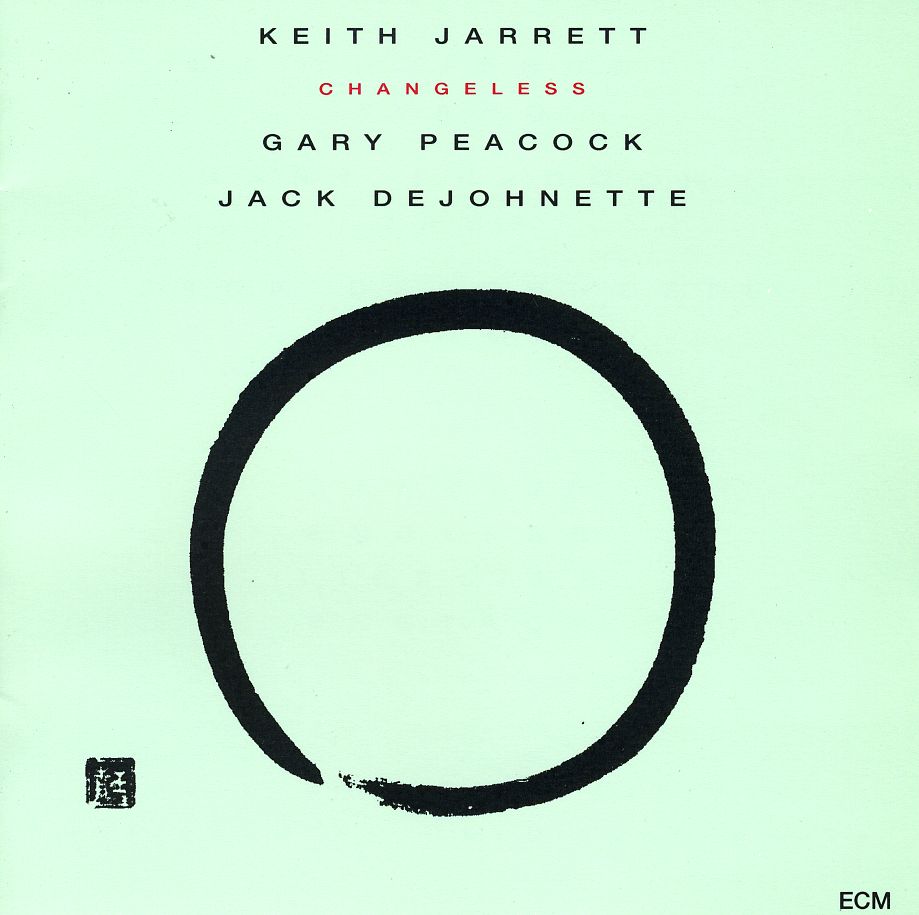
Keith Jarrett Trio: Changeless (ECM 1392)

Keith Jarrett Trio
Changeless

Keith Jarrett piano
Gary Peacock bass
Jack DeJohnette drums
Recorded October 14, 1987 (Denver); October 11, 1987 (Dallas); October 9, 1987 (Lexington); October 12, 1987 (Houston)
Engineer: Tom McKenney
Produced by Manfred Eicher

By the time of this release, Keith Jarrett’s trio with bassist Gary Peacock and drummer Jack DeJohnette was at the height of its creative powers (actually, they started high and simply went higher). One could already hear from their dip into the standards pool that Jarrett’s plenitude of creativity was a force to be reckoned with, if not simply enjoyed, and all the more so in such dovetailed company. That being said, the group was capable of far more than just extending a well-worn tune to a 20-minute diatribe of philosophical proportions. Although Jarrett himself had established quite the reputation as a solo artist, he had only rarely overlaid those transparencies over the topography of his group work. But then there is “Dancing,” the machinations of which open this positively transcendent quatrain of live recordings with a protracted leap of improvisation. As per usual, Peacock sparks the trio’s deepest running flame, and his amplified bass line herein lulls us into a memorable groove. The ostinato feel builds through Jarrett’s grinding left hand, while DeJohnette’s never-cease-to-amazing subtleties draw us in. This energetic yet trance-like state leaves us suitably cleansed for “Endless,” which is one of the most gorgeous things the trio has ever put out. There’s something profound going on here, something that proves the title isn’t just a catchy cue, but rather signals a modus operandi for Jarrett and his cohorts. Peacock’s soloing is revelatory here and spins us into the filmic fade-in of “Lifeline.” With an ear turned inward and his heart beating a versa for every vice, Jarrett floats a flower of resolution down a neorealist canyon. Soil is scarce, though watered all the same by the occasional storms of a hidden life in “Ecstasy.” This aptly titled closer is a tide that simultaneously ebbs and flows, so that the shoreline is forever redrawn.

Perhaps by no coincidence of title, this disc is on par with Changes as a different and sacred side of the trio’s sonorous rites. In some ways these pieces read like Jarrett solos while at the same time being duly enriched by the presence of Peacock and DeJohnette. There is so much to be heard in the experience, and even more to be experienced in the heard.

<< Thomas Demenga: Bach/Carter (ECM 1391 NS)
>> First House: Cantilena (ECM 1393)

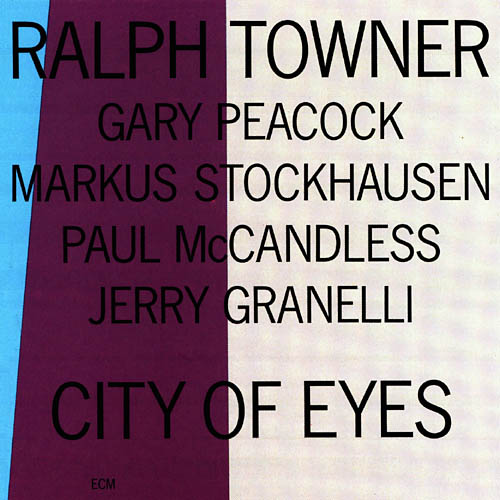
Ralph Towner: City Of Eyes (ECM 1388)


Ralph Towner
City Of Eyes

Ralph Towner 12-string and classical guitars, piano, synthesizer
Markus Stockhausen trumpet, piccolo trumpet, fluegelhorn
Paul McCandless oboe, English horn
Gary Peacock bass
Jerry Granelli drums, electronic drums
Recorded February 1986 at Power Station, New York
Engineer: David Baker
Digitally mixed at Rainbow Studio, Oslo
Recorded November 1988 at Rainbow Studio, Oslo
Engineer: Jan Erik Kongshaug
Produced by Manfred Eicher

While there are, of course, plenty of great pieces to choose from Ralph Towner’s still-growing songbook, I find myself turning more and more to “Jamaica Stopover,” the swinging opener of this late-80s session from the singular guitarist amid a cadre of friends new and old as an introduction to the unenlightened. Picturesque and lively, it is an exemplary showcase of Towner’s melodic (to say nothing of his rhythmic) flair. It is one of a handful of classical solos on City Of Eyes, of which “Janet” is another standout. Each is a snapshot in sound that sings. In addition to Towner’s skills unaccompanied, we are also regaled by a touch of Oregon in the group pieces. These take forms as varied as Towner’s instrumental role, switching as he does from frets to keys a number of times throughout. “Cascades” is perhaps the most successful in this regard. Trumpeter Markus Stockhausen gilds its already fine edges with liquid metal, forging complementary lines to the Jon Hassell-like synthesizers in the background. Stockhausen also dialogues beautifully with Paul McCandless (here on English horn) amid the deft stitching of bassist Gary Peacock. Stockhausen finds himself gilded in turn in the title track. This swell of primal energy sparkles with Towner’s 12 sparkling strings, which carry on through the contemplative solo “Sipping The Past.” Aside from being a lovely blossom in its own right, this piece demonstrates Towner’s talent for shape and architecture. The fullness of these compositional instincts fleshes out into “Far Cry.” This rare trio turn features Towner at both the piano and 12-string and stands as one of his most attractive dreams to date. Drummer Jerry Granelli adds tasteful pointillism to “Sustained Release” before “Tundra” brings us again into Oregon territory, where Stockhausen’s cries speak of an ice age weaving its feathered carpets across the tundra.

The reigning masterstroke of this date, however, has to be “Les Douzilles,” which reprises Towner’s classical against a gallery of spirited ground lines from Peacock. Its sense of movement and emotiveness is deeply performed, and one cannot help but notice the joy that both musicians get out of the interaction. They play as if from behind a sheen of ecstatic nostalgia, Peacock dancing his way through a surprisingly narrow thematic space before settling in for a gentle rejoinder.

There is a rusticity in Towner’s playing that I have always supremely appealing. It is a style unafraid to be a little rough around the edges, for those frays and twangs give the music that much more character. City Of Eyes remains a full portrait of his wide-ranging abilities and is a must-have for any fan.

<< Egberto Gismonti: Dança dos Escravos (ECM 1387)
>> Terje Rypdal: Undisonus (ECM 1389)