Stephan Micus: The Music Of Stones (ECM 1384)


Stephan Micus
The Music Of Stones

Stephan Micus shakuhachi, tin whistle, stone chimes, resonating stones, voice
Elmar Daucher resonating stones
Günther Federer resonating stones
Nobuko Micus resonating stones
Recorded 1986 at Ulm Cathedral
Engineer: Martin Wieland

Elmar Daucher’s resonating stones have haunted me since I first heard them on Klangsteine-Steinklänge (released 1990 on ProViva). While not conceptually unique (stone instruments, notes Micus, have at least a 2500-year history), Daucher’s playable sculptures nevertheless speak with voices all their own. They are, as anyone familiar will tell you, enchanting enough on their own terms, but to hear them in the context of Stephen Micus’s visceral melodies is to hear them as the source of some nameless creation. For the most part Micus has had free reign in recording for and submitting his work to ECM producer Manfred Eicher, who commits the material to disc as an acolyte might transcribe a master’s words. But for this project he took a rare dip into the pool of collaboration along with his wife Nobuko, Günther Federer, and Daucher himself all playing resonating stones. Add to these Micus’s unique instrumental prowess in the reverberant embrace of Germany’s Ulm Cathedral, and the results are as profound as they are extraordinary.


Micus and Daucher at Ulm Cathedral

The stones come alive in Part 1. Their voices hum through the listener’s bones. A shakuhachi begins its bird-like dip from the heavens, touching its wings to freedom. In its song one finds a cave, never knowing what will be heard, for under the cover of that night there is but a single voice calling (or is it weeping?) for someone. Two hands hold a song of water, turning it like a teacup held high in the absence of ceremony for the gods to drink. The shakuhachi then becomes a woodland creature who knows the trees well enough to skip through the branches blindfolded. The striking of the stones in Part 2 therefore startles with a blast of light. With the delicate force of a prepared piano or gamelan it is at once metal and flesh. One feels within it a sense of coming together through falling apart, a slow dissolve into unity at a molecular level. Part 3 introduces a penetrating tin whistle, and with it a feeling of windswept plains and distant shorelines, the continued gonging of the stones like cow bells in the pastures. Underlying rhythms carry over into Part 4, embracing an elemental sound in their tectonic heart, in which every seismic shift carves a new glyph of experience. Part 5 is a shakuhachi solo, tremulous and breaking. Spun of cloud and snow, it is a crane’s inner life unfolding before the dawn. Micus lets his throat unspool at last in Part 6, making music out of the very air around him. Which brings our attention to the one uncredited stone sculpture in all of this: the very cathedral itself, which has collected and preserved the footprint of every note played and which imparts its histories to us in an everlasting whisper.

<< Terje Rypdal: The Singles Collection (ECM 1383)
>> The Hilliard Ensemble: Perotin (ECM 1385 NS)

Shankar: nobody told me (ECM 1397)

Shankar
nobody told me

Shankar double violin, vocals
V. Lakshminarayana violin, double violin, vocals
Ganam Rao vocals
Zakir Hussain tabla
Vikku Vinayakram ghatam
Caroline vocals, tamboura
Recorded 1989 at The Complex, Los Angeles
Engineer: Billy Yodelman
Produced by The Epidemics (Shankar & Caroline)

After the uncharacteristic misstep that was The Epidemics, Shankar returned to his roots with nobody told me and showed us that his flair for Carnatic vocals is almost as deeply fleshed as his improvisational gifts on the double violin. And while he has never quite recaptured the magic of Who’s To Know, that same generative spirit is present here in every gesture of his bow. The recording is far more intimate than anything else he has put out. For that reason alone it bears repeated listening and the nuances that repetition brings to each new experience. He is also accompanied by some staggering talents, among them V. Lakshminarayana (father of the venerable L. Subramaniam and pioneer of the Indian violin, he died the year following this session), Zakir Hussain on tabla (who, if you’re reading this, probably needs no introduction), and ghatam master Vikku Vinayakram. The session is rounded out by vocalists Ganam Rao and Caroline, the latter of whom also provides the foundational tamboura drone throughout.

The most heartening moments are to be found between Lakshminarayana and Shankar, whose exchanges in the opening Chittham Irangaayo constitute a spiritual conversation to which the listener can only nod. From tender beginnings, their stichomythia of the rustic and the laser-like opens into a broader language as the rest join in the fray. Shankar emerges from this milieu with beautifully articulated chording and pizzicato accentuations in turn before bowing his way into a rousing finish. Vocals predominate the Chodhanai Thanthu that follows. The unrestrained cadences therein bring us to the root of this music, which at its best floats straight from the body and into the heart of the divine. Only with the introduction of percussion and violin do words step out onto the histrionic stage, taking us by the hand into the brief yet inescapable Nadru Dri Dhom ­Tillana, a fitting end to a raw and impassioned document of collective music-making.

<< Misha Alperin/Arkady Shilkloper: Wave Of Sorrow (ECM 1396)
>> Charles Lloyd: Fish Out Of Water (ECM 1398)

Egberto Gismonti: Dança dos Escravos (ECM 1387)

Egberto Gismonti
Dança dos Escravos

Egberto Gismonti guitars
Recorded November 1988 at Rainbow Studio, Oslo
Engineer: Jan Erik Kongshaug
Produced by Manfred Eicher

When I first heard Egberto Gismonti’s Dança dos Escravos (Dance of the Slaves) it had been months since I’d listened to the Brazilian master, and the feeling of being wrapped in his brilliant passion again was a joy to say the least, for in his comforting embrace I can always find more than a gesture to relate to. Although he is an adept multi-instrumentalist, I’ve always felt that Gismonti excels alone at the guitar, and you will not likely find a purer distillation of his art than this. The 15-minute title track constitutes the album’s lungs, through which Gismonti respires in concise autobiographical detail. Upon waking, it hits the ground running, flipping space as if through the pages of a well-weathered book into which a photographic record has been pasted. The glue becomes brittle and flakes the farther one goes back, and though images have loosened their grip on the past Gismonti rescues them with every unexpected turn in his playing. There are moments when he seems to time-travel, his fingers working independently yet with an orchestral unity so personal that even when he adds a 12-string it seems but an extension of the same instrument.

“Dança dos Escravos” bears the subtitle “black,” and Gismonti has accordingly designated every track its own color. Red is represented by the enthralling opener, “2 Violões.” From jubilant to regretful, he cycles through a youth’s worth of faded dreams and unrequited loves. It is one of his best and in it we find the intimacies of his craft overflowing in full disclosure. Moving on to blue in “Lundu,” he plows through a cycle so engaging that he cannot help but let out an mm of ecstatic communion with his instrument. That same voice comes out more intentionally in the green (“Trenzinho do Caipira”) and in the white (“Salvador”), uncovering in both the playful spirit that lurks in the interstices of his memories. It is as if he were standing on the center of a seesaw, at one end of which is the weight of the future and at the other sits the child-self thereof. Gismonti pares his abstractions to their hearts, working them into the traditional yellow ornaments of “Alegrinho.” Here he shares a fleeting portrait of the streets (and of the trees not so far away). We encounter open markets and the patter of boys’ feet between stalls as they snatch fruits and life experience from the tables.

There is something indescribably authentic (whatever currency that word may have nowadays) about Gismonti’s music. Listen, for instance, to the burnished brown of “Memoria e Fado” and hear within it a thousand voices, each having fed into this one musical utterance and of which said utterance will one day become a part of the growing chorus to inspire those in the future. It is through this music that one steps outside into the night, looks up at the stars, and thinks not confoundedly, but rather forgoes philosophy, content in knowing that its mysteries are life itself. These are shadows made bright again.

<< Paul Giger: Chartres (ECM 1386 NS)
>> Ralph Towner: City Of Eyes (ECM 1388)

Trio Mediaeval: Soir, dit-elle (ECM New Series 1869)


Trio Mediaeval
Soir, dit-elle

Anna Maria Friman soprano
Linn Andrea Fuglseth soprano
Torunn Østrem Ossum soprano
Recorded April 2003, Propstei St. Gerold
Engineer: Peter Laenger
Produced by John Potter
Executive Producer: Manfred Eicher

The music on this, the second album from the Trio Mediaeval, represents 500 years of creation. And yet, as John Potter notes, “in a sense it is older than that, tapping into the continuing present—a timeless present, perhaps—that is what medieval music means to us.” These three Scandinavian singers have done so much for the music they touch, and in turn British composers Gavin Bryars, Ivan Moody, Andrew Smith, along with Ukrainian Oleh Harkavvy, have nourished that sound with newly fashioned music of their own. At the heart of these dedicatory contributions lies the Missa “Alma redemptoris mater” of Leonel Power (fl. 15th century). The mass is a fine example of early Renaissance polyphony and through the Gloria alone expresses a cathedral’s worth of light and shadow. The tonal qualities of the singers and the sung are luminescent, all coming to a flowering head in the visceral Agnus Dei. Power’s music comes to us in spite of Henry VIII’s Dissolution of the Monasteries, thereby speaking to us all the more lucidly through a history that might have silenced it. Its clarity is as pervasive as its texts and forms a warm framework through and around which the women of Trio Mediaeval weave their artfully conceived program.

Plainchant is the inhalation and exhalation of Harkavvy’s Kyrie (2002), as of the program as a whole, which unfurls bursts of polyphony in its pores. From ashes to flesh and back to ashes, it paints a tableau of life in barest terms, exceeded in simplicity only by the solo laude of Bryars, who also aligns all three voices in his stilling Ave regina gloriosa (2003). The Ave Maria (2000) and Regina caeli (2002) of Smith expand upon the gorgeousness of these horizons, again inscribing broad mosaics of faith with minimal vocal borders. Only when we get to Moody’s The Troparion of Kassiani (1999) do we find ourselves wrapped in a more detailed cartography. Its shifting microtonal harmonies, evocative textual phrasings, and resplendent highs cut to the core of the singers’ art. Moody also offers the pinnacle of this disc in his 2002 composition A Lion’s Sleep, if only because it seems to draw upon the Trio’s talents most intimately.

In light of the above impressions, however, I am wary of treating the album as anything but a unified whole. Like all Trio programs, it is structured like a stained glass window, each section having been soldered into place with great individual detail, but which comes to vibrant life when vocal light shines through it. Only then does the image tell its story, share its moral lesson, and open its wings to an understanding of vibration and sound that is as constant as the sun in its veins.

Charles Ives: Sonatas for Violin and Piano (ECM New Series 1605)


Charles Ives
Sonatas for Violin and Piano

Hansheinz Schneeberger violin
Daniel Cholette piano
Recorded December 1995 at Tonstudio van Geest, Sandhausen
Engineer: Teije van Geest
Produced by Manfred Eicher

The violin sonatas of Charles Ives were famously considered unplayable at the time of their composition (1903-1916). This is about as far my knowledge about their background reaches, for Ives represents a sore gap in my listening that was only recently salved by violinist Hansheinz Schneeberger and pianist Daniel Cholette, who bring 20 years of experience with the sonatas into the studio for what I imagine will be a reference recording for years to come. In this instance I feel fortunate in my ignorance, for it allows me to approach this music with fresh ears and an open mind. Having listened only a few times thus far, I clearly have much to learn and discover.

Perhaps akin to its French counterparts, the First Violin Sonata to my ears feels connected to the intersection of body and landscape, of song and action. It youthfully skirts the line between outright offense and justifiable play (and is that Bartók I hear creeping in through the exuberant double stops?). The second movement, an Allegro, is a pastiche of soaring melodies and grinding moments of impasse, while the final movement is like some anthemic dream turned in on itself. Such twisted charm seems part and parcel of the Ivesian experience, and backgrounds the “Autumn” movement of the Second Violin Sonata with tortured intimations in a magisterial wash of melody. These underlying struggles haunt with such regularity that whenever energies do pick up they seem like desperate attempts to break free from something dark and adhesive. In much the same way, “In The Barn” is at once exuberant and tempered by internal conflict, while “The Revival”—which opens with what I can only describe as a morose version of “Jingle Bells”—fascinatingly overlaps traditions and distortions with a jeweler’s eye. The Third Violin Sonata is the most consistent of the four. Its chain of verses moves through a mosaic of narratives, but always with a sense of forward motion and thematic drive. From the aggressive to the pastoral, it handles its moods with conviction. Subtitled “Children’s Day At The Camp Meeting,” the Fourth Violin Sonata opens with a terse Allegro and a cascading second movement, the latter being for me the masterpiece of the collection. Lullabies give way here to lilting rhythms and jolting cutoffs, inviting us to fill in the gaps with our own experiences and understandings.

Although these sonatas don’t make for the most “pleasant” listening, one can hardly fault them for their honesty. Ives’s was an uncompromising approach to style, which is to say he eschewed it. Instead, he seemed equally bound to a highly idiosyncratic aesthetic and to the whim of the moment. Schneeberger and Cholette bring out that very tension and walk the edge of predetermination and spontaneity with practiced intimacy. Not unlike the early compositions of John Cage, Ives’s music commits to its own unfolding even as it thrives on the mystery of impossible form(ation).

<< Bobo Stenson Trio: War Orphans (ECM 1604)
>> Ingrid Karlen: Variations (ECM 1606 NS
)

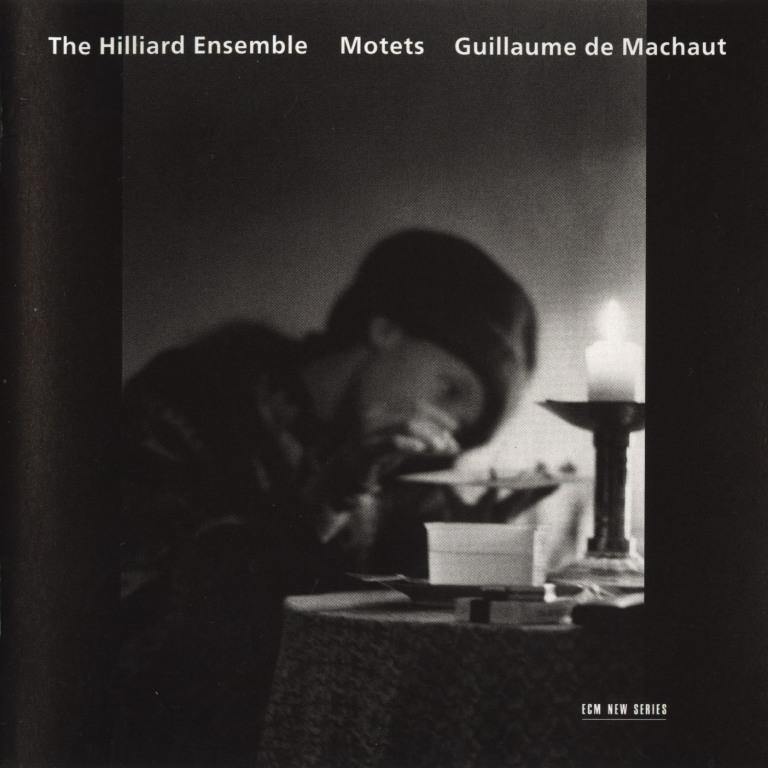
The Hilliard Ensemble: Guillaume de Machaut – Motets (ECM New Series 1823)

Guillaume de Machaut
Motets

The Hilliard Ensemble
David James counter-tenor
David Gould counter-ternor
Rogers Covey-Crump tenor
Steven Harrold tenor
Gordon Jones baritone
Recorded November 2001 at Propstei St. Gerold
Engineer: Peter Laenger
Produced by Manfred Eicher

As one who spent a good part of his formative Renaissance listening digesting the music of Guillaume de Machaut (c. 1300-1377) via non-Hilliard Ensemble recordings (most notably Ensemble P.A.N.’s exemplary Remède de fortune on New Albion), I have to admit to not taking much of a shine to these renditions at first. Yet after sitting with, and returning to, this recording a number of times over the years, I’ve been able to move beyond my preconceived notions and to appreciate the stunning light they shed. I venture to say that others may have the same reaction, but the rewards for immersing oneself in this ECM treatment are revelatory. The Hilliards have never been ones to take any project lightly, nor the choices within it, and the emotive care with which they sand and shape Machaut’s virtuosic settings is something to behold with wholehearted attention.

Like Gesualdo some two centuries later, Machaut was not without his preoccupations with mortality, love (both sacred and secular), and human beings’ penchant for suffering. It is perhaps for this reason that the Hilliards present their program in chronological order, as if to show us how Machaut grew behind and through its trajectory. And indeed we can almost hear that single comet’s tail drawn quietly from a tangle of cosmic lines. To be sure, these performances maintain the composer’s bold dissonances and challenging harmonies as they cascade over one another in waves of overwhelming polyphony (this, also, I think contributes to their hold on a listener), but in the Hilliards’ mouths their edges become rounded and fair, an effect only heightened by the resonance of Propstei St. Gerold, where the session was recorded.

The music is often anchored by dominant lines (e.g., Puis que la douce rousée) even as it spirals through a galaxy of atmospheres. Like a four-dimensional object it is impossible to fathom through the eyes, yet when we hear it through the shadows of the recorded medium it unscrambles our inner vocabulary like a Rubik’s cube until every side is uniform. Thus the movable nature of Machaut is so well suited to the Hilliards, for a likeminded meticulousness of vocal color and rhythmic staggering (O livoris feritas) truly distinguishes these singers from the rest. They also manage to enhance the sometimes-whimsical edge of the music’s piteous core, as in Helas! où sera pris confors. David James glows in the intimacies of Eins que ma dame d’onnour, Faus Samblant m’a deceü, as do the falsetto tenor lines in Fins cuers dous. Ultimately, however, one feels arbitrary in singling out certain moments over others, for Machaut’s knots are too well balanced to begin picking at individual threads.

I feel at pains to articulate what this music feels like, and equally so in trying extract some interpretive statement to which others, whether they’ve heard it or not, may relate. Like so much of what we encounter in our listening lives, these sounds come and go, lost even as they are experienced. That being said, I cannot help but believe that they leave discernible traces in the body, in the very synapses of the brain. If this recording has taught me anything about this art of reviewing in which I so humbly engage, it’s that immediate effect is not the criterion by which music should necessarily be judged. (In a world so bound by linear time, what currency does immediacy carry anymore?) Rather, I have increasingly tried to look at the specks of permanent change that Machaut, here and elsewhere, has lodged in me. Looking back on the experiences that led me to him in the first place, I know that fortune has indeed whispered into my ears with his texts and melodies from so many centuries ago.

If I may interrupt this stream of thought with a technical one, this was the first recording I ever heard with tenor Steven Harrold, who signed on with the Hilliard Ensemble in 1998. And while the colors of John Potter are certainly missed, Harrold delivers a fresh and slightly brighter tone (at the risk of undoing my earlier assertion, may I point your attention to his gorgeousness in the Veni creator spiritus). His presence is duly welcome in the context of Machaut’s motets, and along with countertenor David Gould enhances every motif he touches. If each motet is a series of numbers, then the Hilliards have provided us with legible solutions. Like a proof, each is filled with potential diversions and dead ends, but through this singular recording we are given a full map that we do well to follow with our eyes closed and our ears walking, open-armed.

Terje Rypdal: The Singles Collection (ECM 1383)

Terje Rypdal
The Singles Collection

Terje Rypdal guitar
Allan Dangerfield keyboards, synclavier
Bjørn Kjellemyr bass
Audun Kleive drums
Recorded August 1988 at Rainbow Studio, Oslo
Engineer: Jan Erik Kongshaug
Produced by Manfred Eicher

Long before ECM released its first remix album (for Nils Petter Molvær’s Khmer), it put out this, its first singles collection. Or so it’s nice to think: the title actually has nothing to do with the content. For their third album, Terje Rypdal & the Chasers instead spit out one of the most transcendent rock albums this side of the Milky Way. So much of that transcendence lies in the bandleader’s characteristic sere. When spurred on by the keyboard stylings of Allan Dangerfield and Audun Kleive’s clear-and-present drumming, he simply can’t go wrong. Yet what truly impresses me about this record is the playing of bassist Bjørn Kjellemyr. His sound, depth, and prowess are flat-out inspiring and constitute the red thread running through this set of 10 blistering cuts. His tight spirals in “Sprøtt” (Crazy), for example, rev up the action into the stratosphere, where Rypdal tills vast climates of thematic information over a nostalgic 80s beat and a Hammond organ so intense it’s almost vitriolic. “Coyote” is another Kjellemyr showcase. Along with the worldly percussion, his thrumming heart animates this track with Steve Tibbett-like expansiveness. The bassist isn’t all winces and head-nods, however, for in “Mystery Man” we find a fat slice of noir gilded in weeping tenderness. Still, he does wind a fuse that Rypdal follows into the passage of “The Last Hero,” lighting it into a hard-edged jam. Not to be outdone, of course, Rypdal cracks his whip with enough force to send us into the next county. The drum- and bass-heavy “U.’N.I.,” for one, is the perfect foil for his ring of fire, and in “Steady” he rides a rollercoaster whose tracks are marked by chromatic footfalls and skipping drums. He also excels in the slower numbers. From the twinkling synths of “Strange Behaviour” and on through the pentatonic infusions of “Somehow, Somewhere” to the final “Crooner Song,” he keens across the airwaves with the conviction of one who knows his emotions fairly and squarely. His provocatively titled opener, “There Is A Hot Lady In My Bedroom And I Need A Drink,” pretty much says it all, for here is a guitarist with a thousand stories to tell. With a powerful sense of development and musical architecture, his tunes are like landscapes razed and re-gentrified with every lick.

If you want to know Rypdal’s strengths as composer, you need look no further than Descendre, but for those who also want to experience the rawness of his talents on the axe, this one’s for you. Prepare to rock out.

<< Keith Jarrett: Personal Mountains (ECM 1382)
>> Stephan Micus: The Music Of Stones (ECM 1384)

Dave Holland Trio: Triplicate (ECM 1373)

Dave Holland Trio
Triplicate

Dave Holland bass
Steve Coleman alto saxophone
Jack DeJohnette drums
Recorded March 1988 at Power Station, New York
Engineer: James Farber
Produced by Lee Townsend

Triplicate is a fantastic (surprise, surprise) trio album that joins bassist Dave Holland with altoist Steve Coleman and rhythmatist Jack DeJohnette. This date’s quintessential opener, “Games,” comes from Coleman’s pen and showcases Holland’s love of play. The man with the upright plan is light on his feet here, DeJohnette even more so, while Coleman brings a chocolaty sound to his playing. Holland gives us his first of four compositions in “Quiet Fire,” which might as well fall under Coleman’s job description, such is the warming depth he elicits. In the wake of these tender considerations, Duke Ellington’s “Take The Coltrane” brings a different fire, this one whipped like cream into soft peaks. Coleman injects a classic energy into this tune, so vivid that we must readjust to Holland, who solos in a relatively quiet space. DeJohnette, on the other hand, kicks up the dust to match. With “Rivers Run” we’re back on the Holland track as he opens with a solo before that soulful alto breathes its magic into the air. Holland settles on a groovy line, picked up by DeJohnette’s cymbals and snared into an engaging roll. What seems a short and sweet ending then segues into a solo from the drummer, thereby inspiring the most spirited playing on the album from his bandmates. After a delicate rendition of “Four Winds,” we transition into Holland’s “Triple Dance.” Coleman winds fluently here, while Holland unseals a fantastic solo of his own. The trio take things down a few notches during DeJohnette’s “Blue,” regaling us with a smooth and tattered tale in which Holland’s understated brilliance shows us once again that he can lie low just as well as he can swing. Coleman likewise reveals the depths of his soul, and continues to do so amid the delicacies of the traditional “African Lullaby,” our final coddling before Charlie Parker’s “Segment” throws us back in the loop for an ecstatic close.

Triplicate is not an in-your-face album but one wrought with careful language. It avoids the danger of expletives in search of a clean melodic line. One imagines that if this album were alive, the audience would be whooping and clapping all the same, but in the studio a certain cleanliness of sound wins over. This has its pros and cons, depending on your preferences, but either way we can step outside of this record knowing we’ve just experienced something joyous.

<< Alex Cline: The Lamp And The Star (ECM 1372)
>> Eberhard Weber: Orchestra (ECM 1374)

The Dowland Project/John Potter: Care-charming sleep (ECM New Series 1803)


The Dowland Project
John Potter
Care-charming sleep

John Potter voice
Stephen Stubbs chitarrone, baroque guitar
Maya Homburger violin
John Surman soprano saxophone, bass clarinet
Barry Guy double-bass
Recorded 2001 at Propstei St. Gerold
Engineer: Markus Heiland
Produced by Manfred Eicher

With In Darkness Let Me Dwell, ex-Hilliard Ensemble tenor John Potter did something very special for the early Baroque, for what at first seemed a wild reconfiguration of songs and motives from John Dowland and his contemporaries was instead an act of deference to the improvisatory spirit that moved the music’s inception. The song- and partbooks of Dowland’s time were never meant to be prescriptive, but to function as stepping-stones for musicians’ creative interpretations. Here this concept is taken to task, and the result is music that carries itself across great divides with fluency and, dare I say, charming care. The inclusion of reedman John Surman and bassist Barry Guy is therefore an easy one to digest in what may look on paper to be a potentially disastrous experiment but which is, in fact, a program of awesome originality, which is saying something in a market flooded with early music interpretations of varying quality.

The project has also become an appropriate venue for the music of lutenist Stephen Stubbs, who contributes four plaintive Refrains to the proceedings. The first of these begins the program and weaves an elastic and chromatic net for all that follows. Its biggest catch is without a doubt the title song by Jacobean composer Robert Johnson (1583-1634). It is presented to us in two versions. The first of these takes advantage of the entire ensemble, spinning on the edge of Maya Homburger’s tremulous violin. Potter leaps into falsetto territory against a backdrop of harmonics, even as the entrance of Surman’s soprano adds further dimension and scope. Not unlike Jan Garbarek’s work with the Hilliards, Surman feeds off the infrastructure of the music at hand, spinning from it a weave at once respectful and innovative. An interlude provides Surman room for an enchanting rumination before Potter returns to the fold. In its reprisal, Johnson’s venerable number comes to us as we might expect it: through the familiar strains of lute and voice alone. Johnson’s aching moods wash over us again in two more songs, of which “As I walked forth” is wrought with due restraint and commentary from Homburger.

The often-played “Accenti queruli” of Giovanni Felice Sances (c. 1600-1679) provides some relief from the heavy pool of sentiments in which it finds itself. The tune plays like a jam session and best exemplifies the spontaneity behind the project’s concept. The regretful note on which it ends dovetails smoothly into “Weep, weep, mine eyes.” This mournful ballad by John Wilbye (1574-1638) draws out the program’s splintered relationship to love, and expresses through its saxophonic lines a suitable harmony of word and context. Surman likewise proves himself a defining presence in “Angela siete” by Cherubino Busatti (1600-1644), for here woodwind and throat swap roles like ribbons around a maypole.

Benedetto Ferrari (c. 1603-1681) was a new name to me, and his “Già più volte tremante” is a stunning piece of notecraft. Though brief, its unexpected minor shifts and Monteverdian phrasing make for a heart-stilling monologue.Yet while this album is rich with such luscious music, a single tune by Cipriano da Rore (c. 1515-1565) is for me its flashpoint. We encounter his “Ancor che col partire” also in two versions, once with lute and violin and again with vocals. The latter ends the program with a slow flourish that descends into the crypt from which it sprang in search of sunshine.

Nothing about the Dowland Project cries gimmick. This is not a mere ploy to capitalize on overdone material, but an offering of sounds already so rich with implication that the musicians cannot help but explore those sounds for all they’re worth. Anyone wary of approaching albums like Officium may want to ease into this rewarding ECM niche with Care-charming sleep.