Of Sound Faith: An Interview with Violinist and Educator Ruth Tumpalan

Sing unto him a new song; play skilfully with a loud noise.
For the word of the LORD is right; and all his works are done in truth.
Psalm 33:3-4

Born and raised in Manila, Philippines, violinist Ruth Tumpalan is a dedicated musician and educator. She is currently a faculty member at the Lindeblad School of Music, where her pedagogical zeal has earned her a place of distinction in the hearts of students. She has studied with such renowned classical artists as violinist Christoph Poppen and pianist Gilles Vonsattel, and has performed with a range of others across genres, from Jaime Laredo to Michael Bublé. Most recently, she won first place in the American Protégé International Piano and Strings Composition, and as a result of that honor was a featured soloist at Carnegie’s Weill Recital Hall in New York City. Her focus on cultural diversity is paramount and drives her to constantly improve her technique in all areas.

DSC_1615 2mb

Yet behind the glamour of performing on some of the world’s most hallowed stages, Tumpalan has found special fulfillment as part of the music ministry at Heritage Baptist Church in Manhattan. Her love of God and music have been intertwined since childhood, and manifest with especial depth in her work with the church’s choir as part of a vibrant ministry.

I recently sat down with Tumpalan via Skype to discuss the role of faith in her personal and professional life, asking first about her musical foundations.

“My father is a pastor, so we were all homeschooled, but when I was 10 he enrolled me and my siblings in an extension program at the University of the Philippines to study music. Two weeks later, I was playing in a Christian wedding officiated by my father. Since then, I’ve always played in church, both as a violinist and choir pianist.”

At the age of 12, Tumpalan got the chance to visit the United States with her father while he was touring churches. Upon returning home, she immersed herself in recordings and live performances, all the while cultivating a desire to pursue music as a profession. She went on to earn her Bachelor of Music degree at the University of the Philippines, with a focus on violin, graduating cum laude in 2009.

“After college, I played with the Philippine Philharmonic Orchestra, but after five years decided I wanted to develop myself even further through study. I had been praying since high school for an opportunity to study abroad, ideally in the U.S., in pursuit of new perspectives and higher standards. In 2014, God led me to a full scholarship to earn a Master’s degree at the University of Massachusetts.”

Tumpalan doesn’t take such blessings lightly and has always seen her gifts as God-given. While at UMass, however, she found herself at an impasse.

“There I was, halfway through my two-year program, contemplating what the Lord’s real will was for me. Did he want me to go back to the Philippines or did he have something bigger in store? It was a long journey, filled with prayer. But God provided, one step at a time, lining me up with a job before I even finished my degree. Although music had originally led me here to the U.S., I know in hindsight that it was actually God’s provision all along, working through all the little things to get me where I am now.”

Although Tumpalan’s husband was in Hong Kong at the time, he also earned a scholarship to study percussion at UMass, bringing them closer under an unseen but ever-felt guiding hand. They were further led to Heritage Baptist Church, where Tumpalan became immediately involved in the music ministry.

“Playing at Heritage is my priority. My job is important, but I like the need of going to church and being with brethren. It also enhances my career, leading me with strength through daily life and its many decisions. When I don’t go to church, even for just a week, I feel that my well-being is lowered.”

DSC_6088
(Tumpalan performs at Heritage Baptist Church)

And what, I asked, of her experience playing at Carnegie?

“I never thought I would get to play there as a soloist. I’d played there before with the Philippine Philharmonic, and thought that was going to be a once-in-a-lifetime experience. But then, last year, I was working with an excellent pianist named Jongsun Lee, who suggested we try out for the competition. With my full studio schedule, it wasn’t easy to manage practice time and teaching, but my teaching actually helped me to prepare. Certain things my own teachers had taught me before suddenly made sense. I never expected to get first place, but God made it possible.”
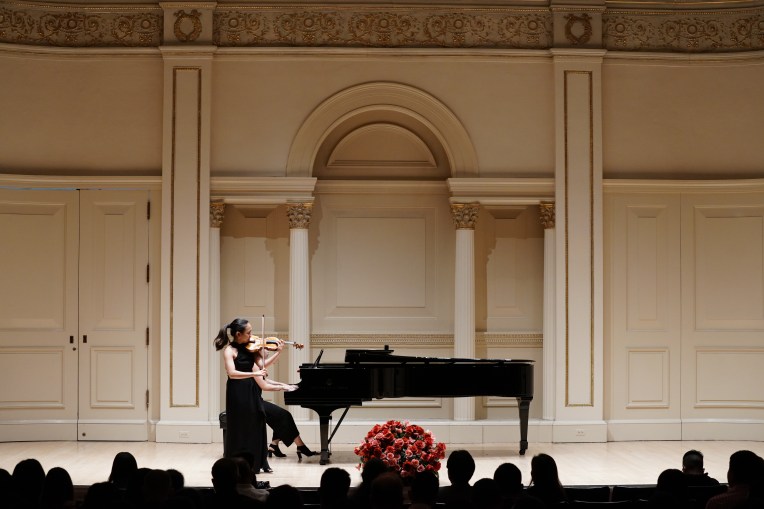
AmericanProtege-06-09-2019b-1652

For that performance, she chose Henryk Wieniawski’s formidable Scherzo Tarantelle Op. 16, a work brimming with the very excitement that stokes her appreciation for music as a means of communication.

AmericanProtege-06-09-2019b-1719

“The best feedback I’ve ever gotten as a musician is being told that I moved someone to tears. In that respect, in my playing I aim to be more of an inspiration, to connect with people at a level beyond words.”

This approach is integral to Tumpalan’s teaching, which builds upon the renowned methods of Shinichi Suzuki.

“I always make sure to explain to parents that the Suzuki method was designed to create better human beings through music, and that the most important things to learn from the experience are discipline, empathy, and cooperation. These are more than musical skills; they’re life skills. Without them, playing well and achieving success in music mean nothing. Whenever someone makes a mistake in my group classes, no one is allowed to point. They must respect themselves, first and foremost.”

As for the future, Tumpalan sees herself becoming even more involved in the church, and has been considering putting together a book of Christian music arranged for various instruments. Whatever may come, her faith will only continue to grow.

Praise ye the LORD. Praise God in his sanctuary:
praise him in the firmament of his power.

Praise him for his mighty acts:
praise him according to his excellent greatness.

Praise him with the sound of the trumpet:
praise him with the psaltery and harp.

Praise him with the timbrel and dance:
praise him with stringed instruments and organs.

Praise him upon the loud cymbals:
praise him upon the high sounding cymbals.

Let every thing that hath breath praise the LORD.
Praise ye the LORD.

Psalm 150

Kim Kashkashian: J. S. Bach – Six Suites for Viola Solo (ECM New Series 2553/54)

Six Suites for Viola Solo

Kim Kashkashian
J. S. Bach: Six Suites for Viola Solo

Kim Kashkashian viola
Recorded November 2016 and February 2017 at American Academy of Arts and Letters, New York
Engineer: Judy Sherman
Mastering: Christoph Stickel
Produced by Manfred Eicher
Release date: October 12, 2018

“Living with Bach: a true and faithful companion who patiently provides a merciless and transparent reflection of one’s failings in vision and simultaneously gives the deepest comfort in all circumstances.”
–Kim Kashkashian

If you were to unravel all the blood vessels contained in the average adult, they would stretch to a distance of 100,000 miles. And while the Six Suites of Johann Sebastian Bach (BWV 1007-1012) have always felt like such an unraveling, heard now from the viola of Kim Kashkashian, one becomes aware of that distance in an entirely new way. Whereas on the cello the extent of their totality feels surprising and overwhelming, here it takes an intimate, inevitable quality. In that respect, Kashkashian makes us believe that this music has passed through every molecule of her own body before a single note has tingled from the regard of a microphone.

Kashkashian heats expectation to the consistency of glass, cools it, and shines new light through its resulting prism by starting with Suite II in D minor. At first, one might miss the “depth” of the cello, but what the viola may lack in octave it makes up for with a resolutely vocal quality. With so much emotion at hand, the listener feels inadequate to contain it all. Yet both composer and interpreter assure us of having enough corridors within us to provide passage. In her rendering of the Sarabande especially, Kashkashian hasn’t so much revealed something once hidden by the screens of former performances, but taken the first pictures of this moon’s far side. Indeed, whereas other performers have focused on the face that’s always illuminated—whether by force of history or convention—Kashkashian shines her creative light onto a darker plane that was always there but for so long went unseen.

Only next do we find ourselves swaddled by Suite I in G major. At last, we get those familiar arpeggios, making their appearance all the more savory for their anticipatory marinade. What might normally be experienced as the seed, then, becomes the stalk born from that seed, at last graspable as an object of silent regard, not unlike the bow used to elicit its photosynthesis. Kashkashian shows her greenest spectrum in the Allemande, tracing every life-giving vein from edge to edge. Here, as also in the Courante that follows and the Menuet a skip beyond, she takes her time, allowing rhythms and ornaments to suggest their own variations and appearances.

Anyone missing the cello’s grit will find it dutifully preserved in C-minor Suite V. Between the angular Prélude and the laddering Gavotte, there’s plenty of sediment to be sifted through. The latter movement is a major turning point in that respect, and was for these ears the moment when the viola took on its spirit as a voice to be reckoned with in its own terms. What becomes clearer from this point forward is that everything Kashkashian plays is infused with as much of her being as Bach’s very own.

While “thinking out loud” is a descriptor often reserved for jazz improvisors, throughout Suite IV in E-flat major, Kashkashian shows us that classical musicians at the highest level are equally deserving of the accolade. Whether in every studied pause of the Allemande, masterful bowing of the Courante, or lively restraint of the duple Bourée, she shifts the light to reveal facets that, while forever singing, need a temporary amplifier to become audible.

Suite III, written in the fundamental C major, is a pantheon among temples, and therefore holds itself with a dignity that the other suites can only taste in shadow. Its own Allemande is another master class in syncopation and finds Kashkashian moving as would a linguist through a text so fully clothed in marginalia that, despite not being written in the native tongue, becomes second nature through years of anthropological internalization. So, too, the Courante, which leaps not from the strings but from the bow bidding them to resonate. Neither has the Bourée sounded so connected to its physical means, cracking in the ear like the softest of whips.

Just as the album began with the unexpected, so does it end as it should: with Suite VI in D major. Offering the most arresting Prélude of the collection, the microtonal rocking of which glows phosphorescently in its present handling, the suite is wisdom incarnate. The Sarabande is another manifesto of tenderness rarely so sustained, and delivers us like children into the dawn-drenched Gavotte. And where would we be but lost without its declamatory Gigue. Like its previous five counterparts, it gives us closure in order to hold us true to ourselves and our experiences. As Paul Griffiths in his liner essay notes of these farewells: “Gigues complete the landscape drawn in each key, not by the composer, not by the instrument, not by the performer, but by all three—complete it and leave.” We, however, stay behind, closing our eyes against the grain of what we’ve just heard in full knowledge that no such experience will ever honor us again. And so, we fold every artery, vein, and capillary we can call our own back into the suitcases of our skin, stepping back on the train of life and counting every track as we try to recall what it all felt like before these sounds compelled our detour into peace.

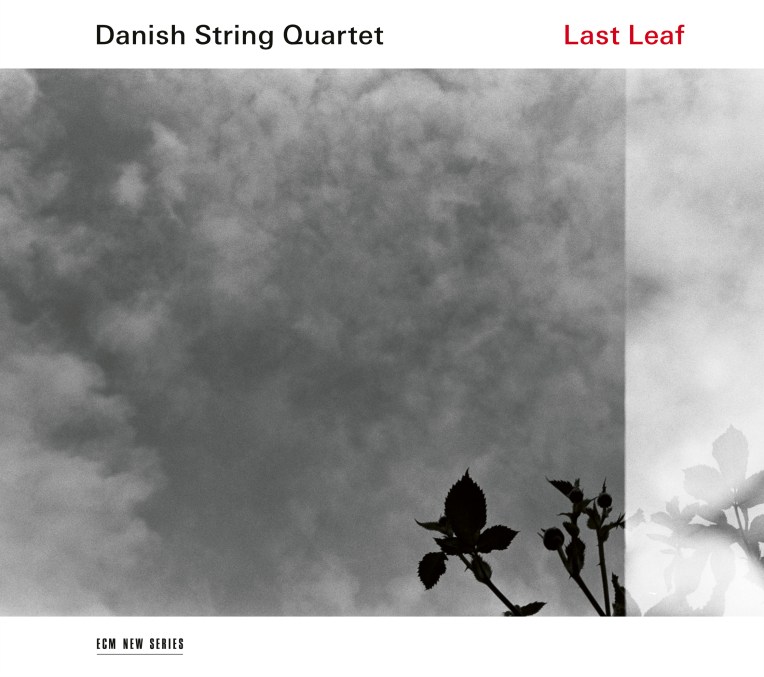
Danish String Quartet: Last Leaf (ECM New Series 2550)

2550 X

Danish String Quartet
Last Leaf

Rune Tonsgaard Sørensen violin, harmonium, piano, glockenspiel
Frederik Øland violin
Asbjørn Nørgaard viola
Fredrik Schøyen Sjölin violoncello
Recorded January 2017, The KirstenKjær Museum, Frøstrup
Engineer: Markus Heiland
Mixed June 2017 at Tritonus Studio, Stuttgart, by Rone Tonsgaard Sørensen, Manfred Eicher, and Markus Heiland (engineer)
Produced by the Danish String Quartet
Executive producer: Manfred Eicher
Release date: September 22, 2017

After an intimately electrifying 2016 ECM debut, the Danish String Quartet follow with this program of original arrangements so well suited to the source material that if their collective heart were a moon, it would be full and bright in the night sky of their creativity. The album’s seed is the Danish Christmas hymn “Now found is the fairest of roses.” First published by poet-theologist H. A. Brorson in 1732, it’s played as if in slow motion and captures the musicians in a film of artful restraint. That the tune concludes rather than begins the sequence is indicative of an underlying philosophy at play, in which stars regress back to their gaseous birth, mere wisps of galactic thought rendered sentient by the incubator of time.

At the other end of the spectrum is “Despair not, o heart.” This Lutheran funeral hymn, first notated in 1517, adds the elegiac cast of a harmonium, and with it the feeling of the open sea unraveled in “Shore.” Written by the quartet’s cellist, Fredrik Schøyen Sjölin, this self-described “folk fantasy” evokes sand and tide while also tracking the footprints left behind and washed away along its canvas. It finds later parallel in Sjölin’s “Naja’s Waltz,” a heartfelt piece of latticework that feels like a gift from father to daughter, and “Intermezzo,” a beautiful segue into “Shine you no more,” by lead violinist Rune Tonsgaard Sørensen. A reel partly inspired by John Dowland’s “Flow My Tears,” it moves kaleidoscopically and jigs its way across the grasslands.

Much of the liminal material at hand is Danish in origin, including the graceful “Minuet No. 60” from a 1760s collection of folk melodies transcribed by Rasmus Storm. Coordinated to the point of feeling untethered by convention, it moves as dancers in their prime. The song “Hur var du i aftes så sildig” (Where were you last night so late), from the same collection, treats pizzicato like a series of semantic puzzle pieces. Other highlights from this geographical focus are “The Dromer,” a so-called English dance collected by the Bast Brothers between 1763-1782, and “Æ Rømeser,” an example of the dance form known as the “sønderhoning,” unique to the southern Danish island village of Sønderho. Slow and sure, but transitioning into a more forthright sway, it grounds the listener as a prerequisite for leaving the earth behind.

Further travels take the quartet from the Swedish traditional “Polska from Dorotea,” attributed to fiddler Johan August Andersson (1866-1902) and filled with luscious interplay from the violin and the Faroese mythology of “Stædelil” to the astonishing sonorities of “Unst Boat Song,” an old Norse song from the Shetland Islands, and “Fastän,” a contemporary Swedish polska by Eva Sæther that ends with a trail of piano.

Regardless of origin, the quartet plays these all with such grace, attention to color, and scenic integrity, that where they’re going is never in question. In their handling, the last leaf becomes the first of another in a cycle of decay and burgeoning life, for which they are humble interpreters. We, in turn, are humbled to witness their unfurling.

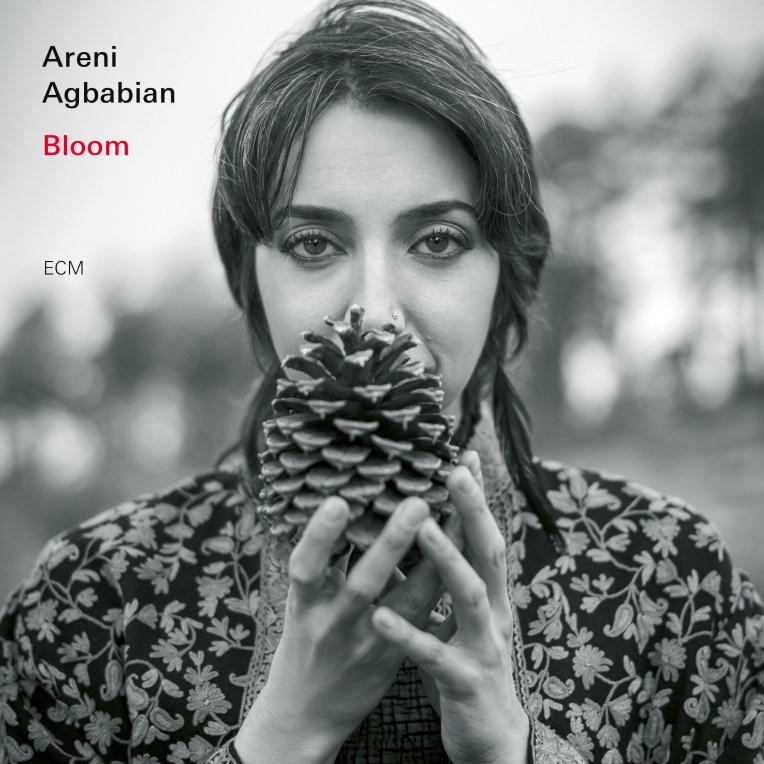
Areni Agbabian: Bloom (ECM 2549)

2549 X

Areni Agbabian
Bloom

Areni Agbabian voice, piano
Nicolas Stocker percussion
Recorded October 2016, Auditorio Stelio Molo RSI, Lugano
Engineer: Stefano Amerio
Produced by Manfred Eicher
Release date: April 26, 2019

Patience is more important now…

Bloom marks the ECM debut of a God-given talent. Areni Agbabian, an Armenian American from Los Angeles, is far more than any biographical sketch might seek to define her, if only because her art points to at least two futures for every past in which it is tangled. As a singer, she is equal parts Meredith Monk and Kate Bush, and in that respect embodies the power of wordless improvisation to tell as much of a story as a crafted lyric. As a pianist, she treats keys as seeds and by her touch inspires them to sprout feathers in place of leaves. As a songwriter, she gathers all of these metaphors in a sacred circle, and by that act offers them as prayers to the forces flowing through her. For this album, she is joined by percussionist Nicolas Stocker, whose textural sensibilities open their arms to whatever impulses arise in the studio.

The album’s cycle of life begins in the fullness of adulthood with the bipartite “Patience.” Its combination of muted piano and brushed snare meshes around Agbabian’s sung mantras, which just as soon pivot into unexpected territories with messages written in blood, tenderness, and possibility. She returns occasionally to auras of meaning, but connects them spontaneously to innermost chambers. “A time to be with you as a time to pray,” she intones, and in that call to psychological arms gives us all the shielding we need to fend for ourselves in a world run emotionally dry. As the first drop in a sprinkling of lyric-based pieces—which also includes the astonishingly cinematic “The Water Bride,” a folk tale rendered in spoken word, and “Mother,” an anthem for all humankind—it is an ocean in the making.

More often, Agbabian takes shelter in absence of words. Drawing a thread of continuity through such diverse selections as the traditional Armenian hymn “Anganim Arachi Ko,” the folk melody “Garun a,” and the original “Seeing More,” she traces that string to a mirror, in whose surface it seems to continue on forever into darkness. In each of these songs she takes a pondering look into the truth of the human condition, naked and vulnerable to pain, and by her very acknowledgment opens herself to intimacies of creation. The latter are best expressed in the fully improvised “The River,” in which she and Stocker add grooves of their own to the other’s sonic fingerprints and which yields the percussionist’s solo vision of “Colored,” which also finds a partner in his haunting “Light Effect.”

Agababian’s pianism shines brightest in “Petal One” and “Petal Two,” both of which presage the natural imagery of “Full Bloom,” and in two further pieces, “Rain Drops” and “Whiteness,” born of suggestions made by producer Manfred Eicher in the studio. But despite the album’s title, we know that most of what we hear is only some of what we get. Like the pinecone held before her face in the cover photograph, Agbabian reveals only the corner of a smile and leaves us free to imagine its curve into melodies yet to be gifted.

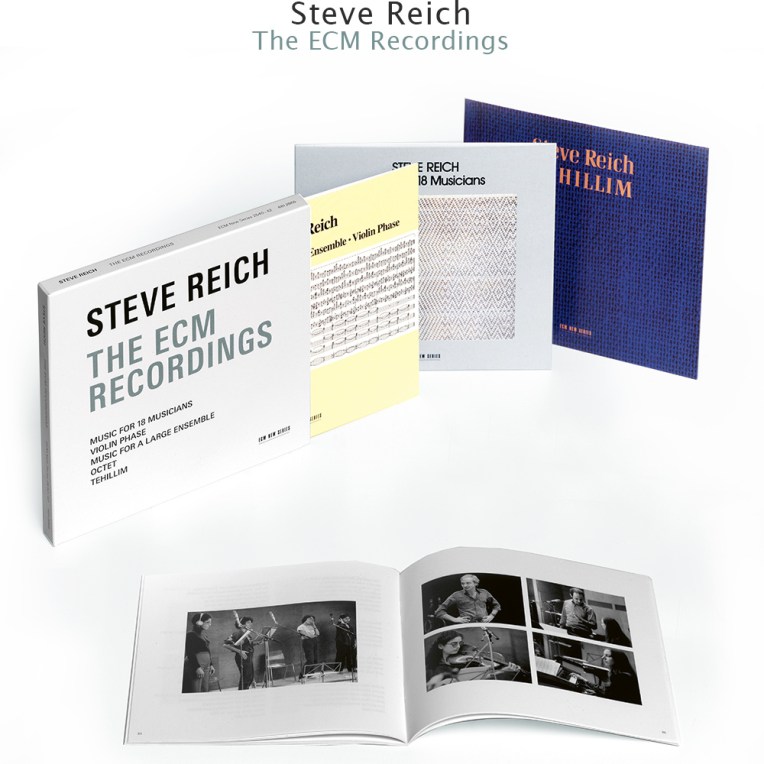
Steve Reich: The ECM Recordings (ECM 2540-42)

Steve Reich

Steve Reich
The ECM Recordings

Recorded 1976-1981
Release date: September 30, 2016

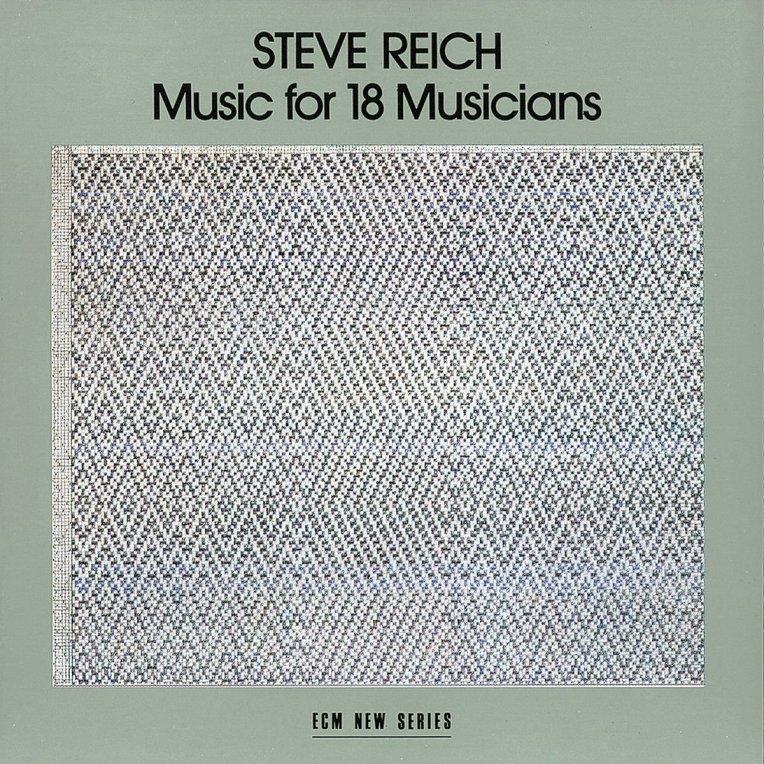
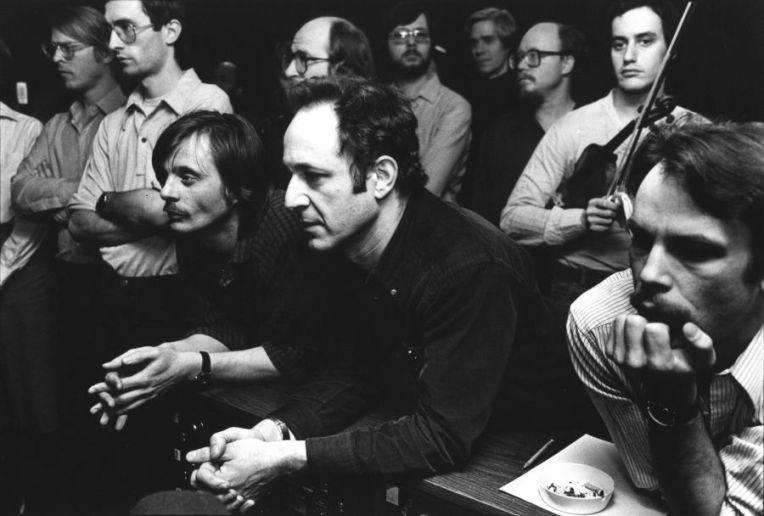
Steve Reich creates more than music; he renders his sound so systematically as to make it seem organic. Like the frond of a fern or the edge of a tide’s diurnal crawl, it reveals internal order upon inspection, working its fractal splendor at the most intimate of listening levels. At their heart, Reich’s compositions are precisely that: aggregates of base elements working toward a larger conveyance of meaning. Their pulse is their nervous system, insisting on linear paths in a tangle of mortal spirals. But as Paul Griffiths notes in his booklet essay for this essential boxed set, Steve Reich struggled to find a recording home, despite a few standalone releases on other labels, and the fact that by this time he was in his forties and had established himself as a musician and composer of international renown. Part of the problem was how to market it. It wasn’t quite or just classical, but a unique amalgam drawn as much from rock music as West African drumming. And while Deutsche Grammophon had made a recording of Music for 18 Musicians in Paris, it wasn’t until ECM head Manfred Eicher heard it that it saw the light of day. “It spoke to the time,” Griffiths goes on, “and to some extent it still speaks of that time, when the Vietnam War was recently over and in most western countries a social revolution had been accomplished under pressure from below. It speaks of optimism and harmony and drive and progress.”

Reich ECM 3D

Whatever their political, social, or geographic connections, the three albums collected here are as historical in scope as they are in ECM’s preservation. With barest means—the primordial contact of living flesh on dead—Reich and his cadre of dedicated musicians offer a three-dimensional experience unlike any other. And while it’s easy to differentiate the intimate details between each recording, hearing them under a single banner reveals powerful interrelationships and dialogues in service of a growing aesthetic. From the unhidden methodologies of Music for 18 Musicians to the numerological mysteries of Tehillim, one finds a spectrum of emotional receivers flipped on in glorious succession.

Music for 18 Musicians

Music for 18 Musicians (ECM New Series 1129)

Shem Guibbory violin
Ken Ishii cello
Elizabeth Arnold voice
Rebecca Armstrong voice
Pamela Fraley voice
Nurit Tilles piano
Steve Chambers piano
Larry Karush piano, maracas
Gary Schall marimba, maracas
Bob Becker marimba, xylophone
Russ Hartenberger marimba, xylophone
Glen Velez marimba, xylophone
James Preiss metallophone, piano
Steve Reich piano, marimba
David Van Tieghem marimba, xylophone, piano
Virgil Blackwell clarinet, bass clarinet
Richard Cohen clarinet, bass clarinet
Jay Clayton voice, piano
Recorded 1976, Studio des Dames, Paris
Recording engineer: Klaus Hiemann
Mixing: Rudolph Werner, Klaus Hiemann, and Steve Reich
Produced by Rudolph Werner

Music for 18 Musicians makes no efforts to obscure the methods behind its construction. It shows us mysteries never notated. The piece is scored for violin, cello, 2 clarinets doubling bass clarinet, 4 women’s voices, 4 pianos, 3 marimbas, 2 xylophones and metallophone (vibraphone with no motor). With his characteristic attention to detail, Reich utilizes these instruments not necessarily for their evocativeness, but for the varied ways in which their timbres can be blended in a nearly hour-long wash of sound. Movements herein are at once linear and multidirectional. Reich’s notecraft commits to its own agenda while grafting on to many others along the way.

It all begins with a living metronome of piano and mallet instruments before a chorus of breaths (via throat and woodwinds) convenes. The interweaving of these strands reinforces the compositional density, like marrow and nerves attaching themselves to a spinal c(h)ord of aural design. Indeed, what develops is one active body of which instruments are the genetic code. And while vocal utterances function as extensions of manufactured instruments, they lend fragility to the underlying spirit at hand. They rise and fall, slowly replaced by clarinets as if one and the same.

Sudden changes in rhythm serve to reconfigure our attention to the intervention of the composer’s hand: just as we are being lulled into a sense of perpetuity, akin to a natural cycle studied from afar, we are reminded of listening to a human creation. This awareness invites us to share in its re-creation through the act of listening. Like much of Reich’s music, Music for 18 Musicians is nothing if not accommodating. Rather than patronize or proselytize, it bares its bones. This brackets Music for 18 Musicians off from much of the histrionic art music in vogue at the time of its creation (1974-76).

The recording quality of this album is ideally suited to its subject matter. A sense of “clusteredness” prevails, such that the performers never stray too far from the nexus of their unity, while also providing just enough breathing room (performers’ lung capacities determine the length of sonic pulses throughout) for individual elements to shine. Most of the mixing, as it were, is done live by the musicians themselves, and requires attentiveness on the part of the engineer to highlight that interplay without overpowering the core.

<< Jack DeJohnette: New Directions (ECM 1128)
>> Azimuth: The Touchstone (ECM 1130)

… . …

Reich Octet etc

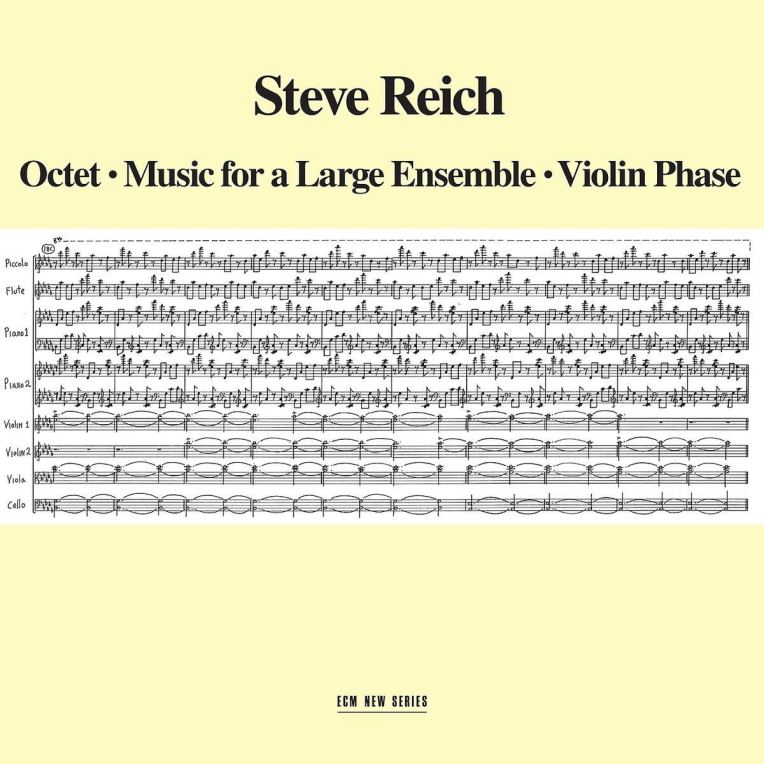
Octet / Music for a Large Ensemble / Violin Phase (ECM New Series 1168)

Russ Hartenberger marimba
Glen Velez marimba
Gary Schall marimba
Richard Schwarz marimba
Bob Becker xylophone
David Van Tieghem xylophone
James Preiss vibraphone
Nurit Tilles piano
Edmund Niemann piano
Larry Karush piano
Steve Reich piano
Jay Clayton voice
Elizabeth Arnold voice
Shem Guibbory violin
Robert Chausow violin
Ruth Siegler viola
Claire Bergmann viola
Chris Finckel cello
Michael Finckel cello
Lewis Paer bass
Judith Sugarman basse
Virgil Blackwell clarinet
Richard Cohen clarinet
Mort Silver flute
Ed Joffe soprano saxophone
Vincent Gnojek soprano saxophones
Douglas Hedwig trumpet
Marshall Farr trumpet
James Hamlin trumpet
James Dooley trumpet
Music for a Large Ensemble / Octet
Recorded February 1980 at Columbia Recording Studios, New York
Recording engineer: Martin Wieland
Violin Phase
Recorded March 1980 at Tonstudio Bauer, Ludwigsburg
Recording engineer: Martin Wieland
Mixing: Manfred Eicher, Martin Wieland, and Steve Reich
Produced by Manfred Eicher

Have you ever repeated a word over and over again until it loses meaning? Cognitive science calls this “semantic satiation.” Now imagine that someone could do the same thing for instruments and you’ll have a clear idea of the power of a Steve Reich composition. In this selection of three longer examples, we get exactly that: an unraveling of music’s linguistic shapes, transformed from within.

The instruments in Music for a Large Ensemble fit into a vast sequence of aural DNA, as logical as it is mystifying. Every voice is given ample space in a piece that, while densely layered, is as airy and fractally ordered as a puff of windblown dandelion. Strings waver with the unrelenting heat of a desert sun, horns ebb and flow in a brassy wash of equilibrium, and a vibraphone rings out like magic over all. Although the music moves mechanically, its texture is organic. This earthiness is maintained in Violin Phase, which consists of a repeated motif that, as with all of Reich’s “phase” pieces, is knocked just slightly out of alignment by the doubling voice, like two turn signals rhythmically staggering and realigning. This is the most localized of Reich’s phases, clearly rooted in the bluegrass fiddling tradition. The violin grinds like sand, small particles swirling and separating yet holding fast to some invisible predictability. After two such strikingly different pieces, the Octet somehow comes across as the most intimate. The inclusion of wind instruments, in particular the clarinet and flute, adds a crystalline contrast, leading to a glorious and sudden silence.

Albums like this and Music for 18 Musicians will easily make one lose track of time. Both are tessellations in sound, each image shifting through time and space like an Escher print, so that what begins as a diamond ends up a bird in flight. Naturally, the precision required to play Reich’s music is a feat in and of itself. That such a synergistic cast of musicians could arise out of the work of one composer is by all accounts spectacular, and when so lovingly recorded their cumulative effect is heightened. This is music that finds its expansiveness internally, charting the waters of our biological oceans until we come to our beginnings anew.

<< Art Ensemble of Chicago: Full Force (ECM 1167)
>> Jan Garbarek/Kjell Johnsen: Aftenland (ECM 1169)

… . …

Tehillim

Tehillm (ECM New Series 1215)

Pamela Wood voice
Cheryl Bensman voice
Rebecca Armstrong voice
Jay Clayton voice
Bob Becker percussion
Russ Hartenberger percussion
Garry Kvistad percussion
Steve Reich percussion
Gary Schall percussion
Glen Velez percussion
Virgil Blackwell clarinet, flute
Mort Silver clarinet, piccolo
Vivian Burdick oboe
Ellen Bardekoff English horn
Edmund Niemann electric organ
Nurit Tilles electric organ
Shem Guibbory violin
Robert Chausow violin
Ruth Siegler viola
Chris Finckel cello
Lewis Paer bass
George Manahan conductor
Recorded October 1981 at Tonstudio Bauer, Ludwigsburg
Recording engineer: Martin Wieland
Mixing: Manfred Eicher, Martin Wieland, and Steve Reich
Produced by Manfred Eicher

Human languages are contrived, insofar as they have undergone extensive sociopolitical reshaping. In Steve Reich’s Tehillim, however, words take on a self-sustaining feel, deeply rooted in the nutrient-rich soil of the composer’s instrumental configuration, and serve to dictate the flow of a seminal shift in American “minimalism.” Being the first document of this new path in Reich’s personal and professional development, this recording matches an endearing trepidation to every practiced gesture. This music, says Reich, may be “heard as traditional and new at the same time,” as it was both a way for him to explore his Jewish roots while weaving a fresh brand of secularism into the many liturgical threads at his back. At just under 30 minutes, Tehillimis a fleeting unraveling of that very fabric.

Eicher Reich
(Photo credit: Deborah Feingold)

Tehillim, meaning “praises” and referring to the Hebrew Book of Psalms from which it borrows its texts, is more than a remarkable work. It is also a work of remarks. The scoring is built around a core of drum and clapping before introducing a female voice doubled by clarinet. This opens into a series of four-part canons against a backdrop of electric organs and maraca. Each melodic line—human and instrumental alike—moves distinctly, unaffected by the trappings of vibrato or other flourishes, as an imitative counterpoint works its way into the smoke of this short-burning votive candle. Part II carries the women’s voices into higher elevations in which the passage of time is marked by a light interplay of drums. Part III is the slowest of the four, ebbing and flowing with a breath’s involuntary precision. Like the most engaging of Gavin Bryars’s ensemble pieces, this section pulses with the quiet splendor of a deep-sea organism. The final part opens our eyes again to sunlight. With the barest assortment of auditory keys, it unlocks just enough doors to usher us into a more personal understanding of exultation. It can be no coincidence, then, that the derivation of the title—Hey, Lamed, Lamed (HLL)—also forms the root for “hallelujah.” And so, when the hallelujahs that close the piece spring up like so much plant life, they seem inevitable. Tehillim is the Tree of Life feeding off itself, bathing in the spores of the Word made flesh.

Despite having turned this triangle around in the inner ear more times than can be counted, I discover something new every time: proof positive that calling it “minimalism” is unfair both to Reich and to the ones among whom he makes these demanding journeys. Thankfully, all we need to join them is a mind prepared to receive every shift of terrain with humility and a body in which to house it.

<< James Newton: Axum (ECM 1214)
>> Pat Metheny Group: Offramp (ECM 1216)

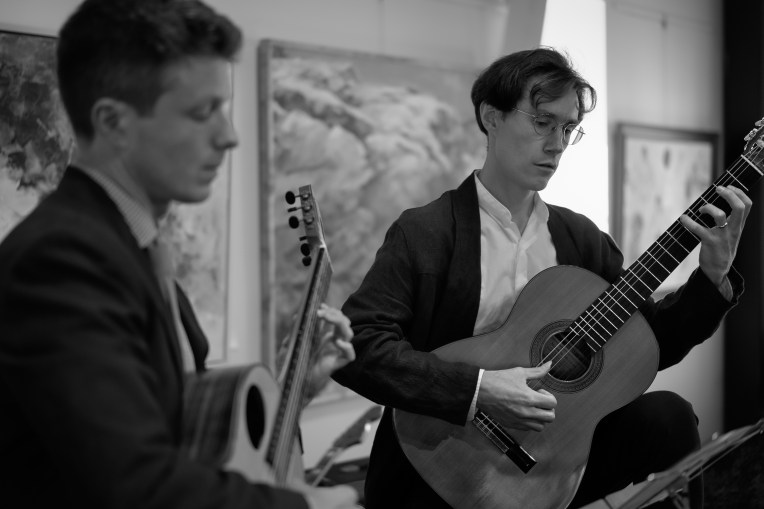
Of Arabesques, Peculiar Yet Familiar

On 27 July 2019, Joseph Ricker and Jamie Balmer—a.k.a. Duo Orfeo—graced Stonington, Connecticut’s La Grua Center for the fourth time, presenting European art music of the 19th century arranged for classical and electric guitars. The program’s title, Peculiar Arabesques, is shared also by the duo’s latest album, which deepens a diurnal approach to repertoire. For just as a famous chorale by Robert Schumann, from his Album für die Jugend, opened the concert with a tune that was clearly a product of its era, so did Ricker and Balmer close with Maurice Ravel’s Pavane pour une infante défunte, which by virtue of its watery textures and resplendent final chord comfortably transcended boundaries of time drawn by subsequent listeners.

DSC03414-Edit

Between those two poles of evocation, each an answer to its own question of motivic faith, we encountered a range of geographic and cultural materials. Of these, two selections from Isaac Albéniz’s Suite Española, struck that same balance between past and future, articulated with a fine touch within a circle of intimate regard. The second of these was an emblematic example of the duo’s proprietary blend of freedom and restraint. Five pieces from Reynaldo Hahn’s La Rossignol Éperdu were even more wonderous, weaving strands of recollection through sonic photographs in color schemes that, while faded, retained their complex interrelationships. Two mazurkas by Frédéric Chopin were also highlights, walking a tightrope between sul ponticello and sul tasto phrasings while holding firm to a melodic core.

DSC03399-Edit

Other evocative journeys included Enrique Granados’s Danzas Españolas, in which architectural splendor shared oxygen with quieter pictures of history and Ferdinando Carulli’s Andante varié de Beethoven. During the latter, a woman in the audience sat on the floor to work on her crocheting. In addition to her willingness to meet art with art, it seemed to serve as a metaphor for what all of us were hearing: a spool of filament unraveled and refashioned through a combination of instrument and human touch. And while the difference of guitars was certainly noticeable and appropriately chosen, adding especial vibrancy to the Ravel, it was more so the way in which they were handled that proved them worthy of expression.

Search Ensembles: Prescient/Legend

Prescient:Legend

With Prescient/Legend, producer and sound artist Dale Lloyd deepens his Search Ensembles project excavation after breaking ground with its 2015 self-titled debut on Lloyd’s and/OAR label. Although released 2019 on the either/OAR sibling imprint, this follow-up was culled from recordings made between 1986 and 2018 by a range of field recordists and instrumental artists, including Alan Courtis, Cedric Peyronnet, Cyril Herry, Eric Lanzillotta, Jani Hirvonen, Jon Tulchin, Mark Reynolds, Michael Northam, Mike Hallenbeck, Phil Legard, and Slavek Kwi. Lloyd sifted through their previously unreleased archives, forging timeless relationships in reassembly, while also inviting new material to be added through a variety of instruments.

“Search Ensembles started as an archaeological dig in the audio sense,” says Lloyd of the project. “I’d always wanted to do a project that revisited this planet’s history, but in a sense beyond anything we’ve learned in our school textbooks. It’s similar to something I started in early 90s called Lucid, for which we intentionally ‘weathered’ or ‘aged’ the recordings to give them an older aesthetic. That’s one of the motivating factors for digging into past recordings with so-called less-than-perfect sound quality. It felt compatible at all levels.”

Search Ensembles renders each of its sources, both organic and manufactured, as instruments in a compositional array. The result is a catalyst for elemental reactions. As far as choosing material that felt appropriate, Lloyd notes that coincidences of opportunity played an important role in shaping what emerged. “It was partially a happenstance thing. Some of the material, for instance, was gradual—things I had heard over time and which felt both appropriate and available.” Beyond that, he points to a relatively new interest in library production music as a tangible influence. Such recordings are forgotten time capsules, and hold in their nostrils the fragrances of ancient civilizations. In that sense, what we have here is nothing short of a patient awakening of buried melodies and textures after millennial slumber. In keeping with the metaphor—indeed, treating it as more than such—the album lays out artifacts still clinging to dust. Each is a village unto itself, spoken in the language of a place that no longer exists.

What follows is this listener’s own field notes, taken while surveying the album’s discoveries and calibrated by ears undeterred by temptation of silence…

1
As natural causes bubble to surface of perception, each works symbiotically with the other in a conversation so internal that it slips through the other side into an external manifesto. Tones at once distant yet so ingrained in the skin that you cannot help but be wounded by them coil around one another, searching for ideas as if they were physical traces left by immaterial souls.

2
Heartbeats and hints of thunder are kindred spirits. Their children are our ancestors, whose messages make paper of our brain tissue when we dream. Worthy only of being imbibed like plants crushed in stone and brewed into a tea of knowledge, they grow for the purpose of being snipped at the source. The crickets nestling around them are not messengers of the night, but remnants of the day speaking in tongues of sunrise.

3
Birds flock behind closed eyes, touching the liminal covering of reality with their wingtips but always returning to the percussion of flesh, metal, and bone.

4
A perpetual shushing of impulses by mothers whose evening chorus filters out the purest components of twilight. Voices are implied by the horizon’s arching back, flush with starlight as a lotus to pond’s surface. What was once implied becomes doctrinal, yearning to bring distances together: a Big Bang in reverse to the first pinprick of creation.

5
That same calling echoes here as dotted lines surround areas of conquering. Like frightened children wielding chalk on a blacktop, they reveal themselves in a tentative cartography, as predictive as it is unknowable.

6
The insects arrive with songs in their thoraxes, hidden until the final sting ejects their souls into death. They wander as if to wonder, hoping for the sky to fill in their broken choices with the possibility of a new hive, only to watch it die with roll of a farm machine intent only on destruction.

7
Splashes of water eject molecules of death, giving way to imaginary towers whose resonant chambers are the beginnings of life.

8
The printing press of the night leaves its mantras visible in the sky above, while the ground below thrives with pre-cultivation memories. A synthesizer is aurora to the flute’s borealis, reaching in for warmth and finding a talisman that is cool to the touch.

9
Static made biological: a song of conception, fertile in its detail. In the background: the cry of a mother yet to be born.

10
Overtones are undercurrents of faith, each dripping with reason until only truth is left in its evaporated wake.

Throughout this album, things hidden in the recesses of our collective past are being reckoned with sonically. More than that, they are turned in the hands until their sharpest points become rounded. A roof over solace, a library of parthenogenetic design whose shelves are as layered as the rock from which they were unearthed. “We’re documenting cultural activity,” Lloyd observes, “something that hasn’t been documented in any other way or is far less known to us.” More than unknown, I would venture to say that what we stumble upon here is a culture that does not exist except by the grace of those fortunate enough to give it three dimensions in the listening.

(For ordering information and to hear a sample, click here.)

Mieczysław Weinberg: Chamber Symphonies / Piano Quintet (ECM New Series 2538/39)


Weinberg Chamber Symphonies

Mieczysław Weinberg
Chamber Symphonies / Piano Quintet

Kremerata Baltica
Gidon Kremer principal violin
Andrei Pushkarev timpani, triangle, percussion
Yulianna Avdeeva piano
Džeraldas Bidva violin
Dainius Puodžiukas violin
Santa Vižine viola
Giedrė Dirvanauskaitė violoncello
Mate Bekavac clarinet
Mirga Gražinytė-Tyla conductor (Chamber Symphony No. 4)
Chamber Symphonies Nos. 1-3
Recorded live June 13, 2015 at Musikverein Wien
Piano Quintet, Chamber Symphony No. 4
Recorded June 9/10, 2015 at Latvian Radio Studio, Riga
Tonmeister: Vilius Keras, Aleksandra Kerienė
Engineer: Varis Kurmins (Riga)
Mastering by Christoph Stickel, Manfred Eicher at MSM Studio, München
Album produced by Manfred Eicher
Release date: January 13, 2017

Following his first examination of Mieczysław Weinberg (1919-1996), violinist Gidon Kremer returns with his eponymous ensemble for another album devoted to the Polish-born Soviet composer. “No other composer has entered my own and Kremerata Baltica’s repertoire with such intensity,” writes Kremer in a liner note for the album, citing the four chamber symphonies recorded here as his finest examples. Despite Weinberg’s penchant for chamber music, if not also because of it, in these pieces one finds heartbreaking intimacy.

The Chamber Symphony No. 3, op. 151 (1990), loosely transcribed from his String Quartet No. 5, opens the program’s descending first half. The string orchestra for which it is scored opens in the mode of Lento with such clarity that it feels like a mirror in which every listener is reflected in high definition. Its tactility of history finds purchase wherever it can, clawing its way slowly into the inner ear, where it nests like a dying bird. Its afterlife is marked Allegro molto, lively yet underlined by melancholy, shifting into a tutti passage of chords that teeters on the brink of decay. The Adagio that follows is Weinberg’s default state of mind, giving itself over to thoughts of fog and shadows. The cello arising from shimmering violins gifts us one of the great solos of modern music. Lastly, the Andantino, a macabre dance interspersed with surprising Baroque textures utters a transfixing farewell.

This piece and its predecessor come from a time when Weinberg was fading into obscurity. Sick and isolated, he could only watch as his friends died or emigrated beyond his reach. Still, works like these continued to be premiered and touch the lives of those fortunate as we to hear them.

Chamber Symphonies Nos. 2 and 1 are further reworkings of string quartets and both supplement new movements in their reiterated forms. The Chamber Symphony No. 2, op. 147 (1987) adds to the orchestral milieu a pounding timpani, and with it a layer of storm. It circles, dances, and flirts with romanticism even as it transcends boundaries with the ease of breathing. The second movement shifts from lacey dance to exuberant outpouring, capped by a solo violin that also figures centrally in the final Andante. The strings are gnarled like tree roots, only some of which are visible aboveground. The Chamber Symphony No. 1, op. 145 (1986) closes out the first disc, balancing the Tchaikovsky-esque textures of its first movement with the final Presto’s full-on desperation, treading the edges of collapse between them with a strange mixture of glee and fear. Although no timpani is to be heard, it may just be the most percussive of the symphonies.

The Piano Quintet, op. 18 was composed in 1944, a year into Weinberg’s settlement in Moscow, where he would spend the remainder of his life, following a harrowing escape from the Nazis in 1941. By influence of Shostakovich, it takes a five-movement structure, and is presently arranged for piano, string orchestra and percussion by Andrei Pushkarev and Gidon Kremer. The gentlest of persuasions eases us into its sound-world, brittle enough to snap at the merest hint of impropriety. In the interest of its protection, Kremer and company lend it an evenness that never ruptures, except at choice moments of catharsis. That said, there’s very little in the way of redemption. In its place are the anxieties of its faster movements, which in their headlong rushes of detail reveal many possible outs, none of which are taken until the mighty Largo that follows. Over its 14-minute duration, as much urgency as recall feeds into the final movement. Appropriately designated Allegro agitato, the latter mocks the army of time.

Last is the Chamber Symphony No. 4, op. 153 (1992). Scored for clarinet, triangle and string orchestra, and bearing dedication to composer Boris Chaykovsky as a gesture of reconciliation to their waning friendship, it was to be Weinberg’s final completed work. Its opening Lento is his crowning achievement. Here, as in all subsequent movements, the clarinet flows as if through the prism of a traumatized yet resolute soul. The second movement, a fierce Allegro molto, treats the clarinet as a voice among voices, a representative of its community, vying for attention in the push and shove of a politically overwhelmed life. Again, a cello figures sagaciously at the end, tracing wisdom born of conflict. The Adagio is another patient stroke of genius, drawn like an ink-laden brush until every last drop is elicited. The final Andantino is a ballet without dancers in which microtonal plies are front and center before collapsing into a funereal drone.

If Shostakovich, with whom he was a close friend, can be said to be pathos, then Weinberg is the pathos of that pathos. Kremer’s focus on this music is therefore more than a recovery effort, but a philosophical resurrection. Under his direction, the music leads itself, and in that spirit walks crosswise with regard to every expectation, head bowed and hand dashing across the page before the flesh expires.

András Schiff: Franz Schubert – Sonatas & Impromptus (ECM New Series 2535)

Schubert Sonatas and Impromptus

András Schiff
Franz Schubert: Sonatas & Impromptus

András Schiff fortepiano
Recorded July 2016, Kammermusiksaal H. J. Abs, Beethoven-Haus, Bonn
Engineer: Stephan Schellmann
Tuning and technical assistance: Georg F. Senn
Executive producer: Manfred Eicher
Release date: April 12, 2019

“Secretly, I hope to be able to make something of myself, but who can do anything after Beethoven?”

In these words, Franz Schubert (1797-1828) at once shadowed himself against his light of inspiration and added to its fiery glow. But because artists of any type are often their worst bêtes noires, the humble interpreter would better judge his place in history, for while this music exuded from the body of its composer, it infuses every sinew and synapse of its performer. In András Schiff, Schubert finds an amplifier both in and out of time. “Schubert’s music,” notes the Hungarian-born pianist, “is the most human that I know,” and only a musician of such humanity could hold true to that doctrine.

In his own day, Schubert was filed prematurely under “recondite,” and so after the publication of his first two early sonatas he dove headlong into his crowning Winterreise, producing also in that period the Moments musicaux (see ECM New Series 2425/26) and the first Impromptus D 899. The latter were never meant to be concert pieces. “And even if we play them in a large hall today,” Schiff insists, “we have to transform that space into an intimate space.” Schiff does that, and more, in his renderings of these mosaics. From the light-footed highs to the surface-level lows and the heavenly mids between them, Schiff achieves a striking balance and dynamic spread on the Franz Brodmann fortepiano, built in Vienna circa 1820, which makes its recording debut here. In the first impromptu especially, one hears a mind thinking aloud in words that can only be captured in their absence. In place of letters, Schubert writes with feelings—not impressions, but fully formed emotional landscapes. As lines diverge, Schiff handles their individuality with surgical care. In both the second and third impromptus, he carries across a sense of water running through a forest, while in the last enhancing the modesty reflected in the epigraph above.

The Sonata in c minor D 958 was written in 1828, just two months before Schubert’s death. Its Allegro plunges us into a world all its own, crafted as much by shadow as by light. Schiff’s rhythmic sensitivity is righteously attuned and reveals a difference of reiteration rarely matched. The mournful Adagio finds its promise fulfilled by asking for no promise to be fulfilled. Its eternal spiral of questioning and answering becomes a private dialogue for composer and performer alike. A Menuett gives us respite from the weight of darkness, turning to a memory as a rift in the fabric of time that cannot be brought closer no matter how far we reach. The final Allegro, which Schiff calls a “dance of death,” is a mad, desperate rush into turbulent night. At any given moment, it threatens to unchain itself, but manages to hold its integrity, even as it unspools to a thread of its former glory.

The Three Piano Pieces D 946, essentially impromptus by another name, are among Schubert’s most adroit. The first of these, in e-flat minor, appeared at Schiff’s fingers previously on ECM in his Encores After Beethoven, and enthralls even more in the present rendition. This piece has it all: drama and introspection, virtuosity and humility, life and death. The second is an inversion of the first, achieving some of its densest textures in the middle between a head and tail of airy resolution, while the final impromptu jumps through one thematic hoop after another until it sticks its landing perfectly.

Schiff is keen to observe that Schubert, even in his brief life, wrote more than 600 lieder for piano and voice, and that even when writing for solo piano “the human voice and the song are always present.” His magnum opus, the Sonata in A Major D 959, is proof positive of this effect and is alone worth the price of admission. Its gargantuan opening is the science of poetry incarnate. At nearly 16 minutes, it floats two images for each one it sinks, and leaves us tenderized for the lachrymose Andantino that follows. If any single movement can be exhibited as proof of the fortepiano’s capabilities, this would be it. From whispers to thunder, it encompasses the full gamut with breadth of mind, and Schiff understands its mechanical heart as his own. The mood is so intense that the Scherzo opens a portal from one end of life to the other, bleeding into the concluding Rondo as if time itself were a physical substance to be waded through on the way to eternity.

As Misha Donat writes in his liner essay, “In the beauty of his material and the magical effects of elliptical key change…it must be said that Schubert actually surpassed his model.” But perhaps their relationship isn’t so much temporal as spatial, for while Schubert had himself buried close to Beethoven, the two would seem to converse from atop distant mountains even as performers of their music try to hang-glide along the currents between them without falling. And while it’s tempting to imagine what Schubert might have written had he lived beyond the tragic age of 31, that his flame caught hold of its worldly wick for as long as it did should be enough to validate the gift of its light.