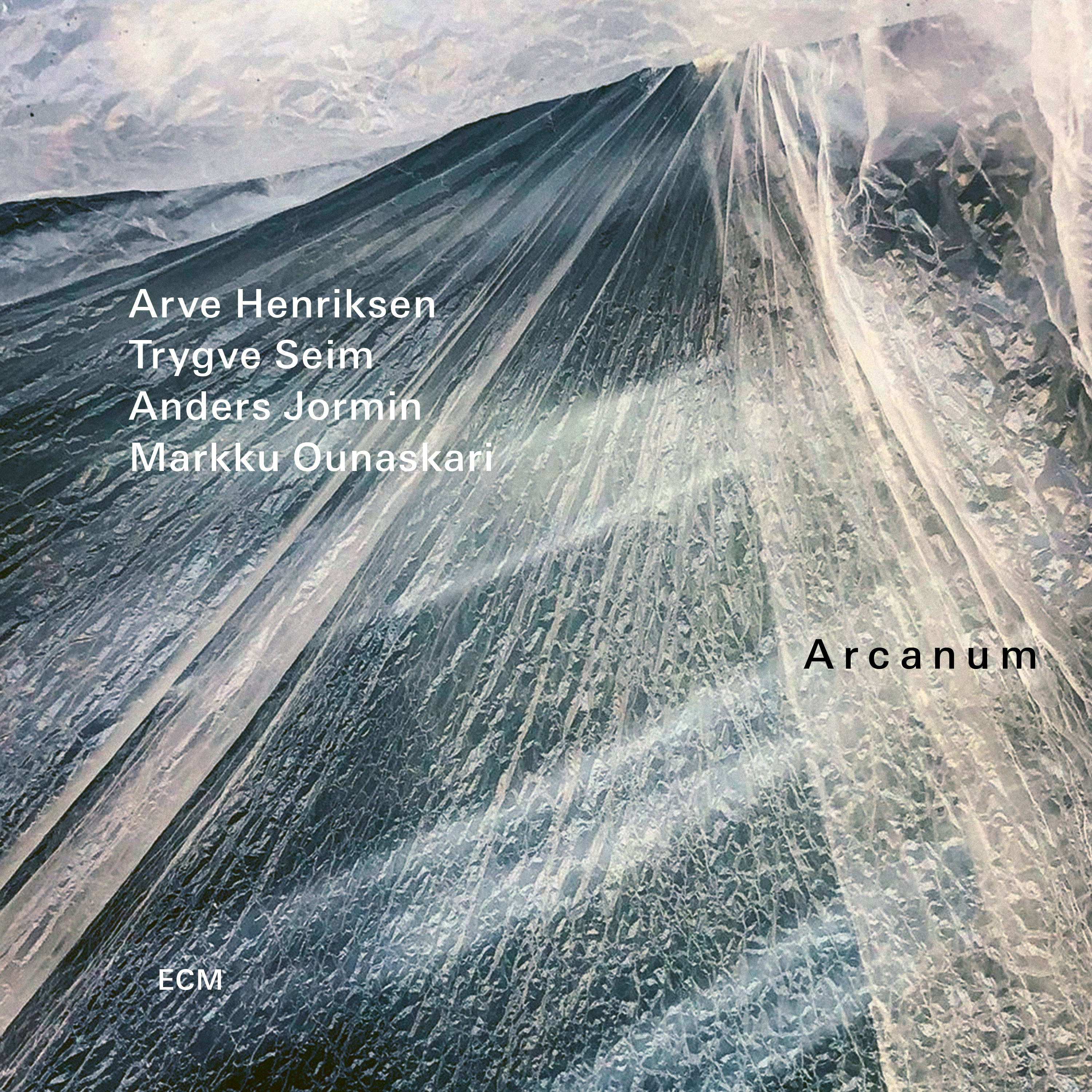
Henriksen/Seim/Jormin/Ounaskari: Arcanum (ECM 2795)

Arve Henriksen
Trygve Seim
Anders Jormin
Markku Ounaskari
Arcanum

Arve Henriksen trumpet, electronics
Trygve Seim soprano and tenor saxophones
Anders Jormin double bass
Markku Ounaskari drums, percussion
Recorded March 2023 at The Village Recording, Copenhagen
Engineer: Thomas Vang
Recording supervision: Guido Gorna
Mixed January 2025 by Manfred Eicher and Michael Hinreiner (engineer) at Bavaria Studios, Munich
Cover photo: Hubert Klotzek
Produced by Manfred Eicher
Release date: May 2, 2025

Arcanum brings together trumpeter Arve Henriksen, saxophonist Trygve Seim, bassist Anders Jormin, and drummer Markku Ounaskari. It is the first album for these longtime associates and ECM luminaries as a standalone quartet, following their previous collaborations with folk singer and kantele virtuoso Sinikka Langeland on StarflowersThe Land That Is Not, and The Magical Forest. In their element here, they look through a prism of shared influences toward something greater than their sum.

Seim’s opening tune, “Nokitpyrt,” is a nod to the greats of Scandinavian jazz (the title is Triptykon backwards, referencing Jan Garbarek’s 1972 watershed recording). It staggers its way forward, but never in doubt of where its feet will land. The horns converse soulfully, as they also do in “Trofast,” Seim’s other contribution to the set. Jormin offers two of his own in the form of “Koto,” a familiar gem that takes on new light through the glorious expanse of Seim’s tenor, and “Elegy,” written with these bandmates in mind on the first day of the war in Ukraine. That the musicians manage to elicit such a wealth of energy in such quietude is nothing short of astonishing. Jormin’s loving arrangement of the Ornette Coleman classic “What Reason Could I Give” and a take on the Kven/Finnish traditional “Armon Lapset” complete the predetermined material. The latter’s bipolar approach, by turns subdued and unbound, allows the band to free-wheel its way into uncharted waters.

And in fact, the lion’s share of the session consists entirely of spontaneous music making. First among these is “Blib A,” a brief yet evocative palate cleanser for the ears that comes second in the set list and once again proves the brilliance of Manfred Eicher in his placement and ordering of tracks into a narrative we can feel. Many of these pieces, such as the softly sunlit “Morning Meditation” and the memory-laden “Shadow Tail,” are almost as brief. Yet what truly impresses in these freely improvised wonders is their subtle and tasteful incorporation of electronics, courtesy of Henriksen. The musicians leverage this extra color to great effect as a bed for soulful sopranism and kindred trumpet (“Lost in Vanløse”), temperance for cymbal scraping (“Polvere Uno”), and tidal pull for distance tenoring (“Fata Morgana”). At any given moment, they are a source of deep comfort and hope.

Ironically, “Folkesong,” despite being ad-libbed, comes across as the most structured and traditional tune by comparison. Ounaskari’s tender brushes add a subtle undercarriage for this train ride, while Seim’s lilting sopranism gives way to Henriksen’s electronically enhanced calls. But even the most flowing tracks, like “Old Dreams” (another ECM reference, perhaps?) and “Pharao” (a highlight for its mind-melded horns), articulate with eye-through-the-needle precision. And in “La Fontaine,” with its late-night streets and evocations of urban solitude, we find ourselves at last coming home, different from when we first stepped out the door.

Arcanum is an experience of new directions born to longstanding impulses that says only what it needs to say—nothing more, nothing less.

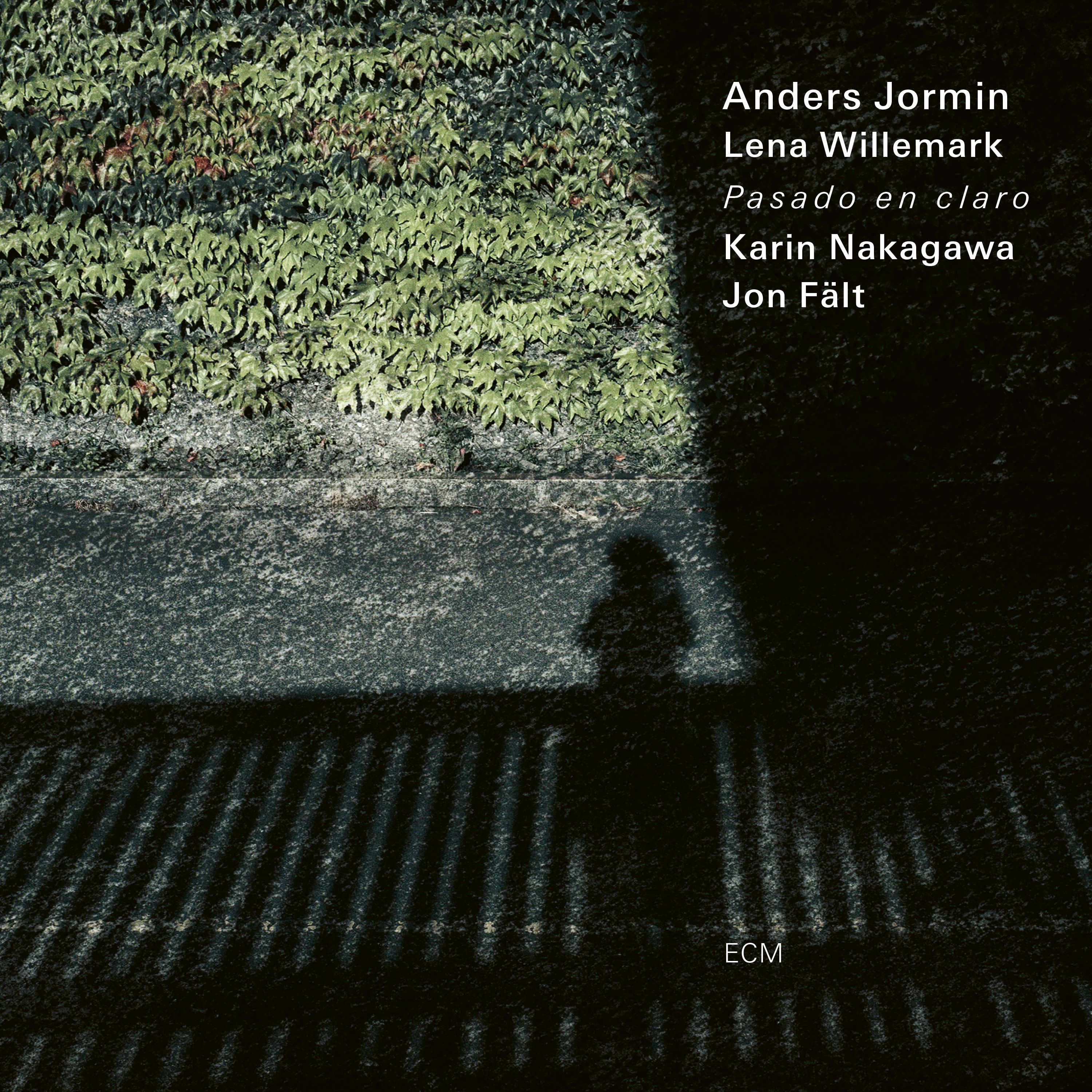
Anders Jormin/Lena Willemark: Pasado en claro (ECM 2761)

Anders Jormin/Lena Willemark
Pasado en claro

Anders Jormin double bass
Lena Willemark vocals, violin, viola
Karin Nakagawa 25-string koto
Jon Fält drums, percussion
Recorded December 2021 at Studio Epidemin, Gothenburg
Engineer and coproducer: Johannes Lundberg
Cover photo: Fotini Potamia
Executive producer: Manfred Eicher
Release date: January 20, 2023

Since breaking ground on 2004’s In Winds, In Light, bassist Anders Jormin and singer/violinist/violist Lena Willemark have charted old and new territories in an increasingly fertile partnership. Their collaboration reached the next stage of development when they welcomed Japanese koto player Karin Nakagawa into their midst on 2015’s Trees Of Light. To that milieu, they’ve added drummer Jon Fält, whose name will be familiar to Bobo Stenson Trio fans. Although Willemark’s roots in Swedish folk heritage and its preservation are at the core of what’s being articulated here, the improvisational packaging has been deepened. The settings touch down on the landing strips of many times and places, including poetry from ancient China and Japan, contemporary Scandinavia, Mexican luminary Octavio Paz (whose “Pasado en claro” gives us this album’s title), and Renaissance humanist Petrarch.

The latter’s Poem no. 164 from Canzoniere, the eponymous subject of “Petrarca,” flickers like a candle flame. It is one of many musical settings by Jormin, whose loose strata give his bandmates plenty of room to look for fossils and regard their shapes melodically. Long before that, “Mist of the River,” his take on Ouyang Xiu (1007-1072), opens with the gentlest shimmer of koto. The poem paints a picture of a fisherman whose cast is obscured by mist and storm, resolving into groovy textures. With the clarity of a statue, Willemark etches the scene one frame at a time until they mesh into a flowing whole. Brushed drums add jazzy touches: water and silver combined. “Glowworm” looks even further back to the 8th century. The tanka by Yamabe no Akahito, rendered here in an evocative Swedish translation, finds Willemark and Jormin’s instruments in a cloudy slumber while percussion and koto yield just enough light to see the contours of their dreams.

Most of Jormin’s tapestries are woven from more recent material. And yet, despite the brief appearance of artifice—as in Jörgen Lind’s “Blue Lamp,” which contrasts hospital buildings against a starkly natural scene—all the modern verses are steeped in an unbroken respect for the organic. This is especially true in “Kingdom of Coldness,” where the haikus of Tomas Tranströmer seep through liquid gongs and arco bass as Willemark’s voice draws maternal lines across Nakagawa’s constellations, and “Returning Wave,” where Anna Greta Wide’s words accumulate against the barrier of closed eyelids.

The remaining tracks consist of original songs by Willemark, who has her bow and throat on the pulse of something so genuinely folkloric that they seem as weathered by time as the rest. “The black sand bears your footprints / trampled by many, but seen by none,” she sings in “Ramona Elena,” forging a scene of heartache, loss, and sisterly love that demands motionless listening. “The Woman of the Long Ice” brings more of that briny sound through her fiddle as she laughs with joy at the power of music to run beneath even the most frozen waters. (This track is also a highlight for its freer playing.) Between the instrumental “Wedding Polska” and the leaping strains of “Angels,” the quartet never loses sight of its roots, which run deep and wide, sustaining forests older than us all.

Anders Jormin: In winds, in light (ECM 1866)

In winds in light

Anders Jormin
In winds, in light

Lena Willemark voice
Marilyn Crispell piano
Karin Nelson church organ
Raymond Strid percussion
Anders Jormin double-bass
Recorded May 2003, Organ Hall at Musikhögskolan, Göteborg
Engineer: Johannes Lundberg
Executive Producer: Manfred Eicher

When Anders Jormin was asked to write sacred music for Sweden’s Västerås cathedral, the Swedish bassist went above and beyond, setting verses by Swedish poets Harry Edmund Martinson, Pär Lagerkvist, Johannes Edfelt and Lotta Olsson-Anderberg, as well a smattering of English from William Blake and Jormin himself, in the exploratory cycle In winds, in light. The choice of Lena Willemark to bring those words to life was an obvious one. Having lent her voice to the memorable ECM folk sessions of Nordan and Frifot, here she expands her palette yet again with a unique corpus of source material and sometimes-hallucinatory adlibs. In the latter vein, “Sång 80” finds her in an adventurous mode in some of the album’s starkest territories.  Pianist Marilyn Crispell, organist Karin Nelson, and percussionist Raymond Strid complete the picture.

Although the musicians are no strangers to one another in various combinations in other contexts, here they comprise an ad hoc chamber ensemble like no other. Crispell plays the role of conscience. Whether percussively tracing the periphery of “Choral” or breathing through album highlight “Allt” with vivid involvement, her pianism expresses the complexity of time in simplest language, acupunctured in all the right places. From the other keyboard, Nelson leaps into vast improvisational pools, tracing the arc of her travels in “Flying” to the ashen dip of her “Introitus” in splintered chronology, reaching wondrous peaks of expression with piano and voice in “En gang,” another standout moment. Her organ is a defining presence throughout, at times blasting like a theological furnace, at others whispering secular secrets. Strid, for his part, is the incantation. Hidden and tactile, he fans the flame beneath the snow in “Gryning,” emotes the ritual core of “Each man,” and bows the ether of “Lovesong.” Through it all, Jormin binds with his uniquely textural playing, an approach epitomized in three geologically minded solos: “Sandstone,” “Soapstone,” and “Limestone.” His texts—fitting snugly alongside the literary juggernauts in whose company they find themselves—embody, on the other hand, freeing impulses. The window of “In winds,” for instance, looks out onto a tearful memory, the landscape of which has withered like the soul that once dwelt there and in whose wake is left only a rotted cabin, snow-covered and still.

In winds, in light is giant footprint from the past, filled with the plaster of the present, preserved for the ears of the future. May it flicker still.

Anders Jormin: Xieyi (ECM 1762)

Xieyi

Anders Jormin
Xieyi

Anders Jormin double-bass
Robin Rydqvist trumpet, flugelhorn
Krister Petersson french horn
Lars-Göran Carlsson trombone
Niclas Rydh bass trombone
Recorded December 17, 1999 at Artisten, Göteborg
Engineer: Johannes Lundberg
Produced by Manfred Eicher

The Chinese title of Anders Jormin’s Xieyi (寫意) means, literally, “to write one’s intentions.” It also names a style of ink painting. Both conceptions—the linguistic and the visual—adequately describe the Swedish bassist’s attempts to sing with his instrument. The result is a session of quiet drama that purges expectations in favor of in-the-moment expressivity. Emerging here on his own after successful ECM tenures with Charles Lloyd, Bobo Stenson, Tomasz Stanko, and Don Cherry, Jormin dips us into a unique world of robust tension, for what began as a solo bass project soon grew, at producer Manfred Eicher’s suggestion, to incorporate morsels for brass quartet. The latter begin, end, and dot the program with cellular interludes, each mobilizing a general reflective theme. These passionate, moveable cores constitute the printing press of all the verbal excursions that occur between them.

The accompanying CD booklet informs us that Xieyi was recorded in one swoop on a rainy December evening. Yet the music is anything but compressed or dank. Rather, it soothes with a warm respect for the many sources recalled at Jormin’s fingertips. From Sibelius to Ornette Coleman and Violetta Parra, Swedish tone poems to children’s songs and improvisations, the sequencing carries us through a globetrotting journey, crystallizing in that single instrument.

Jormin’s unpretentious ability to pluck out the melody behind the melody (listen, for instance, to his harmonic-infused take on Parra’s “Gracias a la vida”) establishes and upholds a strong corporeal presence. Rounded and emotionally descriptive, his musculature acts out every story at hand with interlocking grace. Like teeth biting the edge of a coin, it tests every note for its integrity. At times he folds private shapes from the mind’s origami paper (as in “Idas sommarvisa”), while at others he flings open notions of love like church doors to the world at large. The spontaneous notecraft of tracks such as “Decimas” and “Tenk” further connect ideas by dividing them, thus appreciating their individuality by means of an emerging collective effect. Animated gestures intertwine with winged reciprocation, marking time with glissandi and gaping sluices, through which the trickle of things melodiously passes…

Jormin presents two pieces by composer Stefan Forssén. “Och kanske är det natt” is the album’s most lyrical, a gnarled thing of beauty steeped in nature. “Sonett till Cornelis” is another gem, a recitation of invisible texts. Jormin then pairs his own “Scents” with the ornamental language of “Fragancia” by composer Evert Taube. Its slow trills and deep returns lend plenty of wonder to the scenery. And in that scenery the clearest figure takes shape in the jazz touchstone that is “War Orphans,” realized here with arco brilliance as a dirge of infinite wisdom under the close watch of finitude.

One look at the album’s cover should tell you what this is like: a swath of ever-changing monochrome across which hymns and songs leave their intermittent trail.

Anders Jormin: Ad Lucem (ECM 2232)

Anders Jormin
Ad Lucem

Mariam Wallentin voice
Erika Angell voice
Fredrik Ljungkvist clarinet, bass clarinet, tenor saxophone
Anders Jormin double-bass
Jon Fält drums
Recorded January 2011 at Studio Epidemin, Göteborg
Engineer: Johannes Lundberg
Assistant engineer: Petter Eriksson
Executive producer: Manfred Eicher

As a regular alongside greats Charles Lloyd, Bobo Stenson, Jon Balke, and Tomasz Stanko, Anders Jormin has taken irreplaceable part in some of the strongest records of the last two decades. Yet the Swedish bassist is also a fine composer, and in this vein has honed a sound-world uniquely his own. Ad Lucem is his third such project for producer Manfred Eicher, who has given him all the space his elements require to burgeon.

If water is ECM’s reigning elemental obsession, then light is a close second, and the title of Ad Lucem indeed activates the mind as if it were a prism. The setting places Jormin in unusually arrayed company. At its heart is the trio consisting of multi-reedist Fredrik Ljungkvist, drummer Jon Fälit, and Jormin himself. From this nexus spring the voices of Mariam Wallentin and Erika Angell, singing lyrics by the group’s leader. In Latin, no less. Regarding his preference for this “dead” language, Jormin appeals to its “sense of eternity and mystery”—qualities that lend themselves to the even more ancient language of improvisation. Wallentin and Angell, both experimenters of vibrant import, unravel the compact economy of his words, doing so sometimes without them, as in the diptych of “Clamor” and “Vigor.” Spinning the hearth of this music into a yarn of embers, they pass through the stained glass window of Ljungkvist’s tenor. Their every gesture becomes a color, joined by the solder of Jormin’s bass. The sentiments of “Hic et nunc” express it best: Here and now / Felt deep in my heart / Forever – twin souls touching each other. Over a meditative arco line and drums of distant plains (the patter of giants before a war?), they bring peace and stillness to the air, as also to “Inter semper et numquam.” In this scene of breathless time and bleeding stones from Danish writer Pia Tafdrup, they blend like the strings of a bass whose vibrations now stretch to the constitution of vocal flesh. While the journey is generally arid and ruminative (“Quibus” one of its many desert skies), Fält’s osteopathic interlude, “Lignum,” brings us into the deeper wounds of “Matutinum” and the bright English lyrics—the album’s only—of “Vox animæ.” Other highlights (no pun intended) include the clarinet filigree of “Vesper est,” among the more memorable melodies of the set, and the stunning tenorism of “Lux,” almost Charles Lloyd-like in its delicate brilliance and emblematic of the album’s quiet dazzle. “Cæruleus” is a wrenching sutra with some wild reed work that frees us into a dual kiss of farewell.

The virtue of its linguistic garments gives Ad Lucem the appearance of something eternal, even as it dances in the ephemeral wiggle room of jazz. It is the vagabond saint, the whisky priest on his horse, the elephant in the room who can sing…and do so compellingly.

(To hear samples of Ad Lucem, click here.)

Bobo Stenson Trio: War Orphans (ECM 1604)


Bobo Stenson Trio
War Orphans

Bobo Stenson piano
Anders Jormin double-bass
Jon Christensen drums
Recorded May 1997 at Rainbow Studio, Oslo
Engineer: Jan Erik Kongshaug
Produced by Manfred Eicher

Following a memorable return on 1996’s Reflections, the Bobo Stenson Trio strengthened its resolve with the release of War Orphans. Like the Ornette Coleman tune that gives the album its title, the flow borne out on these proceedings is attentive and sincere. The footfall of the same, tender as if not wanting to wake a sleeping child, lends this and its surroundings a natural feel. Yet it is “Oleo de mujer con sombrero” by Cuban folk singer and nueva trova pioneer Silvio Rodriguez that prefaces. A tender intro from Stenson leads us into the album cover’s barren vista, a place where memories and souls intermingle like characters in a Theo Angelopoulos film. Anders Jormin grows from the piano like a melodic appendage into the waters of his own “Natt.” The first of three tunes by the bassist, its current rolls stones into smooth jewels, while “Eleventh Of January” and “Sediment” bring synergy and whimsy in turn. Captivating solos in both cast him as the hub of this emotional wheel. Coleman resurfaces in “All My Life,” to which drummer Jon Christensen adds his skipping crosscurrents, setting off another star turn from Jormin, whose fingers dance their fretless way into the heart of Stenson’s lone original, “Bengali Blue.” This smooth joint crashes against the rhythm section’s shore before a surprisingly buoyant version of Duke Ellington’s “Melancholia” woos us into the piano’s final words, receding like a sun dipping its ladle into steaming ocean.

War Orphans has a feeling of clockwork, intimate gears set by key to turn and melodize. It is a salve to our innermost wounds. Like ripples in a pond from three stones, these minds naturally find ways to commingle.

Bobo Stenson Trio: Serenity (ECM 1740/41)


Bobo Stenson Trio
Serenity

Bobo Stenson piano
Anders Jormin double-bass
Jon Christensen drums
Recorded April 1999, HageGården Music Center, Brunskog, Sweden
Engineer: Åke Linton
Produced by Manfred Eicher

Serenity is the Bobo Stenson Trio’s night and day. With bassist Anders Jormin and drummer Jon Christensen, pianist Stenson has not only carved a niche for himself but has also redefined the tools with which he carves. With this date the Trio takes itself to yet another level, fashioning anew the very material to which those tools are laid. Something in the opening harmonics of “T.” tells us so. Blossoming against percussive footfalls, Jormin dances a tango of shadow and light into cool slumber, the dreams of which are mapped by the cardinal points of the next four tracks (“West Print,” “North Print,” “East Print,” “South Print”), each a magnetic improvisation which draws its directionality not only from the earth but also from the gravity of our emotions. The surest of these attractions brings us into the exigencies of the “Polska of Despair (II).” This chromatic twist never winds into the legs it needs to stand but only dissolves even as it hoists itself up on crumbling melodic crutches. In “Golden Rain” Jormin’s bass emotes as if a tree might sing, dropping fruit to the tune of Christensen’s cymbals as Stenson’s keys take in their surroundings like chlorophyll to sunlight. The nod to Wayne Shorter (“Swee Pea”) that follows sounds more like the rain that precedes it in title, falling as it does with the rhythm of a weeping cloud. And by the time Jormin redraws those paths with a recognizable surety, we accept it not as a resolution but as an amendment to its scattered beginnings in the piano’s fertile soil. “Simple & Sweet” begins with a protracted intro from Jormin, which after two and a half minutes of brilliance guides Stenson into view against an organic flow from Christensen. This is followed by Hanns Eisler’s “Die Pflaumenbaum,” one of the most reflective turns in the album’s passage. Christensen is brilliant on cymbals along the way, with nary a drum in earshot. “El Mayor” (Silvio Rodriguez) smoothes us out into the comforts of another rainy afternoon, threading itself through every droplet with a grace of a prayer and the immediacy of its answering. Jormin stands out yet again, playing almost pianistically, while Stenson proves that in the sometimes mountainous terrain of the ballad he is our most reliable Sherpa. The haunting group improvisation “Fader V (Father World)” is deep to the last drop, beginning inside the piano (as if in the heart) and drawing from it an array of ribbons around the maypole of memory. Yet the pace is contemplative, filled with bittersweet joy. Jormin’s bass rings true like the voice of the past, at once domineering and loving. “More Cymbals” might as well be Christensen’s middle name, though its results forefront only whispering rolls along with Jormin’s pained arco trails. “Die Nachtigall” (Hanns Eisler) is another foray into smoother territories. It brushes its way through space and time like a street sweeper in the mind, quarantining all the refuse of a varicolored life into the sewers—only we follow it through those corroded pipes, past families of rats and dim reflections and out into the ocean where they are reborn along the waves. The rubato smattering of sticks and strings that is “Rimbaud Gedicht” brings us at last to the most awesome track on the record: “Polska of Despair (I)” embodies the perfect combination of propulsive drumming, buoyant bass work (Jormin even pays brief homage to Andersen’s “305 W 18 St” in his solo), and soaring pianism that every trio aspires to. Finally, “Tonus” is classic Stenson. Around a bass line for the ages he weaves vivacious improvisational lines into a braid from which we may wish never to detangle ourselves.

The topography of Serenity is as varied as that of life, speaking to and from the heart of what this outfit is capable of. This record is first and foremost about clarity, second about a distant storm whose image is its soundtrack. In balancing these two forces—circumstance and memory—Stenson and company forge a shining star whose light illuminates everything that we are. It’s easy to let the spell of its lyricism wash over you like a song, but we are reminded that the Trio speaks as much as it sings, bringing life to a vocabulary that can only be uttered at the keyboard, fingerboard, and drum, each traipsing at the edge where words fail.