Arild Andersen: Green In Blue – Early Quartets (ECM 2143-45)

ECM 2143-45

Arild Andersen
Green In Blue: Early Quartets

Arild Andersen double-bass
Jon Balke piano
Knut Riisnaes tenor and soprano saxophones, flute
Pål Thowsen drums
Juhani Aaltonen tenor and soprano saxophones, flutes, percussion
Lars Jansson piano, Moog-synthesizer, string ensemble

I used to hear jazz through a diurnal lens: it was either night or day. I saw this reflected in many album covers, which could be bright (Milt Jackson’s Sunflower comes to mind) or deeply nocturnal (which pegs a good portion of the Blue Note catalogue). ECM has been unique in charting the in-between, those crepuscular moments of the genre in which transitions abound, and in fact define the parameters of the music. This fabulous collection of long out-of-print label efforts by Norwegian bassist Arild Andersen brings those transitions most clearly into focus. His music is firmly earthbound, yet at the same time so far beyond the stratosphere that seasons and times of day cease to matter. Such an approach allows us to come to the music as we are, absorbing it with the same spontaneity in which it is produced.

ECM 1059

Clouds In My Head (ECM 1059)

Recorded February 1975 at Arne Bendiksen Studio, Oslo
Engineer: Jan Erik Kongshaug
Produced by Manfred Eicher

“305 W 18 St” is a breath of fresh air in even the freshest climate. The title refers to the bassist’s onetime home base, a New York apartment belonging to singer Sheila Jordan (who can be heard on Steve Kuhn’s Playground). I suspect these kinds of autobiographical details lie behind almost every title, some more inferable than others. Either way, Andersen’s gravid bass line and the lilting flute of Knut Riisnaes usher us into the album’s optimistic world, setting the pace for an exemplary thematic journey. There are plenty of breathtaking stops along the way, including the piano-driven “Outhouse,” with fine soloing to be had by all over a tight rhythm section headed by Pål Thowsen on drums; the sympathetic embrace of “Song For A Sad Day,” in which Riisnaes’s bone-tickling tenor tears our inhibitions to shreds; and the uplifting promises of the title cut. Neither can we pass up “The Sword Under His Wings,” a closer to end all closers. Lightning fast fingerwork from Andersen brings a live dynamism that practically begs for applause at every given opportunity. Not to be outdone, Jon Balke shows his chops as well, intimating what would become his own flowering career beyond the band. The album’s finest sax solo sparks a flare of virtuosity, snuffed too soon. A groove-oriented aesthetic dominates Clouds, but with enough downtempo diversions to soften the blow. Each theme is a springboard to fantastic leaps of intuition. Those of Riisnaes, whose resemblance to the early Garbarek is uncanny, are the farthest-reaching, variously filled with glorious hesitations and catharses.

<< Steve Kuhn: ECSTASY (ECM 1058)
>> Ralph Towner: Solstice (ECM 1060)

… . …

ECM 1082

Shimri (ECM 1082)

Recorded October 1976 at Talent Studio, Oslo
Engineer: Jan Erik Kongshaug
Produced by Manfred Eicher

In its second outing, the Arild Andersen Quartet saw the replacement of Balke and Rissnæs with saxophonist Juhani Aaltonen (already heard to mind-blowing effect on Edward Vesala’s Nan Madol and soon to appear on Satu of the same) and pianist Lars Jansson (whose trio, of which Anders Jormin was an original member, remains one of Sweden’s great jazz outfits). Here, Andersen dons more overtly compositional clothing, and lays his heart bare. The mood is a little more relaxed, its sound more porous, its gestures more internal. Starting with some chromatic pianism and Aaltonen’s winged soprano in the title track, and working through the timeless beauties of “No Tears” and “Ways Of Days,” we encounter deeper mysteries in “Wood Song.” On the surface, its wooden flute and colorful percussion evoke an arid landscape populated by rattlesnakes and desert winds, yet on deeper inspection seeks to reveal the improvisational in the mundane. “Vaggvisa För Hanna” is a multifaceted little number that plays like Red Lanta with an added rhythm section. Tenor sax makes its triumphant return in “Dedication.” Jansson wanders into some incredibly lyrical asides, singing like Keith Jarrett (who was among his formative influences as a music student), but led back to the main path by Aaltonen every time. While it is unclear who or what this concluding track is a dedication to, I like to think it was made for the listener, whose very existence animates the creative process at hand. For as Andersen recedes, leaving Aaltonen alone, we are drawn into that final gasp of cymbals and toms like an acolyte into selflessness.

<< Art Lande: Rubisa Patrol (ECM 1081)
>> Terje Rypdal: After The Rain (ECM 1083)

… . …
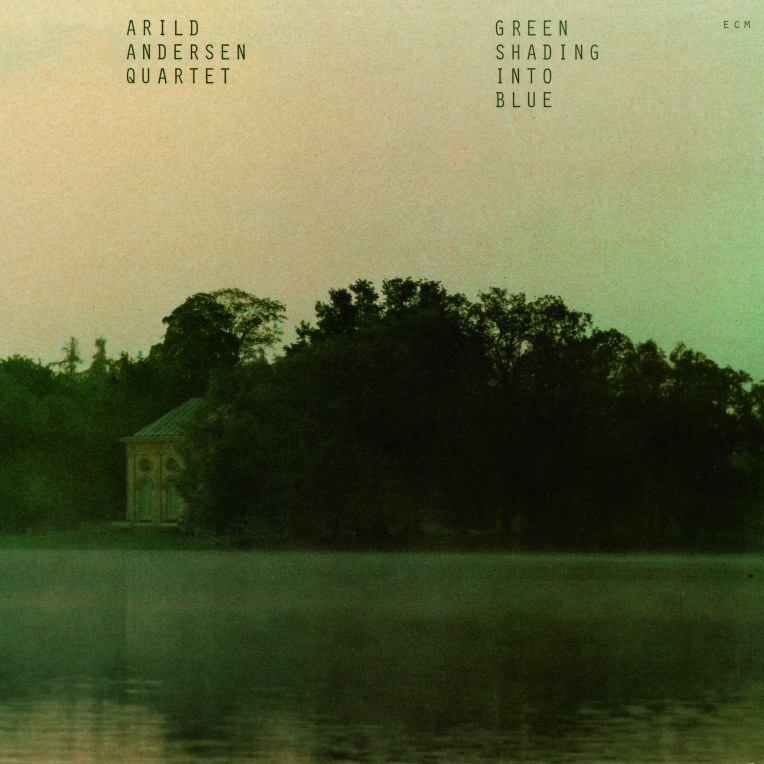
ECM 1127

Green Shading Into Blue (ECM 1127)

Recorded April 1978 at Talent Studio
Engineer: Jan Erik Kongshaug
Produced by Manfred Eicher

The final album of this set changes gears yet again, working itself into a highly refined configuration. Jansson expands his contributions with added electronics. Their presence, subtle as it is, unpacks the music’s histories with far greater visibility. From the laid-back groove of “Sole” to the staccato backing of “Radka’s Samba,” we are treated to a colorful array of songs without words. Stories are the primary driving forces here, such that “The Guitarist” is not about the instrument but about the trembling hands that cradle it. Like an intro that never materializes into a full-blown swing, it has more than enough to sustain itself. “Anima” is another smooth joint that offers some of Andersen’s most understated brilliance. Aaltonen’s legato tenor lends an illusory impermanence. The album’s remainder is like a garden of quiet beauty. The cultivated panache of the sax-heavy “Terhi” and the “organic” backing of the title track wander into Eberhard Weber territory with every step. “Jana” closes in all the lushness this quartet has to offer in a synth-infused groove, finishing with the exuberance of Aaltonen’s soprano flourishes.

Andersen is about as straightforward a musician as you are likely to encounter. His motivic acuity is engagingly bipolar, easily straddling funk and elegy in a single breath. His notes are powerful, sustained, and binding like glue. And in such fine company, the cumulative effects are unfathomable. Though his presence was vividly felt in a handful of early ECM releases, including Afric Pepperbird, Sart, and Triptykon, it was with these three albums that Andersen left his first inedible marks. What a joy it is to finally have them in the digital archive.

<< Art Ensemble of Chicago: Nice Guys (ECM 1126)
>> Jack DeJohnette: New Directions (ECM 1128)

Jan Garbarek: Triptykon (ECM 1029)

ECM 1029

Jan Garbrek
Triptykon

Jan Garbarek soprano, tenor and bass saxophones, flute
Arild Andersen bass
Edward Vesala percussion
Recorded November 8, 1972 at Arne Bendiksen Studio, Oslo
Engineer: Jan Erik Kongshaug
Produced by Manfred Eicher

Jan Garbarek’s third album for ECM is a free, though by no means easy, trek through indeterminate territories. “Rim” breaks into light with the mournful saxophonic cries that thread the entire set. Arild Andersen dots Garbarek’s auditory cloth with almost vocal ink stains. We find Garbarek in a uniquely agitated mode, showing both great restraint and willful shifting in his performance. This is an arresting track, as sublimely depressing as it is soulful. The title denotes “frost” in Norwegian, and describes Edward Vesala’s icy percussion to a T. In “Selje,” Garbarek opts for a wooden flute against a thawed backdrop of bass and wind chime-like glockenspiel: a mystical aside to an otherwise forward projection.

“J.E.V.” breaks from the album’s expansive palette with a more flatly recorded sax intro. The appearance of bass and drums merely underlines the music’s hesitancy, at once assured and unaware of its future paths. “Sang” (Chant) is another subdued interlude, featuring a bass sax caught in a silken web of percussion and bass. The title track unravels like a herding song picked apart piece by piece, its remnants scattered along the base of a low mountain to the tune of an intriguing bass solo. “Etu Hei!” screeches and pounds its way into being before the Norwegian folk song “Bruremarsj” is rendered in a tense bondage of sax and bowed bass, closing with a flutter of wing beats in the final drum break.

In spite of its many abstractions, Triptykon is rife with melody and movement. It’s almost as if a distant relative were singing traditional tunes that everyone else in the family has forgotten. Though drunk with nostalgia and slurred speech, his voice is so genuine that one can hardly fault him for straying a bit off the beaten path. With repeated listenings, one begins to distinguish such thematic material from its improvised surroundings, thereby rendering any challenges this album sets before us much deeper in their returns.

<< Paul Motian: Conception Vessel (ECM 1028)
>> Gary Burton: The New Quartet (ECM 1030)

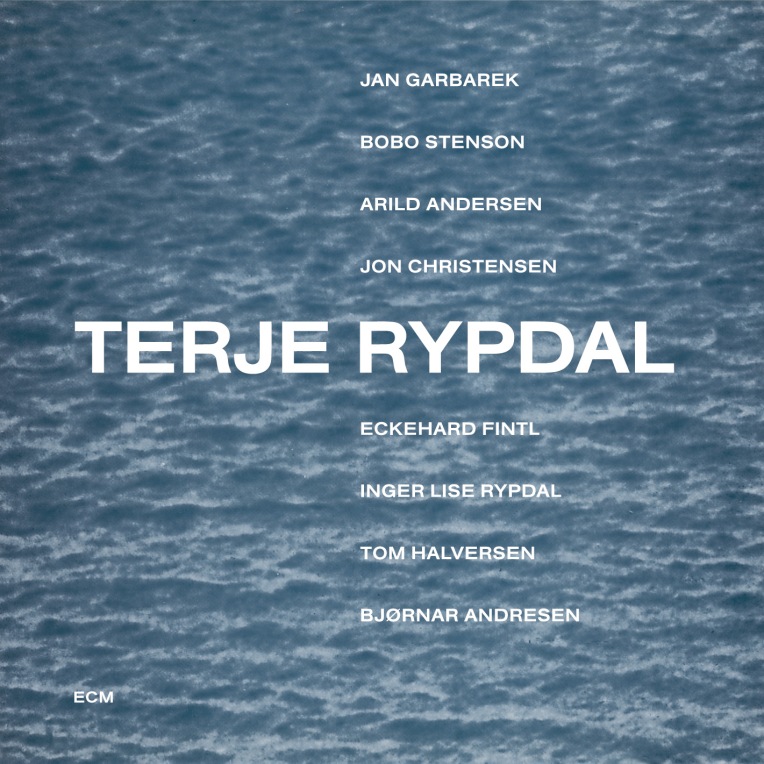
Terje Rypdal: s/t (ECM 1016)

ECM 1016

Terje Rypdal

Terje Rypdal guitar, flute
Inger Lise Rypdal voice
Ekkehard Fintl oboe, English horn
Jan Garbarek tenor saxophone, flute, clarinet
Bobo Stenson electric piano
Tom Halversen electric piano
Arild Andersen electric bass, double-bass
Bjørnar Andresen electric bass
Jon Christensen percussion
Recorded August 12 & 13, 1971, Bendiksen Studio, Oslo
Engineer: Jan Erik Kongshaug
Produced by Manfred Eicher

Terje Rypdal’s first ECM effort as frontman is a bewitching look into the Norwegian guitarist’s formative years. With a bevy of talented musicians in tow, he forges a mercurial portrait of late-night melodies and hidden desires. “Keep It Like That – Tight” is stifling and seedy, buffeted by cooling fans and laced with the fumes of an alcoholic haze. It’s a desolate hotel room where more than evening falls, a cigarette put out on the skin, incoherent words spilling from warm lips. The atmosphere is acutely palpable, oozing with film noir charisma and slurred speech. Garbarek spins a notable solo here, only to be overtaken all too soon by Rypdal’s drunken swagger. One might think this would be a taste of things to come, but Rypdal surprises with “Rainbow,” a most ethereal track laden with reverb and stratospheric beauty, dominated by oboe for a more classical sound. The background clinks and hums with a variety of percussion, bowed electric bass, and flute. The third track, “Electric Fantasy,” lies somewhere between the first two, a jazz suite with symphonic flavor. Rypdal’s former wife Inger Lise adds some moody vocals as an English horn expands the sound even further. Illusive drumming from Christensen and the occasional wah-wah guitar add dynamic touches of their own. The ambient crawl of “Lontano II” reverses the opening effect by leading into the more blues-oriented “Tough Enough,” leaving a grittier aftertaste.

The striking differences in instrumentation between tracks may be off-putting to some, while others may see it as part of a larger concept. Either way, this self-titled album is thematically rich and more than worth the listen.

<< Jan Garbarek Quintet: Sart (ECM 1015)
>> Keith Jarrett: Facing You (ECM 1017)

Stenson/Andersen/Christensen: Underwear (ECM 1012)

1012

Underwear

Bobo Stenson piano
Arild Andersen bass
Jon Christensen percussion
Recorded May 18/19, 1971 at the Bendiksen Studio, Oslo
Engineer: Jan Erik Kongshaug
Produced by Manfred Eicher
Release date: September 15, 1971

With such a solid trio of musicians and a name like Underwear, you just know this one’s going to be good. And sure enough, Stenson kicks things off just right with the spirited title track, throughout which every instrument bubbles in a witches brew of fine flavors. Exuberant drumming, flurried bass lines, and a tightly knit sense of composition make this one of the great openers of ECM’s extensive jazz lineup. Hot on its heels is “Luberon,” the album’s requisite ballad, the placement of which both emphasizes the liveliness of the opener while also bolstering its own lyrical sensibilities. “Test” lays on a more organic sound of percussion and scraped piano strings. This delicate backdrop continues as Stenson breaks into a clearly defined melodic improvisation, prompting cries of ecstatic joy before succumbing to a forced fadeout. “Tant W.” brings us into more laid-back territory with its alluring conversation between piano and drums. Once the bass joins in, the groove becomes certifiably infectious. After this block of Stenson originals, we are treated to a pair of fine closers. Ornette Coleman’s “Untitled” runs with reckless abandon through frenzied pyrotechnics, priming us for the comforting “Rudolf” (Andersen). The latter’s fluid piano intro becomes the heart of the piece, echoing in an otherwise bass-dominant space.

Stenson is entirely on point, as if he were inborn with a finely attuned sense of melody and articulation. His playing is democratic and guides with a gentle hand, always managing to cover so much of the keyboard in a single cut. Andersen’s busy fingers provide the album’s backbone, while his gorgeous vibrato and twang-ridden charm work wonders in the softer moments. And Christensen’s drumming never fails to excite. Triply inspired soloing and a synergistic core make Underwear a prime choice for the ECM newbie and veteran alike. A simply fantastic album, this is one for the ages.

<< Dave Holland/Barre Phillips: Music From Two Basses (ECM 1011)
>> Dave Holland/Derek Bailey: Improvisations for Cello and Guitar (ECM 1013)

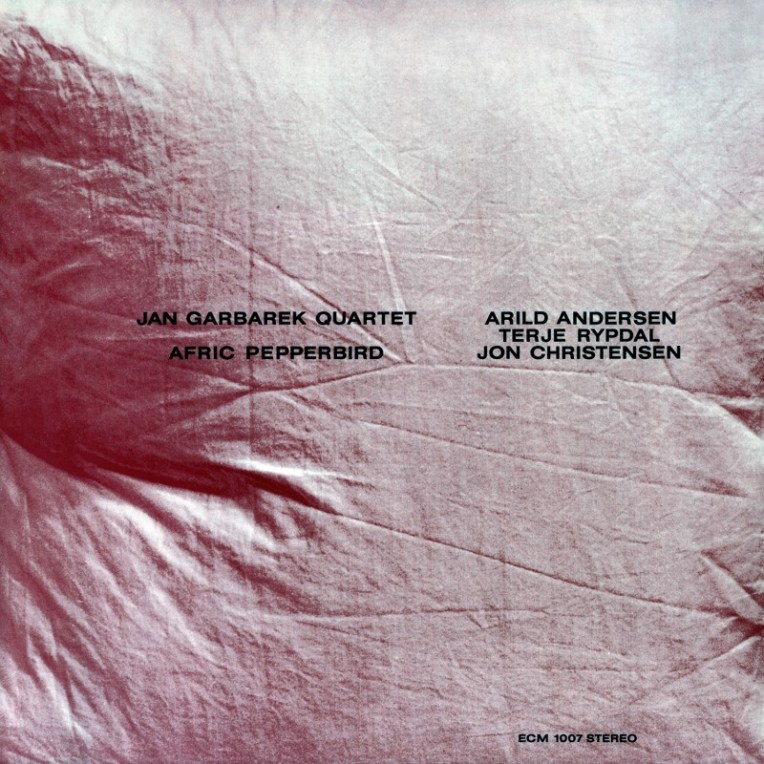
Jan Garbarek Quartet: Afric Pepperbird (ECM 1007)

1007

Jan Garbarek Quartet
Afric Pepperbird

Jan Garbarek tenor and bass saxophones, clarinet, flutes, percussion
Terje Rypdal guitar, bugle
Arild Andersen bass, african thumb piano, xylophone
Jon Christensen percussion
Recorded September 22/23, 1970 at the Bendiksen Studio, Oslo
Engineer: Jan Erik Kongshaug
Produced by Manfred Eicher
Release date: January 1, 1971

Saxophonist Jan Garbarek has changed with time and age, but already in Afric Pepperbird, his first album for ECM and one that would instigate an unbreakable association with the label, he invites us into a world that is playful yet mature. Half of the album is made up of miniatures, “Skarabée” and “Mah-Jong” the most precise and delicate among them, laced as they are with drummer Jon Christensen’s distinctive cymbal work and overall compositional sensibility. “MYB” and “Concentus,” for their part, drop like seeds into the album’s fertile soil. Bassist Arild Andersen’s steady bass line assures us the title track can swing with confidence, pouring on Saharan charm like fresh honey, while “Blow Away Zone” features an adventurous Terje Rypdal on guitar and an ether-wrenching solo from Garbarek, who squeezes his way through an opaque tornado of bass and drums. Clocking in at twelve-and-a-half minutes is “Beast Of Kommodo,” a rewarding romp of gargantuan proportions. Garbarek gives his all, mixing roars with fluted reveries with equal conviction. The set bows out with “Blupp,” a smile-inducing froth of percussion and vocals that doesn’t so much describe its title as demonstrate it.

This may very well be the quintessential Garbarek album for those who normally don’t care for his style. Whatever your taste in jazz, whatever your opinion on Garbarek and the label he calls home, this is a spirited and robust effort worthy of your attention.

<< Wolfgang Dauner: Output (ECM 1006)
>> Robin Kenyatta: Girl From Martinique (ECM 1008)