Carla Bley: Social Studies (WATT/11)

Social Studies

Carla Bley
Social Studies

Michael Mantler trumpet
Carlos Ward soprano and alto saxophones
Tony Dagradi tenor saxophone, clarinet
Gary Valente trombone
Joe Daley euphonium
Earl McIntyre tuba
Carla Bley organ, piano
Steve Swallow bass
D. Sharpe drums
Recorded September through December 1980
Mixed January 1981 at Grog Kill Studio, Willow, New York
Engineer: Tom Mark
Produced by Carla Bley
Release date: April 1, 1981

After leaving the matinee showing of Michael Mantler’s More Movies, there’s no better place to go than the library to check out Carla Bley’s Social Studies. Though distinguished by many features, this 1981 session is the timeless embodiment of what a classic should be. Not only is every tune a staple of her repertoire; it also introduces yet another talented reed player to the Bley family in Tony Dagradi, whose clarinet lends nostalgic warmth to the flirtatious “Copyright Royalties” and whose hickory tenor gives defining flavor to “Útviklingssang.” The latter, one of Bley’s highest compositional peaks, plays further to the strengths of fellow saxophonist Carlos Ward and bassist Steve Swallow. It floats, slumbers, and moves in sequence with time itself. It is the speed of life, personified in melody.

Flip to any page of this set, and you’ll find something as emblematic as a sigil, watermark, or ring seal pressed into wax. “Reactionary Tango” is as social as any of these studies. The horns are precise and delicate (especially Ward’s soprano), as is the snare of drummer D. Sharpe and Swallow’s exquisite bassing. Just when you think it ends, it continues with gentle persistence, as if it were a chapter in a Choose Your Own Adventure book. “Valse Sinistre” balances the groove of Bley’s organ with Swallow’s propulsive (but never overbearing) bassing. Swallow also picks up the first needle of “Floater” and threads his way with confidence. In lockstep with Sharpe at every turn, he exhibits a rainbow of colors. Finally, in “Walking Batteriewoman” we get the most vital of footnotes. Its shaded whimsy shifts into high gear halfway through, finishing in artful post-bop wisdom.

Of all the albums in the Bley catalog, this one is for me the most cohesive in terms of concept, aesthetic, and execution. Social Studies is more than a catchy title, but the very ethos of everything she lays her hands to.
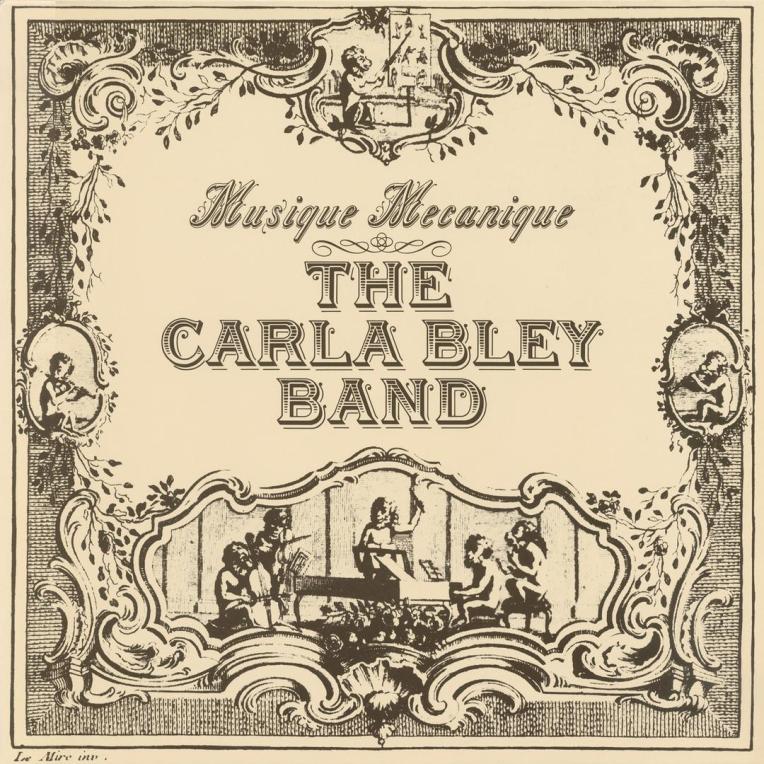
The Carla Bley Band: Musique Mecanique (WATT/9)

Musique Mecanique

The Carla Bley Band
Musique Mecanique

Michael Mantler trumpet
Alan Braufman alto saxophone, clarinet, flute
Gary Windo tenor saxophone, bass clarinet
John Clark French horn
Roswell Rudd trombone, vocals
Bob Stewart tuba
Terry Adams piano
Carla Bley organ
Steve Swallow bass guitar
D. Sharpe drums
Charlie Haden acoustic bass
Eugene Chadbourne acoustic and electric guitars
Karen Mantler glockenspiel
Recorded August through November and mixed December 1978 at Grog Kill Studio, Willow, New York
Engineer: Michael Mantler
Produced by Carla Bley
Release date: April 1, 1979

Hot on the heels of European Tour 1977, Musique Mecanique follows a classic with a classic. Clearly fueled by the energy put forth in that predecessor, Carla Bley funneled a wealth of inspiration from being on the road into her New York studio. Expanding her ten-tet to a 13-piece band, she drops some of her densest compositions to date in an audio time capsule for the ages.

The title of “440” references the modern orchestral pitch standard of A440. Appropriately, the piece begins with the cacophony of a tuning orchestra. From this emerges an insistent pulse and, by extension, a three-dimensional theme. Drummer D. Sharpe signs in as a new team member, and he will prove to be a vital one as the years wear on. Pianist Terry Adams embodies his duties to the fullest, as does Gary Windo on tenor and Alan Braufman on alto, while Bley embraces them all with the expansive wingspan of her organ in trombonist Roswell Rudd’s jet stream.

“Jesus Maria And Other Spanish Strains” is an even more horn-centric gallery of images. Though initially occupying the darker end of a synesthetic spectrum, before long it sports choice solos from tuba virtuoso Bob Stewart and bassist Charlie Haden, who clearly understands Bley’s music from the inside out. As things develop, those robustly whimsical touches we come to expect from Bley creep out of frame, held together by Sharpe’s gorgeous detailing and trumpeter Michael Mantler’s mariachi marinade before ending with a nocturnal stare.

The three-part title suite is one of Bley’s grandest achievements. The first part, sounding for all like a calliope machine struggling to come out of a coma, features Karen Mantler on glockenspiel for a decidedly three-ring vibe. The second part, subtitled “At Midnight,” begins with a clock ticking and chiming the hour. Bley enhances the mood. Rudd puts down the trombone and sings of two souls lost in the night, each opening the door to the room of the other in an endless cycle of unrequited action. The final part is a splash of genius in an already prodigious cocktail. Glacial organ, screeching saxophone, and an earworm of a melody draw us a treasure map to keep in our rucksacks for future outings.

The Carla Bley Band: European Tour 1977 (WATT/8)

European Tour 1977

The Carla Bley Band
European Tour 1977

Michael Mantler trumpet
Elton Dean alto saxophone
Gary Windo tenor saxophone
John Clark French horn, guitar
Roswell Rudd trombone
Bob Stewart tuba
Terry Adams piano
Carla Bley organ, tenor saxophone
Hugh Hopper bass guitar (bass drum on “Drinking Music”)
Andrew Cyrille drums
Recorded September 1977 at Bavaria Musik Studios, Munich
Engineer: Jörg Scheuermann
Assistant: Robert Wedel
Mixed October 1977 at Grog Kill Studio, Willow, New York
Engineer: Michael Mantler
Produced by Carla Bley
Release date: February 1, 1978

European Tour 1977 documents that very event—a significant one in the life of the Carla Bley Band, debuting like a boulder thrown into the ocean of the late 1970s. As per her last project, Dinner Music, Bley takes the opportunity to introduce a perennial tune of the WATT universe. “Wrong Key Donkey” is a wry congregation of dissonant horns, bass guitar (Hugh Hopper this time, with no Swallow in sight), drums (the one and only Andrew Cyrille), piano (Bley), and guitar (John Clark). It’s also the first appearance of tenor saxophonist Gary Windo on the recorded Bley roster, and his presence serves to emphasize a playfulness that invites the listener to be a cocreator rather than a mere spectator. If it takes two to tango, then it takes a legion to donkey.

Before that we are laid to premature rest in the plush coffin of “Rose And Sad Song.” Or so we might think, as the mournful combination of piano and trumpet (courtesy of Michael Mantler) that ushers us into the album proper lays the groundwork for a downtown groove from the rhythm section. With such vivid colors to paint with, deepest among them being Roswell Rudd’s trombone, this canvas of spirits glows the night away with almost religious faith in the music at hand.

The title of “Drinking Music” would seem to be an overt nod to Dinner, its romping horns bringing out a cinematic materiality in preparation for the 19-minute “Spangled Banner Minor And Other Patriotic Songs.” With its flowering allusions (a Beethovenian take on “The Star-Spangled Banner” most brilliant among them) and campy overtones, the suite wears a tongue in cheek as its logo. Alto saxophonist Elton Dean hits a home run with is madly dancing solo before Rudd leads the way to the finish.

This is deconstruction as reconstruction. Another Bley essential.

Michael Mantler: Movies (WATT/7)

Movies

Michael Mantler
Movies

Michael Mantler trumpet
Larry Coryell guitar
Carla Bley piano, synthesizer, tenor saxophone
Steve Swallow bass
Tony Williams drums
Recorded March and mixed November 1977 at Grog Kill Studio, Willow, New York
Engineer: Michael Mantler
Mastered by HR
Produced by Carla Bley

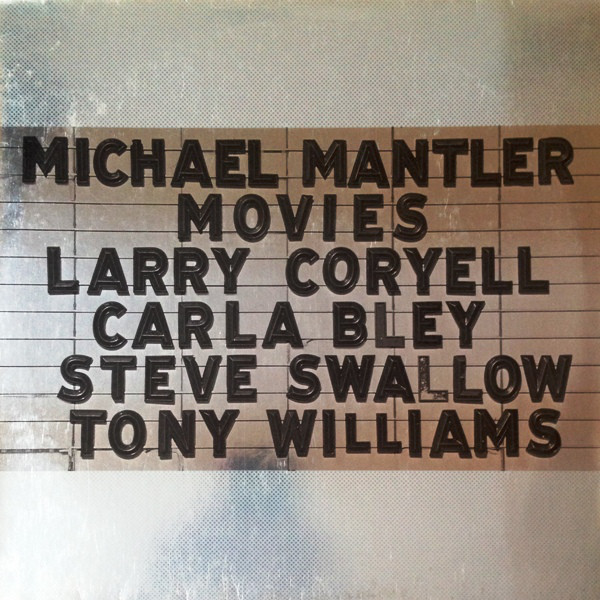
After enjoying a lavish dinner with Carla Bley and her band, what could be better than watching a movie? While we may not have visuals to accompany what we hear in this case, what is a movie if not a sonic entity? Even so-called silent films are nothing without their sounds—described, implied, and visualized. Michael Mantler likewise makes action audible, laying out eight narrative sketches for a silvery quintet consisting of himself on trumpet, Bley on piano (as well as synth and tenor saxophone), Larry Coryell on guitar, Steve Swallow on electric bass, and Tony Williams on drums.

“Movie One” establishes an orchestral sound from this small group of musicians, planting feet firmly in a crisp, mineral-rich soil. Coryell makes a welcome cameo in the WATT roster, fleeting though it may be, in that he brings to the fore a depth of philosophy that transcends its own historical moment (be sure to check out his character role in “Movie Seven” as well). Williams and Swallow are a fluid rhythm section, while Bley rocks the keyboards in harmony with Mantler, whose trumpet sharpens a leading blade that cuts through “Movie Three” (which would seem to move across the same whetstone as Steve Kuhn’s Trance) and “Movie Six.”

Of especial note are “Movie Four,” for Coryell’s ricochet effect and Bley’s mechanical undercurrent, and “Movie Five,” for Swallow’s swing and Mantler’s textural skill. But the Palme d’Or goes to “Movie Two.” ECM listeners may know it from the Mantler playlist that is 2006’s Review. Blistering yet always within view of the camera, its actors punch out a tenuous beginning until it grooves. As Swallow and Williams lead the way with Mantler bringing up the rear, Coryell burns a hole in the celluloid until disbelief can no longer be suspended. Like “Movie Eight” that ends it all, it glows with mortal finality. Then again, what finality is not mortal?

Carla Bley: Dinner Music (WATT/6)

WATT-6-front

Carla Bley
Dinner Music

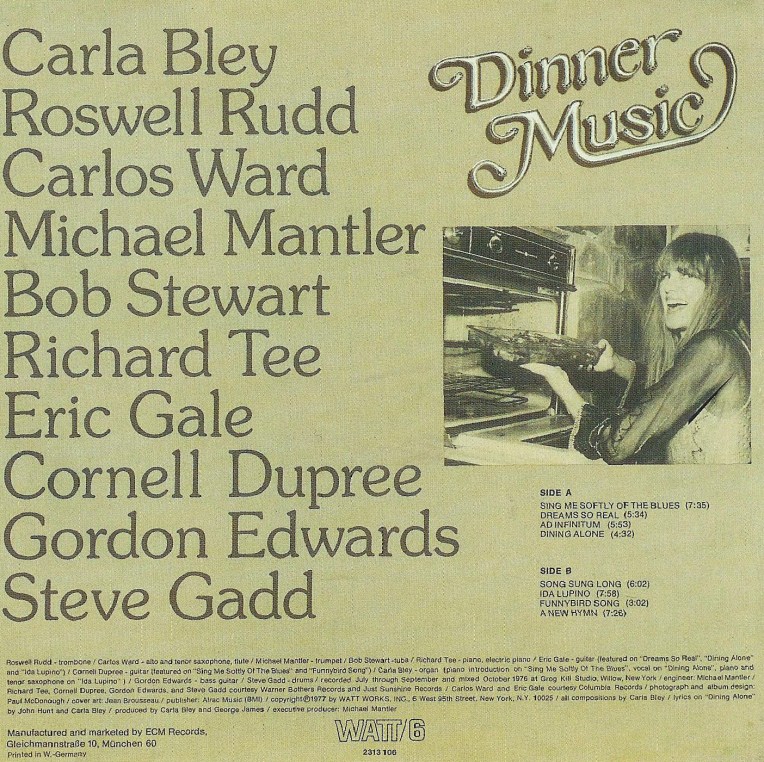
Roswell Rudd trombone
Carlos Ward alto and tenor saxophones, flute
Michael Mantler trumpet
Bob Stewart tuba
Richard Tee piano, electric bass
Eric Gale guitar (on “Dreams So Real,” “Dining Alone,” and “Ida Lupino”)
Cornell Dupree guitar (on “Sing Me Softly Of The Blues” and “Funnybird Song”)
Carla Bley organ (piano introduction on “Sing Me Softly Of The Blues,” vocal on “Dining Alone,” piano and tenor saxophone on “Ida Lupino”)
Gordon Edwards bass guitar
Steve Gadd drums
Recorded July through September and mixed October 1976 at Grog Kill Studio, Willow, New York
Engineer: Michael Mantler
Produced by Carla Bley and George James
Executive producer: Michael Mantler
Release date: September 1, 1977

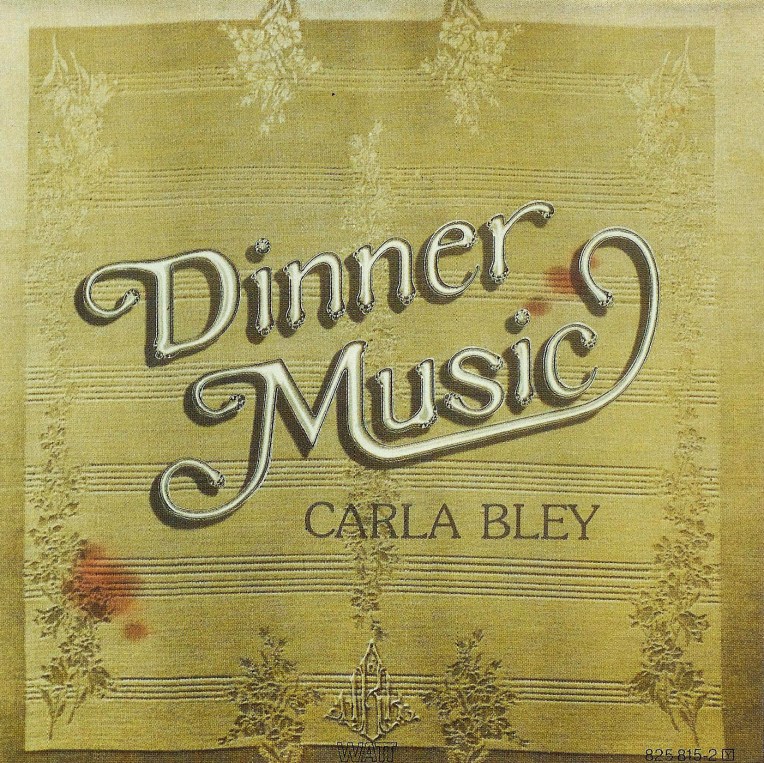
Now that we have been thoroughly psychoanalyzed by Michael Mantler’s dramaturgical shadows, leaving behind the jetlag from our trip, we can at last eat our fill and bask in the glow of Carla Bley’s Dinner Music. Our date with this ten-tet falls under the banner of CLASSIC for several reasons. First, it introduces a big band format that will serve Bley well in the decades to come. Second, it gives her room to interpret some of her most inspired tunes for the first time in the studio (after having been recorded by Paul Bley and others). Third, it welcomes saxophonist Carlos Ward, trombonist Roswell Rudd, and tuba player Bob Stewart into the fold. Fourth, it sets the tonal balance of wit and rigor that defines a particularly fruitful era of her genius.

This time around, the bandleader and composer relegates the pianistic duties to Richard Tee and opts mostly for organ, thereby adding warmth of character and a tingling personality. That said, she does use the piano to heat up the appetizer of “Sing Me Softly Of The Blues.” The sounds of a meal serve as backdrop while joy and self-derision pass around the same funky libation, compelling Rudd to raise an early toast (also check out his dialogue with a trumpeting Mantler on “Song Sung Long”). “Sing Me Softly Of The Blues” also happens to be the title of record by the Art Farmer Quartet, which included the timeless “Ad Infinitum,” also heard here. Though smoother than its surrounding courses, Bley keeps us on our aural toes with some interesting changes in the organ.

“Dreams So Real” (recorded the year before on the eponymous album by Gary Burton for ECM) is another laid-back beauty, replete with electric undercurrent, as is “Dining Alone.” Rudd and Ward are a lovely leading pair, while the electric guitar of Eric Gale is incisive and intriguing. Yet what on the surface appears to be even-tempered teems with chaos and fascinations beneath. Bley sings on the latter tune with a touch of melancholy that cannot be washed away with any amount of champagne. “Ida Lupino” is the standout dish. The sound of a crowd sets the scene as Bley warms up on the piano (she also plays tenor saxophone). And when the rhythm section of bassist Gordon Edwards and drummer Steve Gadd kicks in with a solid groove, and the flute of Carlos Ward draws out the sunset just a little longer than physics will allow, the band unravels a pioneering atmosphere. Bley even references herself by reprising “Funnybird Song” from Tropic Appetites. In this instance it is instrumental, upbeat, and optimistic. Our aperitif is served in a glass etched with the words “A New Hymn.” This anthemic wonder, swirling with full-bodied horns, goes down easy.

Looking back on the meal, I only wish the spices of Edwards and Gadd had been applied more liberally throughout this quintessential meal, as they seem relatively faint in the mix. Otherwise, every flavor stands out in relation to the rest. This is also one of Bley’s best titles for conveying the sheer amount of effort that goes into preparing a dinner, especially for a large group. And despite the energy spent, chef Bley must be “on” for the dinner itself, prolonging her rest that much longer for the sake of her honored guests. In that sense, the music leans against desperation, even as it succeeds in cleaning every plate as if it were the last. This is Bley at her most delectable.

WATT-6-inside-1

Michael Mantler: Silence (WATT/5)

Silence

Michael Mantler
Silence

Robert Wyatt voice, percussion
Carla Bley piano, voice, organ
Kevin Coyne voice
Chris Spedding guitar
Ron McClure bass
Clare Maher cello
Recorded during January 1976 at Grog Kill Studio, Willow, New York
Engineer: Michael Mantler
Robert Wyatt and Chris Spedding recorded during February with the Manor Mobile at Delfina’s farm, Little Bedwin, Wiltshire, England
Engineer: Alan Perkins
Kevin Coyne recorded during April with the Virgin Mobile at the Gong Farm, Whitney, Oxfordshire, England
Engineer: Steve Cox
Additional strings recorded during June and mixed during November at Grog Kill Studio
Engineer: Michael Mantler
Produced by Carla Bley

“One way of looking at speech is to say that it is a constant stratagem to cover nakedness.”
–Harold Pinter

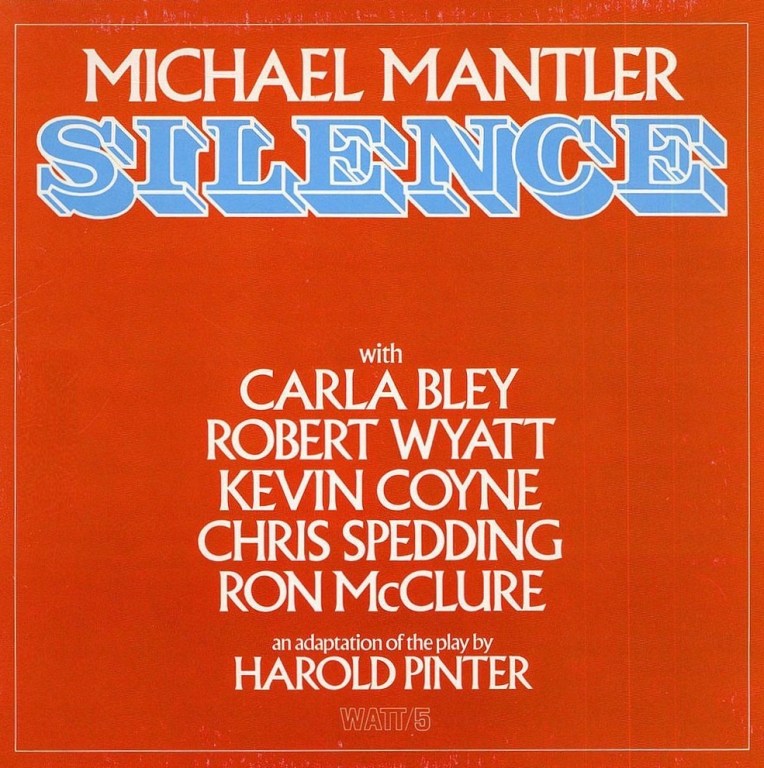
Upon waking from the fever dream of Michael Mantler’s The Hapless Child, we might be forgiven for expecting reality to welcome us back with comforting arms. Instead, Silence throws us into the bore of everyday life, so that by the end we’re left wondering why anything that mattered ever mattered at all. In this musical, though far from incidental, setting of the eponymous play by the ever-contrarian Harold Pinter, we find ourselves in the company of Rumsey (Kevin Coyne), Ellen (Carla Bley), and Bates (Robert Wyatt). Rumsey is brash and self-confident, happy to have a girl on one arm—“She dresses for my eyes,” he sings—and a blissful disregard for mortality on the other. The environment Mantler composes around him creeps in with inevitable foreboding. The dialogue, such as it is, is more internal than external, chillingly honest yet indifferently expository. Ellen, for her part, is possessed of a breezy self-awareness: “There are two. One who is with me sometimes, and another. He listens to me. I tell him what I know.” In so saying, she reveals a hidden motive to the relationship, a conduit between souls that shrivels in fear when Bates enters the scene and brings with them a bevy of piano, bass, and percussion. All of which sets off a chain reaction of circular reasoning that muddies more than clarifies the human condition.

The music is a mixture of rock, funk, downtown cool, and European art song. Without it, there might be nothing to hold on to. Guitarist Chris Spedding is remarkable, gaining deepest traction in “She Was Looking Down,” and Bley lays on a thick layer of expressiveness, both as pianist and as vocalist (note, especially, “After My Work Each Day”). But while this is as luscious and engaging as any Bley/Mantler collaboration from the 70s could be, the play itself is lackluster to say the least. Its theme of lost souls is as fatigued as the characters it threads like beads on a necklace far too big for its own neck. As the drama develops, memory overlaps and all sense of time stops, unravels, and expands. But any pretensions Pinter might have of making an existential statement fall flat for me, especially when compared to the stripped-down brilliances of Samuel Beckett and Edward Gorey that preceded it. That said, in relatively short bursts—as in “When I Run” and “A Long Way”—the dialogue is somewhat tangible. The best example is “Sometimes I See People,” which creates a charmingly metaphysical atmosphere for being so much about music, sensory experience, and sense of belonging. But really it’s Mantler’s stage, rather than the people ambulating across it, that keeps me from walking out.

Both realms, the play and this soundtrack, are cyclical constructions. But if the words are just a spiral, the music is a helix. It binds with our DNA and finds a place in our evolution as listeners.

WATT-5-LP-back

Michael Mantler/Carla Bley: 13 3/4 (WATT/3)

WATT-3-front

Michael Mantler
Carla Bley
13 3/4

Carla Bley piano
The 13 Orchestra
The 3/4 Orchestra
Recorded August 1975
Grog Kill Studio, Willow, New York
Mixed September 1975
Scorpio Sound, London
Engineer: Dennis Weinreich
Assistant: John Hunt
Produced by Carla Bley and Michael Mantler
Release date: February 1, 1978

After sleeping in separate beds, so to speak, in the first two WATT releases, Carla Bley and Michael Mantler share a marquee for the label’s third. The program here is bipartite, sporting one composition by each in a resolutely multi-dimensional form of jazz that pairs Bley’s piano with orchestral forces.

Mantler’s 13 is a morose dive into some light-starved chambers of nature. Sounding like a storm turned into a symphony, it has the climatic features of rain and hail. Bley is a lost and itinerant soul in all of this, one whose mind, despite being over matter, is subject to abuses of the elements. The combinatory dialogue of strings and horns generates internal combustion, reaching textural peaks of brilliance. The piano’s forlorn timbre is emphasized by a slightly detuned and tinny delivery, as if it were an instrument that has known only a life of physical compromise. And so, any glimpses of perfection or woundless-ness feel more traumatic than hopeful. Struggles are indicative not of pain but of an underlying deference to the fate of its infliction. The storm, then, serves to illustrate a way of life, not an interruption to it. We are left with a sea of textures to be felt along the spine and ear canal, building to a cathartic wall of sound à la Glenn Branca.

Bley’s 3/4 is just as distinctly her own, though its breadth of vision may be compared to the classical hybrids of Keith Jarrett (who, incidentally, gave this piece’s premiere). Opening with a cyclical piano that maintains its course throughout, it ties a web of winds and brass, allowing notes to flow through every opening. An overriding drama speaks of the theater, but one in which bodies jump off the stage yet never land. Droll memories share oxygen with coarse futures, yielding a vibrancy that speaks both of its composer and the time during which it came into being. It ends as it began, in a childlike wonder at the immensity of creation. Only now it knows where life will lead because, as we will realize, everything that came before was a prelude to self-destruction.

WATT-3-back

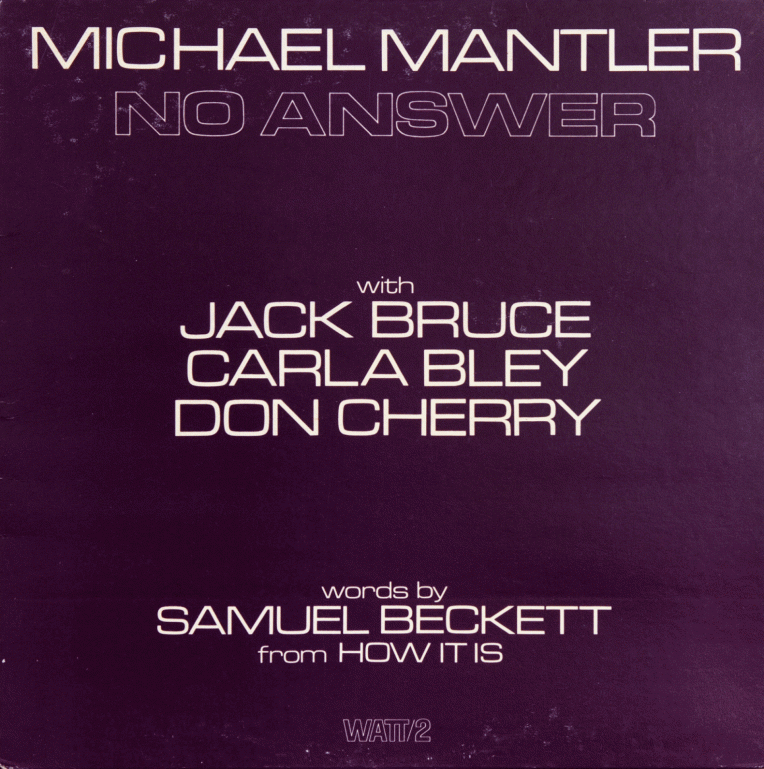
Michael Mantler: No Answer (WATT/2)

No Answer

Michael Mantler
No Answer

Jack Bruce voices, bass
Carla Bley piano, clavinet, organs
Don Cherry trumpet
Recorded February and July 1973
Blue Rock Studio, New York
Jack Bruce recorded November 1973
Island Studios, London
Mixed March 1974
Blue Rock Studio, New York
Produced by Carla Bley and Michael Mantler

when the panting stops yes so that was true yes the panting
yes the murmur yes in the dark yes
in the mud yes to the mud yes

After landing us in the scenery of Carla Bley’s Tropic Appetites, our journey through the land of WATT brings us to its first stopover in the form of Michael Mantler’s No Answer. Here we are exposed not to the snapshots of that first masterful traversal, but rather to the fitful dreams of our displacement following it, wounded by the act of travel in ways that only the unpunctuated prose of Samuel Beckett can articulate. Drawing on the globally talented trio of vocalist Jack Bruce, trumpeter Don Cherry, and Bley herself on piano, clavinet, and organs, Mantler sets passages from 1964’s How It Is (1964) as if each were a life to be shuffled rather than a memory to be pulled from its deck.

Consisting of two sections—NUMBER SIX and NUMBER TWELVE—of four parts each, No Answer is (curiously) an answer to its own question. This philosophical DNA repeats itself endlessly; only we are privy to a sliver of its helix. Bley’s pianism is the damp ground beneath gray-clouded vocal overdubs, yielding beneath every word as if it were a footprint in the making. The quality of Bruce’s singing lends itself organically to Mantler’s stage, as if the two were made for each other. His delivery is sardonic yet sincere, his falsetto particularly haunting in its naked vulnerability. He walks the line of theatrical refraction, rolling up the fourth wall like a backdrop no longer needed. Thus, he represents a lifelong fascination, pulled into an ephemeral mold.

Though the novel itself is a slog through mud and violence, there’s something unclothed about the music that adds an entirely different level to its interpretation. Bley is the curio collector in this regard, at some points rummaging through a closet of memory while at others dancing among the bits of relics she has unearthed. As for Cherry, he is a voice from the past, chanting and bubbling through terrestrial forms of communication.

The second half of the program is introduced via clavinet and Bruce’s congregation of selves. In the context of this vibrant execution, we find ourselves caught in the web of inner meanings over outward appearances. The effect is such that, even when Bruce breaks open a bottle of funk with his bass, there is little to be hopeful for in the bleakness of things. In a reversal of fortune, fire comes before smoke, sinking into the darkness of Bley’s organ in the slow tumble of a drunken tourist.

nothing to emend there no the arms spread yes
like a cross no answer
LIKE A CROSS no answer YES OR NO yes

No Answer back

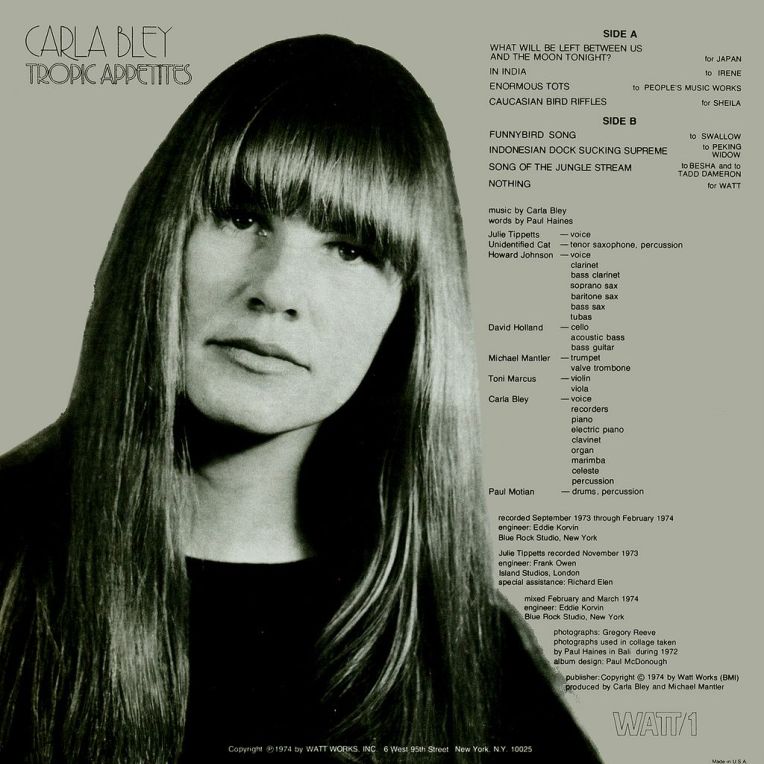
Carla Bley: Tropic Appetites (WATT/1)

Tropic Appetites

Carla Bley
Tropic Appetites

Julie Tippetts voice
Gato Barbieri tenor saxophone, percussion
Howard Johnson voice, clarinet, bass clarinet, soprano, baritone and bass saxophones, tubas
David Holland cello, acoustic bass, bass guitar
Michael Mantler trumpet, valve trombone
Toni Marcus violin, viola
Carla Bley voice, recorders, piano, electric piano, clavinet, organ, marimba, celeste, percussion
Paul Motian drums, percussion
Karen Mantler voice
Recorded September 1973 through February 1974
Engineer: Eddie Korvin
Blue Rock Studio, New York
Julie Tippetts recorded November 1973
Engineer: Frank Owen
Island Studios, London
Special assistance: Richard Elen
Mixed February and March 1974
Engineer: Eddie Korvin
Blue Rock Studio, New York
Produced by Carla Bley and Michael Mantler
Release date: February 1, 1978

Our storybook adventure through the entire catalog of WATT WORKS—the sublabel endorsed by ECM to showcase the work of Carla Bley and Michael Mantler—begins with Bley’s classic prologue, Tropic Appetites. The pianist, composer, and arranger leads a stellar cast of characters in this richly textured slice of jazz theater. Given the fact that Bley’s music has always been so well-traveled, it’s no wonder that her first WATT outing should be so geographically far-flung, setting poems by the late Paul Haines (1933-2003), whose experiences in Southeast Asia inspired the words sung here by Julie Tippetts. Joining them are tenor saxophonist Gato Barbieri, multi-reedist Howard Johnson, Dave (credited as David) Holland, Michael Mantler on trumpet, Paul Motian on drums, and Toni Marcus on violin and viola.

The album’s subtitle (“It’s Rude To Point Your Food At Anyone”) reveals an obvious thrust: the theme of imposing one’s culture on others who might not share it. This sentiment is duly expressed in the opener, “What Will Be Left Between Us And The Moon Tonight?” As Bley’s piano and Motian’s percussion phase across a night sky of bass and tenor, we are taken on a locomotive ride through landscapes of carnal urges and fragrant trees. Holland is superb in this early appearance, lighting our way before the piece pulls steaming into Free-for-All Station.

Much of what follows happens on foot. Whether trekking “In India” or facing “Enormous Tots,” a darkly whimsical worldview guides our way. The latter hands Johnson an evocative passage about snakes and overgrowth, as grungy guitar, bass clarinet, and brass jump from free jazz to carnivalesque at the drop of a hat amid lyrics that explode any vision we might have of childhood, fantasy life, and play. Motian and Holland (on bass guitar) hack their way through with machetes of rhythm. Stripped of artifice, romanticism, and Orientalist trappings, they present us instead with a taste of the earth and of the human condition. “Song Of The Jungle Stream” places us in ancestral territory. Barbieri (the de facto soloist of Bley’s early period) fans catharsis out into a hush of urban cool. Then there’s the unforgettably titled “Indonesian Dock Sucking Supreme,” in which Tippetts and Johnson lob their forces in a context of larger others. Barbieri is once again incendiary. Our tour ends in “Nothing,” a surreal mélange of tango, funk, processional, and a host of other genres.

Along the way we are fortunate to lift off into the air for two spells. First is “Caucasian Bird Riffles,” which reaches through our throats and pulls out something we’ve never seen before: a version of ourselves laid bare for all foreign eyes to see. Thus does travel gut us by removing our egos from the center of things, thus hanging a question mark over the center itself. In this regard, Mantler’s trumpet draws an orbit of self-reckoning. Second is “Funnybird Song.” It’s worth noting that every track on this album bears dedication to a person or collective, and in this case it’s Swallow who gets the nod. (Little did they know this gesture would plant a seed of love—but we’re getting ahead of our story.) A seven-year-old Karen Mantler, Bley’s daughter by Michael, provides guest vocals for this charming little number that, like the album as a whole, polishes exotica until it reflects us critically in its surface.

Tropic Appetites back