Crystal Silence: The ECM Recordings 1972-79 (ECM 2036-39)

ECM 2036-39Crystal Silence: The ECM Recordings 1972-79

Gary Burton vibraphone
Chick Corea piano

The vibraphone and piano combine to make one of jazz’s most potent instrumental combinations, and nowhere so invigorating than at the hands of Gary Burton and Chick Corea. To say that the possibilities between them are limitless is to ignore the immediacy of their abilities, in which we may now bask to the utmost content in this timely reissue. Jazz’s most singular duo in a set of three albums on four CDs. Now those are some positive integers.
1024 X

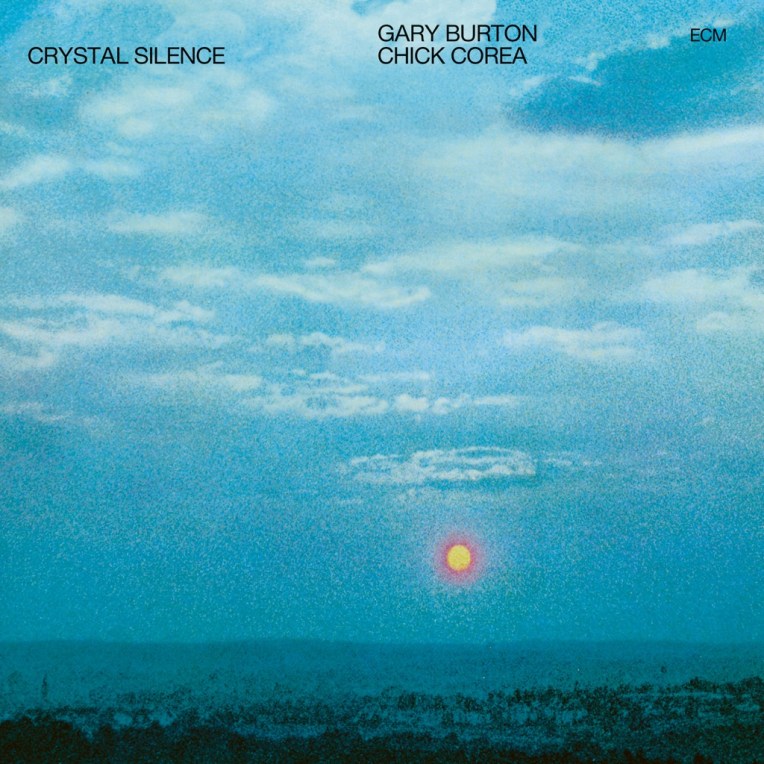
Crystal Silence (ECM 1024)

Recorded November 6, 1972 at Arne Bendiksen Studio, Oslo
Engineer: Jan Erik Kongshaug
Produced by Manfred Eicher

It all begins here, with Crystal Silence. The title says it all: silence crystallized into dazzling melodic gems, each its own prismatic doorway into improvisatory translucence. Corea offers a fine set of five compositions (the most notable being the slick opener “Señor Mouse”), along with three beautifully realized tunes by bassist Steve Swallow (“Arise, Her Eyes” being a personal favorite), and another by Mike Gibbs (the somber “Feelings And Things”). In spite of the variety of voices represented here, the album grows like one long, extended story, a dynamic that seems to shadow the musicians wherever they set foot. The title track, reprised and extended since its inaugural appearance on Return To Forever, is a subdued tour de force in style, presentation, and content. “Falling Grace” (Swallow) is one of the shorter pieces on tap, but what it lacks in time it makes up for in exhilaration. We end with an instrumental version of another Return classic, “What Game Shall We Play Today.” Each piece is rendered with such dynamic sensitivity that one can immediately recognize the effect Crystal Silence must have had when originally released, and no doubt continues to have to this day. Connected as they are by the same mellow fuse, these tunes need hardly a spark to set them to glowing.

This essential album constantly skirts the line between destitution and celebration, rebuilding as many structures as it tears down. The pianism soars, and one could never praise Burton enough for providing the intuitive right hand to Corea’s metronomic left. Above all, this is a masterful exhibition of improvisation around strong thematic material that breaks through its own generic conventions, and is another indispensable example of what ECM has done to enrich and enlarge the landscape of jazz music from day one.

<< Paul Bley: Open, To Love (ECM 1023)
>> Ralph Towner with Glen Moore: Trios/Solos (ECM 1025)

… . …
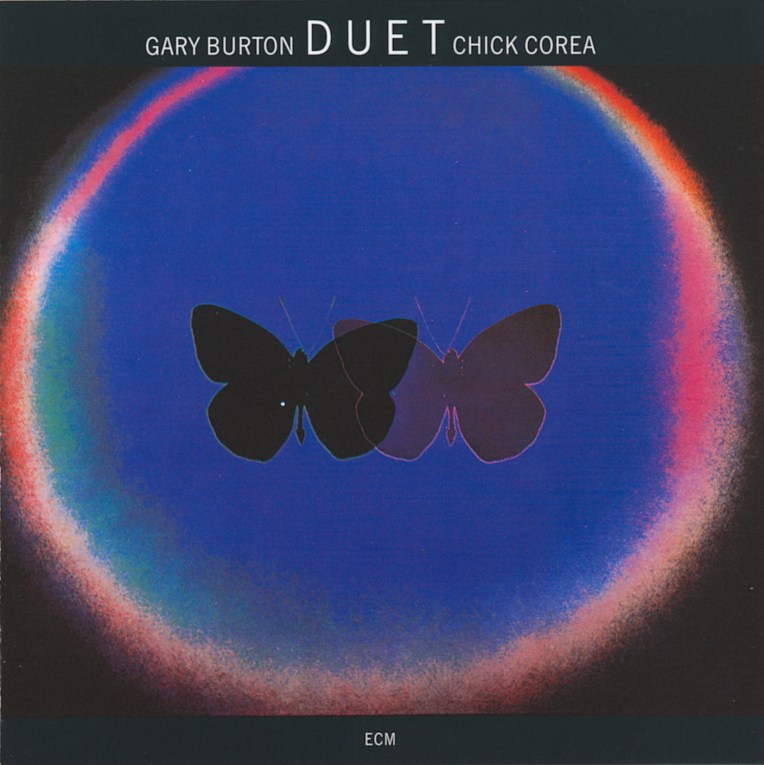
ECM 1140

Duet (ECM 1140)

Recorded October 23 – 25, 1978, at Delphian Foundation, Sheridan/Oregon
Engineer: Bernie Kirsh
Produced by Chick Corea and Gary Burton

If Crystal Silence is the Corea/Burton universe writ large, then the “Duet Suite” that opens this follow-up album is its densest galaxy. Buoyant grace, turn-on-a-dime syncopation, and an abiding sense of direction make every moment an experience to savor and relive as many times as a single lifetime will allow. More than a lasting mosaic of what either of these musicians is capable of, the suite overflows with so much energy that it could easily have gone on to fill the entire album. And in many ways, it does, being a meta-statement of all to come. The lovingly arranged selections from Corea’s Children’s Songs that follow expand fourfold the brief glimpse into this masterwork afforded us in the project’s debut. These otherwise intimate excursions sparkle like film stills sped into viable movement. The hip nostalgia of “Radio” (Swallow) plunges us into the past, even as it directs our eyes to the future, reeling through its motifs with head-tilting abandon. Burton’s staggered rhythms make for an ecstatic crosshatching of polyphony. At last, we come to Corea’s seminal “Song To Gayle.” Soon to be a staple in the outfit’s traveling songbook, this fluid conversation is almost blinding in its agreement. Duet is rounded out by the ever so exquisite “Never” (Swallow) and “La Fiesta,” a Corea original that brings the album’s most enthralling moments into focus.

<< Mick Goodrick: In Pas(s)ing (ECM 1139)
>> George Adams: Sound Suggestions (ECM 1141)

… . …
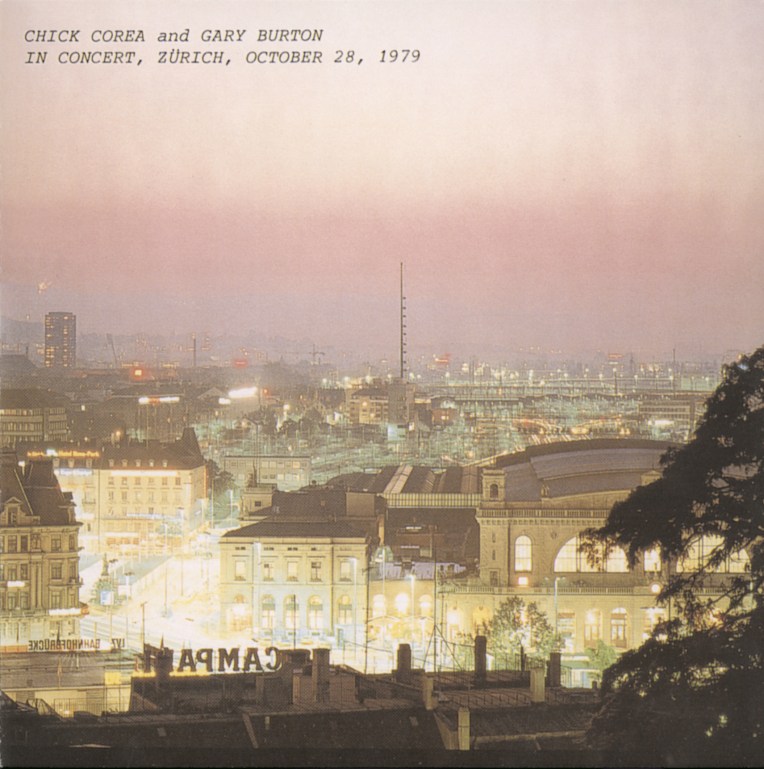
ECM 1182_83

In Concert, Zürich, October 28, 1979 (ECM 1182/83)

Recorded October 28, 1979 at Limmathaus, Zürich
Engineer: Martin Wieland
Produced by Manfred Eicher

The Zürich live album is the clear standout of this collection and a real treasure among many in the ECM catalogue. All the classics are here, gloriously reincarnated for new and veteran listeners alike: a sweeping rendition of “Crystal Silence” flows with the power of a river during spring thaw, “Falling Grace” becomes strangely uplifting, “Song To Gayle” sparkles, and Corea’s improvisational turns during a vivacious “Señor Mouse” have all the makings of a hallmark triumph. These actually outdo themselves in live form, plain and simple. But they are only half the fun. Lest we forget the wealth of other material in the set, the duo delights us with “Bud Powell,” Corea’s pitch-perfect tribute to the bebop pioneer. The man at the piano can’t help but sing along as he negotiates one fluid key change after another. We also get some mesmerizing virtuosity from Burton, which makes us want to join in the applause at home. Another high point is “Endless Trouble, Endless Pleasure” (Swallow), which ends the show with a spicy half-step glory. But the real treasures here are the onetime C-Sides making their ECM digital debut at last. Each gives the respective musician his moment alone. Burton’s tender evocations of the Swallow standards “I’m Your Pal” and “Hullo, Bolinas” flit like a ballerina across the stage, while a lush 15-minute interpretation by Corea of his own “Love Castle” pulls his pianism into utterly new territories.

Live energy brings inexpressible wonder to these pieces. With each listen, they show their colors by an increasingly visible logic, extending solos here and shortening graces there, until the whole picture begins to make intuitive sense.

Once in a great while, there are combinations that simply cannot fail. Chick Corea and Gary Burton embody one of them. Their supporting articulations are sometimes so delicately applied that one cannot help but become an extension of the other. They seem to find in each other a new vision of life, which they bring to every note. They also really know how to introduce a piece. Rather than lead us patronizingly into their sound-world, they drop us directly into its liquid center, so that while coming up for air we begin to understand the music from the inside out. These are two wirewalkers at the height of their creative talents, yet who have since forgone their balance bars in favor of more airborne travels. This is quite simply music for the ages.

<< Pat Metheny: 80/81 (ECM 1180/81)
>> Gary Burton Quartet: Easy As Pie (ECM 1184)


Chick Corea: Solo Piano (ECM 2140-42)

Corea Solo Piano

Chick Corea
Solo Piano

Chick Corea piano
Ida Kavafian violin
(Children’s Songs, Track 20)
Fred Sherry cello
(Children’s Songs, Track 20)
Release date: March 26, 2010

Much of the jazz that has come to characterize the “ECM sound” is known for its pellucid solemnity. Conversations between sound and space abound, in which vestiges of their own histories mark the passage of time. To younger listeners like myself, it is sometimes easy to forget that the label remains rooted in the youthful immediacy one finds in these formative efforts from Chick Corea. While his refreshing approach to pianism inhabits the same continent as other formidable players, Corea is very much his own culture. Much of the later material that would come to define the “Corea sound,” however, is in clear evidence throughout these discs, and especially in the improvised efforts.

1014 X

Piano Improvisations Vol. 1 (ECM 1014)

Recorded April 21 & 22, 1971, Bendiksen Studio, Oslo
Engineer: Jan Erik Kongshaug
Produced by Manfred Eicher
Release date: 1971

From note one, these improvisations abound with the freedom of an artist who is ever at his peak. Their many tender touches and nostalgic leanings are shielded by a powerful optimism. Such exuberance makes them all the more embraceable in their poignancy. Tunes such as “Noon Song” twirl like a skirt in the breeze. Others (“Sometime Ago” and “Song For Sally”) are flirtatious and skip from one thought to another: a love in overdrive. The pièce de résistance, however, is the eight-part suite “Where Are You Now?” In this series of “pictures,” Corea renders for us a film whose soundtrack precedes its images. There are no mysterious titles to ponder; each tells us exactly what we are going to hear. The playing is at once pliant and mechanical, carrying across its feelings with such genuine appreciation for the listener that one cannot help but smile.

<< Dave Holland/Derek Bailey: Improvisations for Cello and Guitar (ECM 1013)
>> Jan Garbarek Quintet: Sart (ECM 1015)

1020

Piano Improvisations Vol. 2 (ECM 1020)
Recorded April 21 & 22, 1971, Bendiksen Studio, Oslo
Engineer: Jan Erik Kongshaug
Produced by Manfred Eicher
Release date: March 1, 1972

This companion volume of Corea’s improvisations doesn’t merely continue where the first left off, but fleshes out finer details unexplored in its neglected depths. This volume is more nocturnal than the last, a siesta in songs without words. “After Noon Song” starts us off alluringly before the crisper interjections of Thelonius Monk’s “Trinkle Tinkle” and Wayne Shorter’s “Masqualero.” The second act is where the album begins to fray at the edges, and becomes all the more mystical for it. At first, experiments like “Departure From Planet Earth” seem to stray into unnecessarily weighty territory. Yet with each listen, they tell us more about their travels. And while Corea’s often-discussed religious predilections (I dare not invoke the “S” word here) may give us even greater insight into the music’s enigmatic borders, in this instance such forays into biographical details provide little advantage. Either way, Corea reacclimates into “A New Place.” This is polyglot music, of which each melody its own tongue. Though some are more readily interpretable than others, we always know what is trying to be said.

<< Circle: Paris Concert (ECM 1018/19)
>> Keith Jarrett/Jack DeJohnette: Ruta And Daitya (ECM 1021)

1267

Children’s Songs (ECM 1267)
Recorded July 1983 at Tonstudio Bauer, Ludwigsburg
Engineer: Martin Wieland
Produced by Manfred Eicher
Release date: April 1, 1984

By a similar twist of fate that kept me from The Köln Concert for so many years, I only discovered this album recently, and I must say that it deserves a throne alongside Keith Jarrett’s magnum opus for its unfathomable hidden power. Beneath the album’s contemplative veneer beats a furnace of a heart stoked by creative flames, the heights of which are rarely surpassed in today’s genre-hungry climate. Begun in 1971, and recorded here twelve years later, Children’s Songs gives us Chick Corea at his compositional best. At first, the title is an enigma: Are these songs to be played by children or for children? But as we soon discover, the child has already outgrown itself. Like clouds, these pieces take on whatever shapes we project onto them. On the one hand, their steady obbligatos and carefully chosen points of contact resemble the latent energies of Philip Glass (No. 1) and Steve Reich (No. 9). On the other, they pantomime a range of influences, from ragtime to Satie (No. 19 is like something lifted straight out of Gymnopédies) to Bartók (the Mikrokosmos parallels being almost too obvious to mention). One can also clearly see how influential this music must have been to others. The filmic beauty of No. 4 cannot have been lost, for example, on Michael Nyman. These are also pieces about contrast. Take, for example, the left hand in No. 6, which lays out a triadic darkness, while the right hand insists on spinning light before our very eyes. Corea’s characteristic ornaments, as in the descending trill at end of No. 3, grow richer every time, and the sweeping elegies of No. 10, 12, and 13 allow the Corea we know and love to shine through. Violin and cello add delightful pliancy to the “Addendum,” a classically minded closer that puts a stylish bow on an already crisply wrapped package.

Corea and his legacy blossom at every moment throughout these three seminal albums, with which he singlehandedly revitalized the solo piano program as an art form to be taken seriously in the post-Art Tatum era. He is the reliable narrator, the quiet provocateur, and the entertainer. He is also none of these. He bids us to listen without pretense, knowing that a carefully defined surface is nothing without the depth to support it. At the same time, he wastes no time in trying to intellectualize what lies beneath, secure in the knowledge that his music will carry on the conversation. This is an essential collection that belongs on any ECM fan’s shelf, not to mention a prime candidate for reissue of the century.

<< Rainer Brüninghaus: Continuum (ECM 1266)
>> Ulrich P. Lask: Sucht+Ordnung (ECM 1268)


Circle: Paris Concert (ECM 1018/19)

ECM 1018_19

Circle
Paris Concert

Anthony Braxton reeds, percussion
Chick Corea piano
Dave Holland bass, cello
Barry Altschul percussion
Recorded February 21, 1971 at the Maison de l’O.R.T.F, Paris
Engineer: Jean Delron
Produced by Manfred Eicher

The short-lived Chick Corea outfit outdoes itself in this 1971 live recording. A delicate piano intro primes us for an extended rendition of Wayne Shorter’s “Nefertiti” to start. Once Braxton throws himself on top of incoming bass and drums, however, what began as contemplative awakening quickly turns into a spastic jaunt into more upbeat territory. The gnarled unity of the quartet paints in bold strokes, all the while flirting with total breakdown. Braxton’s perpetual motion and uncompromising tone make a superb tune out of a great one. “Song For The Newborn” gives Holland a moment in the spotlight. Swaddled in all the innocence of its title and bound by a mature sense of structure, this is an engaging interlude to the Braxton/Corea duet that follows. Corea’s frenetic style in the latter works its way through a host of rhythmic options before settling into a row of block chords. Braxton’s heady phrasing tears a page from the book of Coltrane, while his solitary diversions crackle with the urgency of a broken mirror, as yet unframed by the bastion of mundanity. Altschul delights in “Lookout Farm,” in which he dives headfirst into his percussive arsenal. The tinkling of icicles and cowbells in an open field give way to an extended solo, thus providing ample segue into “73 506 Kelvin 8,” a beautifully convoluted organism that could only come from the mind of Braxton. Below its cacophonous surface pulsates a vast network of instrumental veins, through which flows the passionate immediacy that is Circle’s lifeblood, and from which Holland’s rapture sings with detail and imagination. “Toy Room ­- Q&A” (Holland) boasts Corea in notably fine form, leaving plenty of elbowroom for Braxton to flex his reeds. The freer aesthetic crashes in on itself by the end, leaving us craving a familiar foothold. This, we get in the standard “No Greater Love,” capping things off with notable turns from all.

Corea busts out with some of his most captivating fingerwork, proving himself finely attuned to the mechanisms of his caravan at every rest stop along the way; Braxton’s “Pharaonic” sound titillates the ear; and one could hardly ask for a tighter rhythm section at one’s side. As a collective unit, Circle doesn’t so much make music out of as inhabit its raw melodic materials. This recording is a lasting testament to a vibrant formative period for ECM. The audience’s enthusiastic reactions give the listener the feeling of being present in the making of history.

<< Keith Jarrett: Facing You (ECM 1017)
>> Chick Corea: Piano Improvisations Vol. 2 (ECM 1020)

Marion Brown: Afternoon Of A Georgia Faun (ECM 1004)

1004

Marion Brown
Afternoon Of A Georgia Faun

Marion Brown alto saxophone, zomari, percussion
Anthony Braxton alto and soprano saxophones, clarinet, contrabass clarinet, Chinese musette, flute, percussion
Bennie Maupin tenor saxophone, alto flute, bass clarinet, acorn, bells, wooden flute, percussion
Chick Corea piano, bells, gong, percussion
Andrew Cyrille percussion
Jeanne Lee voice, percussion
Jack Gregg bass, percussion
Gayle Palmoré voice, piano, percussion
William Green top o’lin, percussion
Billy Malone African drum
Larry Curtis percussion
Recorded August 10, 1970 at Sound Ideas Studio, New York City
Engineer: George Klabin
Produced by Manfred Eicher
Release date: November 15, 1971

A subtle congregation of clicks, pops, breaths, and whistles eases us into this challenging yet rewarding recording from a mobile group of musicians, many of whom—Jeanne Lee, Anthony Braxton, Chick Corea, Bennie Maupin, and Marion Brown himself—are now household names in the avant-garde circuit. Over 35 minutes we are treated to a distilled experience that jumps, flies, and slithers its way through a forest of sounds. The arrangements are heavy on reeds and percussion, with star turns from one severely abused piano and a smattering of aphasic human voices who seem bent on reducing all communication to wit and circumstance. The music is indeterminate and uncompromising and unleashes its full torrent only in the second movement, “Djinji’s Corner.” Slide whistles, snares, and bass join in the cacophony as a voice intones, “Listen to me. Can you hear?”—at last giving us some vocabulary to latch on to as we suffocate under a voracious avalanche.


Original cover

Not an album for the faint of heart, Afternoon is indicative of the brave decisions ECM was already making on its fourth release, and on it one begins to hear inklings of the space for which ECM would soon come to be known. It is also meticulously recorded. Every detail comes through (for example, when a percussionist picks up bell and rings it, we clearly hear it being returned to a cloth-dampened surface). Describing the sound of this album is, I imagine, as difficult as it was to lay it down in the studio. The sheer range of implied space is impressive, made all the more so for its organic textures. A masterpiece of free jazz and well worth the chance for the adventurous listener.

<< Paul Bley Trio: Paul Bley with Gary Peacock (ECM 1003)
>> The Music Improvisation Company: s/t (ECM 1005)

Corea/Holland/Altschul: A.R.C. (ECM 1009)

A.R.C.

A.R.C.

Chick Corea piano
Dave Holland bass
Barry Altschul percussion
Recorded January 1971 at Tonstudio Bauer, Ludwigsburg
Engineer: Kurt Rapp
Produced by Manfred Eicher
Release date: April 15, 1971

A.R.C. documents Chick Corea at the cusp of a major leap of intuition. Whether that transition was worthy of being recorded is debatable. The Wayne Shorter tune “Nefertitti” (sic) kicks things off to a grand start. Unfortunately, with the next tune, that spark seems to fade as quickly as it is ignited. With the exception of “Vedana” (Holland), the rest of the album is filled out by Corea originals which, while they may not have the same panache, do provide plenty of joyful moments…just not enough of them.

This cursory set churns out some gritty work from Holland, with Corea and Altschul also in fine form, yet overall the album lacks structure. There is little progression from one cut to the next. For instance, “Thanatos” intrigues at first with its slow fade-in until one gets a handle on the rather disjointed goings on. The subsequent fadeout comes across as formulaic and feels more like an afterthought in the studio than part of the original spirit of the piece.

1009
Original cover

Considering the shoes these three musicians had to fill, not only of their own mounting reputations but also those of the established greats with whom they had played in the recent past, their timing or energies simply may not have been on the same wavelength when this session was recorded. Still an album worth checking out, if not for its historicity, then at least for its stellar opening.

<< Robin Kenyatta: Girl From Martinique (ECM 1008)
>> Paul Bley: Ballads (ECM 1010)

Chick Corea: Return To Forever (ECM 1022)

Chick Corea
Return To Forever

Chick Corea electric piano
Joe Farrell flutes, soprano saxophone
Flora Purim vocal, percussion
Stan Clarke basses
Airto Moreira drums, percussion
Recorded February 2 and 3, 1972 at A & R Studios New York City
Engineer: Tony May
Produced by Manfred Eicher

I fist heard Chick Corea when a jazz pianist friend of mine, knowing how much I loved ECM (I was mainly listening to New Series releases at the time), lent me a copy of this album. For whatever reason, it did not make much of an impression on me. In retrospect, I don’t feel like I was at the right point in my life to welcome such music into my heart. Fast forward some ten years later, and now I can hardly listen to it at all without being overwhelmed by its magic. Fresh from his work with Miles Davis et al., Corea forged a new personal direction with this “electrifying” album, the title of which later spawned a super group of the same name that would become a lasting institution, albeit with a roving lineup, through the late 1970s.

One can hardly listen to Return To Forever without first noting its distinctive mesh of sound. Stan Clarke keeps things running smoothly on bass, and Brazilian jazz singer Flora Purim gives us evocative (sometimes wordless) vocals throughout while her husband Airto Moreira provides ample rhythmic springboards for Corea’s electric piano acrobatics and Joe Farrell’s windy passages on sax and flute. Each instrument is like a voice in a small choir, and the album has been recorded accordingly. Certain passages, like the well-known “Crystal Silence,” dim the lights with a more trio-like aesthetic, but overall the sound is vast and unified. “What Game Shall We Play Today” puts the spotlight on Purim and is a lovingly arranged song that adds just the right amount of color to the album’s palette. Bookending the album are two epic pieces. The opening title track is actually a series of shorter numbers that flow into one another with such continuity that one almost doesn’t notice the pauses, and closes with some impassioned ad-libbing from Purim. At the other end of the spectrum is “La Fiesta” which, after an improvisatory intro, once again features Purim at the helm, leading the way for some inspired solos from Farrell and Corea.

Of all the fine musicians on this set, I cannot help but single out Clarke for his sumptuous bass playing. Never rushed and never forced, his lines thread every needle with unfailing intuition; quite a feat for someone who was only 20 years of age at the time of this recording.

Gorgeous cover art + gorgeous music + gorgeous engineering = a truly definitive experience. What more could one ask for?

This might be as good a place to start as any for those who are new to ECM.

<< Keith Jarrett/Jack DeJohnette: Ruta And Daitya (ECM 1021)
>> Paul Bley: Open, To Love (ECM 1023)