Alban Berg/Karl Amadeus Hartmann: Tief in der Nacht (ECM New Series 2153)

Tief in der Nacht

Alban Berg
Karl Amadeus Hartmann
Tief in der Nacht

Juliane Banse soprano
Aleksandar Madžar piano
Recorded March 2009, Historischer Reitstadel, Neumarkt
Engineer: Peter Laenger
Produced by Manfred Eicher

A grey man goes through the silent wood
singing a dismal song.
The birds at once fall silent.
The spruces tower so mute and sultry
with the heavy turmoil of their branches.
A sound rumbles in distant depths.
–Johannes Schlaf, “Rain”

When discussing Alban Berg, it’s almost impossible not to include Arnold Schoenberg, a mentor of whom he was the brightest protégé. While Berg grew into his own as a defining composer of the early 20th century, in scholarship and on record his early songs were relatively ignored at the time of this release. More than a transition stage, these songs embody key qualities of the composer’s output to come. The hand of Schoenberg is felt less in the music, which still has a foot in the waning Romantic era, and more in the assembly, as the Sieben frühe Lieder (1905–1908) that open the program were extracted from a set of thirty written under his teacher’s careful scrutiny. Setting the poetry of Carl Hauptmann, Nikolaus Lenau, Theodor Storm, Rainer Maria Rilke, Johannes Schlaf, Otto Erich Hartleben, and Paul Hohenberg, these seven songs are stippled with shadows and patches of forest, and the apparent ease with which soprano Juliane Banse and pianist Aleksandar Madžar weave through them enriches the listening experience. With titles like “Nacht” (Night) and “Traumgekrönt” (Crowned in Dreams), one can already sense the nocturnal imagery before a single word is sung. “You came,” goes a verse of the latter, “and softly as in a fairy tale the night resounded.” Thus the lyrics lead us into a world of fantasy. Whether carried on the back of “Die Nachtigall” (The Nightingale) or brightened in the final clip of “Sommertage” (Summer Days), each word turns charcoal to ash and ash to flame.

Rilke, Schlaf, and Storm further populate the Jugendlieder (1904-08) of the same period, along with poetry by Johann Wolfgang von Goethe, Carl Busse, and Peter Altenberg. Now the verses as well as the music are more colorful and, in light of Berg’s compact developments, genuinely impressionistic. From melancholic lullabies—“I mourn lost happiness,” sings Banse in “Erster Verlust” (First Loss)—to the Mozartian patterning of “Hoffnung” (Hope), composer and musicians draw from a nuanced palette of evocative pigments. Schlaf’s “Regen” (Rain) makes for a beautiful highlight, finding in the music a life only implied in the text. All of this culminates in “Mignon,” which expresses a longing for some idyllic land that, while beyond the reach of flesh, blooms across the landscape of art.

Two settings of the same poem—“Schließe mir die Augen beide” (Close Both My Eyes) by Storm—complete the Berg selections. The first, written in 1907, is already a masterful explosion and re-piecing of utterance, while the 1925 version works almost scientifically to balance freedom and precision. What was once a telescope now becomes a microscope.

Banse is extraordinary, not only for her diction but also for the steadiness of her footing as she journeys across Madžar’s constantly shifting topography. Berg is always felt, and Schoenberg over his shoulder, assuring that every change happens in mutual understanding, so that densities and clarities alike always share a strand.

One of those strands surely leads to Karl Amadeus Hartmann’s Lamento (1955), a work that in its original 1936/37 form bore dedication to Berg. Like Hartmann, it survived the war—during which time he studied with another Schoenberg protégé, Anton Webern, in Vienna—with not a few dark clouds in its memory. For this, Hartmann sets three poems of 17th-century Silesian dramatist Andreas Gryphius. One may not feel this as a trilogy, but as a continuous gradation of dusk to dawn. “Elend” (Misery) compares earthly and heavenly troops, and engages the wonder of God’s non-action. Although the light flowers in Banse’s delivery, the geometric diffusion that follows casts a pessimistic shadow to be obliterated in the central song, “An Meine Mutter” (To My Mother). This eulogistic prayer acknowledges the potency of the divine in the realm beyond, a realm in which grace leaks out through Banse’s powerful highs. In the final “Friede” (Peace), she emphasizes the core message: “We once were dead; now peace a life is giving.” The pianism throughout is exquisitely written and executed, and leaves us, like the album as a whole, to reckon with the authority of silence.

Alexander Lonquich: Robert Schumann/Heinz Holliger (ECM New Series 2104)

Schumann:Holliger

Alexander Lonquich
Schumann/Holliger

Alexander Lonquich piano
Recorded November 2008 at Auditorio Radio Svizzera, Lugano
Engineer: Stephan Schellmann
Produced by Manfred Eicher

Alexander Lonquich follows up Plainte Calme, an all-French program that introduced ECM listeners to this erudite German pianist, with a pairing from which New Series aficionados are sure to derive much pleasure. Composers Robert Schumann and Heinz Holliger may have intersected more recently on Aschenmusik, but here’s where it all began.

Schumann’s 1838 Kreisleriana and Holliger’s 1999 Partita share much in common. Both bear dedications to pianists (Schumann’s to Frédéric Chopin and Holliger’s to András Schiff), both are overflowing with ideas, and both immerse themselves in narrative to the last measure. Lonquich traverses the original 1838 version of the Kreisleriana, which, according to the composer, was “heavily revised,” many of its intricacies elided or otherwise obscured in its now-standard 1850 print. Lonquich notes an ego shift from the pianistic Schumann to the symphonic Schumann, but argues for the psychic exactitude of the earlier version, less glossed by a man rightly concerned with his public image. Indeed, the later changes “sacrificed many subtleties to the need for simplicity and clarity,” making the Kreisleriana, in modern parlance, more user-friendly.

Schumann’s wildly popular performance piece presents to us, as Hans-Klaus Jungheinrich notes in the CD booklet, “the dark, nocturnal sides of romanticism: wild dreams, phantasms, obsession, insanity.” Taking E. T. A. Hoffmann’s The Life and Opinions of the Tomcat Murr and its protagonist, Johannes Kreisler, as inspiration (the novel shares another ECM connection with György Kurtág, whose Hommage à R. Sch. also makes reference), the music reveals a growing dissatisfaction with what Schumann saw as the piano’s limitations. Not that we have reason to agree. The sweeping cascades that open the collection make for some invigorating listening. From cautious steps to headlong rush, we are led up spiral staircases and over archways, following Lonquich’s expert navigations of quietude interspersed with flushes of activity. With such a robust palette at our scrutiny, there’s plenty to pique the interest of repeat customers—whether in the reflective fourth movement (every bit as enchanting as Beethoven’s Moonlight Sonata) or in the sportive seventh—all the way to the curlicue finish.

Schumann has long occupied the “true center” of Holliger’s music thoughts, and in the Partita it’s easy to see why. Jungheinrich argues for a romantic affinity in Holliger’s penchant for the “fractured and insecure,” a characterization that in this instance takes sometimes wistful, sometimes complex form. If the title seems to cast its net over Schumann into Bach, it’s only because it seeks a structural traction in the face of romanticism’s self-deprecating infrastructures. Shuffled into the usual Prelude, Fugue, and Chaconne—all of which reflect Holliger’s prodigious ability to twist templates into deeply personal effects—are a few brilliant additions. Most notable are two Intermezzi marked “Sphynxen für Sch.” These achieve the cavernous atmosphere of their namesake by strumming inside the piano, sometimes in the barest whisper of skin on string, amid a pollination of microscopic adjustments. Another clever insertion is the “Csárdás obstiné,” a strangely beguiling vignette of interlocking helixes that seems a nod to Franz Liszt: an intriguing choice, given the complicated nature of Liszt’s relationship with Schumann. Such strategies, however, are to be expected of Holliger, a composer who has always indulged in a wry sense of patterning.

In addition to being a unique recital performed by its ideal interpreter, this is one of the finest pianos ECM has ever recorded. The instrument simply shines at Lonquich’s fingertips, as if eager to feast on every note until only resonant midden remains.

Toshio Hosokawa: Landscapes (ECM New Series 2095)

Landscapes

Toshio Hosokawa
Landscapes

Mayumi Miyata shō
Münchener Kammerorchester
Alexander Liebreich conductor
Recorded October 2009, Himmelfahrtskirche, München
Engineer: Peter Laenger
Produced by Manfred Eicher

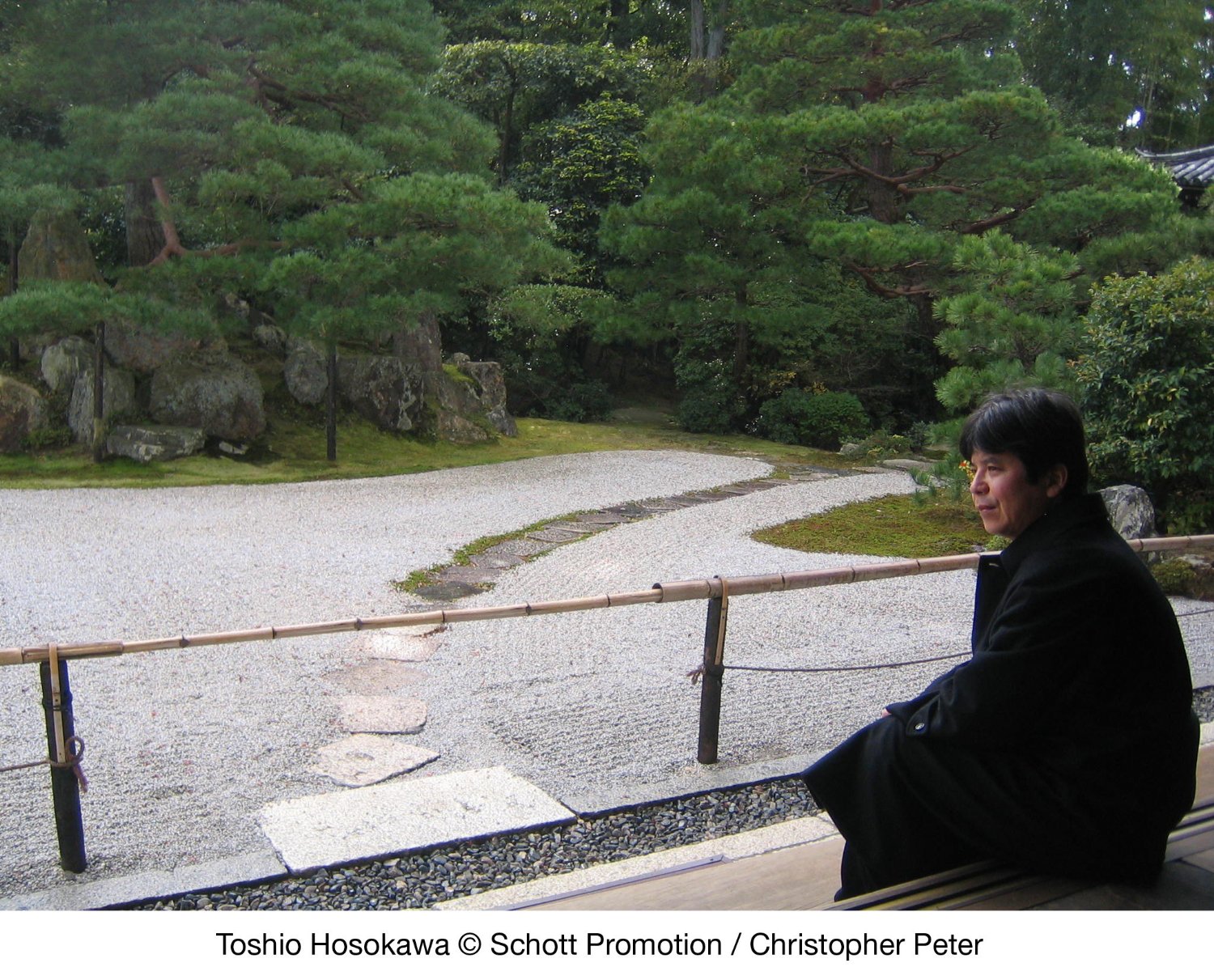
Toshio Hosokawa, born 1955 in Hiroshima, is a fisher of multiple ponds. On the one hand, he carries the torch of European modernism, having studied in Germany under Isang Yun and Klaus Huber. On the other, he professes a deep affinity for traditional Japanese music and Zen Buddhism.

Hosokawa

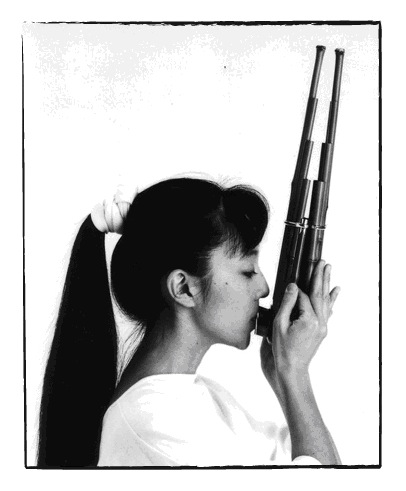
Landscapes is ECM’s only disc dedicated to the composer, who in three of the album’s four pieces employs the shō, or Japanese mouth organ. Here it is played by Mayumi Miyata. A pioneer in introducing the shō as a solo instrument in contemporary classical music, she plays a “concert” shō with a pitch range broader than its standard counterpart. It requires expert control of the lungs, including circular breathing and steady changes in dynamic intensity. In Miyata’s hands it sings like the very phoenix it was originally intended to mimic.

Miyata
Mayumi Miyata

As for Hosokawa’s music, it all too easily falls into an interpretive trap like so many characterizations of Japan in general, which tend to paint the culture as a uniquely enigmatic blend of the ancient and the modern. Yet such an image fails to acknowledge the immediacy of its creative arts, and in particular of Hosokawa’s sound-world, which for all intents and purposes seeks not a bridging of spaces and eras but a reckoning of their aesthetic and (sometimes) political intersections. In the latter vein, he has created massive works in memory of the victims of Hiroshima and the tragic tsunami/earthquake of 3.11. In the former we have this program of meticulous dreamscapes to whet our appetite for beauty. It is, however, a tainted sort of beauty, one not destined for the painter’s canvas but rather for the videographer’s resignation. In his liner notes, Paul Griffiths likens Hosokawa’s constructions to the amorphousness of clouds, and certainly we can feel that stretch of variation, play of sun and spectrum, and stormy grays manifesting throughout the program.

Landscape V, originally composed for string quartet in 1993 and later expanded to the current version for shō and orchestra, unfurls a veil as thin as an insect’s wing that conforms itself to the shō’s summery spirals. One might not expect breath through bamboo to mesh so well with the feel of horsehair drawn across strings, but in Hosokawa’s renderings at least they become harmony incarnate, the shō illuminating the flow of air through an orchestra’s sound holes. In this pairing one may hear voices, shifts of wind, the flow of water, the meeting of stones, and even the light of moon taking sonic shape. The music is, at the same time, crystal clear. It wears no pretension, puts on no airs. It is, rather, the full breadth of its titular landscape pulled through a wormhole of consistency, so that even the more explosive moments take form not as catharses but as opportunities for deeper contemplation.

The Ceremonial Dance (2000) that follows is for string orchestra only, but loses no texture in the shō’s elision. Its heart would seem to lie in the comportment of gagaku (traditional Japanese court music), which turns illusions of a floating world into hyper-articulate bodies. That being said, the “dance” is implied through effect rather than movement, hiding in the absent drum. There is a liminal quality to this piece, performing an indeterminable ritual of which the score is but a simulacrum.

Sakura (2008), for shō solo, acts as a prelude to a choral setting of Japan’s most ubiquitous folk song. Bearing dedication to the former music director of the Westdeutscher Rundfunk, Otto Tomek (who also commissioned the setting), it is intimate and drifting, more postlude than prelude, the afterimage of a fallen blossom’s path toward water. As luminescent as its chords are, they are also dappled by the shadows of an unbroken gaze.

Last is Cloud and Light (2008), which pairs the shō with a full orchestra, including some light yet impactful percussion. Like its predecessors, it never overwhelms with its style, but unpacks itself in real time with self-awareness and tactility. It enacts a sharing of spirit between water and air, between the shapeless and the shaping. Large brushstrokes of brass pull their hairs through ink, soaking up as much of the universe as they can before falling along with the rain into the pond where Hosokawa’s bob and lure continue their meditation, content in knowing that no fish need ever bite to bring meaning to their dangle.

(To hear samples of Landscapes, click here.)

Stefano Scodanibbio: Reinventions (ECM New Series 2072)

Reinventions

Stefano Scodanibbio
Reinventions

Quartetto Prometeo
Giulio Rovighi violin
Aldo Campagnari violin
Massimo Piva viola
Francesco Dillon violoncello
Recorded January 2011, Teatro Giuseppe Verdi, Pollenza
Engineer: Gianluca Gentili
Executive producer: Manfred Eicher

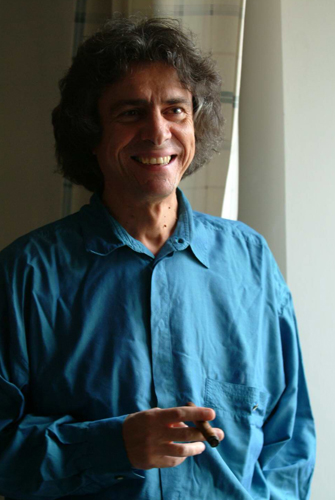
Stefano Scodanibbio (1956-2012), best known for his collaborations with Terry Riley and as an improviser and extended technique innovator on the double bass, was also a prolific composer, writing more than 50 works for strings. His first album for ECM owes its existence to Irvine Arditti, lead violinist of the Arditti Quartet and a longtime friend, and actualizes a dream that occupied the composer’s final years to the point of obsession.

Stefano Scodanibbio
(Photo credit: Alfredo Tabocchini)

The “reinventions” of the album’s title refer to his string quartet reworking of Bach, Spanish guitar music, and Mexican songs in a long-form suite of seamless, expressive character. Although, on the surface, three iterations of the Contrapunctus from Bach’s Art of the Fugue seem little more than slight deviations of their source material, they actually brim with harmonic ornaments and slow tempi that allow the listener to better scrutinize their pathos through Scodanibbio’s idiosyncratic lens. Rather than simply “re-imagine” the works of his interest, Scodanibbio turns them slowly in the hands, studying them as might a diviner a crystal ball, until they sing of their own accord.

The Bach references are the massive vertebrae of the suite, each cushioned by the Spanish and Mexican disks between them. The former take the name of Quattro Pezzi Spagnoli, but breathe as one unit. The pizzicato ornaments of “Lágrima” begin a stroll through elegant gardens, which with every step elicits new aspects from each melody in turn. There is already so much life in this music that Scodanibbio’s filtering would feel intrusive, were it not for his sensitivity, so that by “Studio” we may feel every detail as a song unto itself.

The five Canzoniere Messicano, on the other hand, come across more urgently with the opening “Cuando sale la luna.” Their life force swirls in the night, disturbing the reflection of a waning moon and etching out a dance along the water. Even the evergreen “Bésame mucho” (the most beautiful song ever written, in the composer’s estimation) leaves ripples in the mirror of its timelessness. “Canzone popolare: La llorona” ends this portion as if thrown in a bottle out to sea, a beacon for ghosts whose love of life keeps them haunting the pitch.

The performances by Italy’s Quartetto Prometeo are quiet, assured, and strangely uplifting—as much a quality of the music as of their playing. The cyclicity of both underscores the depth of Scodanibbio’s craft: no mere homage but a profound exercise in empathy.

Ketil Bjørnstad: The Light (ECM 2056)

The Light

The Light

Randi Stene mezzo-sopran
Lars Anders Tomter viola
Ketil Bjørnstad piano
Recorded February/March 2007 at Rainbow Studio, Oslo
Engineer: Jan Erik Kongshaug
Mixed by Jan Erik Kongshaug, Ketil Bjørnstad, and Manfred Eicher
Produced by Manfred Eicher

“Longing itself is a pledge that what we long for exists.”
–Karen Blixen

Ketil Bjørnstad has left a nuanced yet indelible trail through ECM’s forest, leading to the beacon that is The Light. The more he creates, the less ornamental his music becomes, so that here we have distilled melodies and grander human themes that can breathe. Subtitled “Songs Of Love And Fear,” this album is essentially his second for the label as nominal leader, following 1993’s Water Stories. And while many subsequent collaborations, including his classic sessions among the “Sea” quartet (with David Darling, Terje Rypdal, and Jon Christensen), have rendered water his theme par excellence, now he treads the currents of an equally fundamental force of life.

As any Bjørnstad listener knows, the Norwegian pianist and composer has always had a flair for clear and evocative melodies, and fans will surely find their expectations well met in this album’s two song cycles. The strength of this record, then, lies in its personnel. Bringing new depth to the Bjørnstad aesthetic are singer Randi Stene’s and violinst Lars Anders Tomter, the second of whom adds a dash of reality to the dreamlike qualities of the piano-voice telos. Indeed, these songs would seem to reference the great lieder of European art music in spirit, albeit by means of a more translucent architecture.

Bjørnstad’s Fire Nordiske Sanger (Four Nordic Songs) represent three decades of writing, performing, and refinement. It is, perhaps, no coincidence that the Norwegian word for “four” should mimic the English “fire,” for that is indeed the type of inner glow brought to every verse. The personal feel of “Grensen” (The Border) sets the tone. Written for his wife’s 50th birthday in 2006, it is the most recent of the four songs and reads like a love letter. “Sommernatt Ved Fjorden” (By The Fjord), on the other hand, was written in 1978 and has since become, much to the composer’s surprise, a favorite on the Norwegian pop charts. Imagistic contrasts also abound, as between the rustically inflected “Natten” (The Night), in which the viola takes on a narrative role, and the cinematic “Sommersang” (Summer Song), which follows the emotions of its protagonist—the song was, in fact, written for Stene—with the precision of a tracking shot.

The album’s remainder and title piece sets eleven poems by John Donne (1572-1631). While the vagueness of Donne’s poetry has always been key to its appeal, here it is leveled by the music’s even keel, balancing absence with substance and stillness with life.

In songs like “A Valediction: Of Weeping,” “The Dream,” and “The Prohibition,” the words teeter between surrender and command, while in “Air And Angels,” “Love’s Alchemy,” and “Break Of Day,” love assaults the eyes like two transparencies of the same image bumped slightly askew. Nevertheless, the connective spirit of Bjørnstad and Tomter holds on to a vision of unity in the shadow of Stene’s voice, especially in their instrumental interlude, “Lamentoso.”

Moments of unity abound elsewhere. “The Flea” is both one of Donne’s most intriguing poems and receives here an equally vivid melodic treatment. “A Nocturnal Upon St. Lucy’s Day, Being The Shortest Day” is a morsel of comparable skill, weighted by the pall of a long winter, that finds its renunciations answered in “The Sun Rising,” in which rooted pianism evokes the grip of Donne’s passions. Finally, “A Hymn To God The Father” points to the poet’s devout core, where faith in heavenly blessing wraps his fears of death until they dissolve. This is where the album’s light truly shines through, exploring through prayer a love secluded from a world that would pick it clean if given the chance.

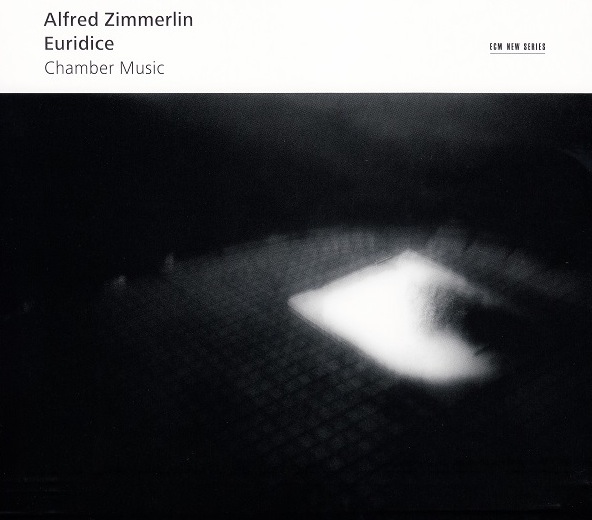
Alfred Zimmerlin: Euridice (ECM New Series 2045)

Euridice

Alfred Zimmerlin
Euridice

Carmina Quartett
Æquatuor

Aria Quartett
Euridice singt
Recorded October 2007
Kultur- & Kongresshaus Aarau
Streichquartette
Recorded August 2006
Radio Studio DRS, Zürich
Engineer: Stephan Schellmann
Produced by Manfred Eicher

One day, when this terrifying vision’s vanished,
let me sing ecstatic praise to angels saying yes!
Let my heart’s clear-struck keys ring and not one
fail because of a doubting, slack, or breaking string.
–Rainer Maria Rilke*

Continuing its mission to make internationally known the work of underrepresented composers, ECM documents on Euridice three chamber pieces by Swiss composer Alfred Zimmerlin. Born in 1955 and currently a professor of free improvisation at the University of Music in Basel, he is the recipient of numerous awards and a longtime member of the Werkstatt für improvisierte Musik (Workshop for Improvised Music), where his reputation as cellist precedes his reputation as composer. Thankfully, we have this pristine, artfully performed album to even the latter scale.

The program is bookended by two string quartets. The first is Zimmerlin’s second; the last is his first. The Second String Quartet, composed in 2003, comes into being by smooth, if ephemeral, brushwork and balances its draw with distinct pointillism. There is a strange push behind the music, a feeling of perpetual motion underlying the very barest outer ripples of a chaotic epicenter: a tsunami in a cupped hand’s worth of droplets. For this relationship, Zimmerlin looks to the “hermetic language” (hermetischen Sprache) of Rainer Maria Rilke’s “Duino Elegies.” Rilke, of course, was known to lament the limitations of orthography, and here Zimmerlin enables a sonic confrontation with those very limitations. As the composer notes, Rilke, too, breaks free from this constriction in the Ninth Elegy, which ends:

Look, I’m alive. On what? Neither childhood nor
the future grows less…More being than I’ll ever
need springs up in my heart.

Such effusion advances the strings along their own semantic path through space and time, finding eternity in a grain of sand. Each instrument is thus born of its own grammar: first violin as verb, second as declension, viola as punctuation, and cello as arbiter of marginalia. One feels the indefinite shape of their text as solidly as a printed page.

The First String Quartet, completed in 2002, at first feels imported from an opposite pole. Like a Terry Riley ritual spiked with a George Crumb infusion, it projects both shaman and possessing spirit. From a “dense state” (einem dichten Aggregatszustand), the quartet unfolds in an inherently even keel. The musicians hiss and muscle their way through this music, which somehow retains an edge of accessibility. It is enticing in its chaos, ordered not only by score but also by interpretation. There is an almost symphonic quality to the slower passages, fragmentary though they may be, suffused with local colorations and vocal paroxysms before settling in a flowerbed of pizzicati. That this quartet pays homage to the 18th-century Swiss folk song “Guggisberglied” and to Heinrich Ignaz Franz Biber’s Mystery Sonatas is of ultimately little consequence. Zimmerlin designates these not as thematic touchstones, but rather as echoes of a cultural memory, of which the string quartet is but one banal expression—one reason, perhaps, why he avoided the format for so long.

At the heart of the album is Euridice singt (2001-2003/04), a self-styled “scene” for soprano, oboe, cello, piano, and soundtrack (i.e., a prerecorded CD of electronics and vocals). Where the Second String Quartet sought inspiration in Rilke, Euridice is foremost a meditation on the opening of Ingeborg Bachmann’s poem, “Darkness Spoken”: Like Orpheus I play / death on the strings of life.** From this arises a refashioned Orphic myth, one in which Orpheus himself is bolstered by the generative power of his grief, brought on by his doomed Euridice. The latter’s death by snakebite (represented here by electronics) is where the piece begins in a text by avant-garde Swiss writer Raphael Urweider. The oboe (played by Matthias Arter) is Orpheus’s grief made manifest, while Euridice’s spirit lingers in the form of soprano Sylvia Nopper, who gifts her beloved a choir upon his return to the Overworld. Meanwhile, Euridice takes a certain reflective solace in her death. At first, she is ghostlike, nearly overtaken by the oboe: reeds above larynx. Euridice’s initial stirrings sound closer to Japanese Noh theatre than to song cycle as Orpheus’s rapping entourage emerges hauntingly. This is not, however, an infusion of contrasts, but a simultaneous reckoning of elements, so that none holds dominance. Although the oboe is a point of particular fascination in this milieu, it navigates the waters of a turgid anger on both sides of the crust, so that by the end it is spent, slave to its own fatigue. There is one passage, for instance, during which the oboe jackknives between clean and multi-phonic notes over an array of white noise, piano, and pizzicati. Even then, it walks the line between confusion and transcendence, of dreams and reality, in kind. Hence the droning conclusion, which culminates in an electronic fade to dark: the cycle will repeat until all colors become one.

There is an unforced feeling to Zimmerlin. He lets the sounds unfold of their own seeming accord and marks their passage as a jazz musician might transcribe a solo after the fact. In this respect, his experience as an improviser pays marked dividends. This leaves us with a compass that is at once full of direction and directionless, a relic from a past we may never recover, except through the affective, if ultimately illusory, experience of making music.

* All Rilke translations by A. Poulin, Jr.
** The translation of Bachmann is by Peter Filkins.

Erkki-Sven Tüür: Strata (ECM New Series 2040)

Strata

Erkki-Sven Tüür
Strata

Jörg Widmann clarinet
Carolin Widmann violin
Nordic Symphony Orchestra
Anu Tali conductor
Recorded May 2007 and June 2009, Estonia Concert Hall
Engineer: Maido Maadik
Assistant engineer: Jaan Tsadurjan
Executive producer: Manfred Eicher

The music of Estonian composer Erkki-Sven Tüür is much like his name. Its frame contains doubled elements, a cosmic chemical signature that embraces a hyphenated signifier in the middle, connection to some gravid space from which one can observe the unfolding of his distinctly personal character. Of that character we get plenty on this album, his fifth for the New Series, for which the usual roster of ECM performers is swapped for the phenomenally talented Nordic Symphony Orchestra and its principal founder and conductor, Anu Tali. Together they bring luminescence to two recent works with mellifluous authority.

The Symphony No. 6, the subtitle of which gives this album its name, is in fact dedicated to Tali and the NSO, who commissioned it. From the first bars, the reasons behind this inception become clear, for the musicians play this music as if they have known it all their lives. Composed in 2007, Tüür’s massive symphony is a master class in affect. It heralds a new direction for the maverick composer, who abandons his “architectonic” method (although echoes of Crystallisatio remain) in favor of self-styled “vectorial writing.” Where the former embodied an interlocking or amalgamation, the latter is more of an expansive or, in the composer’s terms, “genetic” development. One might say that architectonics constructed the body in which the cellular divisions of his vectorial composing could divide. Evolution over invention.

The nature of this newer method is obvious in the symphony’s opening and closing bars, stretching as it does a sudden awakening into a dream of perpetual motion that, like all such experiments, inevitably journeys toward stasis. The result of all this is an orchestra that moves amorphously but singly, even if particular instruments do leave trails in the water. In the latter vein, for instance, piano and harp share a brief yet memorable dialogue. On the whole, strings lurk in recession for some time before revealing their palette of light—all the more effective in music that seeks through a glass darkly.

What makes this feel like a symphony at all is perhaps its grandness of scope, which nevertheless retains an internal spirit, as indicated by the subtle (and not-so-subtle) percussive touches throughout. Tüür’s feel for color and space in this regard is so acute that it opens doors in the mind one never knew were closed. The smoothness of his transitions likewise enhances another symphonic staple: a feeling of luxuriance and orientation of detail that are remarkable for a 33-minute duration. Tüür’s narrative language is thus overlapping yet practical, a form of meta-speech that stretches a whisper to a sigh and allows the listener to draw any number of conclusions.

Noēsis, composed in 2005, grew out of a very different commission (by the Detroit Symphony Orchestra and the Philharmonia Orchestra London, at the behest of Neeme Järvi). Although billed as a concerto for clarinet, violin and orchestra, the soloists are scurrying forces, less leading and more integrative. Each section of the orchestra becomes the panel of a fan, unfolding one rib at a time to reveal a connected focal point. Clarinetist Jörg Widmann joins his sister, violinist Carolin Widmann, in this wonderfully evocative piece, which is equally illustrative of Tüür’s new approach. Unlike the symphony, it begins in a hush of ambience that smoothes into the clarinet’s refracted introduction. The violin, on the other hand, is possessed of a free, if trembling, quality. The orchestra, meanwhile, pitches slowly, a boat on waves of molasses. The ending is one of Tüür’s finest, a braid of violin and clarinet carried into afterlife by a soft gong hit, resonant and touched by the sun.

Tüür’s craft has always been deeply physiological, but with Strata he shows it to be also physiologically deep. Whereas his previous work seemed forged from raw material (cf. Ardor), now it issues a line of spider’s thread, pulled by an unseen hand from galaxy to galaxy. It is an expansion rather than a compression of time, the audio equivalent of quantum physics, the equation of which again finds articulate form in the name.

Bernd Alois Zimmermann: Canto di speranza (ECM New Series 2074)

Canto di speranza

Bernd Alois Zimmermann
Canto di speranza

Thomas Zehetmair violin
Thomas Demenga cello
Gerd Böckmann voice
Robert Hunger-Bühler voice
Andreas Schmidt bass
WDR Sinfonieorchester Köln
Heinz Holliger conductor
Recorded May 2005, Kölner Philharmonie
Engineers: Brigitte Angerhausen and Günther Wollersheim
Edited and mastered by Renate Reuter
Produced by Harry Vogt

In his 2003 monograph, Quotation and Cultural Meaning in Twentieth-Century Music, musicologist David Metzer describes West German composer Bernd Alois Zimmermann (1918-1970) as having “exposed the delusion behind the modernist renunciation of the past and offered a vision of time in which [past, present, and future] were interconnected.” Zimmermann, he goes on to say, “saw time as a broad sphere in which all periods were equally within reach.” Such philosophy was at the heart of a self-styled pluralistic approach to composition, taking comfort in a Joycean spirit of drift and adaptation.

One might say that ECM’s New Series imprint has followed suit, pulling lesser-heard composers like Zimmermann into an orbit equidistant from the massive planets he references. In line with this spirit, the label has brought together a meticulous team of interpreters—at the core of which Heinz Holliger conducts the WDR Sinfonieorchester Köln—to paint the portrait of a composer whose personal demons eventually won out: the final piece of this disc was, in fact, completed just five days before his suicide. Such biographical details, however, render the Violin Concerto that opens this disc all the more effective for its unabashedly serial touches. Completed in 1950 and cited as a model for the postwar concerto, it spans three richly contrasting movements, opening in a cacophony of details at once whimsical and shadowy.

The soloist’s relationship to the orchestra is very much in the Romantic mode, as emphasized by violinist Thomas Zehetmair’s gorgeous traversal of the second movement. As in the work of Erkki-Sven Tüür, the piano figures mysteriously, a distant echo of the violin’s central presence, a simulacrum of the internal. It finds entry points in the periphery and parasitizes the orchestral body therein. Despite some beauteous, even transcendent moments, this portion of the concerto is no fantasy, but rather an intense reality of its own making that transitions into the final movement, which dances circles around a joyful center: a rite of spring, if you will. Some magnificent brass writing spurs a solo violin passage into explosive yet contained finale.

Zimmermann’s sound walks the line between capriciousness and foreboding. Despite the composer’s fatalist (?) trajectory, the concerto exudes panache, presenting the soloist with no small technical task. His neoclassicism suggests Stravinsky and Bartók, but influences from Bach to jazz are equally discernible. His plurivocity is clearest in the cadenzas. The almost bacchanal exuberance and rhythmic color of the concerto is every bit as intense as the program’s relatively brooding title composition, which at the fingertips of cellist Thomas Demenga delineates an even thinner line between nostalgia and forgetting. Originally composed in 1952 and revised in 1957, the title of this “cantata” for cello and small orchestra means “Song of Hope,” although its distinctly internal dialogue would seem to shelter very little at first glance.

The sparse instrumentation yields a world of ideas, which Demenga handles with remarkable sensitivity. Tension is so smooth that it no longer feels like tension, but rather like the metaphorical harmony of lock and key: the yin of security and the yang of trespass. The chamber aesthetic, especially in Zimmermann’s pointillist writing for percussion, is solemn and melds beautifully with the cello’s forthright porosity. Demenga brings to these energies a feeling of such effortlessness that the music seems to unfold of its own need to be heard.

Yet, no solemnity can match that of the final piece on the program: Ich wandte mich und sah an alles Unrecht, das geschah unter der Sonne (“And turning then, I saw there great injustice is done under the heavens”). Designated as “an ecclesiastical action for two speakers, bass soloist, and orchestra,” this 1970 oratorio sets biblical verse and Dostoevsky’s “The Grand Inquisitor” parable from The Brothers Karamazov. Andreas Schmidt is the singer, a pathos-ridden reflection of actors Gerd Böckmann and Robert Hunger-Bühler, who provide the spoken voices.

Despite the large instrumental forces at his command, Zimmermann makes spare use of textural overlap, with brass and percussion adding particular and occasional resonance to the immediate voices. One can almost hear the theatrical gestures built into the score, the very comportment of which forms a language unto itself that is subtext to the piece’s articulated surface. Even with knowledge of German or a translation of the texts in hand, this is morose going. Sitting with it is a nevertheless dark fascination. Some moments recall the drama of Shostakovich’s The Execution of Stepan Razin, while others are their own brand of interlocking parable. It ends with a brass iteration of the Bach chorale “Est is genug” and an orchestral afterthought thereof, the latter an indication of a mind at play to the very end.

Concerning the level of musicianship required bringing this music to life, it is only appropriate that Holliger should hold the baton. This is clearly music after his own heart. Even the most dedicated listeners aren’t likely to pop Ich wandte mich… into their car stereo, but its rewards come earlier in the program, felt only as a retroactive lean toward infinity. In accordance to Zimmermann’s “sphericality of time,” the aftereffects are just as musical as the performances they follow, and sow their traces into our mental fields until, some time later, they sprout anew.